New Video Game Inspired by 20 Haruki Murakami Stories Is Coming Your Way: Help Kickstart It
Back in grade school, I got into the genre of computer games known as “graphic adventures,” narrative experiences — and often quite elaborate ones — through which the player guides the protagonist with points and clicks: games like Maniac Mansion, Space Quest, Mean Streets, Zak McCracken and the Alien Mindbenders. In college I got into the writing of Haruki Murakami, the international superstar of Japanese literature specializing in the kind of stories that, in his words, have undergone “a kind of magical baptism to link the world on this side with the world on the other side.” More recently, I’ve cultivated an interest in projects crowdfunded on platforms like Kickstarter. At long last, someone has come up with a creation that unites all three: Memoranda, a Murakami-inspired graphic adventure now raising its budget on Kickstarter.
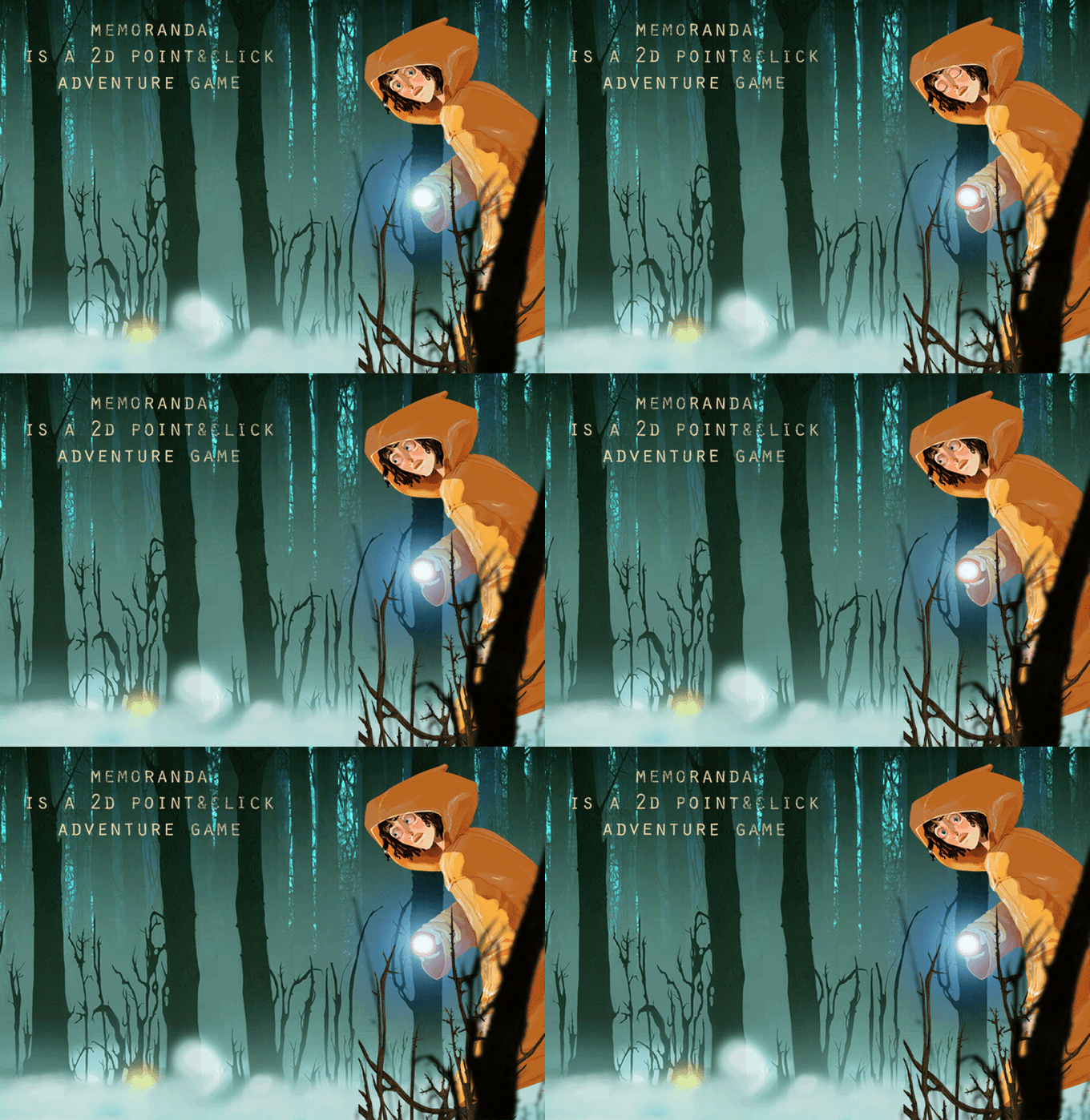
“Three years ago I sat down with a friend to brainstorm for making a game,” writes one of Memoranda’s developers. Murakami’s work “had inspired us profoundly and we thought that the vague, surrealistic reality of his fictional world would have a great potential for being turned into something visual and could lead to the creation of odd characters, an essential element in game design.” This led to a “script inspired by more than 20 stories by Murakami” involving a little town (which has “European-like architecture but that doesn’t mean it belongs to somewhere in Europe”) “where there are both laptops and bamboo water clocks,” a cast of characters from “a WWII surviving soldier to an elephant taking shelter in a man’s house hoping to become human,” and a protagonist “who little by little realizes she is forgetting her own name.”
Kickstarter has proven a viable financing medium for a new wave of graphic adventure games, some of them by the creators of the old wave: Tim Schafer, known for Maniac Mansion’s beloved sequel Day of the Tentacle, raised $3.3 million for what would become Broken Age, and Space Quest masterminds Scott Murphy and Mark Crowe more recently reunited to raise over $500,000 for SpaceVenture. Memoranda, by comparison, requires no more than a shoestring, and, with ten days to go in its funding drive, it has already raised more than the $13,695 requested by Bit Byterz, its Vancouver-based Iranian developers (how’s that for a demonstration of Murakami’s global appeal?). But you can still contribute at its Kickstarter page, and as a reward could get a copy of the game, its soundtrack, a digital art book, or even — enthusiasts of Murakami tropes, take note — the inclusion of your own cat in the story. No game company ever offered me that in grade school.
You can watch a trailer for Memoranda above.
via Flavorwire
Related Content:
Haruki Murakami Lists the Three Essential Qualities For All Serious Novelists (And Runners)
Haruki Murakami’s Passion for Jazz: Discover the Novelist’s Jazz Playlist, Jazz Essay & Jazz Bar
A Photographic Tour of Haruki Murakami’s Tokyo, Where Dream, Memory, and Reality Meet
Colin Marshall writes elsewhere on cities, language, Asia, and men’s style. He’s at work on a book about Los Angeles, A Los Angeles Primer, the video series The City in Cinema, and the crowdfunded journalism project Where Is the City of the Future? Follow him on Twitter at @colinmarshall or on Facebook.
Read More...Hand-Colored 1860s Photographs Reveal the Last Days of Samurai Japan

Any fan of samurai movies knows the elaborate lengths some productions can go to in order to recreate the look and feel of old Japan, but globetrotting Italian-British photographer Felice Beato (1832 — 1909) actually managed to capture those days on celluloid first-hand. He arrived in Japan in 1863, at the very twilight of the era of the samurai, a time he documented evocatively with a series of hand-colored photographs of subjects like “kimonos, parasols, baby’s toys, basket sellers, courtesans at rest and a samurai gang ready for action,” as the Guardian lists them in their gallery of Beato’s Japanese work.

“After spending over two hundred years in seclusion, Japan was being forced by the Americans — under a mission led by Commodore Matthew C. Perry — to expand its trade with the west,” writes Dangerous Minds’ Paul Gallagher, describing the unprecedented moment of Japanese history in which Beato found himself, one that provided the opportunity to photograph not just the last of the samurais but also the courtesans they loved. But all this had its risks: “Travel was dangerous in Japan,” Gallagher adds, “with many of the Shogunate samurai warriors killing westerners,” a fate Beato narrowly avoided at least once.
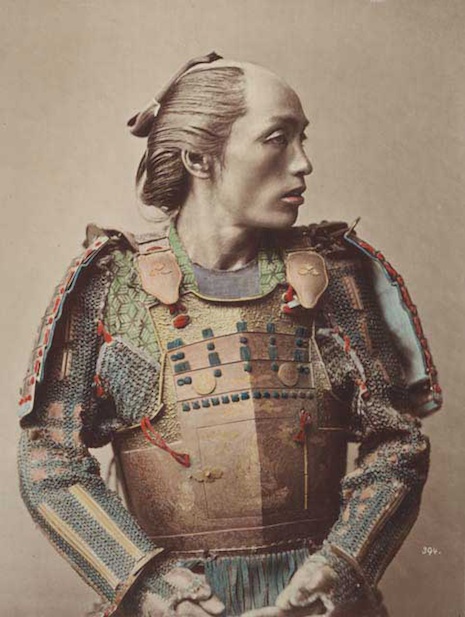
Having photographed in Constantinople, India, and China before Japan, Beato moved on after it to other parts of Asia, including Korea and Burma, before returning to his native Italy at the very end of his life. But his pictures of Japan remain among the most striking of his entire career, perhaps because of their artistic use of color, perhaps because of a historical time and place that we think we’ve come to know through so many sword-and-suicide epics. Their characters, from the honor-bound samurai to the sly courtesan to the simple merchant, can seem to us a bit theatrical as a result, but Beato’s photographs remind us that they all began as very real people. Who might they inspire to make a film about their real lives?



via The Guardian/Dangerous Minds
Related Content:
Hand-Colored Photographs of 19th Century Japan
Advertisements from Japan’s Golden Age of Art Deco
Glorious Early 20th-Century Japanese Ads for Beer, Smokes & Sake (1902–1954)
Early Japanese Animations: The Origins of Anime (1917–1931)
A Photographic Tour of Haruki Murakami’s Tokyo, Where Dream, Memory, and Reality Meet
Colin Marshall writes elsewhere on cities, language, Asia, and men’s style. He’s at work on a book about Los Angeles, A Los Angeles Primer, the video series The City in Cinema, and the crowdfunded journalism project Where Is the City of the Future? Follow him on Twitter at @colinmarshall or on Facebook.
Read More...This Is Your Brain on Exercise: Why Physical Exercise (Not Mental Games) Might Be the Best Way to Keep Your Mind Sharp

In the United States and the UK, we’ve seen the emergence of a multibillion-dollar brain training industry, premised on the idea that you can improve your memory, attention and powers of reasoning through the right mental exercises. You’ve likely seen software companies and web sites that market games designed to increase your cognitive abilities. And if you’re part of an older demographic, worried about your aging brain, you’ve perhaps been inclined to give those brain training programs a try. Whether these programs can deliver on their promises remains an open question–especially seeing that a 2010 scientific study from Cambridge University and the BBC concluded that there’s “no evidence to support the widely held belief that the regular use of computerised brain trainers improves general cognitive functioning in healthy participants…”
And yet we shouldn’t lose hope. A number of other scientific studies suggest that physical exercise–as opposed to mental exercise–can meaningfully improve our cognitive abilities, from childhood through old age. One study led by Charles Hillman, a professor of kinesiology and community health at the University of Illinois, found that children who regularly exercise, writes The New York Times:
displayed substantial improvements in … executive function. They were better at “attentional inhibition,” which is the ability to block out irrelevant information and concentrate on the task at hand … and had heightened abilities to toggle between cognitive tasks. Tellingly, the children who had attended the most exercise sessions showed the greatest improvements in their cognitive scores.
And, hearteningly, exercise seems to confer benefits on adults too. A study focusing on older adults already experiencing a mild degree of cognitive impairment found that resistance and aerobic training improved their spatial memory and verbal memory. Another study found that weight training can decrease brain shrinkage, a process that occurs naturally with age.
If you’re looking to get the gist of how exercise promotes brain health, it comes down to this:
Exercise triggers the production of a protein called brain-derived neurotrophic factor, or BDNF, which helps support the growth of existing brain cells and the development of new ones.
With age, BDNF levels fall; this decline is one reason brain function deteriorates in the elderly. Certain types of exercise, namely aerobic, are thought to counteract these age-related drops in BDNF and can restore young levels of BDNF in the age brain.
That’s how The Chicago Tribune summarized the findings of a 1995 study conducted by researchers at the University of California-Irvine. You can get more of the nuts and bolts by reading The Tribune’s recent article, The Best Brain Exercise May be Physical. (Also see Can You Get Smarter?)
You’re perhaps left wondering what’s the right dose of exercise for the brain? And guess what, Gretchen Reynolds, the phys ed columnist for The Times’ Well blog, wrote a column on just that this summer. Although the science is still far from conclusive, a new study conducted by The University of Kansas Alzheimer’s Disease Center found that small doses of exercise could lead to cognitive improvements. Writes Reynolds, “the encouraging takeaway from the new study … is that briskly walking for 20 or 25 minutes several times a week — a dose of exercise achievable by almost all of us — may help to keep our brains sharp as the years pass.”
If you would like to support the mission of Open Culture, consider making a donation to our site. It’s hard to rely 100% on ads, and your contributions will help us continue providing the best free cultural and educational materials to learners everywhere. You can contribute through PayPal, Patreon, and Venmo (@openculture). Thanks!
Related Content:
This Is Your Brain on Jane Austen: The Neuroscience of Reading Great Literature
New Research Shows How Music Lessons During Childhood Benefit the Brain for a Lifetime
Free Online Psychology & Neuroscience Courses
Read More...How Jean-Paul Sartre’s Philosophy Can Empower You to Live the Life You Truly Want
The latest installment from The School of Life’s animated video series introduces us to Jean-Paul Sartre’s concept of bad faith, a concept integral to his philosophy, Existentialism. As Mark Linsenmayer, one of the founders of The Partially Examined Life podcast, explained on our site back in 2011, “bad faith” is a tendency we have to “disassociate ourselves from our actions,” or more commonly, to claim we have “more limited choices [in life] than we actually do.” He went on to say:
Bad faith is possible because of the nature of the self… There is no predetermined ‘human nature’ or ‘true you,’ but instead you are something built over time, by your own freely chosen actions, too often using the roles and characteristics others assign to you.
As is their wont, The School of Life takes Sartre’s notion of bad faith and applies it to everyday life, showing how it can help you create the life you want to live–from entering into more satisfying relationships, to getting out of dead-end jobs.
For anyone looking to get a fairly accessible introduction to Sartre’s philosophy, you might want to start with his 1946 lecture, Existentialism is a Humanism. And down below, in the Relateds section, we have more helpful introductions to Sartre’s liberating philosophy.
Related Content:
Jean-Paul Sartre Breaks Down the Bad Faith of Intellectuals
Sartre, Heidegger, Nietzsche: Documentary Presents Three Philosophers in Three Hours
Download Walter Kaufmann’s Lectures on Nietzsche, Kierkegaard, Sartre & Modern Thought (1960)
140+ Free Online Philosophy Courses
Simone de Beauvoir Explains “Why I’m a Feminist” in a Rare TV Interview (1975)
Read More...Hear All of C.S. Lewis’ Chronicles of Narnia Novels as Free Audio Books
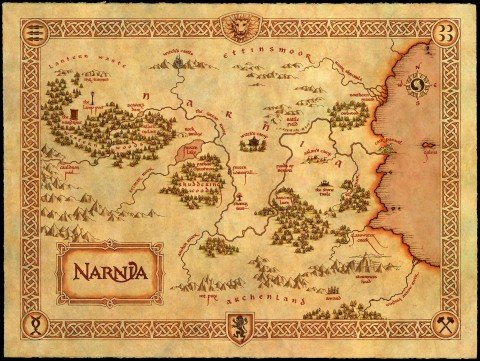
I have not seen the second two of a promised seven films based on the novels in C.S. Lewis’ The Chronicles of Narnia series. But I tend to agree with several critics of the first filmed adaptation, The Lion, the Witch and the Wardrobe: “The PG-rated movie feels safe and constricted,” Peter Travers observed, “in a way the story never does on the page.” Although Lewis “did nothing to hide his devout Christianity” in his allegorical Narnia books for young adults, nor in his grown-up sci-fi fantasy series, The Space Trilogy, Lewis on the page comes across as a rigorous writer first and a Christian apologist second. Except, I’d argue, for his work of explicitly populist, and rather facile, apologetics, Mere Christianity (originally a series of radio lectures), his fiction and popular non-fiction alike present readers—whatever their beliefs—with challenging, inventive, witty, and moving ways to think about the human condition.
Lewis’ immersion in European Medieval and Renaissance literature in his day-job role as an Oxford don—and his ecumenical, almost Jungian, approach to literature generally—gives his fiction a serious archetypal depth that most modern religious novelists lack, making him, along with fellow “Inkling” J.R.R. Tolkien, something of a literary saint in modern Christianity. Though it may offend the orthodox to say so, Lewis’ novels capture a “deep magic” at the heart of all mythological and literary traditions. And they do so in a way that makes exploring heavy, grown-up themes exciting for both children and adults. Though I’ve personally left behind the beliefs that animated my first readings of his books, I can still return to The Chronicles of Narnia and find in them deep magic and mystery.
There’s no denying the enormous influence these books have had on children’s fantasy literature, from Harry Potter to Lewis’ atheist antagonist Philip Pullman. I look forward to sharing his books with my daughter, whatever she ends up making of their religiosity. I’ve still got my tattered paperback copies, and I’ll gladly read them to her before she can tackle them herself, but I’m also grateful for the complete audio recordings of The Chronicles of Narnia, available free online and read by English child psychologist and author Chrissi Hart. In installments of two chapters at a time, Hart reads all seven of the Narnia books, The Lion, the Witch and the Wardrobe, Prince Caspian, The Voyage of the Dawn Treader, The Silver Chair, The Horse and His Boy, The Magician’s Nephew, and The Last Battle.
You can hear the first two chapters of The Lion, the Witch and the Wardrobe above, and stream or download the remaining chapters, and the remaining six books, at Ancientfaith.com. Although Hart and the Ancient Faith site who host her readings clearly approach the novels from an explicitly Orthodox perspective, I don’t think readers need to share their beliefs, or Lewis’, to enjoy and appreciate the storytelling magic of The Chronicles of Narnia.
And it should be noted that CS Lewis Pte. Ltd. granted permission to put these recordings online, according to the Ancient Faith web site. The recordings are therefore listed in our collection, 1,000 Free Audio Books: Download Great Books for Free. Enjoy.
Related Content:
C.S. Lewis’ Prescient 1937 Review of The Hobbit by J.R.R. Tolkien: It “May Well Prove a Classic”
Watch Hand-Drawn Animations of 7 Stories & Essays by C.S. LewisWatch Hand-Drawn Animations of 7 Stories & Essays by C.S. LewisWatch Hand-Drawn Animations of 7 Stories & Essays by C.S. Lewis
The Only Known Recordings of C.S. Lewis (1944–1948)
Josh Jones is a writer and musician based in Durham, NC. Follow him at @jdmagness
Read More...A Spellbinding Supercut of the First & Final Frames of 70 Iconic Films, Played Side by Side
Filmmaker Jacob T. Swinney’s First and Final Frames, Part II, above, is a rare sequel that upholds the quality of the original.
As he did in its predecessor, Swinney screens the opening and closing shots of dozens of recent and iconic films side by side, providing viewers with a crash course in the editorial eye.
What is being communicated when the closing shot replicates—or inverts—the opening shot?
Will the opening shot become freighted with portent on a second viewing, after one has seen how the film will end?
(Shakespeare would say yes.)
Swinney is deeply conversant in the nonverbal language of film, as evidenced by his numerous compilations and video essays for Slate on such topics as the Kubrick Stare and the facial expressions of emotionally revelatory moments.
Most of the films he chooses for simultaneous cradle-and-grave-shot replay qualify as art, or serious attempts thereat. You’d never know from the formalism of its opening and closing shots that Jim Jarmusch’s Mystery Train at the 1:00 mark is a comedy.
To be fair, Clint Mansell’s universally applied score could cloak even Animal House in a veil of wistful, cinematic yearning.
Given the comic sensibility Swinney’s brought to such supercuts as a Concise Video History of Teens Climbing Through Each Others’ Windows and a Tiny History of Shrinking Humans in Movies, I’m hoping there will be a third installment wherein he considers the first and final moments of comedies.
Any you might recommend for inclusion? (Hold the Pink Flamingos, por favor…)
Films featured in First and Final Frames, Part II in order of appearance:
Sunshine
Snowpiercer
Biutiful
21 Grams
The Prestige
All is Lost
Take Shelter
The Impossible
United 93
Vanilla Sky
Ex Machina
Inside Llewyn Davis
Dead Man
Mystery Train
Melvin and Howard
Fury
Full Metal Jacket
A Clockwork Orange
Eyes Wide Shut
Eraserhead
The Elephant Man
The Fall
The Thin Red Line
The New World
Road to Perdition
Snow Falling on Cedars
The Bourne Ultimatum
The Imitation Game
Flight
Hard Eight
Inherent Vice
World War Z
Wild
The Double
The Machinist
Born on the Fourth of July
Brideshead Revisited
Maps to the Stars
The Skeleton Twins
Mommy
A Scanner Darkly
10 Years
Milk
Lost Highway
Boxcar Bertha
Badlands
Ghost Dog: The Way of the Samurai
Ratcatcher
Ida
Raise the Red Lantern
Gattaca
Kundun
Bringing Out the Dead
A Most Wanted Man
The Curious Case of Benjamin Button
The Social Network
Jack Goes Boating
Submarine
Half Nelson
Eternal Sunshine of the Spotless Mind
Babel
Django Unchained
True Grit
Vertigo
Oldboy
Apocalypto
Dawn of the Planet of the Apes
Gladiator
Mad Max: Fury Road
World’s Greatest Dad
Related Content:
A Mesmerizing Supercut of the First and Final Frames of 55 Movies, Played Side by Side
Watch 7 New Video Essays on Wes Anderson’s Films: Rushmore, The Royal Tenenbaums & More
How Akira Kurosawa Used Movement to Tell His Stories: A Video Essay
Discover the Life & Work of Stanley Kubrick in a Sweeping Three-Hour Video Essay
Ayun Halliday is an author, illustrator, and Chief Primatologist of the East Village Inky zine. Her play, Fawnbook, is now playing at The Brick Theater in New York City. Follow her @AyunHalliday
Read More...A Young David Lynch Talks About Eraserhead in One of His First Recorded Interviews (1979)
“One of the first video recordings of a David Lynch interview dates from 1979,” writes The New Yorker’s Dennis Lim. “The twenty-minute black-and-white segment was produced for a television course at the University of California, Los Angeles, and conducted in the oil fields of the Los Angeles Basin, one of the locations that constituted the barren wasteland of his first feature, Eraserhead (1977).” And it is Eraserhead these UCLA students, in what Lim calls “the moment of Lynch’s first brush with cult fame,” want to know about, putting a variety of questions to the young filmmaker, and putting his ability to answer them concretely to the test.
You may well learn more about Eraserhead in the theater-lobby audience responses collected for the video, wherein the viewers — viewers, remember, from a now hard-to-imagine time when the name David Lynch carried no meaning at all — exiting a screening express reactions ranging from great pleasure (some of them boast of having seen it as many as eight times already) to predictable bewilderment (“I’ve gotta think about it for a while”) and even more predictable distaste: “The weirdest thing I’ve ever seen.” “It’s terrible. I didn’t like it.” “Some inane, bizarre person with a disturbed mind wrote that film.” But does the man standing there submitting to a student interview in the middle of an oil field seem so bizarre, so disturbed?
Some of Lynch’s answers, as when he describes Eraserhead as “not like thrown-together abstract” but “meant-to-be-that-way abstract,” may strike you as inane at first, but certainly nothing he says crosses the line from inanity to insanity. In the almost 40 years since the film’s first showing, Eraserhead has grown more artistically divisive even as its fan base spans a wider and wider range of generations and nationalities. Both its promoters and its detractors may sometimes wonder if even Lynch himself understands it, but to my mind, this early interview hints that he does. He made what he calls “an open-feeling film,” a fount of an infinitude of interpretations, and for that reason an enduring work of art. And he meant it to be that way.
Related Content:
The Paintings of Filmmaker/Visual Artist David Lynch
David Lynch’s Unlikely Commercial for a Home Pregnancy Test (1997)
David Lynch Teaches You to Cook His Quinoa Recipe in a Weird, Surrealist Video
What David Lynch Can Do With a 100-Year-Old Camera and 52 Seconds of Film
Colin Marshall writes elsewhere on cities, language, Asia, and men’s style. He’s at work on a book about Los Angeles, A Los Angeles Primer, the video series The City in Cinema, and the crowdfunded journalism project Where Is the City of the Future? Follow him on Twitter at @colinmarshall or on Facebook.
Read More...30,000 Works of Art by Edvard Munch & Other Artists Put Online by Norway’s National Museum of Art

Next time I make it to Oslo, the National Museum of Art, Architecture and Design ranks high on my to-do list. The next time I make it to Oslo will also count as the first time I make it to Oslo, since the tendency of the city itself to rank high on the world’s-most-expensive places lists (and at the very top of some of those lists) has thus far scared me off of booking a flight there. But if you can handle Oslo’s formidable cost of living, the National Museum’s branches only charge you the equivalent of five bucks or so for admission. And now they’ve offered an even cheaper alternative: 30,000 works of art from their collection, viewable online for free.
If it all seems overwhelming, you can view the National Museum’s digital collection in sections of highlights: one of pre-1945 works, one of post-1945 works, and one of Edvard Munch. While few of us could confidently call ourselves experts in Norwegian art, all of us know the work of Munch — or at least we know a work of Munch, 1893’s The Scream (Skrik), whose black-garbed central figure, clutching his gaunt features twisted into an expression of pure agony, has gone on to inspire countless homages, parodies, and ironic greeting cards. But Munch, whose career lasted well over half a century and involved printmaking as well as painting, didn’t become Norway’s best-known artist on the strength of The Scream alone.
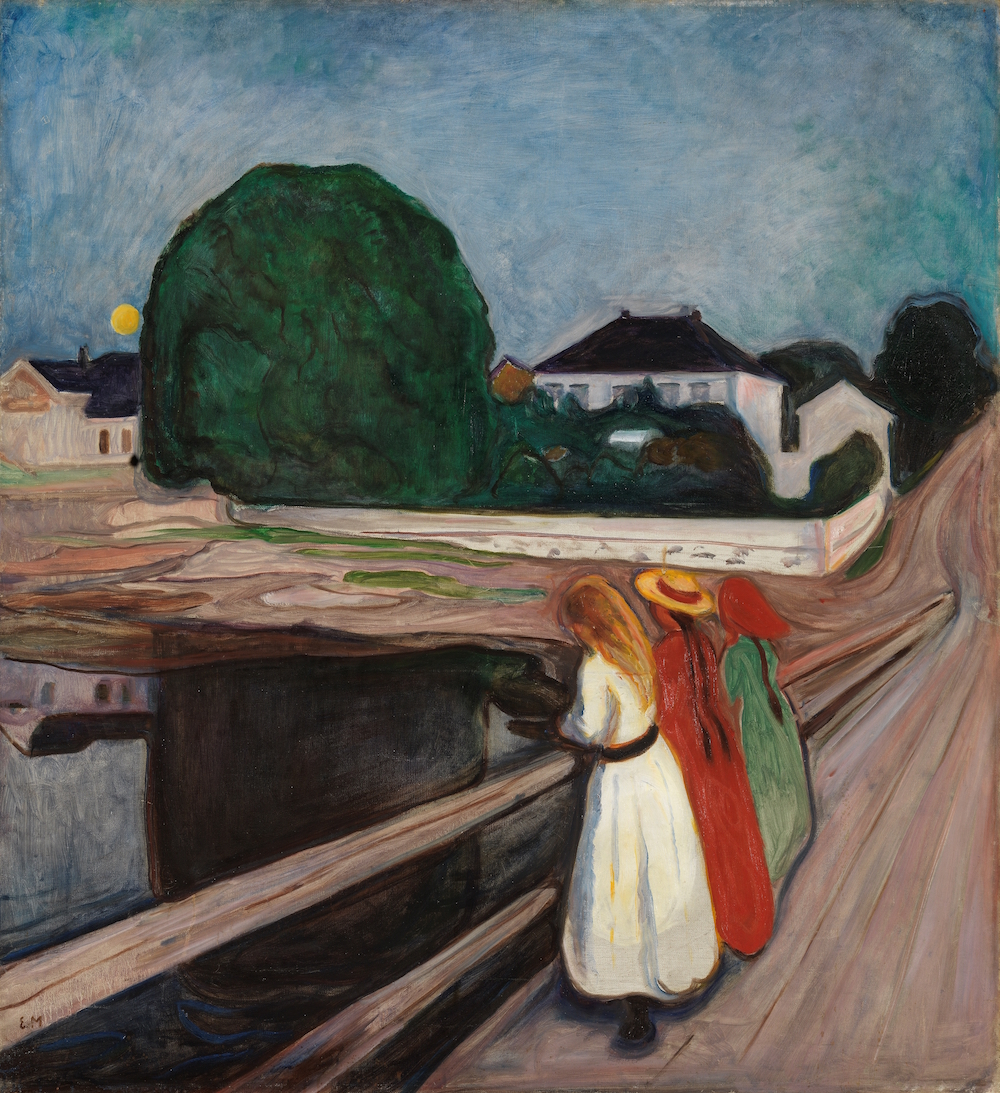
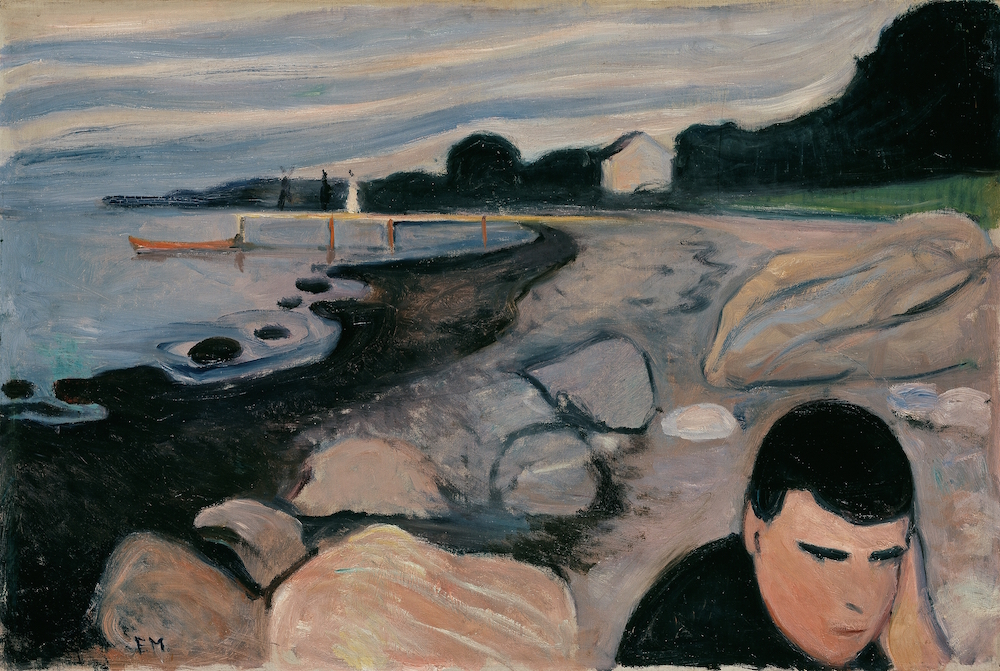
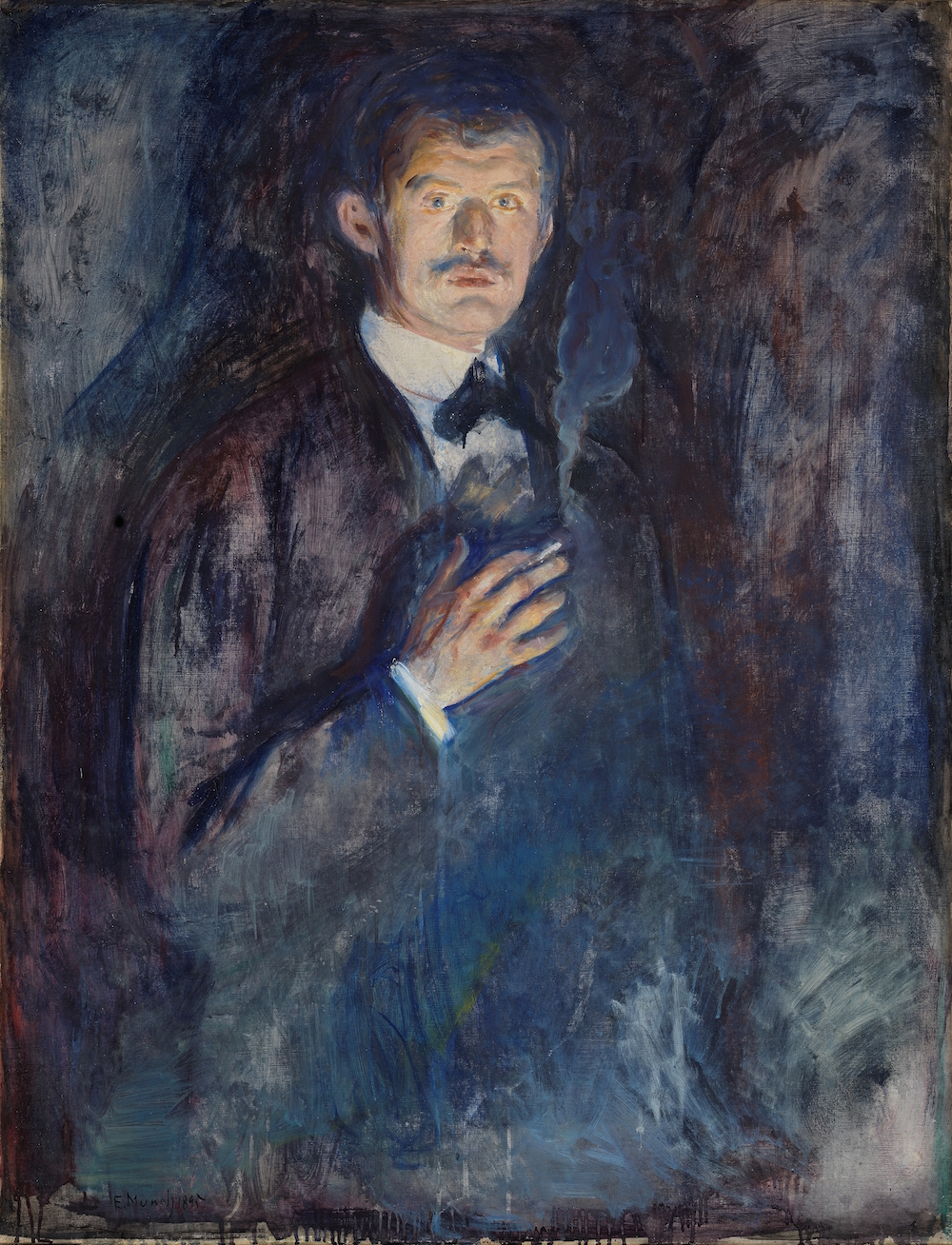
The National Museum’s digital collection offers perhaps your best opportunity to begin to get a sense of the scope of Munch’s art. There you can take an up-close look at (and even download) such pieces as the less agonized Melancholy (Melankoli), painted one year before The Scream; 1901’s The Girls on the Bridge, a more placid treatment of a similar setting; and even, so you can get to know the artist better still, Munch’s 1895 self-portrait with a cigarette. He may not exactly look happy in it, but at least he hasn’t become a visual shorthand for all-consuming pain like the poor fellow he painted on the bridge. (If you want my guess as to what made the subject of The Scream so unhappy, I’d say he just finished looking into average Oslo rents.)
A big thanks to Joakim for making us aware of this collection. If any other readers know of great resources we can feature on the site, please send us a tip here.
Related Content:
Edvard Munch’s Famous Painting The Scream Animated to the Sound of Pink Floyd’s Primal Music
The Guggenheim Puts Online 1600 Great Works of Modern Art from 575 Artists
Rijksmuseum Digitizes & Makes Free Online 210,000 Works of Art, Masterpieces Included!
Download 100,000 Free Art Images in High-Resolution from The Getty
Colin Marshall writes elsewhere on cities, language, Asia, and men’s style. He’s at work on a book about Los Angeles, A Los Angeles Primer, the video series The City in Cinema, and the crowdfunded journalism project Where Is the City of the Future? Follow him on Twitter at @colinmarshall or on Facebook.
Read More...Musician Plays Signature Drum Parts of 71 Beatles Songs in 5 Minutes: A Whirlwind Tribute to Ringo Starr
Kye Smith, a drummer based in Newcastle, Australia, recently hauled his drum kit to a nearby rooftop (an homage to The Beatles’ 1969 rooftop gig?) and started banging out a pretty wonderful tribute to Ringo Starr, playing drum parts from 71 Beatles songs in 5 quick minutes. Smith moves chronologically, playing the songs in the order they were released (not recorded). We start in 1962, move through 1969, and even momentarily visit 1995. On his Facebook page, Smith had this to say:
Way before I found out about punk rock or even knew what a snare drum was I spent my childhood playing vinyl records at my grandparents place spinning artists such as Slim Dusty, ELVIS PRESLEY and The Beatles.
This chronology called for some special treatment and got me out of the studio and onto the rooftop of The Great Northern Hotel — Newcastle, Australia for a pretty stunning view of Newcastle, New South Wales in the background.
Thanks to everyone at The Great Northern for letting me make some noise up there and to Eluminate for helping me shoot it and lug heaps of gear up 7 storeys of stairs!
Below the jump, you can find the list of songs that appear in the video, complete with corresponding time stamps. And keep in mind that Smith, as he mentions on Youtube, is “available for studio and live work and will be opening up some slots for drum lessons shortly.” Contact him here.
PS: If you can name one of the drum parts that was originally played by Paul McCartney, you get bonus points.
Follow Open Culture on Facebook and Twitter and share intelligent media with your friends. Or better yet, sign up for our daily email and get a daily dose of Open Culture in your inbox. And if you want to make sure that our posts definitely appear in your Facebook newsfeed, just follow these simple steps.
Read More...Watch the Cult Classic Horror Film Carnival of Souls (1962)
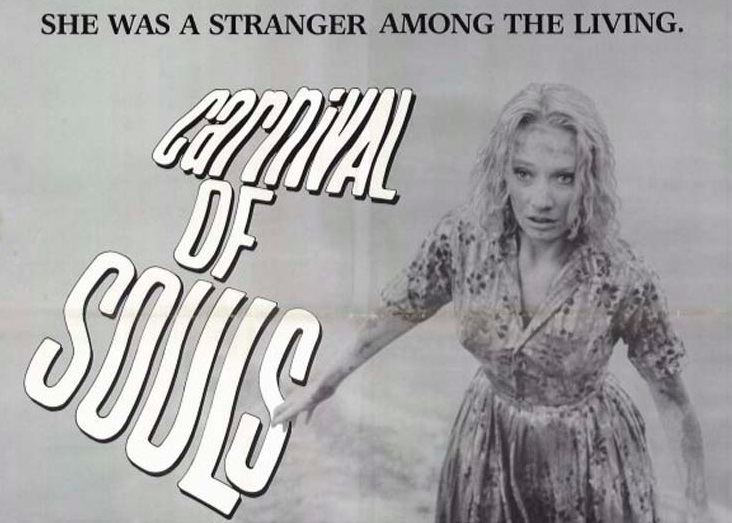
Herk Harvey had a successful career as a director and producer of educational and industrial movies in Lawrence, Kansas, but he longed for something more. After all, fellow Kansas filmmaker Robert Altman had made the leap from industrial flicks to Hollywood, so why couldn’t he?
The resulting movie, Carnival of Souls (1962), became a cult classic influencing the likes of George Romero, James Wan and David Lynch. Mary (played by Candace Hilligoss, the only trained actor in the cast) mysteriously surfaces after an ill-fated drag race sends her car off a bridge and into a deep river. Unmoored and unable to remember what happened, she flees her hometown and ends up in Salt Lake City where she takes a gig as a church organist. She tries to make a life there but is plagued by an otherworldly stranger with a paper white mask of evil (played by Harvey himself.)
Now in the public domain, Carnival is a slow burn of dread that relies on few cheap jumps and little gore. Instead, Harvey creates a sparse world of alienation and creeping hysteria like an Edward Hopper painting gone psychotic. Harvey’s inspirations were clearly more art house than Hammer horror. Echoes of F. W. Murnau, Ingmar Bergman and Jean Cocteau abound. Yet the curiously somnambulate acting exhibited by most of the cast along with the movie’s freaky organ soundtrack gives the film the vibe of a particularly nightmarish Ed Wood movie.
Carnival made a modest showing on the drive-in circuit when it came out but it didn’t become a cult classic until later in the 60s when it started playing on late-night TV. Harvey, however, never made another feature.
You can watch the complete movie above, or find it in our collection, 4,000+ Free Movies Online: Great Classics, Indies, Noir, Westerns, Documentaries & More.
Related Content:
Martin Scorsese Names the 11 Scariest Horror Films: Kubrick, Hitchcock, Tourneur & More
Jonathan Crow is a Los Angeles-based writer and filmmaker whose work has appeared in Yahoo!, The Hollywood Reporter, and other publications. You can follow him at @jonccrow. And check out his blog Veeptopus, featuring lots of pictures of vice presidents with octopuses on their heads. The Veeptopus store is here.
Read More...Support Us
We're hoping to rely on loyal readers, rather than erratic ads. Please click the Donate button and support Open Culture. You can use Paypal, Venmo, Patreon, even Crypto! We thank you!

About Us

Open Culture scours the web for the best educational media. We find the free courses and audio books you need, the language lessons & educational videos you want, and plenty of enlightenment in between.
Advertise With Us

FREE UPDATES!
GET OUR DAILY EMAIL
Get the best cultural and educational resources on the web curated for you in a daily email. We never spam. Unsubscribe at any time.
FOLLOW ON SOCIAL MEDIA

Open Culture editor Dan Colman scours the web for the best educational media. He finds the free courses and audio books you need, the language lessons & movies you want, and plenty of enlightenment in between.
Advertise With Us

