Smithsonian Digitizes & Lets You Download 40,000 Works of Asian and American Art

Art lovers who visit my hometown of Washington, DC have an almost embarrassing wealth of opportunities to view art collections classical, Baroque, Renaissance, modern, postmodern, and otherwise through the Smithsonian’s network of museums. From the East and West Wings of the National Gallery, to the Hirshhorn, with its wondrous sculpture garden, to the American Art Museum and Renwick Gallery—I’ll admit, it can be a little overwhelming, and far too much to take in during a weekend jaunt, especially if you’ve got restless family in tow. (One can’t, after all, miss the Natural History or Air and Space Museums… or, you know… those monuments.)
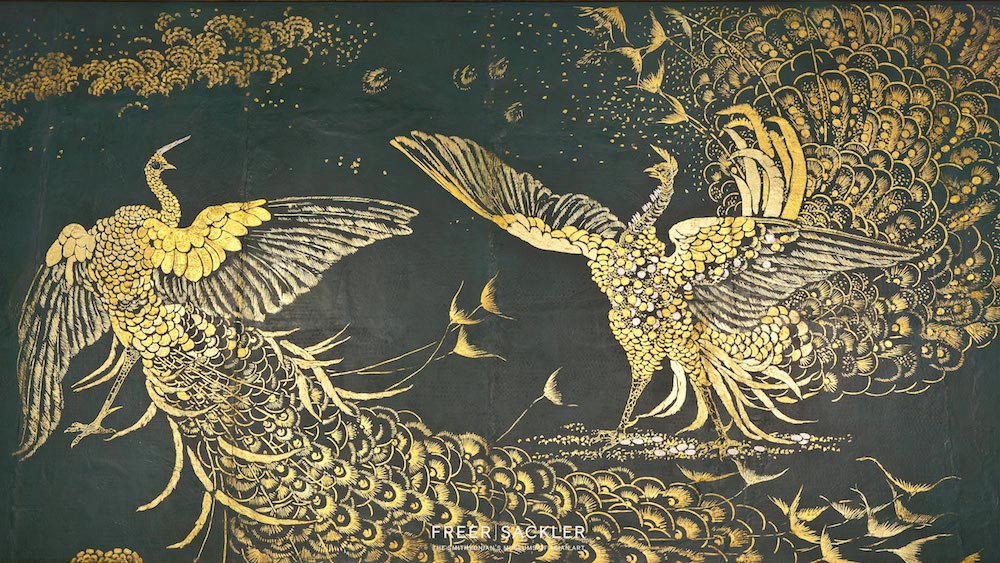
In all the bustle of a DC vacation, however, one collection tends to get overlooked, and it is one of my personal favorites—the Freer and Sackler Galleries, which house the Smithsonian’s unique collection of Asian art, including the James McNeill Whistler-decorated Peacock Room. (See his “Harmony in Blue and Gold” above.)
Standing in this re-creation of museum founder Charles Freer’s personal 19th century gallery—which he had relocated from London to his Detroit mansion in 1904—is an aesthetic experience like no other. And like most such experiences, there really is no virtual equivalent. Nonetheless, should you have to hustle past the Freer and Sackler collections on your DC vacation, or should you be unable to visit the nation’s capital at all, you can still get a taste of the beautiful works of art these buildings contain.

Like many major museums all over the world—including the National Gallery, the Rijksmuseum, The British Library, and over 200 others—the Freer/Sackler has made its collection, all of it, available to view online. You can also download much of it.
See delicate 16th century Iranian watercolors like “Woman with a spray of flowers” (top), powerful Edo period Japanese ink on paper drawings like “Thunder god” (above), and astonishingly intricate 15th century Tibetan designs like the “Four Mandala Vajravali Thangka” (below). And so, so much more.
As Freer/Sackler director Julian Raby describes the initiative, “We strive to promote the love and study of Asian art, and the best way we can do so is to free our unmatched resources for inspiration, appreciation, academic study, and artistic creation.” There are, writes the galleries’ website, Bento, “thousands of works now ready for you to download, modify, and share for noncommercial purposes.” More than 40,000, to be fairly precise.

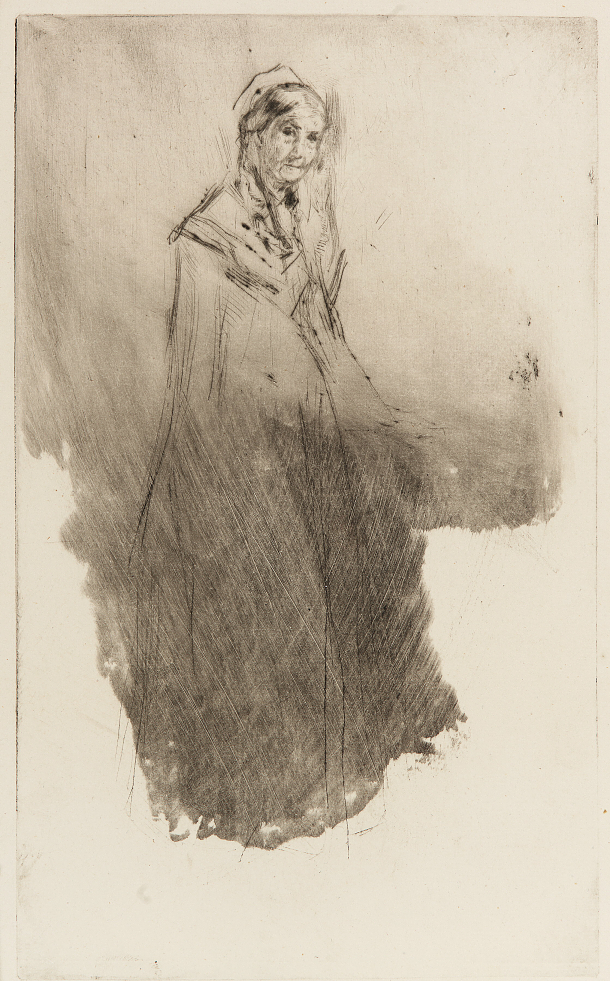
You can browse the collection to your heart’s content by “object type,” topic, name, place, date, or “on view.” Or you can conduct targeted searches for specific items. In addition to centuries of art from all over the far and near East, the collection includes a good deal of 19th century American art, like the sketch of Whistler’s mother, below, perhaps a preparatory drawing for his most famous painting. Though I do recommend that you visit these exquisite galleries in person if you can, you must at least take in their collections via this generous online collection and its bounty of international artistic treasures. Get started today.
Related Content:
40,000 Artworks from 250 Museums, Now Viewable for Free at the Redesigned Google Art Project
Rijksmuseum Digitizes & Makes Free Online 210,000 Works of Art, Masterpieces Included!
Josh Jones is a writer and musician based in Durham, NC. Follow him at @jdmagness
Read More...The Sex Pistols’ 1976 Manchester “Gig That Changed the World,” and the Day the Punk Era Began
“Ever get the feeling you’ve been cheated?”
Johnny Rotten aka John Lydon’s closing words at the last Sex Pistols gig (watch it online) seemed apt this week when Virgin Bank announced their current line of credit cards would feature the band’s signature artwork. That Jamie Reid’s famous cut-n-paste zine-cum-Situationalist aesthetic has turned into a bit of capitalist plastic for your wallet is an irony that the Sex Pistols might never have seen coming back in 1976, when they played the “gig that changed the world.”
Recreated above in a clip from Michael Winterbottom’s 24 Hour Party People, the June 4, 1976 gig at Manchester’s Lesser Free Trade Hall spawned the British punk movement and the post-punk movement that was soon to follow in a scant two years. For in the audience were future members of the Buzzcocks Howard Devoto and Pete Shelley (who organized the gig and opened for the Pistols); a nascent version of Joy Division; the two founders of Factory Records Martin Hannet and Tony Wilson; Mark E. Smith of The Fall, Mick Hucknall of Frantic Elevators and much later Simply Red; and a one Steven Patrick Morrissey, who would form The Smiths. (That’s Steve Coogan playing Tony Wilson in the clip, by the way.)
The Sex Pistols played 13 songs in their set, including covers of Dave Berry’s “Don’t Give Me No Lip Child,” Paul Revere and the Raiders “(I’m Not Your) Stepping Stone”, the Small Faces “What’cha Gonna Do About It,” The Stooges’ “No Fun”, and The Who’s “Substitute.” When asked for an encore, they played “No Fun” again.
Of their originals, their two most famous songs–”God Save the Queen” and “Anarchy in the U.K.” had yet to be written–but “Pretty Vacant,” “Problems,” “New York,” “No Feelings” are all here in their raw form.
A few songs never made it onto their first album, but can be found on their heavily bootlegged demo tape they recorded the same year.
Also of note is how non “punk” the members are dressed, not in the sense of how Malcolm McLaren and Vivienne Westwood would design, package and sell the fashion. The boys look closer to the working class jobbers of early Devo and the Stooges. Plus: no Sid Vicious. He’d come later. That’s Glen Matlock on bass, who left the band in early ’77 after clashing with Lydon. He went on to form Rich Kids with Midge Ure.
When the Pistols returned to London, everybody in Manchester and beyond had started a band, or at least that’s how it felt. By the time the Pistols got back to London, The Clash and The Damned had formed. And even if you hadn’t been at Lesser Free Trade Hall, you told your friends you had been and picked up a guitar.
The Sex Pistols would return three weeks later to play the Hall again, playing to hundreds this time and solidifying the dawn of the punk era.
Below is a BBC documentary on the famous gig, tellingly titled I Swear I Was There, which has an accompanying book.
On a side note: Lesser Free Trade Hall–named after the radical Free Trade political movement–was the site of another famous moment in rock history. It was here that a newly electrified Bob Dylan was called “Judas” by a very upset folk music fan.
Related Content:
Sid Vicious Sings Paul Anka’s “My Way” in His Own Spectacular Way
Rock Critic Greil Marcus Picks 10 Unexpected Songs That Tell the Story of Rock ‘n’ Roll
Ted Mills is a freelance writer on the arts who currently hosts the FunkZone Podcast. You can also follow him on Twitter at @tedmills, read his other arts writing at tedmills.com and/or watch his films here.
Read More...The Entirety of Jean-Luc Godard’s Breathless Artfully Compressed Into a 3 Minute Film
Gérard Courant is a French filmmaker, who, at least until 2011, held the distinction of directing the longest film ever made. Clocking in at 192 hours, and shot over 36 years (1978–2006), Cinématon consisted of “a series of over 2,880 silent vignettes (cinématons), each 3 minutes and 25 seconds long, of various celebrities, artists, journalists and friends of the director, each doing whatever they want for the allotted time.” Ken Loach, Wim Wenders, Terry Gilliam, Julie Delpy all made appearances. And so too did Jean-Luc Godard. (See below.)
While making Cinématon, Courant also created another kind of experimental film — what he calls “compressed” films. In 1995, he shot Compression de Alphaville, an accelerated homage to Jean-Luc Godard 1965 sci-fi film, Alphaville. Then came a “compression” (top) of Godard’s À bout de souffle/Breathless (1960), the classic of French New Wave cinema.
During the 1960s and 1970s, when Courant came of age as a filmmaker, sculptors like César Baldaccini created art by compressing everyday objects–like Coke cans–into modern sculptures. So Courant took things a step further and figured why not compress art itself. Why not compress a 90 minute film into 3–4 minutes, while keeping the plot of the original film firmly intact.
Along the way, Courant asked himself: Do compressed films honor the original? Does one have the right to touch these masterpieces? And can one decompress these compressed films and then return them to their original form? Ponder these questions as you watch the examples above.
Note: If you read French, Courant gives more of the backstory on his compressed films here.
Related Content:
A Young Jean-Luc Godard Picks the 10 Best American Films Ever Made (1963)
Jefferson Airplane Wakes Up New York; Jean-Luc Godard Captures It (1968)
If you would like to support the mission of Open Culture, consider making a donation to our site. It’s hard to rely 100% on ads, and your contributions will help us continue providing the best free cultural and educational materials to learners everywhere. You can contribute through PayPal, Patreon, and Venmo (@openculture). Thanks!
Read More...Jim Jarmusch’s 10 Favorite Films: Ozu’s Tokyo Story, Kurosawa’s Seven Samurai and Other Black & White Classics
Jim Jarmusch, like his younger compatriots in filmmaking Quentin Tarantino and Wes Anderson, made his name as much with his taste as with his body of work. Or maybe it makes more sense to say that he’s made his name in large part by making films shaped by, and showcasing, that taste. This seems to have held especially true in the case of Only Lovers Left Alive, his most recent feature, which focuses on a married couple of vampire aesthetes who split their time between her place in Tangier stacked with yellowed volumes of poetry, and his decaying Detroit Victorian decked out with a noise-rock recording studio and an iPhone patched through an old tube television.
So Jarmusch’s fans will by definition have some familiarity with the director’s preferences in clothing, music, European cultures, and niches of Americana. But what about in other movies? Here we have a top ten list from the maker of Permanent Vacation, Mystery Train, and Night on Earth, originally composed for the British Film Institute’s 2002 Sight and Sound top ten poll. Three of Jarmusch’s selections you can watch online here, or find them in our collection, 4,000+ Free Movies Online: Great Classics, Indies, Noir, Westerns, Documentaries & More.
- L’Atalante (1934, Jean Vigo)
- Tokyo Story (1953, Yasujiro Ozu)
- They Live by Night (1949, Nicholas Ray)
- Bob le Flambeur (1955, Jean-Pierre Melville)
- Sunrise (1927, F.W. Murnau)
- The Cameraman (1928, Buster Keaton/Edward Sedgwick)
- Mouchette (1967, Robert Bresson)
- Seven Samurai (1954, Akira Kurosawa)
- Broken Blossoms (1919, D.W. Griffith)
- Rome, Open City (1945, Roberto Rossellini)
The true Jarmusch enthusiast will immediately notice a number of connections between his own pictures and those he names as his favorites. He began his career working as an assistant to the director of They Live by Night, Nicholas Ray (and you can even glimpse Jarmusch in Lightning Over Water, Wim Wenders’ documentary on Ray’s final years).
Jarmusch’s Ghost Dog: The Way of the Samurai shares not just titular but philosophical qualities with Kurosawa’s Seven Samurai. With Bob le Flambeur, Jean-Pierre Melville gave birth to cinematic “cool,” a tradition Jarmusch has done his level best to uphold. And if D.W. Griffith’s Broken Blossoms sounds a bit like Broken Flowers, the similarities — the indirect ones, at least — don’t end there.
And all cinephiles, Jarmusch fans or otherwise, will notice that he has included not a single color film among his top ten. Some of this might have to do with his generally retro sensibility (something to which even casual viewers of his work can attest), but the likes of Stranger Than Paradise, Down By Law, Dead Man, and Coffee and Cigarettes suggest that he himself counts as one of the finest users of black-and-white cinematography in the modern day. The vivid colors Yorick Le Saux captured for him in Only Lovers Left Alive (and Christopher Doyle did in its predecessor, The Limits of Control), suggest that Jarmusch’s universe exists equally well in both visual realms, but speaking from my own Jarmusch fandom, I do hope he has at least one more black-and-white picture in him.
Related Content:
Two Short Films on Coffee and Cigarettes from Jim Jarmusch & Paul Thomas Anderson
Jim Jarmusch: The Art of the Music in His Films
Free: F. W. Murnau’s Sunrise, the 1927 Masterpiece Voted the 5th Best Movie of All Time
Jim Jarmusch’s Anti-MTV Music Videos for Talking Heads, Neil Young, Tom Waits & Big Audio Dynamite
Colin Marshall writes on cities, language, Asia, and men’s style. He’s at work on a book about Los Angeles, A Los Angeles Primer, and the video series The City in Cinema. Follow him on Twitter at @colinmarshall or on Facebook.
Read More...David Bowie, Mick Jagger, Queen & Elvis Presley Star in Delightfully Absurd Musicless Music Videos
Sometime in the last decade, as both YouTube and smart phones became our primary means of cultural transmission, the isolated vocal track meme came into being, reaching its summit in the sublime ridiculousness of David Lee Roth’s unadorned “Running With the Devil” vocal tics. His yelps, howls, and “Whoooohoooos!” produced the very best version of that virtual novelty known as the soundboard app, and welcomed many a caller to many a kooky voicemail greeting. The isolated track has since become a phenomenon worthy of study, and we’ve done our share here of poring over various voices and instruments stripped from their song’s context and placed before us in ways we’d never heard before.
Perhaps serious analysis too shall be the fate of a goofy visual meme that also thrives on the ridiculousness of pop music’s presentation: the musicless music video. The idea is a similar one, isolating the image instead of the sound: popular videos, already weirdly over the top, become exercises in choreographed awkwardness or voyages into uncanny valleys as we watch their stars pose, preen, and contort themselves in weird costumes for seemingly no reason, accompanied only by the mundane sounds of their shuffling feet and grunts, belches, nervous laughter, etc. Take the particularly funny examples here: Mick Jagger and David Bowie prancing through the bizarre “Dancing in the Streets” video (original here); the members of Queen performing domestic chores in “I Want to Break Free” (original); Elvis Presley squeaking and spasming onstage in a TV take of “Blue Suede Shoes”; Nirvana moping and swaying in that high school gym while a nearby custodian goes about his business…..
Though these skewed re-evaluations of famous moments in pop history make use of a similar premise as the isolated track, the sounds we hear are not—as they sometimes seem—vérité audio recordings from the videos’ sets. They are the creation of Austrian sound designer, editor, and mixer Mario Wienerroither, who, The Daily Dot informs us, “works from a sound library that he’s spent years amassing.” The results, as you will hear for yourself, “range from humorous to disturbing and everywhere in between.” Musicless music videos remind us of how silly and artificial these kinds of staged, mimed pseudo-performances really are—they only become convincing to us through the magical editing together sound and image on cue and on beat.
Wienerroither began his project with the Queen video, inspired when he caught it playing while his TV was on mute. The moment, he says, was “a vital spark.” Since then, dozens of musicless music videos, and TV and film clips, have popped up on YouTube (see a sizeable playlist here.) One of the most awkward, The Prodigy’s “Firestarter,” helped rocket the phenomenon into major popularity. Imitators have since posted musicless videos of the Friends intro and Miley Cyrus’ “Wrecking Ball.” What can we learn from these videos? Nothing, perhaps, we didn’t already know: that pop culture’s most enduring moments are also its most absurd, that nostalgia is a dish best served remixed, that the internet—a powerful force for good as well as ill—is often at its best when it is a powerful force for weird. Though the medium may be frivolous, these are messages worth remembering.
Related Content:
Kurt Cobain’s Isolated Vocal Track From ‘Smells Like Teen Spirit,’ 1991
Josh Jones is a writer and musician based in Durham, NC. Follow him at @jdmagness
Read More...What Kind of Bird Is That?: A Free App From Cornell Will Give You the Answer
Part of the mission of the Cornell Lab of Ornithology is to help people answer the question, “What is that bird?” And so, in collaboration with the Visipedia research project, they’ve designed Merlin, a free app available on iTunes and Google Play.
The app asks you a few basic questions — what’s the color, size, and behavior of the bird you saw, and also when and where did you see it — and then, drawing on a database of information gathered by Cornell experts and thousands of bird enthusiasts, the app will give you a shortlist of possibilities. From there you can zero in on the actual bird you saw.
The free app (introduced in the video above) launched with “285 species most commonly encountered in North America.” But Cornell plans to add more species and features over time. Meanwhile, the current app already offers “more than 2,000 stunning images taken by top photographers,” “more than 1,000 audio recordings from the Macaulay Library, identification tips from experts, and range maps from the Birds of North America Online.”
Happy birdwatching!
If you would like to support the mission of Open Culture, consider making a donation to our site. It’s hard to rely 100% on ads, and your contributions will help us continue providing the best free cultural and educational materials to learners everywhere. You can contribute through PayPal, Patreon, and Venmo (@openculture). Thanks!
Related Content:
A Bird Ballet in Southern France
A Stunning, Chance Encounter With Nature
Read More...Stanley Kubrick’s The Shining Reimagined as Wes Anderson and David Lynch Movies
Stanley Kubrick’s The Shining might have left critics scratching their heads when it first came out, but it has since come to be recognized as a horror masterpiece. The film is both stylistically distinctive – those long tracking shots, the one-point perspective, that completely amazing carpeting – and narratively open-ended. Kubrick freights the movie with lots of signifiers without clearly pointing out what they signify: Like why is there Native American imagery throughout the film? Why is Jack Nicholson writing his masterpiece on a German typewriter? And, for that matter, why is he reading a Playgirl magazine while waiting for his job interview? The multivalence of The Shining inspired a whole feature-length documentary about the meaning of the movie called Room 237, where various theorists talk through their interpretations. Is it possible that the movie is both about the horrors of the Holocaust and about the staging of the Apollo 11 moon landing?
So perhaps it isn’t surprising that The Shining has been the fodder for filmmakers to impose their own meaning on the flick. A couple recent video pieces have reimagined the movie as shot by two of the reigning auteurs of cinema – Wes Anderson and David Lynch.
Wes Anderson is, of course, the filmmaker of such twee, formally exacting works as The Royal Tenenbaums, Moonrise Kingdom and, most recently, The Grand Budapest Hotel. Filmmaker Steve Ramsden creates a quick and witty mash up of The Overlook Hotel and the Grand Budapest. The video raises all sorts of questions. How, for example, would The Shining have been different with an officious concierge with a pencil mustache? You can see Wes Anderson’s The Shining above.
Of the two filmmakers, David Lynch is thematically closer to Kubrick. Both have made violent, controversial movies that plumb the murky depths of the masculine mind. Both have made innovative films that play on multiple levels. And both made movies that completely freaked me out as a teenager. Kubrick was even a big fan of Lynch. In his book Catching the Big Fish: Meditation, Consciousness, and Creativity, Lynch recalls meeting Kubrick, and Kubrick telling the young filmmaker that Eraserhead was his favorite movie. If that doesn’t provide you with a lifetime’s worth of validation, I don’t know what will.
Richard Verina crams every single Lynchian quirk into his eight-minute video – from creepy red curtains to dream-like superimpositions to really interesting light fixtures. Sure, the piece might be a minute or two too long but for hardcore fans this piece is a hoot. Verina even manages to work in references to Lynch’s bête noir, Dune. You can see Blue Shining above.
Related Content:
Stanley Kubrick’s Annotated Copy of Stephen King’s The Shining
Saul Bass’ Rejected Poster Concepts for The Shining (and His Pretty Excellent Signature)
Jonathan Crow is a Los Angeles-based writer and filmmaker whose work has appeared in Yahoo!, The Hollywood Reporter, and other publications. You can follow him at @jonccrow. And check out his blog Veeptopus, featuring pictures of vice presidents with octopuses on their heads. The Veeptopus store is here.
Read More...The Tree of Languages Illustrated in a Big, Beautiful Infographic

Click image, then click again, to enlarge
Call it counterintuitive clickbait if you must, but Forbes’ Pascal-Emmanuel Gobry made an intriguing argument when he granted the title of “Language of the Future” to French, of all tongues. “French isn’t mostly spoken by French people and hasn’t been for a long time now,” he admits,” but “the language is growing fast, and growing in the fastest-growing areas of the world, particularly sub-Saharan Africa. The latest projection is that French will be spoken by 750 million people by 2050. One study “even suggests that by that time, French could be the most-spoken language in the world, ahead of English and even Mandarin.”
I don’t know about you, but I can never believe in any wave of the future without a traceable past. But the French language has one, of course, and a long and storied one at that. You see it visualized in the information graphic above (also available in suitable-for-framing prints!) created by Minna Sundberg, author of the webcomic Stand Still. Stay Silent.
“When linguists talk about the historical relationship between languages, they use a tree metaphor,” writes Mental Floss’ Arika Okrent. “An ancient source (say, Indo-European) has various branches (e.g., Romance, Germanic), which themselves have branches (West Germanic, North Germanic), which feed into specific languages (Swedish, Danish, Norwegian).”
Sundberg takes this tree metaphor to a delightfully lavish extreme, tracing, say, how Indo-European linguistic roots sprouted a variety of modern-day living languages including Hindi, Portuguese, Russian, Italian — and, of course, our Language of the Future. The size of the branches and bunches of leaves represent the number of speakers of each language at different times: the likes of English and Spanish have sprouted into mighty vegetative clusters, while others, like, Swedish, Dutch, and Punjabi, assert a more local dominance over their own, separately grown regional branches. Will French’s now-modest leaves one day cast a shadow over the whole tree? Perhaps — but I’m not canceling my plans to attend Spanish practice group tonight.
If you would like to support the mission of Open Culture, consider making a donation to our site. It’s hard to rely 100% on ads, and your contributions will help us continue providing the best free cultural and educational materials to learners everywhere. You can contribute through PayPal, Patreon, and Venmo (@openculture). Thanks!
via Mental Floss
Related Content:
Learn 48 Languages Online for Free: Spanish, Chinese, English & More
The History of the English Language in Ten Animated Minutes
How Languages Evolve: Explained in a Winning TED-Ed Animation
Noam Chomsky Talks About How Kids Acquire Language & Ideas in an Animated Video by Michel Gondry
Stephen Fry Gets Animated about Language
Colin Marshall writes on cities, language, Asia, and men’s style. He’s at work on a book about Los Angeles, A Los Angeles Primer, and the video series The City in Cinema. Follow him on Twitter at @colinmarshall or on Facebook.
Read More...Vivaldi’s Four Seasons Brought to Life in Sand Animations by the Hungarian Artist Ferenc Cakó
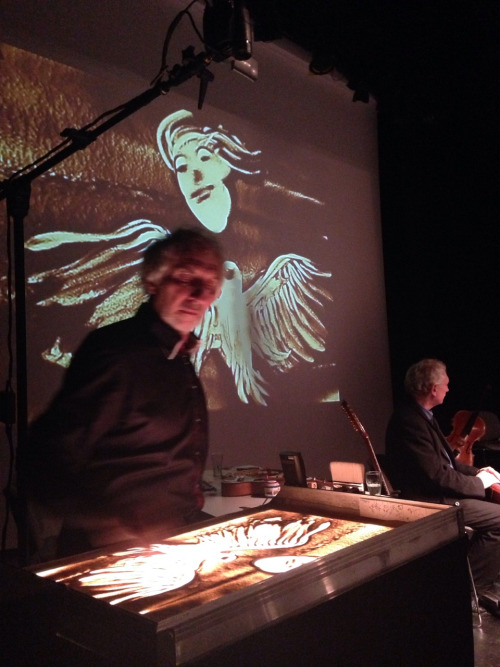
It seems perfectly natural to us that animation is a medium dominated by cel-by-cel drawings, whether made with paint and brush or mouse and software. But it might have been otherwise. After all, some animated films and videos have been made in less conventional formats with less conventional materials. In the past, we’ve featured here stop-motion animations made with dead bugs, innovative pinscreen animations, unusual cutout animations, and the “destructive animation” of painted plaster. And today, we bring you the live-action sand animation of Hungarian artist Ferenc Cakó, who projects his work on a screen for a theatrical audience. These more sculptural forms may be more painstaking than traditional cel animation, and for that reason more rare, but they are also often much more interesting.
Cakó performs his “sand animations,” all over the world, to the accompaniment of classical compositions like Bach’s Orchestral Suite No. 3 in D major and Orff’s Carmina Burana. Here we have his animated interpretation of the most well-known work of Vivaldi, the Four Seasons (“Spring” and “Summer” above, “Autumn” and “Winter” below.) The effect of Cakó’s live technique is mesmerizing; his hands and arms break the fourth wall in broad gestures under which successions of images take shape. His sand drawings tend to be rather static—instead the animated elements in Cakó’s sand animations are his hands as he pushes the sand around, rapidly forming it into faces, flocks of birds, angry clouds. These are quickly wiped away and remade into trees, frightened horses, solitary shepherds….
Watching him work raises many a question: Is Cakó using from storyboards? (No.) How much of his live animation does he improvise? (A good deal.) And why sand, anyway? (It’s dry.) You will find more comprehensive answers to these questions and many more in an interview posted on Cakó’s website. Alluding to the difficulty of his work, compounded by its performative aspect, Cakó says, “Sand cannot be corrected, so while working I do not have control, no motion control. I do not have any opportunity, which cartoonists do, such as the tracing paper phase, during which they either draw the lines or scan them in the computer.” In other words, this is uniquely difficult art that requires the skills of a uniquely confident artist.
Cakó’s website also contains photos of the artist at work, a biography that is also a film‑, art‑, and performance-ography, and a page devoted specifically to scripting “the way Mr Cakó should be announced,” complete with inexplicable uses of parentheses. It’s a fitting bit of bravado for an artist who has legally copyrighted his process.
(Ladies and Gentlemen, what you shall see tonight, is a)
Live Sand Animation Performance, created by Mr Cako, right here by his hands, to the rhythm of the music.
(on the stage and on the screen…….. Mr Ferenc Cako!)
See many more “sandanimations”—and “paint animations”—at Cakó’s YouTube channel.
Related Content:
Watch Piotr Dumala’s Wonderful Animations of Literary Works by Kafka and Dostoevsky
Josh Jones is a writer and musician based in Durham, NC. Follow him at @jdmagness
Read More...The Mystical Poetry of Rumi Read By Tilda Swinton, Madonna, Robert Bly & Coleman Barks
Everyone’s favorite mystical poet, Jalāl ad-Dīn Muḥammad Rūmī, probably could not have predicted how much global influence his work would have eight centuries after his death. Nor could he have appreciated the irony of his 13th century Islamic Persian verse making him the best-selling poet in the U.S. And yet, a huge part of Rumi’s appeal to the majority of his readers, religious and non‑, comes from his non-traditionalism, his anti-dogmatism, gentle iconoclasm, and romanticism.
Claims that the poet was gay may be contentious, but there’s no getting away from the eroticism, much of it homoeroticism, in much of Rumi’s poetry. Rumi also inspired the hardly orthodox Sufi sect known as “Whirling Dervishes,” who invoke a trance-like state through a rhythmic spinning ritual based on the poet’s own devotional practices.
But Rumi did not begin his career as a mystic, or as a poet. Author Brad Gooch, who is writing a biography of Rumi, describes him as “a traditional Muslim preacher and scholar, as his father and grandfather had been.” That is until age 37, when in 1244, he met a mystic called Shams of Tabriz. “The two of them have this electric friendship for three years—lover and beloved [or] disciple and sheikh, it’s never clear,” says Gooch.
After Shams’ death, possibly by murder, Rumi began writing poetry. “Most of the poetry we have comes from age 37 to 67. He wrote 3,000 [love songs] to Shams, the prophet Muhammad and God. He wrote 2,000 rubayat, four-line quatrains. He wrote in couplets a six-volume spiritual epic, The Masnavi.” These poems, writes the BBC, are “recited, chanted, set to music and used as inspiration for novels, poems, music, films, YouTube videos and tweets.” Today we bring you some of those contemporary appropriations of Rumi’s work.
At the top of the post, hear actress Tilda Swinton—who has her own global cult of admirers—read Rumi’s “Like This.” Swinton recently turned to Rumi’s poetry to promote her line of fragrances. Below Swinton’s reading, celebrity spiritual adventurer (some might say spiritual tourist) Madonna reads Rumi’s “Bitter Sweet” with her guru Deepak Chopra.
It was recorded for the album, A Gift Of Love: Deepak & Friends Present Music Inspired By The Love Poems Of Rumi. And just above, we have two very devoted scholars and interpreters of Rumi’s work, Coleman Barks (who translated the poem Swinton reads) and poet Robert Bly, accompanied by tablas, sitar, and drums. Barks has done much to explain the global reach of Rumi’s poetry, writing in the introduction to The Illuminated Rumi that the poet’s “whole life was a witness to the boundless universality of the Heart…. His vision was a whole-world work and the poetry was part of the soul-unfolding done in a learning community.” When Rumi died, Barks tells us, “he was mourned by Christians and Jews, as well as Muslims and Buddhists.” Below, hear Barks attempt to expound on Rumi’s very non-traditional, non-Western, and difficult-to-translate view of love.
If you would like to support the mission of Open Culture, consider making a donation to our site. It’s hard to rely 100% on ads, and your contributions will help us continue providing the best free cultural and educational materials to learners everywhere. You can contribute through PayPal, Patreon, and Venmo (@openculture). Thanks!
Related Content:
Tilda Swinton Recites Poem by Rumi While Reeking of Vetiver, Heliotrope & Musk
Poems as Short Films: Langston Hughes, Pablo Neruda and More
Josh Jones is a writer and musician based in Durham, NC. Follow him at @jdmagness
Read More...Support Us
We're hoping to rely on loyal readers, rather than erratic ads. Please click the Donate button and support Open Culture. You can use Paypal, Venmo, Patreon, even Crypto! We thank you!

About Us

Open Culture scours the web for the best educational media. We find the free courses and audio books you need, the language lessons & educational videos you want, and plenty of enlightenment in between.
Advertise With Us

FREE UPDATES!
GET OUR DAILY EMAIL
Get the best cultural and educational resources on the web curated for you in a daily email. We never spam. Unsubscribe at any time.
FOLLOW ON SOCIAL MEDIA

Open Culture editor Dan Colman scours the web for the best educational media. He finds the free courses and audio books you need, the language lessons & movies you want, and plenty of enlightenment in between.
Advertise With Us

