An Animated Lou Reed Explains The Velvet Underground’s Artistic Goals, and Why The Beatles Were “Garbage”
Blank on Blank returns this week with another one of their groovy animations. This time, we find Lou Reed recalling the goals and ambitions of his avant-garde rock band, The Velvet Underground. We wanted, he says, “to elevate the rock n’ roll song, to take it where it hadn’t been taken before.” And, in his humble opinion, they did just that, far exceeding the musical output of contemporary bands like The Doors and The Beatles, which he respectively calls “stupid” and “garbage.” If you listen to the complete interview recorded in 1987 (web — iTunes), you’ll hear Lou diss a lot of bands. But which one did he give props to? U2. Go figure.
If you would like to support the mission of Open Culture, consider making a donation to our site. It’s hard to rely 100% on ads, and your contributions will help us continue providing the best free cultural and educational materials to learners everywhere. You can contribute through PayPal, Patreon, and Venmo (@openculture). Thanks!
Related Content:
Lou Reed Reads Delmore Schwartz’s Famous Story “In Dreams Begin Responsibilities”
Teenage Lou Reed Sings Doo-Wop Music (1958–1962)
Watch Red Shirley, Lou Reed’s Short Documentary on His Fascinating 100-Year-Old Cousin (2010)
Read More...187 Big Thinkers Answer the Question: What Do You Think About Machines That Think?

It’s time, again, for Edge.org’s annual question. The 2015 edition asks 187 accomplished (and in some cases celebrated) thinkers to answer the question: What Do You Think About Machines That Think?
John Brockman, the literary über agent and founder of Edge.org, fleshes the question out a bit, writing:
In recent years, the 1980s-era philosophical discussions about artificial intelligence (AI)—whether computers can “really” think, refer, be conscious, and so on—have led to new conversations about how we should deal with the forms that many argue actually are implemented. These “AIs”, if they achieve “Superintelligence” (Nick Bostrom), could pose “existential risks” that lead to “Our Final Hour” (Martin Rees). And Stephen Hawking recently made international headlines when he noted “The development of full artificial intelligence could spell the end of the human race.”
But wait! Should we also ask what machines that think, or, “AIs”, might be thinking about? Do they want, do they expect civil rights? Do they have feelings? What kind of government (for us) would an AI choose? What kind of society would they want to structure for themselves? Or is “their” society “our” society? Will we, and the AIs, include each other within our respective circles of empathy?
Numerous Edgies have been at the forefront of the science behind the various flavors of AI, either in their research or writings. AI was front and center in conversations between charter members Pamela McCorduck (Machines Who Think) and Isaac Asimov (Machines That Think) at our initial meetings in 1980. And the conversation has continued unabated, as is evident in the recent Edge feature “The Myth of AI”, a conversation with Jaron Lanier, that evoked rich and provocative commentaries.
Is AI becoming increasingly real? Are we now in a new era of the “AIs”? To consider this issue, it’s time to grow up. Enough already with the science fiction and the movies, Star Maker, Blade Runner, 2001, Her, The Matrix, “The Borg”. Also, 80 years after Turing’s invention of his Universal Machine, it’s time to honor Turing, and other AI pioneers, by giving them a well-deserved rest. We know the history. (See George Dyson’s 2004 Edge feature “Turing’s Cathedral”.) So, once again, this time with rigor, the Edge Question—2015: WHAT DO YOU THINK ABOUT MACHINES THAT THINK?
The replies — 187 in total — feature thoughts by Brian Eno, Douglas Coupland, Kevin Kelly, Esther Dyson, and Daniel Dennett, among others. You can access the complete collection of responses here.
Follow us on Facebook, Twitter and Google Plus and share intelligent media with your friends. Or better yet, sign up for our daily email and get a daily dose of Open Culture in your inbox.
Related Content:
Free Online Computer Science Courses
Noam Chomsky Explains Where Artificial Intelligence Went Wrong
Isaac Asimov Explains His Three Laws of Robots
Read More...40 Years of Saul Bass’ Groundbreaking Title Sequences in One Compilation
A good title sequence tells you everything you need to know about the world of a movie. As it unspools the credits for a given film, it can also convey the movie’s mood, its sense of place, its story’s theme and even a few of its plot points. Saul Bass invented the modern title sequence with Otto Preminger’s The Man with the Golden Arm (1955). Consisting largely of moving white rectangles on a black background set to a jazzy score, the piece feels like a Blue Note record cover come to life – perfect for a gritty tale about heroin addiction. The opening was so striking that Hollywood took note and soon title sequences became the rage, especially ones made by Bass.
Above you can watch a long compilation of Saul Bass titles, starting with Man with the Golden Arm and ending with Martin Scorsese’s Casino (1995). Along the way, the montage illustrates the evolution of style over the course of those 40 years, showing how titles grew in ambition and sophistication. You can see titles for some great films from the yawning spiral in Vertigo to the monochrome crumbling busts in Stanley Kubrick’s Spartacus to the abstract shots of neon in Casino.
But to really get a sense of Bass’s talents, look to some of the less famous movies he worked on. For Carl Forman’s The Victors (1963), a bleak, big-budget anti-war flick, Bass compressed European history from the end of WWI to the devastation of WWII into one masterful montage. At one point, still photos of Hitler giving a speech flash across the screen, each shot pushed closer in on his mouth than the last, before the sequence culminates in a series of explosions. It’s one of the most concise and eloquent retellings of history in cinema. And for the zany comedy Not with My Wife, You Don’t!, Bass created an animated green-eyed monster of jealousy playing a violin. Say what you will about contemporary movies, but there are definitely not enough cartoon green-eyed monsters of jealousy these days.
Related Content:
Saul Bass’ Vivid Storyboards for Kubrick’s Spartacus (1960)
Saul Bass’ Oscar-Winning Animated Short Ponders Why Man Creates
Jonathan Crow is a Los Angeles-based writer and filmmaker whose work has appeared in Yahoo!, The Hollywood Reporter, and other publications. You can follow him at @jonccrow. And check out his blog Veeptopus, featuring lots of pictures of badgers and even more pictures of vice presidents with octopuses on their heads. The Veeptopus store is here.
Read More...The Mastermind of Devo, Mark Mothersbaugh, Shows Off His Synthesizer Collection
Mark Mothersbaugh’s studio is located in a cylindrical structure painted bright green — it looks more like a festive auto part than an office building. It’s a fitting place for the iconoclast musician. For those of you who didn’t spend your childhoods obsessively watching the early years of MTV, Mark Mothersbaugh was the mastermind behind the band Devo. They skewered American conformity by dressing alike in shiny uniforms and their music was nervy, twitchy and weird. They taught a nation that if you must whip it, you should whip it good.
In the years since, Mothersbaugh has segued into a successful career as a Hollywood composer, spinning scores for 21 Jump Street and The Royal Tenenbaums among others.
In the video above, you can see Mothersbaugh hang out in his studio filled with synthesizers of various makes and vintages, including Bob Moog’s own personal Memorymoog. Watching Mothersbaugh pull out and play with each one is a bit like watching a precocious child talk about his toys. He just has an infectious energy that is a lot of fun to watch.
Probably the best part in the video is when he shows off a device that can play sounds backward. It turns out that if you say, “We smell sausage” backwards it sounds an awful lot like “Jesus loves you.” Who knew?
Below you can see Mothersbaugh in action with Devo, performing live in Japan during the band’s heyday in 1979.
Related Content:
Thomas Dolby Explains How a Synthesizer Works on a Jim Henson Kids Show (1989)
Watch Herbie Hancock Rock Out on an Early Synthesizer on Sesame Street (1983)
All Hail the Beat: How the 1980 Roland TR-808 Drum Machine Changed Pop Music
Jonathan Crow is a Los Angeles-based writer and filmmaker whose work has appeared in Yahoo!, The Hollywood Reporter, and other publications. You can follow him at @jonccrow. And check out his blog Veeptopus, featuring lots of pictures of badgers and even more pictures of vice presidents with octopuses on their heads. The Veeptopus store is here.
Read More...600+ Covers of Philip K. Dick Novels from Around the World: Greece, Japan, Poland & Beyond
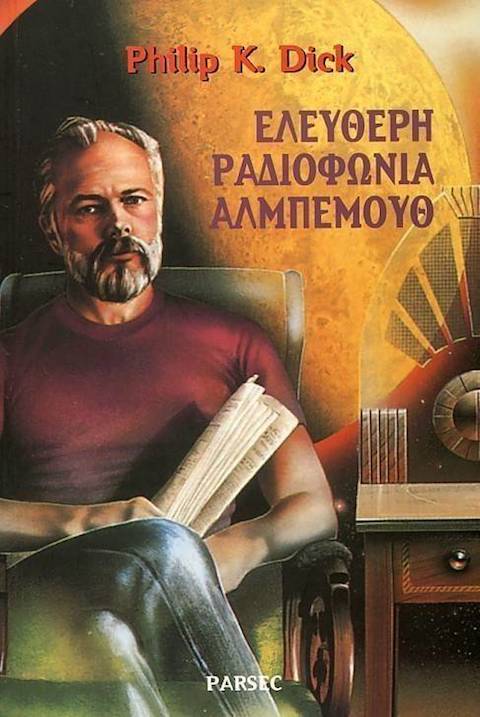
I envy book designers tasked with putting together covers for Philip K. Dick novels, and yet I don’t envy them. On one hand, they get the chance to visually interpret some of the most unusual, indescribable genre fiction ever written; on the other hand, they bear the burden of visually representing some of the most unusual, indescribable genre fiction ever written.

Dick wrote interesting books, to put it mildly, and as book-lovers know, certain countries’ publishing industries tend to put out more interesting book covers than others. So what happens at the intersection? Here we present to you a selection of Philip K. Dick covers from around the world, beginning with a Greek cover of his posthumously published novel Radio Free Albemuth that features the man himself, relaxing in his natural interplanetary environment beside his vintage radio.

That book put a barely fictional gloss on Dick’s own psychological experiences, as did Valis, whose Italian edition you also see pictured here. But his more fantastical novels, such as the I Ching-driven story of an America that lost the Second World War, have received equally compelling international covers, such as the one from Chile just above.

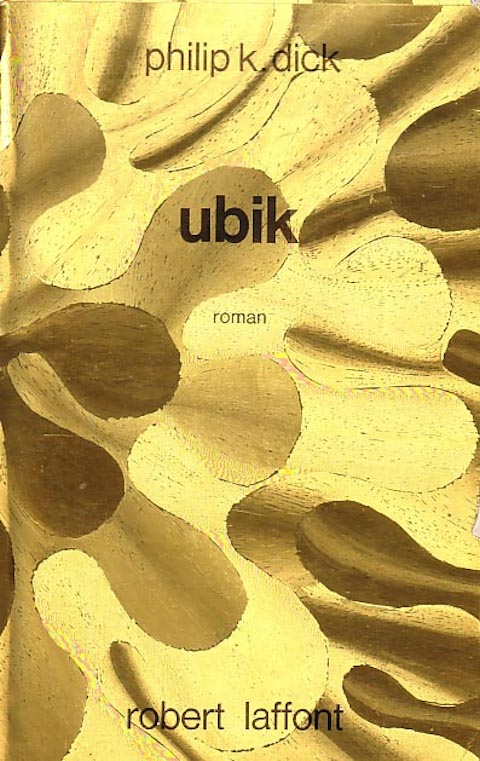
You can usually trust Japanese publishers to come up with book designs neither too abstract nor too literal for the contents within, as one of their editions of Flow My Tears, the Policeman Said quite literally illustrates just above. And if you can rely on Japan for that sort of cover, you can rely on France for understatement; half the French novels I’ve seen have nothing on the front but the name of the work, the author, and the publisher, but behold how Dick’s untamed experimental spirit allowed Robert Laffont to cut loose:
But if you really want to see an unusual graphic design culture, you’ve got to look to Poland. We featured that country’s distinctive movie posters a few years ago, but their books also partake of the very same delightfully askew visual tradition, one I imagine that would have done Dick himself proudest. Below we have Polish cover art for Confessions of a Crap Artist, his novel of midcentury suburban strife, composed with materials few of us would have thought to use:

You can see 600+ international Philip K. Dick covers at philipkdick.com’s cover gallery, which has for some reason gone offline, but which mostly survives through the magic of the Internet Wayback Machine — a device Dick never imagined even in his farthest-out, trickiest-to-represent fantasies.
Related Content:
Philip K. Dick Takes You Inside His Life-Changing Mystical Experience
Robert Crumb Illustrates Philip K. Dick’s Infamous, Hallucinatory Meeting with God (1974)
Download 14 Great Sci-Fi Stories by Philip K. Dick as Free Audio Books and Free eBooks
50 Film Posters From Poland: From The Empire Strikes Back to Raiders of the Lost Ark
Colin Marshall hosts and produces Notebook on Cities and Culture as well as the video series The City in Cinema and writes essays on cities, language, Asia, and men’s style. He’s at work on a book about Los Angeles, A Los Angeles Primer. Follow him on Twitter at @colinmarshall or on Facebook.
Read More...Read 3 Stories from Haruki Murakami’s Short Story Collection Published in Japan Last Year
Briefly noted: Last spring, Haruki Murakami released a new collection of short stories in Japan, roughly translated as Men Without Women. If past trends hold, this volume may never see the light of day in the States. But we may get to read all of the individual stories in the pages of The New Yorker. Last year, the magazine published two of Murakami’s six new stories — “Scheherazade” and “Yesterday.” And now comes another, “Kino.” You can read it online here.
If you would like to support the mission of Open Culture, consider making a donation to our site. It’s hard to rely 100% on ads, and your contributions will help us continue providing the best free cultural and educational materials to learners everywhere. You can contribute through PayPal, Patreon, and Venmo (@openculture). Thanks!
Related Content:
Read 6 Stories By Haruki Murakami Free Online
Haruki Murakami Lists the Three Essential Qualities For All Serious Novelists (And Runners)
Haruki Murakami’s Passion for Jazz: Discover the Novelist’s Jazz Playlist, Jazz Essay & Jazz Bar
Read More...7 Short Stories by Junot Díaz Free Online, In Text and Audio
As much as any contemporary writer of literary fiction ever does, Junot Díaz has become something of a household name in the years since his debut novel, The Brief Wondrous Life of Oscar Wao appeared in 2007, then went on to win the Pulitzer Prize, among other many other honors. The novel has recently topped critics lists of the best 21st century novels (so far), and the recognition is well-deserved, and very hard-won. Díaz spent a decade writing the book, his process, in the words of The New York Times’ Sam Anderson, “notoriously slow” and laborious. But none of his time working on Oscar Wao, it seems, was spent idle. During the long gestation period between his first book of stories, 1996’s Drown, his first novel, and the many accolades to follow, Diaz has reliably turned out short stories for the likes of The New Yorker, culminating in his most recent collection from 2012, This Is How You Lose Her.
Díaz is his own worst critic—even he admits as much, calling his overbearing critical self “a character defect” and “way too harsh.” Perhaps one of the reasons he finds his process “miserable” is that his “narrative space,” as critic Lizabeth Paravisini-Gebert writes, consists not of “nostalgic recreations of idealized childhood landscapes,” but rather the “bleak, barren, and decayed margins of New Jersey’s inner cities,” as well as the tragic, bloody past of his native Dominican Republic.
Despite the historical violence from which his characters emerge, the voices of Diaz’s narratives are a vital force, full of lightening-fast recall of pop cultural touchstones, hip-hop, historic and folkloric allusions, and the minutiae of high geekery, from sci-fi film, to gaming, to comic book lore. (Watch Diaz discuss geek culture at New York’s St. Mark’s Comics above.)
Like a nerdy New World Joyce, Díaz works in a dizzying swirl of references that critic and playwright Gregg Barrios calls a “deft mash-up of Dominican history, comics, sci-fi, magic realism and footnotes.” The writer’s unique idiom—swinging with ease from the most streetwise and profane vernacular to the most formal academic prose and back again—interrogates categories of gender and national identity at every turn, asking, writes Barrios, “Who is American? What is the American experience?” Diaz’s narrative voice—described by Leah Hager Cohen as one of “radical inclusion”—provides its own answers.
That notoriously slow process pays dividends when it comes to fully-realized characters who seem to live and breathe in a space outside the page, a consequence of Díaz “sitting with my characters” for a long time, he tells Cressida Leyshon, “before I can write a single word, good or bad, about them. I seem to have to make my characters family before I can access their hearts in any way that matters.” You can read the results of all that sitting and agonizing below, in seven stories that are available free online, in text and audio. Stories with an asterisk next to them appear in This Is How You Lose Her. The final story comes from Diaz’s first collection, Drown.
- “The Cheater’s Guide to Love” * (The New Yorker, July 2012—text, audio)
- “Monstro” (The New Yorker, June 2012—text)
- “Miss Lora” * (The New Yorker, April 2012—text)
- “The Pura Principle” * (The New Yorker, March 2010—text)
- “Alma” * (The New Yorker, December 2007—text, audio)
- “Wildwood” (The New Yorker, June 2007—text)
- “How to date a brown girl (black girl, white girl, or halfie)” (text, audio)
Related Content:
1,000 Free Audio Books: Download Great Books for FreeJunot Díaz Annotates a Selection of The Brief Wondrous Life of Oscar Wao for “Poetry Genius”
Read 18 Short Stories From Nobel Prize-Winning Writer Alice Munro Free Online
800 Free eBooks for iPad, Kindle & Other Devices
Josh Jones is a writer and musician based in Durham, NC. Follow him at @jdmagness
Read More...Monopoly: How the Original Game Was Made to Condemn Monopolies & the Abuses of Capitalism

The great capitalist game of Monopoly was first marketed by Parker Brothers back in February 1935, right in the middle of the Great Depression. Even during hard times, Americans could still imagine amassing a fortune and securing a monopoly on the real estate market. When it comes to making money, Americans never run out of optimism and hope.
Monopoly didn’t really begin, however, in 1935. And if you trace back the origins of the game, you’ll encounter an ironic, curious tale. The story goes like this: Elizabeth (Lizzie) J. Magie Phillips (1866–1948), a disciple of the progressive era economist Henry George, created the prototype for Monopoly in 1903. And she did so with the goal of illustrating the problems associated with concentrating land in private monopolies.
As Mary Pilon, the author of the new book The Monopolists: Obsession, Fury, and the Scandal Behind the World’s Favorite Board Game, recently explained in The New York Times, the original game — The Landlord’s Game — came with two sets of rules: “an anti-monopolist set in which all were rewarded when wealth was created, and a monopolist set in which the goal was to create monopolies and crush opponents.” Phillips’ approach, Pilon adds, “was a teaching tool meant to demonstrate that the first set of rules was morally superior.” In other words, the original game of Monopoly was created as a critique of monopolies — something the trust- and monopoly-busting president, Theodore Roosevelt, could relate to.

Patented in 1904 and self-published in 1906, The Landlord’s Game featured “play money and deeds and properties that could be bought and sold. Players borrowed money, either from the bank or from each other, and they had to pay taxes,” Pilon writes in her new book.
The Landlord’s Game also had the look & feel of the game the Parker Brothers would eventually bastardize and make famous. Above, you can see an image from the patent Philips filed in 1904 (top), and another image from the marketed game.
Magie Philips never got credit or residuals from the Parker Brothers’ game. Instead, a fellow named Charles Darrow came along and drafted his own version of the game, tweaked the design, called it Monopoly (see the earliest version here), slapped a copyright on the packaging with his name, and then sold the game to Parker Brothers for a reported $7,000, plus residuals. He eventually made millions.
As they like to say in the US, it’s just business.
For more on the origins of Monopoly, read Mary Pilon’s piece in The Times.
If you would like to support the mission of Open Culture, consider making a donation to our site. It’s hard to rely 100% on ads, and your contributions will help us continue providing the best free cultural and educational materials to learners everywhere. You can contribute through PayPal, Patreon, and Venmo (@openculture). Thanks!
Related Content:
Henry Rollins: Education is the Cure to “Disaster Capitalism”
Free Online Economics Courses
Andrei Tarkovsky’s Masterpiece Stalker Gets Adapted into a Video Game
Read More...Free Online Course: Robert Thurman’s Introduction to Tibetan Buddhism (Recorded at Columbia U)

Image by Wonderlane, via Flickr Commons
Today you can be a fly on the wall at Columbia University, and listen to Robert Thurman’s lectures on “The Central Philosophy of Tibet.” Thurman is, as his own website rightly describes him, a “worldwide authority on religion and spirituality,” and an “eloquent advocate of the relevance of Buddhist ideas to our daily lives.” A “leading voice of the value of reason, peace and compassion,” he was “named one of Time magazine’s 25 most influential Americans.” And, in case you’re wondering, he’s also Uma Thurman’s dad.
The audio above comes from a course taught by Prof. Thurman at Columbia, and it’s based on his book The Central Philosophy of Tibet. The course “explores the philosophical thought of Indo-Tibetan Buddhism, both in the intellectual setting of ancient India and Tibet and in the context of the current global philosophy.” You will find the course added to our ever-growing list, 1,700 Free Online Courses from Top Universities.
Note: There are 13 lectures in total, each running almost two hours. The audio player above should stream through them all. The first 30 seconds are a little muffled, but then things improve. The lectures are hosted by Archive.org.
Related Content:
Buddhism 101: A Short Introductory Lecture by Jorge Luis Borges
Leonard Cohen Narrates Film on The Tibetan Book of the Dead, Featuring the Dalai Lama (1994)
The History of the World in 46 Lectures From Columbia University
Martin Heidegger Talks Philosophy with a Buddhist Monk on German Television (1963)
Free Online Religion Courses
Read More...David Carr Gives 10 Pieces of Work & Life Advice to UC Berkeley Graduates
David Carr took seven years to get through college. He didn’t have a Master’s degree or a PhD. Before he made it big writing for The New York Times, he spent time in rehab and on welfare. David Carr didn’t fit the profile of your average commencement speaker.
And yet Carr, who died in the Times newsroom on Thursday night, earned his spot speaking before the 2014 graduating class at UC Berkeley’s Graduate School of Journalism. Known for his insightful reporting on changes in publishing, television and social media, Carr understood the world these young journalists were entering. And when he offered 10 pieces of graduation advice, you know the students took note. You should too:
1.) Someone who is underestimated will be the one who changes the world. It’s not the person everyone expects. It might be you.
2.) “Do what is front of you.” Focus on the small steps ahead of you.
3.) Don’t worry about achieving a master plan, about the plot to take over the world.
4.) Be a worker among workers. It’s more important that you fit in before you stick out.
5.) Follow the “Mom Rule.” Don’t do anything you couldn’t explain or justify to your mom.
6.) Don’t just do what you’re good at. Get outside of your comfort zone. Being a journalist is permission for lifetime learning.
7.) Be present. Don’t worry about documenting the moment with your smartphone. Experience it yourself.
8.) Take responsibility for the good and the bad. Learn to own your failures.
9.) Be honest, and be willing to have the difficult conversation.
10.) Don’t be afraid to be ambitious. It’s not a crime.
He says it’s a listicle that won’t appear on Buzzfeed. But it fits perfectly on OC. David, we’re so sorry to see you go.
If you would like to support the mission of Open Culture, consider making a donation to our site. It’s hard to rely 100% on ads, and your contributions will help us continue providing the best free cultural and educational materials to learners everywhere. You can contribute through PayPal, Patreon, and Venmo (@openculture). Thanks!
Related Content:
Michael Pollan Presents an Edible Education, A Free Online Course From UC Berkeley
“Wear Sunscreen”: The Story Behind the Commencement Speech That Kurt Vonnegut Never Gave
David Foster Wallace’s 2005 Commencement Speech “This is Water” Visualized in Short Film
NPR Launches Database of Best Commencement Speeches Ever
Read More...
Support Us
We're hoping to rely on loyal readers, rather than erratic ads. Please click the Donate button and support Open Culture. You can use Paypal, Venmo, Patreon, even Crypto! We thank you!

About Us

Open Culture scours the web for the best educational media. We find the free courses and audio books you need, the language lessons & educational videos you want, and plenty of enlightenment in between.
Advertise With Us

FREE UPDATES!
GET OUR DAILY EMAIL
Get the best cultural and educational resources on the web curated for you in a daily email. We never spam. Unsubscribe at any time.
FOLLOW ON SOCIAL MEDIA

Open Culture editor Dan Colman scours the web for the best educational media. He finds the free courses and audio books you need, the language lessons & movies you want, and plenty of enlightenment in between.
Advertise With Us