Predict Which 21st Century Novels Will Enter the Literary Canon? And Which Overrated Ones Won’t?
Last year, we featured a 1936 poll where readers predicted what writers would make it into the literary canon of the year 2000. But what results would the same inquiry yield today? What 21st-century novels (early in the game, I know, but still) will remain widely read over half a century from now? How much more prescience have we evolved compared to that of our equivalents almost 80 years ago? How many modern Sinclair Lewises and Willa Cathers would we pick — versus how many modern James Truslow Adamses and James Branch Cabells?
Writing for Arts.Mic, Claire Luchette gives one possible set of answers to this question with her list of “11 Twenty-First Century Books Our Kids Will Be Taught in School,” which runs as follows:
- White Teeth (Zadie Smith, 2000)
- Life of Pi (Yann Martel, 2001)
- Middlesex (Jeffrey Eugenides, 2002)
- The Kite Runner (Khaled Hosseini, 2003)
- The Namesake by Jhumpa Lahiri (2003)
- Gilead by Marilynne Robinson (2004)
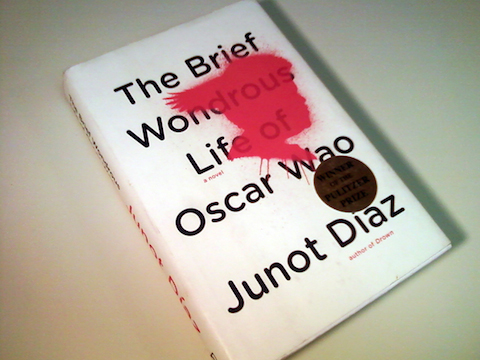
- The Brief Wondrous Life of Oscar Wao (Junot Díaz, 2008)
- A Visit From the Goon Squad (Jennifer Egan, 2010)
- Freedom (Jonathan Franzen, 2010)
- Dear Life (Alice Munro, 2012)
- Tenth of December (George Saunders, 2013)
The future already looks bright for several of Luchette’s picks. Junot Diaz’s “habit-formingly colorful and bright” (not to mention Pulitzer-winning) The Brief Wondrous Life of Oscar Wao recently topped BBC Culture’s critics poll for the best novel of the 21st century so far. Others face longer odds. As high a point in the zeitgeist as Yann Martel’s Life of Pi reached — and no less an opinion leader than Barack Obama called it “an elegant proof of God” — I personally tend to agree with the assessment of James Wood, who likens its central revelation to “an editorial meeting of Social Text.”
And so we hand it over to you, Open Culture readers. What does the future’s canon look like from where you stand? In the comments, name the books you think will remain widely read (or grow more so) at the end of the century, or indeed, the ones widely read now that will have, by that point, collected the better part of a century’s dust. Bonus points for telling us why.
Related Content:
Readers Predict in 1936 Which Novelists Would Still Be Widely Read in the Year 2000
The 10 Greatest Books Ever, According to 125 Top Authors (Download Them for Free)
The 25 Best Non-Fiction Books Ever: Readers’ Picks
600 Free eBooks for iPad, Kindle & Other Devices
Colin Marshall hosts and produces Notebook on Cities and Culture as well as the video series The City in Cinema and writes essays on cities, language, Asia, and men’s style. He’s at work on a book about Los Angeles, A Los Angeles Primer. Follow him on Twitter at @colinmarshall or on Facebook.
Read More...The Marvelous Health Benefits of Chocolate: A Curious Medical Essay from 1631
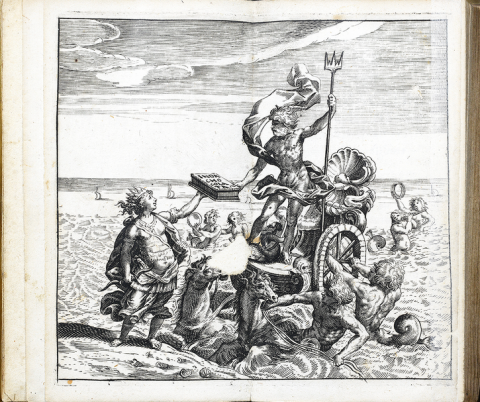
When coffee first came to the western world during the 17th century, it didn’t taste particularly good. So the people importing and peddling the new commodity talked up the health benefits of the new drink. The first known English advertisement for coffee, dating back to 1652, made these claims: Coffee is “very good to help digestion.” It also “quickens the Spirits, and makes the Heart Lightsome.” And it “is good against sore Eys, and the better if you hold your Head o’er it, and take in the Steem that way.”
It turns out that chocolate had a similar introduction to the West. Writing at the always interesting Public Domain Review, Christine A. Jones recounts how when chocolate “first arrived from the Americas into Europe in the 17th century it was a rare and mysterious substance, thought more of as a drug than as a food.” The Spanish, who conquered the Aztecs in 1521, first documented the chocolate they encountered there in 1552. And then, in 1631, they placed chocolate in the annals of medical history when Antonio Colmenero de Ledesma, a Spanish physician and surgeon, wrote a medical essay called Curioso Tratado de la naturaleza y calidad del chocolate. The essay made the case that chocolate, if taken correctly, could help balance the body’s humors (Blood, Yellow Bile, Black Bile & Phlegm) and ward off disease. (You can bone up on the ancient science of Humorism here.) When translated into English in 1651, the treatise now called Chocolate; or, an Indian Drinke came prefaced by an introduction that touted chocolate’s health benefits:
It is an excellent help to Digestion, it cures Consumptions, and the Cough of the Lungs, the New Disease, or Plague of the Guts, and other Fluxes, the Green Sicknesse, Jaundise, and all manner of Inflamations, Opilations, and Obstructions. It quite takes away the Morphew, Cleanseth the Teeth, and sweetneth the Breath, Provokes Urine, Cures the Stone, and strangury, Expells Poison, and preserves from all infectious Diseases.
And it featured one of the first recipes for hot chocolate:
To every 100. Cacaos, you must put two cods of the*Chiles long red Pepper, of which I have spoken before, and are called in the Indian Tongue, Chilparlagua; and in stead of those of the Indies, you may take those of Spaine which are broadest, & least hot. One handfull of Annis-seed Orejuelas, which are otherwise called Pinacaxlidos: and two of the flowers, called Mechasuchil, if the Belly be bound. But in stead of this, in Spaine, we put in six Roses of Alexandria beat to Powder: One Cod of Campeche, or Logwood: Two Drams of Cinamon; Almons, and Hasle-Nuts, of each one Dozen: Of white Sugar, halfe a pound: of Achioteenough to give it the colour.
You can read more about the curious medical history of chocolate at The Public Domain Review. And while you’re there, you should check out their new book of essays, which we featured on Open Culture in December.
Related Content:
Science & Cooking: Harvard’s Free Course on Making Cakes, Paella & Other Delicious Food
MIT Teaches You How to Speak Italian & Cook Italian Cuisine All at Once (Free Online Course)
A Cabinet of Curiosities: Discover The Public Domain Review’s New Book of Essays
Read More...In Animated Cartoon, Alison Bechdel Sees Her Life Go From Pulitizer Prize Winning Comic to Broadway Musical
No one is surprised when authors mine their personal experiences. If they’re lucky enough to strike gold, other miners may be brought on to bring the stories to the silver screen. Here’s where things get tricky (if lucrative). No one wants to see his or her important life details getting royally botched, especially when the results are blown up 70 feet across.
Cartoonist Alison Bechdel’s path to letting others take the reins as her story is immortalized in front of a live audience is not the usual model. The family history she shared in the Pulitzer Prize-winning Fun Home: A Family Tragicomic has been turned into a Broadway musical.
Now that would be a nail biter, especially if the non-fictional source material includes a graphically awkward first sexual encounter and your closeted father’s suicide.
In the animated comic above, Bechdel recounts the surreal experience of seeing her most personal experiences musicalized during Fun Home’s recent Off-Broadway run at the Public Theater.
In the wrong hands, it could have been an excruciating evening, but Fun Home, the musical, has had excellent pedigree from the get go.
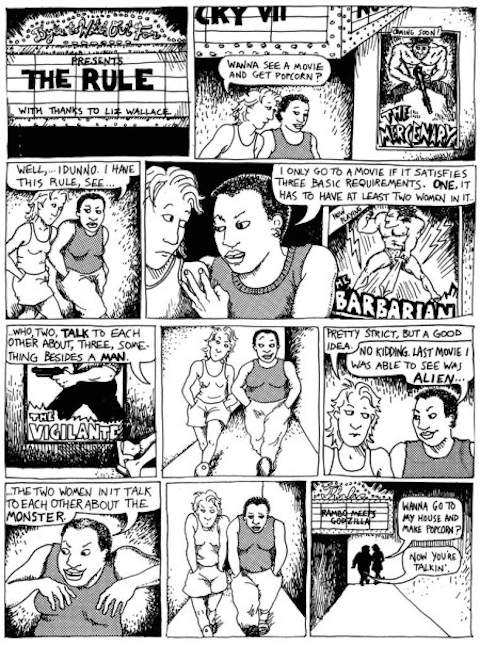
It’s also worth noting that this show passes the infamous Bechdel Test (below) both onstage and off, with a book and lyrics by Lisa Kron and music by Jeanine Tesori.
Previews begin next month in New York City.
Related Content:
Cartoonist Kate Beaton Plays on Literary Classics — The Great Gatsby, Julius Caesar & More
Underground Cartoonist R. Crumb Introduces Us to His Rollicking Album Cover Designs
Ayun Halliday is an author, homeschooler, and Chief Primatologist of the East Village Inky zine. Follow her @AyunHalliday
Read More...Illustrations for a Chinese Lord of the Rings in a Stunning “Glass Painting Style”
J.R.R. Tolkien’s The Lord of the Rings trilogy has had an enormously wide, cross-cultural appeal. This despite the fact that its creator was a university professor of a long-dead language, Anglo-Saxon, who set his story in a world of customs and mores—supernatural elements aside—that bear a fairly close resemblance to ancient and medieval England. But such similarly provincial settings have raised no barriers to the global reach of the Iliad, say, or Shakespeare. Western epics, ancient and modern, may on the one hand have traveled the globe on waves of cultural imperialism (and Hollywood film), and, on the other, they have their own built-in global reach because they tap into archetypal story-types and human characteristics—because their use of myth and folklore reads as universal, though the particulars change from place to place and age to age.
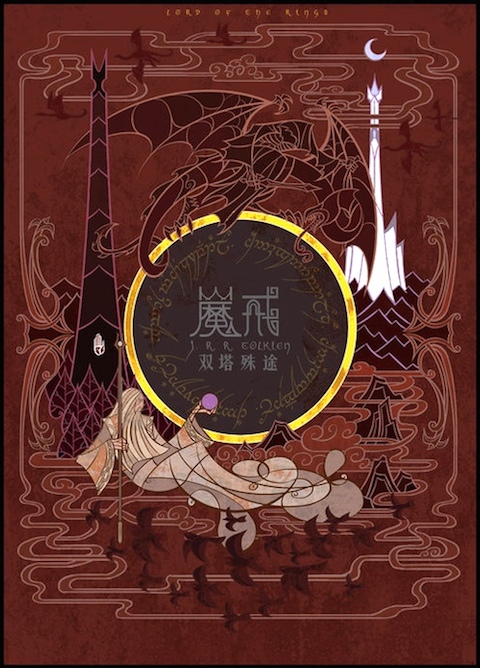
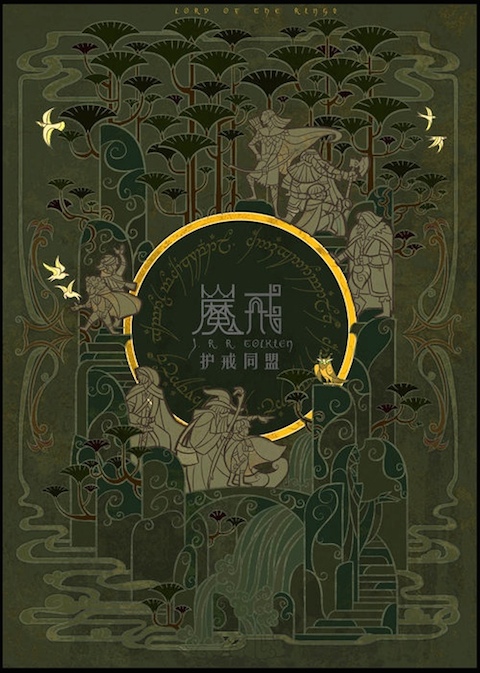
The multilingual among us have the opportunity to see how well, or not, great stories translate into different cultural contexts. Readers, for example, of both Chinese and English will be able to compare Tolkien’s originals with forthcoming editions of the books from WenJing Publishing. The rest of us provincial monolinguals can still make comparisons of visual interpretations of the text, like these possible book covers drawn by artist Jian Guo. Part of a competition held by the publisher of the new Chinese text, the beautiful, monochromatic illustrations draw on many of the design elements of Tolkien’s original paintings for the trilogy’s covers, elaborating on the iconic ring and towers with intricate Asian lines and flourishes. At the top, see The Fellowship of the Ring, above The Two Towers, and below, The Return of the King.
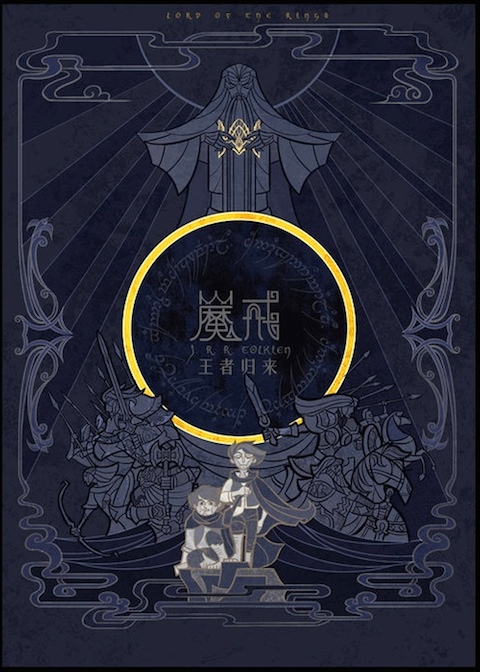
The artist, an architectural student, describes his style as “glass painting style,” which he uses for its “sense of religious magnificence.” Interestingly, before seeing Peter Jackson’s Lord of the Rings adaptation in 2002, he had never heard of the books. (Previous Chinese translations of the books feature rather unimaginative covers with images from Jackson’s movies.) The films converted him into an avid reader of Tolkien—see a Hobbit illustration at the bottom of the post. Jian is also a lover of J.K. Rowling’s popular fantasy series and has designed some wonderfully stylized illustrations for Harry Potter and the Chamber of Secrets and Harry Potter and the Philosopher’s Stone.
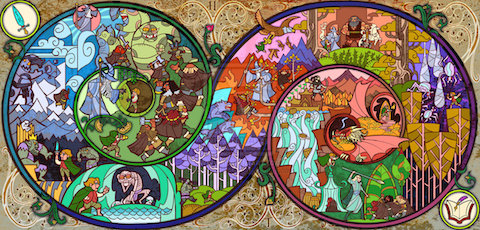
via Tor
Related Content:
Discover J.R.R. Tolkien’s Personal Book Cover Designs for The Lord of the Rings Trilogy
Illustrations of The Lord of the Rings in Russian Iconography Style (1993)
Soviet-Era Illustrations Of J. R. R. Tolkien’s The Hobbit (1976)
Josh Jones is a writer and musician based in Durham, NC. Follow him at @jdmagness
Read More...Gun Nut William S. Burroughs & Gonzo Illustrator Ralph Steadman Make Polaroid Portraits Together
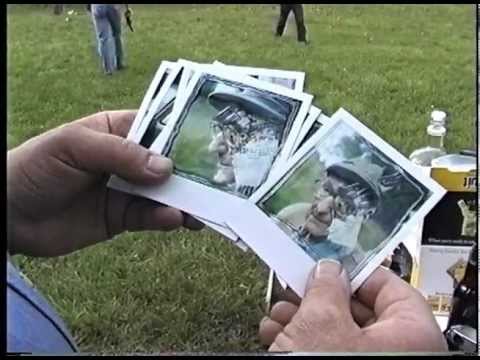
Ralph Steadman is best known as the artist who realized the gonzo vision of Hunter S. Thompson in illustrations for the latter’s books and articles (and more recently, perhaps, for the labels on Colorado’s Flying Dog brew). His work has famously appeared over the past several decades in Punch, Private Eye, The New York Times, and Rolling Stone, and he produced a brilliantly illustrated edition of Alice in Wonderland. Like his friend Gerald Scarfe, another wickedly satirical cartoonist who created the look of Pink Floyd’s The Wall, Steadman has made significant contributions to the look of the counterculture.
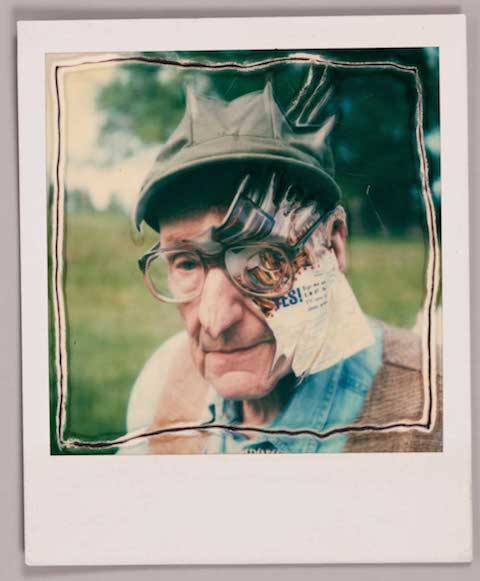
But while Steadman’s work with Hunter Thompson may largely define his career, another notable collaboration with a literary figure, William S. Burroughs, also proved fruitful many years later. In 1995, Steadman brought together his own illustrations with Burroughs love of guns, asking the octogenarian writer to blast holes in original Steadman creations.
Some of these paintings feature the Polaroid portraits of Burroughs above and at the top of the post (see a resulting Steadman/Burroughs silkscreen print, with gunshot holes, here). Just above, you can see Steadman taking the photos. First, he makes some test shots with an assistant, then, at 2:50, we see him with Burroughs and an entourage. As The Independent described the meeting at Burroughs’ house in Lawrence, Kansas, it was something of a “contrived event,” with “swarms of assistants” and “acolytes” in attendance, “taping the whole thing on video.”
Luckily for us, I’d say. Unfortunately, we don’t seem to have video from later in the day, when the group drove “out to Burrough’s friends place outside town, where he does his shooting.” Once there, “Burroughs, Steadman and his wife Anna and Burroughs’ entourage take turns blazing away with .33s, .45s, pump-action shotguns and Saturday-night specials at a variety of targets,” including Steadman’s art. That would be something to see. We’ll have to settle for the art itself, and Steadman’s fascinating demonstration below of his approach to portraiture.
Related Content:
Breaking Bad Illustrated by Gonzo Artist Ralph Steadman
William S. Burroughs Shows You How to Make “Shotgun Art”
Josh Jones is a writer and musician based in Durham, NC. Follow him at @jdmagness
Read More...William Faulkner Outlines on His Office Wall the Plot of His Pulitzer Prize Winning Novel, A Fable (1954)

Image courtesy of enotes
This past summer I had occasion to visit Oxford Mississippi for a conference on William Faulkner, hosted by the university he briefly attended, Ole Miss. Owner of Faulkner’s estate, Rowan Oak, since 1972, the university often stages events on the novelist’s former grounds—particularly to celebrate meetings devoted to his work. While I had wandered around the property a few times during my stay on campus, I thought I’d wait until the capstone barbecue at the conference’s close to enter the house itself. More fool me. A rainstorm forced the festivities into a college hall, and I had to depart early the following morning.
And so, sadly, I missed out on walking Faulkner’s floorboards, peering out through his windows, and, especially, seeing firsthand the notes he scrawled on the walls of his study to outline the plot of his 1954 novel A Fable. The Pulitzer Prize and National Book Award-winning book, which—depending on your tolerance for Faulkner’s excesses is either a “crowning achievement or self-indulgent mess”—occupied the author for over a decade. He began A Fable—set in France during World War 1—just after the end of the Second World War, and did much of the writing in the small office he added to the house in 1950, the year after he won the Nobel Prize. (Hear him read his Nobel Prize Speech here.)
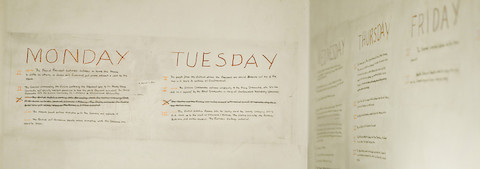
Photo by Nick Russell
Plotting the chronology on the walls helped him become fully immersed in the novel’s density, but, writes education blog Enotes, “not everybody was so pleased with the method”: “Faulkner’s wife, disappointed with the decision, had the walls repainted. In return, Faulkner rewrote the outline and then shellacked the wall to ensure a permanent record.”
There are much worse ways to antagonize one’s spouse, I suppose, but I’m sure that wasn’t his primary intent. Faulkner considered the novel his masterpiece—Pulitzer and National Book Award committees agreed—but critics have not been so kind. It’s now one of his lesser-known works, one of the few not set in the fictional Yoknopatawpha, a stand-in for his own Lafayette county, which he mined for stories all of his mature career after some brief adventuring abroad.
Perhaps his defiant preservation of the plan for A Fable represents his deep desire to leave behind the “postage stamp” of Oxford and its surrounds—to venture into other imaginative territories. If so, his plan failed. Faulkner will be forever associated with the South—with Mississippi, and with Rowan Oak. And like so many devotees, I’ll likely make my pilgrimage to his well-preserved home a yearly event. The next time I’m down there, however, I’ll actually make it inside to see the writing on the walls.
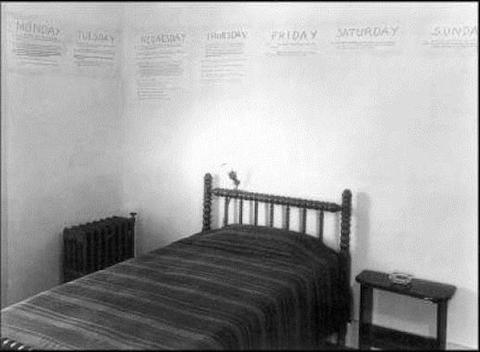
Photo by John Lawrence, from Faulkner’s Rowan Oak , by John Lawrence and Dan Hise
Related Content:
Rare Audio: William Faulkner Names His Best Novel, And the First Faulkner Novel You Should Read
William Faulkner Reads His Nobel Prize Speech
The Art of William Faulkner: Drawings from 1916–1925
How Famous Writers — From J.K. Rowling to William Faulkner — Visually Outlined Their Novels
Josh Jones is a writer and musician based in Durham, NC. Follow him at @jdmagness
Read More...See Penguins Wearing Tiny “Penguin Books” Sweaters, Knitted by the Oldest Man in Australia
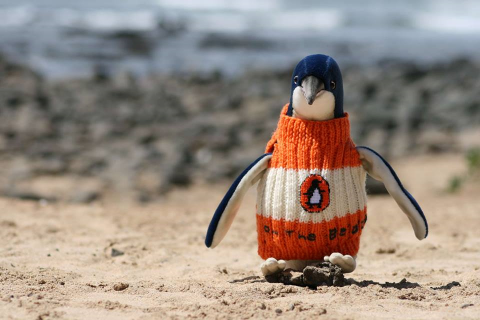
How does 109-year-old Alfred “Alfie” Date keep himself busy? Apparently by knitting sweaters for endangered penguins. The oldest man in Australia, Alfie began knitting these little sweaters at the request of The Penguin Foundation in 2013, after hundreds of Little Penguins were injured by a big oil spill. He makes the sweaters in different styles. But you can’t beat a penguin wearing a Penguin Books logo. We dare you to try.
File under Meta.
via Bored Panda
Follow us on Facebook, Twitter and Google Plus and share Open Culture with your family and friends. Or better yet, sign up for our daily email and get a daily dose of Open Culture in your inbox.
Read More...Harper Lee on the Joy of Reading Real Books: “Some Things Should Happen On Soft Pages, Not Cold Metal”
News of the new, long-awaited but hardly expected Harper Lee novel, Go Set a Watchman—a sequel to the 1960’s To Kill a Mockingbird—has been met with varying degrees of skepticism, surely warranted given her late sister Alice and others’ characterization of Lee’s physical and mental decline. On the other hand, the novelist, it’s been reported, is “extremely hurt” by allegations that she has been pressured to publish. It would be a shame if the controversy over the publication of the novel eclipsed the novel itself. While it had become something of a truism that Harper Lee would only publish the one, great novel and never another, I for one greet this latest news with joy.
For one thing, circumstances aside, the new Harper Lee novel has the mass media doing something it rarely does anymore—talking about literary fiction. And for the thousands of school kids required to read To Kill a Mockingbird and wondering why they should bother, the conversation hopefully communicates that books still matter, and not just dystopian YA sci-fi and mass-market trade books about BDSM fantasies, but books about ordinary people in ordinary times and places. It’s a lesson Lee learned early. In a 2006 letter to Oprah Winfrey, published in O magazine, Lee wrote about her childhood experiences with reading, and being read to. She recalls arriving “in the first grade, literate,” because of her upbringing. She also acknowledges that “books were scarce”; her and her siblings early literacy meant they were “privileged” compared to other children, “mostly from rural areas,” and the “children of our African-American servants.”
While we may dismiss Lee’s contention that in “an abundant society where people have laptops, cell phones” and “iPods” they also have “minds like empty rooms” as the kvetching of a senior citizen, I doubt most people who respect Lee’s wisdom and good humor would do so lightly. Her poetic evocation of the tactile differences between books and gadgets alone should give us pause: “some things should only happen on soft pages, not cold metal.”
Read the full letter below.
May 7, 2006
Dear Oprah,
Do you remember when you learned to read, or like me, can you not even remember a time when you didn’t know how? I must have learned from having been read to by my family. My sisters and brother, much older, read aloud to keep me from pestering them; my mother read me a story every day, usually a children’s classic, and my father read from the four newspapers he got through every evening. Then, of course, it was Uncle Wiggily at bedtime.
So I arrived in the first grade, literate, with a curious cultural assimilation of American history, romance, the Rover Boys, Rapunzel, and The Mobile Press. Early signs of genius? Far from it. Reading was an accomplishment I shared with several local contemporaries. Why this endemic precocity? Because in my hometown, a remote village in the early 1930s, youngsters had little to do but read. A movie? Not often — movies weren’t for small children. A park for games? Not a hope. We’re talking unpaved streets here, and the Depression.
Books were scarce. There was nothing you could call a public library, we were a hundred miles away from a department store’s books section, so we children began to circulate reading material among ourselves until each child had read another’s entire stock. There were long dry spells broken by the new Christmas books, which started the rounds again.
As we grew older, we began to realize what our books were worth: Anne of Green Gables was worth two Bobbsey Twins; two Rover Boys were an even swap for two Tom Swifts. Aesthetic frissons ran a poor second to the thrills of acquisition. The goal, a full set of a series, was attained only once by an individual of exceptional greed — he swapped his sister’s doll buggy.
We were privileged. There were children, mostly from rural areas, who had never looked into a book until they went to school. They had to be taught to read in the first grade, and we were impatient with them for having to catch up. We ignored them.
And it wasn’t until we were grown, some of us, that we discovered what had befallen the children of our African-American servants. In some of their schools, pupils learned to read three-to-one — three children to one book, which was more than likely a cast-off primer from a white grammar school. We seldom saw them until, older, they came to work for us.
Now, 75 years later in an abundant society where people have laptops, cell phones, iPods, and minds like empty rooms, I still plod along with books. Instant information is not for me. I prefer to search library stacks because when I work to learn something, I remember it.
And, Oprah, can you imagine curling up in bed to read a computer? Weeping for Anna Karenina and being terrified by Hannibal Lecter, entering the heart of darkness with Mistah Kurtz, having Holden Caulfield ring you up — some things should happen on soft pages, not cold metal.
The village of my childhood is gone, with it most of the book collectors, including the dodgy one who swapped his complete set of Seckatary Hawkinses for a shotgun and kept it until it was retrieved by an irate parent.
Now we are three in number and live hundreds of miles away from each other. We still keep in touch by telephone conversations of recurrent theme: “What is your name again?” followed by “What are you reading?” We don’t always remember.
Much love,
Harper
via Letters of Note
Related Content:
William Faulkner Reads His Nobel Prize Speech
Download 20 Popular High School Books Available as Free eBooks & Audio Books
Josh Jones is a writer and musician based in Durham, NC. Follow him at @jdmagness
Read More...Watch Agnès Varda’s Les Fiancés Du Pont Macdonald: A Silent Comic Short Starring Jean-Luc Godard & Anna Karina
Agnès Varda claimed to have seen fewer than ten movies before she made her first film at age 25. At the time, she had some pretty naïve ideas about film. “I thought if I added sound to photographs, that would be cinema,” she recalled. She learned the essence of filmmaking and, by all accounts, learned it well. The resulting film, La Pointe-Courte (1954), a self-financed documentary-fiction hybrid, is considered one of the forerunners of the French New Wave.
Fast forward a few years. Varda is shooting her follow up feature Cleo from 5 to 7. The film would prove to be her breakout hit and a classic of the New Wave alongside the likes of 400 Blows and Breathless.
The film, which unspools almost in real time, is about a beautiful young singer who waits anxiously for the results of a medical test. We watch her as she talks with well-meaning friends, finds comfort with a stranger, and even takes some time to watch a movie. In the wrong hands, the story has the potential for being an unleavened exercise in existential angst. But, as she later proved in subsequent movies, she was never one to let things get too dark. The movie that the heroine watches is a silent comedy – one that Varda shot herself.

Les Fiancés Du Pont Macdonald centers on a Buster Keatonsque dandy in a flat straw hat who waves good-bye to his doll-like girlfriend. Yet when he dons a pair of sunglasses, everything goes wrong. He witnesses his beloved getting injured in an accident only to be hauled off by a hearse. When he takes off the glasses to wipe away the tears, he realizes that he saw it all wrong. The glasses make everything seem metaphorically dark. No wonder the movie’s subtitle is “Beware of Dark Glasses.” You can watch it above.
Les Fiancés is interesting not just because of Varda’s spot on pastiche of silent movies but also because of its cast. None other than Jean-Luc Godard plays the dandy. His wife Anna Karina plays the girl, of course. Generally, Godard’s onscreen appearances run the gamut from being sober and aloof to being hectoring and indignant. It’s fun to watch him ham it up.
Related Content:
An Ambitious List of 1400 Films Made by Female Filmmakers
A Young Jean-Luc Godard Picks the 10 Best American Films Ever Made (1963)
Jean-Luc Godard Gives a Dramatic Reading of Hannah Arendt’s “On the Nature of Totalitarianism”
Jonathan Crow is a Los Angeles-based writer and filmmaker whose work has appeared in Yahoo!, The Hollywood Reporter, and other publications. You can follow him at @jonccrow. And check out his blog Veeptopus, featuring lots of pictures of badgers and even more pictures of vice presidents with octopuses on their heads. The Veeptopus store is here.
Read More...Haruki Murakami Reads in English from The Wind-Up Bird Chronicle in a Rare Public Reading (1998)

Note: It looks like the 92nd St Y took the reading off of its Youtube channel for unknown reasons. However you can stream it here.
Haruki Murakami doesn’t make many public appearances, but when he does, his fans savor them. This recording of a reading he gave at New York’s 92nd Street Y back in 1998 (stream it here) counts as a treasured piece of material among English-speaking Murakamists, especially those who love his eighth novel, The Wind-Up Bird Chronicle. When asked to read from that book, the author explains here, he usually reads from chapter one, “but I’m tired of reading the same thing over and over, so I’m going to read chapter three today.” And that’s what he does after giving some background on the book, its 29-year-old protagonist Toru Okada, and his own thoughts on how it feels to be 29.
The Wind-Up Bird Chronicle, published in three parts in Japan in 1994 and 1995 and in its entirety in English in 1997, began a new chapter in the writer’s career. You could tell by its size alone: the page count rose to 600 in the English-language edition, whereas none of his previous novels had clocked in above 400. Thematically, too, Murakami’s mission had clearly broadened: where its predecessors concern themselves primarily with Western pop culture, disappearing girls, twentysomething languor, and mysterious animal-men, The Wind-Up Bird Chronicle takes on Japanese history, especially the country’s ill-advised wartime colonial venture in Manchuria.
As a result, the book finally earned Murakami some respect — albeit respect he’d never directly sought — from his homeland’s long-disdainful literary establishment. Despite having held its place since the time of this reading as Murakami’s “important” book, and one many readers name as their favorite, it might not offer the easiest point of entry into his work. When I asked Wang Chung lead singer Jack Hues about a Murakami reference in the band’s song “City of Light,” he told me he put it there after reading The Wind-Up Bird Chronicle on his daughter’s recommendation and not liking it very much. I suggested he try Norwegian Wood instead.
Note: You can download a complete audio version of The Wind-Up Bird Chronicle if you take part in one of the free trials offered by our partners Audible.com and/or Audiobooks.com. Click on the respective links to get more information.
Related Content:
Haruki Murakami Lists the Three Essential Qualities For All Serious Novelists (And Runners)
Haruki Murakami’s Passion for Jazz: Discover the Novelist’s Jazz Playlist, Jazz Essay & Jazz Bar
A Photographic Tour of Haruki Murakami’s Tokyo, Where Dream, Memory, and Reality Meet
Colin Marshall hosts and produces Notebook on Cities and Culture as well as the video series The City in Cinema and writes essays on cities, language, Asia, and men’s style. He’s at work on a book about Los Angeles, A Los Angeles Primer. Follow him on Twitter at @colinmarshall or on Facebook.
Read More...Support Us
We're hoping to rely on loyal readers, rather than erratic ads. Please click the Donate button and support Open Culture. You can use Paypal, Venmo, Patreon, even Crypto! We thank you!

About Us

Open Culture scours the web for the best educational media. We find the free courses and audio books you need, the language lessons & educational videos you want, and plenty of enlightenment in between.
Advertise With Us

FREE UPDATES!
GET OUR DAILY EMAIL
Get the best cultural and educational resources on the web curated for you in a daily email. We never spam. Unsubscribe at any time.
FOLLOW ON SOCIAL MEDIA

Open Culture editor Dan Colman scours the web for the best educational media. He finds the free courses and audio books you need, the language lessons & movies you want, and plenty of enlightenment in between.
Advertise With Us


