Hear the World’s Oldest Instrument, the “Neanderthal Flute,” Dating Back Over 43,000 Years
Back in July of last year, we brought you a transcription and a couple of audio interpretations of the oldest known song in the world, discovered in the ancient Syrian city of Ugarit and dating back to the 14th century B.C.E.. Likely performed on an instrument resembling an ancient lyre, the so-called “Hurrian Cult Song” or “Hurrian Hymn No. 6” sounds otherworldly to our ears, although modern-day musicologists can only guess at the song’s tempo and rhythm.
When we reach even further back in time, long before the advent of systems of writing, we are completely at a loss as to the forms of music prehistoric humans might have preferred. But we do know that music was likely a part of their everyday lives, as it is ours, and we have some sound evidence for the kinds of instruments they played. In 2008, archeologists discovered fragments of flutes carved from vulture and mammoth bones at a Stone Age cave site in southern Germany called Hohle Fels. These instruments date back 42,000 to 43,000 years and may supplant earlier findings of flutes at a nearby site dating back 35,000 years.

Image via the The Archaeology News Network
The flutes are meticulously crafted, reports National Geographic, particularly the mammoth bone flute, which would have been “especially challenging to make.” At the time of their discovery, researchers speculated that the flutes “may have been one of the cultural accomplishments that gave the first European modern-human (Homo sapiens) settlers an advantage over their now extinct Neanderthal-human (Homo neanderthalis) cousins.” But as with so much of our knowledge about Neanderthals, including new evidence of interbreeding with Homo Sapiens, these conclusions may have to be revised.
It is perhaps possible that the much-underestimated Neanderthals made their own flutes. Or so a 1995 discovery of a flute made from a cave bear femur might suggest. Found by archeologist Ivan Turk in a Neanderthal campsite at Divje Babe in northwestern Slovenia, this instrument (above) is estimated to be over 43,000 years old and perhaps as much as 80,000 years old. According to musicologist Bob Fink, the flute’s four finger holes match four notes of a diatonic (Do, Re, Mi…) scale. “Unless we deny it is a flute at all,” Fink argues, the notes of the flute “are inescapably diatonic and will sound like a near-perfect fit within ANY kind of standard diatonic scale, modern or antique.” To demonstrate the point, the curator of the Slovenian National Museum had a clay replica of the flute made. You can hear it played at the top of the post by Slovenian musician Ljuben Dimkaroski.
The prehistoric instrument does indeed produce the whole and half tones of the diatonic scale, so completely, in fact, that Dimkaroski is able to play fragments of several compositions by Beethoven, Verdi, Ravel, Dvořák, and others, as well as some free improvisations “mocking animal voices.” The video’s Youtube page explains his choice of music as “a potpourri of fragments from compositions of various authors,” selected “to show the capabilities of the instrument, tonal range, staccato, legato, glissando….” (Dimkaroski claims to have figured out how to play the instrument in a dream.) Although archeologists have hotly disputed whether or not the flute is actually the work of Neanderthals, as Turk suggested, should it be so, the finding would contradict claims that the close human relatives “left no firm evidence of having been musical.” But whatever its origin, it seems certainly to be a hominid artifact—not the work of predators—and a key to unlocking the prehistory of musical expression.
Related Content:
Listen to the Oldest Song in the World: A Sumerian Hymn Written 3,400 Years Ago
What Ancient Greek Music Sounded Like: Hear a Reconstruction That is ‘100% Accurate’
Hear The Epic of Gilgamesh Read in the Original Akkadian and Enjoy the Sounds of Mesopotamia
Josh Jones is a writer and musician based in Durham, NC. Follow him at @jdmagness
Read More...An Ambitious List of 1400 Films Made by Female Filmmakers
It’s a truism to say that Hollywood is a boy’s club but Dr. Stacy L. Smith of the University of Southern California put this saying into stark, empirical terms: a mere 4.4% of the top 100 box-office releases in the USA were directed by women. That’s it. It’s a percentage that should be used to describe the amount of cream in whole milk, not half the human race.
The truth is that the film industry in general, not just Hollywood, is dominated by men. In books on cinema and classes on film history, female directors frequently get overlooked.
Over at MUBI, someone aptly named Ally the Listmaker has taken great pains to counter that. She has compiled an exhaustive collection of movies by women. The list runs the gamut from popcorn fare like Amy Heckerling’s Clueless (1995), to foreign art house films like Chantal Akerman’s The Captive (2000), to challenging experimental movies (anything by Peggy Ahwesh).
Ally’s list contains over 1400 movie titles, mostly films made within the past 20 years. Yet within this list are others lists – “Films Directed by Danish Women,” “Actresses Who Have Tried Their Hand at Directing” – revealing a mind-boggling range and diversity of movies. Here are a few favorites:
- The Gleaners & I (2000) – Agnes Varda
A fascinating meditation on art, aging and foraging off leftovers of others. Varda turns the act of hunting for potatoes into a political act. You can watch the first four minutes of the film above. - The Apple (1998) – Samira Makhmalbaf
The daughter of Mohsen Makhmalbaf, one of the true trailblazers of the Iranian new wave, Samira proved to be a cinematic talent in her own right with this movie that blurs the line between documentary and narrative. - Wendy and Lucy (2008) – Kelly Reichardt
A woman at the margins of society whose life utterly comes apart after her car breaks down. Riechardt’s direction is slow, quiet and ultimately devastating. - The Pervert’s Guide to Cinema (2006) – Sophie Fiennes
Slavoj Zizek, the reigning rock star/comedian of the cultural theory world, riffs on some of the greatest films ever made. - American Psycho (2000) – Mary Harron
Perhaps the best portrait out there on the mindset of the 1%. You’ll never listen to Huey Lewis and the News in the same way.
Check out the full list here. And if you’re interested in more, take a look at this sublist – Female Directors Present on the Jonathan Rosenbaum 1000 Essentials List.
Related Content:
Watch The Hitch-Hiker by Ida Lupino (the Only Female Director of a 1950s Noir Film)
4,000+ Free Movies Online: Great Classics, Indies, Noir, Westerns, Documentaries & MoreJonathan Crow is a Los Angeles-based writer and filmmaker whose work has appeared in Yahoo!, The Hollywood Reporter, and other publications. You can follow him at @jonccrow. And check out his blog Veeptopus, featuring lots of pictures of badgers and even more pictures of vice presidents with octopuses on their heads. The Veeptopus store is here.
Read More...New Video Shows What May Be Michelangelo’s Lost & Now Found Bronze Sculptures
We all know that Michelangelo sculpted in marble. What’s less well known is that he worked in bronze too. The historical record shows that Michelangelo once made a David in bronze for a French aristocrat, and a bronze statue of Pope Julius II. But the David disappeared during the French Revolution, and the Julius was later melted down for military purposes in Italy. For years, scholars thought that Michelangelo’s bronze creations were all irretrievably lost to history. And then came the big discovery.
A team of international experts (from Cambridge, the Rijksmuseum and the University of Warwick) recently gathered evidence suggesting that two bronze male nudes “are early works by Michelangelo, made just after he completed the marble David and as he was about to embark on the Sistine Chapel ceiling,” reports a Cambridge blog post. Although the statues aren’t signed by Michelangelo, Prof Paul Joannides (Emeritus Professor of Art History at Cambridge) “connected them to a drawing by one of Michelangelo’s apprentices now in the Musée Fabre, Montpellier, France,” and it turns out that the drawing contains figures that closely resemble the statues. What’s more, Cambridge reports, the “bronzes were compared with other works by Michelangelo and found to be very similar in style and anatomy to his works of 1500–1510.” The Cambridge video above gives you a further introduction to this important discovery.
Related Content:
Michelangelo’s Handwritten 16th-Century Grocery List
Leonardo da Vinci’s Handwritten Resume (1482)
Read More...Listen to 90 Famous Authors & Celebrities Read Great Stories & Poems
In a logocentric culture—as Jacques Derrida defined it—such as has existed in the West for hundreds of years, writing occupies a hallowed space, and literary or philosophical writing all the more so. The rhythms of everyday speech, the gestures and significant looks that characterize our quotidian interactions are deemed less important than the presumably indelible marks on the page. Of course, before the written word, or at least the printed word and widespread literacy, speech was primary, and no literary culture existed without it. From philosophers conducting peripatetic dialogues, to priests reciting scripture, to bards reciting poetry in taverns, the nuances of voice and gesture were inseparable from the text.
Of the many revolutionary qualities of the internet, one of them has been to restore to literature its voice, as literary readings (previously the preserve of a privileged few able to attend specialized events and conferences) become available to all. Whether through Youtube video and audio or mp3, lovers of literature around the world can access the voices and visages of authors like Maya Angelou (top, reading “Still I Rise,” with some ad libs), whose totally distinctive face and voice don’t simply supplement her work but seem to complete it. We can hear W.H. Auden himself read “As I Walked Out One Evening” (above, from a 1937 recording) in his deep baritone. We can hear Sylvia Plath read “Ariel” (below) and many more poems from her final collection of the same name.
We also have the pleasure of hearing, and seeing, other readers interpret the work of authors we love, such as the perfect confluence of text and voice in the Tom Waits’ reading of Charles Bukowski’s “The Laughing Heart,” below. Other notable poetry readings by someone other than the author include James Earl Jones’ rendition of Edgar Allen Poe’s “The Raven” and Allen Ginsberg’s reading—or singing, rather—of the poetry of William Blake. And while poetry should always be read aloud, it can be equally revelatory to hear great prose works read, by their authors and others.
In the list of 90 readings below, excerpted from our collection of 630 Free Audio Books, you can find works by Faulkner and Hemingway, read by Faulkner and Hemingway, and Melville’s Moby Dick, read by a host of celebrity voices. And much, much more. So take some time and reconnect with the voices and faces of literature, which are as important as the words they produce. And if you know of any readings online that aren’t on our list, feel free to leave a link to them in the comments.
- Angelou, Maya – Still I Rise & On the Pulse of the Morning (read by author) – YouTube
- Apollinaire, Guillaume – Le pont Mirabeau (Read by author in 1913) – Free MP3
- Auden, W.H. - As I Walked Out One Evening (read by author) – YouTube
- Auster, Paul – Free MP3 – The Red Notebook (read by the author)
- Barthelme, Donald - “Concerning the Bodyguard” (read by Salman Rushdie) – Free MP3
- Blake, William - Songs of Innocence and Songs of Experience, as read by Allen Ginsberg — Free Stream/MP3
- Borges, Jorge Luis – The Gospel According to Mark (read by Paul Theroux) – Free MP3
- Bradbury, Ray – If Only We Had Taller Been (read by the author) – YouTube
- Bradbury, Ray – The Veldt (Read by Stephen Colbert) – YouTube
- Bradbury, Ray – Stories Read by Leonard Nimoy – YouTube
- Brodkey, Harold – Spring Fugue (read by Jeffrey Eugenides) – Free MP3
- Brodkey, Harold – The State of Grace (read by Richard Ford ) – Free Stream
- Brown, Margaret Wise – Good Night Moon (Read by Susan Sarandon) – YouTube
- Bukowski, Charles – The Laughing Heart (read by Tom Waits) – YouTube Audio
- Bukowski, Charles – The Crunch and Roll The Dice (read by Bono) – YouTube Audio
- Bukowski, Charles – The Secret to My Endurance (read by the author) – YouTube Audio
- Calvino, Italo – Invisible Cities (excerpts read by Calvino) – Free Stream
- Carroll, Lewis – Alice in Wonderland – Alternative version read by Cory Doctorow of BoingBoing
- Carver, Raymond - “Fat” (read by Anne Enright) – Free MP3
- Carver, Raymond – “The Students’ Wife (read by Richard Ford) – Free MP3
- Carver, Raymond – “What We Talk About When We Talk About Love” (Read by Carver) – Free MP3
- Cheever, John – “The Death of Justina” (read by John Cheever) – Free Stream/Download
- Cheever, John ” The Enormous Radio” (read by Nathan Englander) –Free Stream
- Cheever, John - “The Reunion” (read by Richard Ford) – Free MP3
- Cheever, John – “The Swimmer” (read by Anne Enright) – Free MP3
- Cheever, John – “The Swimmer” (read by Cheever) – Free Stream/Download
- Chabon, Michael – “S Angel” (read by author) – Free Stream/Download
- Coleridge, Samuel – Rime of the Ancient Mariner – Version read by Orson Welles
- Cummings, EE - Somewhere I Have Never Travelled – (read by author) – YouTube
- Cummings, EE - Anyone Lived in a Pretty How Town – (read by author) – YouTube
- Danticat, Edwidge - Water Child (read by Junot Diaz) – Free MP3 – Free iTunes
- DeLillo’s, Don – “Baader-Meinhof” (read by Chang-rae Lee) – MP3
- Dickens, Charles – A Christmas Carol (Read by Neil Gaiman) – Free Stream
- Faulkner, William – Faulkner Reads – Free Stream
- Ferlinghetti, Lawrence – Selections from A Coney Island of the Mind (read by author) – Free MP3 – Free Stream
- Frost, Robert – Stopping by Woods on a Snowy Evening (read by author) – YouTube
- Frost, Robert – The Gift Outright (read by author) – YouTube
- Ginsberg, Allen – A Supermarket in California (read by Ginsberg) – Free MP3
- Ginsberg, Allen – America (read by Ginsberg) – Free YouTube Stream
- Ginsberg, Allen - Howl, A Strange New Cottage in Berkeley, and Supermarket in California (read by Ginsberg) – Free MP3/Stream
- Gordimer, Nadine – “A Style of Her Own” and “The Bridegroom” (read by the author, 1961) – Free Stream/Download
- Gordimer, Nadine – “Loot” (read by author) – YouTube
- Hemingway, Ernest – Ernest Hemingway Reads Ernest Hemingway –Free Stream
- Hemingway, Ernest - Homage to Switzerland (read by Julian Barnes) – Free MP3
- Hemingway, Ernest – “In Harry’s Bar in Venice” (a short story read by Hemingway: .au format, .gsm format, .ra format)
- Hemingway, Ernest – “The Snows of Kilimanjaro” (read by Charleston Heston) – Part 1 – Part 2 – Part 3 – Part 4
- Joyce, James – “The Dead” (Read by Cynthia Nixon & Colum McCann) – Free Stream
- July, Miranda - “Ron Spivey” (read by David Sedaris) – Free MP3
- Kafka, Franz – “A Hunger Artist” (read by Hanif Kureishi) – Free MP3
- Kincaid, Jamaica - “Figures in the Distance” (read by Chimamanda Ngozi Adichie) – Free Stream
- Kincaid, Jamaica – “Girl” and “Wingless” (read by Edwidge Danticat) – Free Stream
- McCann, Colum – “Transatlantic” (read by author) – Free MP3
- Melville, Herman – Moby Dick read by Celebrities – Free iTunes – Soundcloud – Big Read – More details
- Moore, Lorrie – “Paper Losses” (read by Gary Shteyngart) – Free Stream
- Nabokov, Vladimir - My Russian Education (Read by Orhan Pamuk) – Free MP3 – Free iTunes
- O’Connor, Flannery – “A Good Man is Hard to Find.” (Read by author in 1959) – Stream/Download
- Oates, Joyce Carol - “Mastiff” (read by Louise Erdrich) – Free Stream
- Ozick, Cynthia – “The Shawl” (read by Joyce Carol Oates) – Free Stream
- Paley, Grace – “Love” (read by George Saunders) – Free Stream
- Plath, Sylvia – Ariel (read by author) – YouTube Stream
- Poe, Edgar Allan - The Raven (as read by Christopher Walken) – Free YouTube Audio
- Poe, Edgar Allan - The Raven (as read by James Earl Jones) – Free YouTube Audio
- Pound, Ezra – Sestina: Altaforte (read by author) – YouTube
- Pritchett, V.S. – The Rescue (Read by Jonathan Lethem) – Free Stream
- Rich, Adrienne – Mourning Poem, Spring Thunder, White Night and other poems (read by author) – Free Stream/Download
- Rumi – Like This (read by Tilda Swinton) – YouTube
- Saramago, José - “The Centaur” (Read by Nadine Gordimer) – Free MP3
- Seuss, Dr. – Green Eggs and Ham (read by Neil Gaiman) – YouTube
- Sexton, Anne – Waiting to Die (read by author) – YouTube
- Shakespeare, William – The Sonnets (read by Sir John Gielgud) – Part 1, Part 2, Part 3, Part 4
- Shelley, Percy Bysshe – Ozymandias (read by Bryan Cranston) – Free YouTube
- Singer, Isaac Bashevis – Disguised – Free MP3 (read by Nathan Englander)
- Stevens, Wallace – “Credences of Summer” and “An Ordinary Evening in New Haven” (read by the author) – Free Stream/Download
- Thomas, Dylan – A Child’s Christmas in Wales (read by Thomas) –Youtube
- Thomas, Dylan – Do Not Go Gentle Into That Good Night (read by the author) – Free MP3/Stream
- Thomas, Dylan – Do Not Go Gentle Into That Good Night (read by the Sir Anthony Hopkins) – Free YouTube
- Thomas, Dylan – The Wild West (read by the author) – Free MP3/Stream
- Thomas, Dylan – Under Milk Wood (read by the author) – Free MP3/Stream
- Updike, John - “Playing with Dynamite” (read by Roger Angell) – Free MP3
- Updike, John – “A & P.” (read by Allegra Goodman) – Free MP3
- Wallace, David Foster - “Consider the Lobster” (read by DFW) – Free MP3
- Wallace, David Foster - “The View from Mrs. Thompson’s” (read by DFW) – Free MP3
- Welty, Eudora - “Where Is the Voice Coming From?” (read by Joyce Carol Oates) (MP3)
- Whitman, Walt – Song of Myself (read by James Earl Jones) – Free Stream/Download
- Wilde, Oscar – The Happy Prince read by Stephen Fry – YouTube
- Williams, Willam Carlos – The Red Wheelbarrow, Tract, The Defective Record, To a Poor Old Woman, A Coronal, To Elsie, The Wind Increases, Classic Scene (read by poet 1954) – Free
- Wolff, Tobias – “Bullet in the Brain” (read by T. Coraghessan Boyle) (MP3)
- Wolff, Tobias – “The Night in Question” (read by Akhil Sharma) (MP3)
- Yeats, William Butler – The Fiddler of Dooney (read by the author) – Free MP3
- Yeats, William Butler – The Song of the Old Mother (read by the author) Free MP3
Related Content:
1,000 Free Audio Books: Download Great Books for FreeDownload 55 Free Online Literature Courses: From Dante and Milton to Kerouac and Tolkien
Josh Jones is a writer and musician based in Durham, NC. Follow him at @jdmagness
Read More...Joni Mitchell’s Application for a Tenure Track Philosophy Position
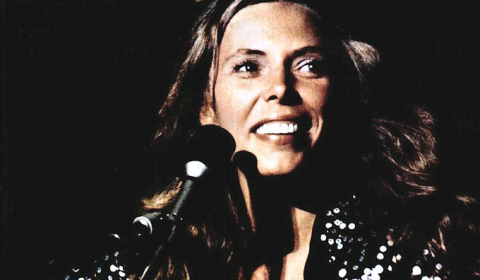
Image by Asylum Records (Billboard page 2) [Public domain], via Wikimedia Commons
Michael Stipe has a teaching gig at NYU. Lynda Barry has one at UW-Madison. Sun Ra gave a classic lecture at UC-Berkeley. So why can’t we imagine Joni Mitchell landing a job at a university too? That’s what Jedidiah Anderson did, when he wrote a satirical piece over at McSweeney’s called “Joni Mitchell Applies for a Tenure Track Philosophy Position.” It begins:
Dear Search Committee:
I am applying for the position of Assistant Professor in Philosophy. I am an advanced doctoral candidate in Philosophy (with minors in Urban Studies and English), and expect to defend my dissertation in May, 2015.
My dissertation, Both Sides Now applies a bilateral, hylomorphic analysis to the phenomenon that is described by the signifier “clouds.” Having been constituted in Western discourse both positively as “rows and flows of angel hair,” “ice cream castles in the air,” “feather canyons everywhere,” and negatively as objects that exist solely to obscure the sun, express rain and snow, and hinder the achievement of various goals, we can conclude that after the application of this bilateral, hylomorphic analysis that due to these contradictory “up” and “down” epistemologies of cloud tropes, the reality of clouds is somehow still understudied, having been ignored in favor of their Platonic form/sign, and that we really don’t “know” clouds at all.
You can read the rest of her “application” here and then spend the evening dreaming about taking Joni’s classes on Plato, Existentialism, and Urban Development. I know I will.
You can find more great Joni Mitchell material below.
Related Content:
Vintage Video of Joni Mitchell Performing in 1965 — Before She Was Even Named Joni Mitchell
James Taylor and Joni Mitchell, Live and Together (1970)
The Music, Art, and Life of Joni Mitchell Presented in a Superb 2003 Documentary
Free Online Philosophy Courses
Read More...What Films Should Get Into The Criterion Collection? Video Series “Three Reasons” Makes the Case
Most film fans I know have played this game: which movie, if you called the shots over there, would you bring into the Criterion Collection? While the fun conversations that result necessarily elide all the difficulties — acquiring the rights, finding restorable materials, design, distribution — of actually getting a film onto Criterion’s roster of high-quality, feature-intensive home video releases, they do illuminate one’s own cinematic values, even if only with idle talk.
Japan-based filmmaker, artist, designer, and gallerist Robert Nishimura plays the game too, but he doesn’t do it idly. On his blog, he features the highly convincing DVD cases he’s designed for such dream Criterion releases as Kim Ki-young’s The Housemaid, Akio Jissoji’s Life of a Court Lady, and Werner Herzog’s Fitzcarraldo. He also has a Vimeo channel called For Criterion Consideration, where he goes so far as to craft new “trailers” of the films he’d like to see in the Collection, each offering three reasons why they qualify. His pitch for Barry Sonnenfeld’s 1997 Men in Black cites its status as a “galactically funny blockbuster,” visuals enhanced by “Rick Baker’s special FX,” and a script even more enhanced with “Ed Solomon’s one-liners.”
Evidently a lover of lesser-seen Japanese pictures and the idiosyncratic quasi-Hollywood releases of the 1970s (but then again, aren’t all cinephiles?), he’s also made videos arguing for films like Hiroshi Teshigahara’s Kobo Abe novel adaptation The Man Without a Map (the logical follow-up to Criterions’s real box set of Teshigahara-Abe collaborations) and Michael Cimino’s faintly homoerotic heist picture Thunderbolt and Lightfoot. And all the way on the other end of the spectrum from Men in Black, he advocates for the likes of Perfumed Nightmare, Kidlat Tahimik’s “playful critique of American cultural dominance,” “exercise in magical realism,” “semi-autobiographical exploration of innocence,” and cornerstone of independent Philippine cinema.
Nishimura’s output of videos and cover designs seems to have slowed in recent years, and I hope for one explanation and one explanation only: that he’s spent the time negotiating a healthy salary from people at Criterion eager to hire him.
Related Content:
Slavoj Žižek Names His Favorite Films from The Criterion Collection
Steve Buscemi’s Top 10 Film Picks (from The Criterion Collection)
120 Artists Pick Their Top 10 Films in the Criterion Collection
The Art of Restoring Classic Films: Criterion Shows You How It Refreshed Two Hitchcock Movies
Colin Marshall hosts and produces Notebook on Cities and Culture as well as the video series The City in Cinema and writes essays on cities, language, Asia, and men’s style. He’s at work on a book about Los Angeles, A Los Angeles Primer. Follow him on Twitter at @colinmarshall or on Facebook.
Read More...All You Need is Love: The Keys to Happiness Revealed by a 75-Year Harvard Study
The latest installment from PBS’ BrainCraft video series introduces us to two scientific studies that teach us a thing or two about what brings us happiness. One set of results comes from Dr. John Gottman’s Family Research Laboratory (a.k.a. the “Love Lab”); the other from the Harvard Grant Study, a 75-year study that has traced the lives and development of 268 Harvard sophomores from the classes of 1939–1944. Although the study focuses on privileged white men (the demographic that attended Harvard College during the 1930s and 40s), the Harvard Grant Study has yielded conclusions that apply to a broader population.
One of the longest-running studies of adult development, the study has found, for example, that alcoholism has some of the most ruinous effects on marriages, family finances and personal health. Likewise, it reveals that liberals have sex much further into old age than their conservative peers.
But those aren’t the big takeaways — the conclusions that talk about happiness. If you watch the interview below with George Vaillant, the longtime director of the study, you will hear him conclude that happiness isn’t about “conforming, keeping up with the Joneses. It is about playing, and working, and loving. And loving is probably the most important. Happiness is love.”
According to Vaillant, “warmth of relationships throughout life have the greatest positive impact on ‘life satisfaction.’ ” When we have warm relationships with our parents, spouses, friends and family, we experience less daily anxiety and a greater sense of overall pleasure; we have better health (including lower levels of dementia later in life); and we’re more effective at work and make more money.
Essentially The Beatles had it right, “All you need is love. Love is all you need.”
You can read more about the Harvard study over at The Atlantic.
Related Content:
A Guide to Happiness: Alain de Botton Shows How Six Great Philosophers Can Change Your Life
Take the ‘Happiness Experiment’
Free Online Psychology Courses
A Crash Course on Psychology: A 30-Part Video Series from Hank Green
Read More...Rare Interview: Tim Curry Discusses The Rocky Horror Picture Show, During the Week of Its Release (1975)
A defining role can be both blessing and curse. In August of 1975, the week the The Rocky Horror Picture Show opened, its 29-year-old star, Tim Curry gave an interview to STOIC, the Student Television Of Imperial College.
In between clips of Curry’s Frank-n-Furter sashaying through such destined-to-become cult favorites as “Sweet Transvestite” and “The Time Warp,” in fishnets, merry widow, and maquillage designed by David Bowie’s personal makeup artist, the actor entertained questions…in luscious black and white!
Kudos to the young interviewer, Mark Caldwell, for never interrupting or trying to elbow his way into the spotlight with jokey asides or double entendres. The reward is a serious consideration of the filmmaking process and the actor’s craft.
(Bear in mind that it would be at least a year until midnight audiences at New York’s Waverly Theater started throwing toast, rice, and toilet paper at the screen, thus initiating an entire script’s worth of audience participation.)
Having originated the role on the London stage (he auditioned with Little Richard’s “Tutti Frutti”) and reprised it in L.A., Curry was clearly ready to put some space between himself and his iconic creation, announcing—correctly, as it turns out—that any sequels would have to proceed without him.
Then he clammed up for three decades, refusing to discuss his most iconic role until 2005, when he broke the silence during an interview on NPR’s Fresh Air .
It’s clear that Curry saw the making of the film as a serious business, but Rocky Horror fans will find plenty of juicy morsels to feed their obsession. Even virgins will enjoy the story of Frank’s evolving accent —from middle European to “Belgravia Hostess with the Mostest.”
Ayun Halliday is an author, illustrator, and Chief Primatologist of the East Village Inky zine. Follow her @AyunHalliday
Read More...Watch 570 Million Years of Evolution on Earth in 60 Seconds
570 millions years of evolution. That’s a lot of ground to cover. And it could be like watching paint dry. But not when it flies by in 60 seconds, with a groovy soundtrack by I‑Konic. First come the arthropods. Next some friendly fish, all followed by land plants, flying insects, amphibians, and reptiles. Way down the line, at the very end, the first humans arrive on the scene. But don’t blink, you might miss it.
To get a little more detail on how this all happened, I’d suggest watching Carl Sagan explain evolution in a classic 8‑minute animation.
Related Content:
New Animated Web Series Makes the Theory of Evolution Easy to Understand
Richard Dawkins Explains Why There Was Never a First Human Being
Free Online Biology Courses
16,000 Pages of Charles Darwin’s Writing on Evolution Now Digitized and Available Online
Read More...B.B. King Explains in an Animated Video Whether You Need to Endure Hardship to Play the Blues
George Harrison had a beloved guitar named Lucy. B.B. King has one named Lucille. Curious, that.
Above, in a new animated video by Blank on Blank, B.B. explains the story behind the naming of his legendary guitar, and then answers the big question: Do you really need to endure hard times to play the blues? No spoilers here.
The audio was recorded in September, 1985 by Warner Bros. A&R manager Joe Smith. While writing a book on the music industry, Smith taped interviews with legendary figures like Dave Brubeck, Lou Reed, Paul McCartney, Joan Baez, Herbie Hancock, David Bowie, George Harrison, Yoko Ono, James Brown, Bo Diddley, Jerry Garcia, Christine McVie, Mick Jagger, Linda Ronstadt and more. Each interview runs 30–60 good minutes. They’re fascinating to listen to, and you can find them on iTunes and the web.
If you would like to support the mission of Open Culture, consider making a donation to our site. It’s hard to rely 100% on ads, and your contributions will help us continue providing the best free cultural and educational materials to learners everywhere. You can contribute through PayPal, Patreon, and Venmo (@openculture). Thanks!
Related Content:
Free Archive of Audio Interviews with Rock, Jazz & Folk Legends Now on iTunes
Maya Angelou Tells Studs Terkel How She Learned to Count Cards & Hustle in a New Animated Video
Read More...Support Us
We're hoping to rely on loyal readers, rather than erratic ads. Please click the Donate button and support Open Culture. You can use Paypal, Venmo, Patreon, even Crypto! We thank you!

About Us

Open Culture scours the web for the best educational media. We find the free courses and audio books you need, the language lessons & educational videos you want, and plenty of enlightenment in between.
Advertise With Us

FREE UPDATES!
GET OUR DAILY EMAIL
Get the best cultural and educational resources on the web curated for you in a daily email. We never spam. Unsubscribe at any time.
FOLLOW ON SOCIAL MEDIA

Open Culture editor Dan Colman scours the web for the best educational media. He finds the free courses and audio books you need, the language lessons & movies you want, and plenty of enlightenment in between.
Advertise With Us

