Albert Camus: The Madness of Sincerity — 1997 Documentary Revisits the Philosopher’s Life & Work
Opening with a childhood story from his life, the documentary above, Albert Camus: The Madness of Sincerity, tells us that the philosopher/journalist/novelist’s first love was “the howling and the tumult of the wind.” It’s a beautiful image for a writer who confronted the pain, joy, and confusion of human existence without the ready-made props of religious belief, nationalist allegiance, or ideological conformity. Camus’ “madness of sincerity” produced enduring work like The Stranger, The Plague, The Rebel, The First Man, and The Fall and won him a Nobel Prize in 1957.
His conviction also cost him friendships as he turned away from mass movements and pursued his own path. It was a cost he was prepared to bear. As he would write in The Fall in 1956, “How could sincerity be a condition of friendship? A liking for the truth at all costs is a passion that spares nothing and that nothing can withstand.”
After the wind, of course, Camus had many more loves, and many lovers. A few of them appear above, along with Camus’ daughter Catherine and son Jean to discuss the great themes of his work in three chapters: the Absurd, Revolt, and Happiness. With discussion and excerpts—read by narrator Brian Cox—from Camus’ work, the documentary traces his life from birth and a difficult childhood in French Algeria, to his daily editorials for Combat during the French Resistance, his turn against Communism and decision to live in near-exile in the ‘50s, and his premature death in a car accident in 1960 at the age of 47. All in all, the documentary leaves us with the impression of Camus as a magnetic individual, and a deeply principled one, who held true to the words quoted from his Nobel acceptance speech early in the film about the writer’s task, which is always, he said, “rooted in two commitments… the refusal to lie about what one knows, and resistance to oppression.”
Find more thought-provoking films in our collection, 285 Free Documentaries Online.
Related Content:
Hear Albert Camus Deliver His Nobel Prize Acceptance Speech (1957)
Josh Jones is a writer and musician based in Durham, NC. Follow him at @jdmagness
Read More...16,000 Pages of Charles Darwin’s Writing on Evolution Now Digitized and Available Online
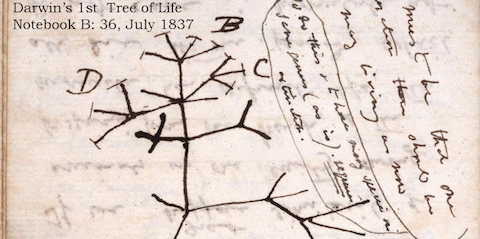
The Darwinian theory of evolution is an amazing scientific idea that seems, at least to a layperson like me, to meet all the criteria for what scientists like Ian Glynn praise highly as “elegance”—all of them perhaps except one: Simplicity. Evolutionary theory may seem on its face to be a fairly simple explanation of the facts—all life begins as single-celled organisms, then changes and adapts in response to its environment, branching and developing into millions of species over billions of years. But the journey Darwin took to arrive at this idea was hardly straightforward and it certainly didn’t arrive in one eureka moment of enlightenment.
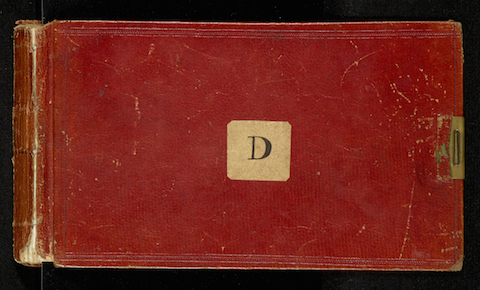
The process for him took over two decades, represented by the hundreds of pages of notes he left behind, all of which will be freely available online at the Darwin Manuscripts Project at the American Museum of Natural History in 2015. This means 30,000 digitized documents, like the naturalist’s first “Tree of Life” at the top of the page, from a July 1837 notebook entry, and Transmutation Notebook D above, the first notebook in which Darwin began working on the theory of natural selection.
The Museum has currently announced that it is a little over the halfway point, with just over 16,000 digitized documents that cover, they write, “the 25-year period in which Darwin became convinced of evolution; discovered natural selection; developed explanations of adaptation, speciation, and a branching tree of life and wrote the Origin [of Species].” Director of the project David Kohn describes that latter famous work as “the mature fruit of a prolonged process of scientific exploration and creativity that began toward the end of his Beagle voyage… and that continued to expand in range and deepen in conceptual rigor through numerous well-marked stages.”
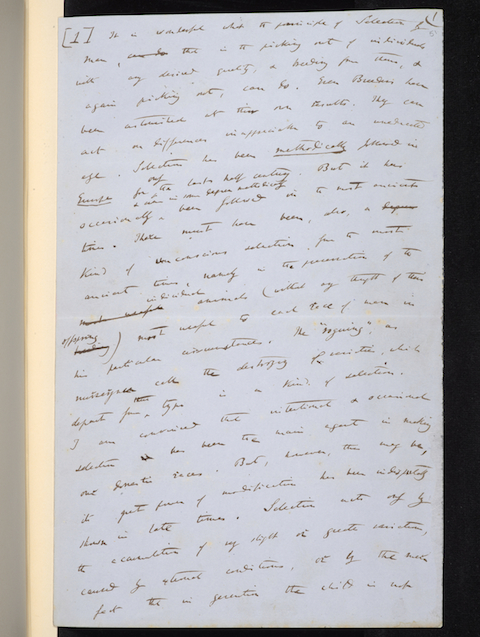
Now historians of science can trace those stages as though they were a fossil record, starting with that famous H.M.S. Beagle voyage, in which the young Darwin sailed from South America to the Pacific Islands—stopping at numerous sites, including the Galapagos Islands of course, and collecting samples and making observations. The journey produced a lively account, 1839’s Voyage of the Beagle, prelude to the fully developed theory presented 20 years later in On the Origin of Species. Looking into the Beagle voyage section, you’ll find hundreds of pages of notes, like that above on Galapagos mockingbirds. Darwin’s handwriting will present a challenge, which is why, Hyperallergic tells us, the project is “adding transcriptions and a scholarly structure to its high-resolution images.”
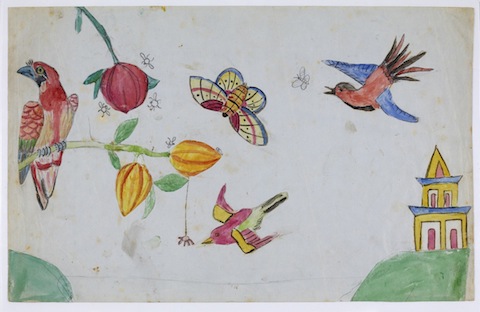
Hyperallergic also sums up the remaining contents of the huge archive, which in addition to the Beagle material will feature everything “from the rest of his life, which he spent defending his work.” This means “scribblings in books he studied, abstracts, his own book drafts, articles and their revisions, journals he read, and his notebooks on transmutation.” You’ll also find “some charming oddities” like drawings by the scientist’s children (above) on the back of original Origin manuscript pages. Learn much more about the archive, and Darwin’s lifelong work, at the American Museum of Natural History’s Darwin Manuscript Project site.
Related Content:
Read the Original Letters Where Charles Darwin Worked Out His Theory of Evolution
Trace Darwin’s Footsteps with Google’s New Virtual Tour of the Galapagos Islands
New Animated Web Series Makes the Theory of Evolution Easy to Understand
Josh Jones is a writer and musician based in Durham, NC. Follow him at @jdmagness
Read More...A Haunting Drone’s-Eye View of Chernobyl
Back in August, Colin Marshall remarked that drones “have drawn bad press in recent years: as the intrusive tools of the coming surveillance state, as deliverers of death from above in a host of war zones, as the purchase-delivering harbingers of world domination by Amazon.com.” “But as with any technology,” Colin went on to note, “you can also use drones for the good, or at least for the interesting.” Like capturing mesmerizing aerial footage of major cities around the world, cities such as Los Angeles, New York, London, Bangkok & Mexico City. Now let’s add Chernobyl to the list.
While working on a recent 60 Minutes episode, filmmaker Danny Cooke visited Chernobyl, and, using a drone (a DJI Phantom 2 and GoPro 3+, to be precise), he captured haunting footage of the city devastated by the nuclear meltdown of April 26, 1986. Chernobyl has cooled off enough that journalists and scientists can now visit the area for short periods of time. (Biologists, for example, are actively studying the crippling effects radiation has had on Chernobyl’s animal life, and producing disturbing videos showing how birds are developing tumors, and spiders are spinning asymmetrical webs.) As for when Chernobyl will be truly habitable again, the best guess is another 20,000 years. By that time, the detritus will have fully given way to nature, and, if people still roam the earth, they’ll get something close to a fresh start.
If you would like to support the mission of Open Culture, consider making a donation to our site. It’s hard to rely 100% on ads, and your contributions will help us continue providing the best free cultural and educational materials to learners everywhere. You can contribute through PayPal, Patreon, and Venmo (@openculture). Thanks!
Read More...
Lynda Barry’s Wonderfully Illustrated Syllabus & Homework Assignments from Her UW-Madison Class, “The Unthinkable Mind”
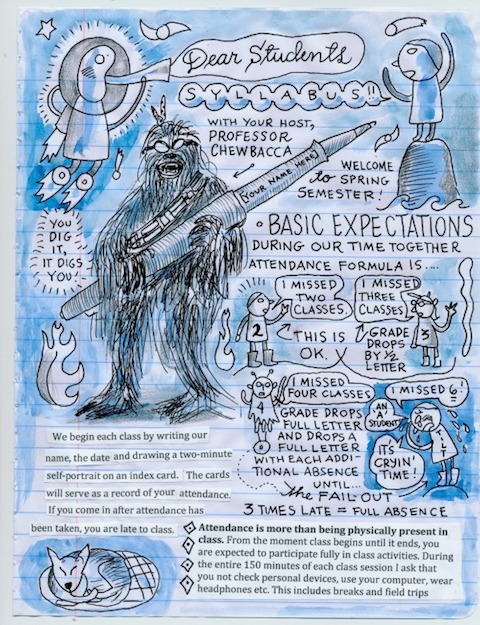
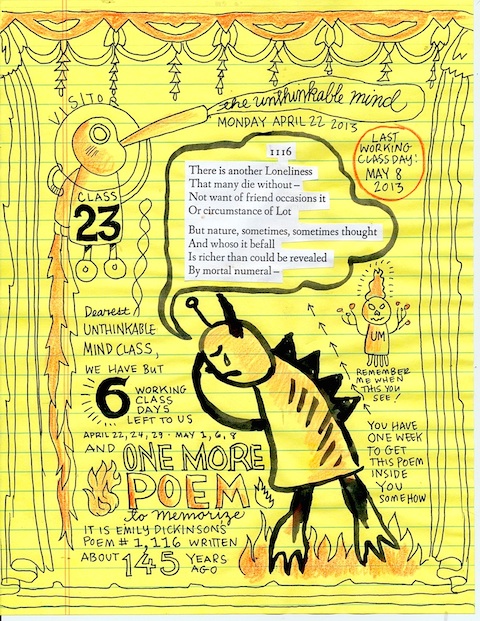
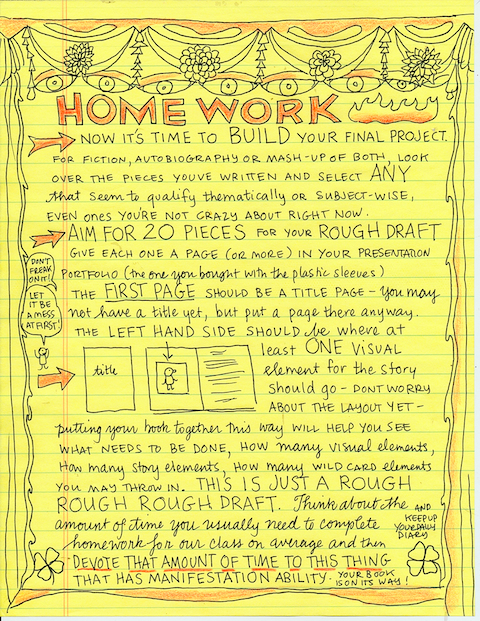
Our reverence for cartoonist Lynda Barry, aka Professor Chewbacca, aka The Near Sighted Monkey is no secret. We hope someday to experience the pleasure of her live teachings. ’Til then, we creep on her Tumblr page, following with homework assignments, writing exercises and lesson plans intended for students who take her class, “The Unthinkable Mind,” at the University of Wisconsin.
And now, those course materials have been collected as Syllabus: Notes from an Accidental Professor, an old fashioned, tangible book. It’s like a paper MOOC!
(Yes, we know, MOOCs are free. This will be too, if you add it to your holiday wish list, or insist that your local library orders a copy.)
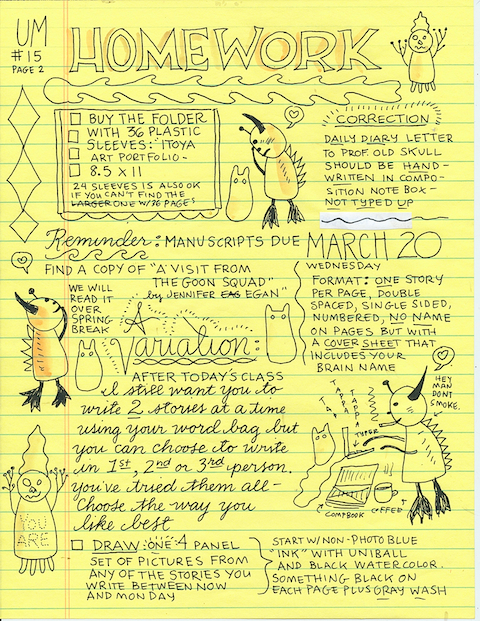
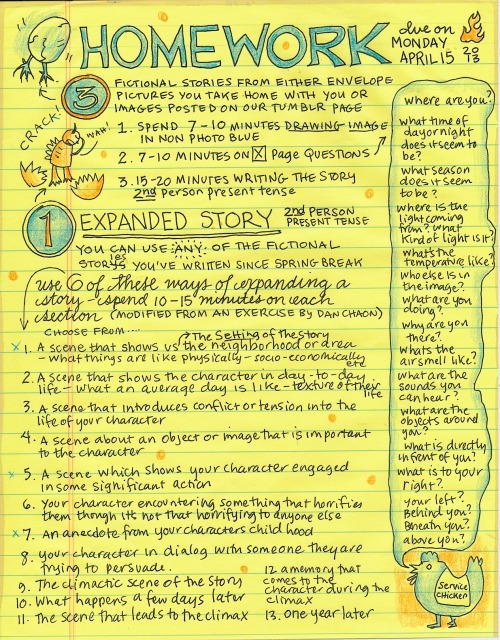
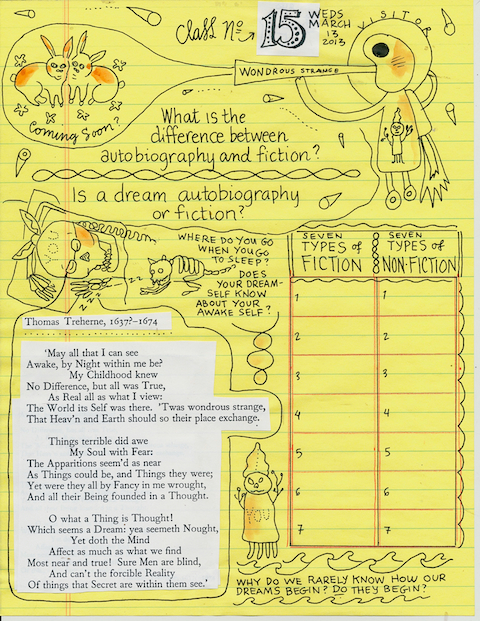
Barry’s marching orders are always to be executed on paper, even when they have been retrieved on smartphones, tablets, and a variety of other screens. They are the antithesis of dry. A less accidental professor might have dispensed with the doodle encrusted, lined yellow legal paper, after privately outlining her game plan. Barry’s choice to preserve and share the method behind her madness is a gift to students, and to herself.
As Hillary L. Chute notes in Graphic Women: Life Narrative and Contemporary Comics:
The decontextualization of cheap, common, or utilitarian paper (which also harkens back to the historical avant-garde) may be understood as a transvaluation of the idea of working on “waste” –a knowing, ironic acknowledgment on Barry’s part that her life narrative, itself perhaps considered insignificant, is visualized in an accessible popular medium, comics, that is still largely viewed as “garbage.”
Working on “garbage” must come as a relief for someone like Barry, who has talked about growing up under a hostile mother who saw her daughter’s creative impulses as a “waste” of paper:
I got screamed at a lot for using up paper. The only blank paper in the house was hers, and if she found out I touched it she’d go crazy. I sometimes stole paper from school and even that made her mad. I think it’s why I hoard paper to this day. I have so much blank paper everywhere, in every drawer, on every shelf, and still when I need a sheet I look in the garbage first. I agonize over using a “good” sheet of paper for anything. I have good drawing paper I’ve been dragging around for twenty years because I’m not good enough to use it yet. Yes, I know this is insane.
Sample assignments from “The Unthinkable Mind” are above and below, and you will find many more in Syllabus: Notes from an Accidental Professor. Let us know if Professor Chewbacca’s neurological assumptions are correct. Does drawing and writing by hand release the monsters from the id and squelch the internal editor who is the enemy of art?
Related Content:
Join Cartoonist Lynda Barry for a University-Level Course on Doodling and Neuroscience
Cartoonist Lynda Barry Reveals the Best Way to Memorize Poetry
1,700 Free Online Courses from Top UniversitiesAyun Halliday is an author, homeschooler, and Chief Primatologist of the East Village Inky zine. Follow her @AyunHalliday
Read More...Crash Course Big History: John Green Teaches Life, the Universe & Everything
If you don’t understand big history, you’ll never understand small history. That idea hasn’t yet attained aphorism status, but maybe we can get it there. Last month, we featured a free, Bill Gates-funded short course on 13.8 billion years of “Big History”. Back in 2012, we featured well-known online educator (and now even better-known young adult novelist) John Green’s Crash Course on World History. Now these worlds, or rather these histories of the world, have collided in the form of Crash Course Big History, a web series “in which John Green, Hank Green, and Emily Graslie teach you about, well, everything.” In true fashion of the biggest possible history, the Crash Course crew begins at the beginning — the real beginning, the Big Bang, which the first fifteen-minute episode gets into above.
“Mr. Green! Mr. Green!” exclaims Green at himself, momentarily taking on his signature secondary pushy-student persona. “That’s not history, that’s science.” Returning to his cool-professor persona, Green lays it out for himself: “Academics often describe history as, like, all stuff that’s happened since we started writing things down, but they only start there because that’s where we have the best information. The advent of writing was a huge deal, obviously, but as a start date for history, it’s totally arbitrary. It’s just a line we drew in the sand and said, ‘Okay, history begins now!’ ” In order to push that line as far back as possible, history must fuse with science, allowing the study of the past to best incorporate and contextualize all it can about (and students of Green had to know he would quote Douglas Adams on this) “Life, the Universe, and Everything.”
Seven episodes in and underway right now, Crash Course Big History has gone on to cover not just the universe, but the sun and the Earth, the emergence of life, the epic of evolution, and how that process produced humans. Having arrived at the appearance of Homo sapiens, Green and company cover, in the freshly released seventh episode, the process of “humanity conquering the Earth. Or at least moving from Africa into the rest of the Earth,” going on to reach “a critical mass of innovators” and develop “collective learning.” And amid the grand sweep of planetary movement, evolution, and mass migration, we continue to find new ways to collectively learn all the time — of which the Crash Courses represent only one particularly entertaining variety.
You can watch future Crash Course Big History videos by following this playlist on Youtube. It’s also worth mentioning that Bill Gates has helped fund these Crash Course videos, just as he has helped fund the larger Big History Project mentioned in our previous post.
Related Content:
Take Big History: A Free Short Course on 13.8 Billion Years of History, Funded by Bill Gates
A Crash Course in World History
The History of the World in 46 Lectures From Columbia University
Free Download of The History Manifesto: Historians New Call for Big-Picture Thinking
Download 78 Free Online History Courses: From Ancient Greece to The Modern World
Colin Marshall hosts and produces Notebook on Cities and Culture and writes essays on cities, language, Asia, and men’s style. He’s at work on a book about Los Angeles, A Los Angeles Primer. Follow him on Twitter at @colinmarshall or on Facebook.
Read More...Thomas Pynchon’s Gravity’s Rainbow Finally Gets Released as an Audio Book

A quick heads up for Thomas Pynchon fans. Four decades after its publication, you can finally get Gravity’s Rainbow as an audio book — possibly even as a free audio book.
According to The New York Times, “Since the mid-1980s, a George Guidall recording [of the 1973 novel] has been floating around, like some mythical lost rocket part — no one had heard it, but all Pynchon fans knew someone who knew someone who had — but in October a new version, authorized and rerecorded… — hit the stands.”
The new release, which runs 40 hours and 1 minute, is also narrated by Guidall. It’s available on Audible.com. (Hear an audio sample below.) And there’s a way to get it for free. As we’ve mentioned before, Audible lets you download an audio book for free if you sign up for their 30-Day Free Trial. And even if you decide to cancel the trial, you can still keep the audio book and pay no money. That said, I dig Audible’s subscription service, as I’ve spelled out before, precisely because you can get big long audio books for a really reasonable price.
Learn more about the Free Trial program here, and to get Gravity’s Rainbow, simply click here and then click the “Try Audible Free” link on the right side of the page. NB: Audible is an Amazon.com subsidiary, and we’re a member of their affiliate program.
Related Content:
Take a Cinematic Journey into the Mind of Thomas Pynchon and His New Book, Bleeding Edge
1,000 Free Audio Books: Download Great Books for Free Read More...Behold a Beautiful Archive of 10,000 Vintage Cameras at Collection Appareils
Digital photography has bestowed many gifts, and some few horrors: selfies, naturally, as well as even less dignified self-portraits, of the sort certain politicians send out; mass surveillance, as well as the ability of average citizens to produce important pieces of evidence and to document history; hard times for professional photographers, as well as the full democratization of the medium. What it has almost rendered obsolete is the mechanism that enabled photographic images in the first place. In place of cameras, we have smartphones, the hated Glass… maybe sometime in the future no external device at all. Given this trajectory, it’s entirely understandable that all sorts of people—steampunks, antiquarians, Luddites, analog fetishists, middle-age hipsters, etc.—would grow nostalgic not only for the cracked, striated monochrome patina of vintage photographs, but also for the boxes—large and small, simple and highly complicated—that produced them.

And what wonderful boxes they were! Before the onslaught of identical, cheap consumer point-and-shoots and (gasp!) disposables, or the utilitarian bricks of professional gear, the camera was very often a work of art in its own right. Today, we bring you a sampling of these objets—elegant, intricate, streamlined, and downright adorable. These are but a tiny fraction of the vintage camera treasures you’ll find represented at Collection Appareils, an online reference of 10,000 analog cameras run by Sylvain Halgand, a Frenchman sorely afflicted with the “insidious disease” of collecting.
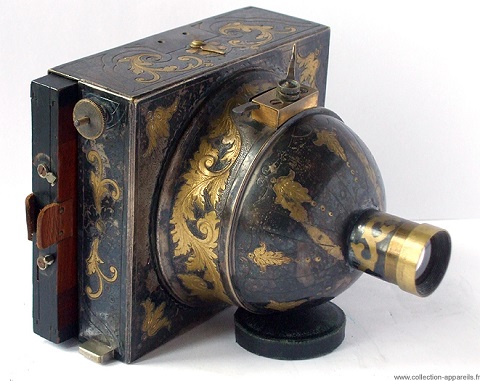
Witness at the top the Photosphere No. 1, manufactured by the Compagnie Francaise de Photographie in 1899—a truly beautiful artifact. No less stylish, but far more camera-like to our eyes, see the Argus A above. Made in the U.S. between 1936 and 1941, this may have been the most popular 35mm of all time. Though not as well known as the Leica A, “it’s a safe bet that Argus sold more cameras in their first twenty years than Leica has sold in their first 70 years.”

Above, we have the first “point and shoot,” the Gap Box 6x9, a curiously attractive device made in France in 1950. This camera “played a very important role by making photography accessible to the general public,” allowing “anyone to take pictures at the lowest price and in the most simple way.”
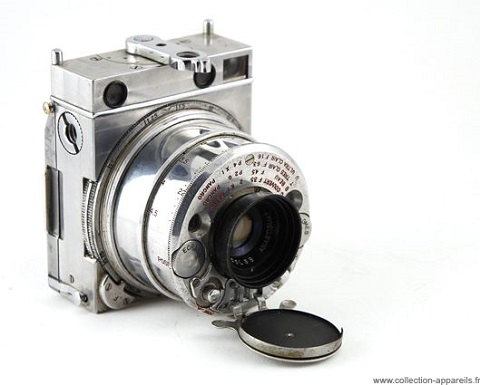
Then there are the stylized and the streamlined. Just above, see a very fine machine called The Compass, manufactured by Swiss watchmaker Le Coultre between 1937 and 1940. And below, gaze upon the graceful Haneel Tri-Vision, made in Los Angeles in 1946.

Almost equally appealing in their design simplicity are the irresistibly cute miniature cameras, such as the “Mickey Mouse” below. Manufactured in Germany in 1958, these tiny things—despite the “copyright” notice on the lens—may have disappeared quickly “due to them not actually being sanctioned by the Disney Corporation.” They were, however, sold with a “large cardboard Mickey Mouse that ‘held’ the camera.”

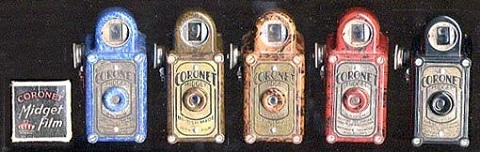
See also the Coronet Midget. Made in England in 1934, this 5‑shilling camera “must be one of the most popular of all small cameras to collect.” The company marketed its own 6‑exposure film for the Midget, which came in a choice of five colors.

From the couture to the high-tech to the quirky and inventive (like the Lark “Sardine Can” below), the French vintage camera archive makes available a visual history of the camera that may exist nowhere else. It is the history of an object that defined the 20th century, and that may fully disappear sometime soon in the 21st. And while we can spend several hours a day marveling over the products of these fine devices, it’s a rare treat to see the things themselves in such an astonishing variety of shapes, sizes, colors, and degrees of design ingenuity. Take some time to get acquainted with the evolution of the handheld camera before digital technology finally renders it extinct.

Via Laughing Squid/ Messy Nessy Chic/PetaPixel
Images courtesy of Collection Appareils.
Related Content:
Yale Launches an Archive of 170,000 Photographs Documenting the Great Depression
Alfred Stieglitz: The Eloquent Eye, a Revealing Look at “The Father of Modern Photography”
Josh Jones is a writer and musician based in Durham, NC. Follow him at @jdmagness
Read More...Watch Dragnet’s 1967 LSD Episode: #85 on TV Guide’s List of the Greatest Episodes of All Time
Jack Webb’s seminal cop show Dragnet, which first ran on television through most of the ’50s, was known for its gritty realism. In every episode, the show’s robotic, laconic lead, Detective Joe Friday, would navigate the seedy underworld and eventually get his man.
Though Dragnet rivaled only I Love Lucy in popularity, Webb pulled the plug on the series in 1959. But he couldn’t stay away. In January 1967, Webb launched a reboot of Dragnet. This time, Friday, quite possibly the squarest person on the planet, takes on youth culture. Case in point, the series’ inaugural show, which you can watch above, where Friday and his new partner Bill Gannon stumble upon that strange new societal scourge LSD. Incidentally, this is also the first episode of Dragnet to be shot in color. Make of that what you will.
When Friday and Gannon investigate a complaint about someone eating bark, they discover a teenager who painted his face Braveheart-style and is babbling about the pilot light at the center of the Earth. This is Blueboy AKA Benjamin Carver and clearly, he is tripping. He’s also selling lousy acid to Marcia Brady look-alikes.
The show is a fascinating time capsule on a number of levels. First, this episode was made while LSD was still legal. (Acid was banned California in October 1966. Not long, one imagines, after the episode was shot.) Friday and Gannon shake their heads in frustration over their legal impotence, especially later when they discover Blueboy dead from an overdose. Just in case you didn’t get the show’s moral (drugs = bad) Webb lards the episode with terrifying facts about the drug. “LSD is so potent that a single pound of the preparation can turn every person in Los Angeles county into a total psychotic. The population of the county – seven million people.”
Media critic Michele Hilmes argues, however, that the show might just be speaking out of both sides of its mouth. To an older generation, Dragnet is a cop show preaching law and order. To the younger generation, Webb’s heavy-handedness crosses the line into parodic camp.
Jack Webb so embodied the role of Joe Friday that he all but became the LAPD in the popular imagination. When Webb died in 1982, he was buried with full police honors and his badge number, 714, was officially retired from the force. It’s curious that a cop so unrelentingly smug would become the paragon of LA’s finest.
Thom Andersen memorably summed up the series in his seminal essay film Los Angeles Plays Itself. “Dragnet admirably expressed the contempt the LAPD had for the law-abiding civilians it was pledged ‘to protect and to serve.’ It protected us from ourselves, and it served us despite our best efforts to make the job more difficult. … Friday’s heavy-handed irony never lets up. None of the witnesses or suspects he questions penetrates his wall of condescension. Of course, Dragnet isn’t a documentary portrait of the LAPD, and its detectives weren’t really like Joe Friday. What’s scary is that he represented the department’s ideal.”
According to Andrew Graham’s Dragnet blog, TV Guide voted this episode #85 on its list of the greatest TV episodes of all time.
Related Content:
Artist Draws Nine Portraits on LSD During 1950s Research Experiment
Watch The Bicycle Trip: An Animation of The World’s First LSD Trip in 1943
Ken Kesey’s First LSD Trip Animated
Jonathan Crow is a Los Angeles-based writer and filmmaker whose work has appeared in Yahoo!, The Hollywood Reporter, and other publications. You can follow him at @jonccrow. And check out his blog Veeptopus, featuring lots of pictures of badgers and even more pictures of vice presidents with octopuses on their heads. The Veeptopus store is here.
Read More...George Orwell’s Final Warning: Don’t Let This Nightmare Situation Happen. It Depends on You!
More than 60 years after his death and the closely preceding publication of his best-known novel 1984, we look to George Orwell as a kind of prophet of the ills of corporatism, socialism, authoritarianism, totalitarianism — any powerful ‑ism, essentially, in which we can find nasty, freedom-destroying implications. The BBC documentary Orwell: A Life in Pictures, which we featured a few years back, makes a point of highlighting Orwell’s “warning” to what he saw as a fast corporatizing/socializing/authoriatarianizing/totalitarianizing world. In the film’s final dramatized scene above (watch the complete film here), the re-created Orwell himself makes the following ominous prediction:
Allowing for the book, after all, being a parody, something like 1984 could actually happen. This is the direction the world is going in at the present time. In our world, there will be no emotions except fear, rage, triumph, and self-abasement. The sex instinct will be eradicated. We shall abolish the orgasm. There will be no loyalty except loyalty to the Party. But always there will be the intoxication of power. Always, at every moment, there will be the thrill of victory, the sensation of trampling on an enemy who’s helpless. If you want a picture of the future, imagine a boot stamping on a human face, forever. The moral to be drawn from this dangerous nightmare situation is a simple one: don’t let it happen. It depends on you.
This fictionalized Orwell — much like the real Orwell — doesn’t mince words. But as with most unminced words, these mask a more complicated reality. Though Orwell fans may find each individual piece of this speech recognizable, especially the bit about the boot and the face, the man himself never spoke it — not in this form, anyway.
It mixes documented statements of Orwell’s with words from the text of 1984, and its dramatic closer [“Don’t let it happen. It depends on you!”] comes, as writes Barnes and Noble’s Steve King, from a post-publication press release directed by publisher Fredric Warburg toward readers who “had misinterpreted [Orwell’s] aim, taking the novel as a criticism of the current British Labour Party, or of contemporary socialism in general.” The quotation from the press release was “soon given the status of a last statement or deathbed appeal, given that Orwell was hospitalized at the time and dead six months later.”
You can read more at georgeorwellnovels.com, which provides a great deal of context on this press release, which runs, in full, as follows:
It has been suggested by some of the reviewers of Nineteen Eighty-Four that it is the author’s view that this, or something like this, is what will happen inside the next forty years in the Western world. This is not correct. I think that, allowing for the book being after all a parody, something like Nineteen Eighty-Four could happen. This is the direction in which the world is going at the present time, and the trend lies deep in the political, social and economic foundations of the contemporary world situation.
Specifically the danger lies in the structure imposed on Socialist and on Liberal capitalist communities by the necessity to prepare for total war with the U.S.S.R. and the new weapons, of which of course the atomic bomb is the most powerful and the most publicized. But danger lies also in the acceptance of a totalitarian outlook by intellectuals of all colours.
The moral to be drawn from this dangerous nightmare situation is a simple one: Don’t let it happen. It depends on you.
George Orwell assumes that if such societies as he describes in Nineteen Eighty-Four come into being there will be several super states. This is fully dealt with in the relevant chapters of Nineteen Eighty-Four. It is also discussed from a different angle by James Burnham in The Managerial Revolution. These super states will naturally be in opposition to each other or (a novel point) will pretend to be much more in opposition than in fact they are. Two of the principal super states will obviously be the Anglo-American world and Eurasia. If these two great blocks line up as mortal enemies it is obvious that the Anglo-Americans will not take the name of their opponents and will not dramatize themselves on the scene of history as Communists. Thus they will have to find a new name for themselves. The name suggested in Nineteen Eighty-Four is of course Ingsoc, but in practice a wide range of choices is open. In the U.S.A. the phrase “Americanism” or “hundred per cent Americanism” is suitable and the qualifying adjective is as totalitarian as anyone could wish.
If there is a failure of nerve and the Labour party breaks down in its attempt to deal with the hard problems with which it will be faced, tougher types than the present Labour leaders will inevitably take over, drawn probably from the ranks of the Left, but not sharing the Liberal aspirations of those now in power. Members of the present British government, from Mr. Attlee and Sir Stafford Cripps down to Aneurin Bevan will never willingly sell the pass to the enemy, and in general the older men, nurtured in a Liberal tradition, are safe, but the younger generation is suspect and the seeds of totalitarian thought are probably widespread among them. It is invidious to mention names, but everyone could without difficulty think for himself of prominent English and American personalities whom the cap would fit.
Readers can still find plenty to quibble with in Orwell, but surely that counts as a point toward his status as an enduringly fascinating writer. The lesson, however much we may misinterpret its delivery — and indeed, how much Orwell himself may sometimes seem to misdeliver it — holds steady: don’t let it happen. How not to let it happen, of course, remains a matter of active inquiry.
Related Content:
George Orwell Explains in a Revealing 1944 Letter Why He’d Write 1984
For 95 Minutes, the BBC Brings George Orwell to Life
The Only Known Footage of George Orwell (Circa 1921)
George Orwell and Douglas Adams Explain How to Make a Proper Cup of Tea
Colin Marshall hosts and produces Notebook on Cities and Culture and writes essays on cities, language, Asia, and men’s style. He’s at work on a book about Los Angeles, A Los Angeles Primer. Follow him on Twitter at @colinmarshall or on Facebook.
Read More...A Year in the Life of Earth’s CO2: A Striking Visualization
During the same week when House Republicans passed a bill forbidding scientists from advising the EPA on its own research, NASA climate scientists (coincidentally but maybe inconveniently) released a video documenting A Year in the Life of Earth’s CO2. According to NASA, “The visualization is a product of a simulation called ‘Nature Run,’ ” which “ingests real data on atmospheric conditions and the emission of greenhouse gases and both natural and man-made particulates. The model is then left to run on its own and simulate the natural behavior of the Earth’s atmosphere.” The video above visualizes how carbon dioxide in the atmosphere traveled around the globe from January 2006 through December 2006. Hopefully the take-away isn’t look at all the pretty colors. The video is in the public domain and can be downloaded here.
To learn more about climate change, see the University of Chicago’s course, Global Warming. It’s a free 23-lecture course presented by David Archer, a professor in the Department of The Geophysical Sciences.
Read More...Support Us
We're hoping to rely on loyal readers, rather than erratic ads. Please click the Donate button and support Open Culture. You can use Paypal, Venmo, Patreon, even Crypto! We thank you!

About Us

Open Culture scours the web for the best educational media. We find the free courses and audio books you need, the language lessons & educational videos you want, and plenty of enlightenment in between.
Advertise With Us

FREE UPDATES!
GET OUR DAILY EMAIL
Get the best cultural and educational resources on the web curated for you in a daily email. We never spam. Unsubscribe at any time.
FOLLOW ON SOCIAL MEDIA

Open Culture editor Dan Colman scours the web for the best educational media. He finds the free courses and audio books you need, the language lessons & movies you want, and plenty of enlightenment in between.
Advertise With Us