Electric Guitars Made from the Detritus of Detroit
When Frank Norris plays a guitar made by Wallace Detroit Guitars, he says it “feels like home.” And maybe that’s because Wallace Detroit Guitars are made with reclaimed wood from abandoned Detroit homes.
Following the financial crisis of 2008, perhaps no American city fared worse than Detroit. The city found itself with 10,000 vacant homes. And eventually the city purchased entire blocks and razed the houses to the ground. According to the Detroit web site Model D, a lot of the wood [from these structures] hasn’t gone to waste. The wood can be found, they write, in “trendy coffee houses, in table tops, even in the frames of sunglasses.” And now high-end electric guitars.
Wallace Detroit Guitars just launched its new web site two days ago, and its first guitars, made of century-old wood, can now be yours.
If you like playing guitars made of found objects, you might also want to check out another new company — Bohemian Guitars. They’ve started building electric guitars made of vintage oil cans, taking inspiration from South African musicians who turn used materials into playable instruments.
Related Content:
Brian May’s Homemade Guitar, Made From Old Tables, Bike and Motorcycle Parts & More
Artist Ken Butler Turns One Man’s Trash Into Another Man’s Quirky Stringed Instrument
Read More...Alain de Botton’s School of Life Presents Animated Introductions to Heidegger, The Stoics & Epicurus
Why is Western philosophy so difficult, so abstruse, and so damned wordy? Perhaps it’s simply a matter of job security. It’s generally well-known, after all, that some of the most taciturn philosophers were also some of the poorest—Ludwig Wittgenstein, who was independently wealthy, notwithstanding. But if you follow the format Alain de Botton lays out in the philosophy department of his video series, “The Big Ideas,” you can pick up some Heidegger, a little Stoic thought, and the ideas of Epicurus each in under ten minutes of lighthearted commentary, accompanied by quirky animation from a studio called Mad Adam (who favor a very Terry Gilliam-like approach to their art). There are those critics who think de Botton glib and shallow, a “self-help guru to the British middle-class—a life coach.” In a certain sense, I suppose he’d have to agree with that assessment, given that his “cultural enterprise,” The School of Life, has as its tagline “good ideas for everyday life.” Do the dead European philosophers of ages past have helpful tips for our mundane 21st century existence, and do de Botton’s videos do any justice to the quality of their thought?
As to the first question, I suppose we’d have to answer, yes. As for the second—I leave it to the philosophers to weigh in. At the top of the post, we have Martin Heidegger—“the most incomprehensible German philosopher that ever lived”—in just over five minutes. It turns out that “beneath the jargon, Heidegger tells us simple, even at times homespun truths” about things like meaning and freedom. Once a ranking member of the Nazi party, Heidegger, de Botton says, “saw the error of his ways,” a claim people often repeat without a great deal of evidence. But Heidegger’s Nazi past aside, his thought, de Botton says, helps us get back in touch with the mystery of existence, what the philosopher called das sein, or “Being.” This term more or less sums up the core of Heidegger’s entire project, and I confess I never really grasped what he means by it. Maybe you will after taking de Botton’s very short course.
Next up, we have the Stoics, not a specific movement or group as such, but an entire school of thought that “flourished for 480 years in ancient Greece and Rome.” Stoicism offered a narrow range of responses to the ancient problem de Botton defines as “Life is very difficult,” and it appealed to commoners and aristocrats alike because of its universal concern with suffering. De Botton gives us the gist by referring to the way we typically use the word “stoic” these days, as a synonym for “brave.” He says a bit more, of course, about Stoicism’s answers to life’s challenges, listen above.
Finally, we have Greek philosopher Epicurus, who “helps us think about money, capitalism, and our runaway consumer society.” This despite the fact that Epicurus predates capitalism and consumer society by well over two-thousand years. Nonetheless, his thought is eternally relevant, given that its primary concern, “What makes people happy?” is a problem unlikely to be solved in anyone’s lifetime. But Epicurus had some answers, and he purveyed them—like de Botton—by founding his own school. He and his disciples, Epicureans, were rumored to be debauched and wicked libertines steeped in excessive food, drink, and sex. In fact, the opposite was true: Epicurus was an austere and sober man, who urged restraint in matters sexual and fiscal, making him, in a way, a genuine conservative.
De Botton’s “Big Ideas” curriculum currently includes two other videos that function as general defenses of the humanities: “What is Art for?” and “What is Literature for?” Both questions might sound meaningless to some refined aesthetes, but for a great many people getting on with the painful, sometimes dreary, and often harried business of daily life, questions about utility are sensible enough. New big ideas videos are on the way—in the meanwhile, visit de Botton’s School of Life Youtube channel for video shorts on “Mood,” “Relationships,” and more.
Related Content:
Free Online Philosophy Courses
Alain de Botton Shows How Art Can Answer Life’s Big Questions in Art as Therapy
A Guide to Happiness: Alain de Botton Shows How Six Great Philosophers Can Change Your Life
Alain de Botton Proposes a Kinder, Gentler Philosophy of Success
Martin Heidegger Talks Philosophy with a Buddhist Monk on German Television (1963)
Josh Jones is a writer and musician based in Durham, NC. Follow him at @jdmagness.
Read More...Oxford Scientist Explains the Physics of Playing Electric Guitar Solos
You’ve heard it before. A power ballad from the 1970s or 1980s is playing and there, smack in the middle, is a face-melting guitar solo that seems to go all over the place before blowing your mind with sheer awesomeness. Think Jimi Hendrix. Think Eric Clapton. And especially think Eddie Van Halen. Unlike the piano, which can only play discrete notes, the guitar can, in the hands of someone like Sir Eddie, bend notes. It’s a quality that recalls the human voice, and it’s most likely what has made the electric guitar the go-to instrument for popular music over the past 50 years.
Enter Dr. David Grimes of Oxford University. While by day he might be working out mathematical models of oxygen distribution to help improve cancer treatment, by night he, too, likes to shred on his electric guitar. So, at some point along the line, he decided to apply a little scientific rigor to the instrument he loves. “I wanted to understand what it was about these guitar techniques that allows you to manipulate pitch,” he said in an interview.
In the name of science, Grimes was forced to make some pretty brutal sacrifices. “I took one of my oldest guitars down to the engineering lab at Dublin City University to one of the people I knew there and explained that I wanted to strip it down to do this experiment. We had to accurately bend the strings to different extents and measure the frequency produced. He was a musician too and looked at me with abject horror. But we both knew it needed to be done – We put some nails into my guitar for science.’
Grimes ended up writing an academic paper on the topic called “String Theory — The Physics of String-Bending and Other Electric Guitar Techniques.” “It turns out it’s actually reasonably straightforward,’ said Grimes. “It’s an experiment a decent physics undergraduate could do, and a cool way of studying some basic physics principles. It’s also potentially useful to string manufacturers and digital instrument modellers.”
You can read Grime’s paper here or, if your idea of fun does not include wading through a lot of complex equations, you can watch the brief video presentation above on his research. And below is a ridiculously sweet guitar solo from Van Halen. While you watch ponder the totally awesome physics involved.
Jonathan Crow is a Los Angeles-based writer and filmmaker whose work has appeared in Yahoo!, The Hollywood Reporter, and other publications. You can follow him at @jonccrow. And check out his blog Veeptopus, featuring one new drawing of a vice president with an octopus on his head daily. The Veeptopus store is here.
Related Content:
Take First-Class Philosophy Courses Anywhere with Free Oxford Podcasts
The Physics of Guinness Beer Demystified
The (Beautiful) Physics of Adding Cream to Your Coffee
The Physics of Coffee Rings Finally Explained
Read More...How to Sing Julia Child’s Mastering the Art of French Cooking
Though she had no tender feelings for Julie Powell’s Julia/Julie blog, I like to think Julia Child wouldn’t have been entirely displeased by the Bushwick Book Club’s efforts to musicalize Mastering the Art of French Cooking, Child’s two volume labor of love (and the inspiration for Powell’s celebrated blog).
The “club,” a free floating, discussion-free group of New York City-based singer-songwriters, started in 2009, when Kurt Vonnegut’s Breakfast of Champions was celebrated with music and thematic drink specials. In the ensuing half-decade, they’ve met monthly to wrestle with such titles as The Great Gatsby, Madame Bovary and Dolly Parton’s autobiography.
Some contributions to these events do feel half-baked, as if the performer delayed starting work in case he or she might be able to finish the book on the bus ride to the show. Others are well crafted, as well as insightful.
Leslie Graves’ musical recitation of Child’s “Flaming Tart” is the sort of naughty fun Bessie Smith wanted in her bowl:
And just before entering
Put a warm liqueur
Over the hot caramelized surface…
Not, presumably, what Child had in mind when she wrote those words, although the happiness of her marriage is well documented. (“If we could just have the kitchen and the bedroom, that would be all we need.”)
The link between stomach and heart underscores Hilary Downes’ bossa nova-inflected “Masters of the Table” and Shannon Pelcher’s gentle “Eating” which looks past Child’s towering culinary achievement to her yearning TV audience.
I did hear a sound midway between an egg beater and someone spinning beneath her Bon Appetit-engraved tombstone when club founder Susan Hwang slipped the phrase “walking corpses” into Child’s “List of Equipment.” But she balanced the scales with a sincere compliment to the all-too-rare sound of Child’s unmistakable voice.
(This made me so nostalgic, I had to rustle up Dan Aykroyd’s tasteless but classic impersonation from 1978…)
Stuff yourself on the entire evening’s songs using the link at the top of this page.
Or, should you crave a different sort of fare, join the Bushwick Book Club on the Frying Pan October 29, when they consider The Shining by Stephen King.
Related Content:
Julia Child Shows How to Edit Videotape with a Meat Cleaver, and Cook Meat with a Blow Torch
Ayun Halliday is an author whose Zinester’s Guide to NYC inspired a pretty great song of its own. Follow her @AyunHalliday
Read More...Muddy Waters, Howlin’ Wolf, Sister Rosetta Tharpe & Other American Blues Legends Perform in the UK (1963–66)
What is American music? Like most things it depends on who you ask. Whoever it is, you’re bound at least to hear jazz… or country, blues, and rock ‘n’ roll. You might even get those last three all at once. There was a brief time in the sixties when we did, with the resurgence of the country blues, or folk blues, as it was called for the American Folk-Blues festival, a long-running European tour of the Delta’s most revered names: Sonny Boy Williamson, Muddy Waters, Lonnie Johnson, Big Joe Williams, Lightnin’ Hopkins, Sugar Pie DeSanto, Howlin’ Wolf, Big Joe Turner, and Sister Rosetta Tharpe. And that’s only to name a very few. Just to get your feet wet, see all those names above perform, in order. The footage was filmed for broadcast on British TV between 1963 and 1966. Sonny Boy Williams opens, striding onstage in a dapper suit, umbrella, bowler hat, and leather case. He takes his time arriving, and in the pause between his announcement of “Keep It to Yourself” and the first note, he has completely mesmerized the audience. Next Muddy Waters, with his easy charisma (at 5:10), delivers “Got My Mojo Working” like a rock ‘n’ roll hypnotist, and leaves the crowd dazed.
The mojo works. Whether traditional acoustic or electrified hybrid blues, you will get chills at least once during each song. That is, if you like American music. The British kids in the audience sure did. At the tour’s first British stop, Manchester in 1962, Mick Jagger, Keith Richards, Brian Jones, and Jimmy Page were in the crowd. It’s said that in London, Erics Burdon and Clapton watched the show. But while those young dudes invaded the States, the Folk Blues Tour kept rolling through Germany, France, the UK and points East, every year until 1972, then again from 1980 to 1985. A staggering number of those performances were recorded and released on LP and CD. Scroll through this discography to get a sense of the embarrassing wealth of blues the entire collection represents. As a bonus for collectors, the albums boast some of the coolest covers to ever grace a live compilation. If these albums sound anything like the film compilation above, then they’ve captured these musicians at their best—if also at times their least edgy and most composed. But it’s no wonder. For a great many of the blues artists represented, Allmusic critic Bruce Elder notes, “these were the largest audiences they’d ever played to, and the first (and often only) decent money they ever made.”
Related Content:
Zeppelin Took My Blues Away: An Illustrated History of Zeppelin’s “Copyright Indiscretions”
Django Reinhardt Demonstrates His Guitar Genius in Rare Footage From the 1930s, 40s & 50s
Josh Jones is a writer and musician based in Durham, NC. Follow him at @jdmagness.
Read More...Open Culture Picks Our 10 Avant-Garde Favorites on Ubuweb: Joyce, Borges, Sontag, Wittgenstein & More

If you know about Open Culture, surely you know about Ubuweb. If you don’t, its slogan says almost everything you need to know about it: “All Avant-Garde. All the Time.” This vast online repository of cutting-edge cultural artifacts from a variety of eras also adheres steadfastly to the principle of keeping all of its material free: free in the sense of charging you nothing to read, hear or view it, and free in the sense that you can do whatever you want with it. Needless to say, the site, founded by poet Kenneth Goldsmith in 1996, has made many fans, and Ubuweb itself has tapped quite a few of the higher-profile ones to curate top ten lists. Assembled by people like New Yorker music critic Alex Ross, novelists Hari Kunzru and Rick Moody, alterna-pop star Nick “Momus” Currie, these help the potentially (and understandably) bewildered find their way through the trove of Ubuweb’s media, which is universally influential and vanishingly obscure, viscerally transgressive and vertiginously intellectual, eternally exciting and deliberately boring.
This month, Ubuweb called upon our fearless editor here at Open Culture for a top ten list. Most of the picks have been previously featured on OC. The list runs as follows:
1. Finnegans Wake (1939), Read by Patrick Healy
Open Culture: Hear All of Finnegans Wake Read Aloud: A 35 Hour Reading“The sheer pleasure one can derive — conventional expectations duly set aside — from the almost tactile quality of Joyce’s prose, its earthy, ancient, elven sounds, seems more to the point of appreciating this odd, frustrating work. Perhaps, like any well-written poem, one simply needs to hear it read aloud. Joyce himself said so, and so you can.”
2. The Craft of Verse: Jorge Luis Borges’ Norton Lectures, 1967–68
Open Culture: Jorge Luis Borges’ 1967–8 Norton Lectures On Poetry (And Everything Else Literary)“Nearing both 70 years of age and total blindness, Borges nonetheless gives a virtuosically wide-ranging series of talks, freely reaching across forms, countries, eras, and languages without the aid of notes. Entitled ‘This Craft of Verse,’ these lectures ostensibly deal with poetry. Alas, like many literary geeks, I know too little of poetry, but if Borges can’t motivate you to learn more, who can?”
3. Three Rare Films by Susan Sontag
Open Culture: The Filmmaking of Susan Sontag & Her 50 Favorite Films (1977)“Sontag, they say, ‘sought to liberate art from interpretation (which is a bit ironic, of course, for someone who was essentially an exalted critic). When it came to her own film, she made something that intended to deliberately confound the notion that there was any sort of underlying meaning beyond exactly what the audience was seeing on the screen directly in front of them.’ ”
4. M.A. Numminen Sings Wittgenstein (1983 / 1989)
Open Culture: Ludwig Wittgenstein’s Tractatus Gets Adapted Into an Avant-Garde Comic Opera“Given the Tractatus’s firebombing of an entire area of human endeavor, it’s no surprise it hasn’t fared well in many traditional departments, but that hasn’t stopped Wittgenstein’s work from finding purchase elsewhere, influencing modern artists like Jasper Johns, the Coen Brothers, and, not least surely, Finnish avant garde composer and musician M.A. Numminen. This odd character, who caused a stir in the 60s by setting sex guides to music, took it upon himself to do the same for many of the Tractatus’s propositions, and the results are, well…. Listen for yourself.”
5. Aldous Huxley’s Visionary Experience
Open Culture: Aldous Huxley, Psychedelics Enthusiast, Lectures About “the Visionary Experience” at MIT (1962)“Huxley had already gained worldwide fame for his views on better living, which was sometimes achieved, he believed, through psychedelic drugs. This might have already sounded like old hat in, say, the San Francisco of the late 1960s, let alone the 70s and onward, but in these recordings Huxley says his piece in — I still can’t quite believe it — the MIT of the early 1960s. But diagnosed a couple years before with the cancer that would claim his life the next, he had nothing to lose by spreading the word of his substance-induced discoveries.”
6. Jacques Derrida’s Interview with Ornette Coleman [PDF]
Open Culture: Philosopher Jacques Derrida Interviews Jazz Legend Ornette Coleman: Talk Improvisation, Language & Racism (1997)“Translating Coleman’s technique into ‘a domain that I know better, that of written language,’ Derrida ventures to compare improvisation to reading, since it ‘doesn’t exclude the pre-written framework that makes it possible.’ For him, the existence of a framework—a written composition—even if only loosely referenced in a jazz performance, ‘compromises or complicates the concept of improvisation.’ ”
7. Joey Ramone Sings a Piece by John Cage Adapted from James Joyce’s Finnegans Wake: “The Wonderful Widow of Eighteen Springs,”
Open Culture: Hear Joey Ramone Sing a Piece by John Cage Adapted from James Joyce’s Finnegans Wake“Ramone’s interpretation of the piece is enthralling simply as a piece of recorded music. But it’s also a fascinating piece of cultural history, representing a confluence of the foremost figures in early twentieth century modernist literature, mid-century avant-garde music, and late century punk rock.”
8. The Avant-Garde Project
Open Culture: The Avant-Garde Project: An Archive of Music by 200 Cutting-Edge Composers, Including Stravinsky, Schoenberg, Cage & More“Every sphere of recorded music has its crate-diggers, those happy to flip through hundreds — nay, hundreds of thousands — of obscure, forgotten vinyl albums in search of their subgenre’s even obscurer, more forgotten gems. This holds especially true, if not in number than in avidity, for enthusiasts of the 20th-century classical-experimental-electroacoustic tradition that The Avant-Garde Project takes as its preservation mandate.”
9. Alice Toklas Reads Her Hashish Fudge Recipe
Open Culture: Alice B. Toklas Reads Her Famous Recipe for Hashish Fudge (1963)“In this 1963 recording from Pacifica Radio, Toklas reads her notorious recipe. The snack ‘might provide an entertaining refreshment for a Ladies’ Bridge Club or a chapter meeting of the DAR,’ Toklas notes in her reedy, dignified voice.”
10. Jean Baudrillard Sings!
Open Culture: Jean Baudrillard Reads His Poetry, Backed By All-Star Arts Band (1996)“Known to hip academic types and avant-garde-ists, Baudrillard’s maybe the kind of thinker who gets name-dropped more than read (and he’s no easy read). But in the audio clip above, he reads to us, from his poetry no less, while backed by the swirling abstract sounds of The Chance Band. It’s an odd, one-time, assemblage of artists and thinkers Ubuweb describes as ‘unbelievable but true!’ ”
If you’ve already seen everything on it, congratulations: you can consider yourself a true, shall we say, OC OG.
Related Content:
Avant-Garde Media: The UbuWeb Collection
Extensive Archive of Avant-Garde & Modernist Magazines (1890–1939) Now Available Online
Take a Virtual Tour of the 1913 Exhibition That Introduced Avant-Garde Art to America
Colin Marshall hosts and produces Notebook on Cities and Culture and writes essays on cities, language, Asia, and men’s style. He’s at work on a book about Los Angeles, A Los Angeles Primer. Follow him on Twitter at @colinmarshall or on Facebook.
Read More...A Free Cartoon Biography of Ayn Rand: Her Life & Thought
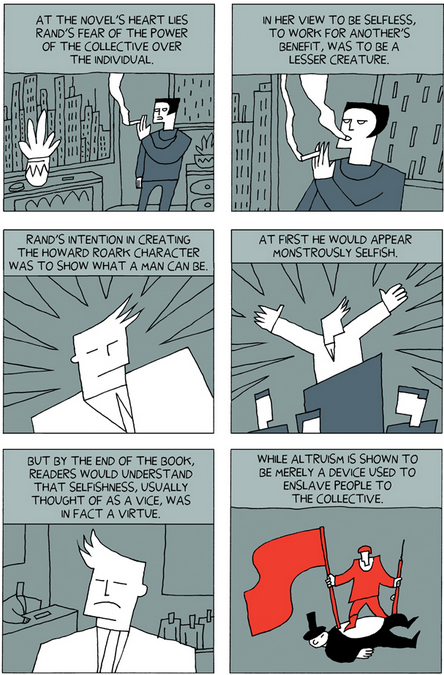
Ayn Rand is one of the most divisive figures in 20th Century American thought. In some circles, particularly on Wall Street and in Washington DC think tanks, she’s seen as a patron saint of laissez faire capitalism. She preached the virtues of individualism and decried government handouts and taxes before it was cool, after all. In other circles, her bestselling books are thought to be little more than justifications of sociopathic behavior couched in stilted, preachy prose. Whittaker Chambers famously dismissed her final book, Atlas Shrugged, in a review for William F. Buckley’s National Review: “Out of a lifetime of reading, I can recall no other book in which a tone of overriding arrogance was so implacably sustained. Its shrillness is without reprieve. Its dogmatism is without appeal.”
Yet Rand’s thought found a great deal of appeal among American conservatives. Alan Greenspan, the former head of the Federal Reserve, was a member of Rand’s inner circle. Former vice presidential candidate Paul Ryan and likely presidential contender Rand Paul are both noted followers. Whether you agree with her or not, Rand is someone you need to understand if you want to get a sense of what’s going on with American politics. So for those of you who might blanche at the thought of wading through one of her phonebook-sized tomes, check out Darryl Cunningham’s cartoon biography of Rand.
Cunningham traces her life — her family’s loss of wealth and property at the hands of the Bolsheviks during the Russian Revolution, her immigration to America at age 21, and her eventual rise in fame and fortune. Elegantly and concisely, Cunningham not only lays out Rand’s philosophy but also paints a complex portrait of a deeply contradictory person. All with the help of cartoons.
Rand preached the virtue of individuality but she ruthlessly excommunicated anyone in her cult-like inner circle who deviated from her ideology. She praised reason over emotion but her spectacularly complicated personal life was riddled with petty jealousies and long simmering feuds. She abhorred government aid for the poor but she lived on Social Security at the end of her life. And perhaps strangest of all, considering the current American political climate, Rand vocally supported both atheism and abortion rights, but she has been utterly embraced by the American right.
You can see a page of Cunningham’s work above, or you can read his entire work, 66 pages of comic goodness, at ACT-I-VATE.
via io9
Related Content:
The History of Economics & Economic Theory Explained with Comics, Starting with Adam Smith
William F. Buckley Flogged Himself to Get Through Atlas Shrugged
Ayn Rand Talks Atheism with Phil Donahue
Great Shakespeare Plays Retold with Stick Figures in Three Simple Drawings
Free Online Philosophy Courses
Jonathan Crow is a Los Angeles-based writer and filmmaker whose work has appeared in Yahoo!, The Hollywood Reporter, and other publications. You can follow him at @jonccrow. And check out his blog Veeptopus, featuring one new drawing of a vice president with an octopus on his head daily. The Veeptopus store is here.
Read More...1000 Digits of Pi, Recited by Jane Barbe, Famous Voice of Telephone Company Recordings
If you came of age during the 1960s and 1970s, you knew the voice of Jane Barbe, aka “The Telephone Lady.” Her voice appeared on telephone company recordings and voicemail systems across the US. Just listen to this clip, and you will immediately know who I’m talking about.
Anyway, Ms. Barbe apparently had more in her repertoire than “If you’d like to make a call, please hang up.” A lot more.
Above, we have her reciting the first 1,000 digits of Pi. The backstory remains unknown to us. We did some research and came up bone dry. If you know something about the circumstances behind the recording, please let us know in the comments section below. To read along with a transcript of the recording, just click here.
If you would like to support the mission of Open Culture, consider making a donation to our site. It’s hard to rely 100% on ads, and your contributions will help us continue providing the best free cultural and educational materials to learners everywhere. You can contribute through PayPal, Patreon, and Venmo (@openculture). Thanks!
Related Content:
Hunter S. Thompson Calls Tech Support, Unleashes a Tirade Full of Fear and Loathing (NSFW)
Saul Bass Gives Ma Bell a Complete Makeover, 1969
The World’s First Mobile Phone Shown on 1922 Vintage Film
How Pi Was Nearly Changed to 3.2 … and Copyrighted!
Read More...Peter Thiel’s Stanford Course on Startups: Read the Lecture Notes Free Online

Peter Thiel has many claims to fame in Silicon Valley. He co-founded PayPal in 1998, before selling it to eBay for $1.5 billion in 2002. He later launched various hedge funds, and made early investments in Facebook. He’s an unabashed libertarian, a proponent of Seasteading and Singularity, a critic of the American university system, and the creator of the annual Thiel Fellowship, which pays promising college-age students to “stop out” of school for two years and launch business ventures instead.
Finally, Thiel is also now the bestselling author of Zero to One: Notes on Startups, or How to Build the Future. Published in mid-September, the book received a pretty rave review in The Atlantic, where Derek Johnson calls it “a lucid treatise on capitalism and entrepreneurship” and perhaps “the best business book I’ve read.”
The book itself is actually a distillation of thoughts Thiel presented in a course he taught at Stanford in 2012. And it just so happens that the notes from that course — CS138 Startups — are freely available online. They come courtesy of Blake Masters, a student in Thiel’s class, who later helped the entrepreneur write Zero to One.
Below, you can find the lecture notes for 19 classes, which, when originally published on Masters’ site, became pretty popular in the tech community. Links to these lectures will be permanently housed in our collections of Free Online Business Courses and Free Online Computer Science Courses. Other Stanford courses on entrepreneurship can be found here: Start Your Startup with Free Stanford Courses and Lectures.
Lectures Notes: CS138 Startups
Class 1: The Challenge of the Future
Class 2: Party Like it’s 1999?
Class 4: The Last Mover Advantage
Class 5: The Mechanics of Mafia
Class 9: If You Build It, Will They Come?
Class 13: You Are Not A Lottery Ticket
Class 16: Decoding Ourselves
Class 18: Founder as Victim, Founder as God
Class 19: Stagnation or Singularity?
For a huge collection of free courses, please see our large and ever-expanding collection: 1,700 Free Online Courses from Top Universities.
Read More...Django Reinhardt Demonstrates His Guitar Genius in Rare Footage From the 1930s, 40s & 50s
In one of my favorite Woody Allen films, Sweet and Lowdown, Sean Penn plays Emmett Ray, a fictional jazz guitarist who embodies the titular qualities in equally great measure. “Already considered peerless among American jazz guitarists,” Ray admits of only one rival—Parisian gypsy guitarist Django Reinhardt, whom Emmett worships, obviously patterns himself after, and can’t stand to see in person without fainting dead away. Where Ray is a tremendously convincing creation of Allen and Penn, Reinhardt was very much a real musician, and was indeed the reigning king of jazz guitar from the 1930s to the 50s. Reinhardt’s incredible skill is all the more impressive considering he only had use of three fingers on his left hand due to injuries sustained in a caravan fire in 1928.
Reinhardt and jazz violinist Stéphane Grappelli founded the Quintette du Hot Club de France in 1934, and in the forties, Reinhardt began composing, and toured England, Switzerland, and the U.S. as a soloist with Duke Ellington’s band. He recorded his final album, Djangology in 1949, retired in 51, and died in 53, already a legend, “one of the few European musicians to exert a serious influence on the American art form of jazz,” writes an NPR “Weekend Edition” profile. Django’s playing, “at times joyous, fierce and lyrical,” draws heavily on his Roma roots while mastering the vocabulary of swing—a language, it seems, still new to many audiences in 1938, when the film at the top of the post, Jazz “Hot,” was made.
In a previous post, Mike Springer points out the “didactic tone” of the first couple minutes of the documentary, created by Reinhardt’s manager Lew Grade in order to familiarize the British public with jazz in advance of the quintet’s first UK tour. The film “really comes alive when Django arrives on the screen,” playing an arrangement of the popular French song “J’attendrai.” Prior to the UK tour, the Quintet du Hot Club traveled to the Netherlands and played The Hague. See them in the Dutch film clip above, beginning at 0:34. Grappelli solos while Django holds down the rhythm.
By 1944, Reinhardt was well known to jazz lovers and musicians alike, appearing at the upscale Paris cabaret Bal Tabarin in the footage above at 2:54, following a clip of Marlene Dietrich looking on from the audience.
In 1952, the year before his death, Reinhardt was famous enough to be cast alongside Louis Armstrong and Sidney Bechet in the French-Italian film La Route de Bonheur (titled Saluti e baci in Italy). In this clip, Reinhardt entertains a packed train car. The song dubbed over the footage is Nuits de St. Germain des Pres.
See much more film and photography of Django Reinhardt and his famous quintet in this biographical documentary, The Genius of Django Reinhardt. Described as an unstable and childlike man capable of the most unusual whims, the portrait of Reinhardt, practically the inventor of jazz guitar, traces his life from birth in a Roma encampment in Belgium to his final years in semi-retirement. And for even more Django, don’t miss this French documentary film, Trois doigts de genie.
Related Content:
Jazz ‘Hot’: The Rare 1938 Short Film With Jazz Legend Django Reinhardt
Django Reinhardt and the Inspiring Story Behind His Guitar Technique
Josh Jones is a writer and musician based in Durham, NC. Follow him at @jdmagness.
Read More...Support Us
We're hoping to rely on loyal readers, rather than erratic ads. Please click the Donate button and support Open Culture. You can use Paypal, Venmo, Patreon, even Crypto! We thank you!

About Us

Open Culture scours the web for the best educational media. We find the free courses and audio books you need, the language lessons & educational videos you want, and plenty of enlightenment in between.
Advertise With Us

FREE UPDATES!
GET OUR DAILY EMAIL
Get the best cultural and educational resources on the web curated for you in a daily email. We never spam. Unsubscribe at any time.
FOLLOW ON SOCIAL MEDIA

Open Culture editor Dan Colman scours the web for the best educational media. He finds the free courses and audio books you need, the language lessons & movies you want, and plenty of enlightenment in between.
Advertise With Us