Swedish Scientists Sneak Bob Dylan Lyrics Into Their Academic Publications For Last 17 Years
Scientists who study and write about intestinal gases—just like the rest of us, I guess—find it hard to resist the occasional fart joke. And when they’re John Jundberg and Eddie Weitzberg, two professors at the Karolinska Institute in Stockholm, they can’t resist couching their occasional fart joke in a Bob Dylan lyric, part of a now seventeen-year tradition among five Swedish scientists who’ve been slipping Dylan lyrics into their publications, wagering on who can fit the most in before retirement.
It all began with Jundberg and Weitzberg’s “Nitric oxide and inflammation: the answer is blowing in the wind,” published in the journal Nature Medicine in 1997. (See Dylan play the paper’s inspiration above in 1963.) Next came articles like “Blood on the tracks: a simple twist of fate” by Konstantinos Meletis and Jonas Frisen and “Tangled up in blue: Molecular cardiology in the postmolecular era” by Kenneth Chien.
The five aren’t the only scientists who try to spice up dry research publications with wordplay. “If you read other scientific articles,” ways Weitzberg, “you’ll find people trying to be clever in different ways.” But they don’t do so at the expense of the science, or their careers: “We’re not talking about scientific papers—we could have got in trouble for that-but rather articles we have written about research by others, book introductions, editorials and things like that.”
The writer with the most Dylan references gets lunch in a restaurant in Solna, a town north of Stockholm. But thanks to interest from outlets like the Washington Post, he may also get a few extra minutes of fame. Weitzberg’s response? “I would much rather become famous for my scientific work than for my Bob Dylan quotes, but yes, I am enjoying this!”
Related Content:
Physical Attraction: Marriage Proposal Comes in the Form of a Physics Paper
Fake Bob Dylan Sings Real Dr. Seuss
Student Rickrolls Teacher By Sneaking Rick Astley Lyrics into Quantum Physics Paper
Josh Jones is a writer and musician based in Durham, NC. Follow him at @jdmagness.
Read More...1797 Temperance Thermometer Measures the Moral & Physical Impact of Your Drinking Habits
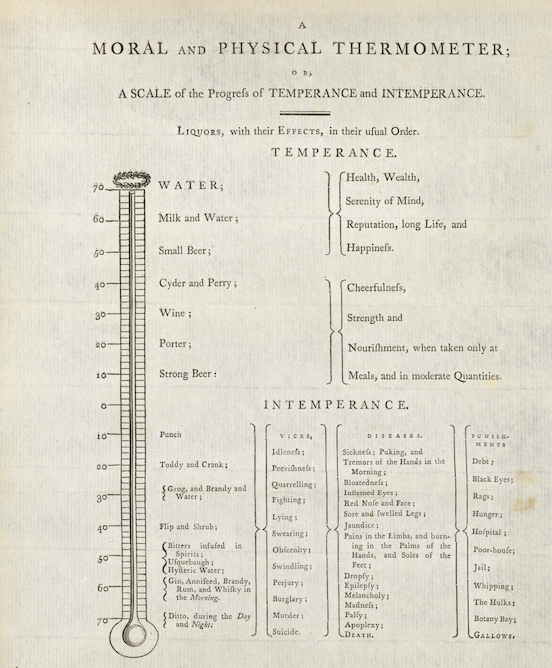
Question for the drinkers out there:
Does strong beer taken in moderate quantities at mealtimes make you cheerful?
Yeah, me too!
That gives us a temperature of 10 according to 18th-century physician John Coakley Lettsom’s “moral and physical thermometer,” one of his Hints Designed to Promote Beneficence, Temperance, and Medical Science (1797).
It’s nothing to be ashamed of—anything above zero constitutes a passing score. The founder of the Medical Society of London, Lettsom was a proponent of true temperance, not total abstinence. According to his rubric, a “small beer” has all the virtues of milk and water.
Dip below a zero, though, and you’re in for a bumpy night.
Punch is apparently the gateway to such demon influences as flip, shrub, whiskey and rum. Gosh. You may as well just skip the punch and go straight for the hard stuff, if, as in Lettsom’s view, they all end in the same vices and diseases.
Puking and Tremors of the Hands in the Morning?
Yes, on occasion.
Peevishness, Idleness, and Obscenity?
Yep, that too.
Murder, Madness, and Death?
Mercifully, no. At least not yet.
While not entirely free of stigma, alcoholism is now something many view through the lens of AA, a problem best remedied through a system of personal accountability shored up by a network of nonjudgmental, sympathetic support.
Back in Lettsom’s day, when an alcoholic hit rock bottom, it was assumed he or she would stay there, a task made easier when the wages of this particular sin included the poor house, a one way ticket to the Botany Bay penal colony, and the gallows.
Such looming consequences are easily laughed off when you’ve had a snoot, which may be why Lettsom also published the illustrated version of his thermometer below. A picture is worth a thousand words, particularly when depicting the pre-Dickensian misery that awaits the drunkard and his family.
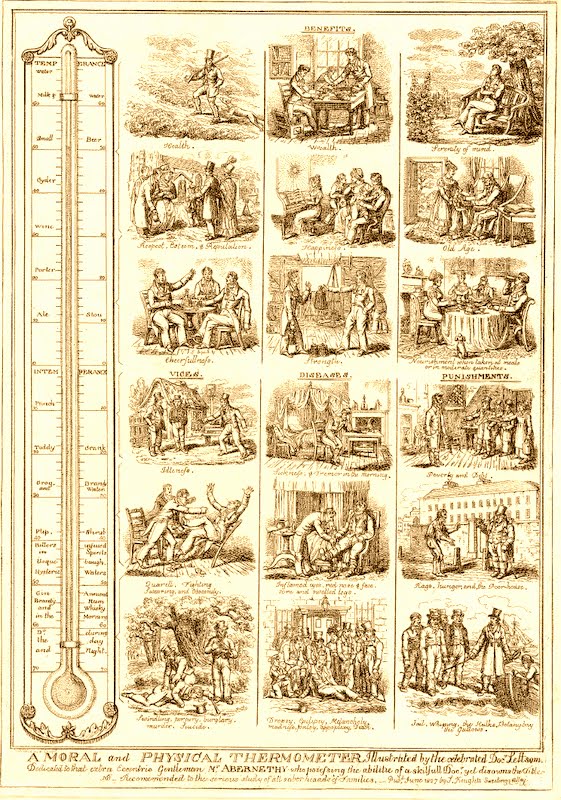
via Rebecca Onion and Slate
Related Content:
George Washington’s 110 Rules for Civility and Decent Behavior
Thomas Jefferson’s Handwritten Vanilla Ice Cream Recipe
“The Vertue of the COFFEE Drink”: An Ad for London’s First Cafe Printed Circa 1652
Ayun Halliday is an author, homeschooler, and Chief Primatologist of the East Village Inky zine. Follow her @AyunHalliday
Read More...Hear the Album Björk Recorded as an 11-Year-Old: Features Cover Art Provided By Her Mom (1977)

Iceland’s biggest export, aside from volcanic ash, is that pixyish pop singer, Björk. Or at least that’s how it seems in the American popular imagination. Björk’s first three of albums were pretty much required listening in certain circles during the ‘90s. Since then, her stature in the indie world has only grown.
Yet before she had a run of beautiful and strange masterpieces; before she was systematically tortured in front of the camera by Lars Von Trier in Dancer in the Dark; and before she was singing about birthdays with her breakout band The Sugarcubes, Björk cut her very first album. It was 1977, and Björk was only eleven.
Björk, whose name rhymes with “work” not “pork,” landed the record deal after a tape of her singing Tina Charles’ 1976 disco hit “I Love to Love” played on Iceland’s one and only radio station. The album, called simply Björk, was something of a family affair. While Björk sang and played the flute, her stepfather Sævar Árnason played guitar while her mom, Hildur Hauksdóttir, designed the album cover. (See above.) Overall, the record sounds exactly like what you might expect an Icelandic album from the ‘70s sung by a tweenaged chanteuse might sound like – part Abba, part King Crimson and part early Miley Cyrus. Björk does pretty groovy covers of The Beatles’ “Fool on the Hill” (top) and Syreeta Wright’s “Your Kiss is Sweet (middle),” both sung in Icelandic. There’s also an equally groovy psychedelic instrumental track dedicated to painter Jóhannes Kjarval, (below) whose work is on Icelandic currency. Björk reportedly went platinum in Iceland. You can listen to more tracks from that album on WFMU.
via WFMU
Related Content:
Björk and Sir David Attenborough Team Up in a New Documentary About Music and Technology
Jonathan Crow is a Los Angeles-based writer and filmmaker whose work has appeared in Yahoo!, The Hollywood Reporter, and other publications. You can follow him at @jonccrow. And check out his blog Veeptopus, featuring one new drawing of a vice president with an octopus on his head daily. The Veeptopus store is here.
Read More...Martin Scorsese’s New Documentary on The New York Review of Books Airs Tonight on HBO
A quick note: Tonight, HBO will air the premiere of The 50 Year Argument. That’s Martin Scorsese’s new documentary about the influential literary and academic journal, The New York Review of Books.
Writes The New York Times: “Robert Silvers has assigned thousands of pieces for The New York Review of Books, so why not a documentary film? “The 50 Year Argument” … originated along the same lines as one of the lengthy, learned articles in The Review: Mr. Silvers sought out a talented essayist, in this case Martin Scorsese, and asked him to explore a subject — the magazine’s 50-year history — that he was passionate about but not expert in.” The result is a “textured and smart but thoroughly celebratory, a paean to the magazine and the amazingly durable Mr. Silvers, now 84.”
Regrettably, the film isn’t available online. But you can watch the trailer above and then a long Q&A about the film. Recorded in Berlin earlier this year, the Q&A features Scorsese on the stage, along with David Tedeschi (his co-director), NYRB editor Robert Silvers, publisher Rea Hederman, and contributor Michael Greenberg.
We have many other heady documentaries (where else?) on our list of 200 Free Documentaries Online.
Related Content:
Martin Scorsese Reveals His 12 Favorite Movies
Longform’s New, Free App Lets You Read Great Journalism from Your Favorite Publishers (including The New York Review of Books)
Revisit Martin Scorsese’s Hand-Drawn Storyboards for Taxi Driver
Martin Scorsese’s Very First Films: Three Imaginative Short Works
Read More...
Glenn Gould Gives Us a Tour of Toronto, His Beloved Hometown (1979)
I write this from Toronto, having come to explore, record interviews in, write about, and generally try to understand this big, busy, famously diverse, and sometimes formless-seeming metropolis Canadians appreciate and resent in equal measure. Despite the difficulty of defining or even describing it, the city has nurtured impressive minds. If not Canadian yourself, you might struggle to come up with a list of notable Torontonians, but surely names like Margaret Atwood, David Cronenberg, Frank Gehry, Joni Mitchell, and Marshall McLuhan ring bells. Despite having passed in 1982, pianist-composer Glenn Gould may still rank as the city’s best-known cultural ambassador. “I’m not really cut out for city living, and given my druthers I’d probably avoid all cities and live in the country,” he said in 1979. “Toronto, however, belongs on a very short list of cities which I’ve visited and which seem to offer to me, at any rate, peace of mind — cities which, for want of a better definition, do not oppose their cityness upon you.”
He says it at the very beginning of Glenn Gould’s Toronto, which spends the rest of its 50 minutes exploring not just the city itself but Gould’s ideas of its nature. The documentary, which originally aired as an episode of the CBC series Cities, follows him from the CN Tower which looms over Toronto to the waterfront (on what he calls “the least great of the Great Lakes”) to the grounds of the Canadian National Exhibition (a sizable event with a “spirit out of a small-town fall fair”) to the then-new city hall. Along the way, his monologue touches on the peace and quiet Toronto offers him, the reflexive distaste it can inspire in others, the “cultural mosaic” to which it plays host (sometimes insistently), the way it survived the 1960s without enduring the disastrous hollowing-out American cities did, and the friendly rivalry it enjoys with Montreal. Gould’s clear, analytical manner of speech delivers a stream of pointed observations, dry jokes, and childhood memories, revealing his nuanced lifelong relationship with the city: not the simple one of a booster, nor the even simpler one of a detractor. But then, Gould never had anything simple about him — nor, as I’ve come to find out this past week, does Toronto.
You can find Glenn Gould’s Toronto in our collection of Free Documentaries.
Related Content:
Watch Glenn Gould Perform His Last Great Studio Recording of Bach’s Goldberg Variations (1981)
Glenn Gould Explains the Genius of Johann Sebastian Bach (1962)
The Art of Fugue: Gould Plays Bach
Colin Marshall hosts and produces Notebook on Cities and Culture and writes essays on cities, language, Asia, and men’s style. He’s at work on a book about Los Angeles, A Los Angeles Primer. Follow him on Twitter at @colinmarshall or on Facebook.
Read More...Rare Footage of the “Human Be-In,” the Landmark Counter-Culture Event Held in Golden Gate Park, 1967
Investigative reporter Steve Silberman awesomely flagged this video for us today. He writes:
This seems to have just surfaced: the most complete recording of the Human Be-In in Golden Gate Park in 1967 that I have ever seen, by far. It opens with Allen Ginsberg and Gary Snyder chanting, Michael McClure follows, and the Grateful Dead (with adorable footage of Allen dancing) pop up at about 14:00. At 18:00, Dizzy Gillespie is smiling in the audience. So much mythical noumenon has piled up around these events over the decades it’s almost inevitable that the real thing seems a little banal compared to one’s imagination, but it’s still cool.
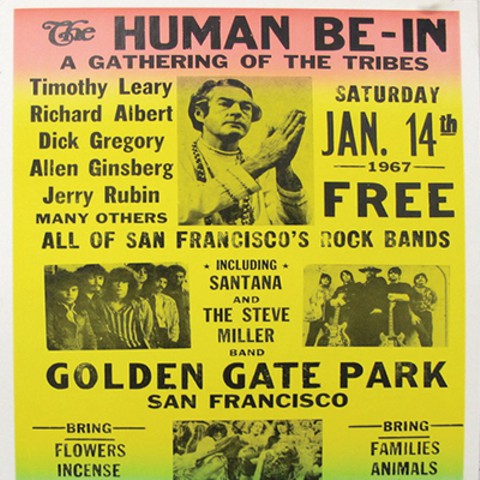
If you’re not quite familiar with what the Human Be-In, held on January 14, 1967, was all about, let me refer you to this succinct description by a web site called Magic Bus San Francisco: “Announced on the cover of the first edition of the counter-culture zine San Francisco Oracle, the ‘Gathering of the Tribes’ or ‘Human Be-In’ as it came to be known, was the prototype of all 1960s counter culture celebrations. The Human Be-In precipitated the legendary Summer of Love, and made San Francisco’s Haight-Ashbury the epicenter of the burgeoning hippie movement.
The Be-In featured all the luminaries of psychedelic counter-culture, including Timothy Leary, Allen Ginsberg, Gary Snyder, Richard Alpert (Ram Dass), Dick Gregory, Lenore Kandel, and Jerry Ruben. Many of the Haight’s best musical acts also performed, including the Grateful Dead and Quicksilver Messenger Service.” As a curious side note, the Dead didn’t get a mention in the poster promoting the event. Is that because they were a late addition? I’m not sure.
Related Content:
The Historic LSD Debate at MIT: Timothy Leary v. Professor Jerome Lettvin (1967)
The Night When Miles Davis Opened for the Grateful Dead in 1970: Hear the Complete Recordings
8,976 Free Grateful Dead Concert Recordings in the Internet Archive
The Acid Test Reels: Ken Kesey & The Grateful Dead’s Soundtrack for the 1960s Famous LSD Parties
Read More...Philosopher Jacques Derrida Interviews Jazz Legend Ornette Coleman: Talk Improvisation, Language & Racism (1997)

Images of Derrida and Coleman, via Wikimedia Commons
This most certainly ranks as one of my favorite things on the internet, and I dearly wish we had audio to share with you, though I doubt any exists. What we do have is an English translation from the French of an interview that originally took place in English between philosopher Jacques Derrida and jazz great Ornette Coleman.
Now there are those who dismiss Derrida—who consider his methods fraudulent. If you’re one of them, this is obviously not for you. For those who appreciate the turns of his thought, and the fascinating possibilities inherent in a Derridian approach to jazz improvisation, not to mention the convergences and points of conflict between these two disparate cultural figures, read on.
The interview took place in 1997, “before and during Coleman’s three concerts at La Villette, a museum and performing arts complex north of Paris that houses, among other things, the world-renowned Paris Conservatory.” As I mentioned, the two spoke in English but, as translator Timothy S. Murphy—who worked with a version published in the French magazine Les Inrockuptibles—notes, “original transcripts could not be located.” Curiously, at the heart of the conversation is a discussion about language, particularly “languages of origin.” In answer to Derrida’s first question about a program Coleman would present later that year in New York called Civilization, the saxophonist replies, “I’m trying to express a concept according to which you can translate one thing into another. I think that sound has a much more democratic relationship to information, because you don’t need the alphabet to understand music.”
As one example of this “democratic relationship,” Coleman cites the relationship between the jazz musician and the composer—or his text: “the jazz musician is probably the only person for whom the composer is not a very interesting individual, in the sense that he prefers to destroy what the composer writes or says.” Coleman goes on later in the interview to clarify his ideas about improvisation as democratic communication:
[T]he idea is that two or three people can have a conversation with sounds, without trying to dominate or lead it. What I mean is that you have to be… intelligent, I suppose that’s the word. In improvised music I think the musicians are trying to reassemble an emotional or intellectual puzzle in which the instruments give the tone. It’s primarily the piano that has served at all times as the framework in music, but it’s no longer indispensable and, in fact, the commercial aspect of music is very uncertain. Commercial music is not necessarily more accessible, but it is limited.
Translating Coleman’s technique into “a domain that I know better, that of written language,” Derrida ventures to compare improvisation to reading, since it “doesn’t exclude the pre-written framework that makes it possible.” For him, the existence of a framework—a written composition—even if only loosely referenced in a jazz performance, “compromises or complicates the concept of improvisation.” As Derrida and Coleman try to work through the possibility of true improvisation, the exchange becomes a fascinating deconstructive take on the relationships between jazz and writing. (For more on this aspect of their discussion, see “Deconstructin(g) Jazz Improvisation,” an article in the open access journal Critical Studies in Improvisation.)
The interview isn’t all philosophy. It ranges all over the place, from Coleman’s early days in Texas, then New York, to the impact of technology on music, to Coleman’s completely original theory of music, which he calls “harmolodics.” They also discuss globalization and the experience of growing up as a racial minority—an experience Derrida relates to very much. At one point, Coleman observes, “being black and a descendent of slaves, I have no idea what my language of origin was.” Derrida responds in kind, referencing one of his seminal texts, Monolingualism of the Other:
JD: If we were here to talk about me, which is not the case, I would tell you that, in a different but analogous manner, it’s the same thing for me. I was born into a family of Algerian Jews who spoke French, but that was not really their language of origin [… ] I have no contact of any sort with my language of origin, or rather that of my supposed ancestors.
OC: Do you ever ask yourself if the language that you speak now interferes with your actual thoughts? Can a language of origin influence your thoughts?
JD: It is an enigma for me.
Indeed. Derrida then recalls his first visit to the United States, in 1956, where there were “ ‘Reserved for Whites’ signs everywhere.” “You experienced all that?” he asks Coleman, who replies:
Yes. In any case, what I like about Paris is the fact that you can’t be a snob and a racist at the same time here, because that won’t do. Paris is the only city I know where racism never exists in your presence, it’s something you hear spoken of.
“That doesn’t mean there is no racism,” says Derrida, “but one is obliged to conceal it to the extent possible.”
You really should read the whole interview. The English translation was published in the journal Genre and comes to us via Ubuweb, who host a pdf. For more excerpts, see posts at The New Yorker and The Liberator Magazine. As interesting a read as this doubly-translated interview is, the live experience itself was a painful one for Derrida. Though he had been invited by the saxophonist, Coleman’s impatient Parisian fans booed him, eventually forcing him off the stage. In a Time magazine interview, the self-conscious philosopher recalled it as “a very unhappy event.” But, he says, “it was in the paper the next day, so it was a happy ending.”
Hear more of Coleman’s thoughts on language, sound, and technology in the 2008 interview above (see here for Part 2). The year previous, in another conjunction of the worlds of language and music, Coleman was awarded the Pulitzer Prize in music for his live album Sound Grammar, a title that succinctly expresses Coleman’s belief in music as a universal language.
Image of Ornette Coleman by Geert Vandepoele
Related Content:
Charles Mingus Explains in His Grammy-Winning Essay “What is a Jazz Composer?”
Derrida: A 2002 Documentary on the Abstract Philosopher and the Everyday Man
1959: The Year that Changed Jazz
How to Potty Train Your Cat: A Handy Manual by Charles Mingus
Josh Jones is a writer and musician based in Durham, NC. Follow him at @jdmagness.
Read More...Sigmund Freud Writes to Concerned Mother: “Homosexuality is Nothing to Be Ashamed Of” (1935)
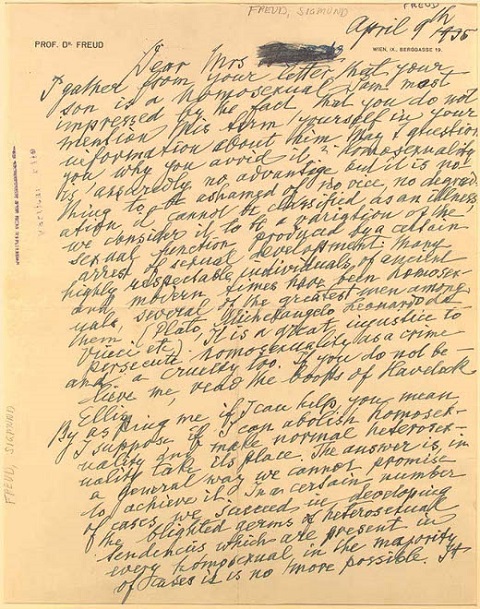
Hank Green, hosting his Crash Course on Psychology, put it best: when we think of the study of the mind, we think of an old, bespectacled bearded man puffing on a pipe. We think, in other words, of Sigmund Freud, whether we know anything about him or not. Despite publishing such very real and still reasonably well-known works as The Interpretation of Dreams, Beyond the Pleasure Principle, and Civilization and its Discontents, the man has somehow passed partially into the realm of popular myth: we think of him at once as an influential pioneer in a little-explored intellectual field, and as something of an idée fixe-hobbled charlatan as well. Perhaps, like many universally recognized 20th-century figures, he combined rightness and wrongness in some kind of irresistible proportion. But the letter above, featured at Letters of Note, demonstrates that, at least on the issue of homosexuality, he had indeed drawn a correct conclusion well before most anyone else.
In 1935, says that post, Freud “was contacted by a worried mother who was seeking treatment for her son’s apparent homosexuality. Freud, who believed that all humans are attracted to both sexes in some capacity, responded with the following letter of advice.”
Dear Mrs [Erased],
I gather from your letter that your son is a homosexual. I am most impressed by the fact that you do not mention this term yourself in your information about him. May I question you why you avoid it? Homosexuality is assuredly no advantage, but it is nothing to be ashamed of, no vice, no degradation; it cannot be classified as an illness; we consider it to be a variation of the sexual function, produced by a certain arrest of sexual development. Many highly respectable individuals of ancient and modern times have been homosexuals, several of the greatest men among them. (Plato, Michelangelo, Leonardo da Vinci, etc). It is a great injustice to persecute homosexuality as a crime – and a cruelty, too. If you do not believe me, read the books of Havelock Ellis.
By asking me if I can help, you mean, I suppose, if I can abolish homosexuality and make normal heterosexuality take its place. The answer is, in a general way we cannot promise to achieve it. In a certain number of cases we succeed in developing the blighted germs of heterosexual tendencies, which are present in every homosexual in the majority of cases it is no more possible. It is a question of the quality and the age of the individual. The result of treatment cannot be predicted.
What analysis can do for your son runs on a different line. If he is unhappy, neurotic, torn by conflicts, inhibited in his social life, analysis may bring him harmony, peace of mind, full efficiency, whether he remains a homosexual or gets changed. If you make up your mind he should have analysis with me — I don’t expect you will — he has to come over to Vienna. I have no intention of leaving here. However, don’t neglect to give me your answer.
Sincerely yours with best wishes,
Freud
While mainstream western thought no longer expects that homosexuals might, under any circumstances, “get changed,” it has aligned to Freud’s view in the sense of regarding their orientation as “nothing to be ashamed of, no vice, no degradation.” And from what I can see, humanity now enjoys the presence of more such “highly respectable individuals” who publicly acknowledge their own non-heterosexuality than ever before. Freud’s letter to this concerned American mother of the 1930s, in any case, brings nuance to the cartoon image we all have of him — the obsession with dreams, the insistence on diagnosing repression, the whole deal with cigar symbolism — just as his view of homosexuals would have brought nuance to the cartoon image this and other concerned American mothers of the 1930s might have had of them.
Related Content:
The Famous Letter Where Freud Breaks His Relationship with Jung (1913)
How a Young Sigmund Freud Researched & Got Addicted to Cocaine, the New “Miracle Drug,” in 1894
Jean-Paul Sartre Writes a Script for John Huston’s Film on Freud (1958)
Sigmund Freud Speaks: The Only Known Recording of His Voice, 1938
Free Online Psychology Courses
Colin Marshall hosts and produces Notebook on Cities and Culture and writes essays on cities, language, Asia, and men’s style. He’s at work on a book about Los Angeles, A Los Angeles Primer. Follow him on Twitter at @colinmarshall or on Facebook.
Read More...A Sneak Preview of Haruki Murakami’s Forthcoming Illustrated Novel, The Strange Library
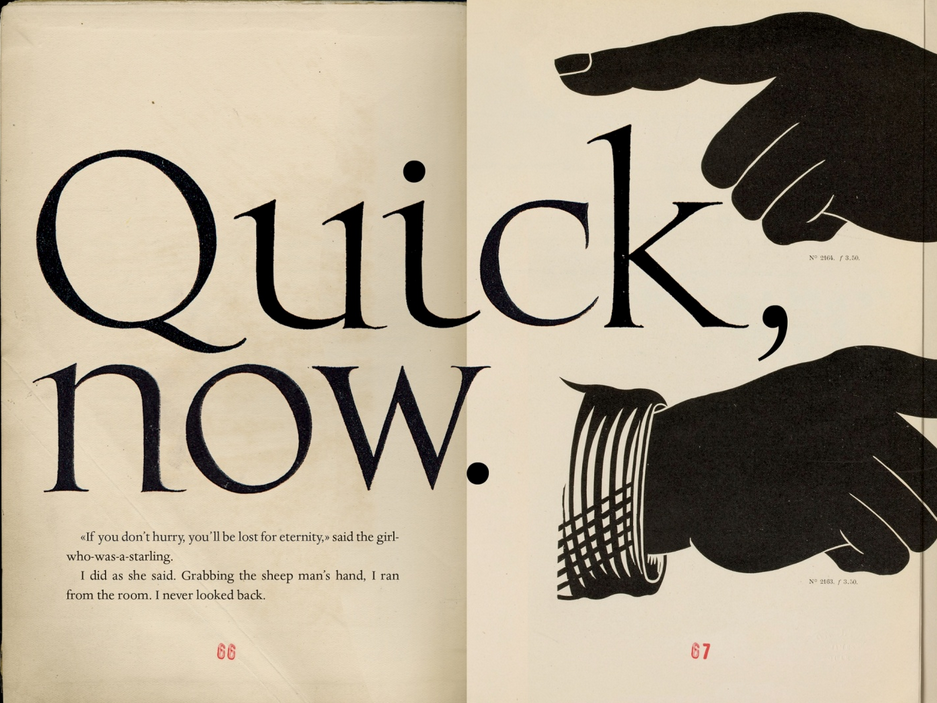
Quick note: If you just finished reading Colorless Tsukuru Tazaki and His Years of Pilgrimage, and if you’re now hankering for some more Murakami, you won’t have to wait very long. In December, his next book, a 96 page novella called The Strange Library, will be published by Knopf. And already, thanks to The Guardian, you can get a sneak preview of the illustrated edition. When you enter the Guardian gallery, make sure you click the arrows in the top right corner of the first image to see the illustrations in a larger format. The book can be pre-ordered here.
In the meantime, we have a few Murakami items (stories, music, film, etc.) to keep you busy this fall.
Related Content:
Read 5 Stories By Haruki Murakami Free Online
Haruki Murakami’s Passion for Jazz: Discover the Novelist’s Jazz Playlist, Jazz Essay & Jazz Bar
Read More...
Art Garfunkel Lists 1195 Books He Read Over 45 Years, Plus His 157 Favorites (Many Free)
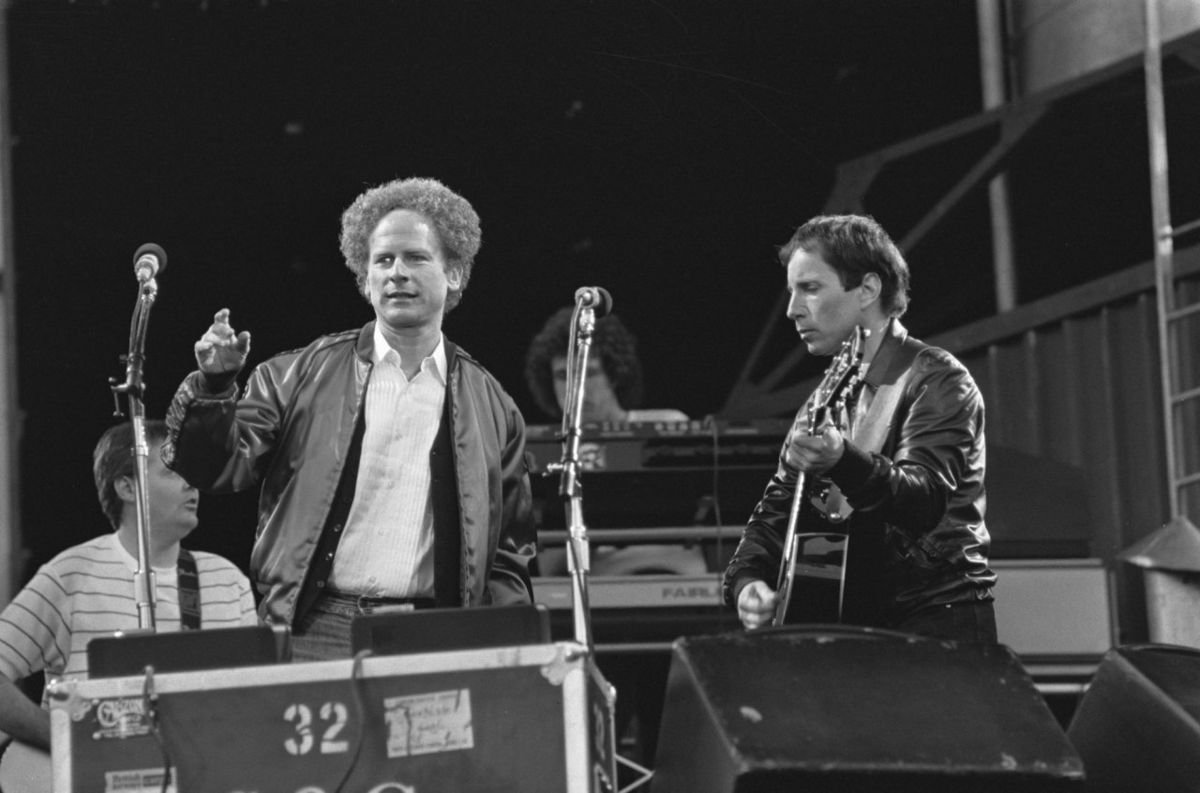
Image by Nationaal Archief, via Wikimedia Commons
If you’ve been wondering what Art Garfunkel has been up to lately, the answer is that it seems that he’s been reading. A lot.
The lanky, curly-haired number two guy for the seminal folk-rock band Simon & Garfunkel has been keeping track of every single thing he has read from June 1968 until October 2013 and he’s posted all of them — 1,195 texts — on his website. The first item on his list is Jean-Jacques Rousseau’s Confessions and the last is Witold Gombrowicz’s Cosmos. In between, Garfunkel has knocked through some seriously daunting tomes –War and Peace, Ulysses, Middlemarch, Remembrance of Things Past and Immanuel Kant’s Foundations of the Metaphysics of Morals. He even reportedly read the entire Random House Dictionary.
His tastes generally run towards the greats of the Western Canon with some more pulpy works thrown in along the way. J.K. Rowling, Anne Rice and Dan Brown make appearances, as does E. L. James’s Fifty Shades of Grey. For those who find it daunting to look at a list of 1,1195 books, Garfunkel also provides a list of his 157 favorites, which includes many great public domain works found in our Free eBooks and Free Audio Books collections. You can 15 of Art’s favorites here:
- Austen, Jane - Pride & Prejudice
- Bronte, Charlotte - Jane Eyre
- Bronte, Emily - Wuthering Heights
- Cervantes - Don Quixote
- iPad/iPhone (Vol 1 — Vol 2) — Kindle + Other Formats
- Dickens, Charles - Bleak House
- Dostoevsky, Fyodor - The Idiot
- Doyle, Arthur Conan - The Adventures of Sherlock Holmes
- Joyce, James - A Portrait of the Artist as a Young Man
- Joyce, James - Ulysses
- Proust, Marcel - Swann’s Way
- Rousseau, Jean-Jacques - The Confessions
- Tolstoy, Leo - Anna Karenina
- Tolstoy, Leo - War and Peace
- Wells, H.G. — A Short History of the World
- Woolf, Virginia - A Room of One’s Own
“I read for the reading pleasure, not for the gold star,” Garfunkel told Nick Paumgarten of the New Yorker in an interview a few years back. “Reading is a way to take downtime and make it stimulating. If you’re in the waiting room of a dentist’s office and don’t want to twiddle your thumbs, you turn to Tolstoy.”
Garfunkel’s list, or “library” as his website calls it, creates an expectantly intimate portrait of the artist. In the winter 1970, when Simon & Garfunkel released their biggest selling album, Like a Bridge Over Troubled Water, just as the duo was breaking up, Garfunkel blew through Moby Dick and Goethe’s The Sorrows of Young Werther before moving on to Jean-Paul Sartre’s Nausea and then later Bertrand Russell’s The Conquest of Happiness. When the duo reunited to play their famous concert in Central Park in 1981, Garfunkel polished off Dickens’ Nicholas Nickleby. And when Simon & Garfunkel was inducted into the Rock and Roll Hall of Fame in January 1990, he was reading Anthony Trollope’s An Autobiography.
The one type of book he doesn’t read is postmodern literature. His list of some 1195 books contains no mention of the likes of Don DeLillo, Donald Barthelme or Thomas Pynchon. “I tried Gravity’s Rainbow, and I thought it was fraudulent,” Garfunkel said.
Image above taken by Eddie Mallin.
via @pickover
Related Content:
Steven Soderbergh Posts a List of Everything He Watched and Read in 2009
Joseph Brodsky’s Reading List For Having an Intelligent Conversation
Carl Sagan’s Undergrad Reading List: 40 Essential Texts for a Well-Rounded Thinker
Jonathan Crow is a Los Angeles-based writer and filmmaker whose work has appeared in Yahoo!, The Hollywood Reporter, and other publications. You can follow him at @jonccrow. And check out his blog Veeptopus, featuring one new drawing of a vice president with an octopus on his head daily. The Veeptopus store is here.
Read More...
Support Us
We're hoping to rely on loyal readers, rather than erratic ads. Please click the Donate button and support Open Culture. You can use Paypal, Venmo, Patreon, even Crypto! We thank you!

About Us

Open Culture scours the web for the best educational media. We find the free courses and audio books you need, the language lessons & educational videos you want, and plenty of enlightenment in between.
Advertise With Us

FREE UPDATES!
GET OUR DAILY EMAIL
Get the best cultural and educational resources on the web curated for you in a daily email. We never spam. Unsubscribe at any time.
FOLLOW ON SOCIAL MEDIA

Open Culture editor Dan Colman scours the web for the best educational media. He finds the free courses and audio books you need, the language lessons & movies you want, and plenty of enlightenment in between.
Advertise With Us


