Bruce Springsteen Plays East Berlin in 1988: I’m Not Here For Any Government. I’ve Come to Play Rock
And you thought Ronald Reagan single-handedly brought down the Berlin Wall and ended the Cold War with his “Tear Down This Wall Speech” in 1987…. Well, a few other things happened before the wall finally came down two years later, including Mikhail Gorbechev’s reforms, the protests of the East German people, and that whole nuclear arms race thing. But if we’re looking for another famous American to credit for reunification, we should look to Bruce Springsteen, who in July of 1988—one year after the aged Gipper issued his famous command to the Soviet President—played an outdoor concert to 300,000 East German fans, “while millions more,” reports The Guardian, “watched the shaky and distorted transmission on state television.”
Springsteen played 32 songs in an epic four-hour performance. But which song was it that sent the Wall crumbling one year later? Was it, perhaps, “Born in the U.S.A.” (top)—the song about a bitter, disenfranchised Vietnam vet that the G.O.P. mistook for a patriotic anthem?
More likely it was his cover of Bob Dylan’s “Chimes of Freedom” (above). Before that song, writes The Guardian, Springsteen gives “a passionate speech, delivered in a creaky but understandable German.” “I’m not here for any government,” he says, “I’ve come to play rock ‘n’ roll for you in the hope that one day all the barriers will be torn down.” It could just as well have been “Promised Land” (below) that tore down that wall, or maybe “Cadillac Ranch”….
Sure, I’m being facetious, but the concert did have significant aftereffects. Historian Gerd Dietrich remarks that “Springsteen’s concert and speech certainly contributed in a large sense to the events leading up to the fall of the wall.” Thomas Wilke, an “expert on the impact of rock and pop music in East Germany,” comments, “there was clearly a different feeling and a different sentiment in East Germany after that concert.” The sentiment, says Dietrich, was an even greater desire for change. The Springsteen concert “showed people how locked up they really were.”
In this respect, it had exactly the opposite effect that the East German leadership intended. Evidence from the Stasi archives tells us it was supposed to “assuage the country’s youth,” who were “still reeling” from the beatings they’d received from police the previous year when they’d tried to listen in on David Bowie and the Eurythmics playing just over the Wall in the West. The Springsteen concert, by contrast, was deliberately situated “in the depths of East Berlin,” far from the border, to prevent “an impromptu revolution.” So much for appeasement.
So, were Reagan and Springsteen working together? Unlikely. Reagan’s attempt to co-opt “Born in the U.S.A.” for his 1984 re-election campaign may have, in fact, activated Springsteen’s latent lefty consciousness—or at least that’s what Professor Marc Dolan argues in the short video above and in this Politico essay. But even if the President and the Boss took different routes politically, there were “undeniable similarities” between them.
Both men liked to talk a lot to their audiences about freedom, and both tended to define that freedom in terms of the agency of the individual. Both men instinctively distrusted structures and institutions, precisely because they saw them as limiting individual freedom.
In that respect, they were the perfect representatives of the U.S. East Germans imagined, whether trying to hear Michael Jackson through a wall of troops stationed in front of the concrete behemoth that kept the West out, or waving homemade American flags while Max Weinberg pounded out the rousing drumbeat that announces “Born in the U.S.A.” Remembering the concert years later, Springsteen said, “Once in a while […] you play a show that ends up staying inside of you, living with you for the rest of your life. East Berlin in 1988 was certainly one of them.”
Related Content:
Heat Mapping the Rise of Bruce Springsteen: How the Boss Went Viral in a Pre-Internet Era
Bruce Springsteen Stumps/Sings for Obama: A Free Six-Song Set
Josh Jones is a writer and musician based in Durham, NC. Follow him at @jdmagness.
Read More...Stephen Fry Explains Humanism in 4 Animated Videos: Happiness, Truth and the Meaning of Life & Death
Answers to life’s big questions don’t come cheap, but they very often come free, or at least we feel they should. Which answers you find compelling among your available options is up to you. In the widely pluralist parts of the world—or at least in their urban centers—the answers come as often in the form of secular humanism as they do in any other variety, and they generally come with a certain amount of satisfaction that it is humanism, in part, that makes such variety possible. So what is humanism and why is it sometimes so proud of itself? You could do much worse than ask Stephen Fry, the genial English actor, comedian, writer, and passionate activist and advocate.
Fry narrates the video series here, “That’s Humanism,” for the British Humanism Association. He begins in “How do we know what is true?” at the top of the post by telling us what humanism is not. It is not a belief that knowledge comes from a supernatural source, from revelations, prophetic visions, or divinely inspired books. While many a humanist has found poetic inspiration in such things, as Fry explains, it’s only the scientific method that provides us with reliable information about the natural world.
In the video just above, Fry takes an evidence-based approach to the question of questions: what happens when we die. The humanist answer, as he plainly states, seems perfectly obvious to anyone—everyone dies, and everyone can live on in the lives of the people who’ve loved them. We leave the work we’ve done behind, and our bodies return to the elements from which they came. Anything else, he suggests, is wishful thinking.
The third video confronts the question that runs neck and neck with fear of death as a reason people seem to believe in the supernatural. “What makes something right or wrong?” Fry asks, then goes on to contrast in layman’s terms two moral theories: divine command and a generally altruist, prosocial ethical stance. Not all humanists subscribe to his ethics and not all, as Fry does above, would describe empathy as the prime motive of moral choice. He also cites “Reason,” “Experience,” and “Respect for Others” as methods by which humanists determine right from wrong, and he touches superficially on the role of culture as a container of morality, though he avoids the many thorny issues implied in that assertion.
The fourth video of the series, below, takes on the much more classically philosophical question, “How can I be happy?” For Fry, who has candidly discussed his struggles with bipolar disorder and suicidal depression, the question is not a purely abstract one. His answers eschew grand cosmic narratives for the value of the natural, the familial, and the observable. Throughout the series, Fry remains upbeat and confident, but if you think him innocent of life’s cruelties, I invite you to read the brief biography in this Guardian article.
If this seems like evangelism, perhaps it is. The British Humanist Association is, after all, the organization behind Richard Dawkins’ atheist bus campaign in England, which plastered signs on “bendy buses” around London saying “There’s probably no God. Now stop worrying and enjoy your life.” But Fry is a much more approachable, avuncular face of humanism than the cantankerous, sometimes callous, Dawkins (or the confrontational Sam Harris). What these videos don’t address are the specific advocacy goals and programs of the British Humanist Association, which include such perennially controversial subjects as assisted dying and abortion rights. Learn more about the association’s campaigns, goals, and outreach attempts at their website.
Related Content:
Stephen Fry: What I Wish I Knew When I Was 18
A Guide to Happiness: Alain de Botton Shows How Six Great Philosophers Can Change Your Life
Shakespeare’s Satirical Sonnet 130, As Read By Stephen Fry
Josh Jones is a writer and musician based in Durham, NC. Follow him at @jdmagness.
Read More...Bill Murray Sings the Poetry of Bob Dylan: Shelter From the Storm
We’ve shown you Bill Murray in full-blown literary mode, reading long passages from Huck Finn and poems by Wallace Stevens, Billy Collins and Emily Dickinson. (My favorite is the poetry reading at the construction site.) Now it’s time to add Bob Dylan to that list. And, why not? Dylan is the undisputed “poet laureate of rock ’n’ roll.” Who would argue with that?
The poem recited — or rather muttered in Murray’s inimitable style — is “Shelter from the Storm,” found on Dylan’s 1975 album, Blood on the Tracks. The scene comes from the film “St. Vincent,” which you can find in theaters on October 10. “Shelter from the Storm” begins:
’Twas in another lifetime, one of toil and blood
When blackness was a virtue and the road was full of mud
I came in from the wilderness, a creature void of form
“Come in,” she said, “I’ll give you shelter from the storm”And if I pass this way again, you can rest assured
I’ll always do my best for her, on that I give my word
In a world of steel-eyed death, and men who are fighting to be warm
“Come in,” she said, “I’ll give you shelter from the storm”
Read along with the full poem here.
Related Content:
Bob Dylan Reads From T.S. Eliot’s Great Modernist Poem The Waste Land
Bill Murray Gives a Delightful Dramatic Reading of Twain’s Huckleberry Finn (1996)
Bill Murray Reads Great Poetry by Billy Collins, Cole Porter, and Sarah Manguso
13 Lectures from Allen Ginsberg’s “History of Poetry” Course (1975)
Read More...
Watch Classic Seinfeld Scenes Dubbed in .… Yiddish
You may never have heard much Yiddish, but we can’t call it a dead language. The tongue of the Ashkenazi Jews, one referred to in the 19th and part of the 20th century as simply “Jewish,” certainly did, however, have a near-death experience. Just before World War II, the number of Yiddish speakers alive numbered somewhere between 11 and 13 million; today we don’t even know the figure, though one estimate from the 1990s-era puts it under two million. The language, which first emerged in ninth-century Europe, has in recent decades come back from the brink of extinction, and resurgences of Yiddish education have happened in many historically Jewish parts of the world. But as in any less-common language, students may find themselves short of those most effective learning tools: fun things to watch. Now, to help with their acquisition of the still not especially popular Yiddish, they have a bit of the massively popular Seinfeld.
Thanks to that massive popularity, the quintessential 1990s sitcom has aired internationally, dubbed into a great many local languages. But when it comes to Yiddish, those interested in learning, speaking, and hearing it have had to take matters into their own hands — an ability celebrated throughout the annals of Jewish history, and just the sort of thing that revived the “Jewish” language in the first place. Vimeo user A Mishel has posted a series of Seinfeld clips educationally repurposed with Yiddish dialogue, often using old-favorite episodes covering culturally relevant territory: a bar mitzvah, for instance, or a briss. And as the one true “show about nothing,” Seinfeld specializes in the universally relevant stuff of everyday life: a dentist visit, or a dire singles mixer. Presumably, a coming advanced-studies segment will bring to Yiddish Seinfeld’s more recent adventures with קאָמעדיאַנס in קאַרס getting קאַווע.
via Metafilter
Related Content:
What’s the Deal with Pop Tarts? Jerry Seinfeld Explains How to Write a Joke
Seinfeld & Nothingness: A Supercut of the Show’s Emptiest Moments
Learn 48 Languages Online for Free: Spanish, Chinese, English & More
Colin Marshall hosts and produces Notebook on Cities and Culture and writes essays on cities, language, Asia, and men’s style. He’s at work on a book about Los Angeles, A Los Angeles Primer. Follow him on Twitter at @colinmarshall or on Facebook.
Read More...Declassified CIA Document Reveals That Ben Franklin (and His Big Ego) Put U.S. National Security at Risk
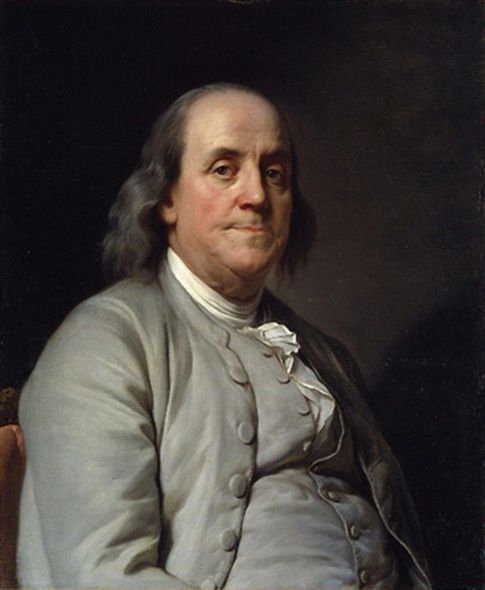
Benjamin Franklin might have been a brilliant author, publisher, scientist, inventor and statesman, but he was pretty lousy at keeping state secrets. That’s the finding from a recently declassified CIA analysis of Franklin’s critically important diplomatic mission to France during the Revolutionary War.
In September 1776, Franklin was dispatched to Paris to enlist France’s support for the American Revolution. At the time, France was still smarting from losing the Seven Years’ War to Britain and was eager to do anything that could reduce its rival’s power and prestige. Franklin’s Commission ran all kinds of clandestine operations with tacit French aid, including procuring weapons, supplies and money for the American Army; sabotaging the Portsmouth Royal Navy Dockyard; and negotiating a secret treaty between America and France.
And according the CIA’s in-house publication, Studies in Intelligence, the British knew just about everything that was going on. “The British had a complete picture of American-French activities supporting the war in America and of American intentions regarding an alliance with France. The British used this intelligence effectively against the American cause.”
Some of the problems with the Commission seem head-slappingly obvious. “There was no real physical security at the Commission itself. The public had access to the mansion, documents and papers were spread out all over the office, and private discussions were held in public areas.”
One of Franklin’s fellow commissioners, Arthur Lee, was outraged over this lack of security.
[Lee] wrote that a French official “had complained that everything we did was known to the English ambassador, who was always plaguing him with the details. No one will be surprised at this who knows that we have no time or place appropriate to our consultation, but that servants, strangers, and everyone else was at liberty to enter and did constantly enter the room while we were talking about public business and that the papers relating to it lay open in rooms of common and continual resort.
Not surprisingly, the American mission was riddled with British spies; chief among them was Franklin’s long-time friend Edward Bancroft, who, as the Commission’s secretary, had complete access to all of its papers. He was reportedly paid a princely sum of 1000 pounds a year by the British Empire to play the part of an Enlightenment-era James Bond.
Lee suspected Bancroft of being a spy, but Franklin dismissed his concerns largely because he greatly disliked Lee. “[Franklin’s] attitude … is all too familiar among policymakers and statesmen,” writes the CIA. “His ego may have overwhelmed his common sense.”
In the end, the analyst lays the blame on these catastrophic lapses in intelligence on that inflated ego.
“By the time [Franklin] arrived in Paris in late 1776, he was elderly and had little interest in the administrative aspects of the Commission. Franklin was widely recognized as a statesman, scientist, and intellectual. While highly respected, he was also vain, obstinate, and jealous of his prerogatives and reputation. … The Commission was “under protection” of the French Government, and Franklin may have underestimated British capabilities to operate in a third country. In any event, he did nothing to create a security consciousness at the Commission.”
The portrait that the CIA paints is indeed a grim one that in different circumstances could have lost the war. Thankfully, Britain proved wholly unable to use this wealth of information to turn the tide of the war. As the CIA wryly notes: “Perhaps the greatest irony in the whole story of the penetration of the American Commission is that, while British intelligence activities were highly successful, British policy was a total failure.”
Related Content:
How the CIA Secretly Funded Abstract Expressionism During the Cold War
Jonathan Crow is a Los Angeles-based writer and filmmaker whose work has appeared in Yahoo!, The Hollywood Reporter, and other publications. You can follow him at @jonccrow. And check out his blog Veeptopus, featuring vice presidents with octopuses on their heads. The Veeptopus store is here.
Read More...Musician Shows How to Sing Two Notes at Once in Mesmerizing Video
Anna-Maria Hefele, a musician based in Munich, has an unusual talent. She can sing two notes at once. In the music world, it’s known as polyphonic overtone singing, and it’s believed that the practice originated and still endures in Mongolia. Above, Hefele offers a pretty captivating five-minute display of her technique. On her YouTube channel, you can also find a series of lessons (seven so far) where Ann-Maria teaches you the basics of polyphonic overtone singing here. Find the lessons here. Enjoy!
Sign up for our daily email and, once a day, we’ll bundle all of our daily posts and drop them in your inbox, in an easy-to-read format. You don’t have to come to us; we’ll come to you!
Read More...In Her Final Speech, Ayn Rand Denounces Ronald Reagan, the Moral Majority & Anti-Choicers (1981)
When the Republican party struggles to determine its future direction, it often looks back to its intellectual and political leaders of decades past. And while we often hear about novel ways to think of those figures, we rarely hear much about what they thought of each other. Such inquiries can show us the historical fault lines visible in current debates between libertarian, small-government types and so-called “values voters,” conflicts that reach back at least to Barry Goldwater, who had no sympathy for the religious right in his heyday. Even in his old age, the conservative senator from Arizona was, for example, “pretty secure in feeling that discriminating against gays is constitutionally wrong.” In a 1994 interview, Goldwater resisted what he called the “radical right […] fellows like Pat Robertson and others who are trying to take the Republican Party away from the Republican Party, and make a religious organization out of it.” “If that ever happens,” Goldwater said, “kiss politics goodbye.”
Thirteen years earlier, in 1981, another figure much-revered on the political right felt similarly about the rise of the “moral majority” after the election of Ronald Reagan. Asked what she thought of Reagan, Ayn Rand replied, “I don’t think of him. And the more I see, the less I think of him.” For Rand, “the appalling part of his administration was his connection with the so-called ‘Moral Majority’ and sundry other TV religionists, who are struggling, apparently with his approval, to take us back to the Middle Ages via the unconstitutional union of religion and politics.” Rand’s primary concern, it seems, is that this “unconstitutional union” represented a “threat to capitalism.” While she admired Reagan’s appeal to an “inspirational element” in American politics, “he will not find it,” remarked Rand, “in the God, family, tradition swamp.” Instead, she proclaims, we should be inspired by “the most typical American group… the businessmen.”
Rand made these remarks in her last public lecture, delivered in 1981 at the National Committee for Monetary Reform conference in New Orleans. You can see excerpts at the top of the post and the full speech above. She clarifies her position on the moral majority in the second clip in the top video, claiming that the lobbying groups and voting blocks of the religious right were seeking to impose their “religious ideas on other people by force.” Rand also supported abortion rights, stating unequivocally that a politician who opposes the right to an abortion is “not a defender of rights and not a defender of capitalism.” It’s not entirely clear how Rand saw religious legislation as a threat to capitalism, but there can be no doubt that she did. And though—as NPR political blogger Frank James writes—many people think that a good deal of “cherrypicking of her ideas has to be done to claim her as a modern conservative hero,” there are also obviously plenty of religious conservatives who can admire Rand without denying or excusing her hostility to their faith. Yet, as the applause she received for her forceful rejection of the religious right suggests, there may have been—at least in 1981—no small number of conservatives who agreed with her.
Related Content:
A Free Cartoon Biography of Ayn Rand: Her Life & Thought
Ayn Rand Trashes C.S. Lewis in Her Marginalia: He’s an “Abysmal Bastard”
Ayn Rand Adamantly Defends Her Atheism on The Phil Donahue Show (Circa 1979)
Josh Jones is a writer and musician based in Durham, NC. Follow him at @jdmagness.
Read More...The 430 Books in Marilyn Monroe’s Library: How Many Have You Read?

If you’re a reader and user of social media, you’ve likely tested your lifetime reading list against the BBC Book Quiz.
Or perhaps you’ve allowed your worth as a reader to be determined by the number of Pulitzer Prize winners you’ve made it through.
The National Endowment for the Arts’ Big Read, anyone?
The 142 Books that Every Student of English Literature Should Read?
The 50 Best Dystopian Novels?
Being young is no excuse! Not when the American Library Association publishes an annual list of Outstanding Books for the College Bound and Lifelong Learners.
So… how’d you do? Or should I say how’d you do in comparison to Marilyn Monroe? The online Monroe fan club Everlasting Star used photographs, interviews, and a Christie’s auction catalogue to come up with a list of more than 400 books in her possession.
Did she read them all? I don’t know. Have you read every single title on your shelves? (There’s a Japanese word for those books. It’s Tsundoku.)
Feminist biographer Oline Eaton has a great rant on her Finding Jackie blog about the phrase “Marilyn Monroe reading,” and the 5,610,000 search engine results it yields when typed into Google:
There is, within Monroe’s image, a deeply rooted assumption that she was an idiot, a vulnerable and kind and loving and terribly sweet idiot, but an idiot nonetheless. That is the assumption in which ‘Marilyn Monroe reading’ is entangled.
The power of the phrase Marilyn Monroe reading’ lies in its application to Monroe and in our assumption that she wouldn’t know how.
Would that everyone searching that phrase did so in the belief that her passion for the printed word rivaled their own. Imagine legions of geeks loving her for her brain, bypassing Sam Shaw’s iconic subway grate photo in favor of home printed pin ups depicting her with book in hand.
Commemorative postage stamps are nice, but perhaps a more fitting tribute would be an ALA poster. Like Eaton, when I look at that image of Marilyn hunched over James Joyce’s Ulysses (or kicking back reading Walt Whitman’s Leaves of Grass), I don’t see someone trying to pass herself off as something she’s not. I see a high school dropout caught in the act of educating herself. If I saw it taped to a library shelf emblazoned with the word “READ,” I might just summon the resolve to take a stab at Ulysses myself. (I know how it ends, but that’s about it.)
See below, dear readers. Apologies that we’re not set up to keep track of your score for you, but please let us know in the comments section if you’d heartily second any of Marilyn’s titles, particularly those that are lesser known or have faded from the public view.
Marilyn Monroe’s Reading Challenge
(Thanks to Book Tryst for compiling Everlasting Star’s findings)
1) Let’s Make Love by Matthew Andrews (novelization of the movie)
2) How To Travel Incognito by Ludwig Bemelmans
3) To The One I Love Best by Ludwig Bemelmans
4) Thurber Country by James Thurber
5) The Fall by Albert Camus
6) Marilyn Monroe by George Carpozi
7) Camille by Alexander Dumas
8) Invisible Man by Ralph Ellison
9) The Boston Cooking-School Cook Book by Fannie Merritt-Farmer
10) The Great Gatsby by F Scott Fitzgerald
11) From Russia With Love by Ian Fleming
12) The Art Of Loving by Erich Fromm
13) The Prophet by Kahlil Gilbran
14) Ulysses by James Joyce
15) Stoned Like A Statue: A Complete Survey Of Drinking Cliches, Primitive, Classical & Modern by Howard Kandel & Don Safran, with an intro by Dean Martin (a man who knew how to drink!)
16) The Last Temptation Of Christ by Nikos Kazantzakis
17) On The Road by Jack Kerouac
18) Selected Poems by DH Lawrence
19 and 20) Sons And Lovers by DH Lawrence (2 editions)
21) The Portable DH Lawrence (more…)
Read More...Free Download of The History Manifesto: Historians New Call for Big-Picture Thinking
Briefly noted…
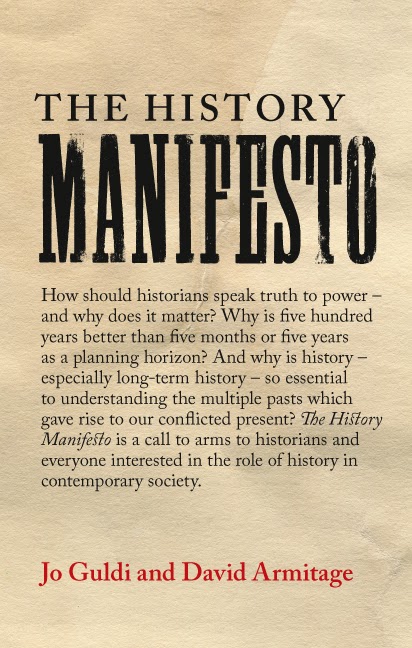
Cambridge University Press has just published a new book called The History Manifesto by Jo Guldi (Assistant Professor, Brown University) and David Armitage (Chair of Harvard’s History Department). In a nutshell, the book argues that historians have lost their public relevance by writing histories of the “short term” — essentially “micro-scale” histories — when they could be writing bigger, deeper histories, covering longer periods of time, that help readers put our world into perspective. What Guldi and Armitage are calling for is a return to long, meaningful narratives and big-picture thinking — the kind of thinking that could perhaps pull the historical profession out of crisis. As someone who got his PhD in History during the “micro-scale” era, all I can say is — amen to that.
Print editions of The History Manifesto will come out in November. But you can already read the entire work online in both html and PDF formats. The book has been released under a Creative Commons license.
H/T @NathanVM
Related Content:
Download 78 Free Online History Courses: From Ancient Greece to The Modern World
800 Free eBooks for iPad, Kindle & Other Devices
Download the “Great American Comic Sci Fi Novel,” Buddy Holly is Alive and Well on Ganymede
Harvard’s David Damrosch Presents “Introduction to World Literature” (Free Course)
Read More...Download the “Great American Comic Sci Fi Novel,” Buddy Holly is Alive and Well on Ganymede
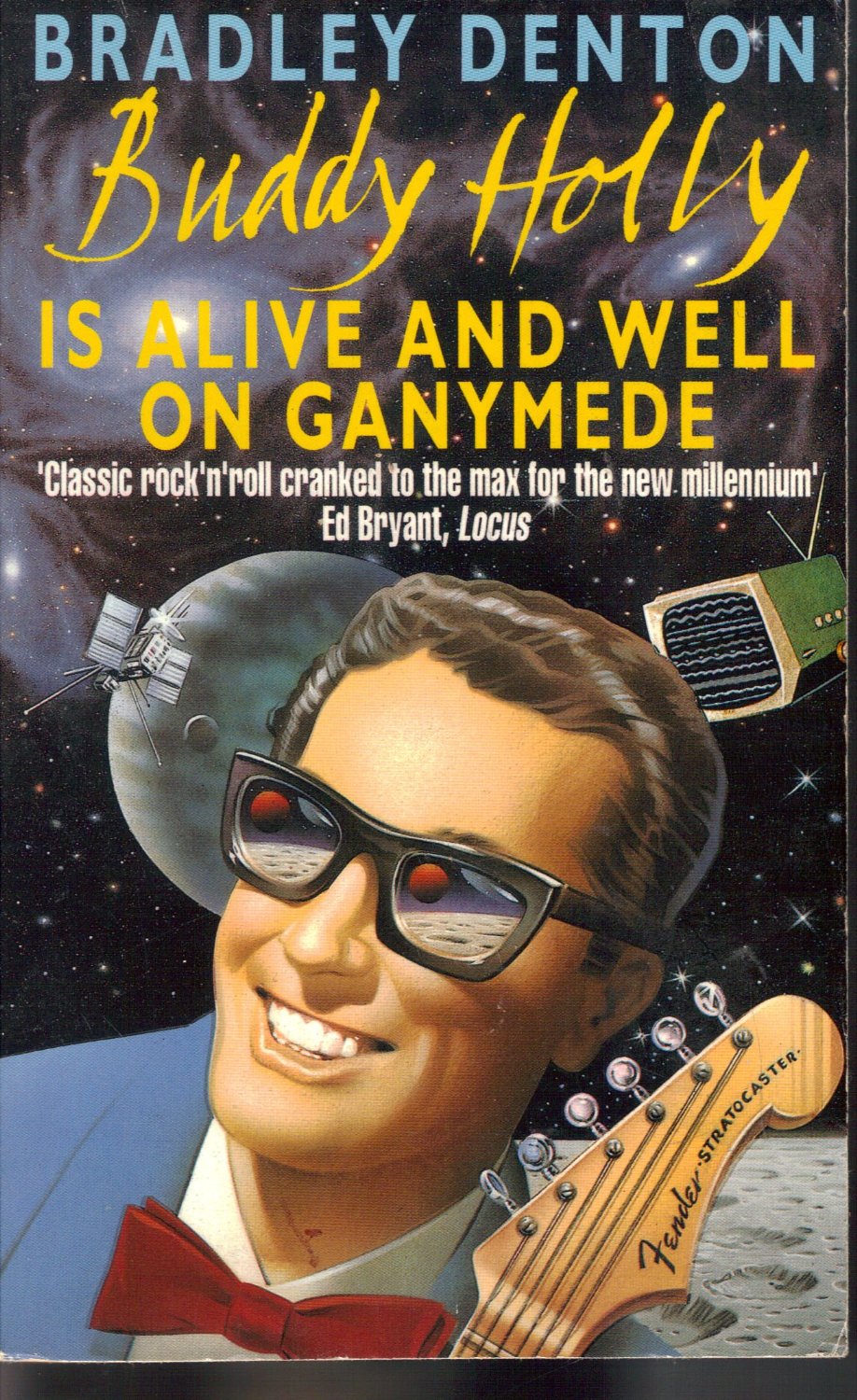
Back in 1991, Bradley Denton published Buddy Holly is Alive and Well on Ganymede. The next year, it won the John W. Campbell Memorial Award for Best Science Fiction Novel.
Writes Cory Doctorow on BoingBoing, Buddy Holly is Alive and Well on Ganymede “is the great American comic science fiction novel, a book about the quest to exhume Buddy Holly’s corpse from Lubbock, TX to prove that he can’t possibly be broadcasting an all-powerful jamming signal from a hermetically sealed bubble on a distant, airless moon.”
Taking advantage of new innovations (new since 1991), Denton has made the novel available for free download on his website, publishing it under a Creative Commons Attribution-NonCommercial-NoDerivatives license. You can access the text in four parts here: Part 1, Part 2, Part 3, Part 4.
If you become a fan, keep an eye out for a film adaptation of the novel starring Jon Heder. It’s been in development for some time, but you can watch a trailer online.
Buddy Holly is Alive and Well on Ganymede will be added to our collection, 800 Free eBooks for iPad, Kindle & Other Devices.
You can find more free sci-fi below:
Free Science Fiction Classics on the Web: Huxley, Orwell, Asimov, Gaiman & Beyond
33 Sci-Fi Stories by Philip K. Dick as Free Audio Books & Free eBooks
Read Hundreds of Free Sci-Fi Stories from Asimov, Lovecraft, Bradbury, Dick, Clarke & More
The Ware Tetralogy: Free SciFi Download
Read More...Support Us
We're hoping to rely on loyal readers, rather than erratic ads. Please click the Donate button and support Open Culture. You can use Paypal, Venmo, Patreon, even Crypto! We thank you!

About Us

Open Culture scours the web for the best educational media. We find the free courses and audio books you need, the language lessons & educational videos you want, and plenty of enlightenment in between.
Advertise With Us

FREE UPDATES!
GET OUR DAILY EMAIL
Get the best cultural and educational resources on the web curated for you in a daily email. We never spam. Unsubscribe at any time.
FOLLOW ON SOCIAL MEDIA

Open Culture editor Dan Colman scours the web for the best educational media. He finds the free courses and audio books you need, the language lessons & movies you want, and plenty of enlightenment in between.
Advertise With Us

