Allen Ginsberg & The Clash Perform the Punk Poem “Capitol Air,” Live Onstage in Times Square (1981)
The Clash had been called sellouts ever since they signed with CBS and made their 1977 debut, so the charge was pretty stale when certain critics lobbed it at their turn to disco-flavored new wave and “arena rock” in 1982’s popular Combat Rock. As Allmusic writes of the record, “if this album is, as it has often been claimed, the Clash’s sellout effort, it’s a very strange way to sell out.” Combat Rock’s hits—“Rock the Casbah” and “Should I Stay or Should I Go”—are catchy and anthemic, respectively, but this hardly breaks new stylistic ground, though the sounds are cleaner and the influences more diffuse. But the true standouts for my money—“Straight to Hell” and “Ghetto Defendant”—perfect the strain of reggae-punk The Clash had made their career-long experiment.
The latter track, a midtempo dub take on the pathos of heroin addiction and underclass angst, features a cameo spoken-word vocal from Allen Ginsberg, who co-wrote the song with Joe Strummer. Far from simply lending the song Beat cred—as Burroughs would for a string of artists, to varying degrees of artistic success—the Ginsberg appearance feels positively essential, such that the poet joined the band on stage during the New York leg of their tour in support of the album.
But before “Ghetto Defendant,” there was “Capitol Air,” a composition of Ginsberg’s own that he performed impromptu with the band in New York in 1981. As Ginsberg tells it, he joined the band backstage during one of their 17 shows at Bonds Club in Times Square during the Sandinista tour. Strummer invited the poet onstage to riff on Central American politics, and Ginsberg instead taught the band his very own punk song, which after 5 minutes of rehearsal, they took to the stage and played.
Just above, hear that onetime live performance of “Capitol Air,” one of those anti-authoritarian rants Ginsberg turned into an art form all its own—ripping capitalists, communists, bureaucrats, and the police state—as the band backs him up with a chugging three-chord jam. Ginsberg wrote the song, according to the Allen Ginsberg Project, in 1980, after returning from Yugoslavia and “realizing that police bureaucracies in America and in Eastern Europe were the same, mirror images of each other finally,” a feeling captured in the lines “No Hope Communism, No Hope Capitalism, Yeah. Everybody is lying on both sides.” Many of these same themes worked their way into “Ghetto Defendant,” written and recorded six months later.
Here you can hear the Combat Rock album version of “Ghetto Defendant.” (The track appeared in longer form on the record’s first, unreleased, incarnation, Rat Patrol From Fort Bragg). Ginsberg’s contributions to the track, which he intones as “the voice of God,” match his free-associative dark humor against Strummer’s narrative concreteness. Off the wall hipster lines like “Hooked on necropolis,” “Do the worm on the acropolis” and “Slamdance the cosmopolis” become elliptical references to Arthur Rimbaud, Salvadorian death squads, and Afghanistan before Ginsberg launches into the Buddhist heart sutra over Strummer’s final chorus. The effect is comic, hypnotic, and disorienting, reminiscent of the sample-based electronic collages groups like Cabaret Voltaire and Throbbing Gristle constructed around the same time. It’s such a perfect symbiosis that the song loses much of its impact without Ginsberg’s nutty offerings, I think, though you can judge for yourself in the live, Ginsberg-less version below.
Related Content:
The First Recording of Allen Ginsberg Reading “Howl” (1956)
William S. Burroughs “Sings” R.E.M. and The Doors, Backed by the Original Bands
Josh Jones is a writer and musician based in Durham, NC. Follow him at @jdmagness
Read More...The Modern-Day Philosophers Podcast: Where Comedians Like Carl Reiner & Artie Lange Discuss Schopenhauer & Maimonides
The Partially Examined Life, The History of Philosophy Without Any Gaps, Philosophy Bites, Philosophize This!: we’ve featured quite a few entertaining and educational fruits of the still-new discipline of podcasting’s inclination toward the very old discipline of philosophy. But the podcast has proven an even better fit for comedians than it has for philosophers. Even if you’ve never downloaded an episode in your life, you’ve almost certainly heard about the medium-legitimizing successes of intelligent, conversational, highly opinionated, or otherwise unconventional funnymen like Ricky Gervais with The Ricky Gervais Show, Adam Carolla with his also-eponymous podcast, and Marc Maron with WTF. Yet nobody dared to explicitly cross podcasting’s comedic and philosophical strengths until last year, when Danny Lobell launched Modern Day Philosophers (web site — itunes — soundcloud).
Lobell, himself a pioneer in not just philosophical comedy podcasting but comedy podcasting, and indeed podcasting itself, began his comic-interviewing show Comical Radio a decade ago. “As podcasting grew in popularity,” he writes, “many celebrity comedians started doing similar shows to the one I was doing. [ … ] Before I knew it, what I had once felt was a unique and important undertaking now no longer seemed like it served a purpose in the universe for me.” This dark night of the soul saw him move from New York to Los Angeles, this cradle of so many podcasts comedic and otherwise, where he turned his attention back toward the subjects he neglected in school. He paid special attention to philosophy, but struggled to understand the material. “I realized that my friends, stand up comedians, would make great study partners. I’ve often heard us referred to as the philosophers of our day which I figured sounded like a good enough excuse to approach them.”
And so Lobell has produced 40 episodes and counting featuring philosophical discussions conducted with some of today’s sharpest comics, many of them star podcasters in their own right. One recent conversation finds Lobell in conversation about John Cage — a philosophical figure too often dismissed as primarily an artist — with the cerebral, chance-oriented, and somewhat askew Reggie Watts (top). (The pairing makes especially good sense, since Cage influenced Brian Eno, and Watts has publicly discussed Eno’s influence on his own act.) A few months ago, Lobell talked the suicide-minded Arthur Schopenhauer with the once-suicide-minded Artie Lange (middle). And he even brings in elder statesmen of comedy to talk about matters eternal, such as Carl Reiner on religion, prayer and memory as reflected upon by Maimonides (above). Each episode contains a healthy consideration of not just the work of the philosopher in question, but that of the comedian as well. Personally, I can’t wait to hear what Yakov Smirnoff has to say about his fellow Russian artist-philosopher of note, Fyodor Dostoyevsky.
H/T Mark Linsenmayer, a founder of Partially Examined Life
Related Content:
The Partially Examined Life: A Philosophy Podcast
The History of Philosophy Without Any Gaps – Peter Adamson’s Podcast Still Going Strong
Philosophy Bites: Podcasting Ideas From Plato to Singularity Since 2007
Download 100 Free Philosophy Courses and Start Living the Examined Life
Take First-Class Philosophy Courses Anywhere with Free Oxford Podcasts
Colin Marshall hosts and produces Notebook on Cities and Culture and writes essays on cities, language, Asia, and men’s style. He’s at work on a book about Los Angeles, A Los Angeles Primer. Follow him on Twitter at @colinmarshall or on Facebook.
Read More...Hear Roland Barthes Present His 40-Hour Course, La Préparation du roman, in French (1978–80)
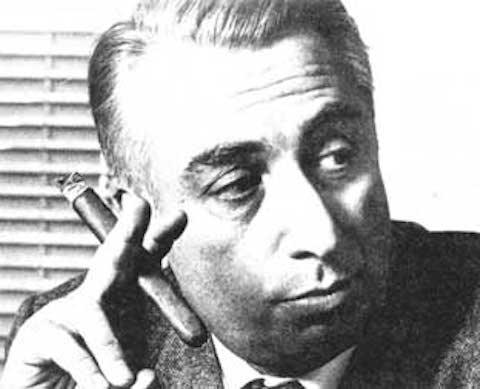
A key figure in such academic areas as semiology, structuralism, and post-structuralism, and author of such theoretical classics as Mythologies, The Pleasure of the Text, and S/Z, Roland Barthes is familiar to students across the humanities. His prolific output encompassed books on literary theory, philosophy, linguistics, anthropology, and theoretical essays on photography, music, fashion, sports, and love. In addition to his wide-ranging writings, Barthes lectured in the U.S., Switzerland, and at the Collège de France, where he was elected Chair of Semiology in 1977.
Barthes’ 1978–1980 lecture course at the Collège de France—titled The Preparation of the Novel—has been preserved in an English translation by Kate Briggs. Speakers of French, however, can hear Barthes himself deliver the lecture series in audio archived at Ubuweb. Listen to the first session from December, 1978 at the top of the post, and hear the fifth, with some musical accompaniment, above.
Delivered shortly after publication of the seminal texts mentioned above, these lectures, writes editor Nathalie Léger in her introduction, “form a diptych—the two parts can be accessed independently of each other, yet each one is indispensable to the other.” The last two lecture courses Barthes taught at the Collège de France, both, Léger writes, represent not a systematic theory, but “the peregrination of a quest,” exploring “one question and one question only: that of literary utopia.” Such probing investigations propelled Barthes’ entire career, and opened up new critical paths for a great many thinkers who dared to trace his winding intellectual steps and often intensely personal explorations.
La Préparation du roman will be added to our list of Free Online Literature Courses, part of our larger collection, 1,700 Free Online Courses from Top Universities.
Related Content:
Susan Sontag Lectures On Literary Pornography (1964)
Walter Kaufmann’s Classic Lectures on Nietzsche, Kierkegaard and Sartre (1960)
Josh Jones is a writer and musician based in Durham, NC. Follow him at @jdmagness
Read More...Fritz Lang’s Metropolis Restored with a Soundtrack Featuring Freddie Mercury, Adam Ant & Pat Benatar
At the 1984 Cannes Film Festival, disco trailblazer and Oscar-winning composer Giorgio Moroder unveiled a restored version of Fritz Lang’s 1927 silent epic Metropolis — the first time that the groundbreaking movie had been restored since it premiered. Though Moroder labored for years with some of the leading archivists in the world to create the most complete version of the film to date, his adaptation also streamlined the movie’s storyline, added sound effects, colorized the movie’s monochrome picture and, most controversially, added a synth pop soundtrack featuring music by Pat Benatar, Billy Squier, Adam Ant and Freddie Mercury. You can watch it above.
The resulting film, as you might expect, is a profoundly odd collision between pop and art. Lang’s pungent imagery exists uneasily alongside Moroder’s MTV treatment. Critic Thomas Elsaesser in his BFI booklet on the movie called Moroder’s version “somewhere between a remake and a post-modern appropriation.” And though the songs are uniformly cringe-inducing – to say that they didn’t age well is a big understatement — Moroder’s version still works.
The reason that Lang’s movie influenced filmmakers from George Lucas to Terry Gilliam to Stanley Kubrick is because of its visual brilliance, not because of its story. The script, penned by Lang’s wife and future Nazi Party propagandist, Thea von Harbou, is stuffed full of allusions to Frankenstein and German folktales along with plenty of maudlin melodrama. But Lang’s high modernist visuals – evoking both the Bauhaus movement and Henry Ford’s new brand of industrialism – transcended the movie’s story, becoming a lasting vision of totalitarian dystopia.
In 2010, a painstakingly researched “complete” version of Metropolis came out, clocking in at almost three hours. It might be an achievement of film preservation but, compared to Moroder’s version, it shows how bloated and meandering Von Harbou’s script was. Moroder’s more svelte version might be cheesy, but at least it’s fun. The great film critic Pauline Kael described Lang’s movie as “a wonderful, stupefying folly.” Moroder’s version is a folly on top of a folly.
Related Content:
Metropolis Restored: Watch a New Version of Fritz Lang’s Masterpiece
Fritz Lang’s “Licentious, Profane, Obscure” Noir Film, Scarlet Street (1945)
Free Film Noir Movies (34 Films in Total)
Jonathan Crow is a Los Angeles-based writer and filmmaker whose work has appeared in Yahoo!, The Hollywood Reporter, and other publications. You can follow him at @jonccrow. And check out his blog Veeptopus, featuring pictures of vice presidents with octopuses on their heads.
Read More...Experience James Joyce’s Ulysses in Virtual Reality, Using the Oculus Rift Headset
If, like Virginia Woolf, you could never read James Joyce’s Ulysses from start to finish, then here’s another way to experience the modernist classic. Virtually rather than textually. According to The Creator’s Project, “an Irish filmmaker named Eoghan Kidney is designing a virtual reality video game that uses an Oculus Rift headset to put the player in the shoes of Stephen Dedalus as he meanders through Dublin on June 16th, 1904.” On his Fundit page and in the video above, Mr. Kidney (not to be confused with Leopold Bloom’s burnt kidney breakfast) gives us an example of how the “In Ulysses” project will work:
My “In Ulysses” project is another way of experiencing the book — this time, using the virtual format. It will be a virtual reality videogame that will allow a user to inhabit the characters of Ulysses and experience the density of Joyce’s language in a fun and accessible way.…
As a user of “In Ulysses” walks along a virtual Sandymount Strand, the book will be read to them — they will hear Stephen’s thoughts as they are written — but these thoughts will then be illustrated around the user in real-time using textual annotations, images and links. A user can stop walking (therefore stopping Stephen walking) and explore these illustrations, gaining insight into the book and adding to the enjoyment of it.
“In Ulysses” has already raised €4000, enough to fund its prototype. No target date for its release has been announced. And, from what I can tell, the consumer version of the Oculus Rift won’t be released until next year. So, like any good reader of Ulysses, you’ll need to have a little patience.
H/T Eric O.
Related Content:
Find Ulysses in our collections of Free eBooks and Free Audio Books
Read Joyce’s Ulysses Line by Line, for the Next 22 Years, with Frank Delaney’s Podcast
Read Ulysses Seen, A Graphic Novel Adaptation of James Joyce’s Classic
James Joyce Reads From Ulysses and Finnegans Wake In His Only Two Recordings (1924/1929)
Read More...Watch World War I Unfold in a 6 Minute Time-Lapse Film: Every Day From 1914 to 1918
World War I began 100 years ago, on 28 July 1914. The initial trigger, the assassination of Archduke Franz Ferdinand of Austria, produced something of a “domino effect,” where European powers, bound by pre-existing international alliances, chose sides and fell rather obviously into a catastrophic war. It started as a European war, pitting Allied powers against Central powers. But, soon enough, it became international, involving a long list of countries from Africa, North and South America, Asia, and Australasia. The trench warfare that became such an important part of World War I ensured that the battle lines moved ever so slowly, at least until the final stages of the war. That grinding quality gets captured remarkably well by EmperorTigerstar’s latest YouTube video, “World War I: Every Day,” which shows “the changing front lines of World War I every day from Austria-Hungary’s declaration of war to the armistice of November 11, 1918.” It also includes the changing front lines in Africa and the Pacific. (A legend, below, will help you sort out the various different players.) When you’re done watching “World War I: Every Day” (above), you’ll perhaps want to spend time with EmperorTigerstar’s previous video, “World War II in Europe: Every Day,” which documents an even bloodier war unfolding at a dramatic pace.
Legend:
Maroon = Central Powers and annexed lands.
Burgundy = Areas militarily occupied by the Central Powers.
Red = Central Power puppet or client states.
Brown = Central Powers in an armistice.
Pink = Central Power gains for that day.
Dark blue = Allied powers.
Blue = Central Powered lands militarily occupied by the Allies.
Blue-grey = Allied powers in an armistice.
Light blue = Allied gains for that day.
Related Content:
Watch World War II Rage Across Europe in a 7 Minute Time-Lapse Film: Every Day From 1939 to 1945
Download 78 Free Online History Courses: From Ancient Greece to The Modern World
British Actors Read Poignant Poetry from World War I
Frank W. Buckles, The Last U.S. Veteran of World War I
Read More...Learn How Crayons Are Made, Courtesy of 1980s Videos by Sesame Street and Mr. Rogers
Some things are difficult to improve upon. Take crayons. The new generation may be clamoring for shades like “mango tango” and “jazzberry jam” but the actual technology appears unchanged since Sesame Street detailed the process in the early 80s, in the lovely, non verbal documentary above. Not a product placement in sight, I might add, though few can mistake that familiar green and gold box.
Those who prefer a bit more explanation might prefer Fred Rogers’ hypnotic step-by-step guide, playing in perpetuity on Picture Picture.
By the time the industry’s giant gorilla got around to weighing in, the wooden collection boxes and analog counters had been replaced, but otherwise, it’s still business as usual on the ol’ crayon-manufacturing floor. Don’t expect to find the recipe for the “secret proprietary blend of pigments and other ingredients” any time soon. Just know they’re capable of cranking out 8500 crayons per minute. For those playing along at home, that’s enough to encircle the globe 6 times per calendar year, with a full third owing their existence to solar energy.
There’s a Homeland Security-ish vibe to some of the dialogue, but the Life of an American Crayon, above, does our native assembly lines proud. Prouder than the American slaughterhouse, anyway, or some other factory floors, I could name. The workers seem content enough to stay in their positions for decades, happily declaring allegiance to this or that hue.
Related Content:
Philip Glass Composes for Sesame Street (1979)
How Animated Cartoons Are Made: Watch a Short, Charming Primer from 1919
Ayun Halliday is an author, homeschooler, and Chief Primatologist of the East Village Inky zine. Follow her @AyunHalliday
Read More...
Greek Myth Comix Presents Homer’s Iliad & Odyssey Using Stick-Man Drawings
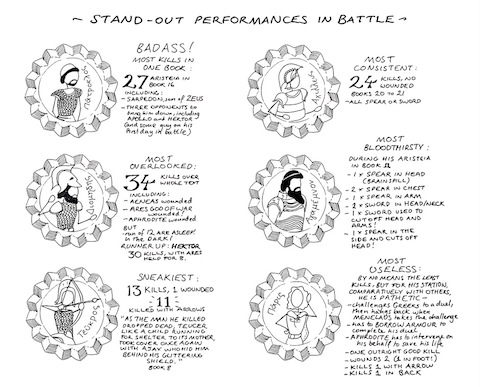
The next time some know-it-all moralist blames any number of social ills on violent video games or action films, ask them if they’d rather kids stick to the classics. When they invariably reply in the affirmative, you can smugly direct their attention to Greek Myth Comix’s astonishing infographic detailing the multitude of gruesome killings in the Iliad. Homer’s epic unflinchingly describes, for example, in graphic detail, the death of Lycon, who in Book 16 has a sword thrust through his neck: “nothing held but a piece of skin, and from that, Lycon’s head dangled down.” And if you’ve held on to your lunch, you may be interested to know the grisly circumstances of the other two candidates for “grimmest death.” Just below, see a section of the comic celebrating “stand out performances in battle.” Can Zack Snyder’s King Leonidas match kills with Homer’s Achilles? Only one way to find out….
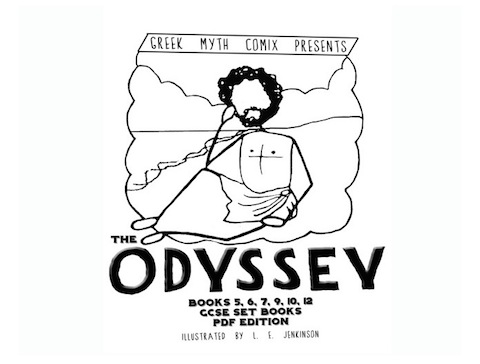
The Iliad graphic is great fun—as well as a succinct way to render modern scolds speechless—but Greek Myth Comix doesn’t stop there… Oh no! Fans of Homer’s Odyssey will not be disappointed; Books 5–7, and much of 9, 10, and 12 also get the “comix” treatment. The artwork is admittedly crude, but the text comes from a much more authoritative source than 300, no disrespect to Frank Miller. Lauren Jenkinson is a “Classical Civilisation and Literature teacher, writer and, apparently, artist,” and her online adaptations are intended primarily to help students pass their GCSE (OCR), the British secondary exams whose nearest equivalent in the States might perhaps be the SATs.
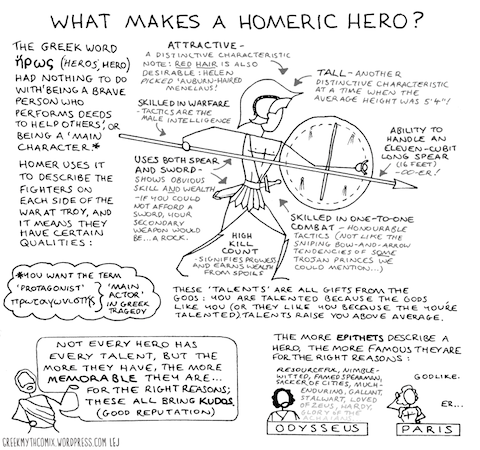
But Greek Myth Comix won’t only appeal to struggling students in the British Isles. Educators will find much to love here, as will lovers of mythology in general. Online access to the site is free, and you can purchase copies of the comix in PDF—either individually, in bulk, or in poster-size resolution. The site’s full archive has other goodies like the above, “What Makes a Homeric Hero?” And with such recent updates, no doubt Greek Myth Comix has much more in store for those struggling to enjoy or understand Homer’s bloody-minded epics, and those who simply love their myths in comic form as well as ancient lyric.
via HolyKaw
Related Content:
The History of Economics & Economic Theory Explained with Comics, Starting with Adam Smith
What’s Next for the Large Hadron Collider? PhD Comics Introduces the Search for Extra Dimensions
A Short History of America, According to the Irreverent Comic Satirist Robert Crumb
Josh Jones is a writer and musician based in Durham, NC. Follow him at @jdmagness
Read More...Ubu Roi: Alfred Jarry’s Scandalous Play Strikingly Adapted for Television (1965)
“Merdre,” the very first word spoken in Alfred Jarry’s Ubu Roi, needs no introduction. When it first opened — and closed — on stage in 1896, it didn’t have to do much more than that to get its audience worked up. As soon as this hyper-vulgar satire of the powerful came to its deliberately undramatic end, a “riot” broke out, history books invariably note. Something in Jarry’s tale of the savage, infantile, and all-desiring royalty of the title touched a nerve, and the Surrealist and Theatre of the Absurd movements that followed would strive to keep on touching it. But the strange, low-minded Ubu Roi and its sequels would, while no longer liable to prompt fisticuffs, retain a kind of power over the next century and beyond. That legacy is visible even in French political discourse, where the insult “Ubuesque” tends to get thrown around to describe a certain impulsive, self-satisfying kind of public figure.
Jean-Christopher Averty’s television production of Ubu Roi above first aired in 1965. Its content, presumably by then familiar enough to the viewing audience, no longer shocked, but its aesthetic choices still look striking today. “I can almost guarantee you will never see another film that looks even remotely like this,” says The Sick, the Strange, and the Awful. It “dispels any types of camera panning, zooms and even moving the camera at all,” placing, “at any one time, three, four, six different mini-scenes onscreen, all interacting with each other in bizarre ways. Characters will pass things to each other, and the item will change size depending on where the camera is. It’s visually disorientating, and cool as hell.” The simply attired characters against backgrounds reduced to their most basic elements (when not just a black void) retain the theatricality of the material, but it all comes together visually with the kind of optical effects that had only recently become possible. Jarry’s daring presaged the era of anything-goes theatre; only natural that his work would go on to explore the limitless visual possibilities opened at the dawn of the video age. But if it started any riots in middle-class French living rooms, history has left them unrecorded.
Related Content:
David Lynch Presents the History of Surrealist Film (1987)
Un Chien Andalou: Revisiting Buñuel and Dalí’s Surrealist Film
The Hearts of Age: Orson Welles’ Surrealist First Film (1934)
Man Ray and the Cinéma Pur: Four Surrealist Films From the 1920s
Colin Marshall hosts and produces Notebook on Cities and Culture and writes essays on cities, language, Asia, and men’s style. He’s at work on a book about Los Angeles, A Los Angeles Primer. Follow him on Twitter at @colinmarshall or on Facebook.
Read More...The Touching Moment When Nicholas Winton (RIP) Met the Children He Saved During the Holocaust
Note: This post was originally published on July 27, 2014. Mr. Winton sadly passed away today (7/1/2015). He was 106 years old. Read his obituary, which documents his amazing deeds, here.
Procrastinators take note.
Some teens of my acquaintance have been agitating for a meeting with a Holocaust survivor. These encounters, common enough in my childhood, are growing less so as those with firsthand knowledge enter their golden years. Bear in mind that Eva Lavi, the youngest person named on Oskar Schindler’s List, is now 76.
Sir Nicholas Winton is definitely an inspiring figure, and not just for his remarkable longevity. From late 1938 until the start of the war, he managed to rescue 669 Czech children—most of them Jews.
Winton made no public mention of his heroics, until 1988, when the BBC obtained his rescue scrapbook and used it to coordinate a massive live on-air surprise during the program That’s Life (see above).
I plan on using the 60 Minutes episode below to introduce my teen friends—most of whom stoutly declare they’d have hidden Anne Frank without a second thought—to a man whose actions speak louder than words.
via Holy Kaw
Related Content:
Alice Herz-Sommer, the Oldest Holocaust Survivor (Thanks to the Power of Music), Dies at 110
Rudolf Brazda, Last Man to Wear the Pink Triangle During the Holocaust, Tells His Story
Anne Frank: The Only Existing Video Now Online
Ayun Halliday is an author, homeschooler, and Chief Primatologist of the East Village Inky zine. Follow her @AyunHalliday
Read More...Support Us
We're hoping to rely on loyal readers, rather than erratic ads. Please click the Donate button and support Open Culture. You can use Paypal, Venmo, Patreon, even Crypto! We thank you!

About Us

Open Culture scours the web for the best educational media. We find the free courses and audio books you need, the language lessons & educational videos you want, and plenty of enlightenment in between.
Advertise With Us

FREE UPDATES!
GET OUR DAILY EMAIL
Get the best cultural and educational resources on the web curated for you in a daily email. We never spam. Unsubscribe at any time.
FOLLOW ON SOCIAL MEDIA

Open Culture editor Dan Colman scours the web for the best educational media. He finds the free courses and audio books you need, the language lessons & movies you want, and plenty of enlightenment in between.
Advertise With Us

