Andy Warhol’s Lost Computer Art Found on 30-Year-Old Floppy Disks

If you saw our post on Andy Warhol digitally painting Debbie Harry at the 1985 launch of the Commodore Amiga 1000, you know how effusively — effusively by the impassive Warholian standard, anyway — the artist praised the computer’s artistic power. Now, thanks to a recent discovery by members of Carnegie Mellon University’s Computer Club, we know for sure that the mastermind behind the Factory didn’t simply shill for Commodore; he actually spent time creating work with their then-graphically advanced machine, a few pieces of which, unseen for nearly thirty years, just came back to light on monitors everywhere. Above we have the 1985 self-portrait Andy2. The 27 other finds include a mouse-drawn rendition of his signature Campbell’s soup can and a three-eyed Venus, surely one of the eerier early uses of cut-and-paste functionality, all products, explains the press release from The Frank-Ratchye STUDIO for Creative Inquiry at Carnegie Mellon,” of a commission by Commodore International to demonstrate the graphic arts capabilities of the Amiga 1000 personal computer.”

1980s electronics-loving artist Cory Arcangel, upon watching the video of Warhol at the launch, contacted the Andy Warhol Museum “regarding the possibility of restoring the Amiga hardware in the museum’s possession.” The effort necessitated acts of “forensic retrocomputing” — a delicate process, since “even reading the data from the diskettes entailed significant risk to the contents.” The CMU Computer Club team even had to reverse-engineer the “completely unknown file format” in which Warhol had saved his images. “By looking at these images, we can see how quickly Warhol seemed to intuit the essence of what it meant to express oneself, in what then was a brand-new medium: the digital,” Arcangel says in the press release. “FYI, it was the most fun project I ever worked on,” he says on his blog — a meaningful statement indeed, since so much of his other work involves old Nintendo games. The Hillman Photography Initiative captured it all in a film called Trapped: Andy Warhol’s Amiga Experiments, which premieres Saturday, May 10, at Pittsburgh’s Carnegie Library Lecture Hall, thereafter becoming viewable at nowseethis.org.
Related Content:
Andy Warhol Digitally Paints Debbie Harry with the Amiga 1000 Computer (1985)
Warhol’s Screen Tests: Lou Reed, Dennis Hopper, Nico, and More
Three “Anti-Films” by Andy Warhol: Sleep, Eat & Kiss
Colin Marshall hosts and produces Notebook on Cities and Culture and writes essays on cities, language, Asia, and men’s style. He’s at work on a book about Los Angeles, A Los Angeles Primer. Follow him on Twitter at @colinmarshall or on Facebook.
Read More...Curious Alice — The 1971 Anti-Drug Movie Based on Alice in Wonderland That Made Drugs Look Like Fun
The Reagan presidency was probably the golden age of anti-drug messaging. America’s school kids were told that a brain was like an egg and drugs were like a frying pan. The First Lady told America’s school kids simply to “Just Say No.” The message was stupefyingly simple. Drugs, like Communism and taxes, are bad.
During the early 1970s, however, that anti-drug message was much more confused. Take for example Curious Alice, a visually stunning, deeply odd movie about the perils of drug abuse that makes the stuff look like a lot of fun. Created by the National Institute of Mental Health in 1971, the film shows young Alice reading Lewis Carroll’s Alice in Wonderland in a sunny dappled meadow before nodding off. She soon finds herself plunging down the rabbit hole and in a wonderland … of drugs. The King of Hearts is hawking heroin. The Mad Hatter is tripping balls on LSD. The hookah-smoking Caterpillar is stoned out of his gourd. The Dormouse is in a barbiturate-induced stupor and the March Hare, who looks like the Trix Bunny’s ne’er-do-well brother, is a fidgeting tweaker. “You oughta have some pep pills! Uppers!” he exclaims. “Amphetamines! Speed! You feel super good.”
The movie was reportedly intended for eight year-olds. While it’s unlikely that your average third grader is going to absorb Alice’s moralizing about acid, they will almost certainly respond to the film’s trippy, Monty Pythonesque animation. The animators clearly had a blast making this movie, but their efforts didn’t exactly translate into an effective message. After the movie came out, the National Coordinating Council on Drug Education slammed the movie, calling it confusing and counterproductive.
As an adult, however, the movie is a lot of fun. So check it out above. And if you live in either Colorado or Washington, feel free to enjoy the movie in a state that it is probably best appreciated.
Related Content:
Artist Draws Nine Portraits on LSD During 1950s Research Experiment
Alice in Wonderland: The Original 1903 Film Adaptation
Jonathan Crow is a Los Angeles-based writer and filmmaker whose work has appeared in Yahoo!, The Hollywood Reporter, and other publications. You can follow him at @jonccrow.
Read More...Who Are the Most Pernicious Thinkers? A List of Five Bad Western Philosophers: Name Your Own

Over at his blog Leiter Reports, UC Chicago professor of philosophy Brian Leiter is currently conducting a very interesting poll, asking his readers to rank the 25 philosophers of “the modern era” (the last 200 years) who “have had the most pernicious influence on philosophy.” The pool of candidates comes from an earlier survey of influential philosophers, and Leiter has imposed some conditions on his respondents, asking that they only rank philosophers they have read, and only include “serious philosophers”–“no charlatans like Derrida or amateurs like Rand.” While I personally wince at Leiter’s Derrida jab (and cheer his exclusion of Rand), I think his question may be a little too academic, his field perhaps too narrow.
But the polemical idea is so compelling that I felt it worth adopting for a broader informal survey: contra Leiter, I’ve ranked five philosophers who I think have had a most pernicious influence on the world at large. I’m limiting my own choices to Western philosophers, with which I’m most familiar, though obviously by my first choice, you can tell I’ve expanded the temporal parameters. And in sporting listicle fashion, I’ve not only made a ranking, but I’ve blurbed each of my choices, inspired by this fun Neatorama post, “9 Bad Boys of Philosophy.”
While that list uses “bad” in the Michael Jackson sense, I mean it in the sense of Leiter’s “pernicious.” And though I would also include the proviso that only “serious” thinkers warrant inclusion, I don’t think this necessarily rules out anyone on the basis of academic canons of taste. One might as well include C.S. Lewis as Jean Baudrillard, both of whom tend to get dismissed in most philosophy departments. My own list surely reveals my anti-authoritarian biases, just as some others may rail at fuzzy thinking with a list of postmodernists, or socialism with a list of Marxists. This is as it should be. Defining the “bad,” after all, is bound to be a highly subjective exercise, and one about which we can and should disagree, civilly but vigorously. So with no more ado, here are my five choices for “Most Pernicious Western Philosophers.” I invite—nay urge you—to make your own lists in the comments, with explanations terse or prolix as you see fit.
The Dominican friar and author of the near-unreadably dense Summa Theologica made it his life’s work to harmonize logical Aristotelian thought and mystical Christian theology, to the detriment of both. While for Aquinas and his medieval contemporaries, natural theology represents an early attempt at empiricism, the emphasis on the “theology” meant that the West has endured centuries of spurious “proofs” of God’s existence and completely incomprehensible rationalizations of the Trinity, the virgin birth, and other miraculous tales that have no analogue in observable phenomena.
Like many church fathers before him, Thomas’s employment as a kind of Grand Inquisitor of heretics and a codifier of dogma makes me all the more averse to his thought, though much of it is admittedly of great historical import.
2. Carl Schmitt
Schmitt was a Nazi, which—as in the case of Martin Heidegger—strangely hasn’t disqualified his thought from serious appraisal across the political spectrum. But some of Schmitt’s ideas—or at least their application—are particularly troubling even when fully divorced from his personal politics. Schmitt theorized that sovereign rulers, or dictators, emerge in a “state of exception”—a security crisis with which a democratic society cannot seem to cope, but which is ripe for exploitation by domineering individuals. These “states” can legitimately appear at any time, or can be ginned up by unscrupulous rulers. The crucial insight has inspired such leftist thinkers as Walter Benjamin and theorists on the right like Leo Strauss. Its political effects are something altogether different. Writes Scott Horton in Harper’s:
It was Schmitt who, as the crown jurist of the new Nazi regime, provided the essential road map for Gleichschaltung – the leveling of opposition within Germany’s vast bureaucracy – and it was he who provided the legal tools used to transform the Weimar democracy into the Nazi nightmare that followed it.
This same road map—many have alleged—guided the unilateral suspensions of constitutional protections and human rights protocols machinated by Bush and Cheney’s Neoconservative legal advisors after 9/11, who read Schmitt thoroughly. (I intend here no direct comparison whatever between these two regimes, Godwin willing.)
3. John Locke
Though he wrote copiously on epistemology, religious toleration, education, and all sorts of other important topics, Locke is often remembered as everyone’s favorite liberal political philosopher. His anonymously published Two Treatises of Government has had an outsized influence on most modern democratic constitutions, and given his primary antagonist in the first part of that work—Sir Robert Filmer, staunch defender of the divine right of kings and natural hierarchies—Locke seems positively progressive, what with his defense of a civil society based on respect for labor and private property against the unwarranted power and abuse of the aristocracy.
But Locke’s Filmer works as something of a straw man. Examined critically, Locke is no democratic champion but an apologist for the petty tyranny of landowners who gradually eroded the commons, displaced the commoners, and seized greater and greater tracts of land in England and the colonies under the Lockean justification that a man is entitled to as much property as he can make use of. Of course, in Locke’s time, and in our own, proprietors and landowners seize and “make use of” the resources and labor of others—slaves, indigenous people, and exploited, landless workers—in order to make their extravagant claims to private property. This kind of appropriation is also enabled by Locke’s thought, since property only justly belongs to the “industrious and the rational”— characteristics that tend to get defined against their opposites (“lazy and stupid”) in any way that suits those in power.
Another darling of Enlightenment tradition, Descartes gets all the credit for founding a philosophy on radical doubt, and thereby doing away with the presuppositional theological baggage imposed on thought by scholastics like Aquinas. And yet, like Locke, Descartes gets too easy a pass for reducing his method to terms that are by no means unequivocal or universally meaningful, though he pretends that they are.
Descartes explains his method as a means of eliminating from his mind all conceptual clutter but those ideas that seem to him “clear and distinct.” Oddly the two bedrock concepts he’s left with are an unshakeable faith in his own individual ego—or soul—and the existence of a monotheistic creator-God. Thus, Descartes’ method of radical doubt leads him to reaffirm the two most core concepts of classical Western philosophy, concepts he more or less assumes on the basis of intuition—or perhaps unexamined ideological commitments.
This is a tough one, because I actually adore Kierkegaard, but I love him as a writer, not as a philosopher. His critiques of Hegel are scathing and hilarious, his takedowns of the self-satisfied Danish petit-bourgeoisie are epic, and the tonal range and ironic deftness of his numerous literary voices—personae as diverse as desert saints and scheming seducers—are unequalled.
But I recoil from the ethical philosophy of Søren Kierkegaard, as so many people recoil from Nietzsche’s brinksmanship with traditional Christian morality. Kierkegaard’s reduction of the human experience to a false choice paradigm—“Either/Or”—, his ethics of blind irrationalism couched as a justifiable leap of faith, exemplified by his glorification of Abraham’s willingness to kill his son Isaac… these things I can’t help but find abhorrent, and if I’ve ever been tempted to read them as ironic expressions of the author’s many masks, further study has robbed me of this balm. Kierkegaard the writer offers us a great deal; Kierkegaard the moral philosopher, not so much.
So there you have my list—riddled, to be sure, with inaccuracies, prejudice, and superficial misreadings, but an honest attempt nonetheless, given my inadequate philosophical training. Again I’ll say that the inclusion of any of these five names in a list of philosophers, pernicious or no, means that I believe they are all thinkers worth reading and taking seriously to some degree, even if one violently disagrees with them or finds glaring and grievous error in the midst of seas of brilliance.
Now that you’ve read my “Five Most Pernicious Philosophers,” please tell us readers, who are yours, and why? Your griping explanations can be as short or long as you see fit, and feel free to violently disagree with my hasty judgments above. Ad hominem attacks aside, it’s all within the spirit of the enterprise.
Related Content:
Take First-Class Philosophy Courses Anywhere with Free Oxford Podcasts
Download 90 Free Philosophy Courses and Start Living the Examined Life
Josh Jones is a writer and musician based in Durham, NC. Follow him at @jdmagness.
Read More...Forrest Gump Directed by Wes Anderson: Here’s What It Would Look Like
Take Forrest Gump, the 1994 film directed by Robert Zemeckis and starring Tom Hanks. Now let’s give it a Wes Anderson makeover. That’s the exercise Louis Paquet went through above, in making a short Andersonion version of Forrest Gump’s opening credits. If you need an introduction to Anderson’s signature style, we’ve got a few helpful posts for you below.
Related Content:
Watch 7 New Video Essays on Wes Anderson’s Films: Rushmore, The Royal Tenenbaums & More
The Perfect Symmetry of Wes Anderson’s Movies
Watch Wes Anderson’s Charming New Short Film, Castello Cavalcanti, Starring Jason Schwartzman
A Glimpse Into How Wes Anderson Creatively Remixes/Recycles Scenes in His Different Films
Watch a Super Cut of Wes Anderson’s Signature Slo-Mo Shots
Read More...Take a Virtual Tour of the Dictionary Shakespeare May Have Owned and Annotated
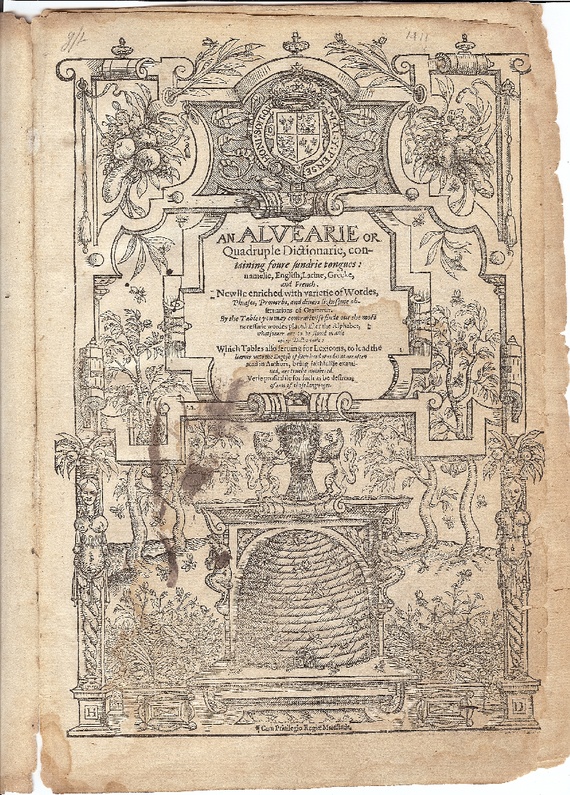
You surely heard plenty about Shakespeare’s birthday yesterday. But did you hear about Shakespeare’s beehive? No, the Bard didn’t moonlight as an apiarist, though in his main line of work as a poet and dramatist he surely had to consult his dictionary fairly often. The question of whether humanity has an identifiable copy of such an illustrious reference volume gets explored in the new book Shakespeare’s Beehive: An Annotated Elizabethan Dictionary Comes to Light by bookseller-scholars George Koppelman and Daniel Wechsler. In their study, they reveal that they may have come into possession of Shakespeare’s very own copy of Baret’s Alvearie, a popular classical quote-laden English-Latin-Greek-French dictionary the man who wrote King Lear would have found “the perfect tool, a honey-combed beehive of possibilities that may not have formed his way of thinking, but certainly fed his appetite and nourished his selection.” He would have, at least, if indeed he owned it. Some solid Shakespeare scholarship points toward his owning a copy of Baret’s Alvearie, but did he own this one, the richly annotated one these guys found on eBay?
Experts haven’t exactly stepped forward in force to back up their claim. Plausible objections include, as Adam Gopnik puts it in a (subscribers-only) New Yorker piece on this Alvearie in particular and humanity’s desire for Shakespearean artifacts in general: “the handwriting just doesn’t look like Shakespeare’s,” “since Shakespeare wrote Elizabethan English, any work of Elizabethan English is going to contain echoes of Shakespeare,” and, of all possible annotators of this particular physical book, Shakespeare “is a prime candidate only because we don’t know the names of all the other bird-loving, inquisitive readers who also liked their dabchicks and their French verbs.” Still, in a striking act of openness, Koppelman and Wechsler have made their — and Shakespeare’s? — Alvearie available for your digital perusal on their site. You have to register as a member first, but then you can draw your own conclusions about Koppelman and Weschler’s discovery — or, as even they call it, their “leap of faith.” Overenthusiastic words, perhaps, but seldom do either successful antiquarian book dealers or dedicated Shakespeare fans lack enthusiasm.
via The Atlantic
Related Content:
Discover What Shakespeare’s Handwriting Looked Like, and How It Solved a Mystery of Authorship
Read All of Shakespeare’s Plays Free Online, Courtesy of the Folger Shakespeare Library
Free Online Shakespeare Courses: Primers on the Bard from Oxford, Harvard, Berkeley & More
Colin Marshall hosts and produces Notebook on Cities and Culture and writes essays on cities, language, Asia, and men’s style. He’s at work on a book about Los Angeles, A Los Angeles Primer. Follow him on Twitter at @colinmarshall or on Facebook.
Read More...How British Codebreakers Built the First Electronic Computer

It was only a matter of time before the folks at Google Cultural Institute wandered down the road in Mountain View to visit the Computer History Museum. Together they’ve taken on a slim little subject, Revolution: The First 2000 Years of Computing
Unlike the best Cultural Institute exhibits (the fall of the Iron Curtain and the dazzling array of other art and history collections come to mind) this one doesn’t do enough to leverage video to bring the material to life. It’s a breezy little tour from the humble (but effective) abacus to punched cards, magnetic discs and the dawn of miniaturization and networking.
But nothing about how the Internet developed, leading to the Web and, now, the Internet of Everything?
I’ll admit that I learned a few things. I hadn’t heard of the design-forward Cray 1 supercomputer with its round tower (to minimize wire lengths) and bench to discretely hide power supplies. The Xerox Alto came with consumer friendly features including a mouse, email and the capacity to print exactly what was on the screen. The unfortunate acronym for this asset wasWYSIWYG (What You See Is What You Get).
I had also never heard about the Utah teapot, a picture of a gleaming white ceramic urn used for 20 years as the benchmark for realistic light, shade and color in computer-generated images.
“>http://youtu.be/amRQ-xfCuR4
More interesting, and up to the Cultural Institute’s standards, is the exhibit built in partnership with the National Museum of Computing in Buckinghamshire, England. It’s a fascinating piece of history, focusing on Hitler’s efforts to encrypt messages during the war and stump the Allied forces. He commissioned construction of a super-sophisticated machine (not Enigma, if you’re thinking of that). The machine was called Lorenz and it took encryption to an entirely new level.
“>http://youtu.be/knXWMjIA59c
British linguists and others labored to manually decipher the messages. Attempts to speed the process led to development of Colossus, the world’s first electronic comuter. The project was kept secret by the British government until 1975.
Kate Rix writes about education and digital media. Follow her on Twitter.
Read More...H.G. Wells Interviews Joseph Stalin in 1934; Declares “I Am More to The Left Than You, Mr. Stalin”
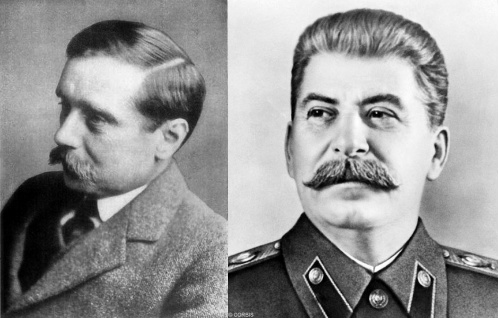
From the 20/20 point of view of the present, Joseph Stalin was one of the 20th century’s great monsters. He terrified the Soviet Union with campaign after campaign of political purges, he moved whole populations into Siberia and he arguably killed more people than Hitler. But it took decades for the scope of his crimes to get out, mostly because, unlike Hitler, Stalin stuck to killing his own people.
In early 1930s, however, Stalin was considered by many to be the leader of the future. That period was, of course, the nadir of the Great Depression. Capitalism seemed to be coming apart at the seams. The USSR promised a new society ruled not by the oligarchs of Wall Street but by the people — a society where everyone was equal.
H.G. Wells interviewed Stalin in Moscow in 1934 for the magazine The New Statesman. Wells was an avowed socialist and one of the left’s most influential authors. His first novel, The Time Machine, is essentially an allegory for class struggle after all. The interview between the two is fascinating.
Wells opens the piece by stating that he speaks for the common people. While that point is debatable — Stalin calls him out on that assertion – Wells does speak in a manner that is readily understandable. Stalin, in contrast, speaks in fluent Politburo. The blandness of his speech, choked with Communist boilerplate, seems designed to make the listener tune out. But then he drops little bon mots into his monologues that hint at the violence he has unleashed on his country. Take this line for instance:
Revolution, the substitution of one social system for another, has always been a struggle, a painful and a cruel struggle, a life-and-death struggle.
It’s a chilling line. Especially when you consider that at the time of this interview, Stalin was just starting to launch his first wave of political purges and he was plotting to assassinate his main political rival Sergei Kirov.
As the interview unfolds, you can imagine Wells growing increasingly frustrated by Stalin’s narrow, dogmatic view of the world. The Soviet leader, as Wells later wrote in his autobiography, “has little of the quick uptake of President Roosevelt and none of the subtlety and tenacity of Lenin. … His was not a free impulsive brain nor a scientifically organized brain; it was a trained Leninist-Marxist brain.”
At several points in the interview Wells challenges Stalin: “I object to this simplified classification of mankind into poor and rich,” the author fumes.
And when Stalin doesn’t agree with Wells that the Capitalist system was on its last legs, the author actually chides him for not being revolutionary enough. “It seems to me that I am more to the Left than you, Mr. Stalin; I think the old system is nearer to its end than you think.” Now that’s chutzpah.
In the end, the interview presents a dueling version of the future of the left. Wells believed, in essence, that the Capitalist world only needed to be reformed, albeit drastically, to achieve economic justice. And Stalin argued that Capitalism had to be torn down completely before any other reform could take place.
In spite of their differences, Wells left the interview with a positive impression of the Soviet leader. “I have never met a man more fair, candid, and honest,” he wrote.
Wells died in 1946 before the worst of Stalin’s crimes became known to the outside world. Stalin died in 1953. Following a stroke, his body remained on the floor in a pool of urine for hours before a doctor was called. His minions were terrified that he might wake up and order their execution.
You can read the entire interview between H.G. Wells and Stalin on The New Statesmen’s website here.
via Kottke
Related Content:
Joseph Stalin, a Lifelong Editor, Wielded a Big, Blue, Dangerous Pencil
How to Spot a Communist Using Literary Criticism: A 1955 Manual from the U.S. Military
Leon Trotsky: Love, Death and Exile in Mexico
Learn Russian from our List of Free Language Lessons
Jonathan Crow is a Los Angeles-based writer and filmmaker whose work has appeared in Yahoo!, The Hollywood Reporter, and other publications. You can follow him at @jonccrow.
Read More...Free Stream of Indie Cindy, the Pixies’ First Album in 23 Years
A quick fyi: Indie Cindy, the Pixies’ first album since 1991, will be released on April 29th. But thanks to NPR’s First Listen site, you can stream the entire LP online for free, for a limited time. Though the band might not sound the same without Kim Deal, Pixies fans will instantly recognize the “disarming beauty nestled against dissonant snarls.” Above, you can listen to the album’s title track. Here you can stream the entire album or the individual tracks — or pre-order it on iTunes or over at Amazon.
Related Content:
The Pixies’ Black Francis Creates Soundtrack for Famous German Expressionist Film, The Golem
Read More...
Slavoj Žižek: What Fulfils You Creatively Isn’t What Makes You Happy
While theorist and provocateur Slavoj Žižek tends to get characterized—especially in a recent, testy exchange with Noam Chomsky—as obscurantist and muddle-headed, I’ve always found him quite readable, especially when compared to his mentor, psychoanalytic philosopher Jacques Lacan. As an interpreter of Lacan’s theories, Žižek always does his reader the courtesy of providing specific, concrete examples to anchor the theoretical jargon (where Lacan gives us pseudo-mathematical symbols). In the short Big Think clip above, Žižek’s examples range from the history of physics to the Declaration of Independence to the familiar “male chauvinist” scenario of a man, his wife, and his mistress. Žižek’s point, the point of psychoanalysis, he alleges, is that “people do not really want or desire happiness.”
This seems counterintuitive. Happiness—our own and others—is after all the goal of our loftiest endeavors, no? This seems to be the pop-psych rendition of, say, Maslow’s theory of self-actualization. But no, says Zizek, happiness is an integral part of fantasy. Like the philanderer’s mistress, the object of desire must be kept at a distance, he says. Once it is achieved, we no longer want it: “We don’t really want what we think we desire.” And in keeping with Žižek’s example of infidelity—which may or may not involve the chauvinist killing his wife—he tells us that for him, “happiness is an unethical category.” I find this statement intriguing, and persuasive, though Žižek doesn’t elaborate on it above.
He does in much of his writing however—explaining in Lacanian terms in his essay collection Interrogating the Real that our desire for something we think will bring us happiness can be construed as a kind of envy: “I desire an object only insofar as it is desired by the Other.” Furthermore, he writes, “what I desire is determined by the symbolic network within which I articulate my subjective position.” In other words, what we think we want is determined by ideology—by the cultural products we consume, the soup of mass media and advertising in which we are permanently immersed, and the political ideals we are taught to revere. What does authentic “self-actualization” look like for Slavoj Žižek? He tells us above—it means being “ready to suffer” for the creative realization of a goal: “Happiness doesn’t enter into it.”
Žižek cites the example of nuclear scientists who willingly exposed themselves to radiation poisoning in pursuit of discovery, but he could just as well have pointed to artists and writers who sacrifice comfort and pleasure for lives of profound uncertainty, religious figures who practice all kinds of austerities, or athletes who push their bodies past all ordinary limits. While there are several degrees of pleasure involved in these endeavors, it seems shallow at best to describe the goals of such people as happiness. It seems that many, if not most, of the people we admire and strive to emulate lead lives characterized by great risk—by the willingness to suffer; lives often containing little in the way of actual happiness.
Whatever stock one puts in psychoanalytic theory, it seems to me that Žižek raises some vital questions: Do we really want what we think we want, or is the “pursuit of happiness” an unethical ideological fantasy? What do you think, readers?
Related Content:
Noam Chomsky Slams Žižek and Lacan: Empty ‘Posturing’
Slavoj Žižek Examines the Perverse Ideology of Beethoven’s Ode to Joy
Slavoj Žižek on the Feel-Good Ideology of Starbucks
In His Latest Film, Slavoj Žižek Claims “The Only Way to Be an Atheist is Through Christianity”
Josh Jones is a writer and musician based in Durham, NC. Follow him at @jdmagness.
Read More...
Close Personal Friend: Watch a 1996 Portrait of Gen‑X Definer Douglas Coupland
Whether we lived through them as kids or as grown-ups, few of us feel sure about whether we miss the 1990s. No generation did more to define the decade before last, at least in the West, than the unmoored, irony-loving, at once deeply cynical and deeply earnest “Generation X” that succeeded the wealthier, more influential Baby Boomers. No writer did more to define that generation than Douglas Coupland, the Canadian novelist, visual artist, and seer of the immediate future whose 1991 literary debut Generation X: Tales for an Accelerated Culture gave the cohort its name. There he wrote of the twentysomethings who lived through the 1990s definitely not as kids, yet, frustratingly, not quite as grown-ups, coming haplessly to grips in the margins of a human experience that an advanced civilization had already begun detaching from supposed expectations — jobs, houses, stability, tight connection between mind and body, unquestionably “real” lived experience — of generations before.
Coupland, also a prolific sculptor (next time you get to his hometown of Vancouver, do visit the somehow always striking Digital Orca), writer of the film Everything’s Gone Green, star of the documentary Souvenir of Canada, and now the developer of a snoring-assistance smartphone app, knows a thing or two about switching media. Five years after breaking out with Generation X, he also made Close Personal Friend, the not-quite-categorizable short about technology, memory, and identity at the top of the post. In what plays as a cross between a Chris Marker-style essay film and a middle-period MTV music video, Coupland continues his career-long rumination about our “accelerated culture” and the fascinatingly empowered yet compromised human beings to which it gives rise. What does it mean in this modern, hypermediated context, he wonders, that we now wonder whether we actually have lives? “Not having a life is so common,” he says. “It’s almost become the norm. […] People just aren’t getting their year’s worth of year anymore.”
Given our culture’s further acceleration since he spoke those words in 1996 — the world wide web as we know it having got its start just three years before — Coupland’s thoughts on the subject, whether expressed in fiction, through sculpture, or onscreen, still sound plenty relevant. Close Personal Friend, with its voidlike backdrops, video-blender editing, and scattered clips of wholesome midcentury Americana, bears the aesthetic mark of its era. Coupland’s faintly ominous talk of “FedEx, Prozac, microwave ovens, and fax machines” also time-stamps it technologically and culturally. But the observations have carried through, only growing sharper, to his latest work. Asked to imagine the “two dominant activities” of life twenty years hence, the Coupland of 1996 names “going shopping and going to jail,” pursuits he sees as now merged in his essay collection published last year, Shopping in Jail. Just above, we have a half-hour conversation between Coupland and Q host Jian Ghomeshi about his even newer book, a study of misanthropy in novel form called Worst. Person. Ever. In the talk, he cites “I miss my pre-internet brain,” a slogan he made up that has gained much traction in recent years. But does he really? “No,” he admits. “It was boring back then!” Close Personal Friend will be added to our collection of 675 Free Movies Online.
Related Content:
Watch Free Online: Richard Linklater’s Slacker, the Classic Gen‑X Indie Film
The Always-NSFW Kevin Smith and Jason Mewes Catch Up in Jay and Silent Bob Get Old Podcast
Colin Marshall hosts and produces Notebook on Cities and Culture and writes essays on cities, language, Asia, and men’s style. He’s at work on a book about Los Angeles, A Los Angeles Primer. Follow him on Twitter at @colinmarshall or on Facebook.
Read More...Support Us
We're hoping to rely on loyal readers, rather than erratic ads. Please click the Donate button and support Open Culture. You can use Paypal, Venmo, Patreon, even Crypto! We thank you!

About Us

Open Culture scours the web for the best educational media. We find the free courses and audio books you need, the language lessons & educational videos you want, and plenty of enlightenment in between.
Advertise With Us

FREE UPDATES!
GET OUR DAILY EMAIL
Get the best cultural and educational resources on the web curated for you in a daily email. We never spam. Unsubscribe at any time.
FOLLOW ON SOCIAL MEDIA

Open Culture editor Dan Colman scours the web for the best educational media. He finds the free courses and audio books you need, the language lessons & movies you want, and plenty of enlightenment in between.
Advertise With Us