The Lonely Photo of Michel Foucault with a Full Head of Hair
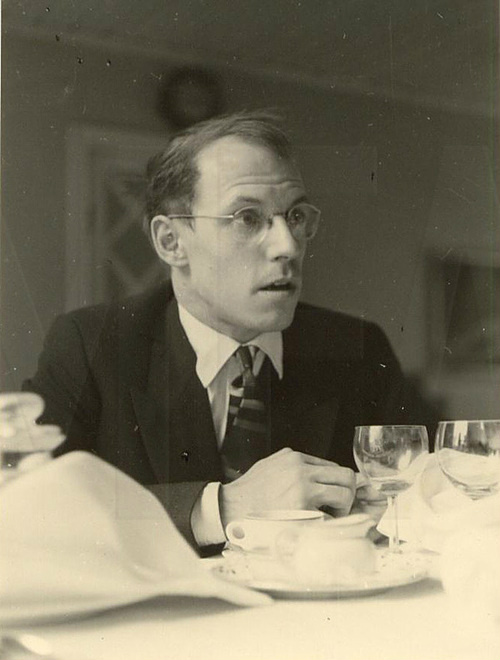
When you think of Michel Foucault, it’s hard not to think of the bald head that’s so part of his persona. Do a Google image search for Foucault, and you’ll find a “profusion of pictures of Foucault’s gleaming bald head” (as Jeffrey Weinstock calls it in an article entitled “This is Not Foucault’s Head”). But, among those many images, you will find one lonely photo of Foucault with a full(ish) head of hair. It’s hard to put a date on the picture. Very likely, it was taken during the mid 1950s, right around when Foucault was 30 years old. The look he’s sporting there is very different than what we see in 1965, when he sits down to talk with Alain Badiou. Or 1971, when he debates Noam Chomsky on Dutch TV. By those later dates, Foucault had the look that became so enduring.
Related Content:
Michel Foucault: Free Lectures on Truth, Discourse & The Self
John Searle on Foucault and the Obscurantism in French Philosophy
Read More...1955 Psychology Experiment Sees What Happens When You Ask an Artist to Paint Under the Influence of LSD
A few months ago, we featured the increasingly abstract portraits drawn by an artist after periodic doses of LSD. It happened in the late 1950s, a time when you might well imagine such an activity going down in, say, a bohemian quarter of New York, but also a time when hallucinogenic drugs rode a wave of popularity among legitimate scientists. Those ostensibly straight-laced researchers (sometimes funded by CIA money) had a fascination not with the taking of hallucinogenic drugs — not necessarily, anyway — but with what, exactly, these hallucinogenic drugs did to those who do take them. Particularly artists drawing portraits. Those portraits drawn on LSD came out under the close watch of University of California, Irvine psychiatrist Oscar Janiger. Above, you can watch the fruit of another, much more verbal 1950s experiment conducted just down the coast by the University of Southern California’s Nicholas A. Bercel, M.D.: “Schizophrenic Model Psychosis Induced by LSD 25.”
Here we also have an artist examined: this time, a Los Angeles painter named Bill. As Bill floats through his altered state, Bercel asks him to describe, in as rigorous detail as possible, his perceptions of objects in the room, of items of food and drink brought in, and of their interactions themselves. This 24-minute film of the four-hour process, punctuated by electroencephalographic scans, comes as a production of Sandoz, the Swiss pharmaceutical company who originally isolated LSD and who apparently had an interest in bringing a form of it to market. (One proposed pharmacological designation: “Phantastium.”) Though that didn’t happen, the Hungarian-born Bercel went on throughout his long career to conduct more research of the kind that ultimately earned him a legacy as a pioneer in neurophysiology. He also, when not in the lab, wrote over a dozen novels and film treatments. Clearly he had an impressive creative streak, whether or not he ever personally had his doors of perception opened by the substances his subjects like Bill so enjoyed.
Related Content:
Artist Draws Nine Portraits on LSD During 1950s Research Experiment
Ken Kesey’s First LSD Trip Animated
Beyond Timothy Leary: 2002 Film Revisits History of LSD
Aldous Huxley’s Most Beautiful, LSD-Assisted Death: A Letter from His Widow
Watch The Bicycle Trip: An Animation of The World’s First LSD Trip in 1943
Colin Marshall hosts and produces Notebook on Cities and Culture and writes essays on cities, language, Asia, and men’s style. He’s at work on a book about Los Angeles, A Los Angeles Primer. Follow him on Twitter at @colinmarshall or on Facebook.
Read More...Bob Dylan Plays First Live Performance of “Hurricane,” His Song Defending Rubin “Hurricane” Carter (RIP) in 1975
This weekend, Rubin “Hurricane” Carter passed away. He was 76. An American middleweight boxer, Carter was tried and convicted twice (once 1967, again in 1976) for homicides that took place in Paterson, New Jersey in 1966 — despite the fact that there were no finger prints or eyewitnesses connecting him to the crime. (Both convictions were later overturned when courts found that the trials were tainted by prosecutorial misconduct.) Before the second trial, Bob Dylan met with Carter in prison and then wrote “Hurricane,” a protest song that reached #33 on the Billboard chart. According to Jambase, Dylan brought a trio to Chicago’s WTTW Studios for a three-song performance where they played “Hurricane” on September 10, 1975. He’s backed by Scarlet Rivera on violin, Rob Stoner on bass, and Howie Wyeth on drums. It was apparently Dylan’s first live performance of the eight minute song.
PS Sorry for the ad that plays before the video. We have no control over that.
via Expecting Rain
Related Content:
Bob Dylan Reads From T.S. Eliot’s Great Modernist Poem The Waste Land
Bob Dylan and George Harrison Play Tennis, 1969
Read More...The Drawings of Jean-Paul Sartre
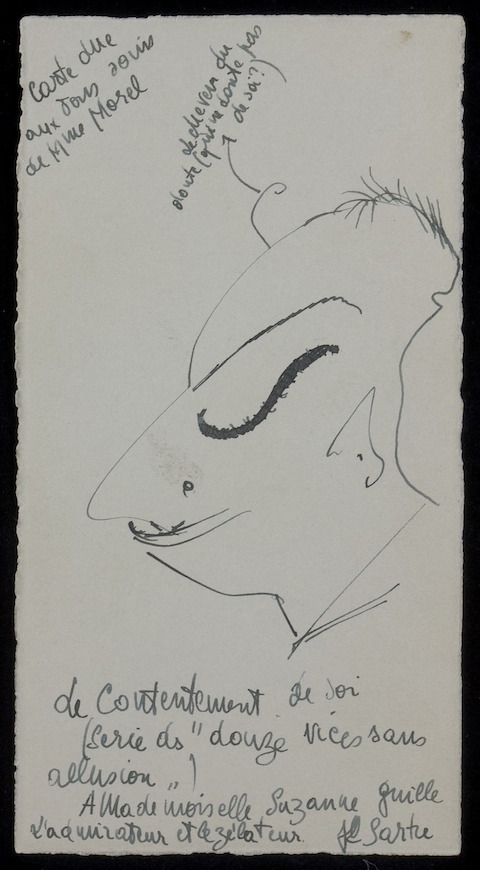
We’ve established something of a tradition here of featuring drawings by famous authors. It seems, unsurprisingly, that skill with the pen often goes hand-in-glove with a keen visual sense, though admittedly some writers are more talented draftsmen than others. William Faulkner, for example, created some very fine pen-and-ink illustrations for his college newspaper during his brief time at Ole Miss. Franz Kafka’s expressionistic sketches are quite striking, despite his anguished protestations to the contrary. And Jorge Luis Borges’ doodles are as quirky and playful as the author himself. Today we bring you the sketches of that great French existentialist philosopher, novelist, and playwright Jean-Paul Sartre—a collection of six rough, childlike caricatures that are, shall we say, rather less than accomplished. It’s certainly for the best—as the cliché goes—that Sartre never quit his day job for an art career.
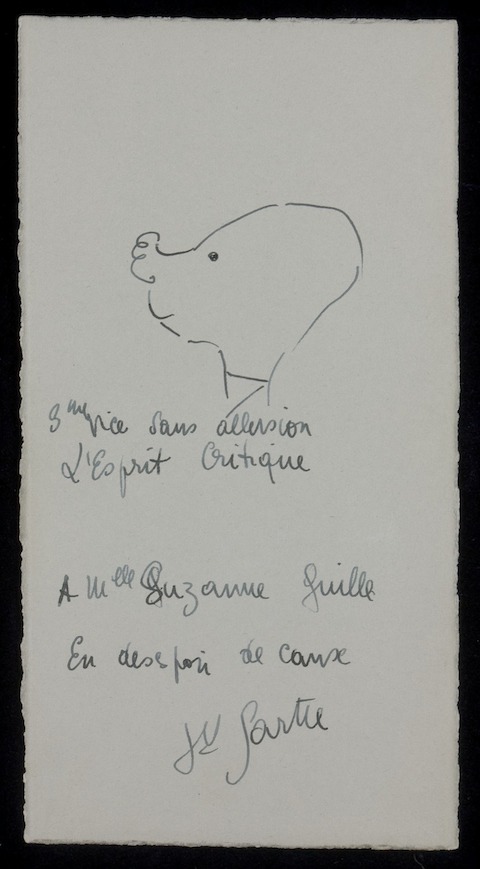
But there is a certain wicked charm in Sartre’s visual satires of human moral failings, which he calls a “series de ‘douze vices sans allusion’”—roughly, “a series of twelve vices without reference.” Either Sartre only completed half the series, or—more likely—half have been lost, since the author assures the recipient of his handiwork, a Mademoiselle Suzanne Guille, that he presents to her a “série complete.” Who was Suzanne Guille? Your guess is as good as mine. Yale’s Beinecke Rare Book & Manuscript Library, which houses these sketches, gives us no indication. Perhaps she was a relative, perhaps the spouse, of Pierre Guille, Simon de Beauvoir’s last lover? Given the many complicated liaisons pursued by both Sartre and his partner, the possibilities are indeed intriguing. As for the drawings? Their subjects hold more interest than their execution, providing us with keys to Sartre’s moral universe.
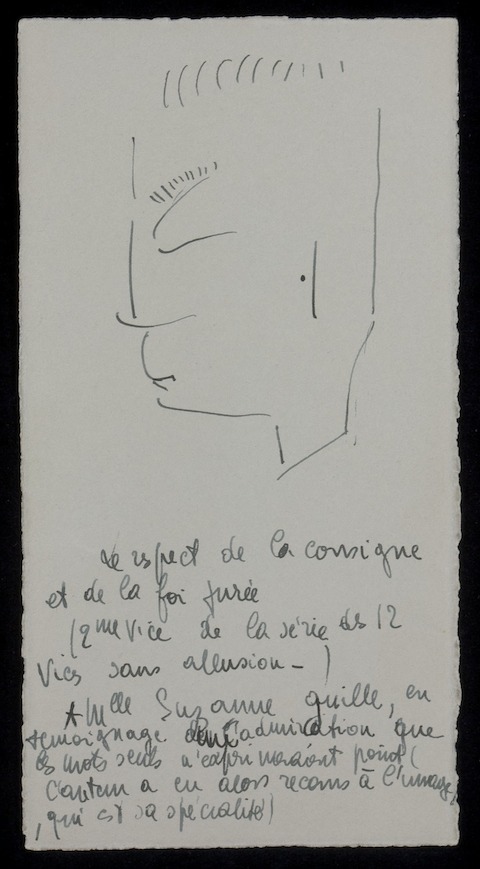
The first caricature, at the top, is titled “Le Contentment de soi”—“Self-Satisfaction”—and the character’s pompous expression says as much. Below it, the curious little fellow with the curlicue nose is called “L’Esprit Critique”—“The Spirit of Criticism.” And above we have “Le respect de la consigne et de la jurée”—“Keeping a Sworn Oath.” You can see the remaining three drawings, and read Sartre’s letter (in French, of course) to Mademoiselle Guille in pdf form here.
Related Content:
James Joyce, With His Eyesight Failing, Draws a Sketch of Leopold Bloom (1926)
Two Childhood Drawings from Poet E.E. Cummings Show the Young Artist’s Playful Seriousness
The Art of Sylvia Plath: Revisit Her Sketches, Self-Portraits, Drawings & Illustrated Letters
Walter Kaufmann’s Classic Lectures on Nietzsche, Kierkegaard and Sartre (1960)
Josh Jones is a writer and musician based in Durham, NC. Follow him at @jdmagness
Read More...Painter Paul Gauguin Plays the Harmonium with No Pants or Shoes (Circa 1895)
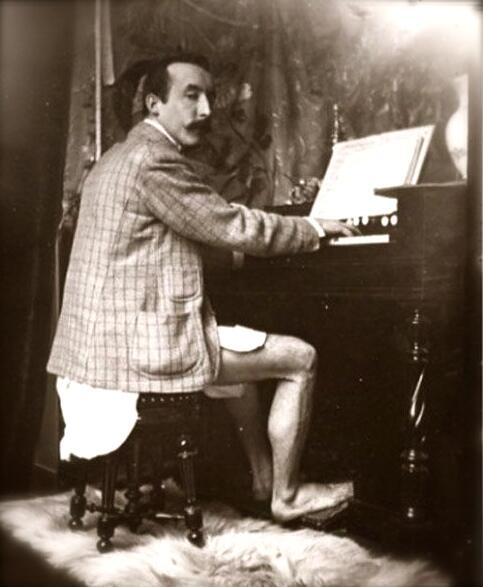
What do we have here? Painter Paul Gauguin playing a harmonium at the Paris studio of Alphonse Mucha, a Czech Art Nouveau painter, in or around 1895. How this came about — how Gauguin decided to strip off his pants and shoes and start playing that pump organ — we’ll probably never know. But we’re certainly glad that this light moment was saved for posterity.
If you would like to support the mission of Open Culture, consider making a donation to our site. It’s hard to rely 100% on ads, and your contributions will help us continue providing the best free cultural and educational materials to learners everywhere. You can contribute through PayPal, Patreon, and Venmo (@openculture). Thanks!
via @SteveSilberman
Related Content:
The Postcards That Picasso Illustrated and Sent to Jean Cocteau, Apollinaire & Gertrude Stein
Read More...Kurt Vonnegut Urges Young People to Make Art and “Make Your Soul Grow”
Art not only saves lives, it casts ripples, as Kurt Vonnegut surely knew when he replied—at length—to five New York City high school students who’d contacted him as part of a 2006 English assignment. (The identities of the other authors selected for this honor are lost to time, but not one had the courtesy to respond except Vonnegut.)
Dear Xavier High School, and Ms. Lockwood, and Messrs Perin, McFeely, Batten, Maurer and Congiusta:
I thank you for your friendly letters. You sure know how to cheer up a really old geezer (84) in his sunset years. I don’t make public appearances any more because I now resemble nothing so much as an iguana.
What I had to say to you, moreover, would not take long, to wit: Practice any art, music, singing, dancing, acting, drawing, painting, sculpting, poetry, fiction, essays, reportage, no matter how well or badly, not to get money and fame, but to experience becoming, to find out what’s inside you, to make your soul grow.
Seriously! I mean starting right now, do art and do it for the rest of your lives. Draw a funny or nice picture of Ms. Lockwood, and give it to her. Dance home after school, and sing in the shower and on and on. Make a face in your mashed potatoes. Pretend you’re Count Dracula.
Here’s an assignment for tonight, and I hope Ms. Lockwood will flunk you if you don’t do it: Write a six line poem, about anything, but rhymed. No fair tennis without a net. Make it as good as you possibly can. But don’t tell anybody what you’re doing. Don’t show it or recite it to anybody, not even your girlfriend or parents or whatever, or Ms. Lockwood. OK?
Tear it up into teeny-weeny pieces, and discard them into widely separated trash recepticals [sic]. You will find that you have already been gloriously rewarded for your poem. You have experienced becoming, learned a lot more about what’s inside you, and you have made your soul grow.
God bless you all!
Kurt Vonnegut
Vonnegut’s kind wishes and Yoko Ono-esque prompt have been widely disseminated on the Internet, which is no doubt where students at Hove Park School in Brighton, East Sussex caught the scent. Working with a professional production company that specializes in narrative-driven work, they literalized the assignment in the video above, and while I might have preferred a sneak peek at the poems and drawings such a task might yield, pre-shredding, I loved how they acknowledged that not everyone heeds the call. (The casting of that one could have gone either way…wouldn’t be surprised if you told me that that boy has a punk band that would’ve ripped Vonnegut’s ears off.)
via Kate Rix
Related Content:
Kurt Vonnegut Diagrams the Shape of All Stories in a Master’s Thesis Rejected by U. Chicago
“Wear Sunscreen”: The Story Behind the Commencement Speech That Kurt Vonnegut Never Gave
Kurt Vonnegut’s Eight Tips on How to Write a Good Short Story
Kurt Vonnegut: Where Do I Get My Ideas From? My Disgust with Civilization
Ayun Halliday is spending tonight’s Night of Vonnegut in Los Angeles rather than her hometown of Indianapolis. So it goes. Follow her @AyunHalliday
Read More...Read 10 Short Stories by Gabriel García Márquez Free Online (Plus More Essays & Interviews)

Image by Festival Internacional de Cine en Guadalajara via Wikimedia Commons
“Our independence from Spanish domination did not put us beyond the reach of madness,” said Gabriel García Márquez in his 1982 Nobel Prize acceptance speech. García Márquez, who died yesterday at the age of 87, refers of course to all of Spain’s former colonies in Latin America and the Caribbean, from his own Colombia to Cuba, the island nation whose artistic struggle to come to terms with its history contributed so much to that art form generally known as “magical realism,” a syncretism of European modernism and indigenous art and folklore, Catholicism and the remnants of Amerindian and African religions.
While the term has perhaps been overused to the point of banality in critical and popular appraisals of Latin-American writers (some prefer Cuban novelist Alejo Carpentier’s lo real maravilloso, “the marvelous real”), in Marquez’s case, it’s hard to think of a better way to describe the dense interweaving of fact and fiction in his life’s work as a writer of both fantastic stories and unflinching journalistic accounts, both of which grappled with the gross horrors of colonial plunder and exploitation and the subsequent rule of bloodthirsty dictators, incompetent patriarchs, venal oligarchs, and corporate gangsters in much of the Southern Hemisphere.
Nevertheless, it’s a description that sometimes seems to obscure García Marquez’s great purpose, marginalizing his literary vision as trendy exotica or a “postcolonial hangover.” Once asked in a Paris Review interview the year before his Nobel win about the difference between the novel and journalism, García Márquez replied, “Nothing. I don’t think there is any difference. The sources are the same, the material is the same, the resources and the language are the same.”
In journalism just one fact that is false prejudices the entire work. In contrast, in fiction one single fact that is true gives legitimacy to the entire work. That’s the only difference, and it lies in the commitment of the writer. A novelist can do anything he wants so long as he makes people believe in it.
García Márquez made us believe. One would be hard-pressed to find a 20th century writer more committed to the truth, whether expressed in dense mythology and baroque metaphor or in the dry rationalist discourse of the Western episteme. For its multitude of incredible elements, the 1967 novel for which García Márquez is best known—One Hundred Years of Solitude—captures the almost unbelievable human history of the region with more emotional and moral fidelity than any strictly factual account: “However bizarre or grotesque some particulars may be,” wrote a New York Times reviewer in 1970, “Macondo is no never-never land.” In fact, García Márquez’s novel helped dismantle the very real and brutal South American empire of banana company United Fruit, a “great irony,” writes Rich Cohen, of one mythology laying bare another: “In college, they call it ‘magical realism,’ but, if you know history, you understand it’s less magical than just plain real, the stuff of newspapers returned as lived experience.”
Edith Grossman, translator of several of García Márquez’s works—including Love in the Time of Cholera and his 2004 autobiography Living to Tell the Tale (Vivir para Cotarla)—agrees. “He doesn’t use that term at all, as far as I know,” she said in a 2005 interview with Guernica’s Joel Whitney: “It’s always struck me as an easy, empty kind of remark.” Instead, García Márquez’s style, says Grossman, “seemed like a way of writing about the exceptionalness of so much of Latin America.”
Today, in honor and with tremendous gratitude for that indefatigable chronicler of exceptional lived experience, we offer several online texts of Gabriel García Márquez’s short works at the links below.
HarperCollins’ online preview of García Marquez’s Collected Stories includes the full text of “The Third Resignation,” “The Other Side of Death,” “Eva Is Inside Her Cat,” “Bitterness for Three Sleepwalkers,” and “Dialogue with the Mirror,” all from the author’s 1972 collection Eyes of a Blue Dog (Ojos de perro azul).
At The New Yorker, you can read García Marquez’s story “The Autumn of the Patriarch” (1976) and his 2003 autobiographical essay “The Challenge.”
Follow the links below for more of García Marquez’s short fiction from various university websites:
“Death Constant Beyond Love” (1970)
“The Handsomest Drowned Man in the World” (1968)
“A Very Old Man with Enormous Wings” (1955)
Visit The Modern Word for an excellent biographical sketch of the author.
See The New York Times for “A Talk with Gabriel Garcia Marquez” in the year of his Nobel win, an essay in which he recounts his 1957 meeting with Ernest Hemingway, and many more reviews and essays.
Finally, we should also mention that you can download Love in the Time of Cholera or Hundred Years of Solitude for free (as audio books) if you join Audible.com’s 30-day program. We have details on it here.
As we say farewell to one of the world’s greatest writers, we can remember him not only as a writer of “magical realism,” whatever that phrase may mean, but as a teller of complicated, wondrous, and sometimes painful truths, in whatever form he happened to find them.
Related Content:
Read 18 Short Stories From Nobel Prize-Winning Writer Alice Munro Free Online
Read 12 Masterful Essays by Joan Didion for Free Online, Spanning Her Career From 1965 to 2013
600 Free eBooks: Download Great Books for Free
Josh Jones is a writer and musician based in Durham, NC. Follow him at @jdmagness
Read More...Free: British Pathé Puts Over 85,000 Historical Films on YouTube
British Pathé was one of the leading producers of newsreels and documentaries during the 20th Century. This week, the company, now an archive, is turning over its entire collection — over 85,000 historical films – to YouTube.
The archive — which spans from 1896 to 1976 – is a goldmine of footage, containing movies of some of the most important moments of the last 100 years. It’s a treasure trove for film buffs, culture nerds and history mavens everywhere. In Pathé’s playlist “A Day That Shook the World,” which traces an Anglo-centric history of the 20th Century, you will find clips of the Wright Brothers’ first flight, the bombing of Hiroshima and Neil Armstrong’s walk on the moon, alongside footage of Queen Victoria’s funeral and Roger Bannister’s 4‑minute mile. There’s, of course, footage of the dramatic Hindenburg crash and Lindbergh’s daring cross-Atlantic flight. And then you can see King Edward VIII abdicating the throne in 1936, and the eventual Pearl Harbor attack in December 1941 (above).
But the really intriguing part of the archive is seeing all the ephemera from the 20th Century, the stuff that really makes the past feel like a foreign country – the weird hairstyles, the way a city street looked, the breathtakingly casual sexism and racism. There’s a rush in seeing history come alive. Case in point, this documentary from 1967 about the wonders to be found in a surprisingly monochrome Virginia.
Here’s a film about a technological innovation that curiously didn’t take off — an amphibious scooter. The look of regal dignity on the driver’s face as his vehicle moves down the Thames is priceless.
In an early example of a political blooper, there’s this footage from 1942 of Bess Truman trying valiantly to smash an unyielding bottle of champagne against the fuselage of a brand new bomber.
And then there’s this newsreel from 1938 on the wedding between Billy Curtis, a 3’7” nightclub bouncer and his 6’4” burlesque star bride. The jaunty, spectacularly un-PC voiceover should probably be filed under “things were different then.”
If you have several weeks to kill, you can watch all of the videos here.
Rare Film: Claude Monet at Work in His Famous Garden at Giverny, 1915
The Weird World of Vintage Sports
The World’s First Mobile Phone Shown on 1922 Vintage Film
Jonathan Crow is a Los Angeles-based writer and filmmaker whose work has appeared in Yahoo!, The Hollywood Reporter, and other publications. You can follow him at @jonccrow.
Read More...The Ultimate Warrior, Professional Wrestler & Philosopher, Created a Glossary of World Philosophies

If you run a web site long enough, you end up covering topics you never thought you’d touch. Like professional wrestling. Come to think of it, we did show you once before Andy Warhol making an unexpected appearance on a 1985 World Wide Wrestling Federation broadcast. But today the subject isn’t an artist with a penchant for wrestling. It’s a wrestler himself. More specifically its The Ultimate Warrior (born James Hellwig) who had a penchant for philosophy.
A star during the 1990s in the WWF, The Ultimate Warrior died of heart disease last week at the age of 54. After his retirement from wrestling, he became a motivational speaker and life coach. And, as Deadspin notes, he maintained a curious web site that featured a glossary of world philosophies.
If you want serious definitions of philosophy, I’d suggest you visit The Stanford Encyclopedia of Philosophy. For something more abbreviated and kooky, you can’t go wrong with The Ultimate Warriors’ dictionary. Let me give you a few quick examples:
Existentialism
This is a real nasty philosophy that asserts man has free will, but exists in an unknowable, malevolent universe with no knowledge of what is right or wrong. The catch is that the individual is responsible (morally accountable) for all his actions, but has no way of knowing what actions are correct. The effects on a person are devastating. (See also Skepticism.)Kantianism
This is the exact opposite of Objectivism. It’s [sic] epistemology is faith-eaten and mystic-appeasing. It’s [sic] metaphysics is subjective, it’s [sic] ethics are altruistic and it’s [sic] politics are collectivistic. Kant created the exact opposite of what constitutes a philosophy based on reason. His “argument” consists of equivocations, elaborate straw-men (the entire Critique of Pure Reason for example), etc. He was quite an evil person.Pacifism
This asserts a moral absolute (without any context) that it is wrong to use force. Instead of recognizing the need for self-defense, the pacifist equates all force with evil, equivocating. A pacifist society would perish absolutely when the first gang came along.Transcendentalism
This is the belief that intuition is superior to sense-perception and reason, and is filled with mystic gooble-dee-gook. Its epistemology is exclusively subjective. I think this is only popular because it has an interesting sounding name. (See also Mysticism, Subjectivism, Zen.)
If you’re wondering what philosophy The Warrior sympathized with, it seems you need to look no further than Ayn Rand’s Objectivism (surprise, surprise), which he defined as follows: “In essence, a concept where man is a heroic being, and his life is an end in itself, with his own happiness as the moral purpose of his life, with productive achievement as his noblest activity, and reason as his only absolute.”
For more definitions, you can dive into the glossary right here. This curious item comes to us via Leiter Reports.
Related Content:
100 Free Philosophy Courses Online
The Epistemology of Dr. Seuss & More Philosophy Lessons from Great Children’s Stories
Ayn Rand Adamantly Defends Her Atheism on The Phil Donahue Show (Circa 1979)
Read More...A Brief Tour of British & Irish Accents: 14 Ways to Speak English in 84 Seconds
Americans, coming from the enormous and relatively recently settled place we do, tend to have a hard time with accents, struggling to grasp the extent of the variety of regional ways of speech in smaller, older countries, let alone to use them ourselves. Studying the Korean language, I’ve found that understanding a native speaker from one city doesn’t mean I’ll understand anything said by another native speaker from a city fifty miles away. (Though that holds true even for Koreans themselves; hence the prevalence of subtitles on their television shows.) Visiting London a few months ago, easily as I could make sense of everybody speaking my native tongue, I pre-emptively gave up hope of picking up on the nuances of all the accents people had brought to the city from their hometowns — much less the numerous and subtle dialects native of London itself. Everyone I met insisted that a Briton’s accent says more about their origin, class, station in life, and degree of self-regard than any other quality, but not knowing Newcastle from Southampton when I first set foot on English soil, I had to take them at their word (however they happened to pronounce it).
The video above, in which professional dialect coach Andrew Jack demonstrates fourteen British accents in 84 seconds, might help sort things out for my fellow confused countrymen. “Received communication is the great communicator,” Jack says, using the accent I assume he grew up with. “As soon as you deviate from that and you go into London speech, for example, you lose a little bit of the communication.” By that point, Jack has seamlessly transitioned into Cockney, from which he then shifts into the accents of East Anglia, the West Country, Yorkshire, Lancashire, Liverpool, Northern Ireland, Dublin, the Scottish highlands, Glasgow, North Wales, and South Wales. The Youtube comment box below has, predictably, filled with complains about all the accents — the commenters’ own, dare I imagine? — that didn’t make it into this brief linguistic tour. Though far from comprehensive, the video does in any case put the lie to the notion so many non-Brits seem to have that they can “do a British accent.” If you encounter one of them, don’t ask them to demonstrate it; ask them which British accent they mean. Then you’ll really hear how poorly they fare.
via Kottke
Related Content:
Peter Sellers Gives a Quick Demonstration of British Accents
Peter Sellers Reads The Beatles’ “She Loves You” in Four Different Accents
Sir Patrick Stewart Demonstrates How Cows Moo in Different English Accents
Colin Marshall hosts and produces Notebook on Cities and Culture and writes essays on cities, language, Asia, and men’s style. He’s at work on a book about Los Angeles, A Los Angeles Primer. Follow him on Twitter at @colinmarshall or on Facebook.
Read More...Support Us
We're hoping to rely on loyal readers, rather than erratic ads. Please click the Donate button and support Open Culture. You can use Paypal, Venmo, Patreon, even Crypto! We thank you!

About Us

Open Culture scours the web for the best educational media. We find the free courses and audio books you need, the language lessons & educational videos you want, and plenty of enlightenment in between.
Advertise With Us

FREE UPDATES!
GET OUR DAILY EMAIL
Get the best cultural and educational resources on the web curated for you in a daily email. We never spam. Unsubscribe at any time.
FOLLOW ON SOCIAL MEDIA

Open Culture editor Dan Colman scours the web for the best educational media. He finds the free courses and audio books you need, the language lessons & movies you want, and plenty of enlightenment in between.
Advertise With Us


