John Coltrane Plays the Only Live Performance of A Love Supreme (1965)
John Coltrane’s A Love Supreme came out in 1964, an “album-long hymn of praise,” writes Rolling Stone, “transcendent music perfect for the high point of the civil rights movement” as well as Coltrane’s growing spiritual awakening after kicking his heroin habit. The record amazed critics and jazz fans alike and by 1970, it had sold over half-a-million copies. But lovers of Coltrane would only have only one chance to see him perform the full four-part suite live, and not in any stateside clubs but in Antibes, France on July 26, 1965, where he played two nights with his quartet.
You can see twelve of those miraculous minutes above, consisting of the first two movements of the suite, “Acknowledgement” and “Resolution.” This is a gorgeous performance, capturing what saxophonist David Liebman describes as “an end and a new musical beginning” for Coltrane.
The second evening’s performance, below, begins with “Naima,” on which, Liebman says, “Trane solos combining a striking lyrical approach offset by multi-noted, densely packed runs.” If you’ve ever wondered what Ira Gitler meant in describing Coltrane’s style as “sheets of sound,” these performances will clear up the mystery.
The mid-sixties was a pivotal time for jazz—before the electronic fusion experiments to come, as hard bop and free jazz combined with the dissonance of early 20th century contemporary classical music, which had “permeated jazz for at least a handful of artists.” Coltrane still spoke the “common language”—the “standard repertoire stemming from the American song book and/or original compositions with similar and predictable harmonic movement,” yet in his case, he “added modality to the mix,” a trick picked up from Miles Davis.
Coltrane sadly died from liver cancer in 1967 at age 40 and did not live to see the strange, surprising turns jazz would take in the decade to come. How his brash, yet enchanting playing would have translated in the 70s is anyone’s guess. Yet, like so many artists who die young and in their prime, he left us with a body of work almost mystical in its intensity and beauty—so much so that his more religious followers made him a saint after his death. Watching these too-brief recordings above, it’s not hard to see why.
The second night’s performances from the Antibes Jazz Festival were issued as a live album in 1988. The first night’s live showcase of A Love Supreme has seen several releases, and if you’re one of those who professes devotion to this amazing piece of work, you’d do well to pick up a copy, if you don’t own one already. “The intensity if the Antibes live performance,” writes Liebman in his 2011 liner notes to the Jazz Icons/Mosaic release of the Coltrane Live at Antibes 1965 DVD, “far exceeds the studio recording” of the album. And that’s saying something.
Related Content:
John Coltrane’s Handwritten Outline for His Masterpiece A Love Supreme
Watch John Coltrane and His Great Quintet Play ‘My Favorite Things’ (1961)
The World According to John Coltrane: His Life & Music Revealed in Heartfelt 1990 Documentary
Josh Jones is a writer and musician based in Durham, NC. Follow him at @jdmagness
Read More...The Secret of Life and Love, According to Ray Bradbury (1968)
“Jump off the cliff and build your wings on the way down.” This—writes Sam Weller in his introduction to a 2010 interview with sci-fi and fantasy luminary Ray Bradbury—was the author’s “lifelong credo.” Weller writes of discovering an unpublished Paris Review interview from the 1970s in Bradbury’s garage, with a note from editor George Plimpton that read “a bit informal in places, maybe overly enthusiastic.” The irony of this judgment is that it is Bradbury’s enthusiasm, his lack of formality, which make him so compelling and so copious a writer and speaker. Bradbury didn’t self-edit or second guess much—his approach is best characterized as fearless and passionate, just as he describes his writing process:
I type my first draft quickly, impulsively even. A few days later I retype the whole thing and my subconscious, as I retype, gives me new words. Maybe it’ll take retyping it many times until it is done. Sometimes it takes very little revision.
It’s that unfettered expression of his subconscious that Bradbury discusses in the short clip above, in which he re-invigorates all the sort of carpe diem clichés one hears so often by framing them not as self-help suggestions but as imperatives for a full and healthy life. Responding in the moment, says Bradbury, refusing to “put off till tomorrow… what I must do, right now,” allows him to “find out what my secret self needs, wants, desires with all its heart.” For Bradbury, writing is much more than a formal exercise or a specialized craft—it is a vital expression of his full humanity and a means of “cleansing the stream” of his mind: “We belong only by doing,” he says, “and we own only by doing, and we love only by doing…. If you want an interpretation of life and love, that would be the closest thing I could come to.”
Bradbury doesn’t limit his philosophy to the writing life; he advocates for everyone an unabashed emotional engagement with the world. For him, the man (and woman, we might presume), who cannot “laugh freely,” cry, or “be violent”—which he defines in sublimating terms as any physical or creative activity—is a “sick man.” Bradbury’s “overly enthusiastic” explorations of creative passion were almost as much a part of his output as his fiction. His interviews, televised and in print, are inspiring for this reason: he is never coy or pretentious but pushes others to aspire to the same kind of authentic joy he seemed to take in everything he did.
By the way, the first person we see above is legendary Warner Bros. animator Chuck Jones (as one Youtube commenter says, we get in this clip “two visionaries for the price of one”). Bradbury’s “vitality,” says Jones, “rubs off on the people who work with him.” And, he might have added, all of the people who read and listen to him, too.
Related Content:
Ray Bradbury: “The Things That You Love Should Be Things That You Do.” “Books Teach Us That”
Ray Bradbury: Story of a Writer 1963 Film Captures the Paradoxical Late Sci-Fi Author
Ray Bradbury Gives 12 Pieces of Writing Advice to Young Authors (2001)
Ray Bradbury: Literature is the Safety Valve of Civilization
Josh Jones is a writer and musician based in Durham, NC. Follow him at @jdmagness
Read More...Read Hundreds of Free Sci-Fi Stories from Asimov, Lovecraft, Bradbury, Dick, Clarke & More
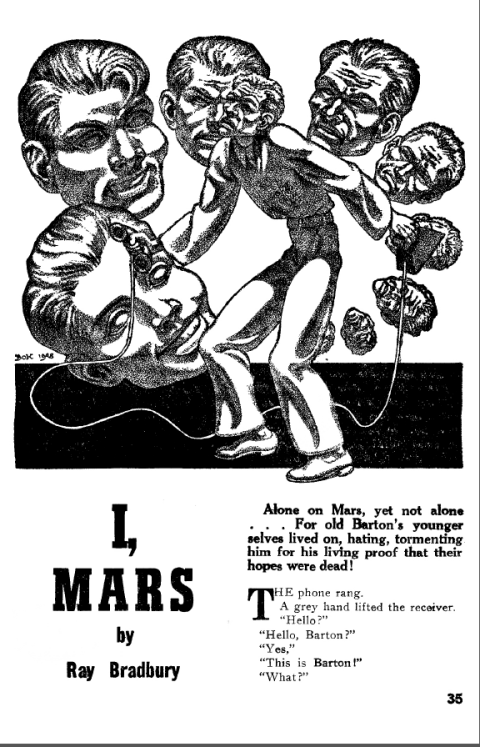
“We think audio is the best medium for Science Fiction literature and drama,” says the “About” page at SFFaudio.com. “We’re not against the dead tree, cathode ray, and celluloid versions, we just know them to be the inferior medium for transmission of story, mood, and ideas.” A strong position indeed, but one wonders: what do they think of the digital display of text as a means of sci-fi conveyance? They must harbor more than a little love for it, given that on their site, otherwise a rich trove of the genre’s literature and drama in free audio form, they’ve also cultivated a robust collection of equally free books and stories available as PDFs, many scanned straight from the original dead-tree magazines in which they first appeared. “The stories listed below are, to the best of my research, all PUBLIC DOMAIN in the United States,” writes the collector in an introduction to the long list, a quick scan of which reveals a who’s who of respected names in science fiction from the mid-twentieth century and earlier, from Piers Anthony to John Wyndham.
In between those two sci-fi eminences, you’ll also encounter a few possibly unexpected names, like Henry James, Jack London, Guy de Maupassant — yes, the very same Henry James, Jack London, and Guy de Maupassant, who seem to have used just enough of the adventurous and the supernatural in their fiction to fit into the spirit of the collection, if not quite into the genre boundaries. But even if you want to stick to sci-fi and sci-fi only, you’ll certainly find plenty of the finest shorter-form work with which to treat yourself. Perhaps “I, Mars” by none other than Mr. Martian Chronicles himself, Ray Bradbury? Alternatively, if you prefer the “harder” side of the tradition, behold the offerings from Foundation series author Isaac Asimov:
- “The Jokester” |PDF| 15 pages
- “Let’s Get Together” |PDF| 18 pages
- “Living Space” |PDF| 15 pages
- “Silly Asses” |PDF| 2 pages
Or those from Arthur C. Clarke, he of Rendezvous with Rama and 2001: A Space Odyssey:
- “The Deep Range” |PDF| 10 pages
- “The Nine Billion Names Of God” |PDF| 8 pages
- “The Parasite” |PDF| 12 pages
- “Second Dawn” |PDF| 24 pages
- “The Star” |PDF| 9 pages
- “The Stroke Of The Sun” |PDF| 8 pages
- “A Walk In The Dark” |PDF| 8 pages
For another vintage entirely, see also their formidable lineup of over forty pieces from H.G. Wells, progenitor of so much of what we think of as science fiction today, which includes “The Island of Dr. Moreau,” “The War of the Worlds,” and “The Time Machine.” Just about as many of the stories of H.P. Lovecraft, a man with a now similarly classic body of work but one with an entirely different sensibility altogether, also appear. You can sample his special brand of the unspeakable in tales like “The Shunned House,” “The Nameless City,” and “The Horror at Red Hook.” Then there are the works of Philip K. Dick, many of which have been aggregated in our collection: 33 Great Sci-Fi Stories by Philip K. Dick: Download as Free Audio Books & Free eBooks.
Related Content:
100 Great Sci-Fi Stories by Women Writers (Read 20 for Free Online)
Free Science Fiction Classics on the Web: Huxley, Orwell, Asimov, Gaiman & Beyond
Download 33 Great Sci-Fi Stories by Philip K. Dick as Free Audio Books & Free eBooks
Free: Download 151 Sci-Fi & Fantasy Stories from Tor.com
Colin Marshall hosts and produces Notebook on Cities and Culture and writes essays on cities, language, Asia, and men’s style. He’s at work on a book about Los Angeles, A Los Angeles Primer. Follow him on Twitter at @colinmarshall or on Facebook.
Read More...The Science of Caffeine: The World’s Most Popular Drug
Here’s a quick shot of science to start your day. The American Chemical Society, an organization representing chemists across the US, has released the latest in a series of Reactions videos. Attempting to explain the science of everyday things, previous Reactions videos have demystified the chemistry of Sriracha, Love, Pepper and more. This latest video breaks down the world’s most widely used stimulant, caffeine. If you haven’t had your morning cup of coffee, you may need to watch this video twice.
On a side note, if you live in the San Francisco Bay Area, consider spending Saturday, May 3rd at Stanford’s one-day coffee symposium. Organized by Stanford Continuing Studies, the symposium – Coffee: From Tree to Beans to Brew and Everything in Between – will feature guest speakers (historians, scientists, the CEO of Blue Bottle Coffee, etc.) talking about what goes into making this great beverage of ours. Students will also have the opportunity to participate in coffee tasting and evaluation sessions. In full disclosure, I helped put the program together. It promises to be a great day. So I had to give a plug. You can learn more and sign up here.
Read More...Take Free Online Courses at Hogwarts: Charms, Potions, Defense Against the Dark Arts & More
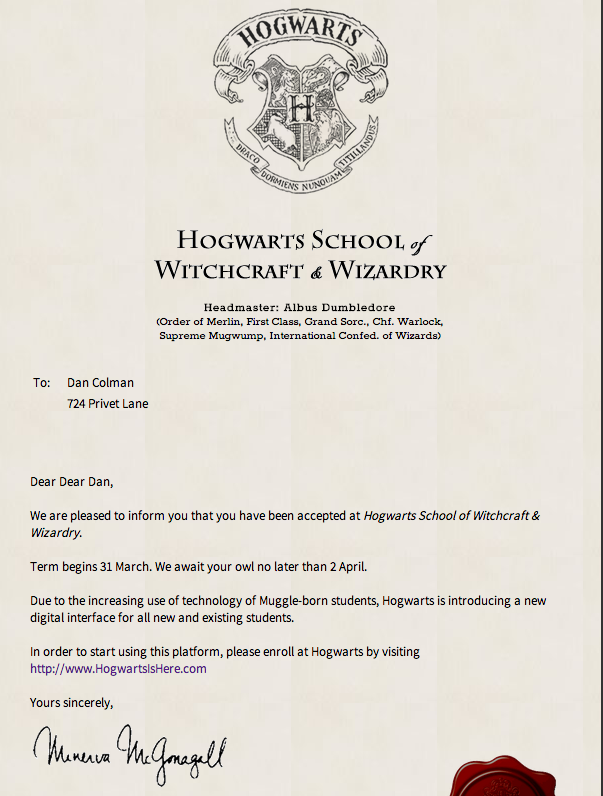
A group of dedicated Harry Potter fans have created a new educational website called Hogwarts is Here. The site is free — you only have to spend fake Galleons on the site — and it lets users enroll at the Hogwarts School of Witchcraft and Wizardry and work through a seven-year curriculum, taking the same courses that Harry, Ron and Hermione did in the great Harry Potter series. The first year consists of courses that will sound familiar to any Harry Potter reader: Charms, Potions, Defense Against the Dark Arts, Astronomy, Herbology, History of Magic, and Transfiguration. The 9‑week online courses feature homework assignment and quizzes. Students can also read digital textbooks, such as A Standard Book of Spells and A Beginner’s Guide to Transfiguration. We have yet to enroll in a course, so we would be curious get your feedback.
Fans of fantasy literature will also want to check out the Tolkien courses listed in our collection of 900 Free Online Courses. Also see this complete reading of The Chronicles of Narnia by C.S. Lewis, found in our collection of Free Audio Books.
Read More...Watch Film, Samuel Beckett’s Only Movie, Starring Buster Keaton
Fresh off the international success of his play Waiting For Godot, Samuel Beckett made a film, called aptly enough Film. It came out in 1965 and proved to be the only motion picture the soon-to-be Nobel Prize winner would ever make. As you might expect, it is enigmatic, bleakly funny and very, very odd. You can check it out on YouTube.
The 17-minute silent short is essentially a chase movie between the camera and the main character O — as in object. Film opens with O cowering from the gaze of a couple he passes on the street. Meanwhile, the camera looms just behind his head. At his stark, typically Beckettesque flat, O covers the mirror, throws his cat and his chihuahua outside and even trashes a picture — the only piece of decoration in the flat — that seems to be staring back at him. Yet try as he might, O ultimately can’t quite evade being observed by the gaze of the camera.
Barney Rosset, editor of Grove Press, commissioned the movie and regular Beckett collaborator Alan Schneider was tapped to direct. As Schneider recalled, the first draft of the screenplay was unorthodox.
The script appeared in the spring of 1963 as a fairly baffling when not downright inscrutable six-page outline. Along with pages of addenda in Sam’s inimitable informal style: explanatory notes, a philosophical supplement, modest production suggestions, a series of hand-drawn diagrams.
It took almost a year of discussion to bring the movie’s themes and story into focus.
For the lead character Beckett wanted to hire Charlie Chaplin until he was informed by an officious secretary that Chaplin doesn’t read scripts. Beckett then suggested Buster Keaton. The playwright was a longtime fan of the silent film legend. Keaton was even offered the role of Lucky on the original American production of Godot, though the actor declined. This time around, though, Keaton signed on, even if he couldn’t make heads or tales of the script.
And he wasn’t the only one. Ever since it came out, critics have been puzzling what Film is really about. Is it a statement on voyeurism in cinema? On human consciousness? On death? Beckett gave his take on the movie to the New Yorker: “It’s a movie about the perceiving eye, about the perceived and the perceiver — two aspects of the same man. The perceiver desires like mad to perceive and the perceived tries desperately to hide. Then, in the end, one wins.”
Keaton himself defined the movie even more succinctly, “A man may keep away from everybody but he can’t get away from himself.”
Related Content:
Samuel Beckett Directs His Absurdist Play Waiting for Godot (1985)
Rare Audio: Samuel Beckett Reads Two Poems From His Novel Watt
Jonathan Crow is a Los Angeles-based writer and filmmaker whose work has appeared in Yahoo!, The Hollywood Reporter, and other publications. You can follow him at @jonccrow.
Read More...Science & Cooking: Harvard’s Free Course on Making Cakes, Paella & Other Delicious Food
I can hardly think of a more appealing nexus of the sciences, for most of us and for obvious (and delicious) reasons, than food. Add a kind of engineering to the mix, and you get the study of cooking. Back in 2012, we featured the first few lectures from Harvard University’s course Science and Cooking: From Haute Cuisine to the Science of Soft Matter. Their collection of rigorous and entertaining presentations of that which we love to prepare and, even more so, to eat has since expanded to include one- to two-hour lectures delivered by sharp professors in cooperation with respected chefs and other food luminaries on culinary subjects like the science of sweets (featuring Flour Bakery’s Joanne Chang), how to do cutting-edge modernist cuisine at home (featuring Nathan Myhrvold, who wrote an enormous book on it), and the relevance of microbes, misos, and olives (featuring David Chang of Momofuku fame). You can watch all of the lectures, in order, with the playlist embedded at the top of this post.
Alternatively, you can pick and choose from the complete list of Harvard’s Science and Cooking lectures on Youtube or on iTunes. Some get deep into the natural workings of specific dishes, ingredients and preparation methods; others, like “The Science of Good Cooking” with a couple of editors from Cook’s Illustrated, take a broader view. That lecture and others will certainly help build an intellectual framework for those of us who want to improve our cooking — and even those of us who can already cook decently, or at least reliably follow a recipe — but can’t quite attain the next level without understanding exactly what happens when we flick on the heat. One school of thought holds that, to come off as reasonably skilled in the kitchen, you need only master one or two showcase meals. When asked to cook something, I, for instance, have tended to make paella almost every time, almost out of sheer habit. But now that I’ve found Raül Balam Ruscalleda’s talk on the science of that traditional Spanish dish, I can see that I must now, on several levels, raise my game. View it below, and feel free to take notes alongside me. You can find Science and Cooking in our collection of 900 Free Online Courses from Top Universities.
Related Content:
Science & Cooking: Harvard Profs Meet World-Class Chefs in Unique Online Course
MIT Teaches You How to Speak Italian & Cook Italian Cuisine All at Once (Free Online Course)
Colin Marshall hosts and produces Notebook on Cities and Culture and writes essays on cities, language, Asia, and men’s style. He’s at work on a book about Los Angeles, A Los Angeles Primer. Follow him on Twitter at @colinmarshall or on Facebook.
Read More...Oxford University Press Gives You Free Access to Books, Dictionaries & More During National Library Week

It’s National Library Week, and to celebrate Oxford University Press is making many of its online resources free for users in the U.S. and Canada this week. Access will be open until the end of Saturday, the 19th. You will be able to read Oxford’s online dictionaries, online scholarly editions, extensive reference materials, and the popular series of Very Short Introductions, which “offer concise introductions to a diverse range of subject areas from Climate to Consciousness, Game Theory to Ancient Warfare, Privacy to Islamic History, Economics to Literary Theory.” (To access the texts, type “libraryweek” as the username and password in the Subscriber Login area. It appears halfway down the page, on the left.)
The open access period excludes Oxford University Press scholarly journals. This is unfortunate. As you probably know, most of the research published by university presses resides behind prohibitive paywalls that make it difficult for independent scholars and laypeople to read current scholarship. It would be nice to see Oxford and other presses make such grace periods more frequent and inclusive in the future. But for now, OUP’s open access week is a great way to entice non-professionals into academic scholarship and temporarily ease the burden on those without regular access to their databases. Visit Oxford’s site and sign in with username and password “libraryweek” to begin reading.
Related Content:
Read All of Shakespeare’s Plays Free Online, Courtesy of the Folger Shakespeare Library
Josh Jones is a writer and musician based in Durham, NC. Follow him at @jdmagness
Read More...Read Hunter S. Thompson’s Fear and Loathing in Las Vegas, as It Was Originally Published in Rolling Stone (1971)
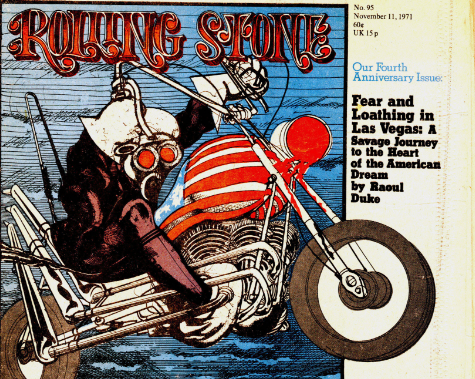
Last week, we revisited Johnny Depp’s reading of the famous “wave speech” from Hunter S. Thompson’s Fear and Loathing in Las Vegas. Wouldn’t you know it, a week later, we’ve discovered that you can read the entire text of the original novel, online, for free. The Gonzo journalism classic first appeared as a two-part series in Rolling Stone magazine in November 1971, complete with illustrations from Ralph Steadman, before being published as a book in 1972. Rolling Stone has posted the original version on its web site. The 23,000 word manuscript famously begins:
We were somewhere around Barstow on the edge of the desert when the drugs began to take hold. I remember saying something like “I feel a bit lightheaded; maybe you should drive. …” And suddenly there was a terrible roar all around us and the sky was full of what looked like huge bats, all swooping and screeching and diving around the car, which was going about 100 miles an hour with the top down to Las Vegas. And a voice was screaming: “Holy Jesus! What are these goddamn animals?”
Down the line, you can find this text permanently listed in our collection of Free eBooks, as well as in our List of 10 Free Articles by Hunter S. Thompson That Span His Gonzo Journalist Career (1965–2005). Enjoy.
via @SteveSilberman
If you would like to support the mission of Open Culture, consider making a donation to our site. It’s hard to rely 100% on ads, and your contributions will help us continue providing the best free cultural and educational materials to learners everywhere. You can contribute through PayPal, Patreon, and Venmo (@openculture). Thanks!
Read More...Vintage Audio: William Faulkner Reads From As I Lay Dying
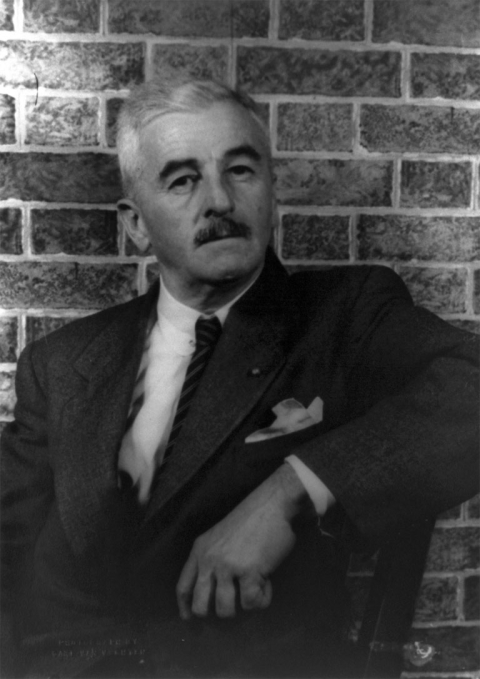
William Faulkner wrote his seventh novel As I Lay Dying in the last months of 1929, almost immediately after another stream-of-consciousness masterpiece, The Sound and the Fury. Like the Shakespearean title of that work, As I Lay Dying’s title, which comes from Homer’s Odyssey, indicates the literary ambitions of its author. Only thirty-two at the time of its writing, Faulkner composed the novel in eight weeks (six by his accounting) while working nights at the University of Mississippi’s power plant, deciding in advance that he would stake his entire reputation as a writer on the book: “Before I ever put pen to paper and set down the first words, I knew what the last word would be… Before I began I said, I am going to write a book by which, at a pinch, I can stand or fall if I never touch ink again.” His passionate conviction is evident in the original manuscript—the first and only draft—which reveals “an ease in creation unlike his other novels.”
Perhaps the most narratively straightforward of William Faulkner’s Yoknapatawpha novels—set in a fictional Mississippi region based on his own home county of Lafayette— As I Lay Dying tells the story of the Bundrens, a poor white family on a perilous journey to honor their matriarch Addie’s request for a burial in the town of Jefferson. Despite the seeming simplicity of its plot, the book’s style is incredibly complex, told from the perspective of fifteen different characters in rough-hewn country dialect and arresting lyrical fugues. It is the novel’s “coarse language and dialect,” that is “exactly Faulkner’s project,” writes Tin House editor Rob Spillman: “Faulkner, a Mississippi high school dropout, made it his mission to capture the emotional lives of the rural poor, unflinchingly writing about race, gender, sexuality, and power.” Through the power of his language and—in the words of Robert Penn Warren—the “range of effect, philosophical weight, originality of style, variety of characterization, humor, and tragic intensity,” the Southern novelist elevated his humble subjects to truly mythic status.
Thanks to HarperCollins, you can listen to Faulkner himself read from his masterpiece: .au file (4.4 Mb), .gsm file (0.9 Mb), .ra file (0.5 Mb). You’ll have to listen carefully to hear the author’s soft southern drawl, which gets lost at times in the poor quality recording. As you do, follow along with the text in Google Books. Faulkner reads from the twelfth chapter, told by Darl, Addie’s second oldest son, a sensitive, poetic thinker who narrates nineteen of the novel’s 59 chapters (and who James Franco plays in his film adaptation of the book). In this passage, Darl observes his mother’s death, and each family member’s immediate reaction, from sister Dewey Dell’s dramatic expressions of grief, to older brother Cash’s taciturn response and father Anse’s tragic-comic insensitivity: “God’s will be done…. Now I can get them teeth.”
To hear much more of Faulkner’s voice, visit Faulkner at Virginia: An Audio Archive, which catalogs and stores digital audio of the author’s lectures, readings, and question and answer sessions during his tenure as writer in residence at the University of Virginia in 1957–58. In one particular session with a group of engineering school students, Faulkner gives us a clue for how we might approach his work, which can seem so strange to those unfamiliar with the history, customs, and speech patterns of the American Deep South. Each of us, he says, “reads into the—the books, things the writer didn’t put in there, in the terms that—that his and the writer’s experience could not possibly be identical. That there are things the writer might think is in that book, which the reader doesn’t find for the same reason that—that no two experiences can be identical, but everyone reads according to—to his own—own lights, his own experience, his own observation, imagination, and experience.” For all of their provincial peculiarities, the Bundren’s epic struggle with the grief and pain of loss has universal reach and resonance.
Related Content:
William Faulkner Names His Best Novel, And the First Faulkner Novel You Should Read
William Faulkner Reads His Nobel Prize Speech
Seven Tips From William Faulkner on How to Write Fiction
Josh Jones is a writer and musician based in Durham, NC. Follow him at @jdmagness
Read More...Support Us
We're hoping to rely on loyal readers, rather than erratic ads. Please click the Donate button and support Open Culture. You can use Paypal, Venmo, Patreon, even Crypto! We thank you!

About Us

Open Culture scours the web for the best educational media. We find the free courses and audio books you need, the language lessons & educational videos you want, and plenty of enlightenment in between.
Advertise With Us

FREE UPDATES!
GET OUR DAILY EMAIL
Get the best cultural and educational resources on the web curated for you in a daily email. We never spam. Unsubscribe at any time.
FOLLOW ON SOCIAL MEDIA

Open Culture editor Dan Colman scours the web for the best educational media. He finds the free courses and audio books you need, the language lessons & movies you want, and plenty of enlightenment in between.
Advertise With Us

