The Curious Story of How Bootlegged Hollywood Movies Helped Defeat Communism in Romania
Chuck Norris helped defeat Communism in Romania… or at least the black market VHS tapes of his movies did. That’s what Romanian filmmaker Ilinca Calugareanu argues in her New York Times Op Ed piece and in a related documentary short, which you can see above.
Nicolae Ceausescu’s regime was notoriously brutal and oppressive, even by Warsaw Pact standards. In his mad efforts to eradicate all foreign debt, he impoverished his people while building a massive, opulent palace for himself in the heart of Bucharest. He shut down all radio stations outside of the capital and restricted all television broadcasts to a mere two hours a day. And what was programmed was, by all accounts, pretty dull unless you’re a fan of Communist propaganda.
So it isn’t a suprise that when an enterprising entrepreneur began to flood the black market with bootleg VHS tapes of Hollywood blockbusters in the mid-80s, they were met with great illicit excitement. “It was amazing to do something illegal during Communism, something not Communist. Watching imperialist movies,” says one interviewee.
Movies like Flashdance, Taxi Driver, and Missing in Action became hits. Arnold Schwarzenegger, Sylvester Stallone and, yes, Chuck Norris all became underground stars. Yet while Romanian audiences were wowed by the spectacle of car chases, machine gun fights and exploding helicopters, they were equally transfixed by things that Western audiences might overlook — the relative luxury of a typical American abode, for instance. It was a powerful reminder that things were far better in the West than at home. “You could see what those people had, what they ate, what freedoms they had, how they spoke to one another,” says another interviewee. “It was completely different. And somehow, underneath it all, you felt … what freedom was.”
Yet the peculiar thing about all these VHS bootlegs is that they were all dubbed by the same person, a young translator named Irina Margareta Nistor. “As Hollywood movies became ubiquitous through the black market, this voice became one of the most recognizable in Romania,” writes Calugareanu. “Yet no one knew who she was.”
Nistor understandably worked in secret, conscious that a brutal crackdown could happen at any moment. But one never came. Ceausescu’s regime met a swift and bloody end on Christmas Day, 1989. As she looks back on her time as a translator and an unwitting underground celebrity, Nistor beams with a quiet pride, explaining that her actions were “a way to trick the Communists. That was my biggest satisfaction.”
Related Content:
How to Spot a Communist Using Literary Criticism: A 1955 Manual from the U.S. Military
How the CIA Secretly Funded Abstract Expressionism During the Cold War
A Short History of Romanian Computing: From 1961 to 1989
Jonathan Crow is a Los Angeles-based writer and filmmaker whose work has appeared in Yahoo!, The Hollywood Reporter, and other publications. You can follow him at @jonccrow.
Read More...
How To Think Like a Psychologist: A Free Online Course from Stanford
 In early January, we brought you a set of 15 tips to help you stick to your New Year’s resolutions, straight from The Willpower Instinct, a bestselling book by Dr. Kelly McGonigal. Today, we’re highlighting a course that McGonigal organized for Stanford’s Continuing Studies Program, entitled How To Think Like a Psychologist. The premise is simple: McGonigal introduces prominent Stanford psychologists, who proceed to discuss their research and explain precisely why their field happens to be so fascinating, after which McGonigal leads a short discussion with the guest. An audience Q&A session follows.
Each of the course’s six lectures is a neatly packaged primer on a researcher’s area of expertise: Greg Walton gives a detailed talk about his work on academic stigma, and the role it plays in the achievement gap so evident in American education, while in later lectures, James Gross discusses his research on emotional regulation, and Bridget Martin Hard explains the benefits of studying animals to better understand humans. The strength of the course lies both in its accessibility, and its level of depth: one does not need a background in science to learn something tangible about current psychological research. What’s more, one gets a sense of how relevant psychology is as a practical science, governing every fleeting thought and social interaction.
How To Think Like a Psychologist is currently available on iTunesU. You can find it listed in our collection of Free Online Psychology Courses, part of our collection, 4,000+ Free Movies Online: Great Classics, Indies, Noir, Westerns, Documentaries & More.
Ilia Blinderman is a Montreal-based culture and science writer. Follow him at @iliablinderman, or read more of his writing at the Huffington Post.
Related Content:
The Power of Empathy: A Quick Animated Lesson That Can Make You a Better Person
Jacques Lacan’s Confrontation with a Young Rebel: Classic Moment, 1972
New Animation Explains Sherry Turkle’s Theories on Why Social Media Makes Us Lonely
Read More...Beat the Devil: Watch John Huston’s Campy Noir Film with Humphrey Bogart & Gina Lollobrigida (1953)
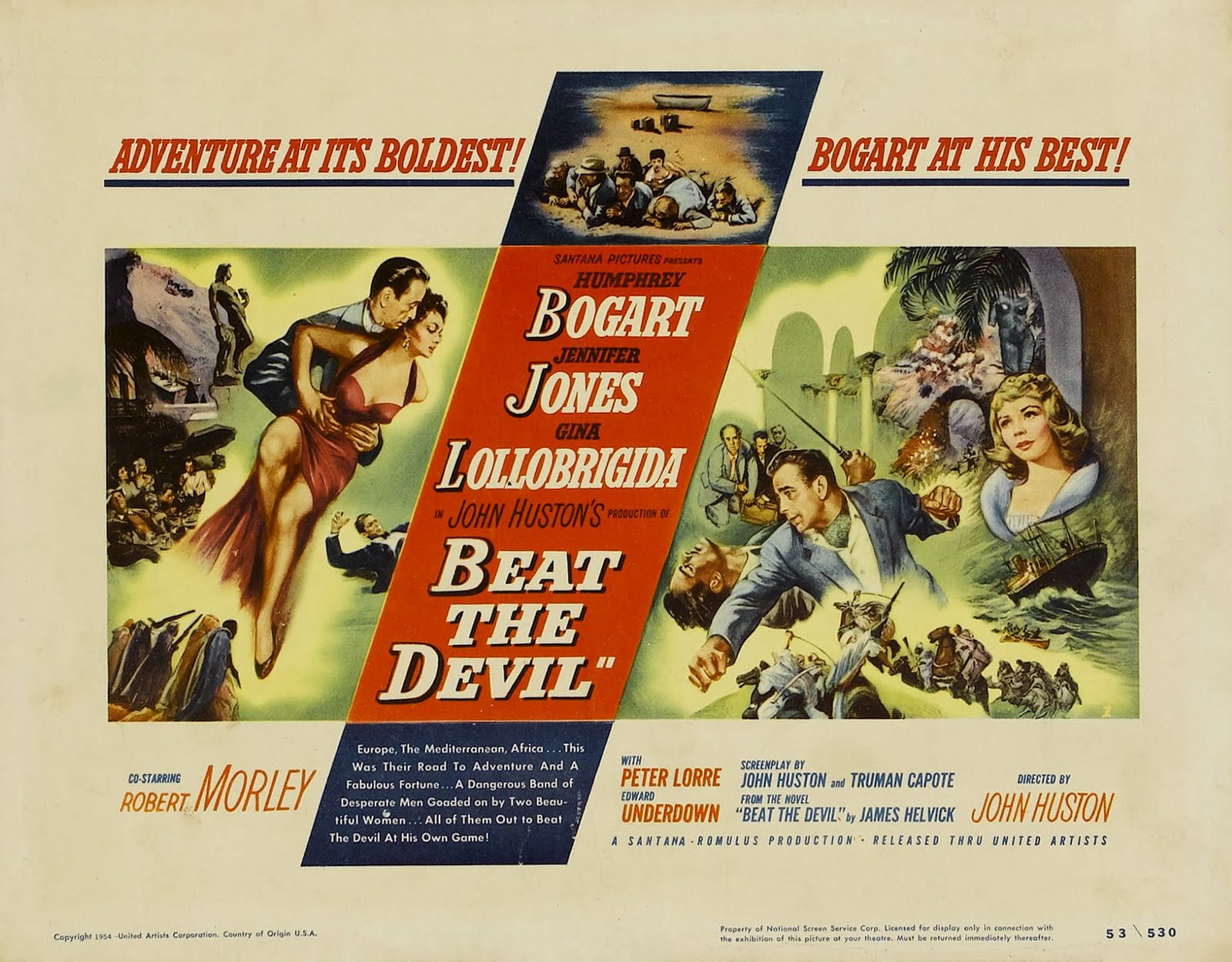
What came out when John Huston, Humphrey Bogart, Gina Lollobrigida, Jennifer Jones, Peter Lorre, and Truman Capote collaborated? You wouldn’t expect a farcical, nearly improvised study in eccentricity, but here we have it. Beat the Devil, which you can watch above, simply confused audiences when it opened in 1953, but humanity has since — with, for better or for worse, the thoroughgoing senses of unseriousness and irony we’ve cultivated — come to appreciate it. This story of would-be uranium pirates stranded in an Italian port on their way to Kenya began, like Stanley Kubrick’s Dr. Strangelove, as an adaptation of a high-minded, stone-faced novel, in this case an eponymous one by Claud Cockburn (father of the late Alexander Cockburn, author of, yes, The Nation’s “Beat the Devil” column). Also like Dr. Strangelove, it took a dose of absurdity somewhere in pre-production, turning from drama into comedy.
Bogart, not just one of the film’s stars but one of its major investors, thought he’d signed up for a Graham Greene-ish thriller but wound up in what many consider the first “camp” film. He must surely have come to understand the scope of his misapprehension by the time Truman Capote turned up on set, rewriting a whole new script — if the proud midcentury film industry would have dignified it with that term — on the fly, throwing together new and more ridiculous scenes each day. This and other unconventional production strategies have all become part of the body of Beat the Devil lore, which Roger Ebert examines in (speaking of ultimate validation) his “Great Movies” essay on the picture. He includes a telling quote from Huston, who supposedly told Jones, “Jennifer, they’ll remember you longer for Beat the Devil than for Song of Bernadette.” Adds Ebert: “True, but could Huston have guessed that they would remember him more for Beat the Devil than for Moby Dick?”
Beat the Devil has been added to our collection, 4,000+ Free Movies Online: Great Classics, Indies, Noir, Westerns, Documentaries & More. It also appears in our list of Free Noir Films.
Related Content:
Jean-Paul Sartre Writes a Script for John Huston’s Film on Freud (1958)
How Ray Bradbury “Became” Herman Melville and Wrote the Script for John Huston’s Moby-Dick (1956)
Colin Marshall hosts and produces Notebook on Cities and Culture and writes essays on cities, aesthetics, Asia, and men’s style. He’s at work on a book about Los Angeles, A Los Angeles Primer. Follow him on Twitter at @colinmarshall or on Facebook.
Read More...Authors Page
All
Administrator|User role
Author|User role
Contributor|User role
Editor|User role
Premium Subscriber
Subscriber|User role
Read More...Get 50% Off Criterion Films on Blu-ray & DVD for the Next 24 Hours

Heads up: For the next 24 hours, all Blu-rays and DVDs are 50% off at Criterion.com with promo code MADFOX! Includes films by Wes Anderson, Truffaut, Hitchcock, Kurosawa and many more. Don’t dilly dally. It looks like some of the films are selling out fast.
PS Speaking of Wes Anderson, Pitchfork is now streaming the soundtrack to his upcoming movie The Grand Budapest Hotel.
Related Content:
The Art of Restoring Classic Films: Criterion Shows You How It Refreshed Two Hitchcock Movies
635 Free Movies Online: Great Classics, Indies, Noir, Westerns, etc.
200 Free Documentaries Online
Read More...
A Playlist of Music Scientifically-Proven to Increase Cows’ Milk Production: REM, Lou Reed & More

Image by Daniel Schwen via Wikimedia Commons
Let’s test our agriculture math skills with a little dairy industry story problem:
If an 8‑ounce glass of whole milk provides 149 calories, 8 grams of protein, 276 milligrams of calcium, 8 grams of fat, 4.5 grams of saturated fat and 24 milligrams of cholesterol, and a cup of two-percent milk has 120 calories, 5 grams of fat, 3 grams of saturated fat and 20 milligrams of cholesterol, what kind of music will result in an overall milk production increase of 3%?
According to a study at the University of Leicester School of Psychology, the answer is slow jams and easy listening.
Huh. Based on the concert tees of the boys I grew up around in Indiana, I would have guessed Rush or Guns N’ Roses. (Maybe there was some Barry Manilow going on behind closed barn doors?)
Actually, research shows that bovine musical preference, like that of aerobics instructors, hinges less on any specific artist than on beats per minute.
…I hope they didn’t spend too much on this study. Upon reflection, isn’t it just common sense that noise-sensitive herd animals attached to machines via their udders would choose a mellow groove over death metal or psychobilly?
(Poor Bananarama. It must’ve stung when the University of Leicester’s team told the world that 1,000 Holstein Friesian cattle liked listening to nothing at all better than their 1986 Billboard Hot 100 #1 hit, “Venus.”)
To paraphrase another 80’s fave, I know what cows like, thanks to a panel of five Holsteins who got to pick the winner of the British Columbia Dairy Association’s 2012 “Music Makes More Milk” contest. Brace yourself:
Did anyone else just imagine a thousand cows with phones to their ears, chewing their cuds and swishing their tails, content to remain on hold indefinitely?
Should the above tune ever grow old (doubtful) there’s always Shakespeare. According to NPR, a theatrical reading of “The Merry Wives of Windsor” proved popular, milk-wise, with an audience of UK cows. And Modern Farmer has honored Lou Reed by including one of his compositions (no, not “Metal Machine Music, Part 1”) in their recent Playlist To Milk By:
“Everybody Hurts,” REM
“What a Difference A Day Makes,” Aretha Franklin
“Bridge Over Troubled Water,” Simon & Garfunkel
“Moon River,” Danny Williams
“Orinoco Flow,” Celtic Woman
“Perfect Day,” Lou Reed (The Little Willie’s Lou Reed cow-tipping song aside, can you picture him milking one?)
via Grist
Related Content:
Sir Patrick Stewart Demonstrates How Cows Moo in Different English Accents
Ayun Halliday is an author, zine publisher, and recent convert to almond milk. Follow her @AyunHalliday
Read More...The Chemistry of Sriracha & What Sets Your Mouth Aflame
If you head over to the Huy Fong Foods web site, they’ll tell you that Sriracha, their ever-popular Thai condiment, is “made from sun ripen chilies which are ground into a smooth paste along with garlic and packaged in a convenient squeeze bottle.” It’s the chilies that make your mouth burn when you pour that Sriracha onto your eggs or burgers, or in your soup and, yes, cocktails. But if you want to get scientific about things, it’s actually the capsaicin and dihydrocapsaicin — the two compounds inside the hot peppers — that set your mouth aflame. All of this, and more, gets covered by this new video, The Chemistry of Sriracha, from the American Chemical Society. It’s part of their video series, Reactions, that examines the chemistry of everyday things.
Related Content:
Free Online Chemistry Courses
The Fascinating Science of Snow
“The Periodic Table Table” — All The Elements in Hand-Carved Wood
The Elements: Tom Lehrer Recites Chemical Elements to the Tune of Gilbert & Sullivan
Read More...Alice Herz-Sommer, the Oldest Holocaust Survivor (Thanks to the Power of Music), Dies at 110
On Sunday, 23 February 2014, Alice Herz-Sommer, thought to be the oldest Holocaust survivor, died in London. She has been an inspiration to many people as the story of her life is shown in the Oscar-nominated documentary called “The Lady in Number 6″ (the video above is the official trailer).
Alice was born in Prague – then part of the Austro-Hungarian Empire – in 1903. She started playing the piano as a child and took lessons with Conrad Ansorge, a student of Liszt. At 16, she attended the master class at Prague’s prestigious German musical academy. Later, Alice became a respected concert pianist in Prague. Through her family, she also knew Franz Kafka. All of this changed when the Nazis occupied Czechoslovakia in March 1939. Along with other Jews living in Prague, Alice was initially forced to live in Prague’s ghetto before being deported to the Theresienstadt concentration camp in 1943, along with her five-year-old son Raphael. Eventually her whole family, including her husband, cellist Leopold Sommer, and her mother, was sent to Auschwitz, Treblinka and Dachau, where they were killed.
Alice and her son survived Theresienstadt because the Nazis used this particular concentration camp to show the world how “well” the inmates were treated. A propaganda film by the Nazis was shot and a delegation from the Danish and International Red Cross was shown around in 1943. To boost morale, Alice and many other imprisoned musicians regularly performed for the inmates. Despite the unimaginable living conditions, Alice and her son survived. They moved to Israel after the war, where she taught music. In 1986, she moved to London. Her son died in 2001 (obituary here).
The way Alice dealt with those horrible times is particularly inspiring. She says about the role of music: “I felt that this is the only thing which helps me to have hope … it’s a sort of religion actually. Music is … is God. In difficult times you feel it, especially when you are suffering.” When asked by German journalists if she hated Germans, she replied: “I never hate, and I will never hate. Hatred brings only hatred.”
Extra material:
- Art Therapy Blog has a transcript of the trailer, memorable quotes by Alice and two BBC Radio interviews with her.
- Alice’s life story is told in the book A Garden of Eden in Hell.
- The most extensive obituaries can be found in The Guardian and The Telegraph.
By profession, Matthias Rascher teaches English and History at a High School in northern Bavaria, Germany. In his free time he scours the web for good links and posts the best finds on Twitter.
Read More...
Edgar Allan Poe Offers Interior Design Advice and Blasts American Aristocrats in “The Philosophy of Furniture” (1840)
Edgar Allan Poe isn’t read much as an essayist, which is too bad. His essays reveal a quick and ironic cast of mind where his dark poetry and stories often mark him as a single-minded hypersensitive, “like a peony just past bloom.” Where Poe the poet can be lugubrious, Poe the essayist is brisk, incisive, and, well… kinda catty. Take the following aphoristic witticisms from his 1846 “A Few Words on Etiquette”:
Never use the term genteel — it is only to be found in the mouths of those who have it nowhere else.
Green spectacles are an abomination, fitted only for students of divinity.
Almost every defect of face may be concealed by a judicious use and arrangement of hair.
Are these casual bon mots or serious prescriptions? Why not both? An editor at the Edgar Allan Poe Society of Baltimore notes that the etiquette essay “bears much the same humorous tone and mixture of genuine and satirical commentary as Poe’s essay ‘The Philosophy of Furniture’ from 6 years earlier.” Indeed, in that earlier critical work on interior design, Poe makes confident judgments, leaps from point to point with delightfully specific examples, and employs a mix of levity and gravity.
Poe begins “The Philosophy of Furniture” with “a somewhat Coleridegy assertion” from Hegel then launches into a pitiless critique of various national styles. His last point—“The Yankees alone are preposterous”—is the basis for what follows, a disquisition on the sad state of American interior design, brought about by “an aristocracy of dollars” in which “the display of wealth” takes the place of heraldry. His critique recalls (and perhaps alludes to) English poet Alexander Pope’s “Epistle to Burlington,” whose satirical target makes such a tasteless mess of his villa that his neighbors cry out “What sums are thrown away!”
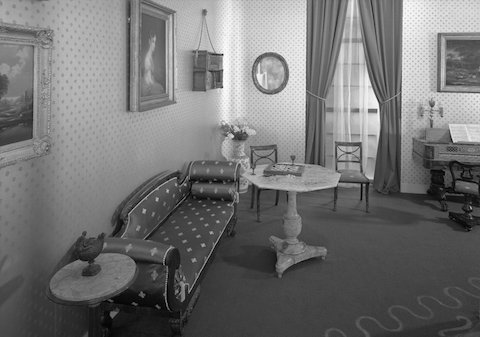
In Poe’s case, the offending estate is “what is termed in the United States, a well-furnished apartment.” He decries the injudicious use of curtains, the poor display of carpets (“the soul of the apartment”), and the problem “of gas and of glass.” Poe deliciously details the decorating habits of a parvenu American aristocracy, whose defects are discernable by even the “veriest bumpkin.” But he offers more than snark. “Like any good critic,” writes The Smithsonian, “Poe doesn’t just condemn, he offers solutions.” In the final, lengthy paragraph of “The Philosophy of Furniture,” Poe turns his talent for vivid description to a portrait of his perfect boudoir. Above, you can see a 1959 recreation of Poe’s “small and not, ostentatious chamber with whose decorations no fault can be found.” But this may be redundant. Poe furnishes us with sufficient fine detail that we can better create his ideal room in our imagination. See the excerpts below, and read Poe’s complete essay here.
The proprietor lies asleep on a sofa — the weather is cool — the time is near midnight: I will make a sketch of the room ere he awakes. It is oblong — some thirty feet in length and twenty-five in breadth — a shape affording the best (ordinary) opportunities for the adjustment of furniture. It has but one door — by no means a wide one — which is at one end of the parallelogram, and but two windows, which are at the other. These latter are large, reaching down to the floor — have deep recesses — and open on an Italian veranda. Their panes are of a crimson-tinted glass, set in rose-wood framings, more massive than usual. They are curtained within the recess, by a thick silver tissue adapted to the shape of the window, and hanging loosely in small volumes. Without the recess are curtains of an exceedingly rich crimson silk, fringed with a deep network of gold, and lined with silver tissue, which is the material of the exterior blind. There are no cornices; but the folds of the whole fabric (which are sharp rather than massive, and have an airy appearance), issue from beneath a broad entablature of rich gilt-work, which encircles the room at the junction of the ceiling and walls […]
The carpet — of Saxony material — is quite half an inch thick, and is of the same crimson ground, relieved simply by the appearance of a gold cord (like that festooning the curtains) slightly relieved above the surface of the ground, and thrown upon it in such a manner as to form a succession of short irregular curves — one occasionally overlaying the other. The walls are prepared with a glossy paper of a silver gray tint, spotted with small Arabesque devices of a fainter hue of the prevalent crimson. Many paintings relieve the expanse of paper. These are chiefly landscapes of an imaginative cast — such as the fairy grottoes of Stanfield, or the lake of the Dismal Swamp of Chapman. There are, nevertheless, three or four female heads, of an ethereal beauty — portraits in the manner of Sully. The tone of each picture is warm, but dark […]
Two large low sofas of rosewood and crimson silk, gold-flowered, form the only seats, with the exception of two light conversation chairs, also of rose-wood. There is a pianoforte (rose-wood, also), without cover, and thrown open. An octagonal table, formed altogether of the richest gold-threaded marble, is placed near one of the sofas. This is also without cover — the drapery of the curtains has been thought sufficient.. Four large and gorgeous Sevres vases, in which bloom a profusion of sweet and vivid flowers, occupy the slightly rounded angles of the room. A tall candelabrum, bearing a small antique lamp with highly perfumed oil, is standing near the head of my sleeping friend. Some light and graceful hanging shelves, with golden edges and crimson silk cords with gold tassels, sustain two or three hundred magnificently bound books. Beyond these things, there is no furniture, if we except an Argand lamp, with a plain crimson-tinted ground glass shade, which depends from the lofty vaulted ceiling by a single slender gold chain, and throws a tranquil but magical radiance over all.
Again, the Edgar Allan Poe Society editor helpfully notes that “Poe, in this article, has adopted an intentionally humorous tone.” Should we take this seriously or treat is as Poe-ean satire? Why not both?
Works by Poe can be found in our collections of Free Audio Books and Free eBooks.
via Smithsonian.com
Related Content:
The Edgar Allan Poe Digital Collection
Edgar Allan Poe’s “The Raven,” Read by Christopher Walken, Vincent Price, and Christopher Lee
Edgar Allan Poe & The Animated Tell-Tale Heart
Josh Jones is a writer and musician based in Durham, NC. Follow him at @jdmagness
Read More...Watch a Witty, Gritty, Hardboiled Retelling of the Famous Aaron Burr-Alexander Hamilton Duel
Imagine Vice President Joe Biden being on the receiving end of a vociferous attack in the press by former Secretary of the Treasury, Tim Geithner. Now, picture Biden demanding satisfaction, and taking the morning off from his vice presidential duties to settle things man-to-man, and Geithner winding up in a coma. As unbelievable as this episode may seem today, this kind of affair played out some 200 years ago on a much grander scale when Vice President Aaron Burr fatally shot Alexander Hamilton during a duel. The Burr-Hamilton confrontation remains an infamous black mark on American politics. Burr, serving as VP in Thomas Jefferson’s administration, is widely seen as a villain for murdering Hamilton. Hamilton, for his part, is beloved as one of the Founding Fathers and a vocal champion of the U.S. Constitution. For our non-American readers, this adulation translates to his face now gracing the $10 bill.
But were things really so simple? Dana O’Keefe, the filmmaker behind Aaron Burr, Part 2, answers with a resounding no. “History is a contest, not unlike a duel. I ended his life. But he ruined mine. I won the duel, but I lost my place in history,” Burr declares in the opening monologue of O’Keefe’s 8‑minute short, and it is precisely Burr’s place in history that the film seeks to address. In O’Keefe’s modern retelling, Burr emerges as an unfairly maligned figure, whose bravery in battle has been overshadowed by the incompetence of superiors such as Generals George Washington and Richard Montgomery. It’s effective. Mixing archival footage of original documents with re-enactments and present day shots, O’Keefe creates a gritty, sometimes witty, hardboiled feel to Burr’s story, and viewers begin to sympathize with the disparaged figure. To the sounds of tracks like Dr. Dre’s “The Next Episode” and some creative use of iPhones, O’Keefe dispels the idea that Burr shot Hamilton first. Rather, Burr is the honorable party, and Hamilton is the scoundrel. It’s well worth a watch.
via The Atlantic
Ilia Blinderman is a Montreal-based culture and science writer. Follow him at @iliablinderman, or read more of his writing at the Huffington Post.
Related Content:
Drunk History: An Intoxicated Look at the Famous Alexander Hamilton – Aaron Burr Duel
Alexander Hamilton: Hip-Hop Hero at the White House Poetry Evening
Free Online History Courses
Read More...Support Us
We're hoping to rely on loyal readers, rather than erratic ads. Please click the Donate button and support Open Culture. You can use Paypal, Venmo, Patreon, even Crypto! We thank you!

About Us

Open Culture scours the web for the best educational media. We find the free courses and audio books you need, the language lessons & educational videos you want, and plenty of enlightenment in between.
Advertise With Us

FREE UPDATES!
GET OUR DAILY EMAIL
Get the best cultural and educational resources on the web curated for you in a daily email. We never spam. Unsubscribe at any time.
FOLLOW ON SOCIAL MEDIA

Open Culture editor Dan Colman scours the web for the best educational media. He finds the free courses and audio books you need, the language lessons & movies you want, and plenty of enlightenment in between.
Advertise With Us