Enjoy a Bluegrass Performance of Elton John’s 1972 Hit, “Rocket Man”
Last fall, our readers loved watching Iron Horse, a bluegrass band from Alabama, performing a most unusual version of Metallica’s “Enter Sandman.” The band’s take on Metallica’s anthem was originally recorded on the 2003 album, Fade to Bluegrass: Tribute to Metallica, where Iron Horse — with Tony Robertson on mandolin, Vance Henry on guitar, Ricky Rogers on bass, and Anthony Richardson on banjo — played Metallica hits in bluegrass fashion — “or at least as bluegrass as it’s possible for Metallica songs to be.”
This January, the quartet released a new video, this time covering “Rocket Man.” Sung by Elton John in ’72, written by Bernie Taupin, and inspired by a Ray Bradbury story, Rocket Man has been covered/performed by Coldplay, Kate Bush, My Morning Jacket and many others. But, if you have a scorecard, you’ll almost certainly give Iron Horse top marks for creativity and originality. Hope you enjoy.
Related Content:
A Bluegrass Version of Metallica’s Heavy Metal Hit, “Enter Sandman”
Pakistani Musicians Play Amazing Version of Dave Brubeck’s Jazz Classic, “Take Five”
Read More...
Crime Jazz: How Miles Davis, Count Basie & Duke Ellington Created Soundtracks for Noir Films & TV
When we think of film noir, we tend to think of a mood best set by a look: shadow and light (mostly shadow), grim but visually rich weather, near-depopulated urban streets. You’ll see plenty of that pulled off at the height of the craft in the movies that make up “noirchaeologist” Eddie Muller’s list of 25 noir pictures that will endure, which we featured last week. But what will you hear? Though no one compositional style dominated the soundtracks of films noirs, you’ll certainly hear more than a few solid pieces of crime jazz. Xeni Jardin at Boing Boing, writing about Rhino’s eponymous compilation album, defines this musical genre as “jazzy theme music from 1950s TV shows and movies in which very bad people do very bad things.” She links to PopCult’s collection of classic crime jazz soundtrack album covers, from The Third Man to Charade (the best Hitchcock film, of course, that Hitchcock never made), to The Man With the Golden Arm, all as evocative as the music itself.
“Previously, movie music meant sweeping orchestral themes or traditional Broadway-style musicals,” says PopCult. “But with the growing popularity of bebop and hard bop as the sound of urban cool, studios began latching onto the now beat as a way to make their movies seem gritty or ‘street.’ ”
At Jazz.com, Alan Kurtz writes about the spread of crime jazz from straight-up film noir to all sorts of productions having to do with life outside the law: “In movies and TV, jazz accompanied the entire sordid range of police-blotter behavior, from gambling, prostitution and drug addiction to theft, assault, murder and capital punishment.” Get yourself in the spirit of all those midcentury degeneracies and more with the tracks featured here, all of which will take you straight to an earlier kind of mean street: the theme from The M Squad, “two minutes of mayhem by Count Basie and his mob of heavies”; Miles Davis’ “Au Bar du Petit Bac,” improvised by Davis and his Parisian band against Louis Malle’s Elevator to the Gallows; and Ray Anthony’s “Peter Gunn Theme,” a “quickie cover” that “beat Henry Mancini’s original to the punch.”
And finally we have Duke Ellington’s score for Anatomy of a Murder, directed by Otto Preminger in 1959.
via Boing Boing
Related Content:
1959: The Year that Changed Jazz
The Nazis’ 10 Control-Freak Rules for Jazz Performers: A Strange List from World War II
Colin Marshall hosts and produces Notebook on Cities and Culture and writes essays on cities, Asia, film, literature, and aesthetics. He’s at work on a book about Los Angeles, A Los Angeles Primer. Follow him on Twitter at @colinmarshall or on his brand new Facebook page.
Read More...Harvard Presents Two Free Online Courses on the Old Testament

A quick note: Shaye J.D. Cohen, a professor of Hebrew Literature and Philosophy at Harvard, has just released his second free course on iTunes. The first course was called The Hebrew Scriptures in Judaism & Christianity. The new one, simply titled The Hebrew Bible, “surveys the major books and ideas of the Hebrew Bible (also called the Old Testament) examining the historical context in which the texts emerged and were redacted. A major subtext of the course is the distinction between how the Bible was read by ancient interpreters (whose interpretations became the basis for many iconic literary and artistic works of Western Civilization) and how it is approached by modern bible scholarship.” The new course, featuring 25 sets of video lectures and lecture notes, has been added to our collection of Free Online Religion Courses, a subsection of our collection of 1,300 Free Online Courses. Other related courses worth exploring are Introduction to the Old Testament and Introduction to New Testament History and Literature, both from Yale.
If you would like to support the mission of Open Culture, consider making a donation to our site. It’s hard to rely 100% on ads, and your contributions will help us continue providing the best free cultural and educational materials to learners everywhere. You can contribute through PayPal, Patreon, and Venmo (@openculture). Thanks!
Read More...“Be All You Can Be. Read”: Peter Max’s 1969 Psychedelic Poster for National Library Week
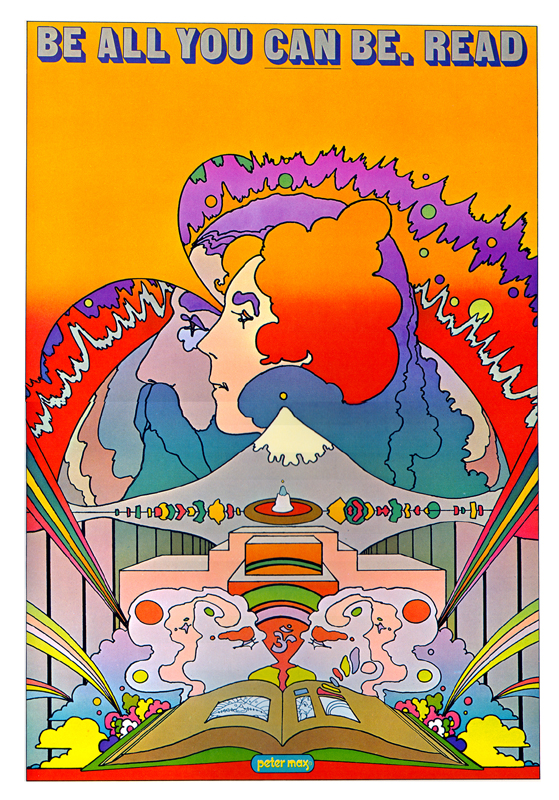
In 1969, Peter Max was creating psychedelic illustrations that captured the countercultural spirit of the 1960s. Bright, trippy, and thought-provoking, Max’s artwork fused together “eastern yogi philosophy, astronomy, comic books, studies in color, and music.” And it certainly found an audience. By the late 60s, college dorm rooms across the U.S. were plastered with Max’s posters. 72 corporations — from General Electric to Burlington Mills, a manufacturer of socks — licensed his art for commercial use. Meanwhile, in ’69, Max appeared on The Tonight Show, The Ed Sullivan Show, and the cover of LIFE magazine (with main article titled “Peter Max: Portrait of the artist as a very rich man”).
Even while the corporate gigs were rolling in, the German-born illustrator took on less commercial projects, like creating this poster for National Library Week, an annual event organized by the American Library Association. Measuring 36 x 24 inches, the 1969 poster, aesthetically speaking, is vintage Max. And it carries a message that sounds as good today as it did then: “Be All You Can Be. Read.” Now dare I steer you toward of our collection of 500 Free eBooks? An easy way to make you, a better you.
If you would like to support the mission of Open Culture, consider making a donation to our site. It’s hard to rely 100% on ads, and your contributions will help us continue providing the best free cultural and educational materials to learners everywhere. You can contribute through PayPal, Patreon, and Venmo (@openculture). Thanks!
via Biblioklept
Read More...The Art Assignment: Learn About Art & the Creative Process in a New Web Series by John & Sarah Green
If you haven’t seen the works of John Green, whose “Crash Course” series on world history and English literature we previously featured here, you’ve missed out on first-class examples of the learning experiences video technology, the internet, and burning curiosity have now made possible. (An antipathy to these subjects’ traditional classroom teaching methods may also have something to do with them.) PBS, however, has not missed out, and in partnership with Green and his wife Sarah Urist Green, they’ve just come out with The Art Assignment, a weekly web series that “celebrates the creative process” and introduces “today’s most innovative artistic minds.” An ambitious mission, and one you can find out more about in the clip above. But the Greens don’t intend to put together a simple primer on art. The Art Assignment, as Urist Green explains, has them “traveling around the country, visiting artists and asking them to give you an art assignment.”
The first episode has just become available, and, in it, they pay a visit to the Flux Factory in Queens, where artists Douglas Paulson and Christopher Robbins tell the story of their first “collaboration,” which involved their meeting at high noon in a lake in the Czech Republic, the exact geographical midpoint between their then-homes in Copenhagen and Serbia. Their assignment? “Find someone. Draw a line between the two of you, meet exactly in the middle. Once you’ve agreed on your meeting point, date, and time, you’re not allowed to speak to each other by any means.” John then wonders if that really counts as art (“On some level, to me, art is painting”), which prompts Sarah to quote artist-theorist Roy Ascott: “Stop thinking about art works as objects, and start thinking about them as triggers for experiences.” The Art Assignment will doubtless put the Greens and their followers through some interesting experiences indeed.
Related Content:
A Crash Course in World History
The 55 Strangest, Greatest Films Never Made (Chosen by John Green)
Free: The Guggenheim Puts 99 Modern Art Books Online
Colin Marshall hosts and produces Notebook on Cities and Culture and writes essays on cities, Asia, film, literature, and aesthetics. He’s at work on a book about Los Angeles, A Los Angeles Primer. Follow him on Twitter at @colinmarshall or on his brand new Facebook page.
Read More...Johnny Depp Reads an Infamous Scene from Hunter S. Thompson’s Hell’s Angels
In 1966, Hunter S. Thompson launched his career with the publication of Hell’s Angels: The Strange and Terrible Saga of the Outlaw Motorcycle Gangs. The book was the result of Thompson living with the bikers for a year. He drank with them, hung out with them and witnessed both their comradery and their brutality. “I was no longer sure whether I was doing research on the Hell’s Angels or being slowly absorbed by them,” he wrote. He was ultimately seduced by their outlaw mystique and particularly by their passion for motorcycles.
In the video clip above, taken from the documentary Gonzo: The Life and Work of Dr. Hunter S. Thompson, Johnny Depp reads excerpts from the famed Edge Speech in Hell’s Angels about the joys and terrors of riding a bike recklessly at night.
There was no helmets on those nights, no speed limit, and no cooling it down on the curves. The momentary freedom of the park was like the one unlucky drink that shoves a wavering alcoholic off the wagon.
Thompson’s flirtation with the Hell’s Angels ended abruptly when he called out a biker named Junkie George for engaging in domestic abuse. “Only a punk beats his wife,” he quipped. Junkie took umbrage and proceeded to beat him senseless.
The book, when it came out, similarly didn’t impress the Angels. In the clip below, which aired on Canadian TV, an Angel confronts a surprisingly quiet and twitchy Thompson before a studio audience.
Related Content:
Hunter S. Thompson Interviews Keith Richards
Johnny Depp Reads Letters from Hunter S. Thompson
Hunter S. Thompson Gets Confronted by The Hell’s Angels
Read 10 Free Articles by Hunter S. Thompson That Span His Gonzo Journalist Career (1965–2005)
Jonathan Crow is a Los Angeles-based writer and filmmaker whose work has appeared in Yahoo!, The Hollywood Reporter, and other publications. You can follow him at @jonccrow.
Read More...The Roving Typist: A Short Film About a New York Writer Who Types Short Stories for Strangers
C.D. Hermelin, a literary agency associate with a degree in Creative Writing, is the self-proclaimed Roving Typist. It’s an apt title for one who achieved fame and fortune — okay, rent money — by appearing in various public spaces around New York City, typewriter in lap. Director Mark Cersosimo’s short film, above, introduces him as a mild-mannered, slightly awkward soul. Engaging with strangers lured by the sign taped to his typewriter case is where Hermelin comes into his own.
The sign promises “stories while you wait,” a concept that recalls the “Poems on Demand” author and writing guru, Natalie Goldberg, who composed poems to raise funds for the Minnesota Zen Center. (Hermelin got his idea — and permission to implement it — from a guy he saw doing something similar in San Francisco.)
He’s open to requests, and payment is left to the discretion of the recipient. He seems to take extra care when his customer is a child.
A harmless enough pursuit in an era where subway musicians and caricaturists lining the path to the Central Park Zoo hustle harder than ‘90s-era shell game artistes.
It’s reasonable to assume that innocently blundering onto a cello player’s turf is the worst trouble a guy like Hermelin’s likely to stir up.
Instead, he became the target of a mass cyberbullying campaign, after a stranger posted a photo of him and his typewriter parked on the High Line on a sweltering day in 2012. Cue an avalanche of hipster-hating Reddit comments, in addition to a meme at his expense.
Rather than succumb to the vast negative outpouring, the Roving Typist confronted the situation head on, publishing his side of the story in The Awl:
Originally, it felt silly labeling my venture a “cause” while I defended myself to an anonymous horde—but now it feels anything but. The experience of being labeled and then cast aside made me realize that what many people call “hipsterism” or, what they perceive as a slavish devotion to irony, are often in fact just forms of extreme, radical sincerity. I think of Brooklyn-based “hipster” brand Mast Brothers Chocolate, which uses an old-fashioned schooner to retrieve their cacao beans, because the energy is cleaner, because they think that’s how it should be done. I think of the legions of Etsy-type handmade artist shops, of people who couldn’t make money in their profession, so found a way to make money with their art.
Subject a whimsical project to the forge, and it just might become a vocation.
Be sure to check out the bonus outtake “I Was A Hated Hipster Meme” and don’t fret if your travels won’t take you near New York City anytime soon. Hermelin and his typewriter are spending the winter indoors, fulfilling the public’s on-demand stories via mail order.
Related Content:
David Rees Presents a Primer on the Artisanal Craft of Pencil Sharpening
Humans of New York: Street Photography as a Celebration of Life
What Happens When Everyday People Get a Chance to Conduct a World-Class Orchestra in NYC
Ayun Halliday is an author, illustrator, and Chief Primatologist of the long running zine, The East Village Inky. Follow her @AyunHalliday
Read More...Why is Ukraine in Crisis?: A Quick Primer For Those Too Embarrassed to Ask
Why have Ukrainians been protesting since November? It’s a question you might feel strange asking in February. But not to worry, The Washington Post has put together a helpful video that explains the crisis in two minutes (above), along with a related primer: 9 questions about Ukraine you were too embarrassed to ask. A deeper analysis can be found in the pages of The New York Review of Books.
For the latest news on what’s happening in Ukraine, you can get live video and social media updates at The New York Times.
Read More...Johnny Rotten Goes Before TV’s Judge Judy in 1997 … and Wins!
In the clip above, ex-Sex Pistols leader John Lydon (aka “Johnny Rotten”) goes before TV’s Judge Judy in a 1997 episode of the daytime show. How and why this came about I cannot begin to imagine. The case is straightforward enough. Robert Williams, former drummer of Lydon’s post-Pistols band Public Image Limited, brought suit against the punk icon for breach of contract and assault and battery. Judy obviously doesn’t care much for Williams and calls him a “nudnik.” She seems to like Lydon, though, despite having to shush his snide outbursts numerous times. It’s also clear she has absolutely no idea who he is. “I don’t know from this band,” she says, “This last band I heard was Lawrence Welk… Jimmy Dorsey… Tommy Dorsey… I don’t know. Those are bands!”
Judy ultimately calls out Williams for expecting so much order amidst the chaos of the music business, and she dismisses his suit. And as for Johnny Rotten’s odd fifteen minutes on daytime television? “Perhaps this was the moment Lydon’s ambition as a TV presenter was born,” muses Dangerous Minds. Who knows? It’s a long way from the famous Bill Grundy interview, yet perhaps not so far from his televised confrontations of the following few decades. But consider as evidence a much earlier Lydon appearance on a 1979 TV court show, “Juke Box Jury” (above), where Lydon and a panel of celebrities pass verdicts on the current pop hits: “It ain’t the Donna Summers I know. I hate it. It was awful!”
via WFMU
Related Content:
Never Mind the Bollocks, Here’s … John Lydon in a Butter Commercial?
Josh Jones is a writer and musician based in Durham, NC. Follow him at @jdmagness
Read More...Watch Behind-the-Scenes Footage of Stanley Kubrick’s Full Metal Jacket
Vivian Kubrick, daughter of the late, great filmmaker, shot a behind-the-scenes movie about the making of The Shining (1980) at the tender age of 17. For Full Metal Jacket (1987) – Stanley Kubrick’s next movie — Vivian not only composed the score under the pseudonym Abigail Mead but she also shot 18 hours of footage for another planned documentary. That movie never came to pass and most likely never will; Vivian broke off all contact with her family in the late ‘90s.
Yet fragments of the behind-the-scenes footage have found their way into a couple of documentaries – Stanley Kubrick: A Life in Pictures, directed by Kubrick’s long time producer and brother-in-law Jan Harlan and in Jon Ronson’s Stanley Kubrick’s Boxes. (Ronson actually discovered the footage in a stable house on the Kubrick estate.)
Someone has helpfully strung together the footage into a single video. See above. One of the first things that strike you is just how weird the shoot was. Though the film climaxes during the battle of Hue in tropical Vietnam, Kubrick is seen on set barking orders in a winter coat. That’s because the movie was shot in England. An abandoned gas works factory near London, of all places, served as the war torn city.
Kubrick’s famed perfectionism shines through in the video. He labors to get just the right spacing between lime-covered actors playing corpses in an open grave and he tells his actors just how many groin pulls to do during the famous “this is my rifle, this is my gun” sequence. “It should be three shakes. This is…my…gun. In time to the thing.”
Related Content:
Stanley Kubrick’s Annotated Copy of Stephen King’s The Shining
The Making of Stanley Kubrick’s The Shining (As Told by Those Who Helped Him Make It)
Room 237: New Documentary Explores Stanley Kubrick’s The Shining and Those It Obsesses
Rare 1960s Audio: Stanley Kubrick’s Big Interview with The New Yorker
Jonathan Crow is a Los Angeles-based writer and filmmaker whose work has appeared in Yahoo!, The Hollywood Reporter, and other publications. You can follow him at @jonccrow.
Read More...Support Us
We're hoping to rely on loyal readers, rather than erratic ads. Please click the Donate button and support Open Culture. You can use Paypal, Venmo, Patreon, even Crypto! We thank you!

About Us

Open Culture scours the web for the best educational media. We find the free courses and audio books you need, the language lessons & educational videos you want, and plenty of enlightenment in between.
Advertise With Us

FREE UPDATES!
GET OUR DAILY EMAIL
Get the best cultural and educational resources on the web curated for you in a daily email. We never spam. Unsubscribe at any time.
FOLLOW ON SOCIAL MEDIA

Open Culture editor Dan Colman scours the web for the best educational media. He finds the free courses and audio books you need, the language lessons & movies you want, and plenty of enlightenment in between.
Advertise With Us

