The Postcards That Picasso Illustrated and Sent to Jean Cocteau, Apollinaire & Gertrude Stein
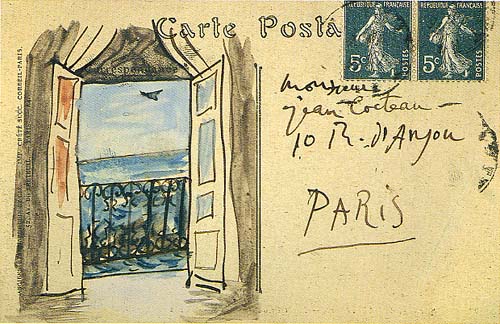
Pablo Picasso’s coterie of friends and collaborators was vast and glamorous. Following his move to France, Picasso befriended the flamboyant Russian ballet impresario Serge Diaghilev, whose Ballets Russes sets he went on to design, and whose prima ballerina Picasso went on to marry. Picasso also became friends with composers (such as Igor Stravinsky) and eminent painters, including his Cubist brother-in-arms Georges Braques, and his compatriot, Juan Gris.
Today, we bring you a number of the postcards that Picasso sent to his friends, many of which he personally illustrated, quickly dashing off a note or a picture in a loose, wavy script. Above, you can view an image of Picasso’s postcard to his close friend and artist, Jean Cocteau, depicting the balcony at No. 10, Rue d’Anjou, where Cocteau’s mother had an apartment. Below, you can view a sketch Picasso sent off to the forefather of the Surrealist movement, his rotund friend and poet Guillaume Apollinaire. The message reads, bluntly, “I don’t see you anymore. Are you dead?”
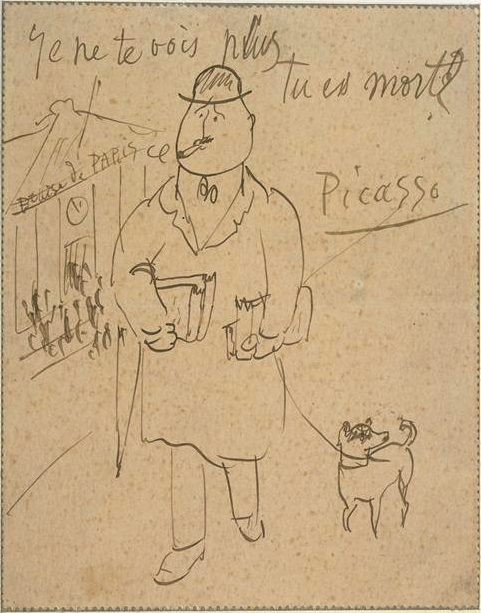
In the lengthiest of the postcards, dating from 1919 and provided by Something Rich & Strange, Picasso writes to Gertrude Sein, perhaps describing a holiday:
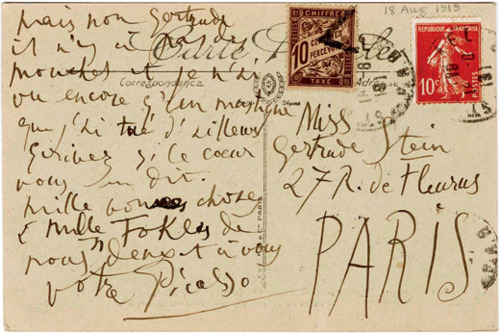
“Mais non Gertrude,
il n’y a pas des mouches et je n’ai vu encore qu’un moustique, que j’ai tué d’ailleurs. Ecrives si le couer vous dit. Milles bonnes choses de nous deux a vous [et mlle Toklas]
votre Picasso.
-
“No, Gertrude,
there are no flies, and I haven’t seen more than one mosquito, which I killed, anyway. Write me if the mood strikes. All the best to you and Ms. Toklas.
Yours, Picasso”
Interested readers may purchase a collection of Picasso’s postcards on Amazon.
Ilia Blinderman is a Montreal-based culture and science writer. Follow him at @iliablinderman, or read more of his writing at the Huffington Post.
Related Content:
Six Postcards From Famous Writers: Hemingway, Kafka, Kerouac & More
Read More...Quantum Entanglement Animated
PhD Comics has released the third video in an animated series explaining Quantum concepts and devices. This one focuses on Quantum Entanglement and features the work of Caltech physicists Jeff Kimble and Chen-Lung Hung. Meanwhile Jorge Cham, creator of PhD Comics, provides the accompanying animation.
Entire courses on Quantum Entanglement can be found in our collection of Free Online Physics Courses, part of our collection of 825 Free Online Courses.
Related Content:
Leonard Susskind Teaches You “The Theoretical Minimum” for Understanding Modern Physics
The Higgs Boson, AKA the God Particle, Explained with Animation
What’s Next for the Large Hadron Collider? PhD Comics Introduces the Search for Extra Dimensions
The Famous Feynman Lectures on Physics: The New Online Edition (in HTML5)
Read More...Who Directed the Psycho Shower Scene?: Hitchcock’s Film & Saul Bass’ Storyboards Side by Side
The shower scene in Alfred Hitchcock’s Psycho (1960) is easily one the most viewed, analyzed and parsed lengths of film in cinema history. Constructed from over 70 shots, the scene shows Marion Crane (Janet Leigh) – the supposed protagonist of the movie – meeting a gory end at the hands of a cross-dressing Norman Bates 30 minutes into the movie. Hitchcock’s quick editing and his subjective camera work brilliantly evokes all the scene’s nudity and transgressive violence without actually showing much of either. The scene freaked out audiences when it came out and 54 years later, it still has the power to shock. Critic David Thomson called it “legitimately among the most violent scenes ever shot for an American film.”
Psycho went a long way toward cementing Hitchcock’s standing as a cinematic auteur. So in 1970, seminal graphic designer Saul Bass, who did the title sequence for the movie, made waves when he claimed that he directed the shower scene. His proof is his storyboard, which shows a sequence of images that are similar — though not exactly the same — as what ended up in the movie. Vashi Nedomansky helpfully placed Bass’s storyboard alongside the actual movie. See above.
As you might notice, that eerie motif of the shower head is not to be found on the storyboards. Other images – the knife-wielding murderer in silhouette, the blood spiraling down the drain, the curtain getting pulled from the rod – look like they came straight from Bass. And some have argued that the scene simply looks more like Bass’s previous work than Hitchcock’s.
Others, including many of the people who were actually on set, insist that Hitchcock was at the helm. Janet Leigh — who, of course, was there for the duration of the scene’s seven day shoot, screaming her head off – has been unequivocal about her thoughts on the matter:
Saul Bass was there for the shooting, but he never directed me. Absolutely not. Saul Bass is brilliant, but he couldn’t have done the drawings had Mr. Hitchcock not discussed with him what he wanted to get. And you couldn’t have filmed the drawings. Why does there always have to be controversy?
Related Content:
Alfred Hitchcock’s Rules for Watching Psycho (1960)
A Brief Visual Introduction to Saul Bass’ Celebrated Title Designs
Jonathan Crow is a Los Angeles-based writer and filmmaker whose work has appeared in Yahoo!, The Hollywood Reporter, and other publications. You can follow him at @jonccrow.
Read More...Name Your Price for 200+ Albums from Deep Elm Records: Prices Start at Free
 A quick heads up, courtesy of Metafilter: Deep Elm Records turns 20 years old next year and announced yesterday that all 200+ of its albums are available on a “name your price, no minimum” basis:
“If you have means please show [the bands] love by naming your price. If you do not have any means, in exchange for each download we kindly request that you post, share, tag and tweet to tell your friends about each album as our bands depend on your word of mouth.”
The indie record label has released LPs by bands such as Lights & Motion, The Appleseed Cast, Brandtson, The White Octave, and Planes Mistaken for Stars, plus a number of compilation albums, including The Emo Diaries. If you’re looking for a place to get started, one reader on Metafilter offers up this list.
* v/a, The Emo Diaries, Vol. 1
* David Singer, The Cost of Living * Appleseed Cast, Low Level Owl, Vol. 1 + 2
* Triplefastaction, Cattlemen Don’t
* Walt Mink, Colossus
* Camber, Beautiful Charade
* Accents, Growth And Squalor
* Papermoons, New Tales
Related content:
Download Free Music from 150+ Classical Composers, Courtesy of Musopen.org
Free: The Metropolitan Museum of Art and the Guggenheim Offer 474 Free Art Books Online
Read More...25 Noir Films That Will Stand the Test of Time: A List by “Noirchaelogist” Eddie Muller
Film noir received its name in 1946 when French critic Nino Frank expressed his fascination with dark Hollywood melodramas of the time. But noir as a genre only took shape retrospectively, and the bitter arguments over what it is continue to the present. I’ve always thought of film noir as the offspring of German Expressionism, pulp fiction, and the hard-boiled crime novels of Raymond Chandler. Its characters—dangerous seductresses and “fallen” women, cynical detectives, sadistic villains and amoral deviants of all kinds—are exaggerated outlaw mirrors of the era’s virtuous everyman protagonists. Most noirs seem expressly created to defy the Hays Code’s strong suggestion that “the sympathy of the audience shall never be thrown to the side of crime, wrongdoing, evil or sin.”
Alain Silver, editor of the Film Noir Reader, dates “the classic era of film noir” to “a fifteen year span from You Only Live Once (1937) to Where Danger Lives (1952).” But films as early as Fritz Lang’s 1931 M are discussed in noir terms, and the aesthetic persists, if only in homage or parody, as in the obvious noir take-off Sin City. Roger Ebert concisely defined the genre in a short list of ten essential features. Despite its French name and stylistically German origins, Ebert called it “the most American film genre, because no society could have created a world so filled with doom, fate, fear and betrayal, unless it were essentially naive and optimistic.”
Whatever the genre’s boundaries, I think it’s safe to say that film noir’s history rests in good hands. The Film Noir Foundation has dedicated itself to “rescuing and restoring America’s Film Noir Heritage”; Film Noir Studies aims to be a critical resource for students, scholars, and fans alike. And perhaps best of all, we have Eddie Muller—self-described “wordslinger, impresario, noirchaelogist”—on the case. A very noir-ish character himself, Muller, a seasoned San Francisco reporter, barfly, boxing enthusiast, and adult film historian, defines film noir as “the flip side of the all-American success story.”
It’s about people who realize that following the program will never get them what they crave. So they cross the line, commit a crime and reap the consequences. Or, they’re tales about seemingly innocent people tortured by paranoia and ass-kicked by Fate. Either way, they depict a world that’s merciless and unforgiving.
On his site, Muller has compiled a list of “25 noir films that will stand the test of time.” His picks range from acknowledged classics like Double Indemnity and Sunset Boulevard to lesser-known pictures like Raw Deal. Below, I’ve listed his favorites in the reverse order he prefers. Calling his list “Endless Night,” Muller asks us to “take this with a grain of salt” and to “consider the listing a sort of carnival barometer, ranging from INFATUATED to PASSIONATE.”
25. Raw Deal (Eagle-Lion, 1948) — Available on YouTube
24. City that Never Sleeps (Republic, 1952)
23. Touch of Evil (Universal, 1958)
22. Scarlet Street (Universal, 1945) — Available on Open Culture or watch above
21. Detour (PRC, 1945) — Available on Open Culture
20. Tomorrow is Another Day (Warner Bros., 1951)
19. The Prowler (United Artists, 1950)
18. Gun Crazy (United Artists, 1950)
17. Act of Violence (MGM, 1949)
16. Odds Against Tomorrow (United Artists, 1959)
15. The Killing (United Artists, 1956)
14. They Live By Night (RKO, 1949)
13. Thieves’ Highway (20th Century-Fox, 1949)
12. Sweet Smell of Success (United Artists, 1958)
11. The Killers (Universal, 1946)
10. Moonrise (Republic, 1948) — Available on YouTube
9. Out of the Past (RKO, 1947)
8. Night and the City (20th Century-Fox, 1950)
7. Nightmare Alley (20th Century-Fox, 1947)
6. The Maltese Falcon (Warner Bros., 1941)
5. Double Indemnity (Paramount, 1944)
4. The Asphalt Jungle (MGM, 1950)
3. Sunset Boulevard (Paramount, 1950)
2. Criss Cross (Universal, 1949)
1. In a Lonely Place (Columbia, 1950)
See Muller’s original article for his priceless commentary on each film. And if his list piques your interest, be sure to visit our considerable collection of free online film noir classics, all otherwise found in our collection, 4,000+ Free Movies Online: Great Classics, Indies, Noir, Westerns, Documentaries & More.
Related Content:
Detour: The Cheap, Rushed Piece of 1940s Film Noir Nobody Ever Forgets
Watch D.O.A., Rudolph Maté’s “Innovative and Downright Twisted” Noir Film (1950)
The Third Man: Film Noir Classic on YouTube
Josh Jones is a writer and musician based in Durham, NC. Follow him at @jdmagness
Read More...The Art of Restoring Classic Films: Criterion Shows You How It Refreshed Two Hitchcock Movies
Why have cinephiles, from the era of Laserdiscs through that of DVDs and now Blu-rays, so consistently respected The Criterion Collection? Speaking as one such cinephile, I could point to a number of factors: their curatorial bent toward important films, their production of rich supplementary features, their always impressive pieces of cover art. But Criterion has become increasingly known for the considerable work they put in not at the end of the process, when they package a classic or potentially classic motion picture for maximum aesthetic and intellectual appeal (and your purchase), but at the beginning, when they track down the actual celluloid film in the first place, often aged or damaged, and engage in the often painstaking task of returning it to the prime of visual and sonic life.
In the short Gizmodo video at the top, Criterion director Lee Kline and his team talk about the work they did to restore Alfred Hitchcock’s 1940 Foreign Correspondent, which included acquiring the negative from the Library of Congress, scanning the whole thing at high resolution over two days to a week, doing the research necessary to figure out how the film “should have looked,” clean up scratches and film damage, and filter out the clicks and pops on the soundtrack. (And yes, we get some insight into its “snazzy” cover design as well.) The Kline-narrated video just above offers a demonstration of Criterion’s restoration process on another piece of classic Hitchcock, the first, 1934-made version of The Man Who Knew Too Much, a picture with no known negative still in existence. A formidable challenge, but if we film geeks entrust that job to anyone, we entrust it to Criterion.
Related Content:
21 Free Hitchcock Movies Online
The Restoration of a Masterpiece, as Narrated by Martin Scorsese
Watch The Pleasure Garden, Alfred Hitchcock’s Very First Feature Film (1925)
Colin Marshall hosts and produces Notebook on Cities and Culture and writes essays on cities, Asia, film, literature, and aesthetics. He’s at work on a book about Los Angeles, A Los Angeles Primer. Follow him on Twitter at @colinmarshall or on his brand new Facebook page.
Read More...Guns N’ Roses “Sweet Child O’ Mine” Retooled as 1920s New Orleans Jazz
Thanks to the efforts of Scott Bradlee’s Postmodern Jukebox and singer Miche Braden, the world now knows how heavy metal rockers, Guns N’ Roses sound with their knees rouged up and their stockings down.
Their New Orleans jazz take on 1987’s “Sweet Child O’ Mine” replaces the preening rock god sensitivity of the original with a sort of mature, female swagger harkening all the way back Bessie Smith. (Braden’s stage credits include turns as Billie Holiday, Valaida Snow, and Ma Rainey.)
The backup musicians get in on the fun, too, retooling Slash’s guitar solo as a horn-driven cakewalk. I know which party I’d rather hit!
Over the years, “Sweet Child O’ Mine” has proved a remarkably study workhorse, withstanding attempts to make it over as electronica, a Gregorian Chant and Brazilian prog rock. Or how about this version played on the Guzheng, an ancient Chinese instrument. Postmodern Jukebox’s entry into this stakes is not without gimmick, but it’s a winning one.
If you would like to support the mission of Open Culture, consider making a donation to our site. It’s hard to rely 100% on ads, and your contributions will help us continue providing the best free cultural and educational materials to learners everywhere. You can contribute through PayPal, Patreon, and Venmo (@openculture). Thanks!
Related Content:
Radiohead’s “Creep” Performed in a Vintage Jazz-Age Style
Enjoy a Bluegrass Performance of Elton John’s 1972 Hit, “Rocket Man”
Pakistani Musicians Play Amazing Version of Dave Brubeck’s Jazz Classic, “Take Five”
A Middle-Eastern Version of Radiohead’s 1997 Hit “Karma Police”
Ayun Halliday is an author, illustrator, and Chief Primatologist of the long running zine, The East Village Inky. Follow her @AyunHalliday
Read More...Watch 13 Experimental Short Films by Tezuka Osamu, the Walt Disney of Japan
Tezuka Osamu (1928–1989) is known as “the God of manga” in Japan. He created classics for both children and adults in every genre – from horror to romance to action. The sheer amount of work produced in Osamu’s relatively short life is staggering; some estimates have it that he drew over 150,000 pages of comics.
While focusing just on manga would have been enough for most mortals, Osamu was also a trailblazer in animation. He created Astro-Boy, the hugely popular character that spawned comic books, TV shows, video games and a couple of movies. The visual style of Osamu’s animated work — Astro-Boy and others — proved to be very influential. Those trademark giant eyes on anime characters come straight from Osamu (who in turn was influenced by Walt Disney and Max Fleischer).
Osamu relentlessly challenged the limits of what manga and anime could do. He’s credited with making the first ever X‑Rated animated feature film, Cleopatra, Queen of Sex (1970) — imagine Disney doing that. He also made a series of experimental animated shorts, which showcase not only Osamu’s creativity and range but also his philosophy, which was heavily influenced by Buddhism.
His 1962 work Tale of Street Corner is a surprisingly moving short about the day-to-day life of a city street corner as seen through the eyes of some anthropomorphized mice and sentient street posters.
And if you want get a sense of Osamu’s versatility, check out his 1966 movie Pictures at an Exhibition. The work is an omnibus film featuring ten smaller shorts, all set to Mussorgsky’s famous suite. Osamu recreated each short in a completely different style from the others.
His 1984 short, Jumping is a technical tour-de-force told with admirable simplicity. Seen from a first person point of view, the movie is about a young child who is jumping down a country road. As each jump gets higher and longer, the camera passes through cities, fields and oceans and eventually into a warzone. The sharp-eyed viewer will see R2D2 and C‑3PO make a surprise cameo at around the 2:57 marker.
And finally, here is an interview with the master himself as he talks about making these movies. And you can see all 13 of the animated shorts here.
Related Content:
Destino: The Salvador Dalí – Disney Collaboration 57 Years in the Making
Kafka’s Nightmare Tale, ‘A Country Doctor,’ Told in Award-Winning Japanese Animation
Japanese Cartoons from the 1920s and 30s Reveal the Stylistic Roots of Anime
How to Make Instant Ramen Compliments of Japanese Animation Director Hayao Miyzaki
Jonathan Crow is a Los Angeles-based writer and filmmaker whose work has appeared in Yahoo!, The Hollywood Reporter, and other publications. You can follow him at @jonccrow.
Read More...15-Year-Old Jane Austen Writes a Satirical History Of England: Read the Handwritten Manuscript Online (1791)
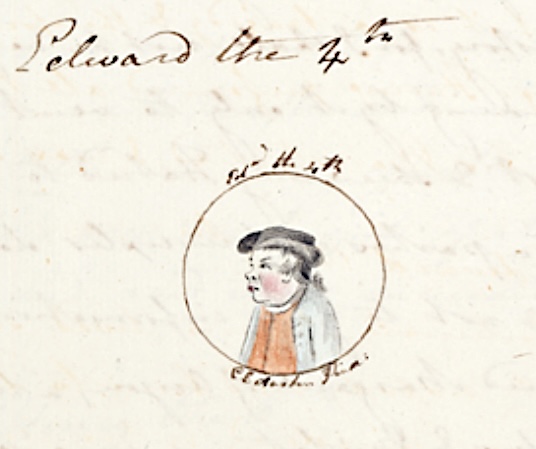
Last week, we posted about the British Library’s colossal online exhibit, which includes over 30,000 items, all freely digitized for reader perusal. Although we’d mentioned some of the choicest holdings — the original writings by Mozart and da Vinci, for example — we’ve recently come across another piece of literary history that compelled us to revisit the collection: a browsable manuscript of Jane Austen’s The History of England, penned in 1791, when the author was only 15 years old.
Austen was, by and large, a homeschooled and autodidactic child. Although she had taken part in some formal schooling between the ages of 7 and 10, illness and the family’s lack of means dictated that she had to rely on her father’s extensive library for an education. By the time she was fifteen, Austen had evidently gathered sufficient material to fuel her writing, and had completed a history of England, beginning with Henry IV (1367–1413), and ending with Charles I (1600–1649). Above, you can see one of the book’s many illustrations drawn by Jane’s elder sister, Cassandra, depicting Edward IV, of whom Austen writes, “This Monarch was famous only for his Beauty & his Courage, of which the Picture we have here given of him, & his undaunted Behaviour in marrying one Woman while he was engaged to another, are sufficient proofs.” In spite of its brevity — the book numbers only 36 handwritten pages — Austen’s juvenilia shows unmistakable signs of her distinct satirical voice. The volume is, in fact, a parody of the stuffy claims of objectivity found in 18th century grade school history textbooks, like Oliver Goldsmith’s The History of England from the Earliest Times to the Death of George II. Rather than follow suit, Austen skips trivialities such as key dates and events, noting to her readers in the introduction to a section on Henry VIII,
“It would be an affront to my Readers were I to suppose that they were not as well acquainted with the particulars of the King’s reign as I am myself. It will therefore be saving them the task of reading again what they have read before, & myself the trouble of writing what I do not perfectly recollect, by giving only a slight sketch of the principal Events which marked his reign”
I had the sense that Austin relished writing such humorous prose as much as I enjoyed reading it. Unconstrained by the formalities of her medium, she takes to referencing Shakespeare and giving voice to her numerous opinions. Take, for example, her entries on Henry V and Henry VI:
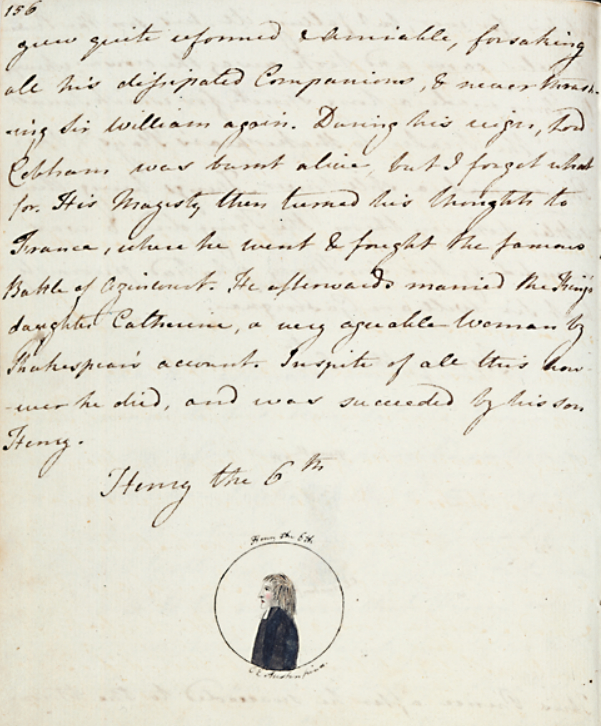
Henry the 5th
This Prince after he succeeded to the throne grew quite reformed and amiable, forsaking all his dissipated Companions, & never thrashing Sir William again. During his reign, Lord Cobham was burnt alive, but I forget what for. His Majesty then turned his thoughts to France, where he went & fought the famous Battle of Agincourt. He afterwards married the King’s daughter Catherine, a very agreeable Woman by Shakespear’s account. Inspite of all this however, he died, and was succeeded by his son Henry.
Henry the 6th
I cannot say much for this Monarch’s sense. Nor would I if I could, for he was a Lancastrian. I suppose you know all about the Wars between him & the Duke of York who was of the right side; if you do not, you had better read some other History, for I shall not be very diffuse in this, meaning by it only to vent my Spleen against, & shew my Hatred to all those people whose parties or principles do not suit with mine, & not to give information. This King married Margaret of Anjou, a Woman whose distresses & misfortunes were so great as almost to make me who hate her, pity her. It was in this reign that Joan of Arc lived & made such a row among the English. They should not have burnt her — but they did.
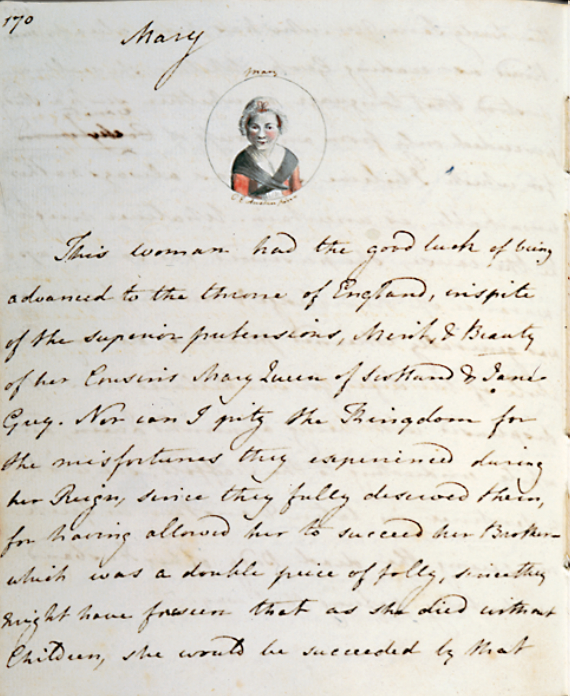
The whole book, including the above pages on Queens Mary and Elizabeth, may be viewed at the British library’s website.
Ilia Blinderman is a Montreal-based culture and science writer. Follow him at @iliablinderman, or read more of his writing at the Huffington Post.
Related Content:
New Stamp Collection Celebrates Six Novels by Jane Austen
Read Jane Austen’s Manuscripts Online
The Recipes of Iconic Authors: Jane Austen, Sylvia Plath, Roald Dahl, the Marquis de Sade & More
Find Jane Austen’s Works in Our Free Audio Books and Free eBooks Collections
Read More...David Foster Wallace’s Surprising List of His 10 Favorite Books, from C.S. Lewis to Tom Clancy
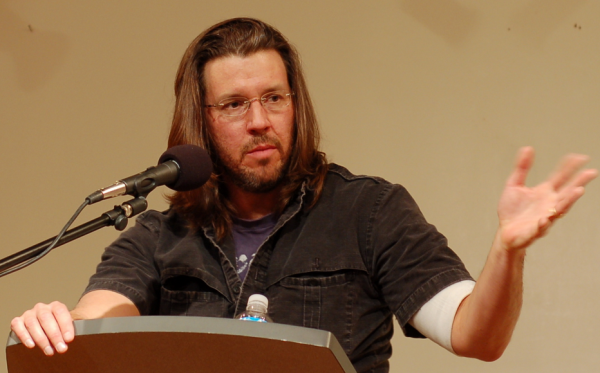
Image by Steve Rhodes, via Wikimedia Commons
Like many David Foster Wallace fans, I bought a copy of J. Peder Zane’s The Top Ten (previously featured here), a compilation of various famous writers’ top-ten-books lists, expressly for DFW’s contribution. Like most of those David Foster Wallace fans, I felt more than a little surprised when I turned to his page and found out which ten books he’d chosen. Here, as quoted in the Christian Science Monitor, we have the Infinite Jest author and widely recognized (if reluctant) “high-brow” literary figure’s top ten list:
1. The Screwtape Letters, by C.S. Lewis
2. The Stand, by Stephen King
3. Red Dragon, by Thomas Harris
4. The Thin Red Line, by James Jones
5. Fear of Flying, by Erica Jong
6. The Silence of the Lambs, by Thomas Harris
7. Stranger in a Strange Land, by Robert A. Heinlein
8. Fuzz, by Ed McBain
9. Alligator, by Shelley Katz
10. The Sum of All Fears, by Tom Clancy
Thrillers, killers, and a dose of Christianity to top it off; I didn’t blame Zane when he asked, “Is he serious? Beats me. To be honest, I don’t know what Wallace was thinking. But I do think there’s a certain integrity to his list.” Wallace himself seemed to read assiduously all over the map — or, more to the point, all up and down the scale of critical respectability. Rattling off “the stuff that’s sort of rung my cherries” to Salon’s Laura Miller in 1996, for a contrast, he named, among other worthy reads, Socrates’ funeral oration, John Donne, “Keats’ shorter stuff,” Schopenhauer, William James’ Varieties of Religious Experience, Wittgenstein’s Tractatus, Joyce’s Portrait of the Artist as a Young Man, Hemingway’s In Our Time, Don DeLillo, A.S. Byatt, Cynthia Ozick, Donald Barthelme, Moby-Dick, and The Great Gatsby. (You can find many of these texts in our Free eBooks collection.)
That, some Wallace readers may think, sounds more like it. But those who’ve paid close attention to Wallace’s language — that often breathlessly but hopelessly imitated mixture of high-caliber vocabulary, casually spoken rhythm, deceptively sharp-edged perception, shrugging presentation, and deliberate solecism — know how fully he simultaneously embodied both “high” and “low” English writing. Just look at the Literary Analysis syllabus from his days teaching at Illinois State University, which demands students read not just The Silence of the Lambs but another Thomas Harris novel, Black Sunday, as well as more C.S. Lewis (in this case The Lion, the Witch, and the Wardrobe) and Stephen King (Carrie). Lest you doubt his commitment to the serious reading of popular fiction, note the presence of Jackie Collins’ Rock Star. In the classroom and in life, Wallace must truly have believed that there exists no low fiction; just low ways of reading fiction.
Looking for free, professionally-read audio books from Audible.com? Here’s a great, no-strings-attached deal. If you start a 30 day free trial with Audible.com, you can download two free audio books of your choice. Get more details on the offer here.
Related Content:
David Foster Wallace’s Love of Language Revealed by the Books in His Personal Library
30 Free Essays & Stories by David Foster Wallace on the Web
David Foster Wallace: The Big, Uncut Interview (2003)
David Foster Wallace’s 1994 Syllabus
Colin Marshall hosts and produces Notebook on Cities and Culture and writes essays on cities, Asia, film, literature, and aesthetics. He’s at work on a book about Los Angeles, A Los Angeles Primer. Follow him on Twitter at @colinmarshall or on his brand new Facebook page.
Read More...Support Us
We're hoping to rely on loyal readers, rather than erratic ads. Please click the Donate button and support Open Culture. You can use Paypal, Venmo, Patreon, even Crypto! We thank you!

About Us

Open Culture scours the web for the best educational media. We find the free courses and audio books you need, the language lessons & educational videos you want, and plenty of enlightenment in between.
Advertise With Us

FREE UPDATES!
GET OUR DAILY EMAIL
Get the best cultural and educational resources on the web curated for you in a daily email. We never spam. Unsubscribe at any time.
FOLLOW ON SOCIAL MEDIA

Open Culture editor Dan Colman scours the web for the best educational media. He finds the free courses and audio books you need, the language lessons & movies you want, and plenty of enlightenment in between.
Advertise With Us


