The Troggs Tapes: ‘Put a Little Bit of F***ing Fairy Dust Over the Bastard!’
Reg Presley, lead singer of the Sixties rock group The Troggs, died Monday at the age of 71. The Troggs (short for Troglodytes) are often mentioned as a major influence on the punk rock movement of the 1970s. They recorded a string of hits between 1966 and 1968, most notably “Wild Thing.” The Troggs are also remembered—much to the band’s chagrin—for one of the most notorious bootlegs ever: “The Troggs Tapes,” described by Uncut magazine as a “hilarious, 12-minute swearathon.”
The Troggs Tapes were recorded in London in 1970. The band was working on a song called “Tranquility,” but things weren’t going well, and the session degenerated into a foul-mouthed orgy of acrimony and recrimination. A copy of the recording somehow made it onto the bootleg market and became legendary. Saturday Night Live parodied the Troggs Tapes in a sketch with Bill Murray, John Belushi and others playing a group of frustrated medieval musicians who say the word “flogging” over and over. The tapes are also parodied in This is Spinal Tap, during the recording scene at the “Rainbow Trout Studios.” In a piece this week paying tribute to Reg Presley, the Telegraph music critic Neil McCormick writes:
Before the internet, The Troggs Tapes were hard to find, yet everyone seemed to know about them, an elusiveness that only added to their allure. I remember getting my hands on a copy in a Dublin flea market, then sitting aroud late at night with friends laughing ourselves silly at the inanity and palpable sense of frustration as the musicians fail to find a way to articulate and capture some sound idea, beyond the reach of either their language or their technical abilities.… In truth, it is the kind of conversation you can hear every day in recording studios all around the world, but there was something liberating and myth-busting about the experience of eavesdropping on these unguarded musicians at work.
You can listen to an abridged version of The Troggs Tapes above. To learn more about Reg Presley, you can read his fittingly unconventional obituary in The Telegraph. And to end things off on a positive note, we offer a glimpse of The Troggs when things were going considerably more smoothly, with the band performing “Wild Thing” in 1966:
Related Content:
8,976 Free Grateful Dead Concert Recordings in the Internet Archive, Explored by the New Yorker
Read More...The Beauty of Namibian Nights in Timelapse Motion
It took Marsel van Oosten two years and 16,000 images to create a timelapse video that captures the ineffable beauty of Namibian Nights. Shot with Nikon D3, D3s and D4 cameras, the film highlights van Oosten’s favorite sites in Namibia — “the fairytale-like quivertrees and the eery, dead camelthorn trees in Deadvlei.” For each second of video, 30 photographs were taken. Namibian Nights won First Prize in the 2012 Travel Photographer of The Year Awards.
Read More...How to Build a Country From Scratch
After half a century of war, the people of southern Sudan voted in early 2011 to break away from the Sudan and create their own independent state. The Republic of South Sudan, formed in July of 2011, has its work cut out for it. South Sudan is one of the poorest and least developed nations in the world, with only a few paved roads in a territory the size of France. In most areas of the country there is no formal legal system. And according to the United Nations, more than half of its 9 million people live in a condition of food insecurity.
In the year and a half since breaking out on its own, South Sudan has managed to undermine its reputation as the “good guys” by arresting journalists, shooting down a U.N. helicopter, expelling a U.N. human rights officer and using its military to seize an oil field in Sudanese territory. Meanwhile, in a country saturated with weapons, fighting has broken out among various ethnic groups.
So there is an element of irony in the title of this “Op-Doc” from the New York Times by independent filmmakers Florence Martin-Kessler and Anne Poiret. How to Build a Country From Scratch (above) is a nine-minute excerpt from a feature-length documentary that Martin-Kessler and Poiret are working on, called State Builders. The filmmakers made four trips to Juba, the largest city and provisional capital of South Sudan, to document the daunting process of creating a new nation. “Our mission as filmmakers,” they wrote this week in the Times, “was to follow the ‘state builders’–those people in the South Sudanese government and in the United Nations who would be on the front line of implementing, step by step, a road map for the world’s newest state.”
Read More...French Philosopher Jean Baudrillard Reads His Poetry, Backed By All-Star Arts Band (1996)

Image by European Graduate School, via Wikimedia Commons
French post-structuralist philosopher/sociologist Jean Baudrillard—usually identified with his postmodern theories of simulacra—is a little bit of a fringe figure in pop culture. Known to hip academic types and avant-garde-ists, he’s maybe the kind of thinker who gets name-dropped more than read (and he’s no easy read).
But in the audio clip above, Baudrillard reads to us, from his poetry no less, while backed by the swirling abstract sounds of The Chance Band, an all art-star ensemble featuring Tom Watson (of The Missingmen), George Hurley (of The Minutemen and fIREHOSE), Lynn Johnston, Dave Muller, Amy Stoll, and guest vocalist, theorist Allucquère Rosanne (“Sandy”) Stone. It’s an odd, one-time, assemblage of artists and thinkers UbuWeb describes as “unbelievable but true!”:
Recorded live as part of the Chance Festival at Whiskey Pete’s Casino in Stateline Nevada, 1996. You’ve never heard Baudrillard like this before! Music to read Nietzsche to.
Indeed. The track above is number two on a twelve-track album called Suicide Moi, released in 2002 by Compound Annex Records. You can buy the CD here or stream and download individual tracks for free on UbuWeb.
Related Content:
Avant-Garde Media: The UbuWeb Collection
Derrida: A 2002 Documentary on the Abstract Philosopher and the Everyday Man
Josh Jones is a writer, editor, and musician based in Washington, DC. Follow him @jdmagness
Read More...Download Walter Kaufmann’s Lectures on Nietzsche, Kierkegaard, Sartre & Modern Thought (1960)

Walter Kaufmann spent 33 years (1947–1980) teaching philosophy at Princeton. And more than anyone else, Kaufmann introduced Nietzsche’s philosophy to the English-speaking world and made it possible to take Nietzsche seriously as a thinker – something there wasn’t always room to do in American intellectual circles.
Without simplifying things too much, Kaufmann saw Nietzsche as something of an early existentialist, which brings us to these vintage lectures recorded in 1960 (right around the time that Kaufmann, a German-born convert to Judaism, also became a naturalized American citizen). The three lectures offer a short primer on existentialism and the modern crises philosophers grappled with. Kierkegaard and the Crisis in Religion begins the series, followed by Nietzsche and the Crisis in Philosophy and Sartre and the Crisis in Morality.
Kaufmann’s talks are now listed in the Philosophy section of our collection of Free Online Courses. There you will also find courses presented by more contemporary philosophers, including John Searle, Hubert Dreyfus, and Michael Sandel.
Related Content:
Download Free Courses from Famous Philosophers: From Bertrand Russell to Michel Foucault
Noam Chomsky & Michel Foucault Debate Human Nature & Power (1971)
Leo Strauss: 15 Political Philosophy Courses Online
Read More...Monty Python’s Life of Brian: Religious Satire, Political Satire, or Blasphemy?
Before I saw Monty Python’s Life of Brian, I only knew that religious people didn’t like it, which intrigued me. Then I found out that some religious people like it very much indeed, which really intrigued me. Building its story on a satirical parallel of the life of Jesus Christ, Life of Brian could never have helped drawing fire. But the Pythons knew how to use it: “So funny it was banned in Norway!” read one of the film’s posters, and indeed, the Norwegian government put the kibosh on its screenings, as did Ireland’s, as did a number of town councils in England. “As a satire on religion, this film might well be considered a rather slight production,” writes Richard Webster in A Brief History of Blasphemy. “As blasphemy it was, even in its original version, extremely mild. Yet the film was surrounded from its inception by intense anxiety, in some quarters of the Establishment, about the offence it might cause. As a result it gained a certificate for general release only after some cuts had been made. Perhaps more importantly still, the film was shunned by the BBC and ITV, who declined to show it for fear of offending Christians in this country.”
All this controversy came to a now-infamous 1979 television debate: In one corner, we have Python’s John Cleese and Michael Palin. In the other, we have contrarian satirist Malcolm Muggeridge and Bishop of Southwark Mervyn Stockwood. You can watch the whole broadcast on Youtube (part one, part two, part three, part four). In the extract above, you can hear Cleese argue that the film does not, in fact, ridicule Jesus Christ, but instead indicts “closed systems of thought” of the type drilled into his consciousness during his boarding school years. Palin takes pains to underscore its nature as not wholly a religious satire, but more of a jab at modern English society and politics transposed into the Biblical past. Muggeridge and Stockwood, while denigrating Life of Brian’s cinematic merit all the while, nonetheless see in it a dangerous potential to corrupt the youth. But it turns out that they’d shown up at their screening fifteen minutes late, missing the scenes which would have told them that Jesus Christ and the hapless Brian of the title are two different people. Indeed, Brian is not the messiah. The lesson here: watch Life of Brian in full, as many times as it takes to get you drawing your own non-received conclusions about religion, society, and comedy.
Related content:
Monty Python’s Best Philosophy Sketches
Monty Python’s Away From it All: A Twisted Travelogue with John Cleese
Colin Marshall hosts and produces Notebook on Cities and Culture and writes essays on literature, film, cities, Asia, and aesthetics. He’s at work on a book about Los Angeles, A Los Angeles Primer. Follow him on Twitter at @colinmarshall.
Read More...Google Street View Takes You on a Panoramic Tour of the Grand Canyon
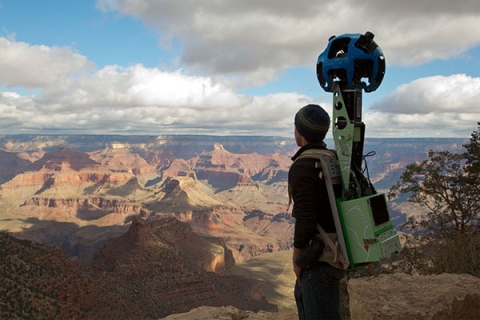
With Google’s Street View we can amble through New York City’s High Line Park, around the National Museum of Iraq in Baghdad, and down the cobbled streets of Ouro Preto, Brazil. Now we can also take a virtual hike along the rim of the Grand Canyon, following Google’s cameras along the historic Bright Angel trail from its start at the south rim all the way down the Black Bridge over the Colorado River and on to the Phantom Ranch camping area.
It’s a perfect way to check out the terrain before taking off for an Arizona vacation.
Unlike views in Google’s earlier Street View maps, the Grand Canyon photos are taken along rocky, narrow trails where no car, snow mobile, or motorbike could ever go. So how did Google collect all of the necessary images?
The Grand Canyon project is the first to utilize Trekker, a backpack-mounted camera apparatus worn by a hiker that takes a picture every 2.5 seconds. Trekker weighs 40 pounds and is operated by an Android phone held by the hiker. It has 15 cameras pointed in different angles that can be combined to create panoramic views.
Follow the South Kaibab Trail to Skeleton Point for majestic 360-degree views of the misty blue Canyon. It took three days to capture the main trails of the Canyon’s south rim. Two teams hiked down the Bright Angel Trail, camped at Phantom Ranch and hiked out the next day along the South Kaibab Trail. Another team stayed at the top, collecting images from the rim and from Meteor Crater outside the park.
Related Content:
Reef View: Google Gives Us Stunning Underwater Shots of Great Coral Reefs
Google Presents an Interactive Visualization of 100,000 Stars
Google Art Project Expands, Bringing 30,000 Works of Art from 151 Museums to the Web
Kate Rix writes about digital media and education. Read more of her work at .
Read More...Anne Sexton, Confessional Poet, Reads “Wanting to Die” in Ominous 1966 Video
Many a writer has said they write to save their lives. And many a writer has died by suicide. In few cases has the connection been so direct as in that of the poet Anne Sexton. Encouraged in 1957 by her therapist to write poetry to stave off her suicidal ideation, she eventually joined a group of mid-century “confessional” poets based in Boston—including Robert Lowell and Sylvia Plath—whose personal pathos, family pain, and severe bouts of depression provided much of the material for their work. Despite Sexton’s tremendous career success at what began, more-or-less, as a hobby, she became overwhelmed by her illness and committed suicide in 1974.
There are those who wish to debate whether so-called “confessional poets” were truly tormented individuals or navel-gazing narcissists. This seems fair enough given the willing self-exposure of poets like Plath, Lowell, and Sexton, but it kind of misses the point; their losses and transgressions were as real, or not, as anyone’s, but we remember them, or should, for their writing. Instead I find it interesting to see their public selves as performances, whatever the autobiographical connections in the work. A former fashion model, Anne Sexton was particularly adept at self-presentation, and as her fame as a writer increased—she won the Pulitzer Prize in 1966 and a succession of grants and awards throughout the sixties—her poetry became less focused on the strictly personal, more on the cultural (she has become well-known, for example, for a sardonic, feminist perspective in such poems as “Snow White and the Seven Dwarfs”). A good deal of her work was pure invention, despite the illusion of intimacy.
Nonetheless, the short, 1966 film “Anne Sexton at Home” (top, with Spanish subtitles, continued below) lets us engage in some voyeurism. It begins with Sexton’s irritation, as she’s interrupted by the dog. Then the film cuts away, the scene has changed, and she frankly acknowledges the poet’s voice as a “persona” (from the Greek for mask); her poems are “monsters,” into which she has “projected herself.” When we cut back again to the first scene, Sexton confidently reads her “Menstruation at Forty.” And we cut away again, and Sexton, her familiar cigarette never far away, riffs on “family & poetry” as her husband Alfred tries to avoid the camera. We see the poet with her daughter, their interactions playful (and also a little disturbing). Throughout it all Sexton performs, seemingly pleased and enjoying the camera’s attention.
In the last part of “Anne Sexton at Home” (above), the poet reads perhaps her most explicit work about her many suicide attempts, “Wanting to Die.” In a brief introduction, she says, “I can explain sex in a minute, but death, I can’t explain.” But the playfulness drains from her demeanor, as she comes to the final two stanzas:
Balanced there, suicides sometimes meet,
raging at the fruit, a pumped-up moon,
leaving the bread they mistook for a kiss,
leaving the page of the book carelessly open,
something unsaid, the phone off the hook
and the love, whatever it was, an infection.
Related Content
For Sylvia Plath’s 80th Birthday, Hear Her Read ‘A Birthday Present’
Josh Jones is a writer, editor, and musician. Follow him @jdmagness
Read More...The Podcast History of Our World Will Take You From Creation Myths to (Eventually) the Present Day
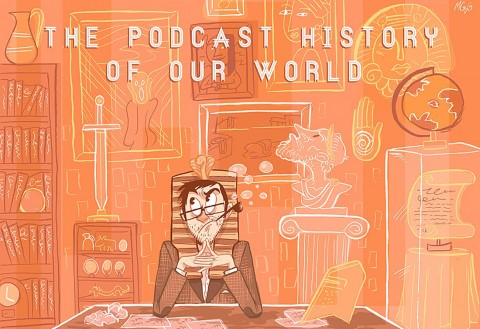
Forward-thinking historians almost come close to forward-thinking comedians in terms of their enthusiasm for podcasting. Perhaps it stands to reason, since excellence at either pursuit, different as they may seem, demands no small degree of memory and articulateness. We’ve covered several sterling examples of the historical podcast right here on Open Culture, including The History of Rome, The History of Byzantium, and The History of Philosophy Without Any Gaps. My own historically-minded podcast explorations have led me to everything from A History of the World in 100 Objects to My History Can Beat Up Your Politics. If you prefer to take your history lessons through a pair of earbuds, technologically savvy history professionals and passionately fascinated amateurs alike have stepped up to fill the need. Rob Monaco, one of the newest entrants into the game, has taken on perhaps the most ambitious history podcast challenge of them all: to tell the entire Podcast History of Our World.
“The genesis of the show happened late one night after quite a few Dogfish Head Midas Touch brews were consumed with this podcaster’s longtime good buddy,” writes Monaco on the podcast’s about page. “As I was a freshly unemployed social studies teacher with a masters degree and nothing to do, my amigo suggested that I take up the microphone and start making my own show.” Beginning with an episode on the earliest creation myths, embedded above, he goes on to discuss the dawn of man, the third dynasty of Ur, the ancient Hebrews, King Solomon, and so on, showing no signs of slowing in his mission to, eventually, get up to the present day. No need to rush him, though, since, like any historian worth his salt, amateur or professional, he understands that telling history well means telling a story well. “Podcasting is a beautiful medium that gives someone like me a chance to reach out and share my love and knowledge of history and culture to a huge audience,” he writes, “an audience that even ten years ago, I would not have been able to reach without the backing of traditional media. And that’s incredible.” If he successfully podcasts the whole history of our world, well, that’s even more so.
The Podcast History of Our World is also available on iTunes.
Related content:
The History of Rome in 179 Podcasts
The History of Byzantium Podcast Picks Up Where The History of Rome Left Off
The History of Philosophy Without Any Gaps – Peter Adamson’s Podcast Still Going Strong
Colin Marshall hosts and produces Notebook on Cities and Culture and writes essays on literature, film, cities, Asia, and aesthetics. He’s at work on a book about Los Angeles, A Los Angeles Primer. Follow him on Twitter at @colinmarshall.
Read More...James Taylor Teaches You to Play “Carolina in My Mind,” “Fire and Rain” & Other Classics on the Guitar
Some days you’d think that Salman Khan was the only person who had the bright idea of putting tutorials on YouTube. But, if you’re an amateur guitarist, you know better. You know that guitarists have been posting free lessons on YouTube since Day 1, teaching newbies how to buy an acoustic guitar, tune it by ear, strum it, and play chord progressions. And, what’s more, you can find clips that will readily teach you how to play your favorite tunes, whether it’s Bob Dylan’s Love Minus Zero/No Limit or Led Zeppelin’s Kashmir.
Think you just hit pay dirt? Well, it gets even better.
You can take lessons straight from James Taylor, the singer-songwriter himself. On his YouTube channel/web site, Taylor demonstrates how to file your nails, tune your guitar, and then start playing his classic songs. Fire and Rain? JT has that covered. Carolina in My Mind? That too. And also Enough To Be On Your Way, Second Wheel, Little Wheel, and Country Road. Stick around for a while and you might get “Something in the Way She Moves” next.
Related Content:
James Taylor Performs Live in 1970, Thanks to a Little Help from His Friends, The Beatles
Jimmy Page Tells the Story of “Kashmir”
A Young Eric Clapton Demonstrates the Elements of His Sound
Read More...Support Us
We're hoping to rely on loyal readers, rather than erratic ads. Please click the Donate button and support Open Culture. You can use Paypal, Venmo, Patreon, even Crypto! We thank you!

About Us

Open Culture scours the web for the best educational media. We find the free courses and audio books you need, the language lessons & educational videos you want, and plenty of enlightenment in between.
Advertise With Us

FREE UPDATES!
GET OUR DAILY EMAIL
Get the best cultural and educational resources on the web curated for you in a daily email. We never spam. Unsubscribe at any time.
FOLLOW ON SOCIAL MEDIA

Open Culture editor Dan Colman scours the web for the best educational media. He finds the free courses and audio books you need, the language lessons & movies you want, and plenty of enlightenment in between.
Advertise With Us


