Listen to T.S. Eliot Recite His Late Masterpiece, the Four Quartets
Here is a complete recording of T.S. Eliot reading the masterpiece of his later years, the cycle of poems called Four Quartets.
Eliot considered the Four Quartets his greatest work. “I’d like to feel that they get better as they go on,” he told Donald Hall in a 1959 interview for the Paris Review. “The second is better than the first, the third is better than the second, and the fourth is the best of all. At any rate, that’s the way I flatter myself.”
The Four Quartets are perhaps the most mystical and religious of Eliot’s poems. Each one is a meditation on time, mixing Christian and Hindu imagery with personal and historical events. “In The Waste Land the waste was place, the ‘Unreal City,’ ” writes Eliot’s biographer, Lyndall Gordon; “here, the waste is time–time unredeemed by a sense of the timeless.”
As in The Waste Land, Eliot uses the four classical elements as a structural device in the Four Quartets. The first poem, “Burnt Norton,” is associated with the element of air. It is named for an English manor house Eliot visited in the 1930s. The poem was first published in 1936. “East Coker” (which begins above at 10:46) is associated with Earth, and takes its name from the village in Somerset, England, from which the poet’s ancestor, Andrew Eliot, set out for America in 1669. The third poem, “The Dry Salvages,” (beginning at 24:17) is associated with Water and is named for a treacherous cluster of rocks off Cape Ann that was among the hazards Andrew Eliot’s ship needed to avoid in order to safely reach the coast of Massachusetts. The final poem, “Little Gidding,” (39:08) was published in 1942. Its underlying theme is one of purgatorial Fire. The poem is named for a village in Cambridgeshire, England, which was the site of a 17th century Anglican commune that based its daily life around the Book of Common Prayer.
The Four Quartets were first published as a unified whole in 1943. Despite their initial appearance as four separate poems, the themes are tightly interwoven and each poem is composed of five parallel parts. You can hear Eliot reading the Four Quartets above. To follow along as you listen, click here to open the full text in a new window. The first poem begins:
Time present and time past
Are both perhaps present in time future,
And time future contained in time past.
If all time is eternally present
All time is unredeemable.
What might have been is an abstraction
Remaining a perpetual possibility
Only in a world of speculation.
What might have been and what has been
Point to one end, which is always present.
Footfalls echo in the memory
Down the passage which we did not take
Towards the door we never opened
Into the rose-garden. My words echo
Thus, in your mind.
Related Content:
Rare 1959 Audio: Flannery O’Connor Reads ‘A Good Man is Hard to Find’
Rare Recording: Leo Tolstoy Reads From His Last Major Work in Four Languages, 1909
Nabokov Reads Lolita, Names the Great Books of the 20th Century
Read More...Hear Theodor Adorno’s Avant-Garde Musical Compositions
Critical theorist and musicologist Theodor Adorno was a contrarian, almost contradictory figure—a committed Marxist thinker who was also a cultural elitist. Anyone who’s sat through a theory class will know his name (most likely through his seminal text Dialectic of Enlightenment, written with Max Horkheimer). For those who don’t, Adorno was an integral member of what was called the “Frankfurt School,” a group of early twentieth-century German scholars and social theorists who were highly critical of both Western capitalism and Soviet communism. Adorno’s work is wide-ranging, penetrating, and, at times, abstruse to the point of nigh-unintelligibility.
Despite Adorno’s hope for social transformation, his influence is (by design) primarily in the academic and cultural spheres, and his critiques of popular culture and music were scathing and sometimes just plain weird. He had a notoriously irrational dislike of jazz, for example. (Historian Eric Hobsbawm said that his writing contained “some of the stupidest pages ever written about jazz.”) Adorno also disliked “protest music,” as you can see from the interview above, in which he slams the folky, hippy stuff for its “cross-eyed transfixion with amusement” that renders it safe. Protest music, Adorno says, takes “the horrendous,” the Vietnam War in this case, and makes it “somehow consumable.” Maybe Dylan felt the same way when he gave up his Woody Guthrie act and started writing those brilliantly arcane, poetic lyrics.
But Adorno didn’t just preach the virtues of difficult art. He practiced them. In addition to championing the twelve-tone music of Arnold Schoenberg, Adorno composed his own music, for piano and strings. The three piano pieces above are his, somewhat reminiscent of the most dissonant passages in Modest Mussorgsky. Performed by pianist Steffen Schleiermacher, the pieces are titled “Langsame halbe—Immer ganz zart,” “Heftige Achtel,” and “Presto.”
A much longer, more substantial work is Adorno’s Studies for Strings in six movements. Movement one is above and movement two below (hear part 3, part 4, part 5, and part 6). It’s challenging and often quite sublime listening. The YouTuber who uploaded the music has seen fit to set it to a montage of black-and-white images. I don’t know whether this hinders or helps your appreciation, but you may wish to leave the videos running and listen to each movement while you work on other things. Or better yet, close your eyes and forget everything you know, don’t know, or think you know about Theodor Adorno.
Note: You can watch a lecture on the Frankfurt School here. It’s part of a Yale Open course on literary theory, which appears in our collection of 700 Free Online Courses.
Related Content:
The Nazis’ 10 Control-Freak Rules for Jazz Performers: A Strange List from World War II
85,000 Classical Music Scores (and Free MP3s) on the Web
Interviews with Schoenberg and Bartók
Josh Jones is a writer and musician based in Washington, DC. Follow him at @jdmagness
Read More...Bauhaus, Modernism & Other Design Movements Explained by New Animated Video Series
UK’s Open University has developed a fun way to market their design courses: a series of six short animations called “Design in a Nutshell” that briefly survey important movements in the arts and architecture—from the late-nineteenth century Gothic Revival to late-twentieth century Postmodermism. While the former looked far into the past, seeking to preserve tradition, the latter looked everywhere, gleefully dismantling, recycling, and recombining fragmented and irrecoverable histories.
Between the two extremes, three inter-related post-WWI movements sought to make peace with the industrial present and design for a harmonious future. The first one featured, the Bauhaus movement (above)—founded in Weimar, Germany by Walter Gropius in 1919—integrated the fine arts and industrial design into one school. Famous teachers included artists Paul Klee and Wassily Kandinsky. Bauhaus designs permeate the larger movement known as Modernism.
The animation above gives us the briefest gist of Modernism, a sweeping umbrella term for a host of radical ‑isms in the arts, literature, design, and architecture—impressionism, cubism, fauvism, futurism, brutalism, surrealism…. European and American artists turned their back on the old-world past after the mass slaughter of World War One. Not all Modernists found solace in the breakdown of the old order. Writers like T.S. Eliot found much reason to despair. But designers like Eero Saarinen and the husband and wife team Charles and Ray Eames embraced industrial techniques and mass production to create forward-looking, minimalist furniture and buildings that still define the way we live now.
The episode above, “American Industrial Design,” describes how industrial designers made innovative use of new materials and production methods to create sleek, streamlined products that reinvigorated the American market in the midst of the Great Depression. Designers like Norman Bel Geddes created a futuristic landscape that inspired faith in technological progress, even as much of the country still lived on struggling farms.
Bel Geddes’ most notable achievement was his design of the “Futurama” ride (which gave the animated show its name) at the 1939–40 World’s Fair. Part of the General Motors exhibit, “Futurama” whisked riders past detailed miniatures of “the world of tomorrow.” The optimism of some Modernist designers would be shattered by the technological horrors of World War Two. But for a few brief decades, the future looked entirely manageable with the right designs, techniques, materials, and savvy marketing.
You can find all six videos appearing in the Design in a Nutshell series on YouTube.
Related Content:
Charles & Ray Eames’ Iconic Film Powers of Ten (1977) and the Lesser-Known Prototype from 1968
Wassily Kandinsky Caught in the Act of Creation, 1926
Josh Jones is a writer and musician based in Washington, DC. Follow him at @jdmagness
Read More...Watch Animations of Oscar Wilde’s Children’s Stories “The Happy Prince” and “The Selfish Giant”
Long before Oscar Wilde became a literary celebrity for his most famous work—The Picture of Dorian Gray and plays like Salome and The Importance of Being Earnest—he was a bit of a reality star. Wilde traveled the UK and the United States (as portrayed by Stephen Fry here) as a representative of the popular philosophy of “aestheticism,” an urbane nineteenth-century movement against Victorian prudery and the dry moral calculus of utilitarianism and its associations with industrial culture. Aesthetes such as Wilde sought to elevate good taste and the pursuit of beauty alone as a guiding principle of art and life. Wilde expressed the ideas in several well-known epigrams, such as the wryly redundant, “In all unimportant matters, style, not sincerity, is the essential. In all important matters, style, not sincerity, is the essential.”
Wilde was ridiculed for the many of the same reasons he was feted—his flamboyant public persona and devotion to aestheticism, which satirists caricatured as a kind of decadent navel-gazing. But careful readers of Wilde’s diverse canon of poetry, prose, and drama will know of his critical looks at solipsism and superficiality. Some of his best works as a moralist are his children’s stories, such as the 1888 book of fairy stories The Happy Prince and Other Tales. In the title story, a prince is transformed into a glittering statue on a pedestal high above a city, where residents look up to him as an example of human perfection. But the prince, we learn, spends his time weeping in compassion for the poverty and suffering he sees below him. Made in 1974 by Canadian company Potterton Productions, and featuring the voices of Christopher Plummer and Glynis Johns, the animated short film above is a faithful rendering of Wilde’s story. You can find it added to our collection of Free Movies Online, under Animation.
In 1971, Potterton produced an earlier animated short film based on another story from the Happy Prince collection. A Christian allegory, The Selfish Giant (above) tells the tale of a cranky giant who walls off his garden to keep children out. The plight of one little boy changes the giant’s disposition. The film was nominated for an Oscar for best animated short in 1972. Potterton also produced a short film of Hans Christian Andersen’s “The Little Mermaid,” and studio head Gerald Potterton would go on in 1981 to direct the cult stoner film Heavy Metal. An interesting irony of the Wilde animations above: both films, and a third called The Remarkable Rocket, were co-produced with Reader’s Digest, the magazine that represents the hard-headed practicality and sentimental, sexually repressive Victorian values (in American dress) that Wilde disdained.
If you can’t get enough of Wilde’s moving fairy tales, you won’t want to miss Stephen Fry reading “The Happy Prince” below.
Related Content:
Hear Oscar Wilde Recite a Section of The Ballad of Reading Gaol (1897)
“Jersey Shore” in the Style of Oscar Wilde
Josh Jones is a writer and musician based in Washington, DC. Follow him at @jdmagness
Read More...The Religious Affiliation of Comic Book Heroes
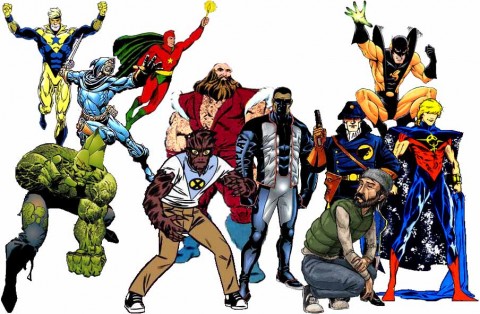
Spider-Man, he was apparently a Protestant. The Hulk, a lapsed Catholic. Thor, a worshipper of a Teutonic deity. The X‑Men, an assemblage of Catholics and Episcopalians. And Stanley Lee, the creator of these famous comic book figures, he’s Jewish. If you’re a comic book fan with a thing for trivia, you can peruse this database of over 10,000 characters and figure out the religious affiliation of Batman and Wonder Woman, plus lesser-known characters like Chameleon Boy, Swamp Thing, and Poison Ivy.
P.S. The creatures in the image above, they’re atheists, a category also tracked by this most thorough database.
via @wfmu
Related Content:
Nine Classic Superman Cartoons Restored and Now on YouTube
When Super Heroes Get Old and Retire to Miami
Read More...Watch Another Green World, a Hypnotic Portrait of Brian Eno (2010)
In September 1975, Brian Eno released his album Another Green World. The following month, the BBC’s acclaimed documentary series Arena first aired, using Another Green World’s title track as its theme music. 35 years later, the show finally got around to documenting Eno himself. This 2010 episode, also called Another Green World, captures the “intellectual guru of the rock world” (as a Desert Island Discs DJ calls him) at work in his studio, in conversation with a variety of interlocutors—including journalist Malcolm Gladwell, record producer Steve Lillywhite, and evolutionary biologist Richard Dawkins—and cycling around the green hills that roll around his neighborhood. Bono from U2, several of whose records Eno produced, calls the man “a mind-expanding drug,” and listening to Eno expound here upon his various ideas about and experiences with art, music, technology, journaling, and his native England, I’d have to agree.
The faintly hypnotic tone and pace of the episode — a sensibility not far removed from Eno’s famous “ambient” records like Discreet Music and Music for Airports — might also have something to do with that. We learn about Eno’s school days, his love of singing, his descent from a long line of “postmen with passion,” his getting more girls than Bryan Ferry in their days with Roxy Music, his preference for inconsistent instruments, his history with Catholicism, his enthusiasm for Stafford Beer’s management book Brain of the Firm, his work with audiovisual installations, and his ever-present interest in how complexity arises from simplicity. But we also feel like we’ve seen something not just about Eno, but Eno-like, where form meets function as closely as in all of Arena’s most memorable episodes and all of Eno’s most memorable projects. Or maybe I just like the sound of the rain outside during the studio segments — a sound which had a lot to do with Eno’s development of ambient music in the first place.
Related Content:
The Genius of Brian Eno On Display in 80 Minute Q&A: Talks Art, iPad Apps, ABBA, & More
Brian Eno Once Composed Music for Windows 95; Now He Lets You Create Music with an iPad App
Brian Eno on Creating Music and Art As Imaginary Landscapes (1989)
Colin Marshall hosts and produces Notebook on Cities and Culture and writes essays on literature, film, cities, Asia, and aesthetics. He’s at work on a book about Los Angeles, A Los Angeles Primer. Follow him on Twitter at @colinmarshall.
Read More...Three University Projects Use Twitter to Understand Happiness, Hate and Other Emotions in America
It turns out that the fleeting pronouncements we post on Twitter are catnip for academics and others eager to find the elusive pulse of American society. Since Twitter launched in 2006, researchers have been hard at work figuring out how to turn those 140-character musings into tea leaves with something meaningful to say about us all.
Here come three new projects that claim to provide a window into the American soul through Twitter. Whether they succeed or not, well, that’s still unclear. (And, by the way, you can start following Open Culture on Twitter here.)
Most feverishly excited about its work are the team behind the Global Twitter Heartbeat, which so far focuses mostly on the United States. With the help of a huge SGI processor to process a live feed of public social media data, a team of researchers from the University of Illinois at Urbana-Champaign has made a heat map to show how people react (through Twitter) to big events.
They looked at two things: Hurricane Sandy (top) and the 2012 Presidential Election (above). Using Twitter’s “garden hose feed”—a random sampling of 10 percent of the roughly 500 million tweets sent every day—researchers color-coded tweets red for negative tone and blue for positive and showed the shifting concentrations of Twitter activity across the country. It looks like a map of a talking weather system as occasional dialogue boxes open up to show representative tweets. Researcher Kalev Leetaru argues that tracking Twitter activity gives us the potential to track the heartbeat of society.

Two other projects look in an on-going way at tweet “tone,” or the negativity/positivity of messages. One spin on this research is the Geographic Hate Map (sample map above), a project by Dr. Monica Stephens of Humboldt State University in Northern California. To begin their work, Stephens and her team accessed a massive database of geographically tagged tweets sent between June, 2012 and April, 2013.
They used only tweets that contained any of ten “hate words.” They read each tweet to be sure the words were used in a negative way and built a map based on where the tweets came from. Then they aggregated to the county level and normalized for the amount of twitter traffic in that area so that densely populated areas don’t look more racist or homophobic by default.
Then there’s the glass half full. The Hedonometer measures happiness, or lack thereof, as expressed by tweets, calculating averages based on what the researchers call “word shifts” (watch an explanation above). This research project, put together by the University of Vermont Complex Systems Center, uses the same garden hose feed as the Global Twitter Heartbeat. This project searches for frequently used words to measure how good a day Twitter users are having. Since 2008 the Hedonometer has kept track of how often words like “happy,” “yes,” and “love” pop up in tweets, as opposed to “hate,” “no,” and “unhappy.” The saddest day on Hedonometer record so far is April 15, 2013, the day bombs exploded at the Boston Marathon finish line. Christmas Day tends to rank as the happiest day of the year.
To be sure, any tool that uses tweets for data is measuring a very young and specific subgroup of people. Tweets are not a reliable measure of anything, really, but maybe with some tweaking, these research models will come up with something interesting.
Related Content:
The Art of Data Visualization: How to Tell Complex Stories Through Smart Design
Watch a Cool and Creepy Visualization of U.S. Births & Deaths in Real-Time
An Animated Visualization of Every Observed Meteorite That Has Hit Earth Since 861 AD
Kate Rix writes about education and digital media. Follow daily ups and downs on Twitter @mskaterix.
Read More...Ricky Gervais Presents “Learn Guitar with David Brent”
To help celebrate YouTube’s first Comedy Week, Ricky Gervais has revived David Brent, the bumbling “Regional Manager” that ran the Wernham Hogg Paper Company in the UK version of The Office. Although the sitcom presented him as the ‘boss from hell,’ Brent fancied himself “a philosopher to rival Descartes, a musician to rival Texas, a dancer to rival MC Hammer.” And a “brilliant singer-songwriter” too. Perhaps you’ll remember a favorite moment from the show, when Brent led his staff in a sing-a-long to Free Love Freeway? (If not, we have it below, and you can find the chords and lyrics here.) Anyway, Brent is back, and he’s now offering guitar lessons on YouTube — lessons guaranteed to teach you absolutely nothing about playing guitar. If you want real lessons, James Taylor has you covered here.
You can find the first lesson above; the second lesson will hit Ricky Gervais’ YouTube Channel on June 3.
Related Content:
“Learn English With Ricky Gervais,” A New Podcast Debuts (NSFW)
Seinfeld, Louis C.K., Chris Rock, and Ricky Gervais Dissect the Craft of Comedy (NSFW)
Read More...Daniel Dennett Presents Seven Tools For Critical Thinking
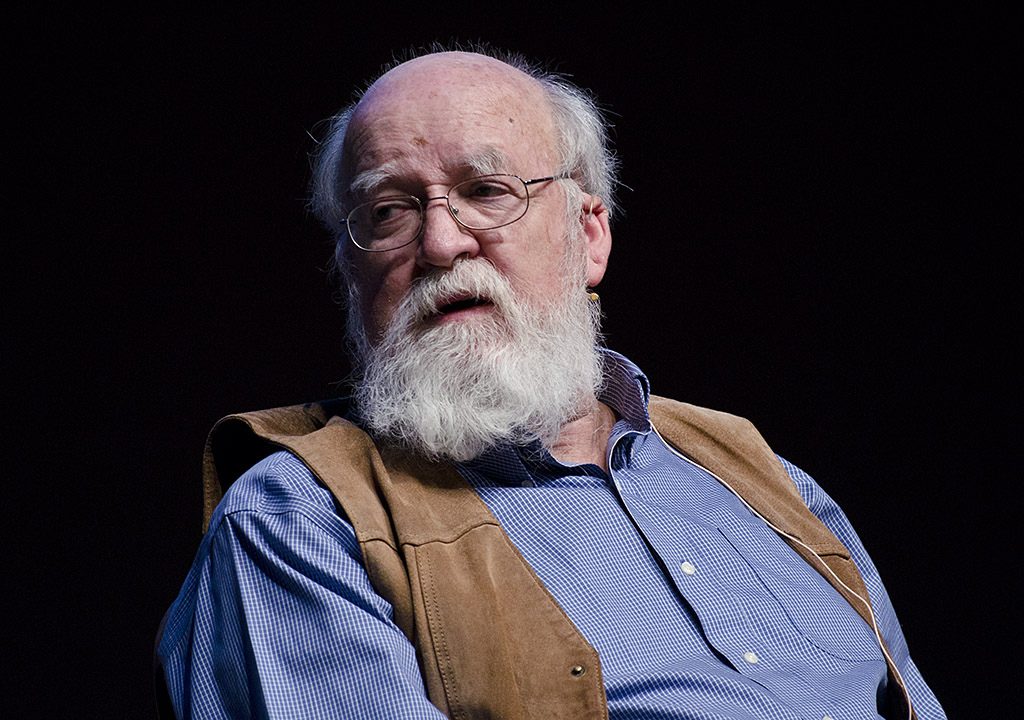
Love him or hate him, many of our readers may know enough about Daniel C. Dennett to have formed some opinion of his work. While Dennett can be a soft-spoken, jovial presence, he doesn’t suffer fuzzy thinking or banal platitudes— what he calls “deepities”—lightly. Whether he’s explaining (or explaining away) consciousness, religion, or free will, Dennett’s materialist philosophy leaves little-to-no room for mystical speculation or sentimentalism. So it should come as no surprise that his latest book, Intuition Pumps And Other Tools for Thinking, is a hard-headed how-to for cutting through common cognitive biases and logical fallacies.
In a recent Guardian article, Dennett excerpts seven tools for thinking from the new book. Having taught critical thinking and argumentation to undergraduates for years, I can say that his advice is pretty much standard fare of critical reasoning. But Dennett’s formulations are uniquely—and bluntly—his own. Below is a brief summary of his seven tools.
1. Use Your Mistakes
Dennett’s first tool recommends rigorous intellectual honesty, self-scrutiny, and trial and error. In typical fashion, he puts it this way: “when you make a mistake, you should learn to take a deep breath, grit your teeth and then examine your own recollections of the mistake as ruthlessly and as dispassionately as you can manage.” This tool is a close relative of the scientific method, in which every error offers an opportunity to learn, rather than a chance to mope and grumble.
2. Respect Your Opponent
Often known as reading in “good faith” or “being charitable,” this second point is as much a rhetorical as a logical tool, since the essence of persuasion involves getting people to actually listen to you. And they won’t if you’re overly nitpicky, pedantic, mean-spirited, hasty, or unfair. As Dennett puts it, “your targets will be a receptive audience for your criticism: you have already shown that you understand their positions as well as they do, and have demonstrated good judgment.”
3. The “Surely” Klaxon
A “Klaxon” is a loud, electric horn—such as a car horn—an urgent warning. In this point, Dennett asks us to treat the word “surely” as a rhetorical warning sign that an author of an argumentative essay has stated an “ill-examined ‘truism’” without offering sufficient reason or evidence, hoping the reader will quickly agree and move on. While this is not always the case, writes Dennett, such verbiage often signals a weak point in an argument, since these words would not be necessary if the author, and reader, really could be “sure.”
4. Answer Rhetorical Questions
Like the use of “surely,” a rhetorical question can be a substitute for thinking. While rhetorical questions depend on the sense that “the answer is so obvious that you’d be embarrassed to answer it,” Dennett recommends doing so anyway. He illustrates the point with a Peanuts cartoon: “Charlie Brown had just asked, rhetorically: ‘Who’s to say what is right and wrong here?’ and Lucy responded, in the next panel: ‘I will.’” Lucy’s answer “surely” caught Charlie Brown off-guard. And if he were engaged in genuine philosophical debate, it would force him to re-examine his assumptions.
5. Employ Occam’s Razor
The 14th-century English philosopher William of Occam lent his name to this principle, which previously went by the name of lex parsimonious, or the law of parsimony. Dennett summarizes it this way: “The idea is straightforward: don’t concoct a complicated, extravagant theory if you’ve got a simpler one (containing fewer ingredients, fewer entities) that handles the phenomenon just as well.”
6. Don’t Waste Your Time on Rubbish
Displaying characteristic gruffness in his summary, Dennett’s sixth point expounds “Sturgeon’s law,” which states that roughly “90% of everything is crap.” While he concedes this may be an exaggeration, the point is that there’s no point in wasting your time on arguments that simply aren’t any good, even, or especially, for the sake of ideological axe-grinding.
7. Beware of Deepities
Dennett saves for last one of his favorite boogeymen, the “deepity,” a term he takes from computer scientist Joseph Weizenbaum. A deepity is “a proposition that seems both important and true—and profound—but that achieves this effect by being ambiguous.” Here is where Dennett’s devotion to clarity at all costs tends to split his readers into two camps. Some think his drive for precision is an admirable analytic ethic; some think he manifests an unfair bias against the language of metaphysicians, mystics, theologians, continental and post-modern philosophers, and maybe even poets. Who am I to decide? (Don’t answer that).
You’ll have to make up your own mind about whether Dennett’s last rule applies in all cases, but his first six can’t be beat when it comes to critically vetting the myriad claims routinely vying for our attention and agreement.
via Mefi
Related Content:
Daniel Dennett and Cornel West Decode the Philosophy of The Matrix in 2004 Film
Daniel Dennett (a la Jeff Foxworthy) Does the Routine, “You Might be an Atheist If…”
90 Free Online Philosophy Courses
Josh Jones is a writer and musician based in Washington, DC. Follow him @jdmagness
Read More...1927 London Shown in Moving Color
Back during the 1920s, Claude Friese-Greene, an early British pioneer of film, shot The Open Road, “a series of ten-minute travelogues of Britain,” which were meant “to be shown before the main feature in cinema programmes,” according to the British Film Institute. Clips from that series have appeared for years on the BFI’s YouTube Channel. But, in recent days, the hive mind of the internet has focused on these five minutes of footage showing 1920s London in rare moving color. What draws us to this footage? Perhaps one Vimeo commenter put it best, saying: “Profoundly moving somehow. All those ghosts on film, foreshadowing our footsteps through the same city. Parts of London remain startlingly unchanged. The megalopolis was less corporate then, more imperial, certainly less suspicious of the camera. But, those pastel shades of people are shown dodging the traffic in the same way as we do, perhaps showing us a way through the labyrinth.” It’s hard not to stop and take notice when the past seems distant, yet so close and familiar.
via Kottke
Related Content:
Early Experiments in Color Film (1895–1935)
The Normandy Invasion Captured on 16 mm Kodachrome Film (1944)
Rare Color Footage of the 1939 World Series: Yankees v. Reds
Read More...Support Us
We're hoping to rely on loyal readers, rather than erratic ads. Please click the Donate button and support Open Culture. You can use Paypal, Venmo, Patreon, even Crypto! We thank you!

About Us

Open Culture scours the web for the best educational media. We find the free courses and audio books you need, the language lessons & educational videos you want, and plenty of enlightenment in between.
Advertise With Us

FREE UPDATES!
GET OUR DAILY EMAIL
Get the best cultural and educational resources on the web curated for you in a daily email. We never spam. Unsubscribe at any time.
FOLLOW ON SOCIAL MEDIA

Open Culture editor Dan Colman scours the web for the best educational media. He finds the free courses and audio books you need, the language lessons & movies you want, and plenty of enlightenment in between.
Advertise With Us

