The Poetry of Bruce Lee: Discover the Artistic Life of the Martial Arts Icon
In the final months of his short life, Bruce Lee wrote a personal essay, “In My Own Process” where he said, “Basically, I have always been a martial artist by choice and actor by profession. But, above all, I am hoping to actualize myself to be an artist of life along the way.” If you’re familiar with Bruce Lee, you know that he studied philosophy at The University of Washington, and even when he auditioned for The Green Hornet in 1964 (and showed off his amazing kung fu moves), he took pains to explain the philosophy underlying the martial arts.
Lee wasn’t just a philosopher. He was also a poet and a translator of poetry. In the book, Bruce Lee: Artist of Life, John Little has published 21 original poems found within Lee’s personal archive. The poems, Little writes, “are, by American standards, rather dark — reflecting the deeper, less exposed recesses of the human psyche… Many seem to express a returning sentiment of the fleeting nature of life, love and the passion of human longing.” Above, you can see Shannon Lee, the daughter of Bruce Lee, read a poem published in Little’s collection. It’s called “Boating on Lake Washington.” Immediately below, she reads “IF” by Rudyard Kipling, a poem her father loved so much that he had it engraved on a plaque and mounted on the wall in his home.
Finally, we leave you with Lee’s translation of another favorite poem, “The Frost” by Tzu Yeh. The video features pieces of his handwritten translation.
Related Content:
Bruce Lee: The Lost TV Interview
Watch 10-Year-Old Bruce Lee in His First Starring Role (1950)
Bruce Lee Plays Ping Pong with Nunchucks
Read More...Astronaut Chris Hadfield Sings David Bowie’s “Space Oddity” On Board the International Space Station
Chris Hadfield has spent the past five months on the ISS. And, if you regularly follow our site, you’ll know that the media-savvy astronaut has engaged earthlings with a steady stream of tweets, a series of educational videos (see below), and the occasional entertaining routine. In recent months, he has kibitzed with William Shatner and even strummed a tune for Peter Gabriel. Now, before handing over command of the ISS to a Russian cosmonaut, Hadfield bade us farewell by singing a zero gravity version of “Space Oddity,” the song that helped launch David Bowie’s music career back in 1969. What could be a more perfect pick? In case you’re wondering, Hadfield is playing a Larrivée Parlor guitar, which he used to make the first album ever recorded in orbit. We’ll eventually tell you more about that.…
Related Content:
Everything You Wanted to Know About Going to the Bathroom in Space But Were Afraid to Ask
If Astronauts Cry in Space, Will Their Tears Fall?
Read More...How Brewster Kahle and the Internet Archive Will Preserve the Infinite Information on the Web
Brewster Kahle is an unassuming man. But as an internet pioneer and digital librarian, he may rightly be called a founding father of the Open Culture ethos. In 1996, Kahle began work on the Internet Archive, a tremendously important project that acts as a safety net for the memory hole problem of Internet publishing. Kahle developed technology that finds and aggregates as much of the internet as it is able in his massive digital library.
Along with the archive, which Open Culture has drawn from many a time, comes Kahle’s “Wayback Machine,” named for the time-traveling device in a Rocky and Bullwinkle segment featuring the genius dog Mr. Peabody and his pet boy Sherman (the cartoon spelled it as an acronym: WABAC). The “Wayback Machine,” as you probably know, logs previous versions of websites, holding on to the web’s past like classic paper libraries hold on to an author’s papers. (Here’s what we looked like in 2006.)
In the animated adventures of Peabody and Sherman, the Wayback Machine was a monstrous contraption that occupied half of Peabody’s den. And while we often think of Internet space as limitless and disembodied, Kahle’s Internet Archive is also physically housed, in a former Christian Science church now lined with towering servers that store digitized books, music, film and other media for free access. It’s an impressive space for an impressive project that will likely expand past its physical boundaries. As Kahle says above, “it turns out there is no end; the web is, in fact, infinite.”
Kahle is deeply invested in data. The challenges of maintaining the Internet Archive are immense, including translating old, unplayable formats to new ones. But what Kahle calls the greatest challenge is the perennial threat to all libraries: “they burn.” And he’s committed to designing for that eventuality by making copies of the archive and distributing them around the world. If you’re interested in what motivates Kahle, you should watch his 2007 TED talk above. He frames the business of archiving the internet as one of making available “the best we have to offer” to successive generations. “If we don’t do that,” Kahle warns, “we’re going to get the generation we deserve.” It’s a warning worth heeding, I think.
If you would like to support the mission of Open Culture, consider making a donation to our site. It’s hard to rely 100% on ads, and your contributions will help us continue providing the best free cultural and educational materials to learners everywhere. You can contribute through PayPal, Patreon, and Venmo (@openculture). Thanks!
Related Content:
10 Classic Films from the Internet Archive
8,976 Free Grateful Dead Concert Recordings in the Internet Archive, Explored by the New Yorker
Kids (and Less Savvy Marketers) Imagine the Internet in 1995
Josh Jones is a writer and musician based in Washington, DC. Follow him @jdmagness
Read More...James Joyce Plays the Guitar (1915)
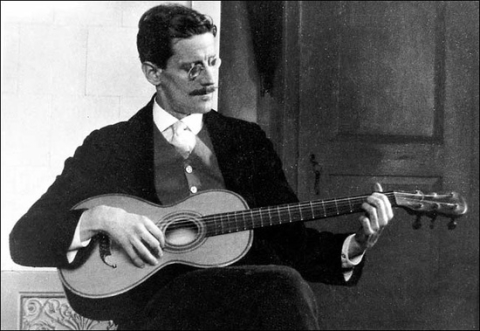
The work of James Joyce has inspired many a musician—from John Cage to Kate Bush, and Lou Reed to Irish band Therapy?. The famed Irish writer was himself a great lover of song (his only collection of poetry is titled Chamber Music); most readers of Joyce know that he packed his stories and novels with thousands of allusions and quotes from popular and classical songs. Fewer know that if the encyclopedic modernist had not become James Joyce the heavyweight author, we might know him as James Joyce, singer and composer. Joyce once shared the stage with opera singer John McCormack and studied and performed music throughout his life.
Joyce the singer is typically pictured “drooping over the keys” of a piano (as Shakespeare and Company founder Sylvia Beach put it). But he also played the guitar, as you can see from the 1915 photo above (taken in Trieste by Joyce’s friend Ottacaro Weiss). Joyce’s small-bodied guitar has been housed at the Joyce Tower Museum in Dublin since 1966, in an unplayable state.
Now, English luthier Gary Southwell has undertaken a restoration of the instrument at the behest of Tower Museum curator Robert Nicholson and Fran O’Rourke, professor of philosophy at Joyce’s alma mater, University College Dublin. A musician himself, O’Rourke will perform Joycean Irish songs during Bloomsweek to offset the cost of the project, accompanied on the restored Joyce guitar by Irish classical guitarist John Feeley
Luthier Southwell describes the guitar as “a fairly standard instrument of the period… not from any great maker of the past or anything like that.” In the video above from The Irish Times, see Southwell, Professor O’Rourke, and Joyce scholar Terence Killeen describe the state of the guitar and its history. And below, listen to Joyce’s only known composition, the melancholy “Bid Adieu to Girlish Days,” sung by tenor Kevin McDermott.
h/t @faraway67 and @matthiasrascher
Related Content:
James Joyce, With His Eyesight Failing, Draws a Sketch of Leopold Bloom (1926)
James Joyce Reads ‘Anna Livia Plurabelle’ from Finnegans Wake
James Joyce’s Ulysses: Download the Free Audio Book
Josh Jones is a writer and musician based in Washington, DC. Follow him @jdmagness
Read More...10 Golden Rules for Making the Perfect Cup of Tea (1941)
In 1941, England found itself in an all-out-war with Nazi Germany. It had sustained severe damage when the Nazis unleashed the Blitz on 16 English cities between September 1940 and May 1941. Despite the heavy toll, there was only one thing for most Brits to do — to keep calm and carry on and preserve small moments of normalcy when possible. Of course, that meant drinking tea and not just any tea, but good tea. Above we present Tea Making Tips, a short 1941 film created by the Empire Tea Bureau, that outlines the golden rules for making tea worthy of its name. The narrator reminds the viewers, “Tea is not a manufactured article which can be made, bottled up and served at will. It must be prepared every time it is acquired, and it’s success or failure depends entirely upon the attention you pay to the six golden rules.” If you watch the 10-minute film, you’ll actually count 10 rules (if not more), many of which are still presumably relevant to a tea drinker today. They are as follows:
1) In general, store tea leaves in an airtight container, preferably away from cheese, soap, spices and other items with strong aromas.
2) Also keep the tea off of the ground and away from walls.
3) Always use a good quality tea. You’ll spend a little more money, but you’ll actually get more bang for your pound.
4) Use fresh water. Stale water makes stale tea, which no one needs, especially in wartime.
5) Make sure you warm your teapot before adding hot water and tea leaves.
6) Use the right ratio of tea leaves to water.
7) Steep the tea in water that’s neither under-boiled nor over-boiled.
8) Let the tea infuse for the right amount of time. 3–5 minutes should cover most kinds of tea. Other kinds will need more time.
9) Use tea pots made of china, earthenware, and stainless steel. Avoid ones made of enamel or tin.
10) Don’t add milk to the tea too soon. Wait for the last possible minute.
Related Content:
The History of Coffee and How It Transformed Our World
“The Vertue of the COFFEE Drink”: London’s First Cafe Creates Ad for Coffee in the 1650s
Epic Tea Time with Alan Rickman
This is Coffee!: A 1961 Tribute to Our Favorite Stimulant
Read More...David Bowie Recalls the Strange Experience of Inventing the Character Ziggy Stardust (1977)
Oh, not another Bowie post! Oh yes, yes it is. We don’t keep our love for Bowie secret, and along with his first album in ten years comes new archival material: new to us that is, and maybe to you too.
Now, if your primary experience of Bowie was through his early 70s character Ziggy Stardust—a rock opera creation as much as Hedwig or Dr. Frank-N-Furter—it would be easy to believe Bowie was Ziggy. He inhabited the character so fully that it’s hard to imagine he was playing a very deliberate part the whole time.
But of course, he was. Ziggy and the Spiders were, as Bowie says above, a “theater piece.” Previously, we’ve featured a documentary (see again below) that chronicles the rise of Ziggy Stardust, from Bowie’s somewhat obscure beginnings to his breakout as the character. In the 1977 interview clip above from the CBC, watch Bowie, as himself, describe the experience of being Ziggy.
He talks of his influences—a mélange of kabuki theater, mime, and New York art rock (“Velvet Underground, whatever”). He calls the music from Ziggy Stardust and the Spiders From Mars “a British view of American street energy.” In retrospect, it’s easy to see the act as just that, but in the moment, Bowie’s fans believed in Ziggy as surely as they believed anything else. Watch, for example, as starstruck audience members rapturously mouth the words to “Moonage Daydream” in this clip from D.A. Pennebaker’s Ziggy Stardust film.
P
ennebaker’s film caught Bowie’s final performance as the alien rock star at London’s Hammersmith in 1973. No doubt these fans were horribly crushed when Ziggy announced his retirement before the final song. But I’m sure they kept their electric eye on the re-invented Bowie in Berlin, a period he also discusses above, when he left L.A. for Germany and began working with Brian Eno and Iggy Pop.
Related Content:
The Story of Ziggy Stardust: How David Bowie Created the Character that Made Him Famous
David Bowie Releases Vintage Videos of His Greatest Hits from the 1970s and 1980s
Josh Jones is a writer and musician based in Washington, DC. Follow him @jdmagness
Read More...A Short Animated History of the GIF
In 1987, Compuserve begatteth Image Format 87A.
Image Format 87A begatteth Graphics Interchange Format or GIF (rhymes with a certain brand of peanut butter, the video history above helpfully points out).
The proliferations of free online GIF generators begatteth the countless annoying, smarmy, boneheaded animated loops you’ve seen junking up emails, profile pictures, and MySpace pages.
Of course, some of them are also pretty cool, which is why they’re being celebrated with a festival at the Brooklyn Academy of Music. No tickets necessary. Moving the Still: A GIF Festival will be screening through June on the outdoor electronic billboard meant to promote upcoming and current attractions. Conceivably, viewers with wheels and time to spare could take it in on an endless loop of their own, by circling up Flatbush to Lafayette, then moving up when the light changes, battling traffic from the nearby Barclays Center on the return leg.
What do we stand to see in this festival? The video history leads us to believe that anything is possible, though certain things—accidental happenings, laser cats, colorful barfing (…wait, colorful barfing?)—have a built in appeal.
Related Content:
A Gallery of Stanley Kubrick Cinemagraphs: Iconic Moments Briefly Animated
Kids (and Less Savvy Marketers) Imagine the Internet in 1995
Ayun Halliday gravitates toward the paper GIFs known as flip books. Follow her @AyunHalliday
Read More...Jane Austen, Game Theorist: UCLA Poli Sci Prof Finds Shrewd Strategy in “Cluelessness”
Professional jealousy is probably the worst reason to dismiss a new perspective, whether it comes from within one’s field, outside it, or anywhere else. Snobbery leads to inbreeding and intellectual dead-ends. So when Michael Chwe, an associate professor of political science at UCLA who specializes in game theory, has an epiphany about Jane Austen as a proto-game theorist, maybe his insights should change the way English profs—and everyone else—read the author of Pride and Prejudice.
I don’t know. I haven’t read Chwe’s book, Jane Austen: Game Theorist (read a sample chapter here), but I’ll confess, I’m skeptical of anyone who calls Austen’s literary work a “research program” that has “results” in a book of “230 diagram-heavy pages.” It seems to miss the point somehow. Austen is perhaps these days the most-adapted of British writers, and her academic cachet couldn’t be higher. But the best takes on her work—whether scholarly or popular—are fun, focused on character and language, not technocratic theory.
But maybe I’ve misjudged Chwe’s intent. He was, after all, inspired to read Austen by “watching movies and reading books with his children.” And one of the concepts Chwe ascribes to Austen is that of “cluelessness,” a term he takes from that classic nineties movie Clueless (inspired by Austen’s Emma, clip above). In Chwe’s analysis, cluelessness is not at all garden-variety stupidity; it’s the benevolent deviousness of Elizabeth Bennet or the “dumb blonde” act Alicia Silverstone’s character pulls off in convincing others that she doesn’t know what she’s doing, all the while manipulating, cajoling, and demurring to get her way.
Chwe also pursues the darker side of cluelessness, relating it to grim episodes like the 2004 killing of four private contractors in Falluja. Overall, his book identifies fifty “manipulation strategies” he finds in Austen. While his book seems to promise some entertaining observations it also might further confirm for serious Austen readers that the eighteenth-century novelist was one of the most psychologically insightful writers of the past few centuries.
Related Content:
New Stamp Collection Celebrates Six Novels by Jane Austen
As Pride and Prejudice Turns 200, Read Jane Austen’s Manuscripts Online
Josh Jones is a writer and musician based in Washington, DC. Follow him @jmagness
Read More...Kurt Cobain’s Isolated Vocal Track From ‘Smells Like Teen Spirit,’ 1991
In 1991, Nirvana’s Nevermind album exploded into mainstream popular culture like–as one writer describes it– “a grenade detonating in your car radio.” The album, and the Seattle-based grunge rock movement it emerged from, was like a booster shot of 70s punk attitude into heavy metal, sweeping away the hedonism and vanity of 80s bands like Quiet Riot and Mötley Crüe. The song that epitomized the new attitude, for many, was the opening track of Nevermind, “Smells Like Teen Spirit,” with its explosive expression of youthful alienation:
With the lights out, it’s less dangerous
Here we are now, entertain us
I feel stupid and contagious
Here we are now, entertain us
The line “Here we are now, entertain us” was a joke Nirvana’s guitarist and singer Kurt Cobain liked to call out to break the ice whenever he would arrive at a party. “A lot of times,” Cobain told Rolling Stone in a 1994 interview, “when you’re standing around with people in a room, it’s really boring and uncomfortable. So it was ‘Well, here we are, entertain us.’ ”
The title of the song was taken from something his friend Kathleen Hanna, lead singer of Bikini Kill, had spray painted across his wall: “Kurt Smells Like Teen Spirit.” Hanna meant that Cobain smelled like Teen Spirit, a brand of deodorant worn by his girlfriend, but Cobain claimed not to know that until much later. Instead, he saw irony and rebellion.
You can hear Cobain’s isolated vocal track from “Smells Like Teen Spirit” above. The song was recorded at Sound City studios in Van Nuys, California in May of 1991. The band reportedly chose the second of three takes. The extreme dynamics of the performance–soft to loud, apathy to rage–were inspired by the music of the Pixies. To watch a video of Nirvana trying out an early version of “Smells Like Teen Spirit” before an audience at Seattle’s OK Hotel a month before the song was recorded, see Josh Jones’s December post, “The First Live Performance of Nirvana’s ‘Smells Like Teen Spirit’ (1991).”
via That Eric Alper
Related Content:
Patti Smith’s Cover of Nirvana’s “Smells Like Teen Spirit” Strips the Song Down to its Heart
Nirvana’s Home Videos: An Intimate Look at the Band’s Life Away From the Spotlight (1988)
Read More...Harvard Thinks Big 4 Offers TED-Style Talks on Stats, Milk, and Traffic-Directing Mimes
Despite having no experience with schools of its stature beyond what I’ve gleaned from Take Ivy, I do know that Harvard University cultivates minds to discuss the next big ideas. That, in fact, has provided the premise for Harvard Thinks Big, a series that takes a handful of Harvard educators and the Harvard-educated and has them talk about what’s next for humanity. The fourth and most recent annual iteration of Harvard Thinks Big brought seven speakers on stage, allowing each of them twelve minutes to break down a topic of great importance. Seemingly with an eye toward the widest intellectual variety, Harvard Thinks Big 4 features information-dense mini-lectures from experts on statistics, literature, evolutionary biology, law, classics, Chinese history, and jackfruit. (That last one comes from Annemarie Ryu, current Harvard junior and founder of Global Village Fruits.) You can watch a collection of Harvard Thinks Big talks on Youtube or on iTunes. At either location, you’ll also find talks from past years including Jill Lepore on the meaning of life and, just below, Edward Glaeser on the ever-increasing importance of cities.
There you can watch selected talks from Harvard Thinks Big 4, to which the Crimson offers a “tl;dr guide” here. “According to Kant, art can communicate that which doesn’t have a name yet,” writes the paper’s Lynn Miao, describing professor Dorris Sommer’s lecture, viewable at the top of this post. “That somehow involves the mayor of Bogota replacing cops with pantomimes to direct traffic, which actually correlated with a decline in traffic accidents and homicide rates. Apparently, the shock value of clowns, and public art, reaches across nations.” Or perhaps you’d prefer to hear why milk “can prevent obesity, save up to 1.5 million deaths from diarrhea by contributing healthy gut bacteria, save premature babies — essentially everything short of curdling when in contact with lemon,” for which check out professor Katherine J. Hinde’s presentation below. It’s called “Why Mammals Suck.” We think of Harvard as one of the most serious places in America, but clearly, at events like Harvard Thinks Big, they know how to have a good time.
Related Content:
Harvard Thinks Big 2012: 8 All-Star Professors. 8 Big Ideas
Harvard Thinks Green: Big Ideas from 6 All-Star Environment Profs
Harvard and MIT Create EDX to Offer Free Online Courses Worldwide
Colin Marshall hosts and produces Notebook on Cities and Culture and writes essays on literature, film, cities, Asia, and aesthetics. He’s at work on a book about Los Angeles, A Los Angeles Primer. Follow him on Twitter at @colinmarshall.
Read More...Support Us
We're hoping to rely on loyal readers, rather than erratic ads. Please click the Donate button and support Open Culture. You can use Paypal, Venmo, Patreon, even Crypto! We thank you!

About Us

Open Culture scours the web for the best educational media. We find the free courses and audio books you need, the language lessons & educational videos you want, and plenty of enlightenment in between.
Advertise With Us

FREE UPDATES!
GET OUR DAILY EMAIL
Get the best cultural and educational resources on the web curated for you in a daily email. We never spam. Unsubscribe at any time.
FOLLOW ON SOCIAL MEDIA

Open Culture editor Dan Colman scours the web for the best educational media. He finds the free courses and audio books you need, the language lessons & movies you want, and plenty of enlightenment in between.
Advertise With Us


