The Always-NSFW Kevin Smith and Jason Mewes Catch Up in Jay and Silent Bob Get Old Podcast
With 1994’s Clerks, Kevin Smith opened up the floodgates for independently produced, micro-budget, dialogue-intensive, cursing-intensive movies by, for, and about a certain stripe of feckless Generation‑X twentysomething. These pictures showcased more aggressively foulmouthed (but, in their way, more energetic) versions of the overgrown kids and/or stalled adults whose meandering lives Richard Linklater had dramatized in Slacker three years before. (Watch Slacker online here.) Clerks hit when I hadn’t yet grown out of comic book-reading pre-adolescence, though I do remember becoming aware of Smith’s work from an ad on the back of, yes, a comic book. The page advertised Mallrats, Smith’s big-budget Clerks followup; in its corner posed a pair of smirking young longhairs. “Snootchie bootchies,” read an inexplicable voice bubble emanating from the thinner of the two. I had to know: who were those guys? The zeitgeist now recognizes Jay and Silent Bob, the outwardly dumb but startlingly wise drug dealers played by Jason Mewes and Kevin Smith himself, as having stolen Clerks’ show. (You can watch one of their finer moments in Mallrats above.)
Smith used the characters in Mallrats as well, and went on to write them into subsequent movies like Chasing Amy, Dogma, and of course Clerks II and Jay and Silent Bob Strike Back, their presence unifying all these stories into one coherent reality. Cinephiles argue over whether Smith has delivered on his promise as a director, but some fans think the man has found his true voice as a podcaster. Today, on his own podcast network, he hosts a staggering array of shows, including SModcast, SMoviemakers, Hollywood Babble-On, and Fat Man on Batman. Jay and Silent Bob Get Old (Web — iTunes — RSS feed) reunites the 42-year-old Smith and the 38-year-old Mewes for regular conversations about adulthood, fame, and struggles with sobriety (in Mewes’ case) and weight (in Smith’s), always featuring the most vulgar jokes imaginable. If you haven’t caught up with these guys since the nineties, have a listen to their podcast’s so-very-Not-Safe-for-Work first episode above. They’ve even got back into character for Jay and Silent Bob’s Super Groovy Cartoon Movie, which begins its roadshow across North America on April 20.
Related Content:
Watch Free Online: Richard Linklater’s Slacker, the Classic Gen‑X Indie Film
Colin Marshall hosts and produces Notebook on Cities and Culture and writes essays on literature, film, cities, Asia, and aesthetics. He’s at work on a book about Los Angeles, A Los Angeles Primer. Follow him on Twitter at @colinmarshall.
Read More...If Astronauts Cry in Space, Will Their Tears Fall?
The astronauts aboard the International Space Station work every day on all kinds of experiments, from working with robots to preparing for spacewalks. But when they get a break, they often field questions from school children and adults about life in space.
Commander Chris Hadfield recently videotaped himself demonstrating a simple experiment inspired by a common question: If an astronaut cries in space, do their tears fall?
On Earth, of course, it’s gravity that causes tears to roll down the cheek. In a microgravity environment, if an astronaut is sad or gets something in his/her eye, tears will certainly well up, but there will be none of what Smokey Robinson’s tears made on his face.
Hadfield, possibly the most social media-savvy astronaut ever with more than 500,000 Twitter followers, gamely demonstrates that tears do pool under the eye but they make no tracks. Squirting water into his right eye, he rolls his head around, causing the puddle of “tears” to shift back and forth and even roll over the bridge of his nose.
Tears don’t fall, he concludes, so bring a hanky.
Hadfield is no stranger to demonstrating, or discussing, human bodily functions in space. Speaking before the Ontario Space Centre a few years ago, he discussed something that you may have wondered about: going to the bathroom in space.
Kate Rix writes about digital media and education. Visit her website: .
The World According to John Coltrane: His Life & Music Revealed in Heartfelt 1990 Documentary
In his short life, John Coltrane continually pushed the boundaries of music. From swing to bebop to hard bop to free jazz, Coltrane was a restless seeker of new sounds. Inspired by the hypnotic, trance-inducing traditional music of North Africa and Asia, Coltrane created a new kind of music that fused jazz and Eastern spirituality.
The World According to John Coltrane tells the story of Coltrane’s quest, from his childhood in a deeply religious household in North Carolina to his early days playing saxophone in the Navy, to his apprenticeship with Miles Davis in the 1950s and his emergence as a bandleader and innovator in the 1960s. Most of the one-hour film is devoted to Coltrane’s later period, when he came into his own. The film is not a biography, in the traditional sense. There is very little about Coltrane’s personal life — his marriages, children, drug problems and declining health. Director Robert Palmer focuses instead on Coltrane’s journey as a musician.
The World According to John Coltrane was made in 1990, and includes interviews with Coltrane’s second wife, pianist Alice Coltrane, and a number of other musicians who knew Coltrane and played with him, including saxophonist Wayne Shorter, drummer Rashied Ali and Pianist Tommy Flanagan. It provides some excellent insights into one of the 20th century’s greatest musicians.
via metafilter
Related Content:
John Coltrane’s Naval Reserve Enlistment Mugshot (1945)
John Coltrane Plays Only Live Performance of A Love Supreme
John Coltrane: Three Great European Performances, 1960, 1961 and 1965
Read More...60 Second Adventures in Astronomy Explains the Big Bang, Relativity & More with Fun Animation
Like many positive terms, the phrase “big bang” originated as a pejorative. Fred Hoyle coined the term in 1949 as a way of deflating the concept of an expanding universe. It stuck, even after Edwin Hubble showed that 13.7 billion years ago, all of the matter in our massive universe was indeed compacted into “one superdense ball.” Astronomers have also figured out that the volume of the big bang was only 120 decibels, about the loudness of your average rock show (though how there might have been sound without an atmosphere escapes me). There is some irony in Hoyle’s dig: the “big bang” wasn’t particularly big, and wasn’t much of a bang, but it happened.
We learn all this and more in the video above from The Open University, and all within a minute, as the title of the series, 60 Second Adventures in Astronomy, promises. These amusing animations are very much like other OU series we’ve featured in the past: 60 Second Adventures in Economics; 60-Second Adventures in Economics: and 60 Second Adventures in Thought. (Find them all on iTunesU here.)
The university describes the new astronomy series like this:
Ever wondered where the Universe came from? Or more importantly, where it’s headed? Voiced by David Mitchell, this series of twelve 60 second animations examines different scientific concepts from the big bang to relativity, from black holes to dark matter. The series also explores the possibility of life beyond Earth and considers why David Bowie is still none the wiser about life on Mars.
Spend a few extra minutes educating yourself with some more 60 second astronomy adventures below, or visit the complete collection here on YouTube or iTunesU.
Supernovae
Exoplanets
Special Relativity
Event Horizons
Life on Mars
Related Content:
Neil deGrasse Tyson Answers the Big Enchilada Question, “Does the Universe Have a Purpose?”
The Higgs Boson, AKA the God Particle, Explained with Animation
Demystifying the Higgs Boson with Leonard Susskind, the Father of String Theory
Read More...Read and Hear Famous Writers (and Armchair Sportsmen) J.M. Coetzee and Paul Auster’s Correspondence
“Why waste my time slumped in front of a television screen watching young men at play?” writes one man. “I have an experience (a secondhand experience), but it does me no good that I can detect. I learn nothing. I come away with nothing.” From the other man comes a reply: “I agree with you that it is a useless activity, an utter waste of time. And yet how many hours of my life have I wasted in precisely this way, how many afternoons have I squandered just as you did?” This epistolary conversation about sports continues, touching on the power of familiarity to endure boredom, performance art, heroism, ethics versus aesthetics, activity versus passivity, the “big business” of the NFL against the subsidization of ballet, childhood sexual identification, the visiblity of the human ideal, chess mania, the pleasure of maximum effort, and genre literature versus “the kinds of books you and I try to write.” What kind of books do these men try to write? Being the novelists Paul Auster and J.M. Coetzee, they write books, we can safely say, in their very own genres.
We now have a new volume from both Auster and Coetzee called Here and Now: Letters (2008–2011), from which a substantial sports-related excerpt appears on the New Yorker. Though not sui generis like the contributors’ own novels, the book does its part for the current mini-revival of collections of letters between men of letters. (2011 saw a similar French project from Michel Houellebecq and Bernard-Henri Lévy. “Who would we end up with?” asked the Observer’s Tim Adams, imagining a British equivalent. “Irvine Welsh and Alain de Botton?”) Fans of the lauded, private Auster and the highly lauded, intensely private Coetzee surely feel grateful for these new pieces of direct insight into the authors’ personalities, and they can get a little more by watching the reading of Here and Now at the New York State Writers Institute at the top of the post. Do see also Auster’s Big Think clips on what keeps him up at night, the fate of the novel, and how he stares down the challenges of writing (above). As for a solo performance from Coetzee, could we do any better than his Nobel lecture?
Related Content:
Nobel Prize Winner Reads From His New Novel
Hear Paul Auster Read the Entirety of The Red Notebook, an Early Collection of Stories
Paul Auster Reads from New Novel, Sunset Park
Colin Marshall hosts and produces Notebook on Cities and Culture and writes essays on literature, film, cities, Asia, and aesthetics. He’s at work on a book about Los Angeles, A Los Angeles Primer. Follow him on Twitter at @colinmarshall.
Read More...Creative Uses of the Fax Machine: From Iggy Pop’s Bile to Stephen Hawking’s Snark
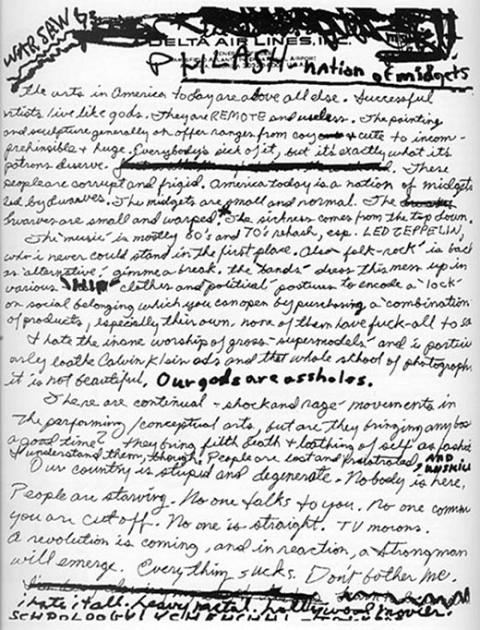
Unlike the typewriter, the lowly fax machine never pulled itself out of the hive-like existence of utilitarian office machines and into literary celebrity. With their bland, functional styling, fax machines will not have their impending obsolescence capped with museum exhibitions. And as little more than conduits for wonky, unglamorous communiqués, fax machines rarely conduct a piece of text that inspires people to savor, and want to save, the words, as with personal letters. While we often feature historic correspondence of a time before email from one of our favorite sites, Letters of Note, the risible, profound, and shocking sentiments expressed by famous figures when they think that no one’s looking rarely make it into office memoranda.
However, inspired by our recent post on Mark Twain’s typewriter, a reader alerted us to a Letters of Note subgenre of sorts, “faxes of note.” These oddball messages defy the workaday conventions of the fax. Take, for example, the fax above sent by Iggy Pop to Plazm magazine writer Joshua Berger as an addendum to a 1995 interview. Scrawled with his fevered thoughts, on Delta Airlines stationary, Pop’s fax amounts to what Letters of Note calls “a rant so rich with quotable lines, it’s amazing he was able to contain it all on a single sheet.”
You can click here for a full transcript of Iggy’s take on American cultural decadence, but here are just a few highlights from his faxed get-off-my-lawn moment: Pop—on tour in Europe at the time—calls his home country “a nation of midgets,” and decries the ‘90s rehash of ‘60s and ’70s music (“none of them have fuck-all to say”); he rails against the Calvin Klein aesthetic, adding “our gods are assholes” (maybe some professional jealousy here—Pop more or less invented heroin chic). Finally, he signs off with some cranky onomatopoeia: “i hate it all. heavy metal. hollywood movies. SCHPOLOOGY! YeHEHCHH!” This is archival-worthy vitriol, for sure.
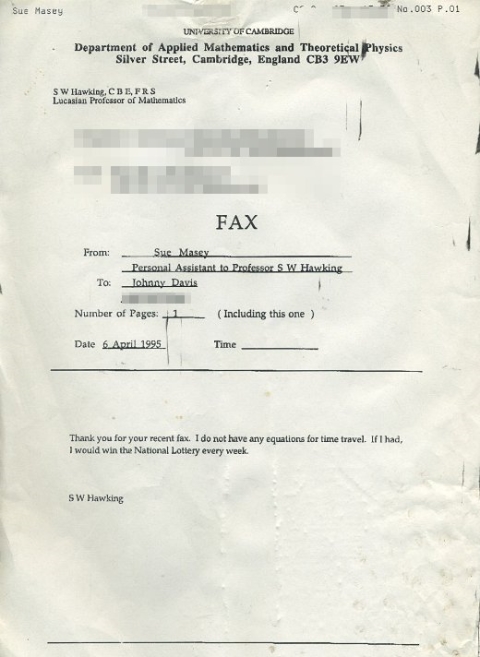
Another fax of note uses the medium to opposite effect; Stephen Hawking’s fax (above), also from 1995, responds to a request from erstwhile British music and fashion magazine The Face for the formula for time travel. Hawking replies, via his personal assistant, “Thank you for your recent fax. I do not have any equations for time travel. If I had, I would win the National Lottery every week.” Unlike Iggy’s explosion of handwritten bile, Hawking’s missive retains all the formal properties of the fax—appropriate institutional letterhead, “from” and “to” lines, etc—which makes his pithy retort all the more incongruous.
While the 1980s and ’90s were boom times for fax transmissions, the machine actually dates back to 1843, when it was patented by Scottish inventor Alexander Bain. As early as 1902, fax technology allowed photographs to be sent over telephone lines. And yes, as every frustrated administrative assistant knows too well, the humble fax machine is still in use in offices around the world, transmitting blearingly boring messages, as well as the occasional flash of individuality. For more on famous faxes, see this helpful infographic from our reader.
H/T @jaclynlambert
Related Content:
From The Stooges to Iggy Pop: 1986 Documentary Charts the Rise of Punk’s Godfather
Seven Questions for Stephen Hawking: What Would He Ask Albert Einstein & More
David Bowie’s First American Fan Letter And His Evolving Views of the U.S. (1967–1997)
Josh Jones is a writer, editor, and musician based in Washington, DC. Follow him @jdmagness
Read More...100 Metropolitan Museum Curators Talk About 100 Works of Art That Changed How They See the World
Which best describes your museum-going experience? Inspiration and spiritual refreshment? Or a soul crushing attempt to fight your way past the hoards there for the latest blockbuster exhibit, with a too-heavy bag and a whining, foot sore companion in tow?
Wouldn’t it be wonderful to lose yourself in contemplation of a single work? What about that giant one at the top of the Metropolitan Museum of Art’s Grand Staircase? For every visitor who pauses to take it in, another thousand stream by with hardly a glance.
The above commentary by curator of Italian paintings, Xavier Salomon, may well turn Giovanni Battista Tiepolo’s The Triumph of Marius into one of the Met’s hottest attractions. It’s often difficult for the average museum-goer to understand what the deal is in one of these densely populated, 19th century oils. Salomon supplies the needed historical context—general Gaius Marius parading captive Numidian king Jugurtha through the streets upon his triumphal return to Rome.
Things get even more interesting when he translates the Latin inscription at the top of the canvas: “The Roman people behold Jugurtha laden with chains.” In other words, you can forgo the hero worship of the title and concentrate on the bad guy. This, Salomon speculates, is what the artist had in mind when swathing Jugurtha in that eye-catching red cape. Jugurtha may be the loser, but his refusal to be humbled before the crowd is winsome.
As is 82nd and 5th, an online series that aims to celebrate 100 transformative works of art from the museum’s collection before year’s end. In addition to Salomon’s compelling thoughts on The Triumph of Marius, some pleasures thus far include Melanie Holcomb, Associate Curator of Medieval Art and The Cloisters, geeking out over illustrated manuscript pages and fashion and costume curator Andrew Bolton recalling his first encounter with one of designer Alexander McQueen’s most extreme garments. Each video is supplemented with a tab for further exploration. You can also find the talks collected on YouTube.
Brilliantly conceived and executed, these commentaries provide virtual museum-goers with a highly personal tour, and can only but enrich the experience of anyone lucky enough to visit in the flesh.
Related Content:
Download Hundreds of Free Art Catalogs from The Metropolitan Museum of Art
Google Art Project Expands, Bringing 30,000 Works of Art from 151 Museums to the Web
Free: The Guggenheim Puts 65 Modern Art Books Online
Ayun Halliday has her fingers crossed for some commentary on the Met’s hunky Standing Hanuman.
Read More...Storm: New Short Film Captures the Artistry of Winemaking
In many ways food—its production, preparation and consumption—is the hottest art form today. Chefs are like celebrity auteurs, revered for their passion and dedication. We even watch reality television shows about the drama of commercial restaurant kitchens.
The newest documentary by Daniel Addelson puts another one of these artists in the spotlight. Addelson’s new film Storm follows vintner Ernst Storm, a native of South Africa who makes wine in the Santa Ynez Valley near Santa Barbara, through a fall grape harvest. The film is as earthy, bright and moody as the beautiful land where it is set. Storm tromps around his land in shorts and boots and a hat operating fork lifts and hoisting pitchforks full of grapes into huge tubs. We also see him in the lab, tracking the chemical transactions taking place in his current batch.
The movie doesn’t shy away from the industrial side of winemaking, all the hoses and vats and stainless steel casks. But Storm’s voiceover reminds us that behind the heavy lifting is the dream of coaxing something pleasurable out of nature’s bounty.
Storm will premiere at the Sonoma Film Festival in April. Clocking in just over eight minutes, Storm conveys the hard work of making wine, the solitude and the fun. Most of all the film conveys the craft’s artistry. The sensual stuff—the smells and colors and flavors—are what drive Storm’s affection for process. He is discerning and attentive. We see him climbing to the top barrel in a high pyramid, with a glass and a fancy turkey baster in hand. Removing the big cork, Storm sucks out a bit and swishes it around in his glass, then tasting it to see how things are going. Each variety must be cared for, he says.
As a filmmaker Addelson isn’t making a commercial for Storm Wines. He’s interested in the ingredients that make for a creative person—the perseverance, passion and attention to detail necessary to follow an idea through.
He will pick up this thread again in his next film, which looks at the benefits of teaching character to children in school.
Kate Rix writes about digital media and education. Read more of her work at .
Read More...Artist Robbie Cooper’s Video Project Immersion Stares Back at Gamers and YouTubers
What if that screen you’re peering at was something akin to a one-way mirror? There’s a definite aspect of dressing room horror, viewing artist Robbie Cooper’s Immersion project, a video collection of the alternately grotesque and dull expressions appearing on people’s faces as they play video games and watch YouTube. (The viewer is never privy to what’s showing on the subjects’ screens, but one suspects it’s likely less rarified than a short animation inspired by physicist Richard Feynman’s remarks on a flower or filmmaker Miranda July’s lyrical advice to the procrastination-prone). But before we denounce the mostly underaged participants’ dead eyes and slack jaws—an effect made more disturbing by the soundtrack’s high incidence of gunfire—perhaps we should turn the web cam on ourselves.
That’s exactly what Cooper is hoping will happen, as he prepares to expand the project’s scope to include people of all ages and nationalities. “Babies being born right now arrive in a landscape where computers, smartphones, the internet, and social media already exist,” he explains, “While the oldest generation alive today can remember a time before TV was a fixture of our living room.”
To widen the net, Cooper is turning to crowd sourcing. Whether someone who knowingly trains the camera on him or herself can achieve the previous participants zoo-like lack of inhibition remains to be seen, but the Kickstarter campaign to fund this next phase lays things out on a grand scale. The plan is for the public to contribute via uploads and a social media aggregator. More excitingly, they’re encouraged to seize the reins by creating a series of instructions and prompts for those coming later to follow.
Let us hope this will lead to a more heartening variety of expressions, as well as the book, documentary, and interactive exhibits Cooper envisions.
Related Content:
This is Your Kid on Television
Art in the Era of the Internet (and Why Open Education Matters)
Ayun Halliday’s laptop is directly responsible for two vertical creases between her brows.
Read More...Short Documentary, How Do You Solve a Problem Like Lolita?, Psychoanalyzes Vladimir Nabokov
Here’s a flawed but fascinating little film about the life of Vladimir Nabokov, examined through the prism of his most famous book.
How Do You Solve a Problem Like Lolita? first aired on British television in 2009. The host is Stephen Smith, a culture correspondent for BBC Newsnight. We don’t know the rest of Smith’s resume, but in watching the documentary we get the feeling he may have picked up a little of his journalistic sensibility from the British tabloids.
The problem referred to in the title is the sense–at least among Smith’s friends–that there is something “pervy” about Nabokov’s 1955 novel, Lolita, and that this raises certain questions about the author’s own sexual penchants. “Was it a morality play,” Smith asks at the outset, “or the fantasy of a dirty old man?”
It’s a contemptible point of departure. But How Do You Solve a Problem Like Lolita? manages to be worthwhile in spite of itself. It’s filled with interesting old footage of Nabokov talking about himself and his work, as well as contemporary footage of the writer’s old haunts in Russia, America and Switzerland. The film is a kind of travelogue. Watching it is like taking a one-hour tour through a fascinating landscape with an amiable but slightly annoying guide.
Related Content:
Vladimir Nabokov Marvels Over Different “Lolita” Book Covers
Vladimir Nabokov (Channelled by Christopher Plummer) Teaches Kafka at Cornell
Nabokov Reads Lolita, Names the Great Books of the 20th Century
Read More...Support Us
We're hoping to rely on loyal readers, rather than erratic ads. Please click the Donate button and support Open Culture. You can use Paypal, Venmo, Patreon, even Crypto! We thank you!

About Us

Open Culture scours the web for the best educational media. We find the free courses and audio books you need, the language lessons & educational videos you want, and plenty of enlightenment in between.
Advertise With Us

FREE UPDATES!
GET OUR DAILY EMAIL
Get the best cultural and educational resources on the web curated for you in a daily email. We never spam. Unsubscribe at any time.
FOLLOW ON SOCIAL MEDIA

Open Culture editor Dan Colman scours the web for the best educational media. He finds the free courses and audio books you need, the language lessons & movies you want, and plenty of enlightenment in between.
Advertise With Us


