David Foster Wallace’s 1994 Syllabus: How to Teach Serious Literature with Lightweight Books
Note: click here to see the full syllabus and other related teaching materials.
As anyone who’s ever done it knows, the art of syllabussing is a fine one. (Yes, it’s a word; don’t look it up, take my word for it—Syllabussing: creating the perfect syllabus for a college-level course). It requires precision planning, stellar formatting and copy-editing skills, and near-perfect knowledge of the college-student psyche. For one, the syllabus must explain in clear terms what students can expect from the class and what the class expects from them. And it must do this without sounding so dry and pedantic that half the class drops in the first week. For another, the perfect syllabus (there’s no such thing, but one must strive) should function as both an FAQ and a contract: need to know how to format your papers? See the syllabus. Forgot when the paper was due? Too bad—see the syllabus. And so on. Most teachers learn over time that a class can stand or fall on the strength of this document.
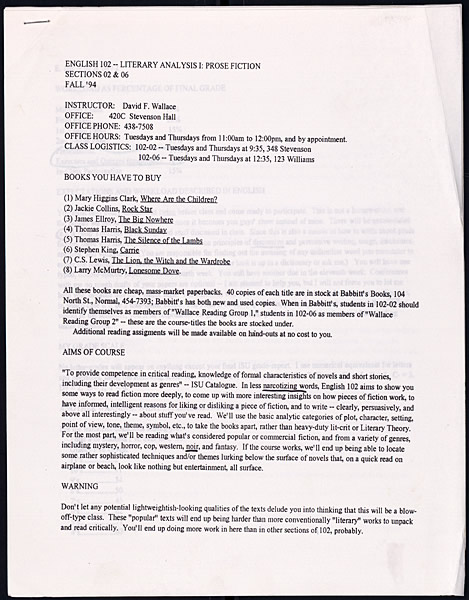
Which brings us to the syllabussing skills of one David Foster Wallace, encyclopedic literary obsessive, modern-day moralist, English professor. Love his work or hate it, it may be safe to say that Wallace was perhaps one of the most careful (or care-full) writers of his generation. And given the criteria above, you might just have to admire the fine art of his syllabi. Well, so you can, thanks to the University of Texas at Austin’s Harry Ransom Center, which has scans available online of the syllabus for Wallace’s intro course “English 102-Literary Analysis: Prose Fiction” (first page above), along with other course documents. These documents—From the Fall ’94 semester at Illinois State University, where Wallace taught from 1993 to 2002—reveal the professionally pedagogical side of the literary wunderkind, a side every teacher will connect with right away.
The text in the image above is admittedly tiny (you can request higher resolution scans on the UT Austin site), but if you squint hard, you’ll see under “Aims of Course” that Wallace quotes the official ISU description of his class, then translates it into his own words:
In less narcotizing words, English 102 aims to show you some ways to read fiction more deeply, to come up with more interesting insights on how pieces of fiction work, to have informed intelligent reasons for liking or disliking a piece of fiction, and to write—clearly, persuasively, and above all interestingly—about stuff you’ve read.
Having taught my own versions of such a class, I’m a little jealous of his (uncharacteristically?) informal concision.
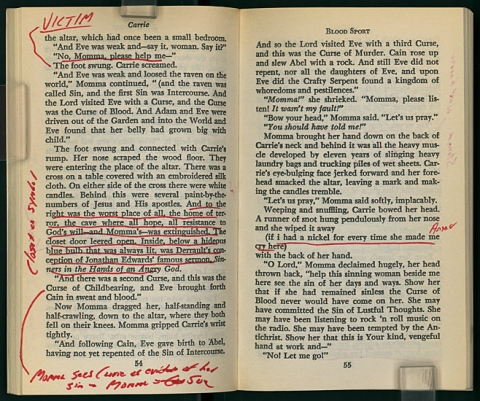
Wallace’s choice of texts is of interest as well—surprising for a writer most detractors call “pretentious.” For his class, Wallace prescribed airport-bookstore standards—what he calls “popular or commercial fiction”—such as Jackie Collins’ Rock Star, Stephen King’s Carrie, Thomas Harris’s The Silence of the Lambs, and James Elroy’s The Big Nowhere. The UT Austin site also has scans of some well-worn paperback teacher’s copies, with the red-ink marginal notes, discussion questions, and underlines one finds behind every podium. In the image above, Wallace has underlined a line of dialogue in Carrie, annotating it with the word “victim” in all-caps. Of the books Wallace requires, he writes in a section of the syllabus above called “Warning”:
Don’t let any potential lightweightish-looking qualities of the texts delude you into thinking that this will be a blow-off-type class. These “popular” texts will end up being harder than more conventionally “literary” works to unpack and read critically. You’ll end up doing more work in here than in other sections of 102, probably.
Something about that “probably” at the end grabs me (again: the precision… the college-student psyche). I admire this brave approach. Having taught conventionally “literary” stuff for years, I can say that some so-called literary fiction is formulaic in the extreme, all but containing checkboxes for the standard lit-crit categories. The commercial stuff isn’t always so careful (which is why it’s so often more fun).
UT Austin’s Harry Ransom Center houses David Foster Wallace’s library and papers, but you’ll have to make a trip to Texas (and present some academic credentials) to access most of the archive. They have scanned a few other choice pieces, however, such as the handwritten first page from a draft of his literary masterpiece/dorm-room doorstop, Infinite Jest.
Related Content:
Download 55 Free Online Literature Courses: From Dante and Milton to Kerouac and Tolkien
Donald Barthelme’s Syllabus Highlights 81 Books Essential for a Literary Education
30 Free Essays & Stories by David Foster Wallace on the Web
David Foster Wallace: The Big, Uncut Interview (2003)
Josh Jones is a writer, editor, musician, and oftentime English teacher to easily-distracted undergraduates. Follow him @jdmagness
Read More...Download Eight Free Lectures on The Hobbit by “The Tolkien Professor,” Corey Olsen
The name Corey Olsen may already be familiar to some readers—or at least those readers who venerate the literary accomplishments of one J.R.R. Tolkien. And if you don’t know Olsen by his real name, you may know him as “The Tolkien Professor,” his internet moniker since 2009, when Olsen, an English Professor at Washington College and lifelong student of Tolkien’s writing, decided to share his own scholarly work with a public “eager to be included in thoughtful, literary conversation” about The Hobbit and The Lord of the Rings trilogy.
For the past four years, Olsen has published specifically online lectures about Tolkien’s work, as well as recordings of his Washington College seminars on Tolkien’s fiction and academic work. He has most recently founded Signum University, an online, non-profit Liberal Arts college that aims to open the experience of high-quality higher ed to everyone, regardless of their means or their location. Signum has, in turn, spawned the Mythgard Institute, which seems (as the name implies) more exclusively focused on the fantasy and science fiction genres that are Olsen’s métier. (There are also college prep options in Signum and Mythgard Academies).
So, Professor Olsen is busy, and he’s happy to be sharing his wealth of Tolkien knowledge with a very receptive public. His most recent course, an eight-part lecture series on The Hobbit, is now available on his site. (iTunes U also has it as of January 31st. Watch the promo for the course above. We also have the class listed in our collection of 650 Free Courses Online.) The course comes via the Mythgard Institute and begins at the beginning in a lecture entitled “Took & Baggins” focused on The Hobbit’s first chapter, “An Unexpected Party.” Recorded before the release of Peter Jackson’s first installment of his trilogy of Hobbit films, the lecture starts with Olsen’s speculations about what those films might look like. He says:
From the beginning, I have thought this was a mistake… a big mistake to go backwards. It seems to me that an audience familiar with the epic grandeur of Peter Jackson’s trilogy is going to bring expectations to a new Tolkien movie that’s going to set a Hobbit film up for one of two very likely failures. Either the movie is going to try tell Bilbo’s story in the mode and register of the Lord of the Rings, and therefore strip the story of the light-heartedness and whimsicality that makes it so delightful, or it’s going to try to be true to the tone and spirit of the book, and will therefore seem kind of silly and childish to an audience hoping for a successor to Peter Jackson’s films.
This is a very canny prediction, and such canniness distinguishes Olsen’s approach to everything Tolkien. He is attuned not only to all of the scholarly minutiae that distinguishes academic Tolkien studies, but he is also well-aware of issues of audience reception and the ever-evolving role of Tolkien’s work in popular culture. As his first lecture continues, Professor Olsen makes it quite clear that The Hobbit was deliberately written as a children’s story, and the successive books were meant to be as well. The Lord of the Rings books became more adult, darker and more fraught with heavy theological and mythical significance, as Tolkien composed them. This happened in part because Tolkien was writing with his own children in mind as his readers, and as he wrote, his kids grew up.
Tolkien, Olsen points out, was by training a philologist—a scholar who specializes in the study of languages—so he thought about not only what words mean, but where they come from and when. As such, he intended The Hobbit to possess a “linguistic playfulness,” mixing ancient and modern words and usages, making up words a la Lewis Carroll, to create a lighthearted and comic atmosphere from the beginning of the novel. Olsen provides us with several examples of this method in his first lecture. Overall, his analysis is a thorough evaluation of the novel in the terms of its language, its composition, its many layers of genre and style—drawing from Tolkien’s explicitly articulated theories of narrative—and its historical and literary allusions. All presented in a very enthusiastic and accessible style that is aimed at every adult reader and lover of Tolkien, not just fellow scholars, who tend to speak a specialized language that excludes nearly everyone outside their narrow coterie.
In the video above—a TED talk Olsen delivered at TEDx Chester River—he discusses how the world of academe, that specialized world that excludes almost everyone, had become a stifling and rather meaningless place for him when he decided to become the online Tolkien Professor. Olsen had what he calls an existential crisis about academia and scholarly publishing—What’s the point?, he thought. Who’s going to read it? Since most people can’t access scholarly publications even if they wanted to, and since he was writing on Tolkien, one of the world’s most popular authors, he felt doubly irrelevant as a cloistered academic, since Tolkien fans are everywhere. Then he discovered something everybody else already knew about the internet—it’s an ideal medium for publishing and disseminating any kind of information, and it’s crowded with people desperate to learn about and discuss the liberal arts. As more and more academics discover this as well, more also cure their existential malaise by opening up their work to everyone online, becoming resources, not gatekeepers, for knowledge.
Related Content:
Listen to J.R.R. Tolkien Read a Lengthy Excerpt from The Hobbit (1952)
Fantastic BBC Footage of J.R.R. Tolkien in 1968
Free Audio: Download the Complete Chronicles of Narnia by C.S. Lewis
Josh Jones is a writer, editor, and musician based in Washington, DC. Follow him @jdmagness
Read More...The Centrifuge Brain Project: Scientists Solve Mankind’s Great Problems by Spinning People
What if the very thing that made you feel crazy happy also made you smarter? That’s the question underlying the work of the Institute for Centrifugal Research, where scientists believe that spinning people around at a sufficiently high G‑force will solve “even the trickiest challenges confronting mankind.”
We follow Dr. Nick Laslowicz, chief engineer, as he strolls through amusement parks, wearing a hard hat and taking notes, and describes the liberating power of spinning and the “mistake” of gravity.
The actor is terrific. Yes, The Centrifuge Brain Project is a joke. Laslowicz is just zany enough to be believable as a scientist whose research began in the 1970s. The sketches on the project’s website are fun too and director Till Nowak’s CGR rendering of the ride concepts are hilarious.

The culminating experiment features a ride that resembles a giant tropical plant. Riders enter a round car that rises slowly up, up, up and then takes off suddenly at incredibly high speed along one of the “branches.”
“Unpredictability is a key part of our work,” says Laslowicz. After the ride, he says, people described experiencing a “readjustment of key goals and life aspirations.” Though he later adds that he wouldn’t put his own children on one of his rides.
“These machines provide total freedom,” Laslowicz says, “cutting all connection to the world we live in: communication responsibility, weight. Everything is on hold when you’re being centrifuged.”
Related Content:
Miracle Mushrooms Power the Slums of Mumbai
Dark Side of the Moon: A Mockumentary on Stanley Kubrick and the Moon Landing Hoax
Kate Rix writes about digital media and education. Visit her work at .
Read More...Monty Python’s Life of Brian: Religious Satire, Political Satire, or Blasphemy?
Before I saw Monty Python’s Life of Brian, I only knew that religious people didn’t like it, which intrigued me. Then I found out that some religious people like it very much indeed, which really intrigued me. Building its story on a satirical parallel of the life of Jesus Christ, Life of Brian could never have helped drawing fire. But the Pythons knew how to use it: “So funny it was banned in Norway!” read one of the film’s posters, and indeed, the Norwegian government put the kibosh on its screenings, as did Ireland’s, as did a number of town councils in England. “As a satire on religion, this film might well be considered a rather slight production,” writes Richard Webster in A Brief History of Blasphemy. “As blasphemy it was, even in its original version, extremely mild. Yet the film was surrounded from its inception by intense anxiety, in some quarters of the Establishment, about the offence it might cause. As a result it gained a certificate for general release only after some cuts had been made. Perhaps more importantly still, the film was shunned by the BBC and ITV, who declined to show it for fear of offending Christians in this country.”
All this controversy came to a now-infamous 1979 television debate: In one corner, we have Python’s John Cleese and Michael Palin. In the other, we have contrarian satirist Malcolm Muggeridge and Bishop of Southwark Mervyn Stockwood. You can watch the whole broadcast on Youtube (part one, part two, part three, part four). In the extract above, you can hear Cleese argue that the film does not, in fact, ridicule Jesus Christ, but instead indicts “closed systems of thought” of the type drilled into his consciousness during his boarding school years. Palin takes pains to underscore its nature as not wholly a religious satire, but more of a jab at modern English society and politics transposed into the Biblical past. Muggeridge and Stockwood, while denigrating Life of Brian’s cinematic merit all the while, nonetheless see in it a dangerous potential to corrupt the youth. But it turns out that they’d shown up at their screening fifteen minutes late, missing the scenes which would have told them that Jesus Christ and the hapless Brian of the title are two different people. Indeed, Brian is not the messiah. The lesson here: watch Life of Brian in full, as many times as it takes to get you drawing your own non-received conclusions about religion, society, and comedy.
Related content:
Monty Python’s Best Philosophy Sketches
Monty Python’s Away From it All: A Twisted Travelogue with John Cleese
Colin Marshall hosts and produces Notebook on Cities and Culture and writes essays on literature, film, cities, Asia, and aesthetics. He’s at work on a book about Los Angeles, A Los Angeles Primer. Follow him on Twitter at @colinmarshall.
Read More...The Podcast History of Our World Will Take You From Creation Myths to (Eventually) the Present Day
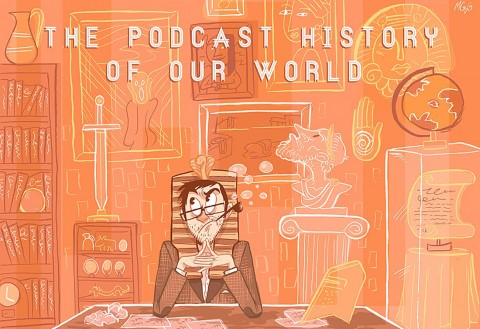
Forward-thinking historians almost come close to forward-thinking comedians in terms of their enthusiasm for podcasting. Perhaps it stands to reason, since excellence at either pursuit, different as they may seem, demands no small degree of memory and articulateness. We’ve covered several sterling examples of the historical podcast right here on Open Culture, including The History of Rome, The History of Byzantium, and The History of Philosophy Without Any Gaps. My own historically-minded podcast explorations have led me to everything from A History of the World in 100 Objects to My History Can Beat Up Your Politics. If you prefer to take your history lessons through a pair of earbuds, technologically savvy history professionals and passionately fascinated amateurs alike have stepped up to fill the need. Rob Monaco, one of the newest entrants into the game, has taken on perhaps the most ambitious history podcast challenge of them all: to tell the entire Podcast History of Our World.
“The genesis of the show happened late one night after quite a few Dogfish Head Midas Touch brews were consumed with this podcaster’s longtime good buddy,” writes Monaco on the podcast’s about page. “As I was a freshly unemployed social studies teacher with a masters degree and nothing to do, my amigo suggested that I take up the microphone and start making my own show.” Beginning with an episode on the earliest creation myths, embedded above, he goes on to discuss the dawn of man, the third dynasty of Ur, the ancient Hebrews, King Solomon, and so on, showing no signs of slowing in his mission to, eventually, get up to the present day. No need to rush him, though, since, like any historian worth his salt, amateur or professional, he understands that telling history well means telling a story well. “Podcasting is a beautiful medium that gives someone like me a chance to reach out and share my love and knowledge of history and culture to a huge audience,” he writes, “an audience that even ten years ago, I would not have been able to reach without the backing of traditional media. And that’s incredible.” If he successfully podcasts the whole history of our world, well, that’s even more so.
The Podcast History of Our World is also available on iTunes.
Related content:
The History of Rome in 179 Podcasts
The History of Byzantium Podcast Picks Up Where The History of Rome Left Off
The History of Philosophy Without Any Gaps – Peter Adamson’s Podcast Still Going Strong
Colin Marshall hosts and produces Notebook on Cities and Culture and writes essays on literature, film, cities, Asia, and aesthetics. He’s at work on a book about Los Angeles, A Los Angeles Primer. Follow him on Twitter at @colinmarshall.
Read More...Kansas City Confidential: The 1952 Noir Film Said to Inspire Quentin Tarantino’s Reservoir Dogs
I saw a screening of Quentin Tarantino’s Django Unchained at the New Beverly Cinema, the Los Angeles theater he owns. It was preceded by a solid half-hour of trailers for the various western and exploitation pictures that inspired it, from Take a Hard Ride to Mandingo. Even if you’ve only seen two or three Quentin Tarantino movies, you know that he not only uses cinema as his medium, but as his content as well. Any interview with the man — especially his first appearance on Charlie Rose in 1994, or for that matter, his most recent appearance last December — reveals that no living director has a more enthusiastic obsession with film itself. This gets him adapting, reimagining, transposing, paying all kinds of homage, and (alas, the inevitable term) remixing whenever he gets creating.
He makes his movies, in other words, by drawing upon his vast experience of watching movies — usually lurid genre pictures, from the beloved to the obscure, the in-their-way-masterful to the borderline incompetent. What a fun lesson in film history it would make to watch a similar series of source-material trailers before every Tarantino movie.
Most fans would expect such a pre-show for Reservoir Dogs, his 1992 heist-gone-wrong debut feature, to include Ringo Lam’s City on Fire, which stars Chow Yun-fat as an undercover cop embedded in a gang of thieves. It would also have Stanley Kubrick’s The Killing, since Tarantino has said of Reservoir Dogs, “I did think of it as my Killing, my take on that kind of heist movie.” Should Phil Karlson’s Kansas City Confidential also make it in? You can watch the complete 1952 noir crime picture, now in the public domain, and decide for yourself. Following the aftermath of a gang’s armored-truck heist, the film has received attention as a possible influence on Reservoir Dogs. “Mr. Karlson’s filmmaking has few of the standard noir flourishes: the dark and brooding shadows, the bizarrely canted camera angles,” writes New York Times critic Dave Kehr. “Instead he works through gigantic close-ups and an unusually visceral treatment of bare-knuckle violence. With refinements, he would continue to pursue this theme (revenge) and this style, right up through his creative resurgence in the ’70s: Ben (1972), Walking Tall (1973) and Framed (1975).” From fifties revenge crime noir to seventies revenge exploitation: talk about Tarantino’s kind of filmmaker.
Kansas City Confidential appears in our collection of 500 Free Movies Online.
Related content
Quentin Tarantino Lists His Favorite Films Since 1992
Quentin Tarantino’s 75 Minute Interview with Howard Stern
Quentin Tarantino Gives Sneak Peek of Pulp Fiction to Jon Stewart (1994)
Colin Marshall hosts and produces Notebook on Cities and Culture and writes essays on literature, film, cities, Asia, and aesthetics. He’s at work on a book about Los Angeles, A Los Angeles Primer. Follow him on Twitter at @colinmarshall.
Read More...John Coltrane’s Naval Reserve Enlistment Mugshot (1945)
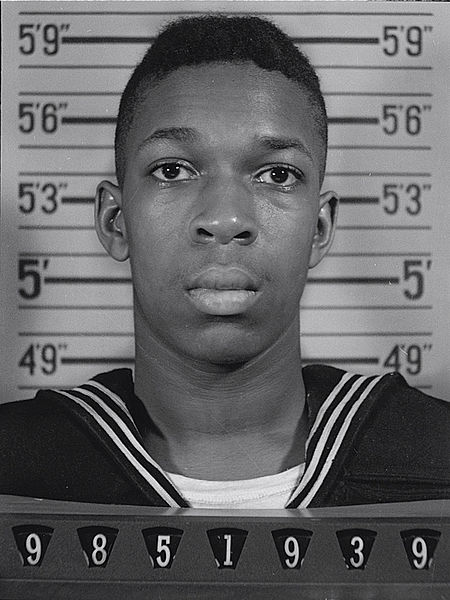
Do you ever have déjà vu? Last week we posted Jack Kerouac’s U.S. Naval Reserve enlistment mugshot from 1943 and the response was enthusiastic. Many of you were fascinated to see the great Beat writer at such a tender age and in such an atypical, unliberated context. Today we offer an eerily similar photo of another freewheeling icon of 20th century art: John Coltrane, when he was 18 years old.
Coltrane entered the Navy on the same day the United States dropped the atomic bomb on Hiroshima (August 6, 1945) and was assigned reserve status, as were many African-Americans at that time. According to Lewis Porter in John Coltrane: His Life and Music, only limited numbers of black men served as seaman after 1942. Prior to that, they were only allowed to work as kitchen help. The Navy was segregated, and Coltrane was sent to boot camp at the black section of Sampson Naval Training Center in upstate New York. By the time he finished training, World War II was over.
In late November of 1945, after a transitional month at Camp Shoemaker near San Francisco, seaman second class Coltrane was assigned to active duty in Hawaii. Stationed on the island of Oahu, Coltrane played clarinet and alto saxophone in a black Navy band called the Melody Masters. He made his first recordings with some of the musicians from the band in the summer of 1946. But all the while Coltrane was serving, the Navy was in the process of downsizing. With the war over, bands were no longer needed to boost morale. So on August 11, 1946–just over a year after his enlistment–Coltrane was discharged from the Navy and sent home.
Related content:
John Coltrane and His Great Quintet Play ‘My Favorite Things’
John Coltrane Plays Only Live Performance of A Love Supreme
John Coltrane: Three Great European Performances, 1969, 1961 and 1965
Read More...Join Cartoonist Lynda Barry for a University-Level Course on Doodling and Neuroscience
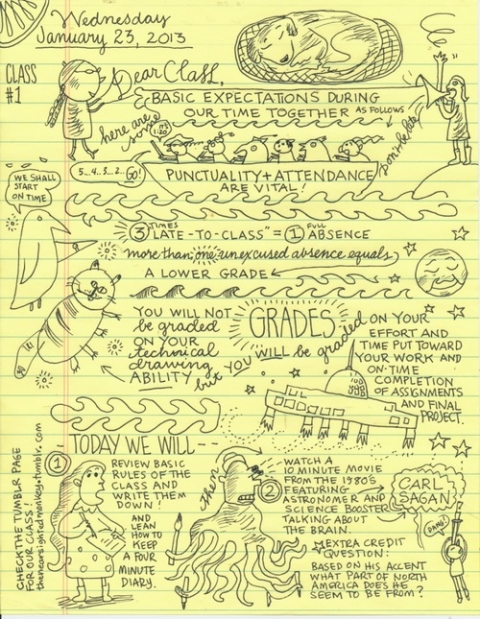
Cartoonist Lynda Barry, who has helped legions of adults grope their way back to the unselfconscious creativity of childhood, is teaching at the university level. Barry’s Unthinkable Mind course is designed to appeal to students of the humanities. Also hardcore science majors, the sort of lab-coated specimens the first group might refer to as “brains.” The instructor describes her University of Wisconsin spring semester offering thus:
A writing and picture-making class with focus on the basic physical structure of the brain with emphasis on hemispheric differences and a particular sort of insight and creative concentration that seems to come about when we are using our hands (the original digital devices) —to help us figure out a problem.
The twenty-one grads and undergrads accepted into Professor Barry’s course have been warned, via the illustrated letter above, handwritten on legal paper, that the workload will be heavy.
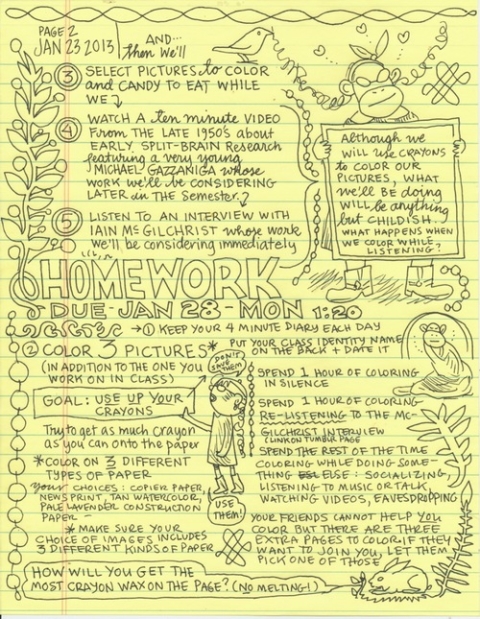
You should be warned as well, if you elect to audit this course from home. Enrollment is not necessary. Professor Barry will be posting her weekly assignments and curriculum materials on her tumblr, a forum where her abiding interest in science is as apparent as her devotion to undirected doodling. Your first assignment, posted above, requires a box of crayons, the coloring pages of your choice, downloaded to four types of paper, and a significant chunk of time set aside for brain-related articles and vintage videos starring Cognitive Neuroscientist Michael Gazzaniga and astronomer Carl Sagan. You should also be committed to keeping a four-minute diary and serving as your own guinea pig.
Who’s in?
A big H/T @kirstinbutler
Related Content
Cartoonist Kate Beaton Plays on Literary Classics — The Great Gatsby, Julius Caesar & More
Steven Pinker Explains the Neuroscience of Swearing (NSFW)
Carl Sagan’s Undergrad Reading List: From Plato and Shakespeare, to Huxley and Gide
- Ayun Halliday ‘s most recent book is Peanut.
Read More...The Time Neil Young Met Charles Manson, Liked His Music, and Tried to Score Him a Record Deal
Waging Heavy Peace — it’s not your average rock star biography. There’s not much sex and drugs. There’s some rock ’n’ roll. But mostly, there’s a lot of Neil Young being an ordinary guy, hanging out with family and friends, tinkering with toy trains, and refurbishing old cars. It’s a decidedly down-to-earth autobiography, so far as autobiographies go. But it’s not entirely devoid of fantastical stories. Like the time when, during the late 1960s, Young stopped by the Los Angeles home of Dennis Wilson, the drummer of The Beach Boys. There, Wilson was living with three or four girls who had an “intense vibe” and a “detached quality about them.” Young continues:
After a while, a guy showed up, picked up my guitar, and started playing a lot of songs on it. His name was Charlie. He was a friend of the girls and now of Dennis. His songs were off-the-cuff things he made up as he went along, and they were never the same twice in a row. Kind of like Dylan, but different because it was hard to glimpse a true message in them, but the songs were fascinating. He was quite good.
Young then adds:
I asked him if he had a recording contract. He told me he didn’t yet, but he wanted to make records. I told Mo Ostin at Reprise about him, and recommended that Reprise check him out.… Shortly afterward, the Sharon Tate-La Bianca murders happened, and Charlie Manson’s name was known around the world.
After the murders, Manson kind of got a record deal. His recordings were commercially released on the album Lie: The Love and Terror Cult. Above, we have one bizarrely upbeat song from the collection, “Home Is Where You’re Happy.”
Related Content:
Neil Young Reveals the New Killer Gadget That Will Save Music
Neil Young Busking in Glasgow, 1976: The Story Behind the Footage
‘The Needle and the Damage Done’: Neil Young Plays Two Songs on The Johnny Cash Show, 1971
Read More...Jack Kerouac’s Naval Reserve Enlistment Mugshot, 1943

In the summer of 1942, Jack Kerouac followed in the footsteps of Joseph Conrad and Eugene O’Neill and went to sea. After dropping out of Columbia University the previous Fall, the 20-year-old Kerouac signed up for the merchant marine and shipped out aboard the U.S. Army Transport ship Dorchester.
Although World War II had broken out at about the time of his departure from Columbia, Kerouac’s motives for going to sea were more personal than patriotic. “My mother is very worried over my having joined the Merchant Marine,” Kerouac wrote in his journal at the time, “but I need money for college, I need adventure, of a sort (the real adventure of rotting wharves and seagulls, winey waters and ships, ports, cities, and faces & voices); and I want to study more of the earth, not out of books, but from direct experience.”
In October of 1942, after completing a voyage to and from an Army command base in Greenland (which he would later write about in Vanity of Duluoz), Kerouac left the merchant marine and returned to Columbia. That was lucky, because most of the Dorchester’s crew–more than 600 men–died three months later when the ship was torpedoed by a German U‑boat. But the restless Kerouac lasted only a month at Columbia before dropping out again and making plans to return to sea. In December of 1942 he enlisted in the U.S. Naval Reserve. He wanted to join the Naval Air Force, but failed an aptitude test. So on February 26, 1943 he was sent to the Naval Training Station in Newport, Rhode Island. That’s apparently when the photograph above was taken of the young Kerouac with his military haircut. It would have been right around the time of his 21st birthday.
Kerouac lasted only 10 days in boot camp. As Miriam Klieman writes at the National Archives, “The qualities that made On the Road a huge success and Kerouac a powerful storyteller, guide, and literary icon are the same ones that rendered him remarkably unsuitable for the military: independence, creativity, impulsivity, sensuality, and recklessness.” According to files released by the government in 2005, Naval doctors at Newport found Kerouac to be “restless, apathetic, seclusive” and determined that he was mentally unfit for service, writing that “neuropsychiatric examination disclosed auditory hallucinations, ideas of reference and suicide, and a rambling, grandiose, philosophical manner.” He was sent to the Naval Hospital in Bethesda Maryland and eventually discharged.
For more on Kerouac’s brief adventure in the Navy, read Kleiman’s Article, “Hit the Road, Jack! Kerouac Enlisted in the U.S. Navy But was Found ‘Unfit for Service’ ”
Related content:
Jack Kerouac Reads from On the Road, 1959
Jack Kerouac’s 30 Revelations for Writing Modern Prose
Read More...Support Us
We're hoping to rely on loyal readers, rather than erratic ads. Please click the Donate button and support Open Culture. You can use Paypal, Venmo, Patreon, even Crypto! We thank you!

About Us

Open Culture scours the web for the best educational media. We find the free courses and audio books you need, the language lessons & educational videos you want, and plenty of enlightenment in between.
Advertise With Us

FREE UPDATES!
GET OUR DAILY EMAIL
Get the best cultural and educational resources on the web curated for you in a daily email. We never spam. Unsubscribe at any time.
FOLLOW ON SOCIAL MEDIA

Open Culture editor Dan Colman scours the web for the best educational media. He finds the free courses and audio books you need, the language lessons & movies you want, and plenty of enlightenment in between.
Advertise With Us

