Watch Bill Murray Perform a Satirical Anti-Technology Rant (1982)
Above you’ll find find a clip from Wired In, a television show produced in the early eighties meant to orient viewers in the midst of that heady era of technological innovation. Alas, the program never aired; only a demo reel and some raw footage survive. But those remains feature no less a comedic luminary than Bill Murray, who even 32 years ago must have been quite a catch for a pilot like this. Though not known for his tech savvy, he has built a reputation for making anything sound hilarious by virtue of his persona alone. This skill he applies to a parody of the everyman’s anti-technology diatribe, as commonly heard then as it is today — or as it no doubt was 32 years before the shoot, or will be 32 years from now. “Who thinks up all this high-tech stuff anyway?” Murray demands. “They start with the digital watches. Tells you the time in numbers, the exact time to the second. 3:12 and 42 seconds. Who needs to know that stuff? I don’t!”
Keep watching, and that Wired In clip heads to Las Vegas to demonstrate for us the wonder of solid-state cartridge software for the Texas Instruments Home Computer. But if you’d rather marvel at more of Murray’s particular kind of craft, watch the full seven minutes of rant takes above. His riffs, seemingly scripted as well as improvised, of varying moods and pitched at varying energy levels, take him from those digital watches to automated car factories to R2-D2 to talking dashboards to the one idea he does like, robots that ride alongside you in your car’s passenger’s seat. “You know what?” he concludes, “They’ll never do it — because it makes too much sense.” The makers of Wired In clearly had a presciently sardonic attitude about the coming waves of tech-related anxiety; the pilot also includes a jab at the notion of video game addiction from “Pac-Man freak” Lily Tomlin.
Related Content:
Fact Checking Bill Murray: A Short, Comic Film from Sundance 2008
Bill Murray Reads Poetry at a Construction Site
Colin Marshall hosts and produces Notebook on Cities and Culture and writes essays on literature, film, cities, Asia, and aesthetics. He’s at work on a book about Los Angeles, A Los Angeles Primer. Follow him on Twitter at @colinmarshall.
Read More...Cornell Launches Archive of 150,000 Bird Calls and Animal Sounds, with Recordings Going Back to 1929
Ornithologists and bird watchers rejoice. After a dozen years, The Cornell Lab of Ornithology’s Macaulay Library has fully digitized its nearly 150,000 audio recordings (a total running time of 7,513 hours), representing close to 9,000 different species, such as the very unsettling-sounding Barred Owl (above). While the collection also includes the sounds of whales, elephants, frogs, primates, and other animals, the primary emphasis here is on birds (it is a Lab of Ornithology, after all), and there is an incredible range of calls. Cornell recommends some of the highlights below:
Earliest recording: Cornell Lab founder Arthur Allen was a pioneer in sound recording. On a spring day in 1929 he recorded this Song Sparrow sounding much as they do today
Youngest bird: This clip from 1966 records the sounds of an Ostrich chick while it is still inside the egg – and the researchers as they watch
Liveliest wake-up call: A dawn chorus in tropical Queensland, Australia is bursting at the seams with warbles, squeals, whistles, booms and hoots
Best candidate to appear on a John Coltrane record: The indri, a lemur with a voice that is part moan, part jazz clarinet
Most spines tingled: The incomparable voice of a Common Loon on an Adirondacks lake in 1992
Most erratic construction project: the staccato hammering sounds of a walrus under water
Most likely to be mistaken for aliens arriving: Birds-of-paradise make some amazing sounds – here’s the UFO-sound of a Curl-crested Manucode in New Guinea
Whether you’re an enthusiastic birder, practicing scientist, or sound-sample hunter, you’ll find something to blow your mind at the extensive collections of the Macaulay Library. Both amateur and professional naturalists, for example, can acquire, visualize, measure, and analyze animal sounds with a free version of the Cornell Lab’s proprietary interactive sound analysis software, Raven.
And admirers of the astonishing variety and beauty of the bird-of-paradise should stay tuned for the Bird-of-Paradise Project website, launching this month. Sign up to receive an email when the full site launches. Meanwhile, watch the project’s spellbinding trailer below.
Visit the Cornell Lab of Ornithology’s YouTube page for more fascinating bird videos.
Related Content
ParaHawking in Nepal: What It’s Really Like to Fly with Birds
The Wild Kingdom: Brought to You by Mutual of Omaha (and YouTube)
Josh Jones is a freelance writer, editor, and musician based in Washington, DC. Follow him @jdmagness
Read More...Listen to Robert Frost Read ‘The Gift Outright,’ the Poem He Recited from Memory at JFK’s Inauguration
The reading from Cuban-American poet Richard Blanco at President Barack Obama’s second inauguration ceremony today follows a tradition that began 52 years ago, when John F. Kennedy invited his fellow New Englander Robert Frost to read at his inaugural.
Frost was an early supporter of Kennedy. On his 85th birthday (March 26, 1959) he was asked by a reporter about the decline of New England’s cultural influence in America. “The next President of the United States will be from Boston,” replied Frost, according to Poets.org. “Does that sound as if New England is decaying?” At that time Kennedy had yet to formally announce his candidacy, so Frost was asked to explain who he was talking about. “He’s a Puritan named Kennedy. The only Puritans left these days are the Roman Catholics. There. I guess I wear my politics on my sleeve.” When President-elect Kennedy invited the 86-year-old poet to read a poem at his inauguration, if it was not too arduous, Frost cabled his response:
IF YOU CAN BEAR AT YOUR AGE THE HONOR OF BEING MADE PRESIDENT OF THE UNITED STATES, I OUGHT TO BE ABLE AT MY AGE TO BEAR THE HONOR OF TAKING SOME PART IN YOUR INAUGURATION. I MAY NOT BE EQUAL TO IT BUT I CAN ACCEPT IT FOR MY CAUSE–THE ARTS, POETRY, NOW FOR THE FIRST TIME TAKEN INTO THE AFFAIRS OF STATESMEN.
Frost wrote a new poem, “Dedication,” especially for the occasion. But conditions on inauguration day conspired against the old poet. A heavy blanket of snow fell on Washington the night before, and the sunlight that day was intense. In the harsh glare from the sun and snow, Frost found that he couldn’t read the typescript of his new poem. Kennedy had earlier asked Frost, if he wasn’t going to write a new poem, to consider reading his poem on American history, “A Gift Outright.” So when Frost found that he couldn’t read the new poem, he recited “A Gift Outright” from memory.
In the video above, we hear Frost reading the poem, which was written in the late 1930s and first published in 1942. Although some have said the audio is from the Kennedy inauguration, it apparently is not, because Frost reads the original text. For the inauguration, the poet reportedly agreed to Kennedy’s request to make a change in the final line. The phrase “Such as she would become” was changed to a more optimistic “Such as she will become.” (You can read the full text of the poem in a new window.) Sometime after the event, Kennedy put Frost’s inaugural appearance in perspective:
I asked Robert Frost to come and speak at the inauguration because I felt he had something important to say to those of us who are occupied with the business of government, that he would remind us that we were dealing with life, of hopes and fears of millions of people. He has said it well in a poem called “Choose Something Like a Star,” in which he speaks of the fairest star in sight and says, “It asks little of us here./It asks of us a certain height./So when at times the mob is swayed/to carry praise or blame too far,/we may choose something like a star/ to stay our mind on and be stayed.”
Related content:
Robert Frost Recites ‘Stopping by Woods on a Snowy Evening’
Read More...The Enigma Machine: How Alan Turing Helped Break the Unbreakable Nazi Code
In 2001, none other than Sir Mick Jagger bought the rights to a novel by Robert Harris called Enigma. The novel, a fictionalized account of WWII British codebreakers, then became a feature film, written by Tom Stoppard, produced by Sir Mick, and starring Mr. Dougray Scott and Ms. Kate Winslett as derring-do Bletchley Park mathematicians and cryptanalysts employed in a race against time and the Nazis to break the fabled Enigma code before all hell breaks loose. It all sounds very dramatic (and I’ve heard the film is entertaining), but things didn’t happen quite like that. Reality is never so formulaic or so good-looking. But the Enigma code was broken, and the story of the code machine and its eventual decryption is fascinating on its own terms. As University of Cambridge “Enigma Project Officer” Dr. James Grime says–in the series of videos above and below–it’s a story of “how mathematicians can save lives.” Still with me?
Okay, so in the first video above, Dr. Grime gives us a thorough tour of the Enigma machine (Sir Mick owns one, by the way… but back to the history…). Developed by the Germans, it’s a marvelous encryption method set into a small box that when opened resembles little more than a fancy WWII-era typewriter. Oh, but it’s clever, you see, because the Enigma machine (the one above belongs to science writer Simon Singh) translates ordinary messages into code through an ingenious method by which no letter in the code ever repeats, making it almost impossible to decode in the ordinary ways. The machine was quite complicated for its time; it works by sending the characters typed by the keys through a series of circuits—first through three rotors like those on a combination bike lock, but each with 26 places instead of ten.
Now at this point, the machine was nothing more than what was available to any bank or business wishing to transmit trade secrets. But the German military machines had an extra layer of encoding: at the front of their machines was a “plugboard,” something like a small switchboard. This allowed the coding coming through the rotors to be resequenced for an extra level of scrambling. In the German military machines, the total number of possible combinations for message encryptions comes to a staggering figure in the quadrillions. (The exact number? 158,962,555,217,826,360,000). There’s a little more to the machine than that, but Dr. Grime can explain it much better than I.
Of course, the Enigma Machine had to have a fatal flaw. Otherwise, no novel, no movie, no drama (and maybe no victory?). What was it, you ask? Amazingly, as you will learn above, the very thing that made the Enigma nearly impossible to break, its ability to encode messages without ever repeating a letter, also made the code decipherable. But first, Alan Turing had to step in. Sadly, Turing is missing from Enigma the film. (More sadly, he was disgraced by the country he served, which put him on trial for his sexuality and humiliated him to the point of suicide). But as Grime shows above, Turing is one of the real heroes of the Enigma code story. Cryptanalysts initially discovered that they could decipher ordinary words and phrases (like “Heil Hitler”) in the Enigma messages by matching them up with strings of random letters that never repeated.
But this was not enough. In order for the Enigma code to work for the Germans, each operator—sender and receiver—had to have exactly the same settings on their rotors and plugboards. (The messages were transmitted over radio via Morse code). Each month had its own settings, printed on code sheets in soluble ink that easily dissolved in water. If the Allied codebreakers deciphered the settings, their decryption would be useless weeks later. Furthermore, the German navy had a more complicated method of encoding than either the army or air force. The Polish had developed a machine called the Bombe, which could decipher army and air force codes, but not navy. What Turing did, along with Gordon Welchman, was develop his own version of the Bombe machine, which allowed him to break any version of the Enigma code in under 20 minutes since it bypassed most of the tedious guesswork and trial and error involved in earlier by-hand methods.
This is all very dramatic stuff, and we haven’t had one celebrity step in to dress it up. While I’m certain that Enigma the film is a treat, I’m grateful to Dr. Grime for his engagement with the actual codebreaking methods and real personalities involved.
A third video of extra footage and outtakes is available here if you’re still hungry for more WWII codebreaking secrets.
via Science Dump
Josh Jones is a writer and musician. He recently completed a dissertation on land, literature, and labor.
Read More...Hannah Arendt’s Original Articles on “the Banality of Evil” in the New Yorker Archive
We’ve all heard the phrase “the banality of evil.” Some of us even know which political theorist to attribute it to, and among those, a few have even read it in context. Hannah Arendt most memorably employed it in both the subtitle and closing words of Eichmann in Jerusalem: A Report on the Banality of Evil, her book on the trial of Nazi lieutenant-colonel Adolf Eichmann. To Arendt’s mind, Eichmann willingly did his part to organize the Holocaust — and an instrumental part it was — out of neither anti-semitism nor pure malice, but out of a non-ideological, entirely more prosaic combination of careerism and obedience. Readers have argued ever since its publication about this characterization, and those with a special interest in how Arendt arrived there can find in the New Yorker’s online archives the original series of “Eichmann in Jerusalem” articles out of which the book grew: part one, part two, part three, part four, and part five. (Click on the images at the bottom of each page to see Arendt’s writing up close. Then click on them again and maneuver your mouse around to peruse the pages.) Given that Hannah Arendt, a new biopic starring Barbara Sukowa, just gained distribution, you may want to read these articles to stay ahead of the next wave of interest in the thinker and her writings.
In today’s magazines, one reads rather fewer five-part intersections of trial reportage and moral inquiry by figures like Arendt. But the New Yorker hasn’t entirely lost its willingness to confront these matters. Shortly after last year’s massacre in Aurora, Colorado, the magazine ran on its site a piece by Rollo Romig in touch with concerns, broadly speaking, similar to Arendt’s. Romig, too, looks at the nature of evil, but in a reflection suited to our time — brief, startlingly timely, and specifically for the web — rather than Eichmann in Jerusalem’s. “The danger of a word like ‘evil’ is that it is absolute,” he writes. “ ‘Evil’ has become the word we apply to perpetrators who we’re both unable and unwilling to do anything to repair, and for whom all of our mechanisms of justice seem unequal: it describes the limits of what malevolence we’re able to bear. In the end, it’s a word that says more about the helplessness of the accuser than it does the transgressor.”
H/T to Christian F. for flagging the New Yorker articles for us.
Related Content:
The Trial of Adolf Eichmann at 50
55 Free Philosophy Courses
Download Free Courses from Famous Philosophers: From Bertrand Russell to Michel Foucault
Colin Marshall hosts and produces Notebook on Cities and Culture and writes essays on literature, film, cities, Asia, and aesthetics. He’s at work on a book about Los Angeles, A Los Angeles Primer. Follow him on Twitter at @colinmarshall.
Read More...Woody Allen’s Typewriter, Scissors and Stapler: The Great Filmmaker Shows Us How He Writes
Here’s a fascinating little window into the working habits of one our most brilliant and prolific artists. It’s from Robert B. Weide’s 2011 PBS film Woody Allen: A Documentary. In the scene above, Allen shows us the machine he has used for sixty years, the only typewriter he has ever owned: an early fifties manual Olympia SM‑3. “I bought this when I was sixteen,” Allen says. “It still works like a tank.”
Every comedy sketch, every screenplay, every essay ever written by Allen was composed on the one typewriter. When Weide asks Allen how he manages without the “cut-and-paste” functions of a word processor, he pulls out a pair of scissors and an old Swingline stapler. “It’s very primitive, I know,” says Allen, “but it works very well for me.”
“Allen’s persistence in using the one and only typewriter of his life, and in practicing cut-and-staple editing are certainly curious, quaint, idiosyncratic, even endearing,” writes Richard Brody in the Front Row blog at The New Yorker; “but they’re also proof on the wing of two of Allen’s lifelong qualities–untimeliness and hermeticism–as well as of the enduring struggle in his films between writing and experience.”
Related Content:
Woody Allen Answers 12 Unconventional Questions
Woody Allen Boxes a Kangaroo, 1967
Woody Allen Talks With the Reverand Billy Graham
Read More...The Making of The Blues Brothers: When Belushi and Aykroyd Went on a Mission for Comedy & Music
Before you close out the week, you’ll want to spend some time with Ned Zeman’s piece in Vanity Fair, “Soul Men: The Making of The Blues Brothers.” It brings us back to the 1970s, when John Belushi and Dan Aykroyd labored to bring their characters, Jake and Elwood Blues, onto the national stage. Despite being the stars of Saturday Night Live, Belushi and Aykroyd had to cajole the show’s producer Lorne Michaels into letting them perform as The Blues Brothers on late night TV. First, Michaels let them warm up SNL audiences before shows. Then, in 1976, Michaels let the Blues Brothers make their first live appearance. But there was a rub. They had to dress as Killer Bees and not as “John Lee Hooker gone Hasidic.” Only in April, 1978, did Jake and Elwood make their true SNL debut as a musical act (see below).
Zeman’s piece focuses mostly on the next chapter in the history of The Blues Brothers — the making of the now legendary film. That had its own set of difficulties. Big budgets, big ambitions and big coke addictions, all threatening to derail the project. Down to the very last moment, the film looked like a guaranteed financial bust, to the tune of $27 million. But, of course, that’s not how things turned out.
Above, you can watch The Making of The Blues Brothers, a 2005 documentary that came out with the 25th anniversary re-release of the comic masterpiece. Below, watch their SNL debut.
via Kottke
Related Content:
John Belushi’s Improvised Screen Test for Saturday Night Live (1975)
William S. Burroughs on Saturday Night Live, 1981
Read More...The Existential Adventures of Iconoclastic Brazilian Musician Tim Maia: A Short Animated Film
Late last year, Luaka Bop Records released Nobody Can Live Forever: The Existential Soul of Tim Maia, a retrospective album that includes 15 tracks recorded by Tim Maia, the greatest Brazilian singer of all time, according to Rolling Stone. Maia “was the Big Bang who completely changed the scene when he arrived [in Brazil] at the turn of the ’70s,” Nelson Motta told The New York Times last fall. “He took the black American thing and mixed it with Brazilian forms like samba, baião and xaxado, inaugurating a new direction in Brazilian pop that remains popular even today: that of urban black music.” As this short animated film makes clear, Maia also had an outsized personality and appetites that brought about his early demise, but not without first making him a legend. Below we have rare footage of Tim Maia performing live in 1971:
Muddy Waters and Friends on the Blues and Gospel Train, 1964
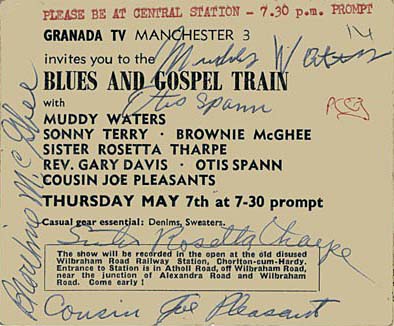
One of the most unique and intimate concerts from the British blues revival of the 1960s was the “Blues and Gospel Train,” filmed in a suburb of Manchester, England. In 2011 we posted an excerpt featuring Muddy Waters singing “You Can’t Lose What You Ain’t Never Had.” Today we’re pleased to bring the whole show–or at least most of it.
The “Blues and Gospel Train” was staged on May 7, 1964 by Granada TV. Fans who were lucky enough to get tickets–some 200 of them–were instructed to meet at Manchester’s Central Station at 7:30 that evening for a short train ride to the abandoned Wilbraham Road Station in Whalley Range.
When the train pulled in at Wilbraham Road, the audience poured out and found seats on the platform, making their way past Muddy Waters, who was singing “Blow Wind Blow.” The opposite platform, decorated to look like an old railway station in the American South, served as a stage for a lineup of now-legendary blues artists including Waters, Sister Rosetta Sharpe, Sonny Terry & Brownie McGhee, Cousin Joe, Otis Spann and Reverend Gary Davis.
The complete concert is available on DVD as part of American Folk ‑Blues Festival: The British Tours 1963–1966. The version above is not of the greatest quality, but it’s still interesting to watch. Rev. Gary Davis’s contribution appears to have been cut, but much of the show is intact. The taping was interrupted by a heavy downpour. Fittingly, Sister Rosetta Tharpe begins her set with a performance of “Didn’t It Rain.” Here’s the full list of performances, in order of appearance:
- Muddy Waters: “Blow Wind Blow”
- Cousin Joe: “Chicken a la Blues”
- Cousin Joe: “Railroad Porter Blues”
- Sister Rosetta Tharpe: “Didn’t It Rain”
- Sister Rosetta Tharpe: “Trouble in Mind”
- Muddy Waters: “You Can’t Lose What You Ain’t Never Had”
- Sonny Terry & Brownie McGhee: “Talking Harmonica Blues”
- Sonny Terry & Brownie McGhee: “Rambler’s Blues” medley
- Sonny Terry & Brownie McGhee: “Walk On”
- Sister Rosetta Tharpe: “He’s Got the Whole World in His Hands”
Martin Scorsese Presents The Blues
Robert Johnson’s ‘Me and the Devil Blues,’ Animated
Lead Belly: Only Known Footage of the Legendary Bluesman, 1935 and 1945
Read More...Akira Kurosawa & Francis Ford Coppola Star in Japanese Whisky Commercials (1980)
In 1980, the revered Japanese director Akira Kurosawa shot Kagemusha, otherwise known as The Shadow Warrior. Francis Ford Coppola was the producer. Somewhere during the production, the two filmmakers lent their star power to a series of commercials for Suntory Whisky. If you’re a regular reader, you know that many cultural icons have pitched Japanese products in times past — take for example Woody Allen, James Brown, Nicolas Cage, Paul Newman and good ole Dennis Hopper. And, if you’re even a casual moviegoer, you know that Sofia Coppola (daughter of Francis) put an American movie star drinking whisky at the center of her Oscar-nominated film, Lost in Translation (2003). And it wasn’t just any whisky that Bill Murray was sipping. It was Suntory Whisky.
If you would like to support the mission of Open Culture, consider making a donation to our site. It’s hard to rely 100% on ads, and your contributions will help us continue providing the best free cultural and educational materials to learners everywhere. You can contribute through PayPal, Patreon, and Venmo (@openculture). Thanks!
Related Content:
Watch Kurosawa’s Rashomon Free Online, the Film That Introduced Japanese Cinema to the West
Fellini’s Fantastic TV Commercials
Ingmar Bergman’s Soap Commercials Wash Away the Existential Despair
Jean-Luc Godard’s After-Shave Commercial for Schick
Read More...Support Us
We're hoping to rely on loyal readers, rather than erratic ads. Please click the Donate button and support Open Culture. You can use Paypal, Venmo, Patreon, even Crypto! We thank you!

About Us

Open Culture scours the web for the best educational media. We find the free courses and audio books you need, the language lessons & educational videos you want, and plenty of enlightenment in between.
Advertise With Us

FREE UPDATES!
GET OUR DAILY EMAIL
Get the best cultural and educational resources on the web curated for you in a daily email. We never spam. Unsubscribe at any time.
FOLLOW ON SOCIAL MEDIA

Open Culture editor Dan Colman scours the web for the best educational media. He finds the free courses and audio books you need, the language lessons & movies you want, and plenty of enlightenment in between.
Advertise With Us

