Stephen Colbert Brings Laughs and Book Tour to Google
Stephen Colbert is one of the most refreshing comedians working today. He maintains his character’s obnoxiousness during his own show, riffing and improvising during interviews with everyone from Bill O’Reilly to Elijah Wood, building his character to deadpan heights even with Jane Fonda’s tongue in his ear.
But in the hot seat himself, as an interviewee on Letterman, Oprah or even with Playboy magazine, Colbert is authentic, candid, funny and a fast-on-his-feet smartie. In early December Colbert visited Google’s New York offices and taped an interview for At Google Talks. Colbert fans will want to check out the unedited version recently posted by Google. As a guest, Colbert is funnier than Jon Stewart and we get an honest look at the bright guy behind the buffoon. The uncut interview has its highlights, including the point when Colbert’s reaction to Eric Schmidt’s suggestion that The Colbert Report launch its own YouTube show. His answers to questions from the audience are engaging, funny and revealing. It’s wonderful to hear the personal story about the moment he realized he wanted to make people laugh.
Colbert was also conducting business. The interview was part of his book tour to promote America Again: Re-Becoming the Greatness We Never Weren’t. Below, you can see Colbert give his comedic pitch for the book. And, if you want to download a free audio copy, you can always do so by starting a Free 30-Day Trial with Audible.com. We have details here.
Kate Rix writes about digital media and education. Read more of her work at and at thenifty.blogspot.com.
Read More...Lenny Bruce Riffs and Rants on Injustice and Hypocrisy in One of His Final Performances (NSFW)
We can remember Lenny Bruce as a masterful social critic or as one of the edgiest, most original comedians of the late-50s/early 60s. Or both, since both sides of him were always present in the live performances preserved on film and tape. Born Leonard Alfred Schneider in Long Island, Bruce came from a showbiz family, in a way; his mother was a performer and a supporter of his stage ambitions. But, after his discharge from the Navy (for a performance in drag, among other things), his New York act evolved quickly from celebrity impressions and burlesque to a more personalized and biting satire that cut through the genteel silences around racism, religious intolerance, drugs, politics, sexuality, and Jewishness in America. Sprinkled liberally with Yiddishisms, hip beat expressions, and topical riffs, Bruce’s jazz-inflected act could swing wildly from giddy falsetto exuberance to heartbreaking downbeat lament in a matter of minutes. Perhaps nowhere is this highwire act better documented than in the recording of his 1961 performance at New York’s Carnegie Hall, which he gave at midnight in a blizzard to a devoted audience of nearly 3,000.
The Carnegie Hall concert marked the height of his career, after which his sad decline began. Later that year, he was arrested in San Francisco for obscenity. He was acquitted, but this began the years-long battle in courts, including two Supreme Court appeals, on similar charges (dramatized in the excellent biopic Lenny, with Dustin Hoffman as Bruce). The legal battles bankrupted Bruce, and exhausted and demoralized him; he stood as a defender of the right to free expression and the need for people like him, whether just “entertainers” or serious satirists, to hold power to account and mock its threadbare contradictions, but he so profoundly rubbed the legal system the wrong way that he didn’t stand a chance.
By 1966, Bruce could not gig outside San Francisco. One of his final performances (above) before his death from overdose sees him rehearsing his legal battles. He is embittered, angry, some might say obsessed, some might say righteous, but he’s still in top form, even if there may be more of Bruce the critic than Bruce the entertainer here. Lenny Bruce has been mourned and celebrated by comedic giants like George Carlin, Richard Pryor, and Bill Hicks and musicians like Nico, Dylan, and R.E.M. But it sometimes seems that his name gets more press than his work. So, get to know Lenny Bruce. Watch the performance above, but also listen to the brilliant Carnegie Hall concert (available in 7 parts on YouTube). And thank him every time a comic gets away with crossing social boundaries with impunity. He wore the system down so that the Carlins and Pryors could break it wide open.
Josh Jones is a writer and scholar currently completing a dissertation on landscape, literature, and labor.
Read More...Google Digitizes Ancient Copies of the Ten Commandments and Genesis
If digital technology poses any threat to the market for words printed on real paper—and the jury is still out on that one—then it must also be credited for exposing us to texts from the ancient world.
Last fall we posted about how the Israel Museum digitized the Dead Sea Scrolls, nearly 1,000 texts found on the northwest shore of the Dead Sea in 1946. They are the earliest known surviving manuscripts from what is called the Hebrew Bible. Digitizing the texts—most were on parchment but some were written on bronze or papyrus—allows viewers to zoom in to examine the writing and even the paper fibers of hundreds of fragments.
Now the Israel Antiquities Authority has expanded upon the collection. Housed in the Leon Levy Dead Sea Scrolls Digital Library are the earliest known copies of the Book of Deuteronomy (which includes the Ten Commandments) and Chapter One of the Book of Genesis .
Each scroll fragment was scanned using spectral imaging technology that allows for the recovery of writing that had faded to near invisibility over the years. The boon for scholars is clear, but for regular folks this archive is better than a museum visit. The Leon Levy site is searchable by discovery site, content and ancient language.
Google is making its mark as a major facilitator of cultural preservation. Another recent project with ties to ancient texts and history is Caminos de Sefarad, a collaboration with Red de Juderías de España to create a digital map of Spain’s Jewish heritage.
 More than 500 landmarks from the Sefarad—the Sephardic Jews before they were expelled from Spain and Portugal in 1492—are fully annotated with current photos, text and special details. Visit Ribadavia, a once-prosperous city in Spain’s northwest mountains, and learn about Jewish wedding traditions from the Middle Ages. The Jewish Quarter of Léon is called the Barrio Húmedo (Wet District) and is known today for its fine wine and food. Use the timeline to keep yourself oriented in chronological history and click Street View to see this vibrant district as it is today.
Kate Rix writes about digital media and education. Read more of her work at and thenifty.blogspot.com.
Read More...Woody Allen Boxes a Kangaroo, 1966
Last month, we featured Woody Allen answering thirteen unusual questions from Robert B. Weide’s film Woody Allen: A Documentary. Well, it turns out that it wasn’t the only unusual footage the documentary had to offer. During the 1960s, the young comic did whatever his managers (Charles H. Joffe and Jack Rollins) thought would enhance his public profile. Some of his early performances and stunts were genius. Others flopped. You decide where this one falls. In 1966, Allen appeared on Hippodrome, a British variety TV show that showcased jumping dogs, trapeze acts, musical acts and … kangaroo boxing matches. This match went one round, with the Australian light heavyweight champion landing the only punches.
Related Content:
Thomas Edison’s Boxing Cats (1894), or Where the LOLCats All Began
Muhammad Ali Plans to Fight on Mars in Lost 1966 Interview
Woody Allen and the Reverend Billy Graham In Conversation
Read More...Bob Dylan Shares a Drug-Hazed Taxi Ride with John Lennon (1966)
D.A. Pennebaker’s cinéma vérité documentary Dont Look Back [sic] followed Bob Dylan on his celebrated 1965 tour through England, letting viewers see what happened along the way — the good, the bad and everything between. Today, it’s considered both a classic documentary and a pop-cultural artifact, something Dylan fans can’t afford to miss.
The same can’t be said for Eat the Document, Pennebaker’s follow-up documentary that captured Dylan’s return to the UK in 1966. The premise had promise. Bob Dylan had just gone electric and boos followed him wherever he went. In Manchester, they famously called him “Judas.” That could have made for an intriguing film. But, according to Dylan’s most recent biographer Daniel Mark Epstein, the singer-songwriter was personally unraveling. He had toured to the point of exhaustion, and taken far too many amphetamines. During one moment filmed by Pennebaker, Dylan shared an incoherent taxi ride with John Lennon. Their rambling conversation touched on Johnny Cash, The Mamas & the Papas, Dylan’s homesickness, and how the Thames River supposedly saved Britain from Hitler. And, once we get 20 minutes into the footage, we find Dylan slumped forward in the backseat, seemingly staving off nausea.
Dylan personally edited the film and gave ABC television the option to air it. The network declined, saying it wouldn’t be comprehensible to a mainstream audience. Because the film was never released, it has been passed around in various bootlegged versions. You can watch a 52-minute version on DylanTube.
As a quick footnote, it’s worth mentioning that, according to Epstein’s biography, Lennon later told Rolling Stone magazine that he and Dylan were doing “junk” (aka heroin) that day, and that Lennon thought Dylan was close to OD’ing. It’s all discussed in The Ballad of Bob Dylan: A Portrait.
Related Content:
The 1969 Bob Dylan-Johnny Cash Sessions: Twelve Rare Recordings
Bob Dylan and The Grateful Dead Rehearse Together in Summer 1987. Listen to 74 Tracks.
John Lennon’s Victorian Circus Poster Lovingly Remade by Artists and Engravers
Read More...Chowda!: Three Centuries of Recipes Reveal the Rise of New England’s Finest Culinary Export
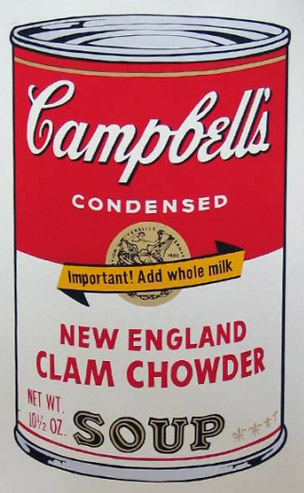
Say chowder out loud: chowder. The word sounds like food. Not an appetizer either. An entree in a small crock topped with broken crackers.
As with so many things related to food, chowder is a storied dish. It hails from New England and northeastern Canada, its first written reference dating back to 1732 when a journalist recalls dining on a “fine chowdered cod.”
There are as many types of chowder as there are soup, though a true chowder is more like a stew than a soup. Some purists would rather eat slugs than a chowder with tomatoes in it or whose name references New York. But all chowders must feature the following: broth, salt pork, biscuit and seafood.
Aside from that, all bets are off. Chow down.
Of course a regional dish with this long a history and which leaves this much room for interpretation deserves a history of its own, and so the good people at the University of Massachusetts, Amherst created the New England Chowder Compendium, a collection of recipes and ephemera exploring how chowder rose to become a staple of New England cookery.
Culled from cookbooks held by the university’s Beatrice McIntosh Cookery Collection, the compendium chronicles chowder recipes from the 1700s to the 1970s, through lean times and fat, through recipes heavy with cream and without.
And so, as readers click through featured chowder recipes from the 1920s on through to the 1940s, they’re sure to notice the ways ingredients vary. Use evaporated milk and a little water, if cream is not available. Housewives were wise in the 1940s to be thrifty while making fresh stock from knuckles: Save that fat that rose to the top and sell it to your meat dealer.
Chowder may be one of the poster food for people who are making do. Don’t have fresh seafood? Canned tuna will do. Lima beans soaked overnight can substitute for clams.
As with most handwritten recipes, the handwriting and illustrations are part of the fun. One radical suggests adding a dash of paprika. This recipe, for the Kingston Yacht Club, may have fed the entire membership (three gallons of clams?!)
The archivists include a nice primer, tracing the development of chowder (the word comes from French for “cauldron”).
One recipe that doesn’t sound so good: diet chowder from the 1970s.
Kate Rix writes about digital media and education. Read more of her work at and at thenifty.blogspot.com.
Read More...Richard Burton Reads ‘Ballad of the Long-Legged Bait’ and 14 Other Poems by Dylan Thomas
When the actor Richard Burton died in 1984 he was buried, as he requested, with a copy of The Collected Poems of Dylan Thomas.
Burton was a great friend and admirer of Thomas, who shared his Welsh heritage and rakish demeanor. The two men also shared a love of literature. “I was corrupted by Faust,” Burton once said. “And Shakespeare. And Proust. And Hemingway. But mostly I was corrupted by Dylan Thomas. Most people see me as a rake, womanizer, boozer and purchaser of large baubles. I’m all those things depending on the prism and the light. But mostly I’m a reader.”
In 1954 Burton read a selection of his friend’s poetry for a recording that would be released the following year as Richard Burton Reads 15 Poems by Dylan Thomas. The recordings were made about a year after the poet’s death, and just when Burton was riding high on the success of his 1954 performance in Thomas’s radio play Under Milk Wood. The long poem “Ballad of the Long-Legged Bait,” above, is from the 1954 sessions. The 14 poems below are mostly from the same sessions, although a couple of them might be from later recordings made by Burton.
- Under Milk Wood
- Deaths and Entrances
- Lament
- Elegy
- A Winter’s Tale
- Fern Hill
- Before I Knocked
- In My Craft or Sullen Art
- I See the Boys of Summer
- Lie Still, Sleep Becalmed
- The Force that Through the Green Fuse Drives the Flower
- The Hand that Signed the Paper
- And Death Shall Have No Dominion
- Do Not Go Gentle Into That Good Night
Related content:
Dylan Thomas Recites ‘Do Not Go Gentle Into That Good Night’ and Other Poems
Read More...Every Apple Ad Ever Aired on TV
Introducing a new YouTube Channel that gives you every Apple ad ever aired on TV — 485 ads, in total.
You can start with the iconic ones — the 1984 Super Bowl commercial directed by Ridley Scott, which aired just weeks after Steve Jobs demoed the first MacIntosh ever. Or, the famous “Think Different” campaign from the late 1990s. The official “Think Different” video was narrated by Richard Dreyfuss, but we’d encourage you to spend time with the never-aired version narrated by Jobs himself. Other vintage ads can be found in these chronologically-organized lists: 1977–1985, 1985–1996, 1996–2007 and 2007–2011. The 1981 Dick Cavett clip above appears in the first group.
But the collection also lets you sort ads thematically. So, for example, you can jump into the U.S. Get a Mac campaign, where you’ll get plenty of John Hodgman. Also find versions of the same campaign from the UK and Japan. Finally, Apple ads featuring celebrities — from Bob Dylan to Zooey Deschanel to Spike Lee — are all neatly packaged together too. H/T @coudal
Woody Guthrie’s Fan Letter To John Cage and Alan Hovhaness (1947)
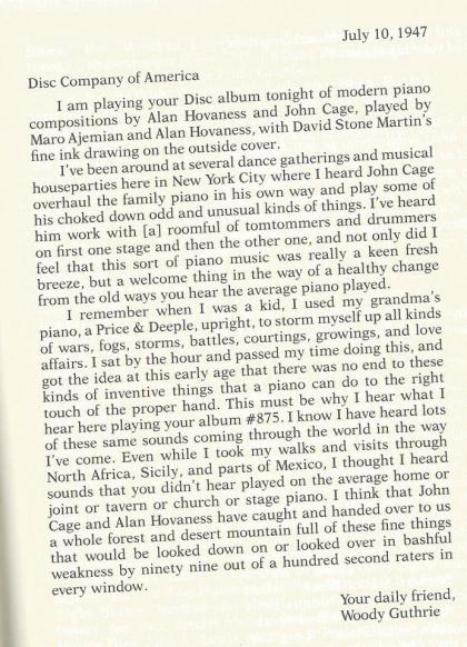
I’ve always felt a certain close affinity with Woody Guthrie. Could be my admiration for his unstinting working-man’s politics or that he hails from my mother’s home state of Oklahoma. Those are strong appeals, and I suppose it’s all of that and more: Guthrie could carve out compact granite sentences even Robert Frost would envy. If the letter above doesn’t convince you, read the man’s autobiography. In the letter, the unapologetic working-class folksinging Okie who embodied depression-era authenticity writes to “Disc Company of America” to enthuse over John Cage for his “overhaul of the family piano” and his “choked down odd and unusual kinds of things.”
Odd and unusual are two words that spring to mind when imagining Guthrie writing a letter in praise of Cage. (He also praises Armenian composer Alan Hovhaness—Guthrie spells it “Hovaness”). Written in 1947, it is the kind of text one wants to quote in its entirety. Fortunately, we have the reproduction above, and you can read it for yourself. What isn’t reproduced is the postscript, in which Guthrie wrote: “I need something like this oddstriking music to match the things I feel in my soul tonight.” He also wrote that that morning, his wife, Marjorie, had “given birth to a big 7‑pound boy”—Arlo.
Guthrie’s letter references a (now extremely rare) two-disc set entitled Piano Compositions by Alan Hovhaness and John Cage played by Maro Ajemian and Alan Hovhanes, featuring a hand-drawn cover by acclaimed jazz-record illustrator David Stone Martin. According to LA Times music critic Mark Swed, the Cage composition on Guthrie’s 78-rpm record was the prepared piano solos from Cage’s Amores, composed in 1943. Below, watch a performance of the “oddstriking” Amores by Spanish ensemble Neopercusión.
Thanks to Tristan for pointing us to this letter originally blogged over at Stool Pigeon.
Josh Jones is a doctoral candidate in English at Fordham University and a co-founder and former managing editor of Guernica / A Magazine of Arts and Politics.
Read More...The Photography of Ludwig Wittgenstein
Philosophers have often ruminated on the aesthetics of photography. Roland Barthes’ Camera Lucida begins with a poignant memorialization of his mother, as remembered through her photograph. Pierre Bourdieu’s Photography: A Middle-Brow Art wondered why and how the medium became so widespread that “there are few households, at least in towns, which do not possess a camera.” And Jacques Derrida’s posthumous Athens, Still Remains, a travel memoir accompanied by the photographs of Jean-Francois Bonhomme, begins with the mystical phrase “We owe ourselves to death.”
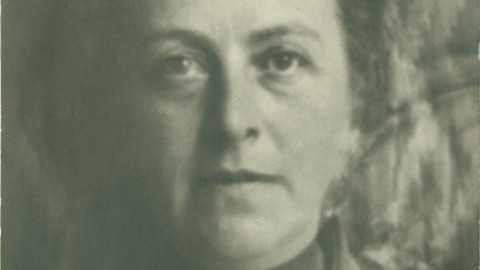
For Barthes and Derrida, photography was a medium of suspended mortality—every photograph a memento mori. For another philosopher, the cryptic, polymath, and notoriously surly Ludwig Wittgenstein, photography was a concrete expression of his preferred means of perception. As he famously wrote in the Philosophical Investigations, “Don’t think, look!” For the unsentimentally cerebral Wittgenstein, a photograph is not a memorial, but a “probability.” The philosopher’s archive at the University of Cambridge includes the photograph above, a true “probability” in that it does not represent any one person but is a composite image of his face and the faces of his three sisters, made in collaboration with the “founding father of eugenics,” Francis Galton. The four separate photographs that Wittgenstein and Galton blended together are below.
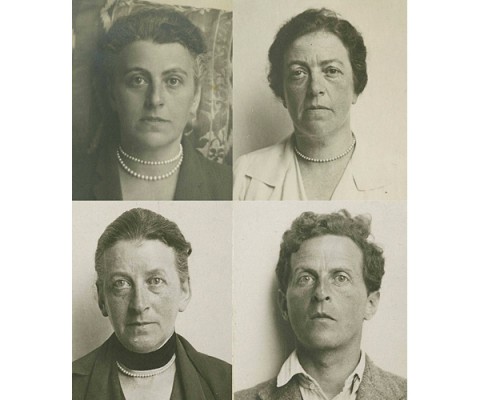
Of the composite image, keeper of the Wittgenstein archives Michael Nedo writes that “Wittgenstein was aiming for different clarity expressed by the photography of fuzziness.”:
Galton wanted to work out one probability, whereas Wittgenstein saw this as a summary in which all manner of possibilities are revealed in the fuzziness.
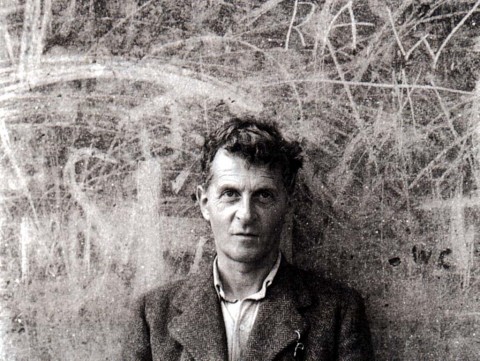
Fuzziness is a word rarely applied to Wittgenstein’s thought—at least his early work in the Tractatus Logico-Philosophicus where his only goal is a clarity of thought that supposedly dissolves all the “fuzzy” problems of philosophy in a series of elliptical aphorisms. The philosopher also called himself a “disciple of Freud,” in that he sought to “think in pictures,” and reach beyond language to the images produced by dreams and the unconscious, “to enable us to see things differently.” Wittgenstein’s photographs are as strangely detached and mysterious as the man himself. Salon has a gallery of the philosopher’s photographs, which includes the portrait of him (below), taken at his instruction in Swansea, Wales in 1947. It’s an iconic image; Wittgenstein half-sneers disdainfully at the camera, his steady gaze a challenge, while the blackboard behind him shows a riot of scratches and scrawls. In the upper right-hand corner, the word RAW hangs ominously above the philosopher’s head.
Wittgenstein’s grim portrait presents a contrast to the warmer recent photographic portraits of philosophers like those in Steve Pyke’s new book of philosopher portraits Philosophers. We’ve previously featured Pyke’s portraits of philosophers like Richard Rorty, David Chalmers, and Arthur Danto. For much a much less formal series of portraits of contemporary philosophers as everyday people, swing by the Tumblr Looks Philosophical.
Josh Jones is a doctoral candidate in English at Fordham University and a co-founder and former managing editor of Guernica / A Magazine of Arts and Politics.
Read More...Support Us
We're hoping to rely on loyal readers, rather than erratic ads. Please click the Donate button and support Open Culture. You can use Paypal, Venmo, Patreon, even Crypto! We thank you!

About Us

Open Culture scours the web for the best educational media. We find the free courses and audio books you need, the language lessons & educational videos you want, and plenty of enlightenment in between.
Advertise With Us

FREE UPDATES!
GET OUR DAILY EMAIL
Get the best cultural and educational resources on the web curated for you in a daily email. We never spam. Unsubscribe at any time.
FOLLOW ON SOCIAL MEDIA

Open Culture editor Dan Colman scours the web for the best educational media. He finds the free courses and audio books you need, the language lessons & movies you want, and plenty of enlightenment in between.
Advertise With Us


