Noam Chomsky Explains Where Artificial Intelligence Went Wrong
While popularly known for his piercing and relentless critiques of U.S. foreign policy and economic neoliberalism, Noam Chomsky made his career as a researcher and professor of linguistics and cognitive science. In his 50 years at MIT he earned the appellation “the father of modern linguistics” and—after overturning B.F. Skinner’s behaviorist paradigm—founder of the “cognitive revolution.” But these are labels the self-effacing Chomsky rejects, in his characteristically understated way, as he rejects all triumphalist narratives that seem to promise more than they deliver.
Such is the case with Artificial Intelligence. The term, coined in 1956 by computer scientist John McCarthy, once described the optimism with which the scientific community pursued the secrets of human cognition in order to map those features onto machines. Optimism has turned to puzzlement, ambivalence, or in Chomsky’s case outright skepticism about the models and methodologies embraced by the field of AI.
Never particularly sanguine about the prospects of unlocking the “black box” of human cognition through so-called “associationist” theories, Chomsky has recently become even more critical of the statistical models that have come to dominate so many of the sciences, though he is not without his critics. At an MIT symposium in May of last year, Chomsky expressed his doubts of a methodology Nobel-winning biologist Sydney Brenner has called “low input, high throughput, no output science.”
Recently Yarden Katz, an MIT graduate student in Cognitive Sciences, sat down with Chomsky to discuss the problems with AI as Chomsky sees them. Katz’s complete interview appeared this month in The Atlantic. He also videotaped the interview and posted clips to his Youtube channel. In the clip above, Katz asks Chomsky about “forgotten methodologies in artificial intelligence.” Chomsky discusses the shift toward practical application in engineering and computing technology, which “directed people away from the original questions.” He also expresses the opinion that the original work was “way too optimistic” and assumed too much from the little data available, and he describes how “throwing a sophisticated machine” at the problem leads to a “self-reinforcing” definition of success that is at odds with scientific discovery.
In the clip below, Chomsky discusses a new field in systems biology called “Connectomics,” an attempt to map the wiring of all the neurons in the brain—an endeavor prickly biologist Sydney Brenner calls “a form of insanity.” Katz asks if the “wiring diagram” of the brain would provide “the right level of abstraction” for understanding its workings.
The interview is worth reading, or watching, in full, especially for students of neuroscience or psychology. Chomsky discusses the work of his onetime colleague David Marr, whose posthumously published book Vision has had an enormous influence on the field of cognitive science. Chomsky also praises the work of Randy Gallistel, who argues that developments in cognitive and information science will transform the field of neuroscience and overturn the paradigms embraced by early researchers in AI. While this is an exciting time to be a cognitive scientist, it seems, perhaps, a difficult time to be a proponent of Artificial Intelligence, given the complexities and challenges the field has yet to meet successfully.
Related Content:
Noam Chomsky Spells Out the Purpose of Education
Noam Chomsky & Michel Foucault Debate Human Nature & Power (1971)
Josh Jones is a doctoral candidate in English at Fordham University and a co-founder and former managing editor of Guernica / A Magazine of Arts and Politics.
Read More...The Best Music to Write By, Part II: Your Favorites Brought Together in a Special Playlist
Last Friday, we raised the topic of writing to music, and we asked all of you out there what music you write to, if you write to music at all. The number and variety of your suggestions was a little overwhelming, and very welcome, and provided a wealth of recommendations to put together into a playlist. There was quite a lot of agreement among you and a near-consensus on instrumental music over vocal. But it also came as no surprise that Open Culture readers’ tastes span a range of genres, cultures, and periods and that everyone who wrote in seemed to raise the bar a little higher for drop-dead gorgeous, meditative compositions.
Out of all of your recommendations, I have made a selection of sixteen artists that I believe is representative. (Apologies if your suggestions didn’t make the cut—there’s bound to be some bias here). Whatever your posture and preference for volume levels, lighting arrangements, or time of day or night, you might try on each of these while you tap away at your latest piece of work. Who knows? You could strike a new rhythm, hit an unfamiliar groove and shake out of a too-familiar rut, or shift the tempo just so, change perspective, temper an unruly mood….
Or maybe just find some cool new music to dig while you cook dinner.
Last week’s post began with Miles Davis’s In a Silent Way, which I believe inspired some jazz lovers to comment. Komiska suggested the top-notch Modern Jazz Quartet’s rendition of “Lonely Woman” (above).
Bill Evans’ name also came up quite a bit in your suggestions. Below is his “You Must Believe in Spring.”
Minimalist composer Steve Reich, and other contemporaries of his like Philip Glass, got many a mention. Below is a live performance of the first two sections of Reich’s Music for 18 Musicians.
Ambient synthesizer music by the likes of the Scottish duo Boards of Canada, Tangerine Dream, former Cocteau Twin Robin Guthrie, and Brian Eno came up quite a bit as well. Commenter Emma Gray Munthe mentioned the work of less famous but very influential electronic composer Jean Michel Jarre. Listen to his groundbreaking album Equinoxe below:
A few of you pointed out that any kind of music serves to distract from your process. Cheeky Michael West said as much and more however with his laconic reference to John Cage’s 4’33″, the ultimate minimalist composition. Below, listen to (or observe, rather) an orchestral interpretation of Cage’s concept:
The Normandy Invasion Captured on 16 mm Kodachrome Film (1944)
The Normandy Invasion, otherwise known as “Operation Overlord,” was launched by the Allies on June 6, 1944. On that day — D‑Day — American, British and Canadian troops landed on five separate beachheads in Normandy, on the western shores of France. By the end of August 1944, the Allies had liberated all of northern France and started marching towards Nazi Germany.
At the time, the filmmaker George Stevens (1904–1975) was a lieutenant colonel in the U.S. Army’s Signal Corps. Dwight D. Eisenhower, tasked with planning and carrying out the Allied invasion of Normandy, wanted film crews present at the invasion to provide footage for a documentary film. Stevens took charge of the Special Motion Pictures Unit and gathered a group of cameramen and writers dubbed the “Stevens Irregulars”. They used the standard Army motion picture stock, 35 mm black and white newsreel film. But they also brought along a hand-held camera and some 16 mm Kodachrome color film. Stevens shot several hours’ worth of color footage from France, Belgium and Germany. The scenes from the liberation of Dachau concentration camp are particularly shocking and left their mark on the lives of the cameramen. In 1994, Stevens’ son used this film footage to assemble the documentary George Stevens: D‑Day to Berlin.
Bonus material:
- Photos of Normandy in 1944 and today
- An excellent collection of photos from D‑Day
- Eisenhower’s call-to-arms letter for the D‑Day landings in Normandy
By profession, Matthias Rascher teaches English and History at a High School in northern Bavaria, Germany. In his free time he scours the web for good links and posts the best finds on Twitter.
Read More...Reefer Madness, 1936’s Most Unintentionally Hilarious “Anti-Drug” Exploitation Film, Free Online
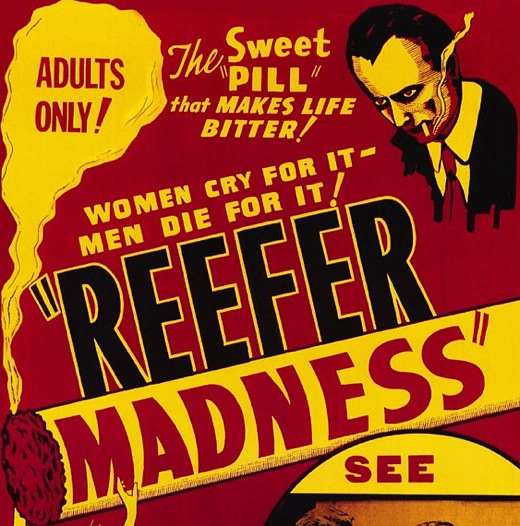
The motion picture you are about to witness may startle you. It would not have been possible, otherwise, to sufficiently emphasize the frightful toll of the new drug menace which is destroying the youth of America in alarmingly increasing numbers. Marihuana is that drug — a violent narcotic — an unspeakable scourge — The Real Public Enemy Number One! Or at least that’s how the opening crawl of Reefer Madness tells it.
Also known, in other forms, as Tell Your Children, The Burning Question, Dope Addict, Doped Youth and Love Madness, the film has spent the past forty years accruing cult credibility on the (highly overlapping) midnight-movie and cannabis-culture circuits. That peculiar spelling of what we know as marijuana reveals only a whiff of its distinctive blend of hand-wringing salaciousness, aggressive squareness, and sheer ignorance. Keith Stroup, founder of the National Organization for the Reform of Marijuana Laws, spotted the movie’s unintended comedic potential back in 1971, when he bought a print and began college-campus screenings. It today draws more prolonged, disbelieving guffaws and chortles than ever before.
Since Reefer Madness has fallen into the public domain, you can hold your own midnight screening nearly without effort by watching it online. Behold the deeply askew motion picture that began as a church-funded morality play, got into the hands of early exploitation-film icon Dwain Esper (he of 1934’s Maniac, 1937’s How to Undress in Front of Your Husband, and 1938’s Sex Madness), and wound up as an uproarious mainstay of hazy university auditoria. While the film clearly knows nothing of marijuana or its real effects — or, seemingly, of the real effects of any narcotic — that doesn’t stop its script from yielding a host of resonant lines. These run from the “straightforward question” of whether “you have, perhaps unwillingly, acquired a certain habit through association with certain undesirable people” to the recollection of having been “high enough to take over the marines and the navy” to that immortal imperative, “Bring me some reefers!” Laugh if you must, but bear in mind the final words from the solemn Dr. Carroll: “The next tragedy may be that of your daughter’s… or your son’s… or yours… or yours… or yours!”
You can always find Reefer Madness in our collection, 4,000+ Free Movies Online: Great Classics, Indies, Noir, Westerns, Documentaries & More.
Related content:
This is What Oliver Sacks Learned on LSD and Amphetamines
Bela Lugosi Discusses His Drug Habit as He Leaves the Hospital in 1955
Beyond Timothy Leary: 2002 Film Revisits History of LSD
Colin Marshall hosts and produces Notebook on Cities and Culture. Follow him on Twitter at @colinmarshall.
Read More...Venice is Way Under Water…
Venice is made up of 124 islands, 183 canals and 438 bridges, with water constantly flowing in and around it. As the video below explains, the city has historically developed an elaborate way of defending itself against the seas. But occasionally mother nature wins out, and floods take their toll on the city. This year it’s particularly bad. Heavy rains and strong winds have left Venice 70% submerged, with water levels reaching 60 inches. It marks the sixth worst flood recorded in the past 150 years. You can find footage above, and a pretty remarkable photo gallery over at The Atlantic. And then another compelling set at Boston.com.
via @eugenephoto
Read More...Watch the Great Russian Composer Sergei Rachmaninoff in Home Movies
“Who did not know Rachmaninoff intimately, did not know him at all.” So begins this recorded remembrance of the great Russian composer by Alexander “Sascha” Greiner, who knew him well.
Grenier was the manager of the concert and artist department at Steinway & Sons from 1928–about a decade after Sergei Rachmaninoff’s emigration to America in the wake of the Russian Revolution–until 1958. As the company’s main liaison with the major musicians who played its pianos, Grenier became friends with many of the great pianists of the era. “His friendship with the great Russian artists was personal as well as professional,” according to People and Pianos: A Pictorial History of Steinway & Sons. “If Rachmaninoff had a birthday party, Greiner would be there. If Hofmann needed him, there woud be a telegram sent instantly to soothe him.”
The recording was apparently made a few years before Grenier’s death in 1958. As he speaks, home movie footage reveals Rachmaninoff, who died in 1943, as an imposing yet sociable man. “Behind an austere, perhaps even severe, countenance,” says Grenier, “there was a most warm-hearted lovable man with a wonderful sense of humor. Yes, a wonderful sense of humor. Rachmaninoff thoroughly enjoyed a good story, and no one who hasn’t seen him laugh with the tears running down his cheeks would believe it possible.” Just before the two-minute mark, Rachmaninoff’s own voice can be heard very briefly speaking in Russian. He is playing the popular Russian song “Bublichki” on the piano as a group of friends sing along. In the end Rachmaninoff breaks off playing and jokes to his companions, “Vy ne znaete slova” (вы не знаете слова), which translates as: “You don’t know the words!”
Related content:
Tchaikovsky’s Voice Captured on an Edison Cylinder (1890)
Rare 1946 Film: Sergei Prokofiev Plays Piano, Discusses His Music
Read More...Bruce Springsteen Stumps/Sings for Obama: A Free Six-Song Set
Back in 2008, Bruce Springsteen threw himself vigorously behind Barack Obama’s campaign. He played small concerts on Obama’s behalf, and then wrote on his personal web site that Obama “speaks to the America I’ve envisioned in my music for the past 35 years, a generous nation with a citizenry willing to tackle nuanced and complex problems, a country that’s interested in its collective destiny and in the potential of its gathered spirit.” Fast forward four years, Springsteen is back at it again, though perhaps with a few more reservations. This summer, he told David Remnick, the editor of The New Yorker, that he admired Obama “for the health-care bill, for rescuing the automobile industry, for the withdrawal from Iraq, for killing Osama bin Laden.” But, on the flip side, he’s “disappointed in the failure to close Guantánamo and to appoint more champions of economic fairness, and .… an unseemly friendliness toward corporations.” [This is The New Yorker paraphrasing his concerns.] Aloud, he wondered whether he could go out there again:
I did it twice because things were so dire.… It seemed like if I was ever going to spend whatever small political capital I had, that was the moment to do so. But that capital diminishes the more often you do it. While I’m not saying never, and I still like to support the President, you know, it’s something I didn’t do for a long time, and I don’t have plans to be out there every time.
That was in July. But, fast forward to October and November, and we find the Boss stumping again for the president in swing states. Springsteen appeared in Madison Wisconsin today (below) and Charlottesville, VA on October 23. You can watch the six-song acoustic set above, which features “We Take Care Of Our Own,” “Forward, “The River,” “Promised Land,” “No Surrender” and “Thunder Road.”
There’s not much that’s positive about this campaign. Every day when you turn on the TV, we’re reminded of how special interests have corrupted our politic process, all with the blessing of the Supreme Court. But if there’s a silver lining to be found — a free set by the Boss — we’ll take it. Go out and vote tomorrow, no matter which candidate you support. And we’ll see you on the other side.
Read More...
Japanese Cartoons from the 1920s and 30s Reveal the Stylistic Roots of Anime
Those who have become interested in Japan in the past twenty years have done so, likely as not, because of Japanese animation, best known by the Japanese term “anime.” And why not? Japan’s take on the cartoon has at this point evolved so high and so distant from its western counterparts that you sometimes can’t help staring, transfixed. Even the word “cartoon” now seems too frivolous to apply. Roll the clock back eighty or ninety years, and Japanese animation looks decidedly more… cartoonish. But even then, you can easily see an excitingly different aesthetic in play. First behold the short above, which since its 1933 production has become a surprisingly popular watch on Youtube. Seemingly influenced by the American animation of the time, this fable of fox versus raccoon still garners acclaim with its craft. Acclaim from commenters, anyway: “Much smoother than the current animes,” writes one. “Not only the quality. Story is also funny and peaceful.”
Go back a few years further, to 1929, and you find a strikingly more foreign viewing experience in The Stolen Lump. Taking the form of a standard live-action silent picture, with intertitles and everything, the film adapts a fairy tale about an old man who happens upon a pack of tengu. He asks these supernatural creatures to remove what looks like a goiter from his face, but when they do, he inspires jealousy in his village. Finally, for an offering that will seem modern by comparison, watch Private Norakuro, from 1935, below. It originally appeared as just one story, in one medium of several, of the pratfall-heavy military adventures of the titular anthropomorphic puppy. Creator Suihō Tagawa drew the humor from his own time in the Imperial Japanese Army, to the delight of Japanese readers and viewers. The delight lasted up until World War II, anyway, when the country stopped looking so kindly on military satire. But Norakuro would soon emerge from retirement, going on to star in major animated films and serve as a mascot of the Japan Self Defense Force.
Related content:
The Early Days of Animation Preserved in UCLA’s Video Archive
The Best Animated Films of All Time, According to Terry Gilliam
Gertie the Dinosaur: The Mother of all Cartoon Characters
Lots of Free Animated Films in our collection of 500 Free Movies Online
Colin Marshall hosts and produces Notebook on Cities and Culture. Follow him on Twitter at @colinmarshall.
Read More...Archive of Handwritten Recipes (1600 — 1960) Will Teach You How to Stew a Calf’s Head and More
 If you’ve ever tried to follow a recipe from your grandmother’s collection, squinting at her spidery writing on a stained 3x5 card, you might be a candidate for the University of Iowa Libraries’ latest DIY History project.
The University’s special collections manages the Szathmary Culinary Manuscipts and Cookbooks, a handwritten collection of American and European recipes from the 1600s to the 1960s.
Helpful foodies, history buffs and handwriting sleuths are invited to participate in UI’s crowdsourcing history project by transcribing digitized images of recipes.
It’s not the first time the university has outsourced a portion of its archival handwork. Last year the Civil War Diaries and Letters Transcription Project was powered by volunteers, who transcribed more than 15,000 pages of material. All you need to do is select a page from within the collection and get started. So far more than 17,000 pages have been transcribed and volunteers chat and post questions on a discussion forum.
An example of the historical nuggets uncovered while transcribing: a posnet is an 18th century term for a small metal pot, a spider is a skillet, and to scearce is to sift. Of course no cookbook historian has completed their task until they have actually tried the recipes themselves. This could be interesting for the lucky transcriber of a recipe from Abigail Wellington Townsend’s cookbook, circa 1840:
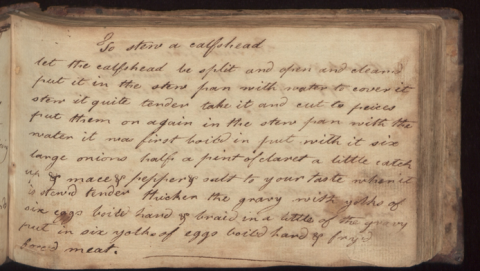
To stew a calfshead, let the calfshead be split and open and cleaned put it in the stew pan with water to cover it stew it quite tender take it and cut it to pieces put them on again in the stew pan with the water it was first boiled in put with it six large onions half a pint of claret a little catch up a little mace & pepper & salt to your taste when it is stewed tender thicken the gravy with yolks of six eggs boiled hard & braid in a little of the gravy put in six yolks of eggs boiled hard & fry’d forced meat.
Kate Rix writes about digital media and education. Find more of her work at and thenifty.blogspot.com.
Read More...Bela Lugosi Discusses His Drug Habit as He Leaves the Hospital in 1955
In 1955 Bela Lugosi was in a sad state. The once-handsome, Hungarian-born star of Dracula had seen his career degenerate over the previous two decades until at last he was reduced to playing a cruel parody of himself in some of the tackiest B horror films ever made. Along the way he picked up a drug habit. In late April of 1955 the 72-year-old actor, destitute and recently divorced from his fourth wife, checked himself into the psychopathic ward at Los Angeles General Hospital. A few days later, in a hearing held at the ward, Lugosi pleaded with a judge to commit him to a state hospital. A United Press article from April 23, 1955 describes the scene:
Although weighing only 125 pounds and only a shadow of his former self, Lugosi’s voice was clear and resonant as he told the court how shooting pains in his legs led him to start taking morphine injections in 1935. Without morphine, he couldn’t work, Lugosi said.
“I started using it under a doctor’s care,” he said. “I knew after a time it was getting out of control.”
“Seventeen years ago, on a trip to England, I heard of Methodone, a new drug. I brought a big box of it back home. I guess I brought a pound,” Lugosi said.
“Ever since I’ve used that, or demerol. I just took the drugs. I didn’t eat. I got sicker and sicker.”
The judge commended Lugosi for taking action to fight his addiction, and committed him to the Metropolitan State Hospital in Norwalk, a suburb of Los Angeles, for a minimum of three months and a maximum of two years. During his time in the hospital, the old man plotted his comeback. In The Immortal Count: The Life and Films of Bela Lugosi, Arthur Lennig writes:
While at the hospital, Lugosi had been given the script of his next Ed Wood picture, The Ghoul Goes West, a strange concoction in which a mad doctor goes out west to carry out his scheme to make super-creatures out of cowboys and rule the world. The actor looked forward to this forthcoming production, which he believed would begin about ten days after leaving the hospital, and brandished the script as proof that he would start work. “It’s very cute,” he said to the reporters. It probably wasn’t, but Lugosi no doubt believed that all the front page publicity, however notorious, would aid in his comeback, a comeback that would eventually raise him above the lowly ranks of Ed Wood’s shoestring productions. Bela posed for a photograph with the script in one hand while his other hand was dramatically raised in an assertive fist.
The interview above was filmed on August 4, 1955, one day before the actor’s release from the hospital. In the clip, Lugosi smiles and declares himself “a new man.” Less than three weeks later he married his fifth wife, an obsessed fan who reportedly sent him a letter every day he was in the hospital. The Ghoul Goes West never materialized, but Lugosi collaborated with Ed Wood on a couple of other projects, including a movie that some critics would eventually call “the worst film ever made,” Plan 9 From Outer Space. As his hope of a genuine comeback crumbled, Lugosi drank heavily. On August 16, 1956–barely over a year after his release from Metropolitan State Hospital–Lugosi died of a heart attack. He was buried in his Dracula costume.
Several Lugosi films appear on our big list of Free Movies Online.
Read More...Support Us
We're hoping to rely on loyal readers, rather than erratic ads. Please click the Donate button and support Open Culture. You can use Paypal, Venmo, Patreon, even Crypto! We thank you!

About Us

Open Culture scours the web for the best educational media. We find the free courses and audio books you need, the language lessons & educational videos you want, and plenty of enlightenment in between.
Advertise With Us

FREE UPDATES!
GET OUR DAILY EMAIL
Get the best cultural and educational resources on the web curated for you in a daily email. We never spam. Unsubscribe at any time.
FOLLOW ON SOCIAL MEDIA

Open Culture editor Dan Colman scours the web for the best educational media. He finds the free courses and audio books you need, the language lessons & movies you want, and plenty of enlightenment in between.
Advertise With Us


