Miracle Mushrooms Power the Slums of Mumbai
If you want to see rough-and-ready experiments in residential architecture and neighborhood construction, look no further than the world’s largest slums. Every day, straitened conditions and high density force the millions upon millions who live in them to improvise creative solutions to the challenges of urban survival using whatever materials and power — both terms broadly defined — happen to lay at hand. In his short New Mumbai, filmmaker Tobias Revell turns his lens toward India, host to some of the most vast and complex slums around, and discovers a highly unconventional material, a sort of organic infrastructure, in use in the knocked-together neighborhoods of Dharavi: giant mushrooms.
Actually, Revell doesn’t discover the mushrooms; he invents them, telling a science-fiction story, if not a terribly far-fetched one, in the plainspoken, street-level style of a developing-world documentary. He even comes up with a semi-plausible explanation for how each of these miracle mushrooms generates enough power to run an entire building: biological samples leak from Amsterdam into the Mumbai gangland, and a few shadowy types struggle to engineer them into a new kind of narcotic. When that doesn’t work, Dharavi’s science-savvy residents — refugees from a religious war — get to work on adapting them to a variety of life-improving uses. Revell, no stranger to speculative projects that tap into modern currents of thought, has taken the zeitgeist’s notions of a new partnership between the city and nature, but run them to an intriguing extreme. And you can’t deny how cool those mushrooms look sprouting from the rooftops.
via @cinnamon_carter
Colin Marshall hosts and produces Notebook on Cities and Culture. Follow him on Twitter at @colinmarshall.
Read More...T.S. Eliot Reads His Modernist Masterpieces “The Waste Land” and “The Love Song of J. Alfred Prufrock”
Did you know T.S. Eliot’s portentous and heavily allusive 1922 masterpiece “The Waste Land” was originally titled “He Do the Police in Different Voices,” a quote from Charles Dickens’ Our Mutual Friend? Filled with references to Dante’s Divine Comedy, Joseph Conrad’s Heart of Darkness, and James Frazier’s The Golden Bough, this most famous of high modernist poems—scourge of millions of college freshman each year—was a very different animal before notorious modernist impresario Ezra Pound got his hands on it. Pound’s heavy reworking is responsible for the poem you hear above, read by Eliot himself. The first image in the video shows Pound’s marginal annotations.
In the video above listen to Eliot read his second-most famous work, “The Love Song of J. Alfred Prufrock,” with the text of the poem choreographed by Wordookie, an open-source version of Wordle. “Prufrock,” first published in 1915, is as dense with literary allusions as “The Waste Land” (and thus as painful for the average undergraduate). And if Eliot’s reedy alto doesn’t deliver “Prufrock“ ‘s gravitas for you, listen to Anthony Hopkins read it here.
You can find these poems catalogued in our collection of 700 Free Audio Books and 800 Free eBooks.
If you would like to support the mission of Open Culture, consider making a donation to our site. It’s hard to rely 100% on ads, and your contributions will help us continue providing the best free cultural and educational materials to learners everywhere. You can contribute through PayPal, Patreon, and Venmo (@openculture). Thanks!
Related Content:
Rare 1959 Audio: Flannery O’Connor Reads ‘A Good Man is Hard to Find’
Rare Recording: Leo Tolstoy Reads From His Last Major Work in Four Languages, 1909
Nabokov Reads Lolita, Names the Great Books of the 20th Century
Read More...Before Mad Men: Familiar and Forgotten Ads from 1950s to 1980s Now Online
Before coming up with the slogan “Utz Are Better Than Nuts!” for the real-world Utz potato chip company on Mad Men, Don Draper and his crew had to study the competition, like this ad for Beech Nut or this one with Andy Griffith for General Foods.
Today we’re saturated with ads, more than the ad men that inspired Draper’s character could have ever imagined. They’re everywhere—on the dark interiors of tunnels as we speed along in light rail trains, in the games we let our kids play on smart phones—and they reveal a lot to us about ourselves.
Duke University’s John W. Hartman Center for Sales, Advertising & Marketing History put together Adviews, a collection that brings together thousands of historic commercials from the 1950s to 1980s. Collected or created by the D’Arcy Masius Benton & Bowles advertising agency, the digital collection is available online and on iTunesU as a free archive. It’s also found at the Internet Archive, where ads can be downloaded as MP4 videos.
Watch Sterling Cooper’s (fictional) ad for Utz potato chips and then compare it to this goofy commercial for Daddy Crisp chips above.
Visit the amazing world of convenience foods that made housewives cheer and miracle fibers that made clean-up a snap.
We may have grown more savvy and suspicious of products that promise better health and efficiency, but if anything we’re more fascinated by advertising than ever. Since launching the archive in 2009, the commercials have logged 2.5 million downloads.
And for y’all who miss Andy Griffith, there’s a wealth of great stuff.
Read More...James Baldwin Bests William F. Buckley in 1965 Debate at Cambridge University
?si=oVRYHqIjMoXt0Xe-
Author of the novel Giovanni’s Room and the nonfiction collection “Notes of a Native Son,” James Baldwin was also a scathing social critic, a witty yet formidable media personality, and a literary ambassador for civil rights. And, as an outspoken gay man, he decried discrimination against gays and lesbians. In 1965, he accepted an invitation by Cambridge University to debate the “father of American conservatism” William F. Buckley on the subject, “The American Dream is at the Expense of the American Negro.” In the video above, Baldwin (introduced as the “star of the evening”) delivers his stirring opening remarks, setting the tone he maintains throughout and pulling his nearly all-white audience to the edge of their seats.
Buckley, founding editor of the conservative journal National Review, had come out four years earlier against desegregation and Civil Rights legislation and was in the midst of his ultimately failed 1965 New York City mayoral campaign. He was always willing to engage with his ideological adversaries (see him debate Noam Chomsky in 1969 on his long-running television program, Firing Line), but remained a staunch opponent of liberalism. In this clip from the debate, Buckley responds to many of Baldwin’s assertions:
Baldwin had just finished his novel Another Country when this debate took place. He was 41, Buckley 40. While both are well-known for the rhetorical savvy on display here, in this case at least, Baldwin proved the more persuasive voice. After the debate, the Cambridge Union Society took a vote and decided the issue in his favor, 540–160.
You can (and should) view the full debate above.
Josh Jones is currently a doctoral student in English at Fordham University and a co-founder and former managing editor of Guernica / A Magazine of Arts and Politics.
Related Content:
James Baldwin Debates Malcolm X (1963) and William F. Buckley (1965): Vintage Video & Audio
Read More...Andy Warhol and Salvador Dalí in Classic 1968 Braniff Commercials: ‘When You Got It, Flaunt It!’
One of the scariest things about air travel is the seating assignment. You never know who you’ll end up next to. This classic 1968 advertising campaign from Braniff International Airways lets you imagine what it would be like to find yourself elbow-to-elbow with Andy Warhol and Salvador Dalí.
In the commercial above, Warhol tries to explain the inherent beauty of Cambell’s Soup cans to heavyweight boxer Sonny Liston. Below, Dalí and major league baseball pitcher Whitey Ford compare notes on the knuckleball versus the screwball. The commercials were part of Braniff’s ambitious “End of the Plain Plane” rebranding campaign, which completely revamped the company’s stodgy image. Advertising executive Mary Wells Lawrence hired architect and textile designer Alexander Girard to redesign everything from airplane fuselages to ash trays. Italian fashion designer Emilio Pucci created flamboyant uniforms for the stewardesses, or “Braniff girls.” And in 1968 Lawrence brought in art director George Lois to oversee the “When You Got It, Flaunt It!” advertising campaign for print and television.
Lois later said he came up with the slogan before the celebrities were cast. In addition to the Warhol/Liston and Dalí/Ford pairings, the campaign included ads with another odd couple: pulp writer Mickey Spillane and poet Marianne Moore. In an interview with the New York Daily News earlier this year, Lois remembered that Warhol had trouble with his lines. “Andy had to say, ‘When you got it, flaunt it.’ But I ended up having to dub his voice. Later, after I sent him a copy of all the commercials, he told me that he said the line better than anybody.” The ads were a product of Lois’s gut-instinct approach to advertising. “Those ads,” he said in another interview, “would have totally bombed in ad tests. As things turned out, it tripled their business.”
UC Santa Cruz Opens a Deadhead’s Delight: The Grateful Dead Archive is Now Online
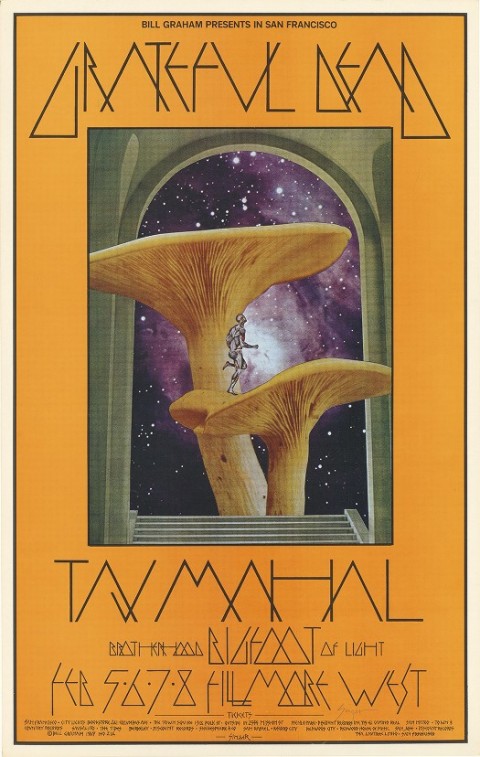
“They’re not the best at what they do,” said respected rock promoter Bill Graham of the Grateful Dead. “They’re the only ones that do what they do.” The band developed such an idiosyncratic musical style and personal sensibility that their legion of devoted fans, known as “Deadheads,” tended to follow them everywhere they toured. The Dead withstood more than their fair share of classic-rock turbulence in the thirty years from their formation in 1965, but didn’t dissolve until the 1995 death of founding member and unofficial frontman Jerry Garcia. The bereft Deadheads, still in need of a constant flow of their eclectic, improvisational, psychedelic-traditional, jam-intensive sound of choice, took a few different paths: some began following other, comparable groups; some would go on to rely on acts formed by ex-Dead members, like Bob Weir and Phil Lesh’s Furthur; some made it their life’s mission to collect everything in the band’s incomparably vast collection of demos, live recordings, and sonic miscellany.
Grateful Dead completists now have another source of solace in the Grateful Dead Archive Online from the University of California, Santa Cruz. Lest you assume yourself Dead-savvy enough to have already seen and heard everything this archive could possibly contain, behold the newly added item featured on the front page as I type this: Jerry Garcia’s Egyptian tour laminate. According to the press release, the archive’s internet presence features “nearly 25,000 items and over 50,000 scans” from the university’s physical archive, including “works by some of the most famous rock photographers and artists of the era, including Herb Greene, Stanley Mouse, Wes Wilson and Susana Millman.” Rest assured that it offers plenty of non-obscurantist Dead-related pleasures, including television appearances, radio broadcasts, posters, and fan recordings of concerts. Like any rich subject, the Grateful Dead provides its enthusiasts a lifetime of material to study. UC Santa Cruz, a school often associated in the public imagination with the Dead’s greater San Francisco Bay Area origins as well as their penchant for laid-back good times, has just made it that much easier to plunge into.
Related content:
Free Grateful Dead Concert Archive
Colin Marshall hosts and produces Notebook on Cities and Culture. Follow him on Twitter at @colinmarshall.
Read More...
Evolver: A Darwinist Reimagination of The Beatles’ 1966 album
 The Evolver T‑Shirt, it’s the perfect gift for the science believin’ Beatles fan. It’s obviously a play on The Beatles’ great 1966 album Revolver. And, over at BoingBoing, Mark Frauenfelder asked readers to rethink the titles of various songs on the album — to imagine them in evolutionary terms. Here are some of the creative suggestions:
Taxman = Macaques, Man
And Your Bird Can Sing = And Your Chimp Can Swing
I’m Only Sleeping = I’m Only Simian
Doctor Robert = Doctor Fossey
I Want to Tell You = I Want to Groom You
Tomorrow Never Knows = Too Many Bonobos
Personally, I think “Tomorrow Never Knows” could stay just as it is. Doesn’t it already capture the Darwinian spirit in its own way?
Related Content:
Darwin’s Personal Library Goes Digital: 330 Books Online
Darwin: A 1993 Film by Peter Greenaway
Read More...Science Behind the Bike: Four Videos from the Open University on the Eve of the Tour de France
Right in time for the Tour de France (which gets underway tomorrow) the Open University has released a new video series called Science Behind the Bike. During the past two decades, science has taken cycling to new places — sometimes good, sometimes bad. The introduction of performance enhancing drugs nearly damaged the sport beyond repair, and it certainly destroyed the careers and reputations of many leading cyclists. But all along, somewhere outside the public glare, many well-intentioned scientific minds have toiled away, trying to find legitimate ways to advance the sport. Physiologists, physicists, engineers, software designers, techies from Formula 1 racing — they’ve all brought a new perspective to cycling.
In the video above, Science Behind the Bike looks at how science and technology have influenced the making and breaking of the prestigious World Hour Record first established in 1893. Then, below, Forces breaks down the physics of cycling; Physiology explains, well, the physiology that boosts performance; and Technology digs deeper into the high-tech hardware that cyclists push along. If you’re a fan of the sport, you’ll undoubtedly appreciate appearances by Chris Boardman, Francesco Moser, Graeme Obree and Rebecca Romero.
Forces
Physiology
Technology
Related Content:
Brussels Express: The Perils of Cycling in Europe’s Most Congested City
David Byrne: From Talking Heads Frontman to Leading Urban Cyclist
Read More...Alfred Hitchcock Presents a Chilling Tale by Roald Dahl (1960)
“Good evening, ladies and gentlemen.” From 1955 to 1962, Alfred Hitchcock greeted viewers to his weekly series Alfred Hitchcock Presents with some version of this phrase, in his unmistakable English drawl. After the iconic introductory sequence featuring Hitchcock stepping into a caricature—drawn by himself—of his jowly profile, the veteran director introduced the audience to the week’s episode with a droll monologue written by longtime TV writer James B. Allardice, in which Hitchcock would poke fun at himself, the viewers, and the show’s sponsors. In addition to Allardice, Hitchcock’s series relied on the talents of several well-known writers, including literary names like John Cheever, Robert Bloch (author of Psycho), and, most famously, the much-loved Roald Dahl.
Primarily known for his whimsical, and often quite dark, children’s books (James and the Giant Peach, Charlie and the Chocolate Factory, Fantastic Mr. Fox), Dahl was also a novelist, screenwriter, and a writer of macabre short stories for adults (he won three Edgars, or mystery writer awards). In 1958, Alfred Hitchcock Presents adapted Dahl’s story “Lamb to the Slaughter.” And, two years later in 1960, Dahl’s story “Man from the South” provided the basis for AHP’s most popular episode (above). The episode stars Steven McQueen as a young man talked into a grisly wager by a mysterious figure named Carlos, played by Peter Lorre. “Man from the South” was adapted several more times in the following years: in 1979 by Dahl himself in a television series called Tales of the Unexpected, again in the 1985 revival of AHP (starring John Huston as Carlos), and in 1995 as the basis for Quentin Tarantino’s segment in the film Four Rooms. Without a doubt, however, this original adaptation of Dahl’s story remains the most memorable and haunting.
J. David Jones is currently a doctoral student in English at Fordham University and a co-founder and former managing editor of Guernica / A Magazine of Arts and Politics.
Read More...Isaac Asimov Recalls the Golden Age of Science Fiction (1937–1950)
In this short clip, Isaac Asimov discusses the golden age of science fiction, which began in 1937 (and ended in 1950) when John W. Campbell Jr. took over as editor of the magazine Astounding Science Fiction. Prior to Campbell’s editorship, most sci-fi stories were published in the “pulps,” and were in Asimov’s words “heavily adventure-flavored” because underpaid writers often wrote in several genres in order to compete in an overcrowded marketplace for escapist stories of romance, war, jungle and sea adventures, and horror tales. Unlike most of the “pulp” writers, Campbell was a scientist who studied physics at MIT and Duke, not to mention a prolific writer of fiction. (Many of Campbell’s novels and short stories are available in full-text as ePUB and PDF files here).
Campbell’s ascension was a watershed moment for the genre since his “engineering attitude” gave him a high regard for writers of science fiction who understood the science of the day and could portray scientists authentically while still having the freedom to “extrapolate wildly.” Astounding published some of the earliest stories by Asimov, Robert Heinlein (an early story, published under the name “Anson MacDonald” in 1941 is here), and L. Ron Hubbard. The relationship between Campbell and Hubbard is a fascinating story. Campbell published a very early version of what would become the founding text of Scientology in March 1950, and he claimed to be an early supporter of Hubbard’s “science of dianetics.”
Campbell is a complicated figure. In addition to supporting Hubbard’s ideas, writer Harlan Ellison has claimed that Campbell was an adherent of pseudoscience who would “believe anything,” and he apparently held some very objectionable racist and far right political views which he championed in his editorials and which made Asimov uncomfortable, as Asimov writes in his introduction to the golden age collection Astounding: John W. Campbell Memorial Anthology. Nevertheless, Asimov acknowledges Campbell as a “Father of Science Fiction” who was indispensable in bringing the genre out of the pulp era.
J. David Jones is currently a doctoral student in English at Fordham University and a co-founder and former managing editor of Guernica / A Magazine of Arts and Politics.
Related Content:
Free Science Fiction Classics on the Web: Huxley, Orwell, Asimov, Gaiman & Beyond
A Trip to the Moon (1902): Where Sci Fi Movies Began
Read More...Support Us
We're hoping to rely on loyal readers, rather than erratic ads. Please click the Donate button and support Open Culture. You can use Paypal, Venmo, Patreon, even Crypto! We thank you!

About Us

Open Culture scours the web for the best educational media. We find the free courses and audio books you need, the language lessons & educational videos you want, and plenty of enlightenment in between.
Advertise With Us

FREE UPDATES!
GET OUR DAILY EMAIL
Get the best cultural and educational resources on the web curated for you in a daily email. We never spam. Unsubscribe at any time.
FOLLOW ON SOCIAL MEDIA

Open Culture editor Dan Colman scours the web for the best educational media. He finds the free courses and audio books you need, the language lessons & movies you want, and plenty of enlightenment in between.
Advertise With Us


