Isaac Asimov Recalls the Golden Age of Science Fiction (1937–1950)
In this short clip, Isaac Asimov discusses the golden age of science fiction, which began in 1937 (and ended in 1950) when John W. Campbell Jr. took over as editor of the magazine Astounding Science Fiction. Prior to Campbell’s editorship, most sci-fi stories were published in the “pulps,” and were in Asimov’s words “heavily adventure-flavored” because underpaid writers often wrote in several genres in order to compete in an overcrowded marketplace for escapist stories of romance, war, jungle and sea adventures, and horror tales. Unlike most of the “pulp” writers, Campbell was a scientist who studied physics at MIT and Duke, not to mention a prolific writer of fiction. (Many of Campbell’s novels and short stories are available in full-text as ePUB and PDF files here).
Campbell’s ascension was a watershed moment for the genre since his “engineering attitude” gave him a high regard for writers of science fiction who understood the science of the day and could portray scientists authentically while still having the freedom to “extrapolate wildly.” Astounding published some of the earliest stories by Asimov, Robert Heinlein (an early story, published under the name “Anson MacDonald” in 1941 is here), and L. Ron Hubbard. The relationship between Campbell and Hubbard is a fascinating story. Campbell published a very early version of what would become the founding text of Scientology in March 1950, and he claimed to be an early supporter of Hubbard’s “science of dianetics.”
Campbell is a complicated figure. In addition to supporting Hubbard’s ideas, writer Harlan Ellison has claimed that Campbell was an adherent of pseudoscience who would “believe anything,” and he apparently held some very objectionable racist and far right political views which he championed in his editorials and which made Asimov uncomfortable, as Asimov writes in his introduction to the golden age collection Astounding: John W. Campbell Memorial Anthology. Nevertheless, Asimov acknowledges Campbell as a “Father of Science Fiction” who was indispensable in bringing the genre out of the pulp era.
J. David Jones is currently a doctoral student in English at Fordham University and a co-founder and former managing editor of Guernica / A Magazine of Arts and Politics.
Related Content:
Free Science Fiction Classics on the Web: Huxley, Orwell, Asimov, Gaiman & Beyond
A Trip to the Moon (1902): Where Sci Fi Movies Began
Read More...Whole Lotta Led Zeppelin: Live at the Royal Albert Hall and The Song Remains the Same–the Full Shows
Here’s a Friday night double feature for the die-hard rock and roll fan: two full-length Led Zeppelin movies.
Both films grew out of band manager Peter Grant’s dream of bringing the experience of a Led Zeppelin concert to the big screen. And although both were essentially attempts at the same thing, the two films were shot more than three years apart, so they show the band in two distinct periods of its career.
Led Zeppelin Live at the Royal Albert Hall:
On January 9, 1970, less than three months after the release of Led Zeppelin II, the band played the historic Royal Albert Hall on the third night of an eight-show UK tour. By all accounts it was a high-energy show. When the concert was over, Nick Logan of the New Music Express wrote:
I spoke to Jimmy Page after the show and he confessed that the whole band had suffered extreme nerves beforehand, mainly because people like John Lennon, Eric Clapton and Jeff Beck had requested tickets. “But it was just like it was at the Albert Hall in the summer,” said Jimmy, “with everyone dancing around the stage. It was a great feeling. What could be better than having everyone clapping and shouting along? It’s indescribable; but it just makes you feel that everything is worthwhile.
You can read Logan’s review of the show, along with other press reports, at LedZeppelin.com. The concert was filmed by Peter Whitehead and Stanley Dorfman. But the band was unhappy with the quality of the footage, and it was put away until the release of the two-disc Led Zeppelin DVD in 2003. The film (above) captures the powerful early phase of the band’s career. Here’s the set list:
- We’re Gonna Groove
- I Can’t Quit You Baby
- Dazed and Confused
- White Summer
- What Is and What Should Never Be
- How Many More Times
- Moby Dick
- Whole Lotta Love
- Communication Breakdown
- C’mon Everybody
- Somethin’ Else
- Bring It On Home
The Song Remains the Same:
Unhappy with the Royal Albert Hall film, Grant waited several years before trying to produce another concert film. With little more than a week left in the band’s 1973 North American tour, he hired filmmaker Joe Massot to document the final three shows at New York’s Madison Square Garden. Massot scrambled to assemble a film crew before the concerts, which took place July 27–29. Not surprisingly, the production was a disorganized mess. Again the band was unhappy with the concert footage. Eventually Massot was fired from the project and Peter Clifton was hired to complete the film. In 1974 the band rented space at Shepperton Studios in England to film supplementary concert footage.
The movie was finally released in October of 1976. Fans loved it but critics found the film amateurish and self-indulgent. The concert footage was interspersed with “fantasy sequences” filmed by Massot of Grant and the band members playing different roles. “The Song Remains the Same is not a great film,” Page said later, “but there’s no point in making excuses. It’s just a reasonably honest statement of where we were at that particular time.” The concert captures the band at the height of their fame. Here are the songs played in the concert scenes:
- Bron-Yr-Aur
- Rock and Roll
- Black Dog
- Since I’ve Been Loving You
- No Quarter
- The Song Remains the Same
- The Rain Song
- Dazed and Confused
- Stairway to Heaven
- Moby Dick
- Heartbreaker
- Whole Lotta Love
Read More...
Jean-Luc Godard Shoots Marianne Faithfull Singing “As Tears Go By” (1966)
When you want to learn a thing or two about Jean-Luc Godard, you turn to New Yorker film critic Richard Brody. I do, anyway, since the man wrote the book on Godard: namely, Everything is Cinema: The Working Life of Jean-Luc Godard. He followed up our post on Godard’s film of Jefferson Airplane’s 1968 rooftop concert with a tweet linking us to a clip from Godard’s feature Made in U.S.A
That film came out in 1966, two years before the immortal Airplane show but well into Godard’s first major burst of daring creativity, which began with 1959’s Breathless and lasted at least until Sympathy for the Devil, his 1968 documentary on — or, anyway, including — the Rolling Stones. Brody pointed specifically to the clip above, a brief scene where Marianne Faithfull sings “As Tears Go By,” a hit, in separate recordings, for both Faithfull and the Stones.
Brody notes how these two minutes of a cappella performance from the 19-year-old Faithfull depict the “styles of the day.” For a long time since that day, alas, we American filmgoers hadn’t had a chance to fully experience Made in U.S.A. Godard based its script on Donald E. Westlake’s novel The Jugger but never bothered to secure adaptation rights, and the film drifted in legal limbo until 2009. But today, with that red tape cut, crisp new prints circulate freely around the United States. Keep an eye on your local revival house’s listings so you won’t miss your chance to witness Faithfull’s café performance, and other such Godardian moments, in their theatrical glory. The cinephilically intrepid Brody, of course, found a way to see it, after a fashion, nearly thirty years before its legitimate American release: “The Mudd Club (the White Street night spot and music venue) got hold of a 16-mm. print and showed it — with the projector in the room — to a crowd of heavy smokers. It was like watching a movie outdoors in London by night, or as if through the shrouding mists of time.”
If you would like to support the mission of Open Culture, consider making a donation to our site. It’s hard to rely 100% on ads, and your contributions will help us continue providing the best free cultural and educational materials to learners everywhere. You can contribute through PayPal, Patreon, and Venmo (@openculture). Thanks!
Related Content:
Jean-Luc Godard Films The Rolling Stones Recording “Sympathy for the Devil” (1968)
Jean-Luc Godard’s After-Shave Commercial
Jean-Luc Godard Meets Woody Allen
Colin Marshall hosts and produces Notebook on Cities and Culture. Follow him on Twitter at @colinmarshall.
Read More...The 15 Worst Covers of Beatles Songs: William Shatner, Bill Cosby, Tiny Tim, Sean Connery & Your Excellent Picks
Thanks to The Wall Street Journal, you can endure boxer Manny Pacquiao singing a version of John Lennon’s 1971 peace anthem, Imagine. It’s pretty painful, not quite as painful as taking a Pacquiao punch, but painful nonetheless. We floated it on Twitter (follow us here) and we were quickly reminded that Pacquiao is hardly the first person to butcher The Beatles. (No real knock on him, we’re just having some fun here.) So we started pulling together your favorites. What are the worst Beatles’ covers you’ve ever heard — ones so bad, they’re good? Let us know in the comments or on Twitter, and we’ll start adding them to the post.
In 1968, William Shatner, riding high on his Star Trek fame, released his first music album, The Transformed Man. It featured poetry mixed with pop lyrics and a nearly blasphemous version of Lucy in the Sky with Diamonds. It’s here that the cheese began.
Also in 1968, the young comedian Bill Cosby released Bill Cosby Sings Hooray For The Salvation Army Band!. The parody album starts with Cosby singing a semi-serious version of Sgt. Pepper’s Lonely Hearts Club Band. It was a high point for neither the comedian nor the band.
Telly Savalas — you know him from Kojak — sings George Harrison’s Something in a very lounge lizard kind of way. So awful it’s awesome.
Michael McKean (This is Spinal Tap!) offers up this: Milton Berle singing The Yellow Submarine. It wasn’t one of The Beatles’ best songs, let’s admit it. But Berle didn’t exactly elevate it. Uncle Miltie’s recording was made in 1968 (do you see a trend here?), not long after the animated Yellow Submarine hit theaters.
From her 1966 album Way Out West, old time movie star Mae West sings Day Tripper. Recommended by @tonymolloy.
Sean Connery talking his way through In My Life. And amazingly George Martin is responsible for this.
You can’t talk about so-bad-they’re-good Beatles covers without giving a nod to Wing. The Hong Kong-born singer, now based in New Zealand, has recorded a full album in her out-of-tune singing style. Is it parody? Is it serious? Who knows. Her album can be had here: Wing Sings the Beatles
Elva Ruby Connes Miller, otherwise known as Mrs. Miller, covered numerous songs during the 1960s, including A Hard Day’s Night. Her voice was compared to the sound of “roaches scurrying across a trash can lid.” More recently, this clip was featured on EarBleed.com … for pretty good reason. Good find Daniel.
And now the male answer to Mrs. Miller, the immortal Tiny Tim and his version of Nowhere Man.
Here is Germany’s answer to Wing. It is Klaus Beyer’s remake of Back in the U.S.S.R.
This is from “Banda Plástica de Tepetlixpa.” According to legend, John and Paul went to Mexico, to a town called Tepetlixpa, where people received them as distinguished guests. Local brass bands started playing the Beatles’ music and moved the singer-songwriter duo to tears. Some time later, the Tepetlixpa band recorded Adios a Los Beatles (Goodbye to the Beatles), a 10-song tribute to the geniuses from Liverpool. Jaime Ortega has more backstory in the comments section below.
@Brian_M_Cassidy asks: Is this what you’re looking for? Indeed it is. The Red Navy Singers, Dancers & Musicians sings Let It Be, during the final days of the Soviet Union.
We wouldn’t want to leave France out. Here, Les compagnons de la chanson sing Le Sous-Marin Vert. Thanks Pierre.
And finally pulling up the rear, The Metropolitan Police Male Voice Choir sing When I’m Sixty Four. H/T Olidez
Read More...Bryan Magee’s In-Depth, Uncut TV Conversations With Famous Philosophers (1978–87)
Bryan Magee comes from a tradition that produced some of the twentieth century’s most impressive media personalities: that of the scholarship-educated, Oxbridge-refined, intellectually omnivorous, occasionally office-holding, radio- and television-savvy man of letters. Students and professors of philosophy probably know him from his large print oeuvre, which includes volumes on Popper and Schopenhauer as well as several guides to western philosophy and the autobiographical Confessions of a Philosopher. He also wrote another memoir called The Television Interviewer, and philosophically inclined laymen may fondly remember him as just that. When Magee played to both these strengths at once, he came up with two philosophical television shows in the span of a decade: Men of Ideas, which began in 1978, and The Great Philosophers, which ran in 1987. Both series brought BBC viewers in-depth, uncut conversations with many of the day’s most famous philosophers.
You can watch select interviews of Men of Ideas and The Great Philosophers on YouTube, including:
- Herbert Marcuse on the Frankfurt School
- Bernard Williams on the Spell of Linguistic Philosophy
- Bernard Williams on Descartes
- Miles Burnyeat on Plato
- Martha Nussbaum on Aristotle
- Anthony Kenny on Medieval Philosophy
- Iris Murdoch on Philosophy and Literature
- Geoffrey Warnock on Kant
- J.P. Stern on Nietzsche
- Hubert Dreyfus on Husserl and Heidegger
- Anthony Quinton on Spinoza and Leibniz
- Peter Singer on Hegel and Marx
- Michael Ayers on Locke and Berkeley
- John Passmore on Hume
- Sidney Morgenbesser on the Pragmatists
- A.J. Ayer on logical Positivism
- A.J. Ayer on Frege and Russell
- John Searle on the Philosophy of Language
- Anthony Quinton on Wittgenstein
- John Searle on Wittgenstein
- Hilary Putnam on the Philosophy of Science
- Frederick Copelston on Schopenhauer
At the top of the post, you’ll find Magee talking with A.J. Ayer, a well-known specialist in “logical positivism,” about the development of, and challenges to, that philosophical sub-field. Two philosophers, relaxed on a couch, sometimes smoking, enthusiastically engaged in a commercial-free back-and-forth about the most important thinkers and thoughts in the field — watch something like that, and you can’t possibly think of now as a golden age of television.
Note: Oodles of philosophy courses, many thought by famous philosophers, can be found in the Philosophy section of our list of Free Online Courses from Top Universities.
Colin Marshall hosts and produces Notebook on Cities and Culture. Follow him on Twitter at @colinmarshall.
Related Content:
Free Online Philosophy Courses
44 Essential Movies for the Student of Philosophy
Read More...Why the University System, as We Know It, Won’t Last .… and What’s Coming Next
It’s easy to sell books and other commodities on the web. It’s not easy to deliver a quality education. But two converging trends point toward a future when we will see the traditional university give way to an online alternative — something I wasn’t willing to bank on two years ago. First, Silicon Valley is finally focusing on e‑learning. Udacity, Coursera, Kahn Academy, EdX — they’re all looking to lift e‑learning out of a long period of stagnation. And, second, times are tough, and the traditional university system doesn’t care enough about managing costs, while wrongly assuming that it has a captive audience.
This weekend, The New York Times took a good look at the financing of a college education and highlighted a few staggering data points.
- The U.S. has racked up more than $1 trillion in student loans.
- Today 94 percent of students earning a bachelor’s degree take out loans — up from 45 percent in 1993.
- It’s estimated that the “average debt [per student] in 2011 was $23,300, with 10 percent owing more than $54,000 and 3 percent more than $100,000.”
- “Payments are being made on just 38 percent of the balance of federal student loans, down from 46 percent five years ago.”
- Finally, state funding of education is going down, and tuition is going up, which means that the figures above will just get worse.
You don’t need me to spell things out. Paying for a college education is getting unsustainable, so much so that many expect a crisis in the college loan market in the coming years. And then you consider this. Many universities seem indifferent to the difficulties students face, if they’re not intentionally exacerbating the problem. At one point in the Times article, E. Gordon Gee, the president of Ohio State University, goes on record saying, “I readily admit it … I didn’t think a lot about costs. I do not think we have given significant thought to the impact of college costs on families.” Now listen to the latest episode of Planet Money, The Real Price of College (audio), which underscores a more galling fact — many colleges think that they gain a competitive advantage if they have a high sticker price. For many schools, lower tuition is a sign of weakness, not strength.
Universities can behave this way because they think they have a captive audience. Because college grads still earn considerably more than high school grads, colleges assume that students will keep enrolling. But what will happen when cash-strapped students are presented with a viable alternative? It may take 10 to 20 years, but I wouldn’t be surprised if a new breed of school emerges, schools that throw away the four year model (and the humanities too) and offer students a very targeted online education in “practical” fields — from accounting to coding to nursing to law and business — at a dramatically lower cost. Here, the education cycle gets shortened to perhaps two years, and then students get credentialed (maybe by a trusted third-party provider) and go to work, only to return later in their careers to take more courses in specialized areas. This model will require the right technology platform (something that will get worked out fairly soon) and a change in the expectations of employers and society more broadly (something that will take time to develop, but less time than complacent colleges think).
The new system won’t be better than the current one in many respects. It won’t offer a rounded education. The teaching will be less personal. Long-lasting social bonds won’t be made as easily. (You’ll need to pay the big bucks at a traditional school for that. No, they won’t all go away.) And the teaching jobs created by these universities won’t be terribly fulfilling or lucrative. But the new system will offer a more focused and affordable education to students on a mass scale. And when students graduate mostly debt free, they won’t complain. Nor will they be forced to forego college altogether, as some would now advocate. There’s perhaps something inevitable about this shift. But the insouciance of administrators and faculty inhabiting the current system won’t do anything to delay it. Stick around, and you’ll probably see that I’m right. And if you think my look into the crystal ball is wrong, let me know.
In the meantime, we give you another take on how to solve our world’s educational problems — Father Guido Sarducci’s Five Minute University:
For oodles of free courses, don’t forget to visit our collection of 450 Free Courses from Top Universities.
Read More...
Watch the German Expressionist Film, The Golem, with a Soundtrack by The Pixies’ Black Francis
As cinematically savvy Open Culture readers know, most films of the silent era have fallen into the public domain, making them easy to watch on the internet. Several of the choicest have found their way into our collection of Free Movies Online. Anyone with an internet connection can thus give themselves an early-film education that would have been unthinkably convenient just twenty years ago, but the opportunities stretch out even further than that. Certain enterprising musicians have seized the opportunity to re-score these freely available silents, revitalizing the era’s clunkers and masterpieces alike with sonic styles that the composers of those days could never have even imagined. Above, you’ll find one of Weimar Germany’s finest expressionist films, The Golem: How He Came Into the World, brought to life like the clay statue of its title by a driving, jangling, rock-operatic score courtesy of one Black Francis.
If you’re unfamiliar, Black Francis, also know as Frank Black, fronts the rock band the Pixies. If you’re unfamiliar with them, you probably don’t tend to admit it in mixed company, since the combination of their startlingly widespread influence (Kurt Cobain called “Smells Like Teen Spirit” an attempt to “rip off the Pixies”) and enduring avoidance of the mainstream has earned them enormous rock-enthusiast credibility. Film geeks, for their part, probably won’t give you a hard time about not having seen Paul Wegener’s the Golem trilogy, since two of the three have been lost. Though it came out in 1920 as the third Golem film, How He Came Into the World, a prequel to both its predecessors, tells the origin story of its title creature of Jewish legend. Created to protect the Chosen People of 16th-century Prague, the mute inhuman colossus soon turns against his makers. Watch what happens, in a cultural three-for-one to begin your week, with cinematographer Karl Freund’s manipulation of shadow and light (which he later showed off in Metropolis and Dracula), Black Francis’ casually complex rock magpie-ism, and the distinctive storytelling sensibility that produced the golem fable in the first place. (It’s available on DVD here.)
The Golem, featuring a soundtrack by Black Francis, has been added to our collection, 4,000+ Free Movies Online: Great Classics, Indies, Noir, Westerns, Documentaries & More.
If you would like to support the mission of Open Culture, consider making a donation to our site. It’s hard to rely 100% on ads, and your contributions will help us continue providing the best free cultural and educational materials to learners everywhere. You can contribute through PayPal, Patreon, and Venmo (@openculture). Thanks!
Related content:
Fritz Lang’s Metropolis: Uncut & Restored
Lost Films: Identify Missing Cinema Through Crowdsourcing
The Power of Silent Movies, with The Artist Director Michel Hazanavicius
Colin Marshall hosts and produces Notebook on Cities and Culture. Follow him on Twitter at @colinmarshall.
Read More...The Invention (and Demonstration) of the First Football Helmet, 1932
British Pathe continues to dust off and digitize some amazing clips from its archive. First came The World’s First Mobile Phone (1922) and footage of The King’s Speech in 1938 — you know, the real King George VI working his way through a public speech in Scotland. Now British Pathe returns with some 1932 footage of an inventor showing off the first football helmet, his modest “attempt to prevent fatal injuries” in the sport. You won’t want to miss the demo of this new fangled piece of sports equipment. H/T Devour
If you would like to support the mission of Open Culture, consider making a donation to our site. It’s hard to rely 100% on ads, and your contributions will help us continue providing the best free cultural and educational materials to learners everywhere. You can contribute through PayPal, Patreon, and Venmo (@openculture). Thanks!
Read More...Ray Bradbury Gives 12 Pieces of Writing Advice to Young Authors (2001)
Like fellow genre icon Stephen King, Ray Bradbury has reached far beyond his established audience by offering writing advice to anyone who puts pen to paper. (Or keys to keyboard; “Use whatever works,” he often says.) In this 2001 keynote address at Point Loma Nazarene University’s Writer’s Symposium By the Sea, Bradbury tells stories from his writing life, all of which offer lessons on how to hone the craft. Most of these have to do with the day-in, day-out practices that make up what he calls “writing hygiene.” Watch this entertainingly digressive talk and you might pull out an entirely different set of points, but here, in list form, is how I interpret Bradbury’s program:
- Don’t start out writing novels. They take too long. Begin your writing life instead by cranking out “a hell of a lot of short stories,” as many as one per week. Take a year to do it; he claims that it simply isn’t possible to write 52 bad short stories in a row. He waited until the age of 30 to write his first novel, Fahrenheit 451. “Worth waiting for, huh?”
- You may love ’em, but you can’t be ’em. Bear that in mind when you inevitably attempt, consciously or unconsciously, to imitate your favorite writers, just as he imitated H.G. Wells, Jules Verne, Arthur Conan Doyle, and L. Frank Baum.
- Examine “quality” short stories. He suggests Roald Dahl, Guy de Maupassant, and the lesser-known Nigel Kneale and John Collier. Anything in the New Yorker today doesn’t make his cut, since he finds that their stories have “no metaphor.”
- Stuff your head. To accumulate the intellectual building blocks of these metaphors, he suggests a course of bedtime reading: one short story, one poem (but Pope, Shakespeare, and Frost, not modern “crap”), and one essay. These essays should come from a diversity of fields, including archaeology, zoology, biology, philosophy, politics, and literature. “At the end of a thousand nights,” so he sums it up, “Jesus God, you’ll be full of stuff!”
- Get rid of friends who don’t believe in you. Do they make fun of your writerly ambitions? He suggests calling them up to “fire them” without delay.
- Live in the library. Don’t live in your “goddamn computers.” He may not have gone to college, but his insatiable reading habits allowed him to “graduate from the library” at age 28.
- Fall in love with movies. Preferably old ones.
- Write with joy. In his mind, “writing is not a serious business.” If a story starts to feel like work, scrap it and start one that doesn’t. “I want you to envy me my joy,” he tells his audience.
- Don’t plan on making money. He and his wife, who “took a vow of poverty” to marry him, hit 37 before they could afford a car (and he still never got around to picking up a license).
- List ten things you love, and ten things you hate. Then write about the former, and “kill” the later — also by writing about them. Do the same with your fears.
- Just type any old thing that comes into your head. He recommends “word association” to break down any creative blockages, since “you don’t know what’s in you until you test it.”
- Remember, with writing, what you’re looking for is just one person to come up and tell you, “I love you for what you do.” Or, failing that, you’re looking for someone to come up and tell you, “You’re not nuts like people say.”
Related content:
Ray Bradbury: Literature is the Safety Valve of Civilization
The Shape of A Story: Writing Tips from Kurt Vonnegut
John Steinbeck’s Six Tips for the Aspiring Writer and His Nobel Prize Speech
Colin Marshall hosts and produces Notebook on Cities and Culture. Follow him on Twitter at @colinmarshall.
Read More...Detour: The Cheap, Rushed Piece of 1940s Film Noir Nobody Ever Forgets
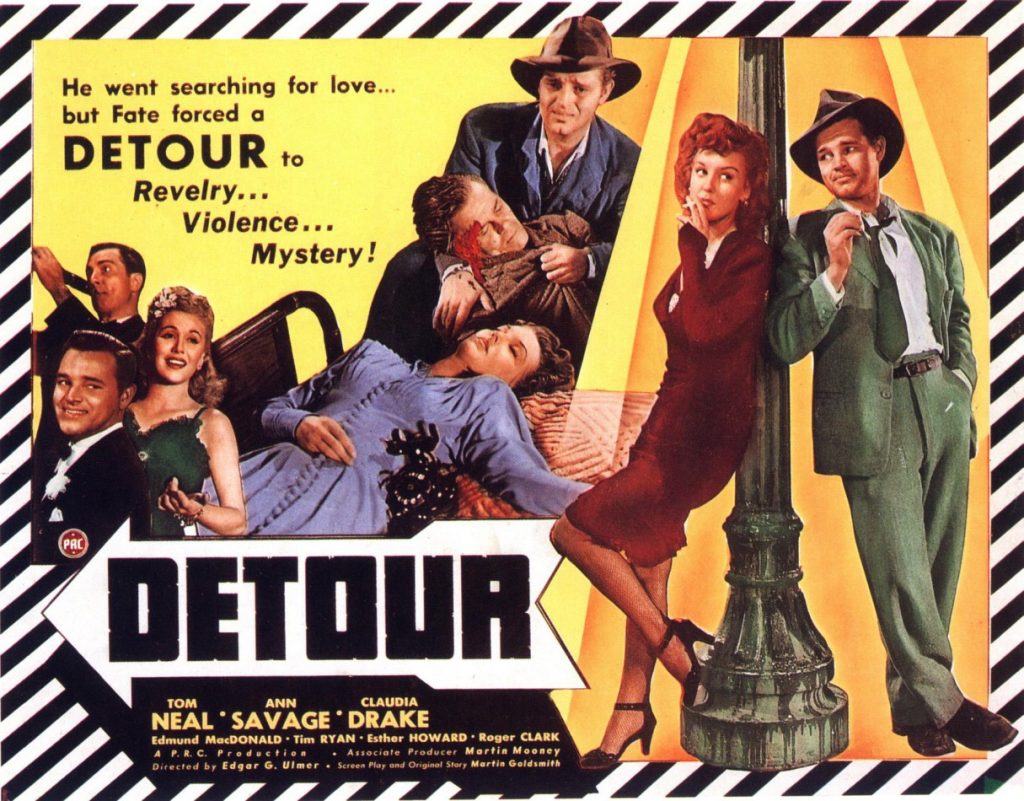
According to cinema lore, Edgar G. Ulmer’s Detour, a slapdash, unprofessional $20,000 melodrama shot in a mere mistake-filled six days, has somehow, over the past 66 years, accrued a sizable and appreciative following among film noir enthusiasts. Except it turns out that, in reality, its budget probably ran to some $117,000. And those six days might have actually been three six-day weeks. And the Austrian-born Ulmer, who had not only worked for such European luminaries as F.W. Murnau, Billy Wilder, and (so he claimed) Fritz Lang, but even made The Black Cat for Universal Pictures, hardly lacked professional bona fides. And the film’s careful use of sound and striking use of light set it apart even from its brethren in the genre.
And speaking of that genre, a hearty critical agreement now holds that Detour distills, in its brief 68 minutes, the most vital emotional and aesthetic elements of film noir in a way that none of its other exemplars have managed. And mistakes? What mistakes? As Roger Ebert wrote on ushering the film into his Great Movies canon, “Placing style above common sense is completely consistent with Ulmer’s approach throughout the film.”
To recount Detour’s story here — a piano-player down on his luck; a sudden death; a scheming, venomous dame — would be to miss the point. To cite out its many, er, unconventional production choices — nonexistent backgrounds concealed with fog, shots simply flipped over and re-used, stock footage meant to pad the runtime almost to feature length, unconvincing rear projection even by 1945’s standards — would be to miss the point from another direction. The film has fallen into the public domain, so watch it free online and experience for yourself the way that, for all its apparent bluntness, it stealthily lodges itself in your sense memory. To call a movie “dreamlike” reeks of cliché, but Detour presents the elements of film noir in such a pure, naked state that you have little choice but to accept them directly, the way you would accept the “facts” of a dream. Though seemingly incompetent on all the levels subject to conscious analysis, the film operates effectively on all the levels beneath, hence the lasting inspiration it offers to certain filmmakers today. Make Detour, if you can, a double-feature with David Lynch’s Lost Highway, which plays almost like a straight tribute to Ulmer’s picture. As a dedicated transcendental meditator with a fascination for the dark side of Los Angeles and a tendency to bend archetypal characters toward his often oblique but always vivid stylistic will, Lynch has internalized Detour’s legacy — intended or otherwise — more deeply than any other filmmaker alive today.
More noir classics can be found in our collection of 60+ Free Noir Films.
Colin Marshall hosts and produces Notebook on Cities and Culture. Follow him on Twitter at @colinmarshall.
Read More...Support Us
We're hoping to rely on loyal readers, rather than erratic ads. Please click the Donate button and support Open Culture. You can use Paypal, Venmo, Patreon, even Crypto! We thank you!

About Us

Open Culture scours the web for the best educational media. We find the free courses and audio books you need, the language lessons & educational videos you want, and plenty of enlightenment in between.
Advertise With Us

FREE UPDATES!
GET OUR DAILY EMAIL
Get the best cultural and educational resources on the web curated for you in a daily email. We never spam. Unsubscribe at any time.
FOLLOW ON SOCIAL MEDIA

Open Culture editor Dan Colman scours the web for the best educational media. He finds the free courses and audio books you need, the language lessons & movies you want, and plenty of enlightenment in between.
Advertise With Us

