Socrates on TV, Courtesy of Alain de Botton (2000)
We could call Alain de Botton, in the classical sense, a philosophical amateur: that is, one who loves philosophy. But not everybody loves the way he approaches the field. His 2000 book The Consolations of Philosophy drew a particularly sharp line through the critics: some found great refreshment in the accessibility he granted philosophers like Seneca and Schopenhauer by framing them in an unexpectedly sincere parody of a self-help book; others judged this method inadequate to deal with the thinkers’ true seriousness and complexity. This clicks right in with what seems like de Botton’s grand mission: taking Western civilization’s most respected words, written and spoken, and using them to adjust the nuts and bolts of our modern, everyday pursuit of happiness. He wrote another book called How Proust Can Change Your Life; he established a school which offers courses like “How to Balance Work with Life” and “How to Be Cool;” and his latest project involves adapting religion for use by atheists (watch related video here).
No surprise, then, that de Botton’s work would extend to that most common medium, television, with a series called Philosophy: A Guide to Happiness. You can watch a number of episodes on YouTube, including but not limited to “Socrates on Self-Confidence.” Zipping through the streets of Athens on a canary-yellow Vespa, de Botton tells us of the life and methods of the fifth-century-BC philosopher who seems to remain the discipline’s most famous practitioner. Illustrating Socrates’ famous habit of public interrogation, de Botton strolls up to other visitors in the marketplace, asking them to define the idea of justice or their conception of their personal life. The answers don’t come easily: a Frenchwoman struggles to respond even when our intrepid host shifts into her language, and a religiously outfitted local blows him off without even slowing down. A few hearty Australian travelers — a breed found at every point on the map, cradles of philosophy and otherwise — do lay out their self-styled philosophies without hesitation, but de Botton has plenty more places to go and people to see, like a focus group whose volley of opinions would have summoned Socrates’ gravest reservations about democracy, and a potter who crafts a tangible metaphor for Socrates’ notion of the well-tested, watertight belief.
Those who’ve questioned whether de Botton knows how to handle philosophy may well come away from these programs convinced that he doesn’t. I, however, find something almost radical in the way his demeanor, unyieldingly straightforward and never forgetful of concerns others might dismiss as mundane, interacts with the great works of the philosophical canon. I sense an almost strategic naïveté at work, and it takes him places, intellectually and geographically, to which his closest peers in letters may never get around. The starkly divided reaction de Botton draws shows, to my mind, that he’s being just the right kind of provocative — in his gentle manner.
Complete set of links to Philosophy: A Guide to Happiness episodes: Socrates on Self-Confidence, Epicurus on Happiness, Seneca on Anger, Montaigne on Self-Esteem, Nietzsche on Happiness
Related content:
Philosophy: A Guide to Happiness
Alain de Botton: The Glass of Life is Half-Empty
Alain de Botton Wants a Religion for Atheists
55 Free Philosophy Courses
Colin Marshall hosts and produces Notebook on Cities and Culture. Follow him on Twitter at @colinmarshall.
Read More...36 Free Oscar Winning Films Available on the Web
How about some hors d’oeuvres meant to accompany the main course, the 2014 Academy Awards? We scouted around the web and found 36 Oscar-winning (or nominated) films from previous years. The list includes many short films, but also some long ones, like Sergei Bondarchuk’s epic version of War & Peace. Sit back, enjoy, and let us know if we’re missing any other Oscar winners…
Find more films in our collection of 700 Free Movies Online.
- A Herb Alpert & the Tijuana Brass Double Feature — Free — A precursor to modern music videos, this Oscar-winning animated film by John & Faith Hubley is set to the music of two popular songs recorded by Herb Alpert. (1966)
- A Story of Healing — Free – Won Academy Award for best Documentary Short Subject. Follows a team of volunteers in Vietnam. (1997)
- Churchill’s Island — Free – WWII propaganda film chronicling the defense of Great Britain. Won the very first Academy Award for Documentary Short Subject. (1941)
- Der Fuehrer’s Face – Free – Disney’s anti-Nazi propaganda movie featuring Donald Duck. Won the Academy Award for Best Animated Short Film. (1942)
- Every Child – Free – Eugene Fedorenko’s animated short about an unwanted baby cared for by a homeless men. Won 1979 Oscar for Best Animated Short Film.
- Father and Daughter – Free – Michaël Dudok De Wit’s heartbreaking short won the 2000 Academy Award for Animated Short Film. (2000)
- Flamenco at 5:15 – Free – Oscar-winning short film about a flamenco dance class given to senior students. (1983)
- Franz Kafka’s It’s a Wonderful Life - Free — Directed by Peter Capaldi, the Oscar-winning short film shows Kafka, on Christmas Eve, struggling to come up with the opening line for his most famous work, The Metamorphosis. (1993)
- Glass - Free — Directed by Bert Haanstra, this short documentary about the glass industry won the Academy Award for Documentary Short Subject in 1959. (1958)
- Granny O’Grimm’s Sleeping Beauty- Free – 6 minute animated black comedy. Shortlisted for the 2010 Oscar for Best Animated Short Film. (2008)
- Logorama – Free – François Alaux and Herve de Crecy’s 17 minute film, Logorama, won the Oscar for Short Film (Animated) in 2009.
- If You Love This Planet – Free – Oscar-winning short film on the need for nuclear disarmament. (1982)
- I’ll Find a Way – Free – Oscar-winning documentary presents Nadia, a 9‑year-old girl with spina bifida. (1977)
- Is It Right to Be Always Right? — Free — Narrated by Orson Welles, this Oscar-winning film directed by Lee Mishkin is a parable that comments on divisions in the United States. (1970)
- J’attendrai le suivant – Free – A French film nominated for an Academy Award for the Best Short Film in 2002.
- Madame Tutli-Putli – Free – Oscar-nominated animated short film by Montreal filmmakers Chris Lavis and Maciek Szczerbowski. (2010)
- Neighbors – Free – Norman McLaren animates live actors with techniques normally used to put drawings/puppets into motion. Oscar winner. (1952)
- Ryan – Free – Oscar-winning animated short from Chris Landreth based on the life of Ryan Larkin, the influential Canadian animator. (2004)
- Special Delivery – Free – Hilarious story won 1978 Oscar for Best Animated Short Film.
- Superman – Free – Max Fleischer’s short animated movie. Nominated for the 1942 Academy Award for Best Short Subject: Cartoons. (1941)
- The Cathedral — Free — “The Cathedral” is the title of a sci fi short story by Jacek Dukaj. It was turned into a short animated movie by Tomasz Bagiński and nominated in 2002 for the Academy Award for Animated Short Film. (2002)
- The Critic - Free — Mel Brooks 1963 animation features an old Yiddish watching abstract animations. Hilarious film won Oscar. (1963)
- The Danish Poet — Free — Animated short film written, directed, and animated by Torill Kove and narrated by Liv Ullmann, won the Academy Award in 2006.
- The Dot and the Line - Free — Chuck Jones’ animated film celebrates geometry and hard work. (1965)
- The Fantastic Flying Books of Mr. Morris Lessmore — Free — Oscar-winning film by Moonbot Studios pays homage to a bygone era when elegantly printed books inhabited our world. (2011)
- The Hole – Free — A 15-minute animated film by John Hubley and Faith Hubley that won an Academy Award for Best Animated Short Film in 1962. Features the voice of Dizzy Gillespie. (1962)
- The Last Farm – Free – Short Icelandic film nominated for Oscar in 2006.
- The Lunch Date – Free – Adam Davidson’s commentary on race in America. The short film won an Oscar and a prize at Cannes. (1989)
- The Man with the The Golden Arm – Free — Directed by Otto Preminger. Starring Frank Sinatra and Kim Novak. Nominated for three Academy Awards. (1955)
- The Old Man and the Sea – Free – Aleksandr Petrov won the Academy Award for Short Film for this film that follows the plot of Ernest Hemingway’s classic 1952 novella. Made of 29,000 images painted on glass. (1999)
- The Red Balloon — Free — A short fantasy film directed by French filmmaker Albert Lamorisse. Won Academy Award for Best Original Screenplay and a Palme d’Or for Best Short Film at the Cannes Film Festival in 1956.
- The Sand Castle – Free – Short animated film about the sandman and the creatures he sculpts out of sand. 1977 Oscar-winner for Best Animated Short Film.
- Tin Toy – Free – John Lasseter created this Oscar-winning short film in 1988 at Pixar. It was the beginning of the company’s transition into being a premier animation studio.
- Toot, Whistle, Plunk and Boom – Free – Disney’s music education film. First cartoon released in widescreen CinemaScope. Won 1954 Academy Award for Best Short Subject (Cartoons). (1953)
- Walking – Free – Oscar-nominated animated short film by Ryan Larkin. (1969)
- War & Peace — Free — Soviet director Sergei Bondarchuk turns Tolstoy’s great novel into what Roger Ebert calls “the definitive epic of all time.” Won Academy Award – Best Foreign Language Film in 1969. (1965–1967)
- Why Man Creates - Free - Saul Bass’ Oscar-winning animation on the nature of creativity. (1963)
Related Content:
200 Free Documentaries Online
21 Free Hitchcock Movies Online
Tarkovsky Films Now Free Online
The 10 Greatest Films of All Time According to 846 Film Critics
Read More...Francis Bacon on the South Bank Show: A Singular Profile of the Singular Painter
When did you first feel the rush of stealthily mannered grotesquerie that is Francis Bacon’s Study after Velázquez’s Portrait of Pope Innocent X? If you’ve seen the painting in detail, even in reproduction, you’ll always remember that moment. By the same token, if you watch this Emmy Award-winning profile of Francis Bacon (above), you’ll always remember these 51 minutes. A production of London Weekend Television (now ITV London), The South Bank Show offered documentary portraits of well-known artists and performers from Douglas Adams to Steve Reich to Terry Gilliam to the Pet Shop Boys. Only natural, then, that it would turn its lens toward Bacon in 1985, when his canvasses of human figures, often in triptych, just abstracted enough to cause subconscious trouble, reached a peak on the art market. Roving from gallery to studio to café to bar, the program reveals an artist, one then held, in the words of host Melvyn Bragg, to be the greatest living painter in the world.
This episode ended up winning an International Emmy, and beyond the dose of vigor for the craft it can still shoot into the veins of documentarians both fresh-faced and world-weary, it attests to the sharpness of the minds London Weekend Television employed back then. Displaying a combination of casualness, spontaneity, rigor, and cinematic presentation rare even in theatrical films, the broadcast follows Bragg (now best known as the presenter of BBC Radio 4’s In Our Time) and Bacon in a single long-form conversation. It begins, soberly enough, in the blue glow of a slide projector and ends, drunkenly enough, in the ruddiness of the painter’s favorite “drinking club,” carving out spaces in between for Bacon’s imagery as well as its visual inspirations and referents.
The program finds Bacon ready to discuss his life and work with utter frankness: his gambling; his homosexuality; his distaste for the academy; his famous paintings he’d rather see burned; his habit of not only painting without a sketch, but doing so on the “wrong” side of the canvas. And how often do you see an interview over a bottle of wine whose participants have actually been drinking? “Do you think anything exists apart from the moment?” Bragg asks Bacon before the latter staggers up to pour another round. “Are you real?” interviewee later demands of interviewer.
Colin Marshall hosts and produces Notebook on Cities and Culture. Follow him on Twitter at @colinmarshall.
Read More...Three Passions of Bertrand Russell (and a Collection of Free Texts)
“Three passions, simple but overwhelmingly strong, have governed my life,” wrote Bertrand Russell in the prologue to his autobiography: “the longing for love, the search for knowledge, and unbearable pity for the suffering of mankind.”
This five minute video, a preview of a three-part series produced in 2005 for Ontario public television called “The Three Passions of Bertrand Russell,” features a recording of Russell reading passages from the prologue, entitled “What I Have Lived For.” You can read the original text at the Bertrand Russell Society, an excellent online resource, that also makes available free books by Russell, including:
- An Essay on the Foundations of Geometry (1897)
- The Principles of Mathematics (1903)
- Our Knowledge of the External World (1914)
- Introduction to Mathematical Philosophy (1919)
- Mysticism and Logic and Other Essays (1919)
- The Analysis of Mind (1921)
- The Conquest of Happiness (1930)
You can also download the first edition of Russell’s landmark 1910–13 collaboration with Alfred North Whitehead, Principia Mathematica, as well as many of Russell’s essays, including:
- “A Free Man’s Worship” (1903)
- “On Denoting” (1905)
- “The Elements of Ethics” (1910)
- “The Ethics of War” (1915)
- “On Propositions” (1919)
- “Theory of Knowledge” (1926)
- “Why I am Not a Christian” (1927)
To explore the full list of available resources, and to learn how you can support the society’s activities, visit the Bertrand Russell Society website.
Also don’t miss some great Russell material in our own archives, including all six of his 1948 BBC Reith Lectures, a clip from a Canadian television interview featuring his views on God, and his eloquent 1959 message to the future.
Read More...Remembering Eve Arnold, Pioneering Photojournalist
Eve Arnold, one of the pioneering women of photojournalism, died Wednesday at the age of 99.
Widely known for her photographs of Marilyn Monroe and other celebrities, Arnold just as often photographed the poor and the unknown. “I don’t see anybody as either ordinary or extraordinary,” she told the BBC in 1990. “I see them simply as people in front of my lens.”
Born Eve Cohen in Philadelphia on April 21, 1912, she was one of nine children of Ukrainian immigrant parents. When she was 28 years old she gave up plans to become a doctor after a boyfriend gave her a camera. She studied photography for a brief time under Alexey Brodovitch at the New School for Social Research before going out on her own and finding her style.
“I didn’t work in a studio, I didn’t light anything,” Arnold would later say. “I found a way of working which pleased me because I didn’t have to frighten people with heavy equipment. It was that little black box and me.”
A series of photographs Arnold took of fashion shows in Harlem attracted the attention of Henri Cartier-Bresson, one of the founders of Magnum Photos, and she was invited to contribute to the agency. In 1957 Arnold became the first woman photographer to join Magnum as a full member. She worked often for Life and later, after moving to England in 1961, for The Sunday Times Magazine, traveling to places like Afghanistan, South Africa, Mongolia and Cuba while always maintaining a personal point of view. In her 1976 book, The Unretouched Woman, Arnold wrote:
Themes recur again and again in my work. I have been poor and I wanted to document poverty; I had lost a child and I was obsessed with birth; I was interested in politics and I wanted to know how it affected our lives; I am a woman and I wanted to know about women.
Arnold published 15 books in her lifetime, including the National Book Award-winning In China. In 2003 she was awarded the Order of the British Empire by Queen Elisabeth II, whom she had once photographed. In the 2007 book Magnum Magnum, photographer Elliott Erwitt summed things up:
Eve Arnold’s legacy is as varied as it is fascinating. It is hard to fathom how one person’s work can be so diverse. I covers the humblest to the most exalted, the meanest to the kindest, and everything in between. The subjects are all there in Eve Arnold’s photographs and they are treated with intelligence, consideration and sympathy. Most important is Eve’s ability to visually communicate her concerns directly, without fanfare or pretense, in the best humanistic tradition.
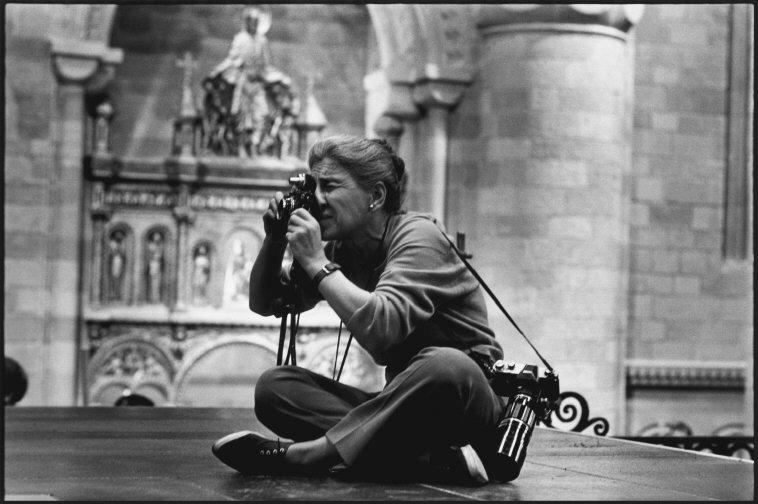
Eve Arnold on the set of Beckett, 1963, by Robert Penn. (© Copyright Eve Arnold/Magnum Photos)
Read More...A Young Frank Zappa Turns the Bicycle into a Musical Instrument on The Steve Allen Show (1963)
Last week we gave you John Cage performing his avant-garde composition Water Walk on the CBS game show “I’ve Got a Secret” in 1960. Now, this week, we’re following up with a nice complement — Frank Zappa bringing his own brand of offbeat music to the American airwaves in 1963. Only 22 years old and not yet famous, Zappa appeared on The Steve Allen Show and made music with some drumsticks, a bass bow, and two garden-variety bicycles — and nothing more.
The video above gives you mostly the prelude to the actual music. Then, in the first video below, Zappa gives a demo of the instruments. Next comes the Concerto for Two Bicycles, which features the show’s house orchestra joining the cacophonous fun. The clips run a good 15 minutes.
If you would like to support the mission of Open Culture, consider making a donation to our site. It’s hard to rely 100% on ads, and your contributions will help us continue providing the best free cultural and educational materials to learners everywhere. You can contribute through PayPal, Patreon, and Venmo (@openculture). Thanks!
Related Content:
Frank Zappa Explains the Decline of the Music Business (1987)
Frank Zappa’s Amazing Final Concerts: Prague and Budapest, 1991
Read More...Drinking with William Faulkner: The Writer Had a Taste for The Mint Julep & Hot Toddy
“Civilization begins with distillation,” William Faulkner once said, and like many of the great writers of the 20th century — Ernest Hemingway, F. Scott Fitzgerald, James Joyce — the bard of Oxford, Mississippi certainly had a fondness for alcohol.
Unlike many of the others, though, Faulkner liked to drink while he was writing. In 1937 his French translator, Maurice Edgar Coindreau, was trying to decipher one of Faulkner’s idiosyncratically baroque sentences. He showed the passage to the writer, who puzzled over it for a moment and then broke out laughing. “I have absolutely no idea of what I meant,” Faulkner told Coindreau. “You see, I usually write at night. I always keep my whiskey within reach; so many ideas that I can’t remember in the morning pop into my head.”
Every now and then Faulkner would embark on a drunken binge. His publisher, Bennett Cerf, recalled:
The maddening thing about Bill Faulkner was that he’d go off on one of those benders, which were sometimes deliberate, and when he came out of it, he’d come walking into the office clear-eyed, ready for action, as though he hadn’t had a drink in six months. But during those bouts he didn’t know what he was doing. He was helpless. His capacity wasn’t very great; it didn’t take too much to send him off. Occasionally, at a good dinner, with the fine wines and brandy he loved, he would miscalculate. Other times I think he pretended to be drunk to avoid doing something he didn’t want to do.
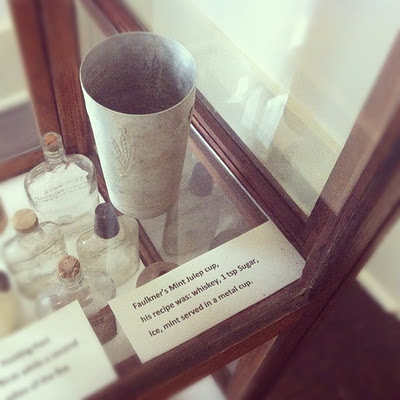
Wine and brandy were not Faulkner’s favorite spirits. He loved whiskey. His favorite cocktail was the mint julep. Faulkner would make one by mixing whiskey–preferably bourbon–with one teaspoon of sugar, a sprig or two of crushed mint, and ice. He liked to drink his mint julep in a frosty metal cup. (See image above.) The word “julep” first appeared in the late 14th century to describe a syrupy drink used to wash down medicine. Faulkner believed in the medicinal efficacy of alcohol. Lillian Ross once visited the author when he was ailing, and quoted him as saying, “Isn’t anythin’ Ah got whiskey won’t cure.”
On a cold winter night, Faulkner’s medicine of choice was the hot toddy. His niece, Dean Faulkner Wells, described the recipe and ritual for hot toddies favored by her uncle (whom she called “Pappy”) in The Great American Writers’ Cookbook, quoted last week by Maud Newton:
Pappy alone decided when a Hot Toddy was needed, and he administered it to his patient with the best bedside manner of a country doctor.
He prepared it in the kitchen in the following way: Take one heavy glass tumbler. Fill approximately half full with Heaven Hill bourbon (the Jack Daniel’s was reserved for Pappy’s ailments). Add one tablespoon of sugar. Squeeze 1/2 lemon and drop into glass. Stir until sugar dissolves. Fill glass with boiling water. Serve with potholder to protect patient’s hands from the hot glass.
Pappy always made a small ceremony out of serving his Hot Toddy, bringing it upstairs on a silver tray and admonishing his patient to drink it quickly, before it cooled off. It never failed.
Related Content:
William Faulkner Audio Archive Goes Online
William Faulkner Reads from As I Lay Dying
Read More...The Large Hadron Collider Rap, Yo
Last week, the reports about Higgs Boson, otherwise called the God particle, put CERN and the Large Hadron Collider back into the news, leading some to ask: What exactly are Higgs and the Collider all about? We’re glad you asked. And what better way to answer that question than with a fly, little rap by Kate McAlpine (aka Alpinekat) and Will Barras. You can find the full lyrics below the jump, and the parts about Higgs Boson right below…
Read More...The Higgs Boson – that’s the one that everybody talks about.
And it’s the one sure thing that this machine will sort out
If the Higgs exists, they ought to see it right away
And if it doesn’t, then the scientists will finally say
“There is no Higgs! We need new physics to account for why
Things have mass. Something in our Standard Model went awry.”But the Higgs – I still haven’t said just what it does
They suppose that particles have mass because
There is this Higgs field that extends through all space
And some particles slow down while other particles race
Straight through like the photon – it has no mass
But something heavy like the top quark, it’s draggin’ its ***
And the Higgs is a boson that carries a force
And makes particles take orders from the field that is its source.
They’ll detect it…
10,000 Solutions
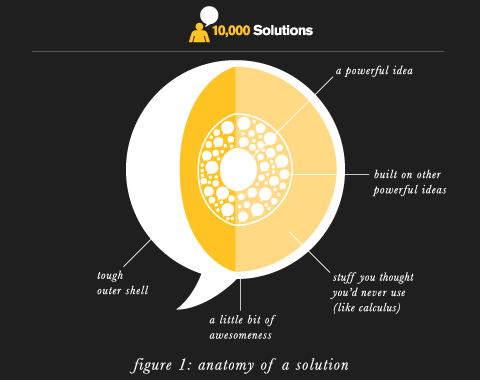
Arizona State University has launched a new contest called 10,000 Solutions open to anyone over 18, anywhere in the world, and it offers a $10,000 prize. Entries can take on one of the eight greatest challenges facing the world, like sustainability and the future of education. What makes the contest unusual is that participants are encouraged to collaborate and build on one another’s solutions. ASU wants to create an open solutions bank that others can use to generate new ideas, and some students at ASU have already met up in person to talk over things they shared on the site. The school is promoting 10,000 Solutions as an experiment in collaborative invention and the National Science Foundation is funding a team of ASU researchers to study the contest and see how ideas are shared and developed.
The contest is off to a strong start, getting some high-profile entries like this one from Dan Ariely.
While many of the solutions share questions or ideas at the brainstorming stage, some groups are using the platform to promote working prototypes. This group of ASU student engineers is working on a low-cost smartboard technology based on the Wii that could be set up anywhere you can run a projector.
ASU hopes 10,000 Solutions will bring some fresh energy to problems that often seem overwhelming. If you have a minute to spare and a bright idea for making the world a better place, why not share it?
Ed Finn is an occasional contributor to Open Culture. He recently started working at Arizona State University in University Initiatives, an office focused on developing new projects and thinking big about the future of public university education. 10,000 Solutions is a project his team is helping to launch this year.
Read More...Listen to the New Tom Waits Album, ‘Bad As Me,’ Free for a Limited Time
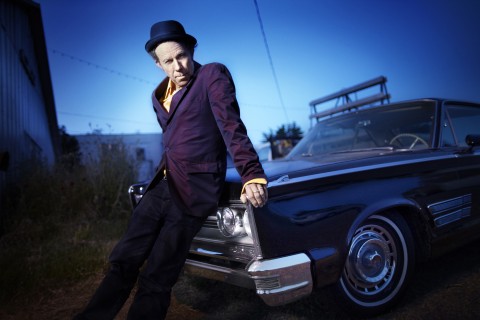
This week Tom Waits released his first studio album in seven years, and it doesn’t disappoint. Bad As Me, writes Will Hermes in a four-star Rolling Stone review, may be Waits’ most broadly emotional album to date: “Certainly it’s his most sharply focused record since the game-changing tag team Swordfishtrombones and Rain Dogs decades ago.” You can judge for yourself: For a limited time, National Public Radio is offering a sneak preview of the complete album.
Bad As Me is more accessible than many of Waits’ albums. As his long-time session guitarist Marc Ribot told The New York Times, “On this record it was less, ‘O.K. let’s be super rigorous and create music completely without precedent,’ and more just ‘Let’s rock the house.’ ” The title track is a good example. It’s a rollicking blues stomp, with Waits channeling the ghost of Screamin’ Jay Hawkins as he shouts:
You’re the head on the spear
You’re the nail on the cross
You’re the fly in my beer
You’re the key that got lost
You’re the letter from Jesus on the bathroom wall
You’re mother superior in only a bra
You’re the same kind of bad as me
On a more serious note, Waits sings of America’s infantile politics, its military and economic quagmires, and the general breakdown of discourse in the melancholy “Talking At The Same Time”:
A tiny boy sat and he played in the sand
He made a sword from a stick
And a gun from his hand
Well we bailed out the millionaires
They’ve got the fruit
We’ve got the rind
And everybody’s talking at the same time
Waits is joined by a stellar group of backing musicians, including Keith Richards on guitar and vocals, David Hidalgo on guitar, and Flea on bass. Bad As Me comes in two versions: the standard edition, with 13 songs, and the deluxe edition, with 16. You can hear all 13 tracks from the standard edition on the NPR website, and follow along with the lyrics on TomWaits.com.
Read More...Support Us
We're hoping to rely on loyal readers, rather than erratic ads. Please click the Donate button and support Open Culture. You can use Paypal, Venmo, Patreon, even Crypto! We thank you!

About Us

Open Culture scours the web for the best educational media. We find the free courses and audio books you need, the language lessons & educational videos you want, and plenty of enlightenment in between.
Advertise With Us

FREE UPDATES!
GET OUR DAILY EMAIL
Get the best cultural and educational resources on the web curated for you in a daily email. We never spam. Unsubscribe at any time.
FOLLOW ON SOCIAL MEDIA

Open Culture editor Dan Colman scours the web for the best educational media. He finds the free courses and audio books you need, the language lessons & movies you want, and plenty of enlightenment in between.
Advertise With Us

