“Big Data” Comes to the Humanities
Fast forward a generation, and you might hardly recognize the humanities. Big data is here, and it’s allowing tech savvy students to take a whole new approach to “reading” texts. Using Google’s digital library and other tools powered by high power computing, students can now quantitatively analyze large bodies of literature and draw new conclusions about the evolution of ideas, language, and culture. (More on this here.) Some worry that these “stat-happy quants” risk taking “the human out of the humanities.” Others (myself included) suspect that this approach could enliven the humanities, allowing scholars to focus on new methods and questions. How “big data” is transforming the humanities (and the sciences too) is the subject of six articles appearing in The Chronicle of Higher Education. Let me highlight them for you:
- Humanities Go Google
- Crowd Science Reaches New Heights
- The Spoken Word, Searchable for Scholarship
- Scholars Scale Up Music Studies
- A Many-Sourced Map of the Gulf Oil Spill
- A Swarm of Volunteers, a Honey of an Idea
Woody Allen Talks Life with Priest
As he grows older, Woody Allen increasingly finds himself positioned as the philosopher filmmaker. Fresh Air host Terry Gross asked him some heavy existential questions in an interview last year. (Listen here). And, more recently, we have Allen grappling with some big life questions in an interview conducted by Father Robert E. Lauder in the Catholic magazine, Commonweal. The conversation begins:
RL: When Ingmar Bergman died, you said even if you made a film as great as one of his, what would it matter? It doesn’t gain you salvation. So you had to ask yourself why do you continue to make films. Could you just say something about what you meant by “salvation”?
WA: Well, you know, you want some kind of relief from the agony and terror of human existence. Human existence is a brutal experience to me…it’s a brutal, meaningless experience—an agonizing, meaningless experience with some oases, delight, some charm and peace, but these are just small oases. Overall, it is a brutal, brutal, terrible experience, and so it’s what can you do to alleviate the agony of the human condition, the human predicament? That is what interests me the most. I continue to make the films because the problem obsesses me all the time and it’s consistently on my mind and I’m consistently trying to alleviate the problem, and I think by making films as frequently as I do I get a chance to vent the problems. There is some relief. I have said this before in a facetious way, but it is not so facetious: I am a whiner. I do get a certain amount of solace from whining.
You can read the full interview here, and, in case you missed it, you can watch Jean-Luc Godard’s 1986 movie with Woody Allen entitled Meetin’ WA.
Thanks to Mike for the tip on this one.
The iPad eBook Reader: Some First Reactions
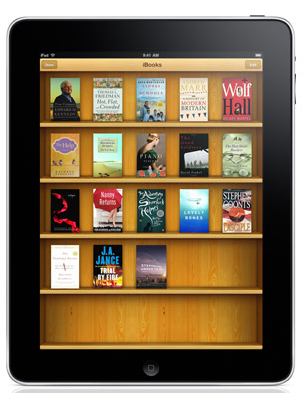 Yesterday morning, I headed to the Palo Alto Apple Store, spent an hour waiting in line, then finally gained entrance to the store. And who entered alongside me? Steve Jobs! An auspicious beginning. I left with a 32 gig iPad, took it home, and started playing particularly with the eBook reader. Here are my very early impressions:
15 months ago, I bought a Kindle and returned it. I just couldn’t read with it at night (a non-starter for me), and figured that Apple would eventually get it right. Well, they largely have. The iPad initially feels a little heavy. But, it’s actually no heavier than your average hardback book. Plus it’s fairly easy to hold. Score one for the iPad.
Then, when you fire up the eBook reader, you instantly like what you see. The fonts are crisp, and the images are in color, which means that you can read children’s books, comics and other graphic intensive texts. Plus, you can change the size and kind of the font. You can adjust the brightness of the screen. And, in some cases, you can even alter the background color of the screen. (Most of this you can’t do with the Kindle.) All of this contributes to a reader-friendly screen that’s easy on the eyes. And, yes, I can read with this device at night. (Readers make other good observations in the comments below.)
How about buying books for the iPad? Well, it’s pretty easy. Both Apple and Amazon sell books for the device, with prices generally ranging between $9.99 and $12.99. Rather notably, they also offer access to a sizable collection of free books in the public domain. (You can get more freebies here, too.) Overall, Amazon has a much larger inventory, and their books tend to be cheaper. But otherwise these are pretty similar services. And, because Apple now has a far superior device, you have to wonder whether this is the beginning of a big shift in the book market. In five years, Amazon might not be quite the behemoth it is today — something that’s probably letting Steve Jobs sleep easier than Jeff Bezos at night.
A final point worth mentioning here: Neither company will let you have true ownership over the books you buy. Both vendors lock down their books, dictate the operating environments in which you can read them, and control the user interfaces that shape the reading experience. (PC World has more on that here.) You don’t have much ultimate control over the underlying file. So the upshot is that you had better like the iPad (or Kindle) reading experience before deciding to amass a large and costly library.
Now for a few random observations:
1) The video generally looks great (unless, of course, it’s produced in Flash). I was really impressed with the quality of YouTube videos, and Netflix movies (free app here) stream over the iPad rather brilliantly.
2) On the downside, I found typing on the iPad to be rather difficult — even more so than typing on an iPhone. The device is large enough that it’s hard to stretch your fingers to reach various keys. Maybe I will get a hang of it. But, for now, it’s unwieldy.
3) The New York Times and Wall Street Journal have developed new apps for the iPad, and they deliver a pleasant reading experience, to be sure. But I don’t see this suddenly making consumers any more (or less) willing to pay. The concept of the iPad saving the newspaper industry seems fairly overplayed, I’m sorry to say.
4) Is this a must-have device? Or just nice-to-have? Right now, I’m inclined toward the latter (and so is Slate). Aside from the eBook reader, your home computer or smart phone can accomplish most of what the iPad can. However, the iPad will rapidly differentiate itself. It will become a nice low-cost, portable computer — one that lets you store data in the cloud, and provides access to a large volume of cheap or free software (at least more than your average consumer normally gets). Give it a year. Wait for the flood of apps to come. Wait for innovative software developers to extract the potential of this machine, and wait for Apple to make the iPad lighter, cheaper, and even faster. Right now, it’s not a game changer. But it will be down the line.
Are you a new iPad owner? Have any thoughts in general? Or particularly about the eBook reader? Add them to the comments below, or send them our way. We look forward to hearing what you have to say …
Read More...Orson Welles Reads Moby Dick
Welles is reading just a short introduction here. But if you want a complete audio download of Moby Dick, let me tell you how to get one. You can download a free reading of Melville’s classic at Librivox. The full mp3 zip file is right here.
If you would like to support the mission of Open Culture, consider making a donation to our site. It’s hard to rely 100% on ads, and your contributions will help us continue providing the best free cultural and educational materials to learners everywhere. You can contribute through PayPal, Patreon, and Venmo (@openculture). Thanks!
Read More...For a Tiny Instant, Physicists Broke a Law of Nature
An intriguing bit of news from the Yale Bulletin. It begins:
For a brief instant, it appears, scientists at Brook haven National Laboratory on Long Island recently discovered a law of nature had been broken.
Action still resulted in an equal and opposite reaction, gravity kept the Earth circling the Sun, and conservation of energy remained intact. But for the tiniest fraction of a second at the Relativistic Heavy Ion Collider (RHIC), physicists created a symmetry-breaking bubble of space where parity no longer existed.
You can read more about what went down here. And, if you want to brush up your physics, head over to the Physics section of our Free Online Course collection. There you’ll find free physics courses from Yale, Stanford, MIT and other fine institutions of higher learning.
Read More...Sapolsky Breaks Down Depression
Robert Sapolsky, a Stanford biologist, is currently one of the most publicly accessible science writers in the country, perhaps best known for his book on stress, Why Zebras Don’t Get Ulcers. In the lecture above, Sapolsky takes a hard look at depression. The topic is a little heavy. I’ll grant that. But, it’s also important. As Sapolsky is quick to point out, depression is pervasive and getting worse. Currently, it’s the 4th greatest cause of disability worldwide, and it will soon become the 2nd. For Sapolsky, depression is deeply biological; it is rooted in biology, just like, say, diabetes. Here, you will see how depression changes the body. When depressed, our brains function differently while sleeping, our stress response goes way up 24/7, our biochemistry levels change, etc. Given the pervasiveness of depression, this video is well worth a watch.
Also don’t miss Sapolsky’s amazing Stanford course, Introduction to Human Biology. It’s equally worth your time. It’s housed in our collection of 750 Free Courses Online.
Read More...Advertise on Open Culture
Reach Savvy Education/Culture Audience Online:
- 3.5 million page views / month
- 914,000 followers and friends on Twitter and Facebook
- 83,000 RSS and email subscribers
Audience Statistics:
- Gender: 56% male/44% female
- Age: 72% in 18–54 bracket.
- Education: 69% with college or grad school degree
Data according to Quantcast.
Advertise with us Through Adwords:
You can immediately place ads on Open Culture by using Google’s Adwords platform. This will give you the ability to target the whole site or specific pages. Find directions on how to target our site here.
Read More...A Vision of Students Today
Another video brought to you by cultural anthropologist Michael Wesch, who previously brought you Information R/evolution and The Machine is Us/ing Us. You may also want to see his talk, An Anthropological Introduction to YouTube.
Read More...Should You Give to Harvard?
That’s the question that The Ethicist asks in The New York Times. Below, I present the issue and part of the answer. Read through it all and tell us where you stand on the issue.
Read More...The Issue
The fiscal year for major university endowments ended June 30, and schools have been reporting their results: not good. In the Harvard-Yale portfolio game, the latter was down 24.6 percent, while its rival lost even more, 27.3 percent. If you are an Ivy alum, this might seem a good moment to donate to your alma mater, to help rebuild its battered portfolio. But should you, given the power of education to improve people’s lives?
The Argument
Do not donate to Harvard. To do so is to offer more pie to a portly fellow while the gaunt and hungry press their faces to the window (at some sort of metaphoric college cafeteria, anyway). Even after last year’s losses, Harvard’s endowment exceeds $26 billion, the largest of any American university, greater than the G.D.P. of Estonia. By contrast, among historically black colleges and universities, Howard has the largest endowment, about $420 million, a mere 1.6 percent the size of Harvard’s. (Donors gave Harvard more than $600 million just this fiscal year.) The best-endowed community college,Valencia, in Orlando, Fla., has around $67 million, or 0.26 percent of Harvard’s wealth. This is not to deny that Harvard does fine work or could find ways to spend the money but to assert that other schools have a greater need and a greater moral claim to your benevolence… More here.
“September 1, 1939” by W.H. Auden
The poem was W.H. Auden’s. The date marked the moment when Germany invaded Poland, initiating the start of World War II. “September 1, 1939” was originally published in The New Republic on October 18, 1939. You can find the text of the poem here. Plus, you can also read George Orwell’s account of what happened that historic day in Poland. I found it, and just had to throw that in.
Read More...Support Us
We're hoping to rely on loyal readers, rather than erratic ads. Please click the Donate button and support Open Culture. You can use Paypal, Venmo, Patreon, even Crypto! We thank you!

About Us

Open Culture scours the web for the best educational media. We find the free courses and audio books you need, the language lessons & educational videos you want, and plenty of enlightenment in between.
Advertise With Us

FREE UPDATES!
GET OUR DAILY EMAIL
Get the best cultural and educational resources on the web curated for you in a daily email. We never spam. Unsubscribe at any time.
FOLLOW ON SOCIAL MEDIA

Open Culture editor Dan Colman scours the web for the best educational media. He finds the free courses and audio books you need, the language lessons & movies you want, and plenty of enlightenment in between.
Advertise With Us

