Why–and When–Did the United States Turn Against Science?: Views from Neil DeGrasse Tyson, Bill Nye, Margaret Atwood & More
When did Americans lose the ability to think and act rationally? Or did they ever, on the whole, have such ability? These are the questions at the heart of the Big Think video above, a supercut of interview clips from public intellectuals — Neil DeGrasse, Michael Shermer, Tyson, Kurt Andersen, Bill Nye, and Margaret Atwood — opining on the state of the nation’s intellectual health. Unsurprisingly, the prognosis is not good, as Carl Sagan predicted over 25 years ago.
Of interest here is the diagnosis: How did the country get to a place where it is unable to defend itself against a deadly virus because millions of citizens refuse to take it seriously? How did Americans let Exxon wreck the climate because millions of Americans refused to believe in human-caused climate change? How did a failed mogul and reality TV star become president? How did Qanon, Pizzagate…. How did any of it happen?
The roots are long and deep, says writer and former host of NPR’s Studio 360, Kurt Andersen, who has spent a significant amount of time thinking about the culture of American irrationalism. On the one hand, “Americans have always been magical thinkers and passionate believers in the untrue,” from the time of the Puritans, who were not persecuted refugees so much as fanatics no one in England could stand. And the problem is even older than the country’s founding, Andersen argues in his book Fantasyland: How America Went Haywire: A 500-Year History — it dates to the foundations of the modern world.
On the other hand, and somewhat contradictorily, it was those Puritans again who kept the worst of things in check. “We also have the virtues embodied by the Puritans and their secular descendants,” Andersen writes at The Atlantic: “steadiness, hard work, frugality, sobriety, and common sense” — such virtues as helped build the country’s scientific industries and research institutions, which have been steadily undermined by the relativism of the 1960s (Andersen argues), the effects of the internet, and a series of devastating political choices. The delusional irrationalism was built in — but hyper-individualism and profiteering of the last several decades supercharged it. “The United States used to be the world leader in technology,” says Bill Nye, but no more.
Margaret Atwood, who is Canadian not American, talks mostly about the universal human difficulty of letting go of comforting core beliefs, and the uses the example of the outcry against Darwinian evolution. Yet her very presence in the discussion will make viewers think of her most famous novel, The Handmaid’s Tale, in which she imagined what lies beneath the supposedly enlightened common sense of the country’s government. The stage was long ago set for a revolution that could easily turn the country against science, she believed.
As Atwood wrote in 2018 of the novel’s genesis: “Nations never build apparently radical forms of government on foundations that aren’t there already.… The deep foundation of the United States — so went my thinking — was not the comparatively recent 18th-century Enlightenment structures of the Republic, with their talk of equality and their separation of Church and State, but the heavy-handed theocracy of 17th-century Puritan New England — with its marked bias against women — which would need only the opportunity of a period of social chaos to reassert itself.”
Rather than identifying the problems with Puritans or 60s hippies, Neil DeGrasse Tyson — as he has done throughout his career — discusses issues of science education and communication. On both fronts, there has been some improvement. “More journalists who are science fluent… are writing about science than was the case 20 years ago,” he says, “so now I don’t have to worry about the journalist missing something fundamental.… And [science] reporting has been much more accurate in recent years, I’m happy to report.”
But while the internet has amplified our opportunities for scientific literacy, it has also done the opposite, grossly muddying the intellectual waters with misinformation and a competitive need to get the story first. “If it’s not yet verified, it’s not there yet.… So be more open about how wrong the thing you’re reporting on could be, because otherwise you’re doing a disservice to the public. And that disservice is that people out there say, ‘Scientists don’t know anything.’ ”
There are also those who choose to side with handful of contrarian scientists who disagree with the consensus. “This is irresponsible,” says Tyson. “Plus it means you don’t know how science works.” Or it means you’re looking to confirm biases rather than genuinely take an interest in the scientific process. For all of their insights, the talking head critics in the video fail to mention a primary driver behind so much of the U.S.‘s science denialism, a motivation as foundational to the country as the Puritan’s zealotry: profit, at all costs.
Read a transcript of the video here.
Related Content:
1,700 Free Online Courses from Top Universities
An Animated Margaret Atwood Explains How Stories Change with Technology
Isaac Asimov Laments the “Cult of Ignorance” in the United States (1980)
Josh Jones is a writer and musician based in Durham, NC. Follow him at @jdmagness
Read More...The Does and Don’ts of Putting on a Prison Concert: Johnny Cash, BB King, the Grateful Dead, Bonnie Tyler & The Cramps
The prison gig has been a staple of live performance since Johnny Cash played Folsom in 1968, with variations on the theme like the Cramps’ legendary performance at a California Psychiatric Hospital (revisited in the documentary We Were There to Be There). Some bands who play institutions may not be far away from inhabiting them. When the Sex Pistols played Chelmsford Prison, it was not the first time guitarist Steve Jones had been inside, what with his 14 criminal convictions. In fact, Jones has credited the band for saving him from a life of crime.
BB King gave one of the best performances of his career from behind the walls of Sing Sing, three years after Cash’s concert at San Quentin. King himself hadn’t done time, but having grown up in poverty on a cotton plantation in Mississippi, he well understood the conditions that led people to incarceration.
As his keyboardist Ron Levy said after an earlier prison concert in Cook County Jail, “If anybody had the blues, it was those people incarcerated. And BB really felt compassion for those guys.” Likewise, Johnny Cash never did hard time, but his childhood poverty, struggles with addiction, and love for underdogs and outcasts lent him an authenticity inmates recognized immediately.
Other matchups between stars and prison audiences have not only been less authentic, but sometimes downright baffling, as when Bonnie Tyler gave a concert at Long Lartin prison in England …. or so the inmates thought. It turned out Tyler had only used her audience as props for a botched music video that never aired. This, clearly, is how not to run a prison concert, also the title of the Bandsplaining video at the top, which begins with Tyler’s kerfuffle and goes on to examine the genre of prison concerts through prison concert films, TV, and albums.
Johnny Cash, the Grateful Dead, BB King, Freddie King, John Lee Hooker, The Cramps, Fugazi, and Fugazi’s previous incarnation, Minor Threat, are all covered here. Missing are artists like Freddy Fender (who did it before Cash), Sonny James, and Big Mama Thornton, who released an album called Jail in 1975, compiled from two different prison performances, and who surely deserves top honors for knowing how to do it right. In prison, writes Music Times, “she finally gets to perform her hit, ‘Ball ‘n’ Chain’ — which was made famous by Janis Joplin and The Holding Company — where it was made to be played: Jail.”
Related Content:
B.B. King Plays Live at Sing Sing Prison in One of His Greatest Performances (1972)
Josh Jones is a writer and musician based in Durham, NC. Follow him at @jdmagness
Read More...When Salvador Dali Viewed Joseph Cornell’s Surrealist Film, Became Enraged & Shouted: “He Stole It from My Subconscious!” (1936)
Did Salvador Dalí meet the diagnostic criteria for a personality disorder and maybe, also, a form of psychosis, as some have alleged? Maybe, but there’s no real way to know. “You can’t diagnose psychiatric illnesses without doing a face to face psychiatric examination,” Dutch psychiatrist Walter van den Broek writes, and it’s possible Dali “consciously created an ‘artistic’ personality… for the money or in order to succeed.” No doubt Dalí was a tireless self-promoter who marketed his work by way of a sensationalist persona.
But maybe Dalí faked symptoms of mental illness (via his understanding of Freud) in order to deliberately induce states of psychosis as part of his paranoid-critical method, a “spontaneous method of irrational knowledge based on the critical and systematic objectivity of the associations and interpretations of delirious phenomena,” he wrote. One of Dalí’s extreme “unorthodox methods for idea generation,” the practice of pretending to be insane may have driven Dalí to believe too strongly in his own delusions at times.
Throughout the early 1930s, Dalí championed paranoia, “a form of mental illness in which reality is organized in such a manner so as to be served through the control of an imaginative construction,” he said in a 1930 lecture. “The paranoiac who thinks he is being poisoned discovers in all the things that surround him, down to their most imperceptible and subtle details, preparations for his death.” And the paranoiac Surrealist who believes he’s being robbed of his ideas may see artistic theft everywhere — especially in an exhibit of Surrealist artists that does not include him. (After all, as Dalí once declared, “I am Surrealism.”)
In 1936, Dalí attended a screening of Joseph Cornell’s short Surrealist film Rose Hobart (top), named for the obscure silent actress whose scenes Cornell excised from a “1931 jungle adventure film” called East of Borneo. Cornell took the footage, slowed it down, “chopped it up, reordered it, and discarded the entire plot,” writes Catherine Corman. “He cut out reaction shots… removed overtly upsetting scenes,” edited in scenes from other films, and “made the film seem deliberately modest and worn,” projecting it through a blue filter and scoring it with two songs from Nestor Amaral’s album Holiday in Brazil (which he’d found at a junk shop).
The screening happened to be held in New York at the same time as the Museum of Modern Art’s first exhibit of Surrealist art, an exhibition “rife with controversy,” MoMA writes, that “provoked fierce reactions from battle factions among the Dadaists and the Surrealists.” French Surrealist poet and critic André Breton, who two years earlier expelled Dalí from the Surrealist group for “the glorification of Hitlerian fascism,” wrote the catalogue introduction. The Spanish Civil War had just broken out that year, further aggravating Dalí, no doubt, when he encountered Cornell’s film at a matinee screening.
Partway through the screening of Rose Hobart, Dalí became enraged, stood up, shouting in Spanish, and overturned the projector. Later, he reportedly told Julian Levy, whose gallery held the screening: “My idea for a film is exactly that, and I was going to propose it to someone who would pay to have it made.… I never wrote it or told anyone, but it is as if [Cornell] had stolen it.” Other versions of the story had Dalí saying, “He stole it from my subconscious!” or “He stole my dreams!” Cornell had not, of course, reached into Dalí’s subconscious but had manifested the film from his own obsessions with silent film and Hollywood divas, themes that run throughout his work. After Dalí’s outburst, the shy, reclusive artist refused to screen Rose Hobart again until the 1960s.
Dalí had vanquished an imaginary rival, but perhaps his true targets — Breton and his former Surrealist colleagues — remained untouched. It would not matter: Dalí eclipsed them all in fame, especially in the age of television, which embraced the artist’s antics like no other medium. But through his performances of insanity, maybe Dalí actually did touch into a creative preconscious state shared among artists — a place in which Joseph Cornell just might have found and stolen his ideas.
In 1932, Dalí had an epiphany about Jean-Francois Millet’s The Angelus, a painting with which he’d been obsessed since childhood and that influenced him heavily as an adult, becoming a key source for his paranoid-critical method. Dalí claimed that the two farmers praying over a meager harvest were actually mourning a lost child. He persisted in this belief until the Louvre agreed to X‑ray the painting. Underneath, they found a small, child-sized coffin, and at least one of Dalí’s paranoid fantasies was proved true.
Related Content:
When Salvador Dalí Created a Surrealist Funhouse at New York World’s Fair (1939)
Josh Jones is a writer and musician based in Durham, NC. Follow him at @jdmagness
Read More...The Little-Known Bombing of Pompeii During World War II
In 79 AD, 17-year-old Gaius Plinius Caecilius Secundus, known as Pliny the Younger, gazed across the Bay of Naples from his vacation home in Misenum and watched Mount Vesuvius erupt. “Darkness fell, not the dark of a moonless or cloudy night,” Pliny wrote in his eyewitness account — the only surviving such document — “but as if the lamp had been put out in a dark room.” Unbeknownst to Pliny and his famous uncle, Pliny the Elder, admiral of the Roman navy and revered naturalist, hundreds of lives were also snuffed out by lava, clouds of smoke and ash, and temperatures in the hundreds of degrees Fahrenheit. The Elder Pliny launched ships to attempt an evacuation. In the morning, he was found dead, likely from asphyxiation, along with over two thousand residents of Pompeii and Herculaneum.
When the buried town was first unearthed, a new cycle of witness, death, and resurrection began. “Since its rediscovery in the mid-18th century,” writes National Geographic, “the site has hosted a tireless succession of treasure hunters and archeologists,” not to mention tourists — starting with aristocratic gentlemen on their Grand Tour of Europe. In 1787, Goethe climbed Vesuvius and gazed into its crater. “He recorded with disappointment that the freshest lava was already five days old, and that the volcano neither belched flame nor pelted him with stones,” writes Amelia Soth in an article about “Pompeii Mania” among the Romantics, a passion that culminated in Edward Bulwer-Lytton’s 1834 potboiler, The Last Days of Pompeii, “hands-down the most popular novel of the age.”
Bulwer-Lytton’s book “had such a dramatic impact on how we think about Pompeii,” the Getty writes, that the museum named an exhibition after it that features — unlike so many other histories — Pompeii’s 20th century “apocalypse”: an Allied bombing raid in the autumn of 1943 that damaged nearly every part of the site, including “some of Pompeii’s most famous monuments, as well as its museum.” As Nigel Pollard shows in his book Bombing Pompeii, over 160 Allied bombs hit Pompeii in August and September. Few tourists who now flock to the site know how much of the ruins have been rebuilt since then. “Only recently have the literature and the scientific community paid due attention to these dramatic events, which constitute a fundamental watershed in the modern history of the site,” writes archeologist Silvia Bertesago.
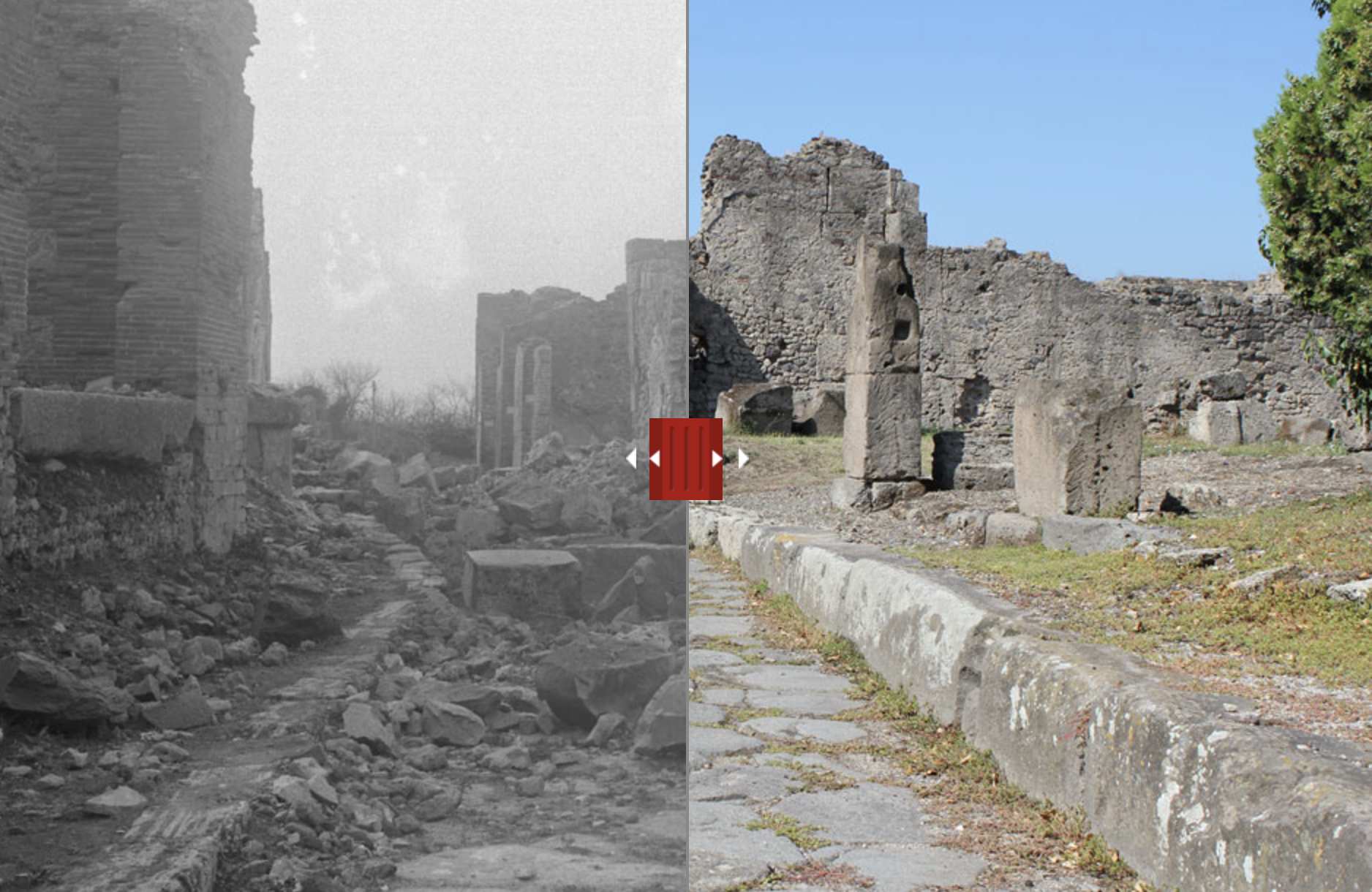
A Pliny of his time (an Elder, given his decades of scientific accomplishment), Pompeii’s superintendent, archeologist Amedeo Maiuri, “accelerated the protection of buildings and moveable items” in advance of the bombing raids. But “who will save monuments, houses and paintings from the fury of the bombardments?” he wrote. Maiuri had warned of the coming destruction, and when false information identified the slopes of Vesuvius as a German hideout, the longest-running archeological excavation in the world became “a real target of war.… The first bombing of Pompeii took place on the night of August 24 1943.… Between August 30 and the end of September, several other raids followed by both day and night.… No part of the excavations was completely spared.”
Maiuri chronicled the destruction, writing:
It was thus that from 13 to 26 September Pompeii suffered its second and more serious ordeal, battered by one or more daily attacks: during the day flying low without fear of anti-aircraft retaliation; at night with all the smoke and brightness of flares […]. During those days no fewer than 150 bombs fell within the excavation area, scattered across the site and concentrated where military targets were thought to be.
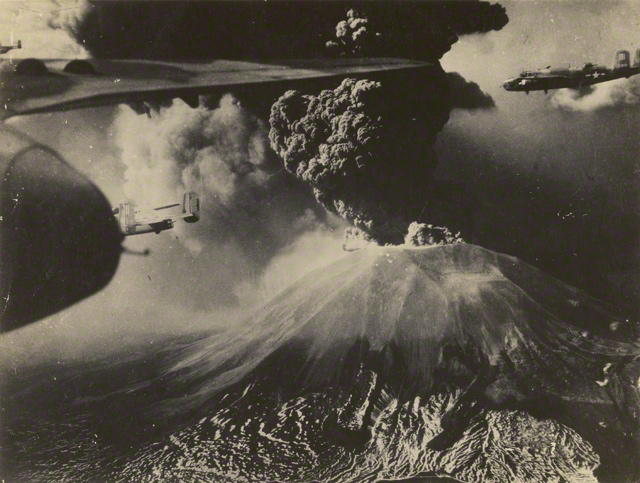
Himself wounded in his left foot by a bomb, Maiuri helped draw up a list of 1378 destroyed items and over 100 damaged buildings. Hasty, emergency rebuilding in the years to follow would lead to the use of “experimental materials” like reinforced concrete, which “would later prove incompatible with the original materials” and itself require restoration and repair. The ruins of Pompeii were rebuilt and resurrected after they were nearly destroyed a second time by fire from the sky — this time entirely an act of humankind. But the necropolis would have its revenge. The following year, Vesuvius erupted, destroying nearly all of the 80 B‑25 bombers and the Allied airfield at the foot of the mountain.
In the video above, you can learn more about the bombing of Pompeii. See photographs of the destruction at Pompeii Commitment and at the Getty Museum, which features photos of Pompeiian sites destroyed by bombing side-by-side with color images of the rebuilt sites today. These images are dramatic, enough to make us pay attention to the seams and joints if we have the chance to visit, or revisit, the famous archeological site in the future. And we might want to ask our guide if we can see not only the ruins of the natural disaster, but also the multiple undetonated bombs from the “apocalypse” of World War II.
Related Content
Pompeii Rebuilt: A Tour of the Ancient City Before It Was Entombed by Mount Vesuvius
A Drone’s Eye View of the Ruins of Pompeii
Josh Jones is a writer and musician based in Durham, NC. Follow him at @jdmagness
Read More...Archaeologists Discover 1300-Year-Old Pair of Skis, the Best-Preserved Ancient Skis in Existence
Surfing is generally believed to have originated in Hawaii and will be forever associated with the Polynesian islands. Yet anthropologists have found evidence of something like surfing wherever humans have encountered a beach — on the coasts of West Africa, in the Caribbean, India, Syria, and Japan. Surfing historian Matt Warshaw sums up the problem with locating the origins of this human activity: “Riding waves simply for pleasure most likely developed in one form or another among any coastal people living near warm ocean water.” Could one make a similar point about skiing?
It seems that wherever humans have settled in places covered with snow for much of the year, they’ve improvised all kinds of ways to travel across it. Who did so with the first skis, and when? Ski-like objects dating from 6300–5000 BC have been found in northern Russia. A New York Times article recently described evidence of Stone Age skiers in China. “If skiing, as it seems possible,” Nils Larsen writes at the International Skiing History Association, “dates back 10,000 years or more, identifying a point of origin (or origins) will be difficult at best.” Such discussions tend to get “bogged down in politics and national pride,” Larsen writes. For example, “since the emergence of skiing in greater Europe in the late 1800s” — as a sport and purely recreational activity — “Norway has often been considered the birthplace of skiing. Norway has promoted this view and it is a point of national pride.”
Despite its earliest records of skiing dating millennia later than other regions, Norway has some claim. The word ski is, after all, Norwegian, derived from Old Norse skíð, meaning “cleft wood” or “stick.” And the best-preserved ancient skis ever found have been discovered in a Norwegian ice field. “Even the bindings are mostly intact,” notes Kottke. The first ski, believed to be 1300 years old, turned up in 2014, found by the Glacier Archeology Program (GAP) in the mountains of Innlandet County, Norway. The archaeologists decided to wait, let the ice melt, and see if the other ski would appear. It did, just recently, and in the video above, you can watch the researchers pull it from the ice.
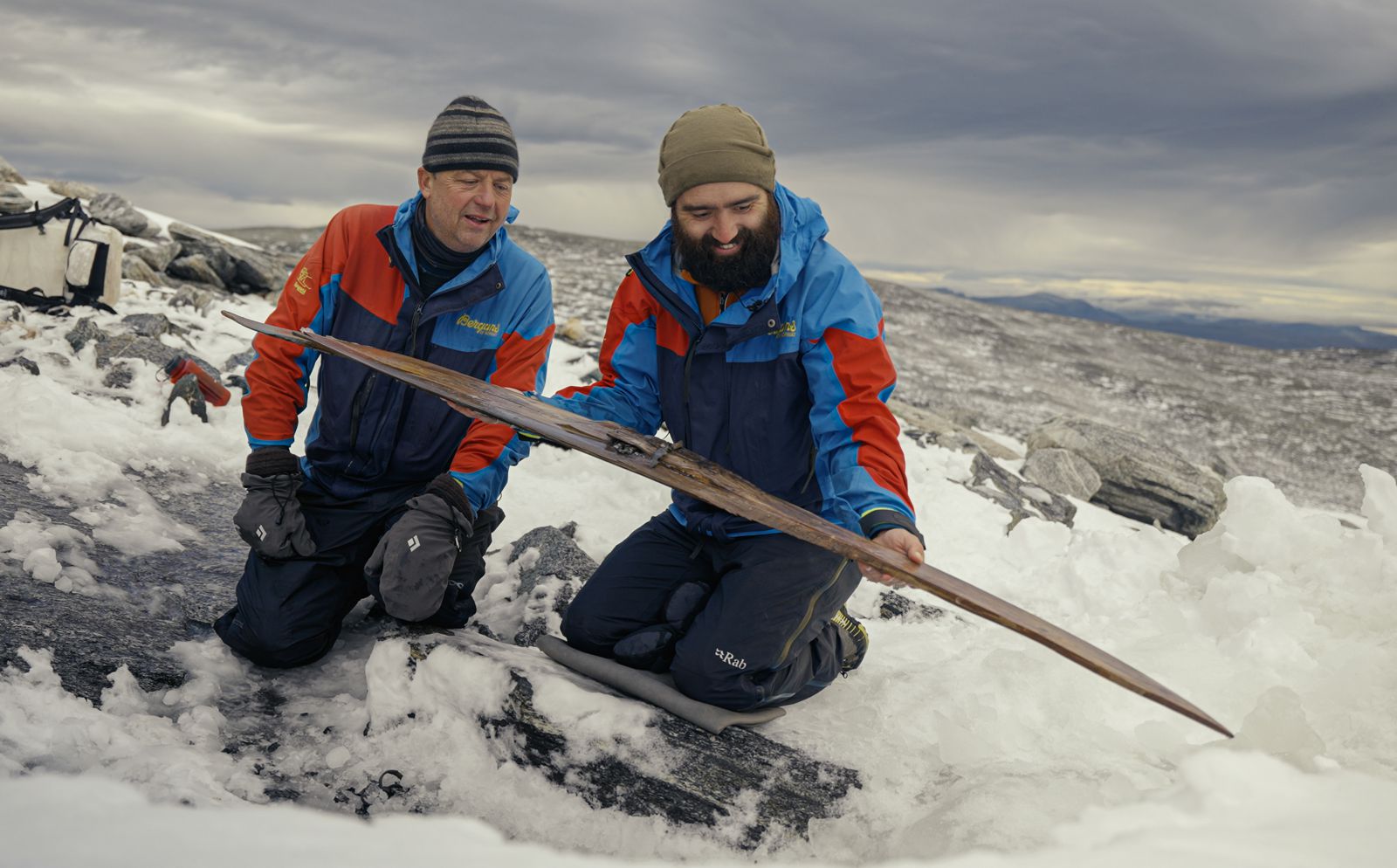
Photo: Andreas Christoffer Nilsson, secretsoftheice.com
“Measuring about 74 inches long and 7 inches wide,” notes Livia Gershon at Smithsonian, “the second ski is slightly larger than its mate. Both feature raised footholds. Leather straps and twisted birch bark bindings found with the skis would have been attached through holes in the footholds. The new ski shows signs of heavy wear and eventual repairs.” The two skis are not identical, “but we should not expect them to be,” says archaeologist Lars Pilø. “The skis are handmade, not mass-produced. They have a long and individual history of wear and repair before an Iron Age skier used them together and they ended up in the ice.”
The new ski answered questions the researchers had about the first discovery, such as how the ancient skis might have maintained forward motion uphill. “A furrow on the underside along the length of the ski, as you find on other prehistoric skis (and on modern cross-country skis), would solve the question,” they write, and the second ski contained such a furrow. While they may never prove that Norway invented skiing, as glacier ice melts and new artifacts appear each year, the team will learn much more about ancient Norwegian skiers and their way of life. See their current discoveries and follow their future progress at the Secrets of the Ice website and on their YouTube channel.
Related Content:
Archaeologists Find the Earliest Work of “Abstract Art,” Dating Back 73,000 Years
Medieval Tennis: A Short History and Demonstration
Josh Jones is a writer and musician based in Durham, NC. Follow him at @jdmagness
Read More...Medieval Tennis: A Short History and Demonstration
British You Tuber Nikolas “Lindybiege” Lloyd is a man of many, many interests.
Wing Chun style kung fu…
Children’s television produced in the UK between 1965 and 1975…
Ancient weaponry, chainmail, and historically accurate WWII model miniatures…
Actress Celia Johnson, star of the 1945 romantic drama Brief Encounter…
Evolutionary psychology…
…and it would appear, tennis.
But not the sort you’ll find played on the grass courts of Wimbledon, or for that matter, the hard courts of the US Open.
Lloyd is one of a select few who gravitate toward the version of the game that was known as the sport of kings.
It was, according to a 1553 guide, created, “to keep our bodies healthy, to make our young men stronger and more robust, chasing idleness, virtue’s mortal enemy, far from them and thus making them of a stronger and more excellent nature.”
Henry VIII was a talented and enthusiastic player in his youth, causing the Venetian Ambassador to rhapsodize, “it was the prettiest thing in the world to see him play; his fair skin glowing through a shirt of the finest texture.”
Henry’s second wife, the ill-fated Anne Boleyn, was also a fan of the sport, with money riding on the match she was watching when she was summoned to the Privy Council “by order of the King,” the first stop on her very swift journey to the Tower of London.
The sport’s roots reach all the way to the 11th and 12th centuries when monks and villagers in southern France were mad for jeu de paume, a tennis-like game predating the use of racquets, whose popularity eventually spread to the royals and aristocrats of Paris.
The game Lloyd tries his hand at above is now known as Real Tennis, a term invented in the 19th-century to distinguish it from the then-new craze for lawn tennis.
Mention “the sport of kings” these days and most folks will assume you’re referring to fox hunting or horse-racing.
Mind you, real tennis is just as rarified. You won’t find it being played on any old (which is to say new) indoor court. It requires four irregularly sized walls, an asymmetrical layout, and a sloping penthouse roof. Behold the layout of a Real Tennis court by Atethnekos, compliments of English Wikipedia:

Compared to that, the Tennis Department’s diagram of the familiar modern set up seems like child’s play:

Other cognitive challenges for those whose version of tennis doesn’t extend back to medieval days: a slack net; lopsided, tightly strung, small raquets; and a gallery of waist-high screened “hazards,” that are spiritually akin to pinball targets, especially the one with the bell.
The handmade balls may look similar to your average mass-produced Penn or Wilson, but expect that each will be “unique in its particular quirks”:
They are not perfectly spherical and these seams stick out a little bit more here and there, which means that the bounce can be rather unpredictable. Because these are heavier and harder, they don’t swerve when you spin them in the air very much, but when they hit a wall and get a decent grip, the swerve can send them zinging off along the wall to great effect.
Once Lloyd has oriented viewers and himself to the court and equipment, Real Tennis pro Zak Eadle walks him through serving, scoring, and strategy in the form of chases.
Quoth Shakespeare’s Henry V:
His present, and your pains, we thank you for:
When we have match’d our rackets to these balls,
We will, in France, by God’s grace play a set,
Shall strike his father’s crown into the Hazard:
Tell him, he made a match with such a wrangler,
That all the Courts of France will be disturb’d with chases.
Even non-athletic types could find themselves fascinated by the historical context Lindybeige provides.
If you’re moved to take racquet in hand, there are a handful of Real Tennis courts in the USA, UK, Australia, and France where you might be able to try your luck.
The sport could use you. Estimates indicate that the number of players has dwindled to a mere 10,000. Surely someone is desperate for a partner.
Delve further into the world of Real Tennis on the International Real Tennis Professionals Association’s website.
Check out some of Lindybeige’s other interests on his YouTube channel.
Related Content:
What It’s Like to Actually Fight in Medieval Armor
Ayun Halliday is an author, illustrator, theater maker and Chief Primatologist of the East Village Inky zine. Follow her @AyunHalliday
Read More...DEVO Co-Founder Jerry Casale Muses on Songwriting & Social Protest: Stream the Nakedly Examined Music Interview Online

This week’s Nakedly Examined Music podcast features a discussion of songwriting and social protest with Jerry Casale, the co-frontman of Devo since its formation in 1973.
Jerry developed the idea of “devolution” with his friend Bob Lewis in the late ’60s when attending Kent State University, and by his own account was radicalized to political action by the Kent State shootings in 1970. This took the form of what was originally a partnership with Mark Mothersbaugh to create visual art, but this quickly became a musical partnership as well. Mark had used his synthesizer skills to ape British progressive rock, while Jerry was more influenced by blues, having played bass in The Numbers Band and other outfits. The two started recording independently, bringing in Mark’s brother Bob (“Bob 1”) to play lead guitar and later adding Jerry’s brother Bob (“Bob 2”) to play rhythm guitar and more keyboards as well as drummer Alan Myers. Buoyed by heralded live shows in Ohio that included a particularly idiosyncratic and catchy take on The Rolling Stones’ “Satisfaction,” Devo was signed to a major label and released seven albums before coming to a gradual stop in after their album sales declined in the late ’80s given that Mark was doing more and more music for TV and film.
This created a dilemma for Jerry, who has regarded Devo as his life’s work and also regarded it as essentially a partnership with Mark. There have been many Devo live reunions (including one happening now), and there was a full new Devo album in 2010, but that leaves a lot of time to merely collect residuals from “Whip It” and run a winery in Napa.
In reaction to the falsehoods that launched the 2003 Iraq War, Jerry recorded a limited-release solo album under the name “Jihad Jerry and the Evildoers.” This work has now been repackaged to accompany the release of a brand new single (attributed to “DEVO’s Gerald V. Casale”) called “I’m Gonna Pay U Back,” written with current Devo drummer Josh Freese and featuring guitars by Oingo Boingo’s Steve Bartek. As Jerry has always thought of his videos as integral to his musical output, this new song features an elaborately storyboarded and textured video co-directed with Davy Force of Force! Extreme Ani-Mation.
This revival of the Jihad Jerry character created to criticize America’s paranoid post‑9/11 mindset allowed Jerry to visualize a conflict between Jihad Jerry and DEVO Jerry, in the Nakedly Examined Music interview, host Mark Linsenmayer engages Jerry about what these characters amount to and how exactly irony does (or does not) play into them. It was both a blessing and a curse for Devo that their various militaristic and/or robotic personas were so funny. The humor (and fun danceability) involved in songs like “Whip It,” “Mongoloid,” and “Freedom of Choice” meant they could gain an enduring foothold in popular culture, but on the other hand, they’ve been dismissed as merely jokes. Including themselves in the critique, acknowledging themselves as subject to the same human foibles, allowed them to create minimalist, anthemic songs that had a self-conscious stupidity and lampooned the pretensions of art rock. There was a clear connection between the musical styles that Devo sported and the message of this critique: They could all chant in unison that we are all degenerate conformists and use synthesizers and jerky rhythms to act out our dehumanization.
Jihad Jerry, i.e. Jerry wearing a theatrical turban and sunglasses, was given a specific backstory involving escaping Iranian theocracy, determined to use music as a weapon to fight prejudice and ignorance everywhere. Whatever the virtues of this character as a narrative device, it was a marketing disaster, raising ire both with American conservatives and with Muslims who felt they were being mocked, and so the character was retired in 2007. Jerry’s Nakedly Examined Music interview discusses “The Owl,” a track written during Jihad Jerry’s initial run, which confusingly has Jihad Jerry (a character) speaking narratively through the voice of a superhero character “The Owl,” who threatens physical violence on all boorish, selfish American evildoers. Now, given that there’s a character named Nite Owl in Alan Moore’s comic Watchmen, which is explicitly about the mental instability of those who appoint themselves the moral and physical guardians of society, it would be natural to think that irony is playing ask thickly in this new portrayal as it was for the Devo “smart patrol” characters, but in this interview, Jerry urges us to take the critique at face value, as a straightforward condemnation of American arrogance. Does the critique land better without the explicit self-incrimination? Or is the fact that Jihad Jerry is obviously a joke, the Owl as a superhero is obviously a joke, and the fact that we’re talking about characters talking through characters give Jerry Casale enough of a framework to be able to launch very direct attacks without being dismissed as shrill or condescending?
The latter portion of the interview turns to a lesser known Devo track “Fountain of Filth,” which Jerry says he wrote with his brother Bob Casale (who passed away in early 2014) during the recording sessions for Devo’s most famous album, 1980s Freedom of Choice. The song (in the form presented in the podcast) was included in the Hardcore Devo: Volume Two CD in 1991, and was performed live for the first time as part of the 2014 Hardcore Devo Live! tour. In Jerry’s introduction to the song in that concert and in this interview, he describes the “fountain” as all the misinformation and other commercial garbage that makes up much of American media. However, the lyrics of the song are ambiguous: “I’ve got a hunger that makes me want things… Nowhere are we safe… from the appeal of the eternal fountain of filth.” Like one of Devo’s well-known songs “Uncontrollable Urge” (written by Mark without Jerry), this could be a song not actually condemning the temptations, but laughing at prurient hysteria about temptation, i.e. a firmly ironic missive. The technique here is most likely irony that cuts in all directions: One can condemn the overreaction while still condemning the thing it was a reaction to, and a prudish fear of sexuality and full immersion in it are two sides of the same degenerate (i.e. “de-evolved”) coin.
The interview concludes with a 2016 single attributed to Jerry Casale with Italy’s Phunk Investigation that explicitly states this totalizing condemnation/celebration: “It’s All Devo.” Again, the song was released with an elaborate, evocative video, in this case using the art of Max Papeschi and direction by Maurizio Temporin.
Get more links related to this episodes on the Nakedly Examined Music website. Nakedly Examined Music is a podcast hosted by Mark Linsenmayer, who also hosts The Partially Examined Life Philosophy Podcast, Pretty Much Pop: A Culture Podcast, and Philosophy vs. Improv. He releases music under the name Mark Lint.
Read More...David Bowie’s Lost Album Toy Will Get an Official Release: Hear the First Track “You’ve Got A Habit Of Leaving”
To the serious Bowie fan, the unreleased self-covers album Toy is not a secret. This collection of reworked pre-“Space Oddity” songs recorded with his touring band from his 2000 Glastonbury appearance was bootlegged a year after it was shelved in 2001. And it has been re-pressed illegally nearly every year since, sometimes as Toy and sometimes as The Lost Album. Some of the fourteen cuts popped up as b‑sides over the years, but the whole album? Maybe, fans thought…one day.
Well, that one day is here, as the first single “You’ve Got a Habit of Leaving” dropped yesterday along with an announcement for a larger 90’s‑encompassing box set release coming soon after.
According to Chris O’Leary’s Pushing Ahead of the Dame webpage—which you really should bookmark if you haven’t yet—the original version of “You’ve Got a Habit of Leaving” was written when he was only 18, and earned him a reprimand from none other than The Who’s Pete Townshend. ”You’re trying to write like me!” said Pete.
You can totally hear the Who influence in the chorus of the version released by Davy Jones and the Lower Third, which apes the fuzz-guitar freak-outs from “My Generation.”
Three and a half decades and multiple Bowie-incarnations later, and the former Davy Jones decided to look back at those hungry early years and redo some of his songs.
The plan in 2000 was to gather his band and record an album old-school, live, in studio, with all the energy and sometimes sloppiness that used to happen in the 1960s, when most bands got at most two days to record their first albums. The first Beatles album was recorded this way, and look where that got them.
But this also afforded Bowie a chance to fix the weaknesses of those original songs in structure and arrangement. Says O’Leary: “The new version is longer, far more elaborately produced, far more professionally played and it still sounds like a Who knock-off, only a knock-off of The Who ca. 1999. That said, Bowie sings it well and it does finally rock out at the end.”
Bowie’s plan was to quickly finish Toy and drop it unannounced as a surprise to his fans. This is commonplace now—Beyonce and Radiohead have done similar secret releases—but EMI freaked out, balked, and their reaction ultimately led Bowie to leave the label.
Other songs reimagined on Toy include “Liza Jane,” Bowie’s debut single from 1964; “Silly Boy Blue” from his first self-titled 1967 LP; and “The London Boys” a 1966 B‑side. The album also includes songs that didn’t make it on the bootlegs: “Karma Man,” the original of which turned up on Bowie at the Beeb from a 1968 session, and “Can’t Help Thinking About Me,” originally released in 1966.
The release will be part of Brilliant Adventure (1992–2001) an 11-CD or 18-LP box set that will focus on Bowie’s third decade. Toy will be released separately as a 3‑CD release called Toy:Box, containing “alternate mixes and outtakes.” Better save your pennies!
Related Content:
When David Bowie Launched His Own Internet Service Provider: The Rise and Fall of BowieNet (1998)
How David Bowie Used William S. Burroughs’ Cut-Up Method to Write His Unforgettable Lyrics
Ted Mills is a freelance writer on the arts who currently hosts the Notes from the Shed podcast and is the producer of KCRW’s Curious Coast. You can also follow him on Twitter at @tedmills, and/or watch his films here.
Read More...Behold the Newly-Discovered Sketch by Vincent van Gogh Sketch, “Study for Worn Out” (1882)
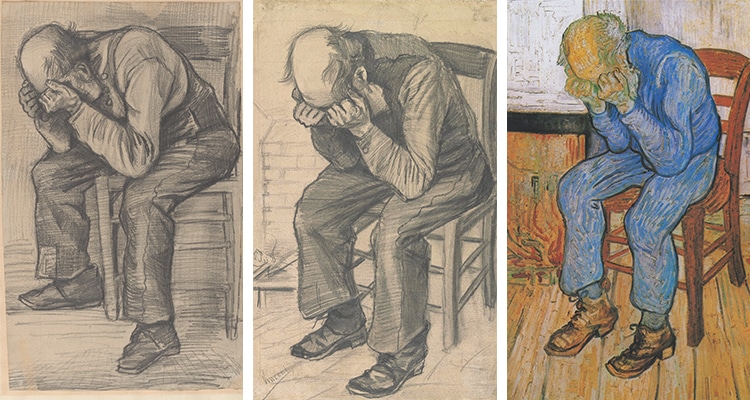
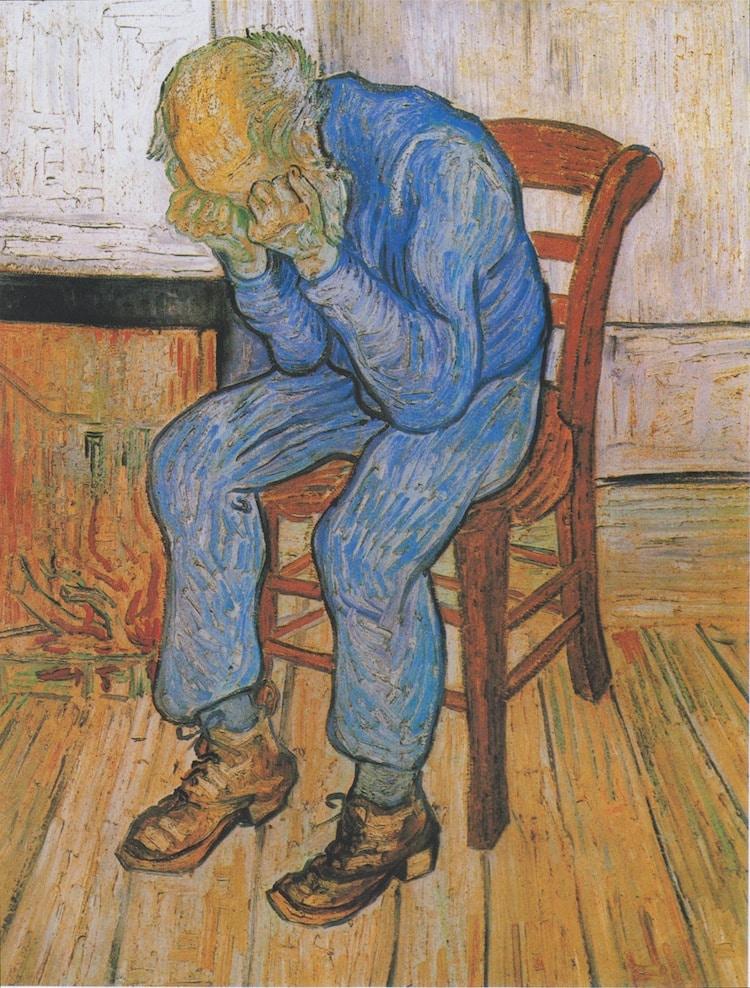
Having been dead for more than 130 years now, Vincent van Gogh seldom comes up with a new piece of work. But when he does, you can be sure it will draw the art world’s attention as few works by living artists could. Such has been the case with the newly discovered Study for Worn Out, an 1882 sketch that recently came into possession of the Van Gogh Museum, according to Margherita Cole at My Modern Met, “when a Dutch family requested that specialists take a look at their unsigned drawing.” The figure in the drawing strongly resembles the one in van Gogh’s 1890 painting At Eternity’s Gate. But it took the experts at the museum to determine that the artist was none other than van Gogh himself.
“Today and yesterday I drew two figures of an old man with his elbows on his knees and his head in his hands,” wrote the 29-year-old van Gogh to his brother in a letter from 1882. “What a fine sight an old working man makes, in his patched bombazine suit with his bald head.” The immediate fruit of these labors was the pencil drawing Worn Out, for which “the artist employed one of his favorite models, an elderly man named Adrianus Jacobus Zuyderland who boasted distinctive sideburns (and who appears in at least 40 of van Gogh’s sketches from this period).” So writes Smithsonian.com’s Nora McGreevy, who adds that van Gogh revisited the work to adapt it as a painting “just two months before his death” in an asylum near Saint-Rémy-de-Provence.
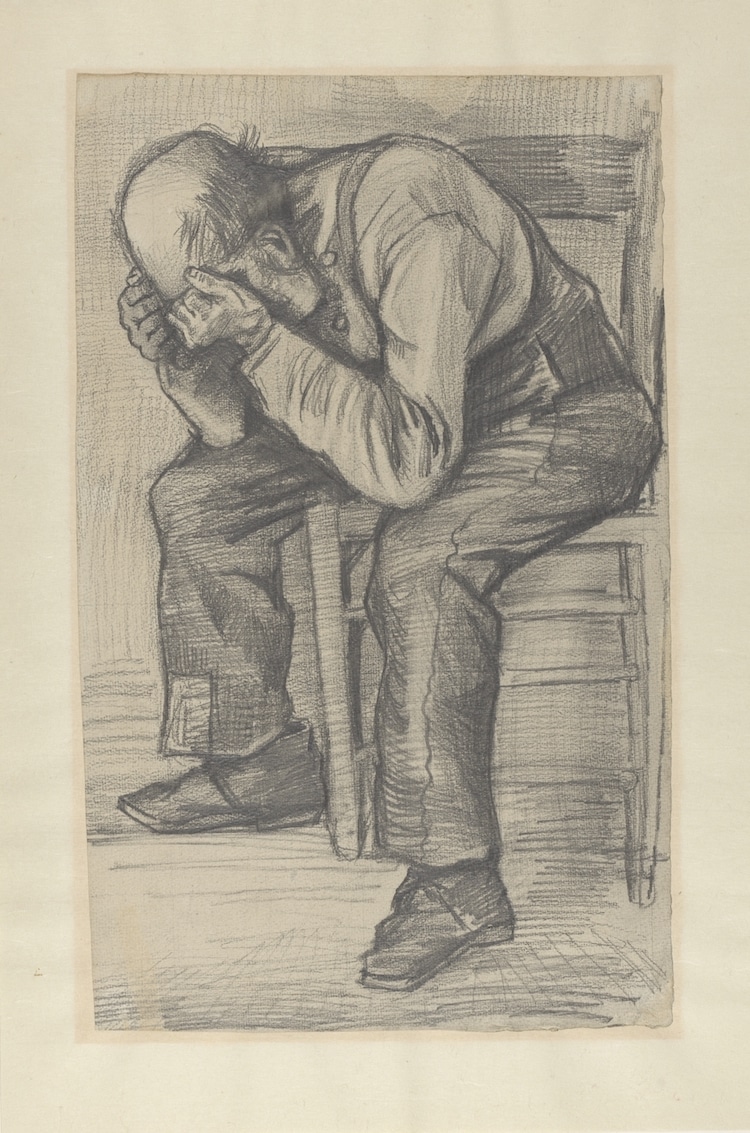
“In drawings like these,” says the Van Gogh Museum, “the artist not only displayed his sympathy for the socially disadvantaged — no way inferior in his eyes to the well-to-do bourgeoisie — he actively called attention to them too.” Another aim with Worn Out, adds McGreevy, was “to seek employment at a British publication, but he either failed to follow through on this idea or had his work rejected.” This would have counted as just another seeming instance of failure, the likes of which characterized the painter’s short life. Little could he, his correspondents, or his models have imagined that his works would one day become some of the most famous in the world — and certainly not that one of his sketches would go on to be enshrined well over a century later, as it has been since last Friday at the museum that bears his name.
via My Modern Met
Related Content:
Download Hundreds of Van Gogh Paintings, Sketches & Letters in High Resolution
Experience the Van Gogh Museum in 4K Resolution: A Video Tour in Seven Parts
Based in Seoul, Colin Marshall writes and broadcasts on cities, language, and culture. His projects include the Substack newsletter Books on Cities, the book The Stateless City: a Walk through 21st-Century Los Angeles and the video series The City in Cinema. Follow him on Twitter at @colinmarshall or on Facebook.
Read More...Hear the Brazilian Metal Band Singing in–and Trying to Save–Their Native Language of Tupi-Guarani
The indigenous languages spoken in Brazil number around 170, a testament to the survival of tribal communities nearly wiped out by colonialism and commerce. Yet 40 of those languages have fewer than 100 speakers, and many more are declining rapidly. For linguists, “it’s a fight against time,” Luisi Destri writes at Pesquisa. Researchers estimate most, if not all, of these languages could disappear within 50 to 100 years, and some believe 30 percent might fade in the next 15 years.
“Knowledge is passed down from generation to generation,” says Luciano Storto, professor of linguistics at the University of São Paulo, “mainly through narratives told by the oldest and most experienced to the community’s youngest members.” What happens when those younger generations are uprooted and leave home. When their elders die without passing on their knowledge? (What happens to language in general as the linguistic gene pool shrinks?) These questions weighed on Zhândio Aquino in 2004 when he founded Brazilian metal band Arandu Arakuaa.
Aquino has a degree in pedagogy and his band has been invited to play in schools and lecture at universities. But they do not use indigenous instrumentation and sing in an indigenous Tupi-Guarani language as a purely academic exercise. Raised in the northern state of Tocantins and descended from a Guarani-speaking tribe, the guitarist and singer says, “I [had] very close contact with indigenous culture because of my grandmother and classmates. When I [began] playing in bands, it just felt natural to put my background on it.”
When he moved to Brasilia in 2004, Aquino searched for like-minded musicians and formed what may be the country’s first folk metal band. While folk metal as a category is hardly new (metal has always incorporated elements of folk music, from its earliest incarnations in Black Sabbath and Led Zeppelin to the bleakest of Scandinavian black metal bands), most folk metal has been European (and Pagan or Viking or Pirate), and some of it has allied, sadly, with the same fascist movements that threaten indigenous existence.
While Arandu Arakuaa — the name translates to “cosmos knowledge” — may be one of the first folk metal bands in Brazil, it isn’t the only one. Along with bands like Aclla, Armahda, and Tamuya Thrash Tribe, the band is part of a movement called the Levante do Metal Nativo, or Native Metal Uprising, a collection of musicians using native instruments, themes, and languages — or all three in the case of Arandu Arakuaa, who incorporate maracas and the guitar-like viola caipira.
How do acoustic indigenous folk and the electric crunch and growl of metal come together? Hear for yourself in the videos here. Aquino knows Arandu Arakuaa doesn’t win everyone over at first. “People are not indifferent to our music,” he says. “They will love it or hate it. Most people think it’s strange at first and then we have to prove that we are good.”
While intelligible lyrics are hardly necessary in metal, the language barrier may turn some listeners away. But subtitled videos help. Arandu Arakuaa might seem to have a different focus than most metal bands, but in songs like “Red People,” we hear the rage and the resistance to war and depredation that bands like Black Sabbath, Iron Maiden, and Metallica — all influences on the Brazilian band –have channeled in their music:
Some of us ran away, we hide in the forest
We still fight
The red people still resisting, while there is land, while there is forest
Everything became different
Our spirits are called demons
Each day less trees, less animals, less histories, less songs…
Related Content:
Native Lands: An Interactive Map Reveals the Indigenous Lands on Which Modern Nations Were Built
Josh Jones is a writer and musician based in Durham, NC. Follow him at @jdmagness
Read More...Support Us
We're hoping to rely on loyal readers, rather than erratic ads. Please click the Donate button and support Open Culture. You can use Paypal, Venmo, Patreon, even Crypto! We thank you!

About Us

Open Culture scours the web for the best educational media. We find the free courses and audio books you need, the language lessons & educational videos you want, and plenty of enlightenment in between.
Advertise With Us

FREE UPDATES!
GET OUR DAILY EMAIL
Get the best cultural and educational resources on the web curated for you in a daily email. We never spam. Unsubscribe at any time.
FOLLOW ON SOCIAL MEDIA

Open Culture editor Dan Colman scours the web for the best educational media. He finds the free courses and audio books you need, the language lessons & movies you want, and plenty of enlightenment in between.
Advertise With Us

