Art History School: Learn About the Art & Lives of Toulouse-Lautrec, Gustav Klimt, Frances Bacon, Edvard Munch & Many More
Artist and videographer Paul Priestly is an enthusiastic and generous sort of fellow.
His free online drawing tutorials abound with encouraging words for beginners, and he clearly relishes lifting the curtain to reveal his home studio set up and self designed camera rig.
But we here at Open Culture think his greatest gift to home viewers are his Art History School profiles of well-known artists like Henri de Toulouse-Lautrec and Vincent Van Gogh.
An avid storyteller, he’s drawn to those with tragic histories — the decision to pivot from impersonating the artist, as he did with Van Gogh, to serving as a reporter interested in how such details as syphilis and alcoholism informed lives and careers is a wise one.
Priestly makes a convincing case that Lautrec’s aristocratic upbringing contributed to his misery. His short stature was the result, not of dwarfism, but Pyknodysostosis (PYCD) a rare bone weakening disease that surely owed something to his parents’ status as first cousins.
His appearance made him a subject of lifelong mockery, and ensured that the freewheeling artist scene in Montmartre would prove more welcoming than the blueblood milieu into which he’d been born.
Priestly makes a meal of that Demi-monde, introducing viewers to many of the players.
He heightens our appreciation for Lautrec’s masterpiece, At the Moulin Rouge, by briefly orienting us to who’s seated around the table: writer and critic Édouard Dujardin, dancer La Macarona, photographer Paul Secau, and “champagne salesman and debauchee” Maurice Guibert, who earlier posed as a lecherous patron in Lautrec’s At the Café La Mie.
Queen of the Cancan La Goulue hangs out in the background with another dancer, the wonderfully named La Môme Fromage.
Lautrec places himself squarely in the mix, looking very much at home.
Consider that these names, like those of frequent Lautrec subjects acrobatic dancer Jane Avril and chanteuse Yvette Guilbert were as celebrated in Belle Epoque Montmartre as many of the painters Lautrec rubbed shoulders with — Degas, Pissarro, Cézanne, Van Gogh and Manet.
In an article in The Smithsonian, Paul Trachtman recounts how Lautrec discovered the model for Manet’s famous nude Olympia, Victorine Meurent, “living in abject poverty in a top-floor apartment down a Montmartre alley. She was now an old, wrinkled, balding woman. Lautrec called on her often, and took his friends along, presenting her with gifts of chocolate and flowers — as if courting death itself.”
Meanwhile Degas sniffed that Lautrec’s studies of women in a brothel “stank of syphilis.”
Perhaps Priestly will delve into Degas for an upcoming Art History School episode … there’s no shortage of material there.
Above are three more of Paul Priestly’s Art History School profiles that we’ve enjoyed on Frances Bacon, Edvard Munch and Gustav Klimt. You can subscribe to his channel here.
Related Content:
Art Historian Provides Hilarious & Surprisingly Efficient Art History Lessons on TikTok
Free Art & Art History Courses
Ayun Halliday is an author, illustrator, theater maker and Chief Primatologist of the East Village Inky zine. Follow her @AyunHalliday.
Read More...Darth Vader’s Voice: The Original Voice Versus the Vocals of James Earl Jones
The hulking black-caped figure, “a walking iron lung,” as George Lucas called him in 1977, Darth Vader more than rightly tops a list of the 50 best movie villains of all time as the “gold standard of villainy,” but it took more than inspired costuming to make him so. Vader is a composite creation of several different talents. The quality by which we most know (and fear) him – the booming voice that commands and kills from afar — came, of course, from James Earl Jones. As one of the 20th century’s greatest actors, it’s fair to say that Jones not only provided Vader’s voice, but he also provided the villains soul, inasmuch as the Sith Lord had one left.
Although he redeemed himself at the end of Return of the Jedi, Vader’s humanity was an open question throughout most of the trilogy. When he “naturally … wanted to make Darth Vader more interesting, more subtle, more psychologically oriented,” Jones says,” Lucas reportedly replied, “No, no. What we’re finding out is you’ve got to keep his voice on a very narrow band of inflection because he ain’t human, really.”
While he worried about casting the only Black actor in the first Star Wars film in the role of a dehumanized villain, Lucas ultimately decided that no one else, not even Orson Welles, could convey Vader’s serious intent.
But first, actor David Prowse understandably thought he had the role when he put on the heavy black suit, helmet, and cape. Best known for his role as the Green Cross Code Man, a well-loved public service announcement hero in the UK, the former bodybuilder Prowse performed Vader’s lines from inside the costume, his voice muffled, as you can hear in the clips above, by the mask. During the filming of Star Wars: A New Hope, Prowse was told that Vader’s lines would be re-recorded. He did not know that someone else would play the role.
Jones himself asked for no credit and did not receive any until Return of the Jedi. Paid $7,500, he thought of the 2 ½ hours spent in the recording booth for the first film as “just special effects.” (The real effects artist, sound designer Ben Burtt, created Vader’s iconic mechanical breathing sound by syncing recordings of his scuba gear to Jones’ breaths.) Jones once told Star Wars Insider that David Prowse “is Vader.” And while the six-foot-seven Prowse, who passed away last November, might have been perfectly cast as the imposing form, no one on set could hear him as Darth Vader.
“With a strong Devonshire accent that earned him the nickname ‘Darth Farmer’ from the crew,” Force Material notes, “the reality is that Dave Prowse was never going to be called upon to provide the voice of Darth Vader.” We might digress on the distribution of accents in the Star Wars universe. Maybe Prowse wasn’t the right Englishman to play the part, but why didn’t Lucas cast another British actor, as he had for every other major bad guy in the film, beginning a tradition that continues in Star Wars movies and related media over forty years later?
There’s hardly any question. No one can command attention with his voice like James Earl Jones. And perhaps no other actor could give such enduringly human menace to a character described by its creator as a walking iron lung.
Related Content:
James Earl Jones Reads Edgar Allan Poe’s “The Raven” and Walt Whitman’s “Song of Myself”
The Original Star Wars Trilogy Adapted into a 14-Hour Radio Drama by NPR (1981–1996)
Josh Jones is a writer and musician based in Durham, NC. Follow him at @jdmagness
Read More...Meet Brushy One String, the One String Guitar Player Who Will Blow Your Mind
When Jamaican musician Andrew Chin, better known as Brushy One String first told friends about his vision — “a dream in which he was told to play the one-string guitar” — they responded with mockery — all but one, who “insisted it was fate,” writes Playing for Change, “and that he had to make that dream come true.” So Brushy set out to do just that, playing on streetcorners and in the market, “in a big broad hat and sunglasses,” he says. The music came to him naturally. He is no ordinary street musician, however, and his one-string guitar is not a gimmick. Brushy is a talented singer-songwriter, with a powerful voice and a musical sensibility that transcends his bare-bones minimalism.
He doesn’t look particularly flashy, perched on the street with his beat-up guitar in the video at the top for “Chicken in the Corn.” Brushy came of age in a scene “where most performers long to be hip-hop MCs or dancehall style DJs.”
Brushy’s one-string technique reaches back to the origins of the blues in the Diddley Bow (from which Bo Diddley took his name), and even further back into musical history, recalling what musicologists would call a “monochord zither.” One-string players in history have included Mississippi bluesman Eddie “One String” Jones, Lonnie Pitchford, and Willie Joe Duncan, who invented the Unitar, an electrified one-string guitar and scored a hit in the 1950s.
Whether or not Brushy fits himself into this tradition, he “came by his musical abilities honestly,” playing a reggae infused soul-meets-Delta Blues inspired by his parents. His father was Jamaican soul singer Freddy McKay and his mother, Beverly Foster, toured as a backup singer with Tina Turner. Unfortunately, he was orphaned at a young age and unable to finish his education. He didn’t learn to read at all until he became an adult. Brushy tried to learn guitar, but “I didn’t really know how to play,” he says, “and I played so hard, all the strings broke. So the guitar went under the bed” until his one string epiphany. As he began to sing and play, his one, low‑E string and the wooden body of his acoustic guitar became a rhythm section, his expansive voice rising up between beats, “a voice so rich and full,” NPR writes, “all it wants is a bit of rhythmic and melodic underpinning.”
Brushy names both soul legend Teddy Pendergrass and dancehall legend Shabba Ranks as influences, a key to the range of his songwriting, which comes “from the situations I’m in,” he says. “It’s like magic: From the situation, I don’t search for something, not in my head or nowhere else. The song just comes.” He had some early modest success, did a tour of Japan, then returned to his hometown of Ochoa Rios to kick around and play locally. It was then that filmmaker Luciano Blotta encountered him while finishing the 2007 Jamaican music documentary, Rise Up. “Chicken in the Corn” made the soundtrack, and it turned into Brushy’s big break.
He’s since played South by Southwest, New Orleans House of Blues, and the New Orleans Jazz & Heritage Festival, had a documentary made about him — The King of One String (2014) — and released three studio albums and a live album. It’s well deserved success for a musician who was ready to quit music until he had a dream — and who then found the courage (and the good luck) to make it real.
Related Content:
Keith Richards Shows Us How to Play the Blues, Inspired by Robert Johnson, on the Acoustic Guitar
The History of the Guitar: See the Evolution of the Guitar in 7 Instruments
The Encyclopedia Of Alternate Guitar Tunings
Josh Jones is a writer and musician based in Durham, NC. Follow him at @jdmagness
Read More...The Velvet Underground: Get a First Glimpse of Todd Haynes’ Upcoming Documentary on the Most Influential Avant-Garde Rockers
To the question of the most influential band formed in the 1960s a list of easy answers unfolds, beginning with the Beatles, the Beach Boys, and the Rolling Stones. As three of the makers of the best-selling records of all time, those bands all lay fair claim to the title. But even within the commercial dynamo of postwar America, it was also possible to exert great influence without topping the charts, or indeed without even reaching them. This is proven by the story of avant-garde rockers the Velvet Underground, whose meager success in their day as compared with their formidable cultural legacy inspired Brian Eno to sum them up with a quip now so well-known as to have become a cliché.
But not even a mind like Eno’s can truly sum up the Velvet Underground. Better to tell the band’s story — the story, in its way, of art and popular culture in mid-to-late 20th-century America — in a feature-length documentary, as Todd Haynes has done with The Velvet Underground, which premiered at this year’s Cannes Film Festival and debuts on AppleTV+ on October 15th.
“Haynes appears to have vacuumed up every last photograph and raw scrap of home-movie and archival footage of the band that exists and stitched it all into a coruscating document that feels like a time-machine kaleidoscope,” writes Variety critic Owen Gleiberman. He introduces the Velvets and their associates “by playing their words off the flickering black-and-white images of their Warhol screen tests.”
The Velvets were, in a sense, a product of Warhol’s Factory. The pop-art icon managed the band himself early on, connecting them with the singer who would become the second titular figure on their debut The Velvet Underground & Nico and designing that album’s oft-visually-referenced banana-sticker cover. Having died in 1987, Warhol couldn’t grant Haynes an interview; having followed Warhol the next year, neither could Nico. Band leader Lou Reed, too, has now been gone for the better part of a decade, but he does have plenty to say in the 1986 South Bank Show documentary above. Haynes’ The Velvet Underground includes Reed in archival footage, but also features new reminiscences from surviving members like Maureen Tucker and John Cale. Like all human beings, the Velvets are mortal; but their expansion of rock’s sonic possibilities will outlast us all.
Related Content:
The Velvet Underground Captured in Color Concert Footage by Andy Warhol (1967)
Based in Seoul, Colin Marshall writes and broadcasts on cities, language, and culture. His projects include the Substack newsletter Books on Cities, the book The Stateless City: a Walk through 21st-Century Los Angeles and the video series The City in Cinema. Follow him on Twitter at @colinmarshall or on Facebook.
Read More...The Evolutionary History of Fat: Biologists Explain Why It’s Necessary for Our Survival & Why We’re Biased Against It
The Fat Acceptance movement may seem like a 21st century phenomenon, rising to public consciousness with the success of high-profile writers, actors, filmmakers, and activists in recent years. But the movement can date its origins to 1967, when WBAI radio personality Steve Post held a “fat-in” in Central Park, bringing 500 people together to protest, celebrate, and burn diet books and photos of Twiggy. “That same year,” notes the Center for Discovery, “a man named Llewelyn ‘Lew’ Louderback wrote an article for the Saturday Evening Post titled, ‘More People Should be FAT.’” These early sallies led to the founding of the National Association to Advance Fat Acceptance (NAAFA) two years later and more radical groups in the 70s like the Fat Underground.
There would be no need for fat activism, of course, if there were no biases against fat people. This raises the question: where did those biases come from? They are not innate, says Harvard University evolutionary biologist Daniel Lieberman in the Slate video above, but are a product of a history that tracks, coincidentally, with the rise of mass marketing and mass consumerism. We have been sold the idea that thin bodies are better, healthier, more attractive, and more desirable, and that fat is something to be warred against. “However, as an evolutionary biologist, “says Lieberman, I’ve come to appreciate that without fat, we’d be dead. Humans wouldn’t really be the way we are. Fat is really life.”
A quick perusal of art history shows us that larger bodies have been valued around the world in much of human history. We now associate fat with poor health, but it has also signaled the opposite — a storehouse of caloric wealth and healthy fertility. “Our bodies have all sorts of tricks to make sure we never run out of energy,” says Lieberman, “and the main way that we store energy is fat.” Leiberman and other biologists in the video survey the role of fat in human survival and thriving. “Fat is an organ,” and scientists are learning how it communicates with other systems in the body to regulate energy consumption and feed our comparatively enormous brains.
Among animals, “humans are especially adapted to be fat.” Even the thinnest among us are corpulent compared to most primates. Still, the average human did not have any opportunity to become obese until relatively recent historical developments — in the grand evolutionary scheme of things — like agriculture, heavy industry, and the science to preserve and store food. When Europeans discovered sugar, then mass produced it on plantations and exported it around the world, sugar consumption magnified exponentially. The average American now eats 100 pounds of sugar per year. The average hunter-gatherer might have struggled the eat “a pound or two a year” from natural sources.
The over-abundance of calories has led to a type-II diabetes epidemic worldwide that is closely related to sugar consumption. It isn’t necessarily related to having a larger body, although fat deposits in the heart and elsewhere can worsen insulin resistance (and heart disease); the problem is almost certainly linked to excess sugar, the constant availability of high-calorie foods, and low incentives to exercise. Our hunger for sweets and love of comfort are not character flaws, however. They are evolutionary drives that allow us to acquire and conserve energy, operating in a food economy that often punishes us for those very drives. Dieting not only doesn’t work, as neuroscientist Sandra Aamodt explains in her TED Talk above, but it often backfires, making us even hungrier because our brains perceive us as deprived.
As scientists like Lieberman gain a better understanding of the role of fat in human biology, those in the medical community are realizing that doctors and nurses are hardly free from the societal biases against fat. Studies show those biases can translate to poorer medical care and bad advice about dieting, a vicious cycle in which health conditions unrelated to weight go untreated, and are then blamed on weight. Evolutionary biology explains the role of fat in human development, and human history explains its increase, but the question of where the hatred of fat comes from is a trickier one for these scientists to answer. They barely mention the role of advertising and entertainment.
In 1979, activists in the “Fat Liberation Manifesto” identified the problem as fat people’s “mistreatment by commercial and sexist interests” that have “exploited our bodies as objects of ridicule, thereby creating an immensely profitable market selling the false promise of avoidance of, or relief from, that ridicule.” Despite decades of resistance, the diet industry thrives. A Google search of the phrase “body fat” yields page upon page of unscientific advice about ideal body fat percentages, as though reminding the majority of Americans (7 in 10 are classified as overweight or obese) that they should feel there’s something wrong with them.
Blame, shame, and ridicule won’t solve medical problems, say the biologists in the video above, and it certainly doesn’t help people lose weight, if that’s what they need to do. If we better understood the role of fat in keeping us healthy, happy, and alive, maybe we could overcome our hatred of it and accept others, and ourselves, in whatever bodies we’re in.
Related Content:
How the Food We Eat Affects Our Brain: Learn About the “MIND Diet”
Exercise May Prove an Effective Natural Treatment for Depression & Anxiety, New Study Shows
Why Sitting Is The New Smoking: An Animated Explanation
Josh Jones is a writer and musician based in Durham, NC. Follow him at @jdmagness
Read More...The Wicked Scene in Amadeus When Mozart Mocked the Talents of His Rival Antonio Salieri: How Much Does the Film Square with Reality?
Pity the ghost of Antonio Salieri, “one of history’s all-time losers — a bystander run over by a Mack truck of malicious gossip,” writes Alex Ross at The New Yorker. The rumors began even before his death. “In 1825, a story that he had poisoned Mozart went around Vienna. In 1830, Alexander Pushkin used that rumor as the basis for his play ‘Mozart and Salieri,’ casting the former as the doltish genius and the latter as a jealous schemer.” The stories became further embellished in an opera by Nikolai Rimsky-Korsakov, then again in 1979 by British playwright Peter Shaffer, whose Amadeus, “a sophisticated variation on Pushkin’s concept, …became a mainstay of the modern stage.”
In 1984, these fictions became the basis of Miloš Forman’s Amadeus, written by Shaffer for the screen. The film further solidifies Salieri’s villainy in F. Murray Abraham’s Oscar-winning performance of his envy and despair. Like all great cinematic villains, Salieri is shown to have good reason for his hatred of the hero, played as a manic toddler by Thomas Hulce, who was nominated for the same best-actor award Abraham won. In their first meeting (above), Mozart humiliates Salieri in the presence of the Emperor, insulting him several times and showing that Salieri’s years of toil and devotion are worth little more than what the German prodigy mastered as a small child, and could improve upon immeasurably with hardly any effort at all.
Is there truth to this scene? In general, the history of Amadeus is “laughably wrong,” Alex von Tunzelmann writes at The Guardian, though maybe the joke’s on us if we believe it. As Forman’s film takes pains to show, what we see on screen is not an objective point of view, but that of an aged, embittered, insane man remembering his past with regret. Salieri is a most unreliable narrator, and Forman an unreliable storyteller. The supposed “Welcome March” composed for Mozart in the scene above is not a Salieri composition at all, but a simplification of the aria from Mozart’s The Marriage of Figaro, which Hulce-as-Mozart then transforms into the actual tune of the aria.
Other inaccuracies abound. The Salieri of history was not “a sexually frustrated, dried-up old bachelor,” von Tunzelmann notes. “He had eight children by his wife, and is reputed have had at least one mistress.” He was also more colleague and friendly competitor than enemy of the newly-arrived Mozart in Vienna. The two even composed a piece together for singer Nancy Storace, who played the first Susanna in The Marriage of Figaro. While Mozart wrote to his father of a shadowy cabal arrayed against him at court, there is no evidence of a plot, and Mozart could be, by all accounts, just as puerile and obnoxious as his portrayal in the film.
Mozart did die a pauper from a mysterious illness at 34. (He did not dictate the final passages of his Requiem to Salieri). And Salieri did later confess to poisoning Mozart while he was aged and in a temporary state of mental illness, then retracted the claim when he later recovered. (“Let’s be honest,” writes von Tunzelmann, “nobody seriously thinks Salieri murdered Mozart.”) These are the barest historical facts upon which Amadeus’s infamous rivalry rests. The Salieri of the film is a fictional construction, created, as actor Simon Callow said of Shaffer’s play, to serve “a vast meditation on the relationship between genius and talent.”
In Forman’s film, the theme becomes the relationship between genius and mediocrity. But to call Salieri a mediocrity — or the “patron saint of mediocrities,” as Shaffer does in his play — “sets the bar for mediocrity too high,” Ross argues. “His music is worth hearing. Mozart was a greater composer, but not immeasurably greater.” Furthermore, “amid the procession of megalomaniacs, misanthropes, and basket cases who make up the classical pantheon, [Salieri] seems to have been one of the more likable fellows.”
Learn more about Salieri’s life and work in Ross’s New Yorker profile, and hear “4 Operas by Antonio Salieri You Should Listen To” at Opera Wire.
Related Content:
Mozart’s Diary Where He Composed His Final Masterpieces Is Now Digitized and Available Online
The Letters of Mozart’s Sister Maria Anna Get Transformed into Music
Josh Jones is a writer and musician based in Durham, NC. Follow him at @jdmagness
Read More...How Caffeine Fueled the Enlightenment, Industrial Revolution & the Modern World: An Introduction by Michael Pollan
According to the current research, caffeine, “contributes much more to your health than it takes away.” These words come from a thinker no less vigilant about the state of food-and-drink science than Michael Pollan, and perhaps they’re all you feel you need to know on the subject. In fact, you’re probably taking in some form of caffeine even while reading this now. I know I’m doing so while writing it, and this, according to the Pollan-starring Wired video above, gives us something in common with the central figures of the Enlightenment. “Isaac Newton was a big coffee fan,” says Pollan, and Voltaire “apparently had 72 cups a day. I don’t know quite how you do that.”
The Enlightenment, the Age of Reason, and the Industrial Revolution also owe much to the intellectual and commercial churn of the coffee house, an institution that emerged in 17th-century London. “There were coffee houses dedicated to literature, and writers and poets would congregate there,” says Pollan.
“There was a coffee house dedicated to selling stock, and that turned into the London Stock Exchange eventually. There was another one dedicated to science, tied to the Royal Institution, where great scientists of the period would get together.” Consumed in dedicated houses or elsewhere, the “new, sober, more civil drink was changing the way people thought and the way they worked.”
The relevant contrast is with alcohol, once an element of practically all beverages in Europe. Before caffeine got there, “people were drunk or buzzed most of the day. People would have alcohol with breakfast” — children included, since it was still healthier than contaminated water. This custom hardly encouraged clear, linear thought; Diderot, Pollan tells us, wrote the Encyclopédie while drinking coffee, but imagine the result, if any, had he been drinking wine. More than a quarter-millennium later, we have solid evidence that caffeine “does improve focus and memory, and the ability to learn,” if at the cost of a decent night’s sleep. Not that this seems to have bothered coffee-pounding Enlightenment thinkers: what’s a little tossing and turning, after all, when there’s a worldview to be revolutionized?
Pollan elaborates on the role coffee plays in our lives in his new book, This Is Your Mind on Plants. And separately see his short audio book, Caffeine: How Caffeine Created the Modern World.
Related Content:
The Curious Story of London’s First Coffeehouses (1650–1675)
Philosophers Drinking Coffee: The Excessive Habits of Kant, Voltaire & Kierkegaard
“The Virtues of Coffee” Explained in 1690 Ad: The Cure for Lethargy, Scurvy, Dropsy, Gout & More
Based in Seoul, Colin Marshall writes and broadcasts on cities, language, and culture. His projects include the Substack newsletter Books on Cities, the book The Stateless City: a Walk through 21st-Century Los Angeles and the video series The City in Cinema. Follow him on Twitter at @colinmarshall or on Facebook.
Read More...Mattel’s Barbie Turns Women of Medicine, Including COVID Vaccine Developer, Into Dolls
The multinational toy manufacturer Mattel is encouraging youngsters to play doctor — not a euphemism — and honoring first responders with the recent release of three healthcare-themed “Career Barbies.”
The company is putting its money where its mouth is by donating $5 to the First Responders Children’s Foundation for every doctor, paramedic, or nurse Barbie purchased at Target through August 28.
Mattel has also identified six female healthcare pioneers whose efforts during the pandemic merit a one-of-a-kind Barbie who shares their likeness.
Vaccinologist Sarah Gilbert, who led the team that developed the Oxford/AstraZeneca vaccine, describes this unexpected honor as “a very strange concept” (presumably as compared to being awarded a damehood or receiving a standing ovation at Wimbledon.)
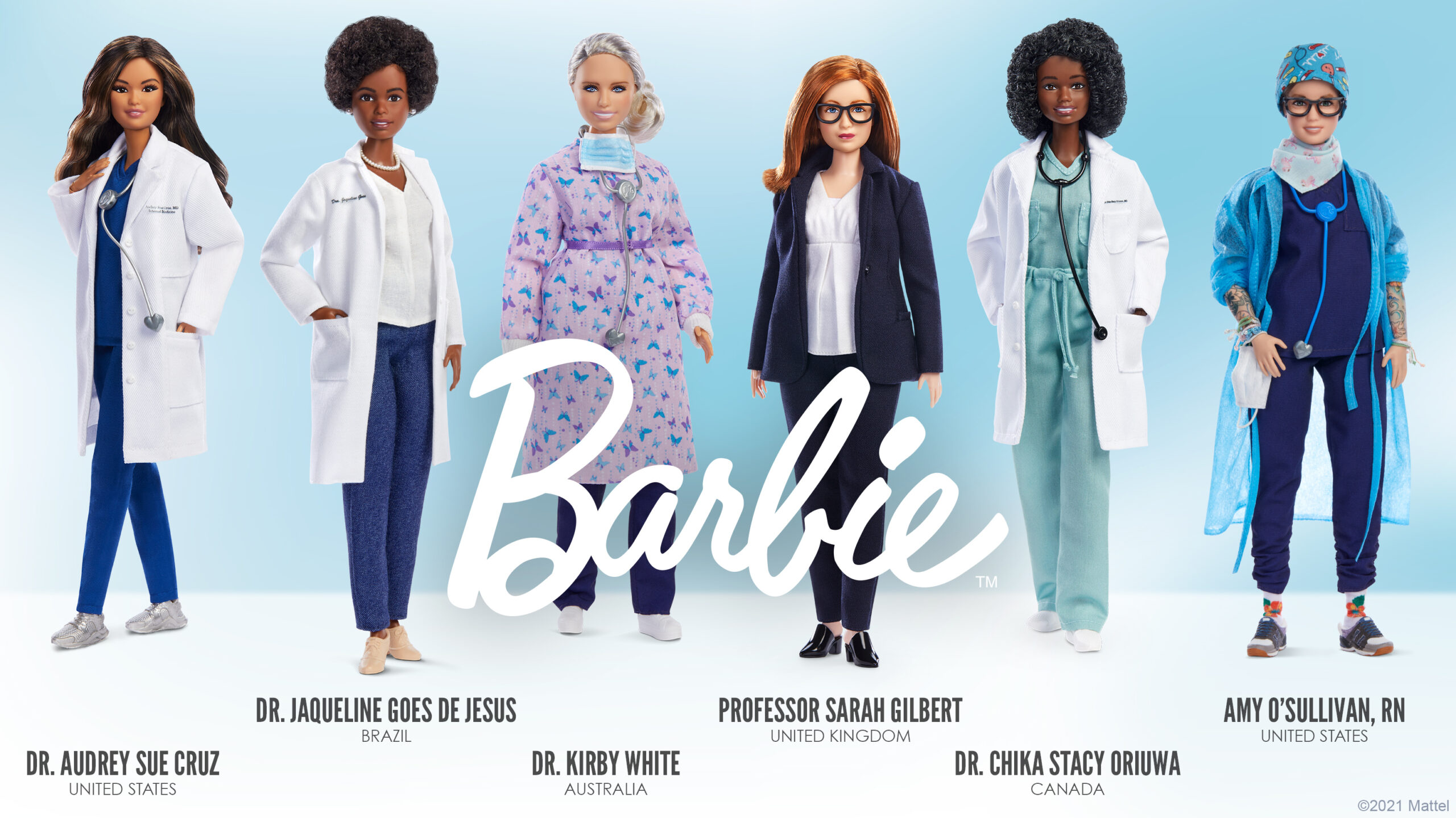
The 59-year-old Oxford University professor added that she hoped the characteristically smooth plastic doll would be “part of making it more normal for girls to think about careers in science, although, to be honest, when I was a young girl I never believed that I wouldn’t have a career in science.”
If the doll falls short of inspiring girls to consider a career in STEM, Women in Science & Engineering (WISE), the nonprofit organization Professor Gilbert chose to receive a donation from Mattel on her behalf, can take up the slack.
One of the most compelling of the six custom-made Front Line Responder Barbies is based on veteran nurse Amy O’Sullivan, a heavily tattooed, queer mother of three, who cared for the first COVID-19 patient (soon to become New York City’s first official COVID death) in Brooklyn’s Wycoff Hospital.
Soon thereafter, she survived being put on a ventilator with COVID herself, eventually winding up on the cover of Time Magazine, in the same neckerchief, floral socks, eye catching surgical cap and woven bracelets her tiny scrub-suited doppelganger wears.
Surely Amy O’Sullivan is a better all around role model than the similarly inked Tokidoki Barbie or Totally Tattoo Barbie, or for that matter, the non-custom made First Responder Nurse, whose description on Target’s website seems a bit retrograde, given the events of the last year and a half:
Wearing cute scrubs featuring a medical-tool print top, pink pants and white shoes, Barbie nurse doll (12-in/30.40-cm) is ready make her rounds and check on patients!
The real life O’Sullivan, who was very involved in the creation of her custom doll, seems tickled by Mattel’s faithful recreation, telling The New York Post:
When I was younger I always felt like an outsider — nobody ever looked like me, talked like me, walked like me. I had no role model at all when I was growing up. So if I can be some little girl’s role model that feels like this, I would love that.
Nurse O’Sullivan had stronger words for those who have aged out of the demographic, in a recent interview with Time:
I see these young people not wearing masks. And, you know, those are the people that COVID is affecting now, the younger generation. They’re becoming very sick. And it’s never going to go away until we get vaccinated and wear masks.
That might be a bit heavy for those on the younger end of Career Barbie’s recommended 3 and up age group (“especially those interested in caretaking and helping others!”), but hopefully her words will carry some weight with those responsible for protecting those children.
The other custom-made Barbies honor:
Dr. Audrey Cruz, who collaborated with other Asian-American physicians to battle anti-Asian-related bias springing from the pandemic
Canadian psychiatry resident at who battled systemic racism in healthcare a doctor in Las Vegas who is campaigning against racial bias against Asian-American physicians
University of Toronto psychiatry resident, Chika Stacy Oriuwa, whose activism includes creating initiatives to boost the number of Black students applying to medical school and create networks of support for scholarly and professional advancement within the Black community.
Biomedical researcher Dr Jaqueline Goes de Jesus whose team sequenced the SARS-CoV‑2 genome within 48 hours of receiving samples from the first infected Brazilian patient, differentiating the variant from the one that caused infections earlier in the pandemic.
Dr Kirby White, founder of Gowns for Doctors, an Australian initiative that addressed a nationwide shortage of personal PPE by delivering free, washable, volunteer-made reusable gowns to frontline staff.
Related Content:
Women Scientists Launch a Database Featuring the Work of 9,000 Women Working in the Sciences
Ayun Halliday is an author, illustrator, theater maker and Chief Primatologist of the East Village Inky zine.Follow her@AyunHalliday
Read More...
Make Body Language Your Superpower: A 15-Minute Primer on Body Language & Public Speaking from Stanford Business School
A few years ago, the idea of “power poses” — that is, physical stances that increase the dynamism of one’s personality — gained a great many adherents in a very short time, but not long thereafter emerged doubts as to its scientific soundness. Nevertheless, while standing with your hands on your hips may not change who you are, we can fairly claim that such a thing as body language does exist. And in that language, certain bodily arrangements communicate better messages than others: according to the presenters of the talk above, keeping your hands power-poseishly on your hips is actually a textbook bad public-speaking position, down there with shoving them in your pockets or clasping them before you in the dreaded “fig leaf.”
Now viewed well over 5.5 million times, “Make Body Language Your Superpower” was originally delivered as the final project of a team of graduate students at Stanford’s Graduate School of Business. That same institution gave us lecturer Matt Abrahams’ talk “Think Fast, Talk Smart,” which, with its 23 million views and counting, suggests its campus possesses a literal fount of public-speaking wisdom.
Working as a team, these students keep it short and simple, accompanying their talk with takeaway-announcing Powerpoint slides (“1. Posture breeds success, 2. Gestures strengthen our message, 3. The audience’s body matters too”) and even a video clip that vividly illustrates what not to do: in this case, with a fidgety, rotation-heavy turn on stage by Armageddon and Transformers auteur Michael Bay.
Though we can’t hear what Bay is saying, we couldn’t be blamed for assuming it’s not the truth. That owes not so much to the Hollywood penchant for dissimulation and hyperbole as it does to his particular stances, gestures, and perambulations, all of a kind that primes our subconsciousness to expect lies. “We all want to avoid our own Michael Bay moments when we communicate,” says one of the presenters, but even when we take pains to tell the truth, the whole truth, and nothing but the truth, the defensive postures into which many of us instinctively retreat can undercut our efforts. “Decoding Deceptive Body Language,” the talk just above, can help us learn both to identify the impression of dishonesty and to avoid giving it ourselves. Not that it’s always easy: as the example of Bill Clinton underscores in both these presentations, even master communicators have their slip-ups.
Related Content:
How to Spot Bullshit: A Primer by Princeton Philosopher Harry Frankfurt
How to Sound Smart in a TED Talk: A Funny Primer by Saturday Night Live‘s Will Stephen
Based in Seoul, Colin Marshall writes and broadcasts on cities, language, and culture. His projects include the Substack newsletter Books on Cities, the book The Stateless City: a Walk through 21st-Century Los Angeles and the video series The City in Cinema. Follow him on Twitter at @colinmarshall or on Facebook.
Read More...Inside MK-Ultra, the CIA’s Secret Program That Used LSD to Achieve Mind Control (1953–1973)
If the CIA ever wants to change its motto to something hip and trendy that the kids’ll like, may I suggest “f*ck around and find out”? Because in this above mini-doc on the secret LSD mind-control experiments known as MK-Ultra (1953–1973), they were certainly doing a lot of the former, and then they took a lot of the latter and sent it down the old memory hole.
Could the Soviets be developing mind-control programs? The CIA, as several of these accounts tell us, became convinced they were. However, it’s never specified why they were convinced. Could it be a bit of guilt for hiring some ex-Nazi (and/or Nazi supporting) German scientists through Operation Paperclip? Or was this all just a cover because the CIA really wanted to experiment with mind control? I mean, it’s 70 years later, you can admit it. There were all these new drugs being developed that altered the mind, so why not start there?
Top among the cornucopia of pharmacologica was lysergic acid diethylamide, and the man who knew LSD the best was Dr. Sidney Gottlieb, the “Poisoner in Chief” as his biographer Stephen Kinzer calls him. (See his book: Poisoner in Chief: Sidney Gottlieb and the CIA Search for Mind Control.) Raised in the Bronx, Gottlieb’s love of chemistry and science earned him a prestigious place at CalTech. By the end of the 1940s he had been recruited by the CIA.
Gottlieb’s paradox was his love of LSD. He took it more than 200 times. He tended towards Buddhism, not surprising for those whose mind has been expanded by psychedelics. And he lived like a proto-hippie, growing his own vegetables and living “off the grid” for a while with his family. Yet at the same time, he had no problems with absolute devilish behavior. Once he convinced the CIA to buy up the world’s supply of LSD, he set to work. He’d dose colleagues with massive amounts and only tell them afterwards. He’d conduct experiments on sex workers, prisoners, or people with terminal illness. Many didn’t know what they were signing up for. The LSD in heavy doses were meant to annihilate the mind, and allow a new mind to be put in place. That didn’t work out that well, but Gottlieb and associates kept trying, under the aegis of then-CIA director Allen Dulles and Chief of Operations Richard Helms. In reality, Dulles and others high up in the CIA had a hands-off approach. Better not to know what Gottlieb was up to, especially when it went against the Nuremberg Code of experimenting on people against their will–the very things the Nazis did.
There were many victims too, corpses that were the cost of doing business in the Cold War, and so many we will not know about. The highest profile death—and what pulled MK-Ultra out of obscurity—was government scientist Frank Olsen. His jump from a NYC hotel room was ruled a suicide by the government, a result of work stress. (The whole Olsen affair forms the backbone of Errol Morris’ 2017 documentary series Wormwood.) The uncovering of the truth helped expose the history of MK-Ultra to a mid-‘70s America that had lost faith in its government and was ripe for conspiracy theories to take hold.
Yes, MK-Ultra was an actual thing. But because Gottlieb and his bosses had destroyed most of the records, conspiracy theories filled in the gaps. Were Lee Harvey Oswald and Sirhan Sirhan MK-Ultra experiments gone wrong? What about Charles Manson, who author Tim O’Neill discovered was a “lab rat” for CIA experiments? Mobster Whitey Bulger was part of a LSD experiment and the FBI let him continue to commit crimes. The future Unabomber Ted Kaczynski had taken part in “brutal” psychological experiments while at Harvard.
On the other hand, the MK-Ultra experiments also affected culture in a good way. Allen Ginsberg tried his first dose in Northern California, as did Ken Kesey, who came out of it a proponent of LSD and formed the nascent hippie movement.
Gottlieb retired in 1972, and MK-Ultra’s results were lacking in any practical results. In 1999, Gottlieb passed away from unknown causes. Possibly a heart attack…but who knows, right?
Related Content:
Hofmann’s Potion: 2002 Documentary Revisits the History of LSD
Ken Kesey’s First LSD Trip Animated
Ken Kesey Talks About the Meaning of the Acid Tests
Ted Mills is a freelance writer on the arts who currently hosts the Notes from the Shed podcast and is the producer of KCRW’s Curious Coast. You can also follow him on Twitter at @tedmills, and/or watch his films here.
Read More...Support Us
We're hoping to rely on loyal readers, rather than erratic ads. Please click the Donate button and support Open Culture. You can use Paypal, Venmo, Patreon, even Crypto! We thank you!

About Us

Open Culture scours the web for the best educational media. We find the free courses and audio books you need, the language lessons & educational videos you want, and plenty of enlightenment in between.
Advertise With Us

FREE UPDATES!
GET OUR DAILY EMAIL
Get the best cultural and educational resources on the web curated for you in a daily email. We never spam. Unsubscribe at any time.
FOLLOW ON SOCIAL MEDIA

Open Culture editor Dan Colman scours the web for the best educational media. He finds the free courses and audio books you need, the language lessons & movies you want, and plenty of enlightenment in between.
Advertise With Us

