Kurt Vonnegut’s Recipes in Deadeye Dick: Polka-Dot Brownies, Linzer Torte & Haitian Banana Soup
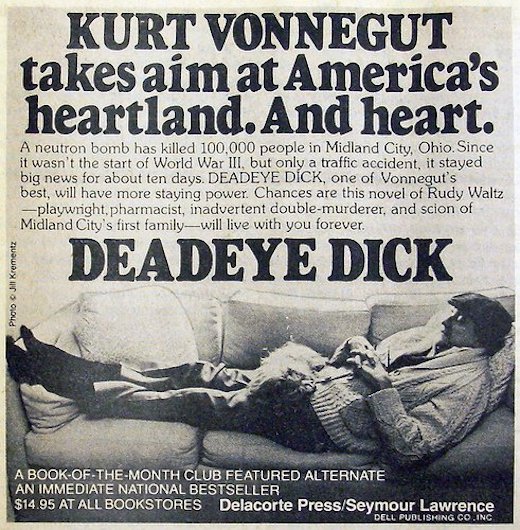
Author Kurt Vonnegut incorporated several recipes into his 1982 novel Deadeye Dick, inspired by James Beard’s American Cookery, Marcella Hazan’s The Classic Italian Cook Book, and Bea Sandler’s The African Cookbook.
He writes in the preface that these recipes are intended to provide “musical interludes for the salivary glands,” warning readers that “no one should use this novel for a cookbook. Any serious cook should have the reliable originals in his or her library anyway.”
So with that caveat in mind…
Early on, the narrator/titular character, née Rudy Waltz, shares a recipe from his family’s former cook, Mary Hoobler, who taught him “everything she knew about cooking and baking”:
MARY HOOBLER’S CORN BREAD
Mix together in a bowl half a cup of flour, one and a half cups of yellow corn-meal, a teaspoon of salt, a teaspoon of sugar, and three teaspoons of baking powder.
Add three beaten eggs, a cup of milk, a half cup of cream, and a half cup of melted butter.
Pour it into a well-buttered pan and bake it at four hundred degrees for fifteen minutes.
Cut it into squares while it is still hot. Bring the squares to the table while they are still hot, and folded in a napkin.
Barely two paragraphs later, he’s sharing her barbecue sauce. It sounds delicious, easy to prepare, and its placement gives it a strong flavor of Slaughterhouse-Five’s “so it goes” and “Poo-tee-weet?” — as ironic punctuation to Father Waltz’s full on embrace of Hitler, a seeming non sequitur that forces readers to think about what comes before:
When we all posed in the street for our picture in the paper, Father was forty-two. According to Mother, he had undergone a profound spiritual change in Germany. He had a new sense of purpose in life. It was no longer enough to be an artist. He would become a teacher and political activist. He would become a spokesman in America for the new social order which was being born in Germany, but which in time would be the salvation of the world.
This was quite a mistake.
MARY HOOBLER’S BARBECUE SAUCE
Sauté a cup of chopped onions and three chopped garlic cloves in a quarter of a pound of butter until tender.
Add a half cup of catsup, a quarter cup of brown sugar, a teaspoon of salt, two teaspoons of freshly ground pepper, a dash of Tabasco, a tablespoon of lemon juice, a teaspoon of basil, and a tablespoon of chili powder.
Bring to a boil and simmer for five minutes.
Rudy’s father is not the only character to falter.
Rudy’s mistake happens in the blink of an eye, and manages to upend a number of lives in Midland City, a stand in for Indianapolis, Vonnegut’s hometown.
His family loses their money in an ensuing lawsuit, and can no longer engage Mary Hoobler and the rest of the staff.
Young Rudy, who’s spent his childhood hanging out with the servants in Mary’s cozy kitchen, finds it “easy and natural” to cater to his parents in the manner to which they were accustomed:
As long as they lived, they never had to prepare a meal or wash a dish or make a bed or do the laundry or dust or vacuum or sweep, or shop for food. I did all that, and maintained a B average in school, as well.
What a good boy was I!
EGGS À LA RUDY WALTZ (age thirteen)
Chop, cook, and drain two cups of spinach.
Blend with two tablespoons of butter, a teaspoon of salt, and a pinch of nutmeg.
Heat and put into three oven-proof bowls or cups.
Put a poached egg on top of each one, and sprinkle with grated cheese.
Bake for five minutes at 375 degrees. Serves three: the papa bear, the mama bear, and the baby bear who cooked it—and who will clean up afterwards.
By high school, Rudy’s heavy domestic burden has him falling asleep in class and reproducing complicated desserts from recipes in the local paper. (“Father roused himself from living death sufficiently to say that the dessert took him back forty years.”)
LINZER TORTE (from the Bugle-Observer)
Mix half a cup of sugar with a cup of butter until fluffy.
Beat in two egg yolks and half a teaspoon of grated lemon rind.
Sift a cup of flour together with a quarter teaspoon of salt, a teaspoon of cinnamon, and a quarter teaspoon of cloves. Add this to the sugar-and-butter mixture.
Add one cup of unblanched almonds and one cup of toasted filberts, both chopped fine.
Roll out two-thirds of the dough until a quarter of an inch thick.
Line the bottom and sides of an eight-inch pan with dough.
Slather in a cup and a half of raspberry jam.
Roll out the rest of the dough, make it into eight thin pencil shapes about ten inches long. Twist them a little, and lay them across the top in a decorative manner. Crimp the edges.
Bake in a preheated 350-degree oven for about an hour, and then cool at room temperature.
A great favorite in Vienna, Austria, before the First World War!
Rudy eventually relocates to the Grand Hotel Oloffson in Port au Prince, Haiti, which is how he manages to survive the — SPOILER — neutron bomb that destroys Midland City.
Here is a recipe for chocolate seafoams, courtesy of one of Midland City’s fictional residents:
MRS. GINO MARTIMO’S SPUMA DI CIOCCOLATA
Break up six ounces of semisweet chocolate in a saucepan.
Melt it in a 250-degree oven.
Add two teaspoons of sugar to four egg yolks, and beat the mixture until it is pale yellow.
Then mix in the melted chocolate, a quarter cup of strong coffee, and two tablespoons of rum.
Whip two-thirds of a cup of cold, heavy whipping cream until it is stiff. Fold it into the mixture.
Whip four egg whites until they form stiff peaks, then fold them into the mixture.
Stir the mixture ever so gently, then spoon it into cups, each cup a serving.
Refrigerate for twelve hours.
Serves six.
Other recipes in Rudy’s repertoire originate with the Grand Hotel Oloffson’s most valuable employee, headwaiter and Vodou practitioner Hippolyte Paul De Mille, who “claims to be eighty and have fifty-nine descendants”:
He said that if there was any ghost we thought should haunt Midland City for the next few hundred years, he would raise it from its grave and turn it loose, to wander where it would.
We tried very hard not to believe that he could do that.
But he could, he could.
HAITIAN FRESH FISH IN COCONUT CREAM
Put two cups of grated coconut in cheesecloth over a bowl.
Pour a cup of hot milk over it, and squeeze it dry.
Repeat this with two more cups of hot milk. The stuff in the bowl is the sauce.
Mix a pound of sliced onions, a teaspoon of salt, a half teaspoon of black pepper, and a teaspoon of crushed pepper.
Sauté the mixture in butter until soft but not brown.
Add four pounds of fresh fish chunks, and cook them for about a minute on each side.
Pour the sauce over the fish, cover the pan, and simmer for ten minutes. Uncover the pan and baste the fish until it is done—and the sauce has become creamy.
Serves eight vaguely disgruntled guests at the Grand Hotel Oloffson.
HAITIAN BANANA SOUP
Stew two pounds of goat or chicken with a half cup of chopped onions, a teaspoon of salt, half a teaspoon of black pepper, and a pinch of crushed red pepper. Use two quarts of water.
Stew for an hour.
Add three peeled yams and three peeled bananas, cut into chunks.
Simmer until the meat is tender. Take out the meat. What is left is eight servings of Haitian banana soup.
Bon appétit!
The recipe that closes the novel is couched in an anecdote that’s equal parts scatology and epiphany.
As a daughter of Indianapolis who was a junior in high school the year Deadeye Dick was published, I can attest that Polka-Dot Brownies would have been a hit at the bake sales of my youth:
POLKA-DOT BROWNIES
Melt half a cup of butter and a pound of light-brown sugar in a two-quart saucepan. Stir over a low fire until just bubbly.
Cool to room temperature.
Beat in two eggs and a teaspoon of vanilla.
Stir in a cup of sifted flour, a half teaspoon of salt, a cup of chopped filberts, and a cup of semisweet chocolate in small chunks.
Spread into a well-greased nine-by-eleven baking pan.
Bake at two hundred and thirty-five degrees for about thirty-five minutes.
Cool to room temperature, and cut into squares with a well-greased knife.
Enjoy, in moderation of course.
I was wearing my best suit, which was as tight as the skin of a knackwurst. I had put on a lot of weight recently. It was the fault of my own good cooking. I had been trying out a lot of new recipes, with considerable success. — Rudy Waltz
Related Content:
Why Should We Read Kurt Vonnegut? An Animated Video Makes the Case
Watch a Sweet Film Adaptation of Kurt Vonnegut’s Story, “Long Walk to Forever”
The Recipes of Iconic Authors: Jane Austen, Sylvia Plath, Roald Dahl, the Marquis de Sade & More
Ayun Halliday is an author, illustrator, theater maker and Chief Primatologist of the East Village Inky zine. Follow her @AyunHalliday
Read More...The First Museum Dedicated to Mary Shelley & Her Literary Creation, Frankenstein, Opens in Bath, England
Halloween came early this year!
Last week, Mary Shelley’s House of Frankenstein opened its doors in Bath, England, mere steps from the infinitely more staid Jane Austen Centre.
Both authors had a connection to Bath, a popular tourist destination since 43 CE, as evidenced by the ruins of the Roman thermal spa that give the city its name and UNESCO World Heritage Site status.
Austen lived there between 1801 and 1806, and used it as a setting for both Persuasion and Northanger Abbey.
The teenaged Shelley’s residence was briefer, but eventful, and creatively fertile.
It was here that she wed poet Percy Bysshe Shelley, learned of the suicides of his pregnant first wife and her own half-sister, attended the birth of her illegitimate step-niece (daughter of Lord Byron), attended lectures on galvanism, or reanimation via electrical current… and wrote the majority of Frankenstein.
Bath has long mined its connection to Austen, but in embracing Shelley, it stands to diversify the sort of literary pilgrims it appeals to.
Visitors to the Jane Austen Centre can try on bonnets, exchange witty repartee with one of her characters, nibble scones with Dorset clotted cream in the tea room, and participate in an annual costume promenade.
Meanwhile, over at the House of Frankenstein, expect ominous, unsettling soundscapes, shocking special effects, ghoulish interpreters in blood-spattered aprons, “bespoke scents,” a “dank, foreboding basement experience” and an 8‑foot automaton of you-know-who.
(No, not Mary Shelley!)
Coming soon — Victor Frankenstein’s “miserable attic quarters” repackaged as an escape room “strewn with insane equations, strange artefacts, and miscellaneous body parts.”
Co-founder Chris Harris explains the creators’ immersive philosophy:
We are trying to play on people’s fears, but we’re not taking ourselves massively seriously. With Mary Shelley’s House of Frankenstein, we are creating an experience that, hopefully, people will really enjoy in a visceral way. We want them to come out feeling that the experience was unnerving, but also feeling happy. That’s the ultimate aim.
The BBC reports that the attraction also promises to explore Shelley’s “tragic personal life, literary career and the novel’s continuing relevance today in regards to popular culture, politics, and science.”
May not be suitable for children (or timorous Austen fans) as it contains “ominous and foreboding audio and visual effects, darkened environments and some scenes and depictions of a disturbing nature.”
Lovers of Pride and Prejudice and Zombies, however, should be sure to exit through the gift shop.
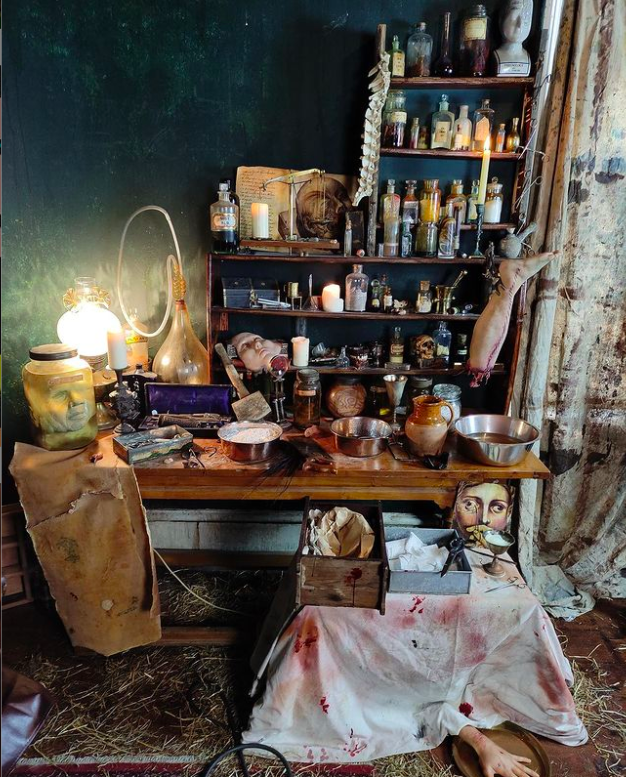
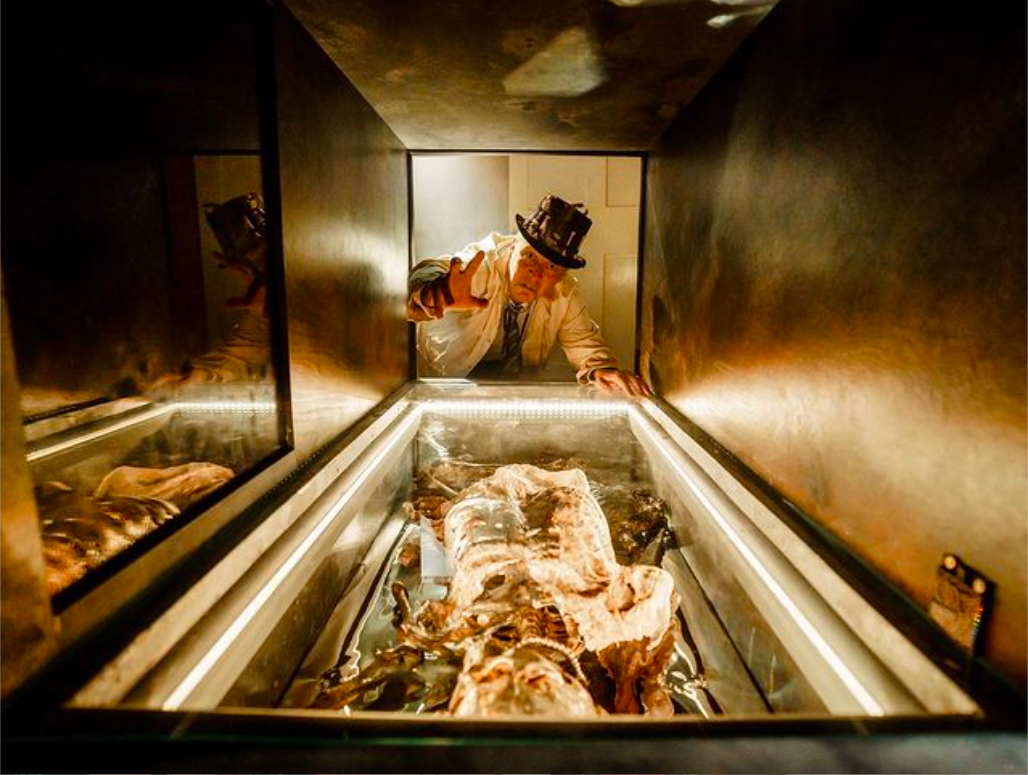
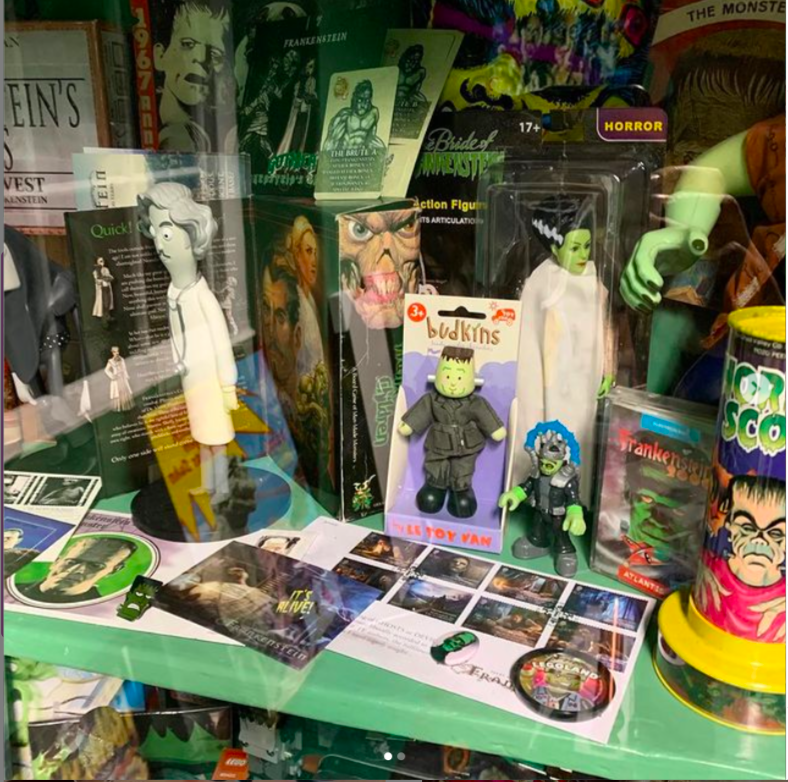
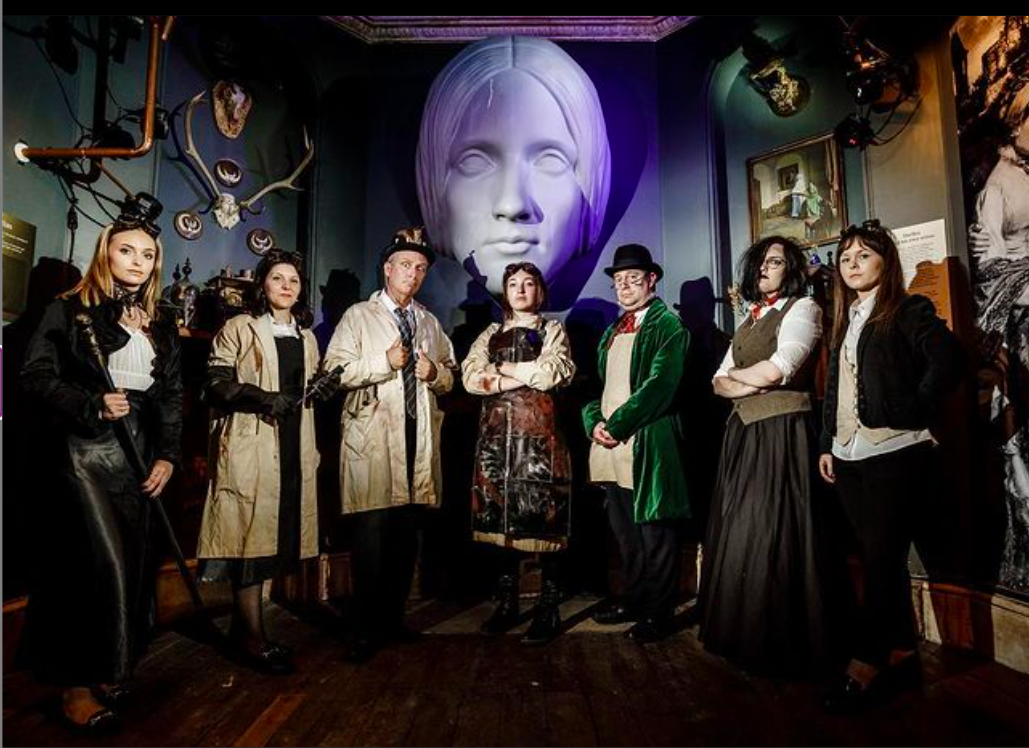
Visit the House of Frankenstein on Instagram where the weekly #FrankensteinFollowerFriday should appeal to monster movie buffs of all ages.
Related Content:
Ayun Halliday is an author, illustrator, theater maker and Chief Primatologist of the East Village Inky zine. Follow her @AyunHalliday.
Read More...How West Magazine Created a Southern-California Pop-Culture Aesthetic with the Help of Milton Glaser, Gahan Wilson, and Others (1967–1972)
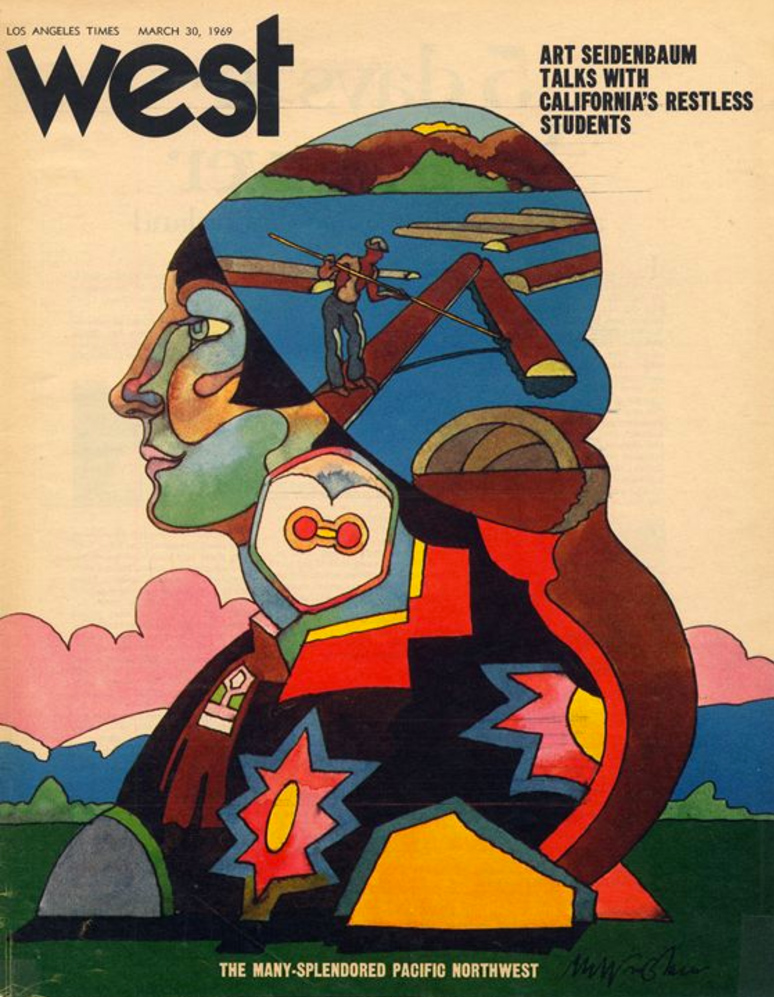
In the late 1960s, a counterculture-minded media professional could surely have imagined more appealing places to work than the Los Angeles Times. Widely derided as the official organ of the Southern California Babbitt, the paper also put out a bland Sunday supplement called West magazine. But West had the potential to evolve into something more vital — or so seemed to think its editor, Jim Bellows. The creator of “the original New York magazine in the early 1960s,” writes Design Observer’s Steven Heller, Bellows convinced a young adman named Mike Salisbury, “who worked for Carson Roberts Advertising in L.A. (where Ed Ruscha and Terry Gilliam worked), to accept the job as art director.”
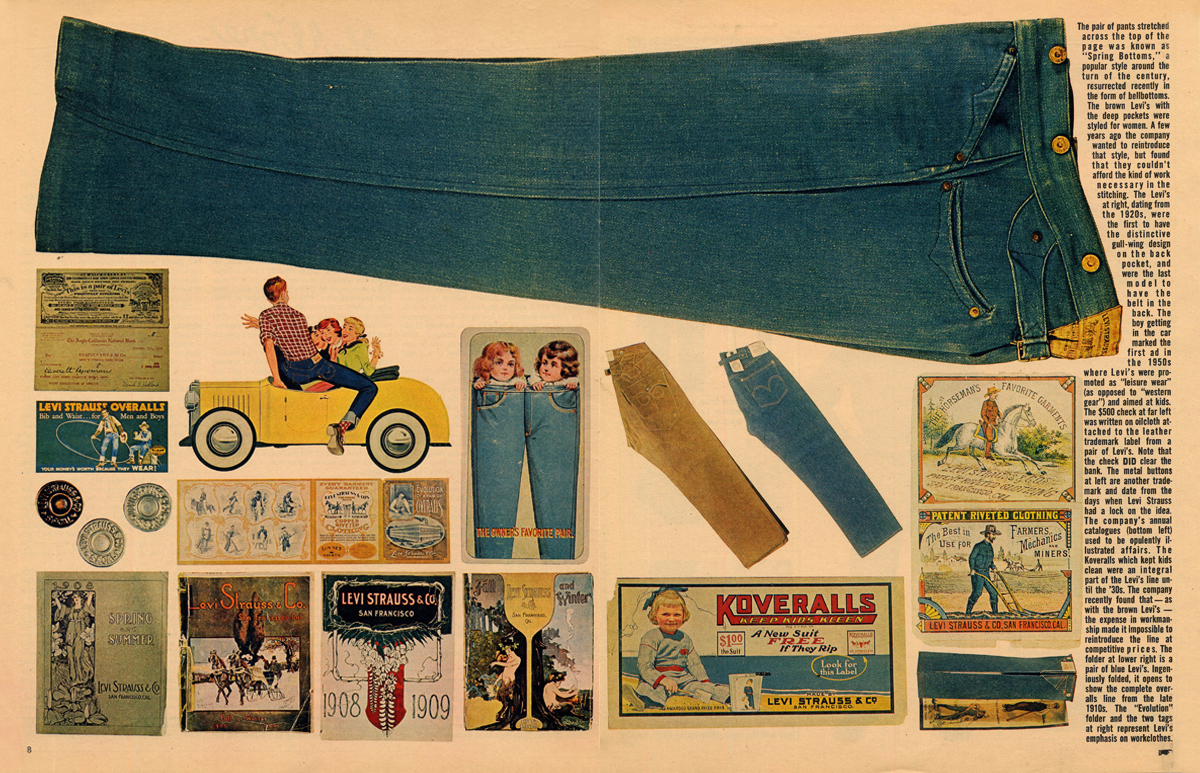
Salisbury injected West “with such an abundance of pop culture visual richness that it was more like a miniature museum than weekly gazette.” Its weekly issues “covered a wide range of themes — mostly reflecting Salisbury’s insatiable curiosities — from a feature on basketball that illustrated the tremendous size of center forwards by showing a life-size photograph of Wilt Chamberlin’s Converse sneaker, to a pictorial history of movie star pinups with a bevy of gorgeous silhouettes fanning on the page, to an array of souped-up VW Beetles in all shapes and sizes.”
On any given Sunday, subscribers might find themselves treated to “the history of Mickey Mouse, Coca-Cola art (the first time it was published as ‘art’), the visual history of Levis, Hollywood garden apartments, Raymond Chandler locations, and Kustom Kars.”
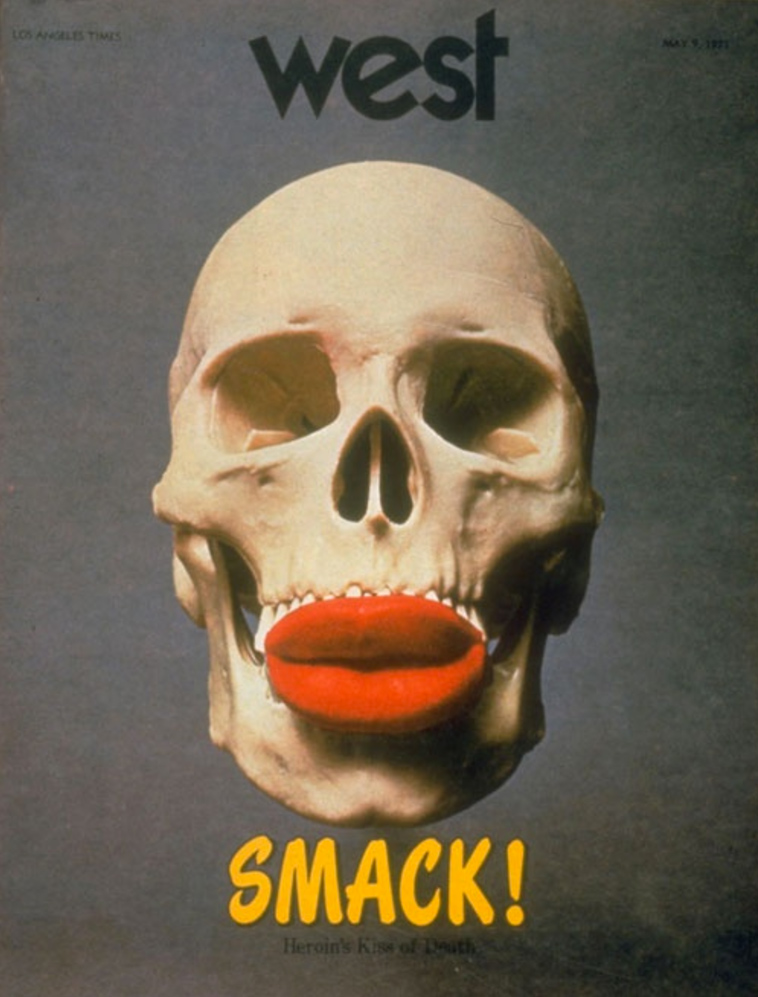
“I was the writer on the Coca-Cola ‘art’ piece as well as the first ‘programmatic’ architecture article to see print,” says a commenter under the Design Observer retrospective named Larry Dietz. He also claims to have written the feature on Raymond Chandler’s Los Angeles; much later, he adds, Chinatown screenwriter “Robert Towne said that he was inspired to learn about L.A. history from that piece, but that the writing was crappy.” But then, the main impact of Salisbury’s West was never meant to be textual. Heller quotes Salisbury as saying that “design was not my sole objective: cinema-graphic information is a better definition.” Of all the covers he designed, he remembers the one just above, promoting an exposé on heroin, as having been the most controversial: “Don’t give me too much reality over Sunday breakfast,” he heard readers grumbling.
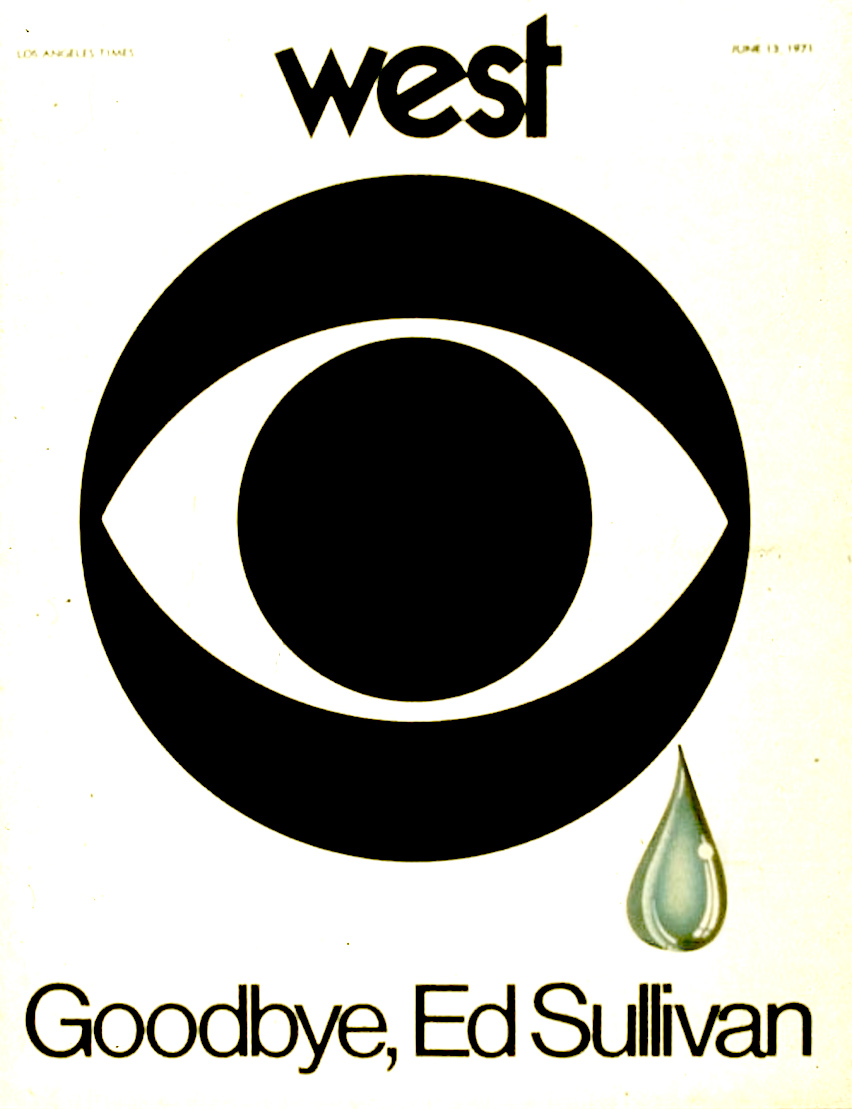
Other memorable West covers include the magazine’s tribute to the just-canceled Ed Sullivan show in 1971, as well as contributions by artists and designers like Victor Moscoso, Gahan Wilson, John Van Hamersveld, and Milton Glaser, all figures who did a great deal to craft the American zeitgeist of the 1960s and 70s. The magazine as a whole consolidated the Southern Californian pop-cultural aesthetic of its period, as distinct from what Salisbury calls the “quasi-Victorian” look and feel of San Francisco to the north and the “Rococo or Baroque” New York to the east. Los Angeles, to his mind, was “streamline,” emblematized by the culture and industry of motorcycle customization and its “belief in Futurism.”
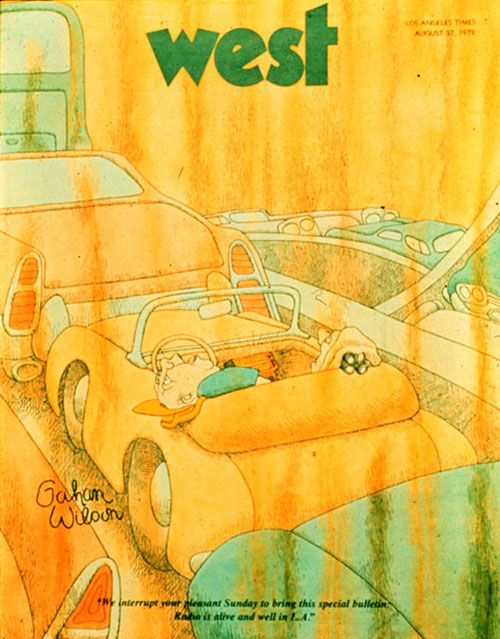
West was a product of the Los Angeles Times under Otis Chandler, publisher from 1960 to 1980, who dedicated his career to expanding the scope and ambition of the newspaper his great-grandfather had once run. His labors paid off in retrospect, especially from readers as astute as Joan Didion, who praised Chandler’s Times to the skies. But by 1972, West seemed to have become too much of an extravagance even for him. After the magazine’s cancellation, Salisbury moved on to Rolling Stone, then in the process of converting from a newspaper to a magazine format. No small part of that magazine’s pop-cultural power in the 70s must have owed to his art direction.
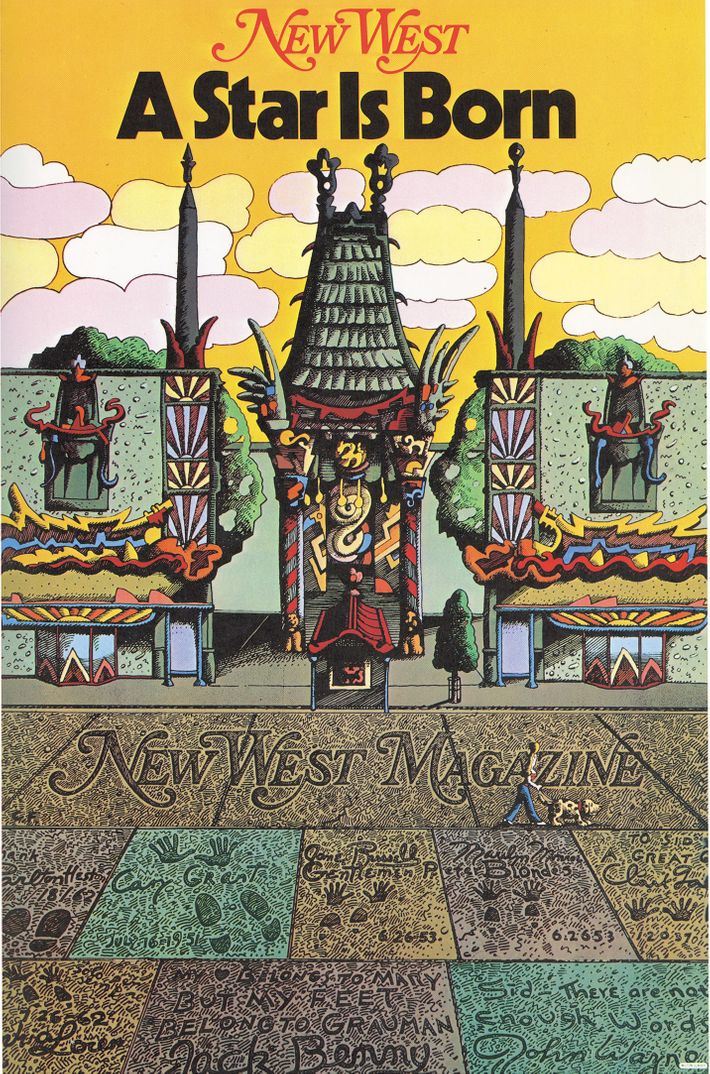
Later in the decade, both Salisbury and Glaser would bring their talents to the just-launched New West magazine. It had no direct connection with West or the Los Angeles Times, but was conceived as the sister publication of New York Magazine, which itself had been re-invented by Glaser and publisher Clay Felker in the mid-1960s. Its debut cover, just above, featured Glaser’s artwork; three years later, in 1979, Salisbury designed a cover on California’s water crisis that the American Institute of Graphic Arts’ Steven Brower calls “prescient.” At that same time, he notes, Salisbury “worked with Francis Ford Coppola on the set design for Apocalypse Now; he designed Michael Jackson’s breakthrough album, Off the Wall,” and he even collaborated with George Harrison on his eponymous album.” But when “veteran magazine art directors” get together and “reminisce about the glory years,” writes Heller, it’s West they inevitably talk about.
Related Content:
Milton Glaser’s Stylish Album Covers for The Band, Nina Simone, John Cage & Many More
Based in Seoul, Colin Marshall writes and broadcasts on cities, language, and culture. His projects include the Substack newsletter Books on Cities, the book The Stateless City: a Walk through 21st-Century Los Angeles and the video series The City in Cinema. Follow him on Twitter at @colinmarshall or on Facebook.
Read More...757 Episodes of the Classic TV Game Show What’s My Line?: Watch Eleanor Roosevelt, Louis Armstrong, Salvador Dali & More
What would the host and panelists of the classic primetime television game show What’s My Line? have made of The Masked Singer, a more recent offering in which panelists attempt to identify celebrity contestants who are concealed by elaborate head-to-toe costumes and electronically altered voiceovers.
One expects such shenanigans might have struck them as a bit uncouth.
Host John Charles Daly was willing to keep the ball up in the air by answering the panel’s initial questions for a Mystery Guest with a widely recognizable voice, but it’s hard to imagine anyone stuffing former First Lady Eleanor Roosevelt into the full body steampunk bee suit the (SPOILER) Empress of Soul wore on The Masked Singer’s first season.
Mrs. Roosevelt’s Oct 18, 1953 appearance is a delight, especially her pantomimed disgust at the 17:29 mark, above, when blindfolded panelist Arlene Francis asks if she’s associated with politics, and Daly jumps in to reply yes on her behalf.
Later on, you get a sense of what playing a jolly parlor game with Mrs. Roosevelt would have been like. She’s not above fudging her answers a bit, and very nearly wriggles with anticipation as another panelist, journalist Dorothy Kilgallen, begins to home in on the truth.
While the roster of Mystery Guests over the show’s original 17-year broadcast is impressive — Cab Calloway, Judy Garland, and Edward R. Murrow to name a few — every episode also boasted two or three civilians hoping to stump the sophisticated panel with their profession.
Mrs. Roosevelt was preceded by a bathtub salesman and a fellow involved in the manufacture of Bloodhound Chewing Tobacco, after which there was just enough time for a woman who wrote television commercials.
Non-celebrity guests stood to earn up to $50 (over $500 today) by prolonging the revelation of their professions, as compared to the Mystery Guests who received an appearance fee of ten times that, win or lose. (Presumably, Mrs. Roosevelt was one of those to donate her honorarium.)
The regular panelists were paid “scandalous amounts of money” as per publisher Bennett Cerf, whose “reputation as a nimble-witted gentleman-about-town was reinforced by his tenure on What’s My Line?”, according to Columbia University’s Oral History Research Office.
The unscripted urbane banter kept viewers tuning in. Broadway actor Francis recalled: “I got so much pleasure out of ‘What’s My Line?’ There were no rehearsals. You’d just sit there and be yourself and do the best you could.”
Panelist Steve Allen is credited with spontaneously alighting on a breadbox as a unit of comparative measurement while questioning a manhole cover salesman in an episode that featured June Havoc, legend of stage and screen as the Mystery Guest (at at 23:57, below).
“Want to show us your breadbox, Steve?” one of the female panelists fires back off-camera.
The phrase “is it bigger than a breadbox” went on to become a running joke, further contributing to the illusion that viewers had been invited to a fashionable cocktail party where glamorous New York scenemakers dressed up to play 21 Professional Questions with ordinary mortals and a celebrity guest.
Jazz great Louis Armstrong appeared on the show twice, in 1954 and then again in 1964, when he employed a successful technique of light monosyllabic responses to trick the same panelists who had identified him quickly on his initial outing.
“Are you related to anybody that has anything to do with What’s My Line?” Cerf asks, causing Armstrong, host Daly, and the studio audience to dissolve with laughter.
“What happened?” Arlene Francis cries from under her pearl-trimmed mask, not wanting to miss the joke.
Television — and America itself — was a long way off from acknowledging the existence of interracial families.
“It’s not Van Clyburn, is it?” Francis ventures a couple of minutes later.…
Expect the usual gender-based assumptions of the period, but also appearances by Mary G. Ross, a Cherokee aerospace engineer, and physicist Helen P. Mann, a data analyst at Cape Canaveral.
If you find the convivial atmosphere of this seminal Goodson-Todman game show absorbing, there are 757 episodes available for viewing on What’s My Line?’s YouTube channel.
Allow us to kick things off on a Surreal Note with Mystery Guest Salvador Dali, after which you can browse chronological playlists as you see fit:
Related Content:
How American Bandstand Changed American Culture: Revisit Scenes from the Iconic Music Show
Ayun Halliday is an author, illustrator, theater maker and Chief Primatologist of the East Village Inky zine. Follow her @AyunHalliday.
Read More...How ABBA Won Eurovision and Became International Pop Stars (1974)
Eurovision, the flashy original song contest that captivates Europeans, tends to get roundly mocked in the U.S., where we choose our stars by having them sing other people’s songs on TV in ridiculous costumes. Nonetheless, Americans have fallen in love with many a contest winner, and that’s no more true than in the case of ABBA, the Swedish pop-disco juggernaut who broke through to international stardom when they won in 1974 with “Waterloo,” chosen twice as the greatest song in the competition’s history.
The two couples — Agnetha Fältskog and Björn Ulvaus; Benny Andersson and Anni-Frid Lyngstad — first formed as Festfolket (“Party People”) in 1970, and Ulvaus and Andersson began submitting songs to Swedish national contest Melodifestivalen. In 1973, they submitted “Ring Ring,” finally placed third, then released an album called Ring Ring as Björn & Benny, Agnetha & Frida. They had taken on a new glam rock look and sound, and the album was a hit in parts of Europe and South Africa, but didn’t break the UK and US charts.
It was time for another name change, an anagram formed from the first letters of their first names. (They were obliged to ask permission from a local fish cannery called Abba, who agreed on condition the band didn’t make the canners “feel ashamed for what you’re doing.”) The name, producer Stig Anderson thought, would translate internationally, and the band would sing in English for their next single, the song that would launch their rapid ascent into seemingly eternal relevance.
How did “Waterloo” not only break ABBA into stardom but also “reinvent pop music” as we know it? As the Polyphonic video at the top explains, it did far more than raise the bar for every Eurovision performance since. ABBA brought glam, glitter, and theatrical bombast into pop, using Phil Spector’s “wall of sound” studio techniques to coax an enormous, enveloping sound from their vocal harmonies, guitars, pianos, horns, drums, etc., and taking heavy inspiration from English band Wizzard’s song “See My Baby Jive,” while “pulling back on the rock” and leaning into cleaner, more dance-floor-friendly production.
ABBA wisely put Agnetha and Anni-Frid’s vocal harmonies in the center, and they took a decidedly quirky turn from glam rock’s love of sleazy come-ons and songs about aliens. Originally called “Honey Pie,” the band’s breakout hit became “Waterloo” when Stig Anderson turned it into an odd reference to Napoleon’s surrender, “such a novel conceit for a song that it’s hard to forget.” ABBA continued this tradition in short story-songs like “Fernando,” first written with different lyrics in Swedish for Lyngstad, then rewritten in English by Ulvaeus as a tale about two old campaigners from the Mexican-American War.
Smart songwriting, catchy hooks, impeccable vocal harmonies, and flashy beauty — once the world saw and heard ABBA, few could resist them. But it took their uniquely theatrical (at the time) Eurovision performance to break them out, as Ulvaeus says. “We knew that the Eurovision Song Contest was the only route for a Swedish group to make it outside Sweden.” The win was huge, but the contest was a means to an end. True validation came with hit after hit, as ABBA proved themselves indispensable to wedding dance floors everywhere and “completely transformed what it meant to be a pop star.” See their original Eurovision performance of “Waterloo” just above.
Related Content:
Listen to ABBA’s “Dancing Queen” Played on a 1914 Fairground Organ
This Man Flew to Japan to Sing ABBA’s “Mamma Mia” in a Big Cold River
Josh Jones is a writer and musician based in Durham, NC. Follow him at @jdmagness
Read More...What’s the Role of a Director in Constructing Comedy? Pretty Much Pop: A Culture Podcast #100
What makes for a good comedy film or show? Funny people reading (or improvising) funny lines is not enough; an good director needs to capture (or recreate in the editing room) comic timing, construct shots so that the humor comes through and coach the actors to make sure that the tone of the work is consistent.
Your Pretty Much Pop hosts Mark Linsenmayer, Erica Spyres, and Brian Hirt are joined by Heather Fink to discuss the role of the director in making a comedy (or anything else) actually good. Heather has directed for TV, film, and commercials and spent a lot of time doing sound (a boom operator or sound utility) for productions like Saturday Night Live, Get Out, The Morning Show, and Marvel’s Daredevil.
We talk about maintaining comedy through the tedious process of filming, putting actors through sex scenes and other hardships, not telling them how to say their lines, comedians in dramas, directing improv/prank shows, and more. We touch on include Bad Trip, Barry, and Ted Lasso, and more.
Watch some of Heather’s work:
- Alleged, a short about dramatizing accusations against Steven Segal
- Inside You, a film she wrote, directed, and (reluctantly) starred in
- The Focus Group, a short Heather directed written by and starring Sara Benincasa
We used some articles to bring various directors and techniques to mind:
- “Directing Comedy 101″ by Ray Richmond
- “Judd Apatow Talks to Jason Bateman About Being the ‘Anti-David Fincher’ | Directors on Directors”
- “10 Best Contemporary Comedy Directors” by Rafael Sarmiento
- “The Best Comedy Directors in Film History” from Ranker
- “10 Hollywood notables who directed an episode of ‘The Office’” by Mike Rose
Hear more of this podcast at prettymuchpop.com. This episode includes bonus discussion that you can access by supporting the podcast at patreon.com/prettymuchpop. This podcast is part of the Partially Examined Life podcast network.
Pretty Much Pop: A Culture Podcast is the first podcast curated by Open Culture. Browse all Pretty Much Pop posts.
Read More...Watch 15 Hours of The Pink Panther for Free
Remember Saturday mornings?
If you’re an American of a certain age, you probably spent a good chunk of them sprawled in front of the TV, absorbing a steady stream of network cartoons peppered with ads for toys and sugared cereal.
One of Saturday morning’s animated stars stood out from the crowd, a lanky, bipedal feline of a distinctly rosy hue.
He shared Bugs Bunny’s anarchic streak, without the hopped-up, motormouthed intensity.
In fact, he barely spoke, and soon went entirely mute, relying instead on Henry Mancini’s famous theme, which followed him everywhere he went.
Above all, he was sophisticated, with a minimalist aesthetic and a long cigarette holder.
Director Blake Edwards attributes his lasting appeal to his “promiscuous, fun-loving, devilish” nature.
John Cork’s short documentary Behind the Feline: The Cartoon Phenomenon, below, details how Edwards charged commercial animators David DePatie and Friz Freleng with creating a cartoon persona for the Pink Panther Diamond in his upcoming jewel heist caper.
DePatie, Freleng and their team drafted over a hundred renderings in response to the character notes Edwards bombarded them with via telegram.
Edward’s favorite, designed by director Hawley Pratt, featured the iconic cigarette holder and appeared in the feature film’s trailer and title sequence, ultimately upstaging a star studded cast including David Niven, Claudia Cardinale, Robert Wagner, and Peter Sellers as Inspector Clouseau.
The cartoon panther’s sensational debut prompted United Artists to order up another 156 shorts, to be released over a four to five year period. The first of these, The Pink Phink, not only established the tone, it also nabbed the Academy Award for 1964’s best animated short.
Although he was created with an adult audience in mind — the narrator of the original theatrical trailer asks him about bedroom scenes — his wordless torment of the simplified cartoon Inspector proved to be money in the bank on Saturday mornings.
The Pink Panther Show ran from 1969 to 1980, weathering various title tweaks and a jump from NBC to ABC.
Syndication and cable TV ensured a vibrant afterlife, here and in other countries, where the character’s sophistication and reliance on body language continues to be a plus.
The plots unfolded along predictable lines — the groovy panther spends 6 minutes thwarting and bedeviling a less cool, less pink-oriented character, usually the Inspector.
Every episode’s title includes a reference to the star’s signature color, often to groaning degree — Pink of the Litter, Pink-A-Boo, The Hand Is Pinker Than the Eye, Pinkcome Tax, The Scarlet Pinkernel.…
We won’t ask you to guess the color of Pink Panther Flakes, manufactured under the auspices of Post, a Pink Panther Show co-sponsor.
“I thought it was just fine for the film,” Edwards says of the animated Pink Panther in Cork’s 2003 documentary, “But I had no idea that it would take off like that, that it would have that kind of a life of its own… that kind of a merchandising life of its own. Thank god it did!”
Stay cool this summer with an 11-hour Pink Panther marathon, comprised of the following free compilations of Seasons 1, 2, 3 and 4.
Season 1
Season 2
Season 3
Season 4
Related Content:
How Looney Tunes & Other Classic Cartoons Helped Americans Become Musically Literate
Peter Sellers Performs The Beatles “A Hard Day’s Night” in Shakespearean Voice
Ayun Halliday is an author, illustrator, theater maker and Chief Primatologist of the East Village Inky zine. Follow her @AyunHalliday.
Read More...Do We Outgrow the Music of Our Youth? Pretty Much Pop: A Culture Podcast #99
What long-term effects do songs that we’re exposed to early have on our adult tastes? As children we (hopefully) learn to love music, but then our critical faculties and peer pressure kick in, and many early influences become unacknowledged or transformed into guilty pleasures. Is the generation gap in musical taste really just due to how styles change over time (and we old folks just don’t get the new sound), or are there more fundamental reasons why it’s easier for younger people to absorb new music?
Today’s panel includes your host Mark Linsenmayer plus Erica Spyres, Brian Hirt, and The Hustle podcast host Jon Lamoreaux. They share their own experiences, songs from yesteryear that they have complicated feelings about now, and get into related topics like the activities of former pop stars and nostalgia in film soundtracks.
A few particular tracks that we mention are Go West’s “King of Wishful Thinking,” Jo Boxers’ “Just Got Lucky,” Jethro Tull’s “Songs from the Wood,” and The Cars’ “Magic.” Can a pretty Steve Howe intro redeem this Asia cheesefest?
A few articles we consulted included:
- “Why Old People Hate New Music” by Frank McAndrew
- “We Stop Discovering New Music at Age 30, a New Survey Suggests — Here Are the Scientific Reasons Why This Could Be” by Linsay Dodgson
- “Inside the Heads of People Who Don’t Like Music” by Divya Abhat
Follow Jon’s podcast @thehustlepod. To get an idea of the formats of The Hustle as compared to Mark’s Nakedly Examined Music, why not take a deep dive on Grand Funk Railroad’s amazing Mark Farner who appeared on both? …NEM, Hustle.
Hear more of this podcast at prettymuchpop.com. This episode includes bonus discussion that you can access by supporting the podcast at patreon.com/prettymuchpop. This podcast is part of the Partially Examined Life podcast network.
Pretty Much Pop: A Culture Podcast is the first podcast curated by Open Culture. Browse all Pretty Much Pop posts.
Read More...How Ramen Became the Currency of Choice in Prison, Beating Out Cigarettes
The last decade ushered in a slew of traditional Japanese-style ramen restaurants — enough to justify ramen maps to New York City, Chicago, and the Bay Area.
Yet most Americans still conceive of ramen as the pack of seasoning and dehydrated instant noodles that have long sustained broke artists and college students.
Add incarcerated persons to the list of packaged ramen’s most ardent consumers.
In the above episode of Vox’s series, The Goods, we learn how those ubiquitous cellophane packages have outstripped cigarettes and postage stamps as the preferred form of prison currency.
Ramen is durable, portable, packaged in standard units, available in the prison commissary, and highly prized by those with a deep need to pad their chow hall meals.
Ramen can be used to pay for clothing and hygiene products, or services like laundry, bunk cleaning, dictation, or custom illustration. Gamblers can use it in lieu of chips.
Ramen’s status as the preferred form of exchange also speaks to a sharp decline in the quantity and quality of food in American penal institutions.
Ethnographer Michael Gibson-Light, who spent a year studying homegrown monetary practices among incarcerated populations, notes that slashed prison budgets have created a culture of “punitive frugality.”
Called upon to model a demonstrably tough on crime stance and cut back on expenditures, the institutions are unofficially shunting many of their traditional costs onto the prisoners themselves.
In response, those on the inside have pivoted to edible currency:
What we are seeing is a collective response — across inmate populations and security levels, across prison cliques and racial groups, and even across states — to changes and cutbacks in prison food services…The form of money is not something that changes often or easily, even in the prison underground economy; it takes a major issue or shock to initiate such a change. The use of cigarettes as money in U.S. prisons happened in American Civil War military prisons and likely far earlier. The fact that this practice has suddenly changed has potentially serious implications.
Ramen may be a relatively new development in the prison landscape, but culinary experimentation behind bars is not. From Pruno prison wine to Martha Stewart’s prison grounds crabapple jelly, it’s a nothing ventured, nothing gained type of deal. Work with what you’ve got.
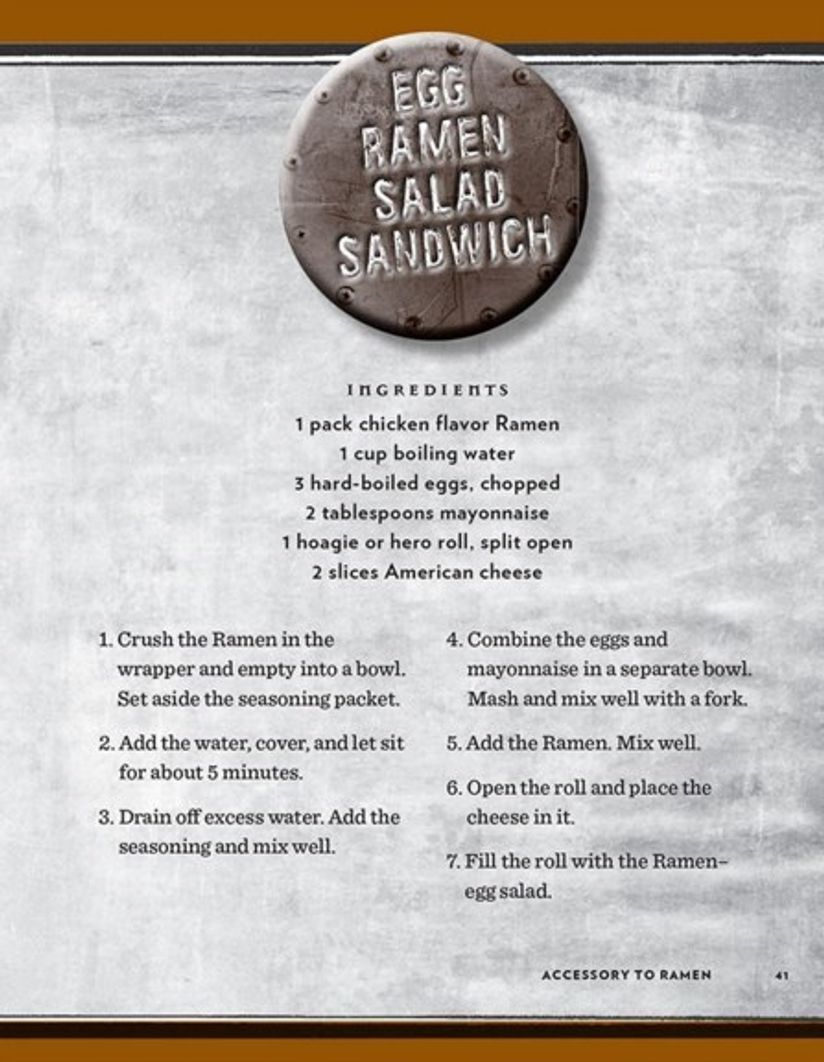
Gustavo “Goose” Alvarez, who appears in Vox’s video, collected a number of the most adventurous recipes in his book, Prison Ramen: Recipes and Stories from Behind Bars. Anyone can bring some variety on the spur of the moment by sprinkling some of your ramen’s seasoning packet into your drinking water, but amassing the ingredients for an ambitious dish like Orange Porkies — chili ramen plus white rice plus ½ bag of pork skins plus orange-flavored punch — takes patience and perseverance.
Alvarez’s Egg Ramen Salad Sandwich recipe earns praise from actor Shia LeBoeuf, whose time served is both multiple and minimal.
Someone serving a longer sentence has a more compelling reason to search for the ramen-centered sense of harmony and wellbeing on display in Tampopo, the first “ramen western”:
Appreciate its gestalt. Savor the aromas.
Joe Guerrero, host of YouTube’s AfterPrisonShow, is not immune to the pleasures of some of his ramen-based concoctions, below, despite being on the outside for several years now.
You’re free to wrinkle your nose at the thought of snacking on a crumbled brick of uncooked ramen, but Guerrero points out that someone serving a long sentence craves variety in any form they can get. Experiencing it can tap into the same sense of pride as self-governance.
Guerrero’s recipes require a microwave (and a block of ramen).
Even if you’re not particularly keen on eating the finished product, there’s a science project appeal to his Ramen Noodle Cookie. It calls for no additional ingredients, just ten minutes cooking time, an outrageous prospect in a communal setting with only one microwave.
Related Content:
The Proper Way to Eat Ramen: A Meditation from the Classic Japanese Comedy Tampopo (1985)
What Goes Into Ramen Noodles, and What Happens When Ramen Noodles Go Into You
Japanese Animation Director Hayao Miyazaki Shows Us How to Make Instant Ramen
Ayun Halliday is an author, illustrator, theater maker and Chief Primatologist of the East Village Inky zine. Follow her @AyunHalliday.
Read More...Take 193 Free Tech and Business Courses Online at Udacity: Product Design, Programming, A.I., Marketing & More
Each of us now commands more technological power than did any human being alive in previous eras. Or rather, we potentially command it: what we can do with the technology at our fingertips — and how much money we can make with it — depends on how well we understand it. Luckily, the development of learning methods has more or less kept pace with the development of everything else we now do with computers. Take the online-education platform Udacity, which offers “nanodegree” programs in areas like programming, data science, and cybersecurity. While the nanodegrees themselves come with fees, Udacity doesn’t charge for the constituent courses: in other words, you can earn what you need to know for free.
Above you’ll find the introduction to Udacity’s Product Design course by Google (also creator of the Coursera professional-certificate programs previously featured here on Open Culture). “Designed to help you materialize your game-changing idea and transform it into a product that you can build a business around,” the course “blends theory and practice to teach you product validation, UI/UX practices, Google’s Design Sprint and the process for setting and tracking actionable metrics.”
This is a highly practical learning experience at the intersection of technology and business, as are many other of Udacity’s 193 free courses, like App Marketing, App Monetization, How to Build a Startup, and Get Your Startup Started.
If you have no particular interest in founding and running the next Google, Udacity also hosts plenty of courses that focus entirely on the workings of different branches of technology, from programming and artificial intelligence to 2D game development and 3D graphics. (In addition to the broad introductions, there are also relatively advanced courses of a much more specific focus: Developing Android Apps with Kotlin, say, or Deploying a Hadoop Cluster.) And if you’d simply like to get your foot in the door with a job in tech, consider such offerings as Refresh Your Résumé, Strengthen Your LinkedIn Network & Brand, and a variety of interview-preparation courses for jobs in data science, machine learning, product management, virtual-reality development, and other subfields. And however cutting-edge their work, who couldn’t another spin through good old Intro to Psychology?
Find a list of 193 Free Udacity courses here. For the next week Nanodegrees are 75% off (use code JULY75). Find more free courses in our list, 1,700 Free Online Courses from Top Universities.
Note: Open Culture has a partnership with Udacity. If readers enroll in certain Udacity courses and programs that charge a fee, it helps support Open Culture.
Related Content:
Learn How to Code for Free: A DIY Guide for Learning HTML, Python, Javascript & More
1,700 Free Online Courses from Top Universities
Based in Seoul, Colin Marshall writes and broadcasts on cities, language, and culture. His projects include the Substack newsletter Books on Cities, the book The Stateless City: a Walk through 21st-Century Los Angeles and the video series The City in Cinema. Follow him on Twitter at @colinmarshall or on Facebook.
Read More...Support Us
We're hoping to rely on loyal readers, rather than erratic ads. Please click the Donate button and support Open Culture. You can use Paypal, Venmo, Patreon, even Crypto! We thank you!

About Us

Open Culture scours the web for the best educational media. We find the free courses and audio books you need, the language lessons & educational videos you want, and plenty of enlightenment in between.
Advertise With Us

FREE UPDATES!
GET OUR DAILY EMAIL
Get the best cultural and educational resources on the web curated for you in a daily email. We never spam. Unsubscribe at any time.
FOLLOW ON SOCIAL MEDIA

Open Culture editor Dan Colman scours the web for the best educational media. He finds the free courses and audio books you need, the language lessons & movies you want, and plenty of enlightenment in between.
Advertise With Us


