1540 Monet Paintings in a Two Hour Video
I am distressed, almost discouraged, and fatigued to the point of feeling slightly ill. What I am doing is no good, and in spite of your confidence I am very much afraid that my efforts will all lead to nothing.
To know anything about the school of painting called Impressionism, one must know Claude Monet, who gave the movement its name with his painting Impression, Sunrise and provided its method — an almost confrontational relationship with landscape in plein-air. “I have gone back to some things that can’t possibly be done: water, with weeds waving at the bottom,” Monet wrote in a letter to his friend Gustave Geffroy in 1890. “It is a wonderful sight, but it drives one crazy trying to paint it. But that is the kind of thing I am always tackling.”
That “kind of thing,” the compulsion to paint nature in motion, required working quickly, repeating the same experiments over and over, despairing of getting it right, producing in the attempt his glorious series of haystacks and water lilies. Monet began painting landscapes upon meeting artist Eugene Boudin, who taught him to paint in open air, and he never stopped, refining his brushstroke for almost seventy years: from his first canvas, 1858’s View from the banks of the Lezade, to his last, The Rose Bush, finished in 1926, the final year of his life.
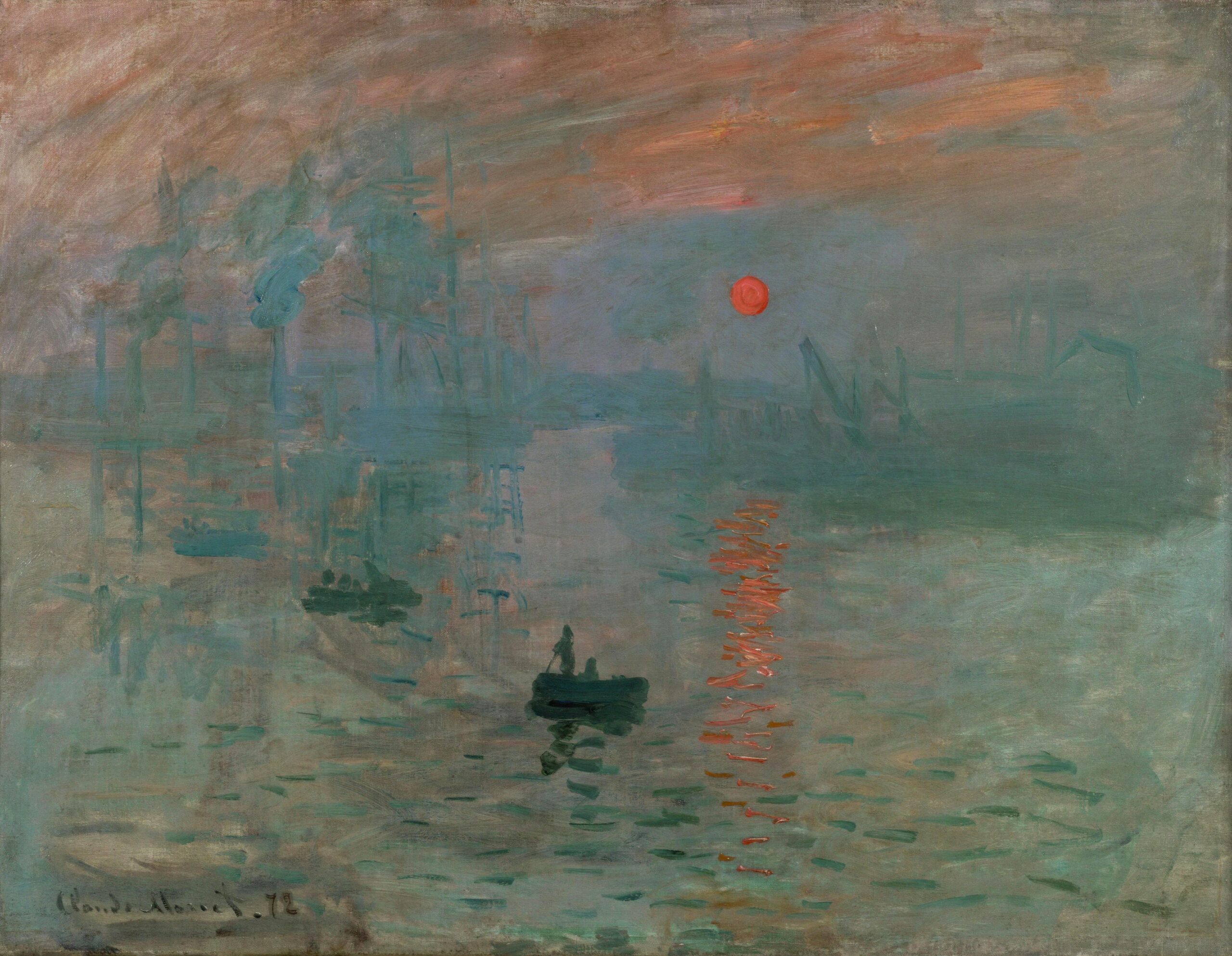
Whatever else Impressionism might mean, when it comes to Monet, it entails a prodigious amount of drawing, sketching, and painting. Over 2,500 such works have been attributed to him. That number is probably much higher “as it is known that Monet destroyed a number of his own works and others have surely been lost over time,” notes the Monet Gallery. Around 2,000 of those works are paintings, now spread around the world, with the largest collection located at the Marmottan Monet Museum in Paris, where Impression, Sunrise (above) is held.
While it may be nearly impossible to see all of Monet’s known works in one lifetime (just as it seems impossible that he could have made so many masterpieces in one life), you can see 1540 of them in the video at the top — in a presentation that may or may not suit your art viewing sensibilities. If zooming slowly into hundreds of Monet paintings for a few seconds leaves you feeling a little overwhelmed, you can also head to the Monet Gallery online to see over 1900 of the artist’s attempts at “following Nature,” as he put it, “without being able to grasp her.”
Related Content:
Rare 1915 Film Shows Claude Monet at Work in His Famous Garden at Giverny
Claude Monet at Work in His Famous Garden at Giverny: Rare Film from 1915
How to Paint Water Lilies Like Monet in 14 Minutes
Josh Jones is a writer and musician based in Durham, NC. Follow him at @jdmagness
Read More...Hear Demos & Outtakes of Joni Mitchell’s Blue on the 50th Anniversary of the Classic Album
When Joni Mitchell released Blue in 1971, she revealed herself to the world as a poet with a hard-boiled interior life. The album, writes Rolling Stone, challenged the image many had of her as an innocent flower child. “The West Coast feminine ideal” was a role “Mitchell hadn’t asked for and did not want.” Of her writing of the album, she said in a 2013 interview, “They better find out who they’re worshipping. Let’s see if they can take it. Let’s get real.”
Get real she did, shocking the men around her, some of whom she’d written about candidly, including Graham Nash, Leonard Cohen, and James Taylor, who played on several tracks. She wrote about the heartbreak of leaving her daughter and rewrote the breakup song as a confessional on “River.” The album’s cultural impact, 50 years after its release, has much to do with Mitchell as a lone female protagonist in a male-dominated industry. “Along with its romantic melancholy,” Rolling Stone writes, “Blue was the sound of a woman availing herself of the romantic and sexual freedom that was, until then, an exclusively male province in rock.”
We listen to Blue now and hear the voices of later generations of singer-songwriters, from Tracy Chapman and Tori Amos to Phoebe Bridgers, who seized their own power. By the time of Blue’s release, Mitchell had become a powerful voice of her generation, penning “Woodstock” just the year before. “Blue is Mitchell’s first song cycle whereby all the songs interrelate in their themes of loss and transformation,” writes Classic Album Sundays. “The album reflects the disillusionment and disenchantment felt by a generation during the closing of The Sixties.”
“It’s a description of the times,” Mitchell attests. “There were so many sinking but I had to keep thinking I could make it through the waves. You watched that high of the hippie thing descend into drug depression. Right after Woodstock, then we went through a decade of basic apathy where my generation sucked it’s thumb and then just decided to be greedy and pornographic.”
As if capturing the feelings of her own personal losses and those of millions of others weren’t enough, Mitchell’s songwriting and musicianship on the album are consistently astonishing, each word married to a suspended note, an unexpected chord voicing, a pregnant breath. “My words and music are locked together,” she says. She proved on Blue that she was a talent to be reckoned with and never underestimated. On the 50th anniversary of Blue’s release, Mitchell is releasing a five song EP, Blue 50 (Demos & Outtakes), which you can hear above (see tracklist below).
- A Case Of You (Demo) 0:00:00
- California (Demo) 0:04:00
- Hunter (Outtake) 0:07:30
- River (Outtake with French Horns) 0:10:25
- Urge For Going (Outtake with Strings) 0:14:27
It’s a document of a different album, one that might have included “Hunter” — a country-like strummer — and might have had french horns on “River,” perhaps the album’s best-known song and one of the most beloved Christmas songs of the past 50 years. Look for the next release celebrating a half-century of Blue on October 29th. Joni Mitchell Archives Vol. 2: The Reprise Years (1968–1971) “will explore the period leading up to Blue,” notes her official YouTube, “through nearly six hours of unreleased home, studio, and live recordings.” Or, you could just listen to Blue over and over. It seems to reveal something different every time.
Related Content:
How Joni Mitchell’s Song of Heartbreak, “River,” Became a Christmas Classic
Josh Jones is a writer and musician based in Durham, NC. Follow him at @jdmagness
Read More...The Captivating Art of Restoring Vintage Guitars
Mention the Martin D‑28 and you need say no more to fans of folk, country, rock and roll, country-rock, folk-rock, country-folk, etc. Elvis, Dylan, Joni Mitchell, Johnny Cash, Hank Williams, Neil Young… all played one. (Neil, in fact, owns Hank’s guitar, and calls it “Hank.”) It is the standard against which all “Dreadnought”-style guitars are measured, because it was the first, and is still, arguably, the best. Named after the Royal British Navy’s HMS Dreadnought, a famous vessel that “spawned a new class of battleships around the world,” writes Daryl Nerl, the larger-bodied D‑28 (D for “Dreadnought”), first arrived in 1917, at a time when small parlor guitar and ukuleles were the norm.
The D‑28 has lived up to its name, says Jason Ahner, C.F. Martin & Co.’s archivist. “If you were on that ship, you wouldn’t fear anything else and if you were playing that guitar you wouldn’t fear not being heard over a banjo or another instrument.” Built like battleships, D‑28s don’t only take up space in an ensemble, they fill a room perfectly well on their own, with delicate fingerpicked figures or big booming strums. The D‑28 flopped on arrival but exploded in popularity after it was advertised in 1935 as a “bass guitar,” before such things as bass guitars existed.
As more and more folk and country players fell for the D‑28’s square shoulders, broad waist, and rich, almost symphonic, tonal range, the guitar became an object no player, once they got their hands on one, would part with easily, or ever. Repairing and maintaining vintage Martins, however, is a delicate business that requires an intimate understanding of the guitar’s construction. Not every luthier is up to the task, but as you can see in the video above, Norwegian guitarmaker Lars Dalin has the experience, patience, and know-how to disassemble and restore one head (and neck) to tail.
Dalin’s D‑28 restoration video should not only interest students of guitar repair. In it, we learn about the special features of Martin’s build that give the instrument its special tonal qualities, those we’ve been dancing and crying to for over a century. For those more interested in electric guitars, Dalin presents a refret and restoration of another American classic — one that also didn’t get its due at first, but has since become an icon: the Fender Jazzmaster. Introduced in 1958, the guitars didn’t catch on until the 1970s when they could be picked up cheaply at pawn shops by punk and new wave pioneers like Television and Elvis Costello. The 1960 model above is a joy to behold, and a lesson in guitar building, repair, engineering, like no other. See more of Dalin’s guitar restoration projects on his Instagram.
Related Content:
Watch a Luthier Birth a Cello in This Hypnotic Documentary
Josh Jones is a writer and musician based in Durham, NC. Follow him at @jdmagness
Read More...AI & X‑Rays Recover Lost Artworks Underneath Paintings by Picasso & Modigliani
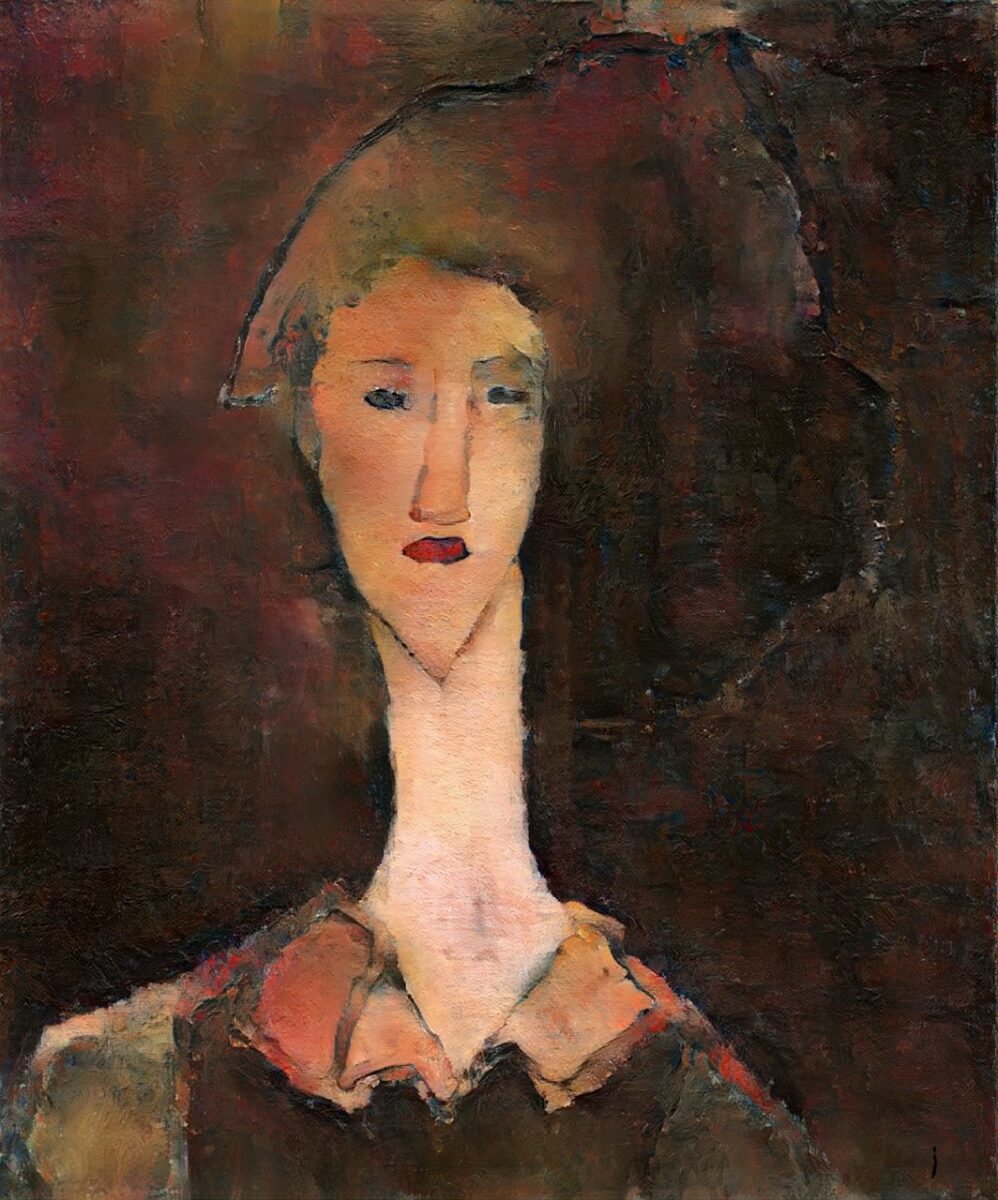
You see above a painting by Amedeo Modigliani, a portrait of the artist’s lover Beatrice Hastings, unseen by the public until its rediscovery just this year. Or at any rate, some see that: in another sense, the image is a new or almost-new artistic creation, based on X‑rays of Modigliani’s Portrait of a Girl. Underneath the paint that makes up that celebrated work lie traces enough to establish the presence of a different, earlier one beneath. But only now, after the employment of neural networks fed with enough of the artist’s acknowledged work to recognize and replicate his signature style, do we have a sense of what it could have looked like.
“Anthony Bourached and George Cann, both PhD candidates, are heading the ‘NeoMasters’ project through a company called Oxia Palus,” writes The Guardian’s Dalya Alberge. “They have ambitious plans to rediscover further hidden paintings on canvases that were reused by artists, who were perhaps too impoverished to buy supplies or dissatisfied with initial compositions.”
Modigliani was certainly impecunious enough to have done so more than once, and his relationship with Hastings — a long affair that was volatile even by the standards of the early 20th-century Parisian bohemia they inhabited — did provide material for other portraits.
Specialists, respectively, in neuroscience and the surface of Mars (their company’s name refers to a region of that planet), Bourached and Cann have proven enterprising in this art-oriented endeavor. “A 3D-printed physical rendering of their creation, complete with computer-simulated ‘brushstrokes’ and texture, will soon go on display at London’s Lebenson Gallery as part of the duo’s ‘NeoMasters’ project,” writes Nora McGreevy at Smithsonian.com. Earlier this year, McGreevy also covered Oxia Palus’ digitally assisted recovery of a Barcelona landscape possibly painted by the Spanish poet, playwright, and artist Santiago Rusiñol — before it was painted over by Pablo Picasso.
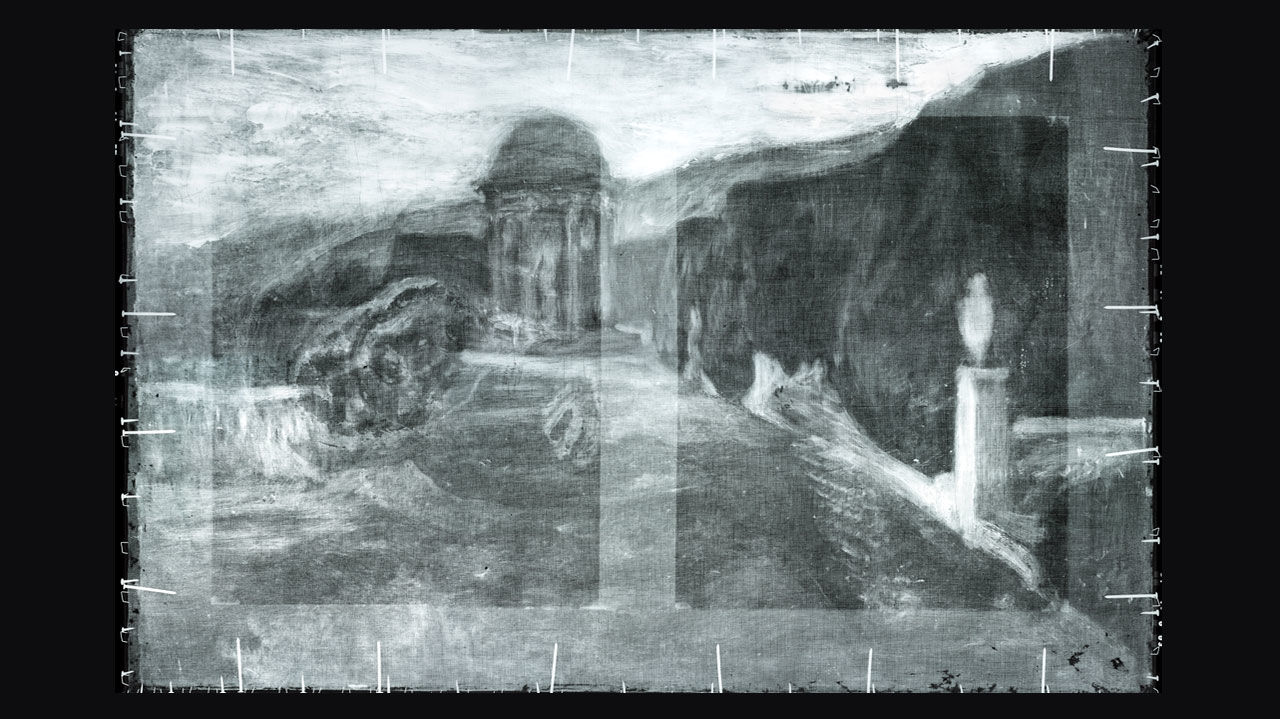
This discovery actually goes back to 1992, when conservators first determined the existence of another image beneath Picasso’s little-known La Miséreuse accroupie, or The Crouching Beggar. “Researchers suspect that Picasso used the mountains in Rusiñol’s landscape to shape the contours of his female subject’s back,” writes McGreevy. “A 2018 X‑ray of that lesser-known work by the Art Gallery of Toronto provided Oxia Palus what they needed to start work on their A.I.-assisted recreation. Not only did Bourached and Cann 3D print 100 physical copies of the final product, they linked each one to a unique non-fungible token (NFT), the new kind of digital artifact that has become something of a craze in the art world — surely an unimaginable afterlife for these images Modigliani and Picasso must have assumed they’d obliterated for good.
Related Content:
Original Portrait of the Mona Lisa Found Beneath the Paint Layers of da Vinci’s Masterpiece
Short Film Takes You Inside the Recovery of Andy Warhol’s Lost Computer Art
A 10 Billion Pixel Scan of Vermeer’s Masterpiece Girl with a Pearl Earring: Explore It Online
Based in Seoul, Colin Marshall writes and broadcasts on cities, language, and culture. His projects include the Substack newsletter Books on Cities, the book The Stateless City: a Walk through 21st-Century Los Angeles and the video series The City in Cinema. Follow him on Twitter at @colinmarshall or on Facebook.
Read More...Google’s UX Design Professional Certificate: 7 Courses Will Help Prepare Students for an Entry-Level Job in 6 Months
During the pandemic, Google launched a series of Career Certificates that will “prepare learners for an entry-level role in under six months.” One such certificate focuses on User Experience Design, or what’s called UX Design, the process design teams use to create products that provide meaningful experiences to users.
Offered on the Coursera platform, the User Experience (UX) Design Professional Certificate features seven courses, including the Foundations of User Experience, Start the UX Design Process, Build Wireframes and Low-Fidelity Prototypes, and Conduct UX Research and Test Early Concepts. In total, this program “includes over 200 hours of instruction and hundreds of practice-based activities and assessments that simulate real-world UX design scenarios and are critical for success in the workplace. The content is highly interactive and developed by Google employees with decades of experience in UX design.” Upon completion, students can directly apply for jobs with Google and over 130 U.S. employers, including Walmart, Best Buy, and Astreya. You can start a 7‑day free trial and explore the courses. If you continue beyond that, Google/Coursera will charge $39 USD per month. That translates to about $235 after 6 months.
Explore the User Experience (UX) Design Professional Certificate by watching the video above. Learn more about the overall Google career certificate initiative here. And find other Google professional certificates here.
Note: Open Culture has a partnership with Coursera. If readers enroll in certain Coursera courses and programs, it helps support Open Culture.
Related Content:
Read More...Watch Franz Liszt’s “Un Sospiro” Played with the Mesmerizing “Three-Hand Technique”
“Piano education is important for teaching polyphony, improving sight-reading, consolidating the knowledge of harmony and gaining much more musical abilities,” write Turkish researchers in the behavioral sciences journal Procedia. The student of the piano can advance solo or with another player in duets, playing what are called “four-hand pieces.” But learning “to gain the attitudes of duet playing” poses a challenge. Researchers Izzet Yucetoker and Koksal Apaydinli suggest a possible intervention — overcoming the difficulties of playing four-hand pieces by learning to play what are called “three-hand pieces.”
How, you might wonder, does one play the piano with three hands? It does not take an extra limb or a partner with one hand tied behind their back. Three-hand technique is a dextrous sleight-of-hand developed in the 1830s, most prominently by pianist Sigismond Thalberg, a rival of Franz Liszt who could “apparently not only counter Liszt’s legendary fire and thunder with subtlety,” Bryce Morrison writes at Gramophone, “but who played as if with three hands. Three hands were heard, two were visible!” Might this somehow be easier than playing duets?
One contemporary reviewer of Thalberg’s playing described it as “myriads of notes sounding from one extremity of the instrument to the other without disturbing the subject, in which the three distinct features of this combination are clearly brought out by his exquisite touch.” The Polish pianist and student of Liszt Moriz Rosenthal claimed Thalberg adopted the technique from the harp. “Such legerdemain quickly had novelty-conscious Paris by the ears,” Morrison writes, “and an elegant white kid-glove rather than than a mere gauntlet was thrown down before Liszt.”
Liszt would have none of it, deriding three-hand technique as a trick unfit for his virtuosity. Nonetheless, “in 1837, Liszt, arguably the most charismatic virtuoso of all time, was challenged for supremacy by Sigismond Thalberg…. Stung and infuriated by what he saw as Thalberg’s aristocratic pretensions… Liszt replied with corruscating scorn.” He agreed to meet Thalberg, not in a duet but a duel, at “the home of Countess Cristina Belgiojoso — lover of Lafayette, Heine and Liszt,” notes Georg Prodota at Interlude.
The Countess “gave a charity event for the refugees of the Italian war of independence, and the contemporary press compared the concert to the battle between Rome and Carthage.” Countess Belgiojoso herself (as did the press) pronounced the outcome a draw:
Never was Liszt more controlled, more thoughtful, more energetic, more passionate; never has Thalberg played with greater verve and tenderness. Each of them prudently stayed within his harmonic domain, but each used every one of his resources. It was an admirable joust. The most profound silence fell over that noble arena. And finally Liszt and Thalberg were both proclaimed victors by this glittering and intelligent assembly. Thus two victors and no vanquished …
History was not so kind. Liszt is now celebrated as “the most charismatic virtuoso of all time,” while Thalberg is hardly remembered. And some of the most celebrated examples of pieces played with three-hand technique come not from Thalberg but from Liszt, such as “Un Sospiro” (“A Sigh”), the last of his Three Concert Études, composed between 1845 and 1849, not only as performance pieces, but — as it so happens — for the general improvement of a pianist’s technique. Hear pianist Paul Barton play three versions of “Un Sospiro” above and download the sheet music for the piece here.
Related Content:
The Piano Played with 16 Increasing Levels of Complexity: From Easy to Very Complex
Acclaimed Japanese Jazz Pianist Yōsuke Yamashita Plays a Burning Piano on the Beach
Josh Jones is a writer and musician based in Durham, NC. Follow him at @jdmagness
Read More...A History of Punk from 1976–78: A Free Online Course from the University of Reading
From Matthew Worley, professor of modern history at the University of Reading, comes the free online course Anarchy in the UK: A History of Punk from 1976–78. (Worley is also the author of the book, No Future: Punk, Politics and British Youth Culture.) The course covers the following ground:
In the late 1970s, a new youth subculture emerged in the UK. This, of course, was punk, and a cultural revolt was underway.
In this course, you will learn about the emergence of punk and its diverse range of meanings. You’ll use that lens to explore how youth cultures provided space for people to reimagine, discover and challenge the society and communities in which they were coming of age.
You’ll explore punk as a tool of expression for young people, and how it related to politics and events. You’ll consider punk’s relationship with gender, class, race, sexuality and protest, drawing comparisons with the youth culture of today…
This history course also has an emphasis on the creative side of punk. You’ll explore DIY punk design and writing, epitomised by fanzines. You’ll learn how to create a real-life fanzine of your own, all the way to publishing and distribution. This will help strengthen your communication skills and encourage independent thought and creativity.
Among other things, the course will cover:
- The diverse meanings of ‘punk’, its roots and its effects on British culture.
- The originators and defining events that led to punk’s spread across the UK and beyond.
- The music: how the Sex Pistols opened the way for a wide range of sounds and bands.
- Why fanzines became the perfect medium for punk.
- Punk’s influence on publishing, fashion, art and design.
- Punk’s impact on issues of gender, class, race, sexuality and protest.
- Punk’s legacy and continuing influence on society.
Anarchy in the UK: A History of Punk from 1976–78 can be taken for free on the FutureLearn platform. The course will be added to our list: 1,700 Free Online Courses from Top Universities.
Related Content:
The Sex Pistols’ 1976 Manchester “Gig That Changed the World,” and the Day the Punk Era Began
Read More...A Beautiful, High-Resolution Map of the Internet (2021)
The beginnings of the Internet were uncharted territory, especially before the days of graphic browsers. You had a number, you dialed up to a location. Certain locations were named after their host universities or government sites and that made sense in an old-school telephone exchange way. But the rest was just a vast ocean of data, of strange lands, and many, many barriers. How big, exactly, is the internet? And how do we measure it? What is the “space” of cyberspace?
There have been maps that overlay the internet’s main landlines onto the map of the earth—this Vox article shows the spidery web growing from the first four locations of ARPANET until the whole world is connected. But that’s not how we think of it. Surely Open Culture is always where you, dear reader, reside, and this writer’s undisclosed location has nothing to do with it. Maybe the internet is really the space that it takes up in our minds, in our lives, and in the amount of internet traffic.
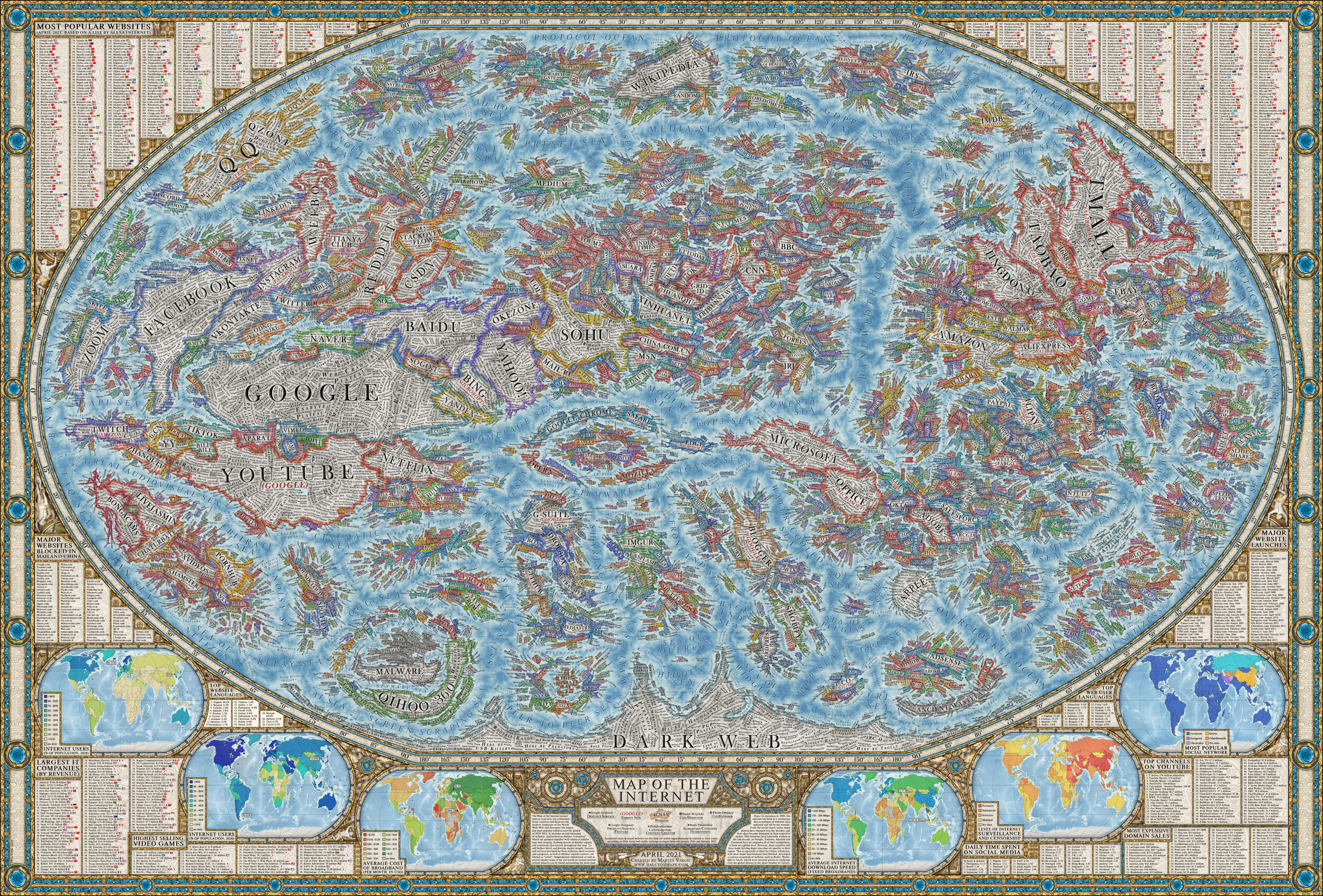
Amateur graphic designer Martin Vargic visualized those spaces as countries on a vast globe inspired by National Geographic Magazine. (Although National Geographic borrowed its cartographic style from some of the first printed maps of the world.) Vargic first published his map in 2014 when he was a student in Slovakia. And now he has decided to update the map for 2021. (See the map in high resolution here.) Large continents represent the main websites of the Internet: Facebook, Google, Apple, Amazon. The seas represent the aforementioned ocean of data under different names: Ocean of Information, North Connection Ocean, etc. To compare his relatively spare original map to the one he just released is to notice how much more crowded this world has become, and how divided.
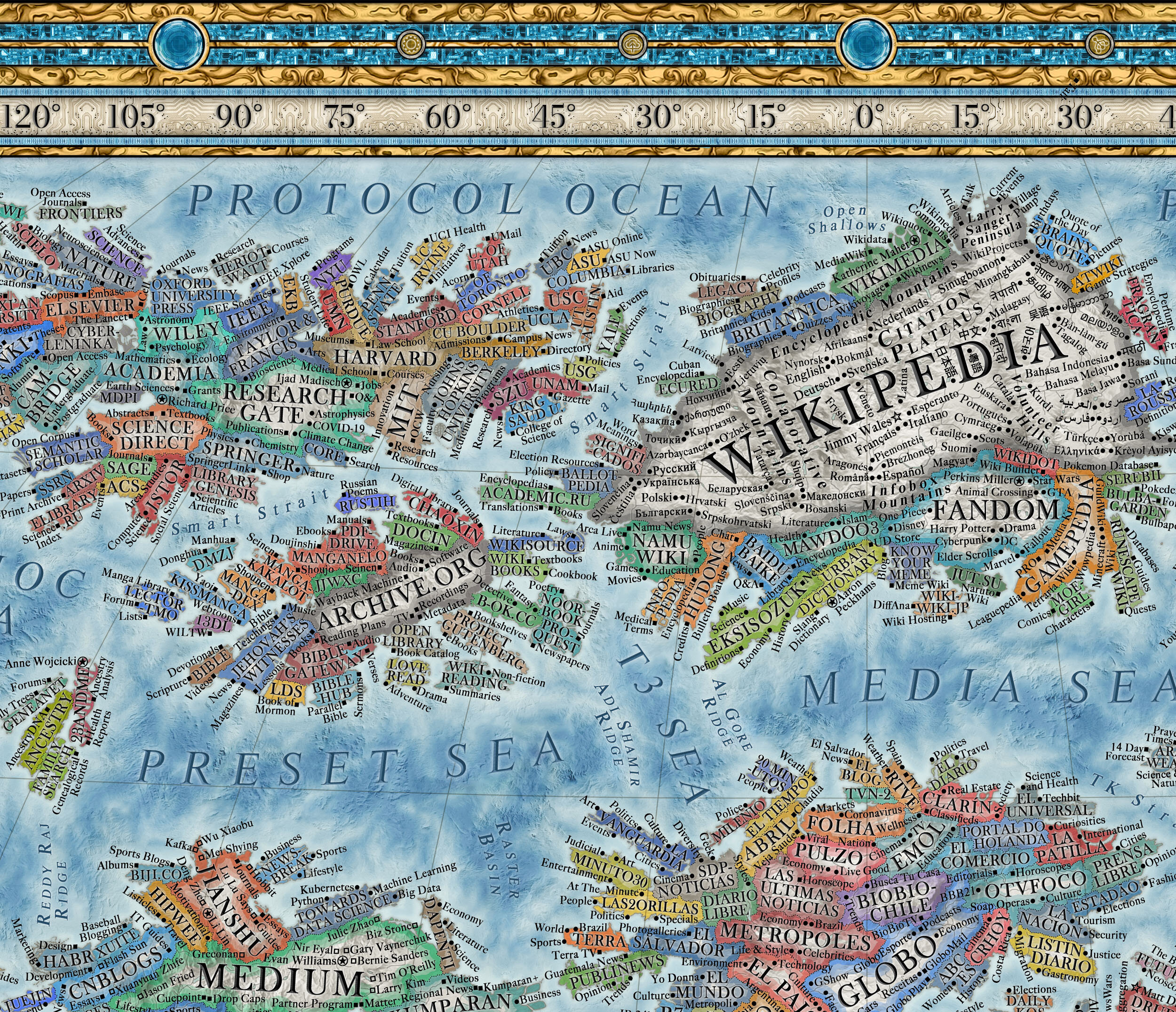
Vargic based the relative size of each website on its average traffic between January 2020 and January 2021, according to Alexa Rank, the Amazon-owned Alexa Internet’s measure of how popular a website is, calculated by unique users and page views.
However, the center of the map is now different. This now depicts the “core and backbone of the Internet as we know it,” Vargic said. This means a core of service providers surrounded by larger islands of web browsers (Chrome, Firefox, et al).
While the 2014 map considered website size as the main organizer and contained around 200 websites, this version contains 3,000. The north of the globe features country clusters: a grouping of academic, research, and free education sites (wikipedia, archive.org, etc.), governmental websites to the east and conspiracy QAnon lands to the west.
The Antarctica of the map? The Dark Web, where the Onion isn’t a parody news site and TOR isn’t the sci-fi/fantasy publisher.
You might find some of Vargic’s decisions odd, or you might just spend your time wondering how much of the internet is indeed an unknown land, with large “countries” you’ve never heard of, but with millions of “residents”. It might not be real, but Vargic’s map will put you in an exploratory mood while you light off for the territories. You can view it in a high resolution format here. Purchase it as a poster here.
Related Content:
The History of the Internet in 8 Minutes
How the Internet Archive Digitizes 3,500 Books a Day–the Hard Way, One Page at a Time
Ted Mills is a freelance writer on the arts who currently hosts the Notes from the Shed podcast and is the producer of KCRW’s Curious Coast. You can also follow him on Twitter at @tedmills, and/or watch his films here.
Read More...Scientists Create an Interactive Map of the 13 Emotions Evoked by Music: Joy, Sadness, Desire, Annoyance, and More
Most of our playlists today are filled with music about emotions: usually love, of course, but also excitement, defiance, anger, devastation, and a host of others besides. We listen to these songs in order to appreciate the musicianship that went into them, but also to indulge in their emotions for ourselves. As for what exactly evokes these feelings within us, lyrics only do part of the job, and perhaps a small part at that. In search of a more rigorous conception of which sonic qualities trigger which emotions in listeners — and a measurement of how many kinds of emotions music can trigger — scientists at UC Berkeley have conducted a cross-cultural research project and used the data to make an interactive listening map.
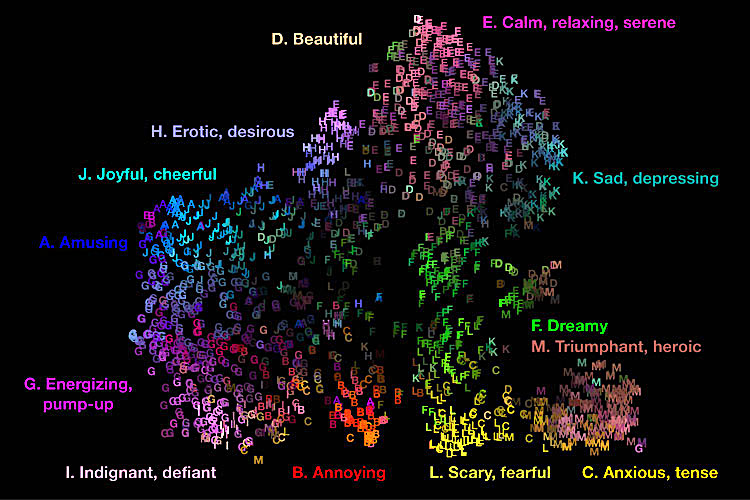
The study’s creators, a group including psychology professor Dacher Keltner (founding director of the Greater Good Science Center) and neuroscience doctoral student Alan Cowen, “surveyed more than 2,500 people in the United States and China about their emotional responses to these and thousands of other songs from genres including rock, folk, jazz, classical, marching band, experimental and heavy metal.” So writes Berkley News’ Yasmin Anwar, who summarizes the broader findings as follows: “The subjective experience of music across cultures can be mapped within at least 13 overarching feelings: Amusement, joy, eroticism, beauty, relaxation, sadness, dreaminess, triumph, anxiety, scariness, annoyance, defiance, and feeling pumped up.”
Many listener responses can’t have been terribly surprising. “Vivaldi’s ‘Four Seasons’ made people feel energized. The Clash’s ‘Rock the Casbah’ pumped them up. Al Green’s ‘Let’s Stay Together’ evoked sensuality and Israel (Iz) Kamakawiwoʻole’s ‘Somewhere over the Rainbow’ elicited joy.
Meanwhile, heavy metal was widely viewed as defiant and, just as its composer intended, the shower scene score from the movie Psycho triggered fear.” The cultural influence of Hitchcock, one might object, has by now transcended all boundaries, but according to the study even Chinese classical music gets the same basic emotions across to Chinese and non-Chinese listeners alike.
Still, all respectable art, even or perhaps especially an abstract one such as music, leaves plenty of room for personal interpretation. You can check your own emotional responses against those of the Berkeley survey’s respondents with its interactive listening map. Just roll your cursor over any of point on its emotional territories, and you’ll hear a short clip of the song listeners placed there. On the peninsula of category H, “erotic, desirous,” you’ll hear Chris Isaak, Wham!, and a great many saxophonists; down in the netherlands of category G, “energizing, pump-up,” Rick Astley’s immortalized “Never Gonna Give You Up” and Alien Ant Farm’s novelty cover of “Smooth Criminal.” Anwar also notes that “The Shape of You,” Ed Sheeran’s inescapable hit, “sparks joy” — but if I have to hear it one more time at the gym, I can assure you my own emotional response won’t be quite so positive.
Related Content:
Daniel Levitin Shows How Musicians Communicate Emotion
Watch Classical Music Get Perfectly Visualized as an Emotional Roller Coaster Ride
Neurosymphony: A High-Resolution Look into the Brain, Set to the Music of Brain Waves
Based in Seoul, Colin Marshall writes and broadcasts on cities, language, and culture. His projects include the Substack newsletter Books on Cities, the book The Stateless City: a Walk through 21st-Century Los Angeles and the video series The City in Cinema. Follow him on Twitter at @colinmarshall or on Facebook.
Read More...A Data Visualization of Every Italian City & Town Founded in the BC Era

Ancient people did not think about history the way most of us do. It made no difference to contemporary readers of the popular Roman historian, Livy (the “JK Rowling of his day”), that “most of the flesh and blood of [his] narrative is fictitious,” and “many of the stories are not really Roman but Greek stories reclothed in Roman dress,” historian Robert Ogilvie writes in an introduction to Livy’s Early History of Rome. Ancient historians did not write to document facts, but to illustrate moral, philosophical, and political truths about what they saw as immutable human nature.
Much of what we know about Roman antiquity comes not from ancient Roman history but from modern archeology (which is still making “amazing” new discoveries about Roman cities). The remains of Rome at its apogee date from the time of Livy, who was likely born in 59 BC and died circa 12 AD. A contemporary, and possibly a friend, of Augustus, the historian lived through a period of immense growth in which the new empire spread across the continent, founding, building, and conquering towns and cities as it went — a time, he wrote, when “the might of an imperial people is beginning to work its own ruin.”
Livy preferred to look back — “turn my eyes from the troubles,” he said — “more than seven hundred years,” to the date long given for the founding of Rome, 753 BC, which seemed ancient enough to him. Modern archeologists have found, however, that the city probably arose hundreds of years earlier, having been continuously inhabited since around 1000 BC. Livy’s own prosperous but provincial city of Padua only became incorporated into the Roman empire a few decades before his birth. According to Livy himself, Padua was first founded in 1183 BC by the Trojan prince Antenor… if you believe the stories….
The point is that ancient Roman dates are suspect when they come from literary sources (or “histories”) rather than artifacts and archaeological dating methods. What is the distribution of such dates across articles about ancient Rome on Wikipedia? Who could say. But the sheer number of documents and artifacts left behind by the Romans and the people they conquered and subdued make it easy to reconstruct the historical strata of European cities — though we should allow for more than a little exaggeration, distortion, and even fiction in the data.

The maps you see here use Wikipedia data to visualize towns and cities in modern-day Italy founded before the first century — that is, every Italian settlement of any kind with a “BC” cited in its associated article. Many of these were founded by the Romans in the 2nd or 3rd century BC. Many cities, like Pompeii, Milan, and Livy’s own Padua, were conquered or slowly taken over from earlier peoples. Another version of the visualization, above, shows a distribution by color of the dates from 10,000 BC to 10 BC. It makes for an equally striking way to illustrate the history, and prehistory, of Italy up to Livy’s time — that is, according to Wikipedia.
The creator of the visualizations obtained the data by scraping 8000 Italian Wikipedia articles for mentions of “BC” (or “AC” in Italian). Even if we all agreed the open online encyclopedia is an authoritative source (and we certainly do not), we’d still be left with the problem of ancient dating in creating an accurate map of ancient Roman and Italian history. Unreliable data does not improve in picture form. But data visualizations can, when combined with careful scholarship and good research, make dry lists of numbers come alive, as Livy’s stories made Roman history, as he knew it, live for his readers.
See the creator’s dataset below and learn more here.
count 1152
mean 929.47
std 1221.89
min 2
25% 196
50% 342.5
75% 1529.5
max 10000
Related Content:
The Roads of Ancient Rome Visualized in the Style of Modern Subway Maps
Rome’s Colosseum Will Get a New Retractable Floor by 2023 — Just as It Had in Ancient Times
Josh Jones is a writer and musician based in Durham, NC. Follow him at @jdmagness
Read More...Support Us
We're hoping to rely on loyal readers, rather than erratic ads. Please click the Donate button and support Open Culture. You can use Paypal, Venmo, Patreon, even Crypto! We thank you!

About Us

Open Culture scours the web for the best educational media. We find the free courses and audio books you need, the language lessons & educational videos you want, and plenty of enlightenment in between.
Advertise With Us

FREE UPDATES!
GET OUR DAILY EMAIL
Get the best cultural and educational resources on the web curated for you in a daily email. We never spam. Unsubscribe at any time.
FOLLOW ON SOCIAL MEDIA

Open Culture editor Dan Colman scours the web for the best educational media. He finds the free courses and audio books you need, the language lessons & movies you want, and plenty of enlightenment in between.
Advertise With Us