The Bob Ross Virtual Art Gallery: A New Site Presents 403 Paintings from The Joy of Painting Series

“We don’t make mistakes. We have happy accidents,” the late Bob Ross soothed fans painting along at home, while brushing an alarming amount of black onto one of his signature nature scenes.
His mellow on-camera demeanor and flowing, wet-on-wet oil painting style were perfectly calibrated to help tightly-wound viewers relax into a right-brained groove.
The creators of the Bob Ross Virtual Art Gallery take a more left brained approach.

Having collected data on Ross’ evergreen series, The Joy of Painting, they analyzed it for frequency of color use over the show’s 403 episodes, as well as the number of colors applied to each canvas.
For those keeping score, after black and white, alizarin crimson was the color Ross favored most, and 1/4 of the paintings made on air boast 12 colors.
The data could be slightly skewed by the contributions of occasional guest artists such as Ross’ former instructor, John Thamm, who once counseled Ross to “paint bushes and trees and leave portrait painting to someone else.” Thamm availed himself of a single color — Van Dyke Brown — to demonstrate the wipe out technique. His contribution is one of the few human likenesses that got painted over the show’s 11-year public television run.
The Bob Ross Virtual Art Gallery has several options for viewing the data.

Mouse over a grid of grey rectangles to see the 403 artworks presented in chronological order, along with titles and episode numbers.
(This has all the makings of a thumping good memory game, à la Concentration… flip all the rectangles, study them, then see if you can navigate back to all the cabins or meadows.)
A bar graph, similarly composed of rectangles, reveals the colors that went into each painting.
Another chart analyzes Ross’ use of color over time, as he moved away from Burnt Umber and eased up on Pfthalo Green.

Indian Red was accorded but a single use, in season 22’s first episode, “Autumn Images.” (“Let’s sparkle this up. We’re gonna have fall colors. Let’s get crazy.”)
For art lovers craving a more traditional gallery experience, site creator Connor Rothschild has installed a virtual bench facing a frame capable of displaying all the paintings in random or chronological order, with digital swatches representing the paints that went into them and YouTube links to the episodes that produced them.
And for those who’d rather gaze at data science, the code is available on GitHub.
Explore the Bob Ross Virtual Art Gallery here. Scroll down to take advantage of all the options.
Related Content:
Experience the Bob Ross Experience: A New Museum Open in the TV Painter’s Former Studio Home
Bob Ross’ Christmas Special: Celebrate, Relax, Nod Off
Ayun Halliday is an author, illustrator, theater maker and Chief Primatologist of the East Village Inky zine. Join her Necromancers of the Public Domain: The Periodical Cicada, a free virtual variety show honoring the 17-Year Cicadas of Brood X. Follow her @AyunHalliday.
Read More...Yes’ Rick Wakeman Explores Vivaldi’s Four Seasons, and Why It Was the First Concept Album
In this 2015 production, Yes keyboardist Rick Wakeman revisits Antonio Vivaldi’s The Four Seasons, and makes the case for why “it was so far ahead of its time that it was actually the first ever concept album, making Vivaldi the world’s first rock superstar.”
“Uncovering the dark rumours surrounding the churches, orphanages and canals of Venice, Rick Wakeman sets out to investigate the extraordinary life of Antonio Vivaldi. From 18th century scandals to interviews with fellow musician Mike Rutherford, uncover the mystery behind one of the world’s favourite composers.” Rick Wakeman: Vivaldi’s Four Seasons appears on the “Rick Wakeman’s World” YouTube channel.
If you would like to support the mission of Open Culture, consider making a donation to our site. It’s hard to rely 100% on ads, and your contributions will help us continue providing the best free cultural and educational materials to learners everywhere. You can contribute through PayPal, Patreon, and Venmo (@openculture). Thanks!
Related Content:
Rick Wakeman’s Prog-Rock Opera Adaptation of George Orwell’s 1984
14-Year-Old Girl’s Blistering Heavy Metal Performance of Vivaldi
Vivaldi’s Four Seasons Brought to Life in Sand Animations by the Hungarian Artist Ferenc Cakó
Read More...
Tasting History: A Hit YouTube Series Shows How to Cook the Foods of Ancient Greece & Rome, Medieval Europe, and Other Places & Periods
The food of our ancestors has come back into fashion, no matter from where your own ancestors in particular happened to hail. Whether motivated by a desire to avoid the supposedly unhealthy ingredients and processes introduced in modernity, a curiosity about the practices of a culture, or simply a spirit of culinary adventure, the consumption of traditional foods has attained a relatively high profile of late. So, indeed, has their preparation: few of us could think of a more traditional food than bread, the home-baking of which became a sweeping fad in the United States and elsewhere shortly after the onset of the COVID-19 pandemic.
Max Miller, for example, has baked more than his own share of bread at home. Like no few media-savvy culinary hobbyists, he’s put the results on Youtube; like those hobbyists who develop an unquenchable thirst for ever-greater depth and breadth (no pun intended) of knowledge about the field, he’s gone well beyond the rudiments.
18th-century Saly Lunn buns, medieval trencher, Pompeiian panis quadratus, even the bread of ancient Egypt: he’s gone a long way indeed beyond simple sourdough. But in so doing, he’s learned — and taught — a great deal about the variety of civilizations, all of them heartily food-eating, that led up to ours.
“His show, Tasting History with Max Miller, started in late February,” writes Devan Sauer in a profile last year for the Phoenix New Times. “Since then, Tasting History has drawn more than 470,000 subscribers and 14 million views.” Each of its episodes “has a special segment where Miller explains the history of either the ingredients or the dish’s time period.” These periods come organized into playlists like “Ancient Greek, Roman, & Mesopotamian Recipes,” “The Best of Medieval & Renaissance Recipes,” and “18th/19th Century Recipes.” In his clearly extensive research, “Miller looks to primary accounts, or anecdotal records from the people themselves, rather than historians. He does this so he can get a better glimpse into what life was like during a certain time.”
If past, as L.P. Hartley put it, is a foreign country, then Miller’s historical cookery is a form of not just time travel, but regular travel — exactly what so few of us have been able to do over the past year and a half. And though most of the recipes featured on Tasting History have come from Western, and specifically European cultures, its channel also has a playlist dedicated to non-European foods such as Aztec chocolate; the kingly Indian dessert of payasam; and hwajeon, the Korean “flower pancakes” served in 17th-century snack bars, or eumshik dabang. He’s also prepared the snails served at the thermopolium, the equivalent establishment of the first-century Roman Empire recently featured here on Open Culture. But however impressive Miller’s knowledge, enthusiasm, and skill in the kitchen, he commands just as much respect for having mastered Youtube, the true Forum of early 21st-century civilization.
Related Content:
What Did People Eat in Medieval Times? A Video Series and New Cookbook Explain
Cook Real Recipes from Ancient Rome: Ostrich Ragoût, Roast Wild Boar, Nut Tarts & More
How to Bake Ancient Roman Bread Dating Back to 79 AD: A Video Primer
How to Make the Oldest Recipe in the World: A Recipe for Nettle Pudding Dating Back 6,000 BC
Based in Seoul, Colin Marshall writes and broadcasts on cities, language, and culture. His projects include the Substack newsletter Books on Cities, the book The Stateless City: a Walk through 21st-Century Los Angeles and the video series The City in Cinema. Follow him on Twitter at @colinmarshall or on Facebook.
Read More...When Neil Young & Rick “Super Freak” James Formed the 60’s Motown Band, The Mynah Birds
At the height of Motown’s powers in the 1960s they were setting trends, not chasing them, but even that record company fell under the spell of the British Invasion. Sure, the jukebox R’n’B singles that made their way across the Atlantic were in the DNA of The Beatles, Rolling Stones, and the Who, but in the mid’60’s the label decided they needed a beat group of their own. That’s how one of the weirdest tales of pop music unfolded, and would have stayed a tiny footnote if it weren’t for the future fame of two of the Mynah Birds’ members: funk overlord Rick James and folk-rocker-noisemaker Neil Young.
Yes, for a brief period of time they were in the same band together in Toronto, Canada, part of an exploding beat group scene that was mostly all white. “I was an authentic R&B singer living in a city where white musicians were striving to play authentic R&B,” Rick James wrote in his autobiography quoted in Bandsplaining’s above video. “That added to my status. It also got me laid.”
James Ambrose Johnson Jr., had been in Canada for two years already, having escaped the Vietnam draft by fleeing north in 1964. Saved from a bar brawl by future members of The Band, Levon Helm and Garth Hudson, he entered the music scene and adopted the name Ricky Matthews, as a way to hide his identity. The Mynah Birds began in 1964 and even put out a single on Columbia that went nowhere. They tried (and failed) again in 1965, with an ever-changing line-up. Ricky Matthews though, remained the dynamic lead singer.
Enter Neil Young. As Rick James tells it, he was looking to change their sound and he saw Neil Young playing in a coffeehouse and asked him to join. (James’ recollection is in the above video.) However, Kevin Plummer in the Torontoist has a different version:
One day—most likely in the fall of 1965, but some say in early 1966—Young was walking down Yorkville Avenue with an amp on his shoulder. As he passed, Palmer struck up a conversation. The Mynah Birds were, once again, without a lead guitarist, so he asked Young to join—despite the fact that Young only owned the twelve-string acoustic. “I had to eat,” Young is quoted in John Einarson’s Neil Young: Don’t Be Denied (Quarry Press, 1992). “I needed a job and it seemed like a good thing to do. I still liked playing and I liked Bruce so I went along. There was no pressure on me. It was the first time that I was in a band where I wasn’t calling the shots.”
As Young and James were soon to share a basement apartment and a whole lot of drugs, the participants can be forgiven for their hazy memories.
The video also conflates their svengali (John Craig Eaton, a department store heir who bankrolled the band and gave them rehearsal space) with their manager (folk singer and fan Morley Shelman). Whether it was Eaton, Shelman, or just luck, within two months of having Young in the band, and a reputation for wild, amphetamine-driven concerts—the band had signed a seven-year contract with Motown, the first mostly-white act to do so.
Neil Young remembered the first album sessions in an interview with Cameron Crowe:
We went in and recorded five or six nights, and if we needed something, or if they thought we weren’t strong enough, a couple of Motown singers would just walk right in. And they’d Motown us! A couple of ’em would be right there, and they’d sing the part. They’d just appear and we’d all do it together. If somebody wasn’t confident or didn’t have it, they didn’t say, ‘Well, let’s work on this.’ Some guy would just come in who had it. Then everybody was grooving. And an amazing thing happened—we sounded hot. And all of a sudden it was Motown. That’s why all those records sounded like that.
Rick James was worried about entering the States and being arrested for avoiding the draft. But in Detroit he was safe. It was when he returned that the trouble began—he discovered that Shelman had apparently spent their advance on a fancy new motorbike and a not-so-fancy heroin habit. A fight broke out and Shelman retaliated by ratting James out. James turned himself in to the American authorities and the Mynah Birds’ career—at least the James/Young version—ended. Only four of the tracks recorded for the album were ever released, two at the time as a single, the other two in 2006 as part of a Rhino Records Motown retrospective. More are rumored to exist but they remain hidden away in a vault at best, destroyed at worst.
Young would move to California soon after and join Buffalo Springfield. James, once out of jail, would make his way back into the recording industry, ironically returning to Motown. Band members Goldy McJohn and Nick St. Nicholas would form Steppenwolf. And through it all, James and Young remained friends.
Related Content:
Catch Stevie Wonder, Ages 12–16, in His Earliest TV Performances
Ted Mills is a freelance writer on the arts who currently hosts the Notes from the Shed podcast and is the producer of KCRW’s Curious Coast. You can also follow him on Twitter at @tedmills, and/or watch his films here.
Read More...When Salvador Dalí Created a Surrealist Funhouse at New York World’s Fair (1939)
Only the violence and duration of your hardened dream can resist the hideous mechanical civilization that is your enemy, that is also the enemy of the ‘..pleasure-..principle’ of all men. It is man’s right to love women with the ecstatic heads of fish. — Salvador Dalí, “Declaration of the Independence of the Imagination and the Rights of Man to His Own Madness”
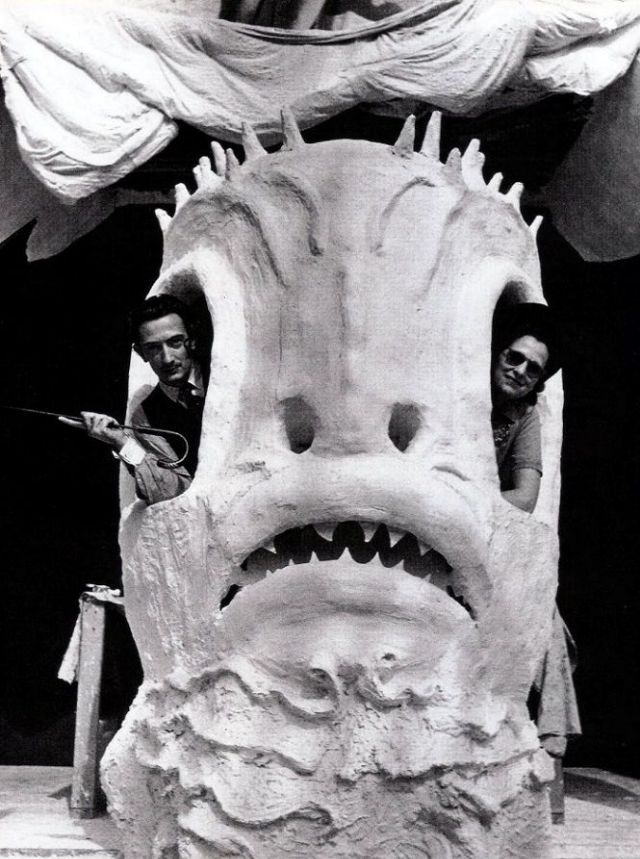
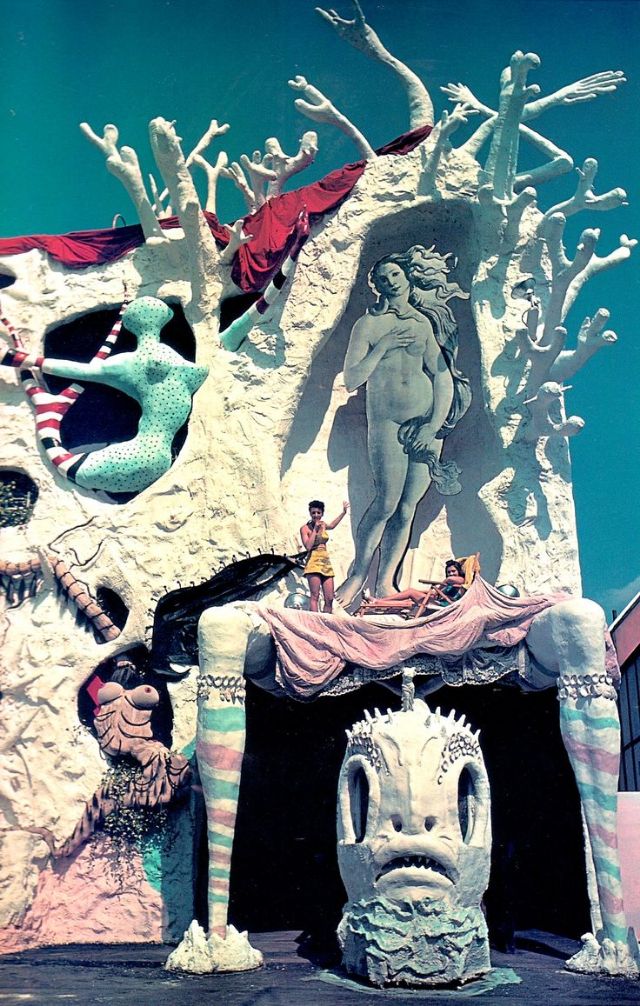
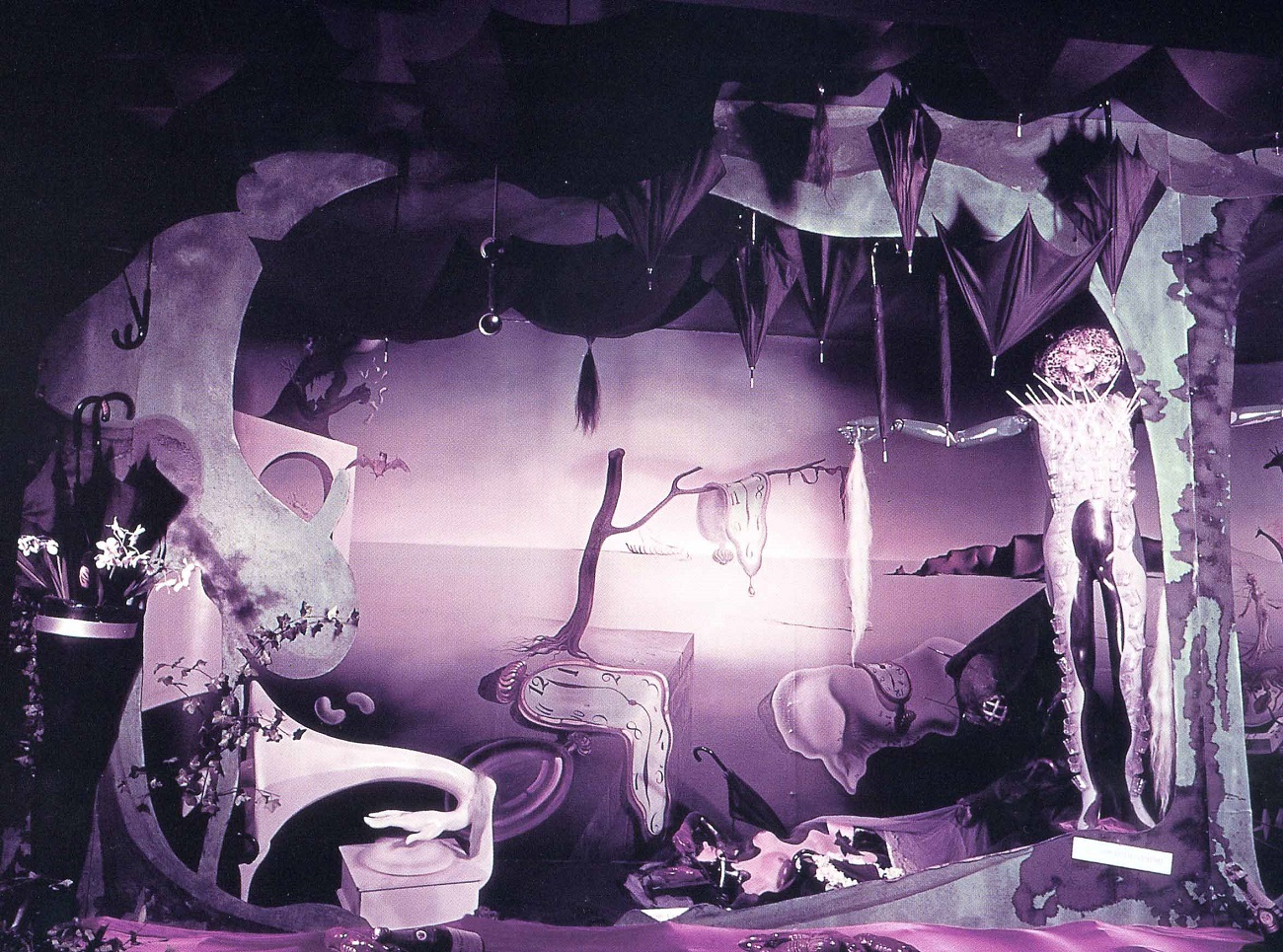
Whatever organizers of the 1939 New York World’s Fair thought they might get when Salvador Dalí was chosen to design a pavilion, they got a Coney Island of the Surrealist mind. The vision was so initially upsetting, the committee felt compelled to censor Dalí’s plans. They nixed the idea, for example, of reproducing a gigantic reproduction of Boticelli’s Venus with a fish head — as well as fish heads for the many partially nude models in Dalí’s exhibit. These and other changes enraged the artist, and he hired a pilot to drop a manifesto over the city in which he declared “the Independence of the Imagination and the Rights of Man to His Own Madness.”
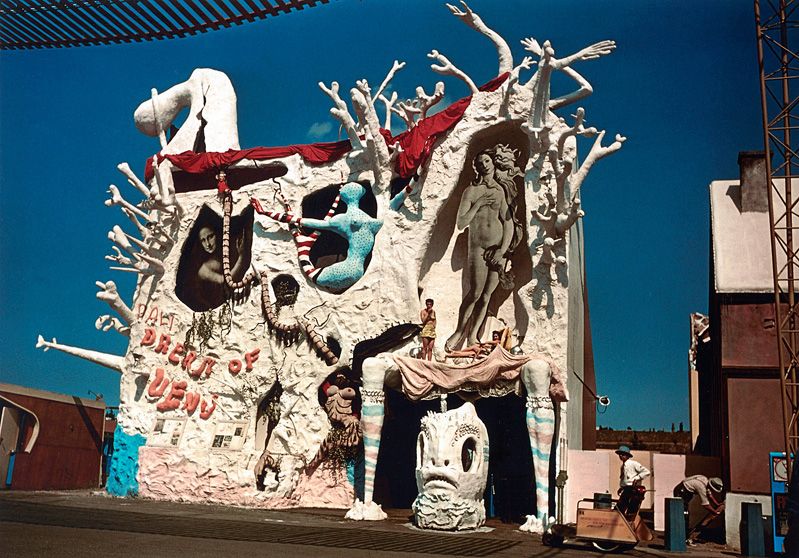
It was all part of the theater of the “Dream of Venus,” Dalí’s so-called “funhouse” and public experiment playing with “the old polarity between the elite and popular cultures,” says Montse Aguer, Director of the Dalí Museums.
This conflict had “changed into a tense confrontation between true art and mass culture, with all that the second ambiguous concept brought with it consumed by the masses, but not produced by them.” While Dalí rained down a “screw you” letter to the establishment, he also seduced the public away from “the streamline style that dominated the Expo in 1939” — the “modern architecture, which with time had turned against modern life.”
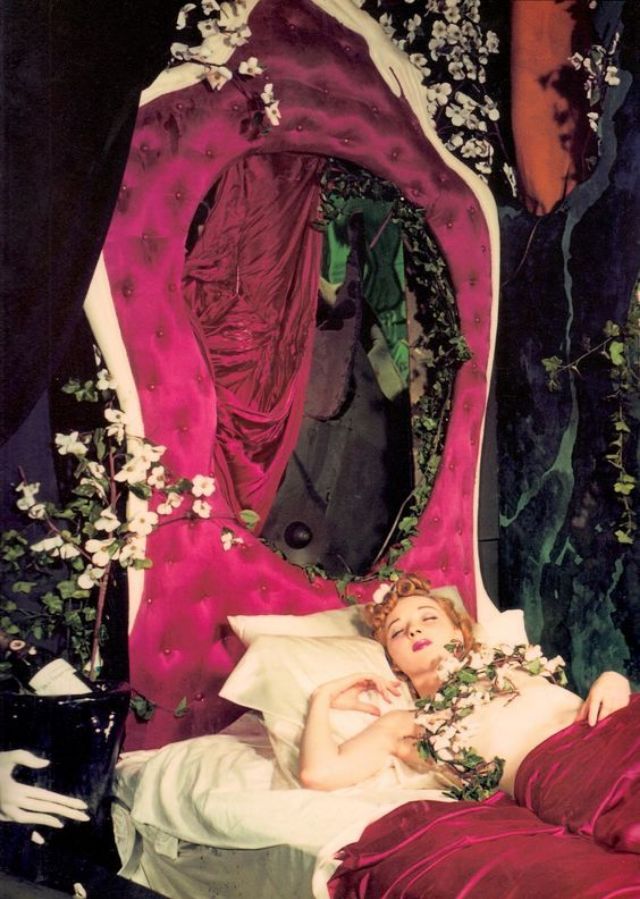
Rather than a sleek “World of Tomorrow,” visitors to Dalí’s pavilion encountered “a kind of shapeless mountain from which sprouts out, like the body of a sticky hedgehog, a series of soft appendages, some in the shape of arms and hand; others of cactus or tips and others of crutches…. The world of machines, cars and robots had been replaced — or should one say challenged — by a universe of dreams.” Inside the weird structure, a goddess stretched out on bed, dreaming two dreams, “wet,” and “dry.” As Dangerous Minds describes it, once visitors entered the exhibit, through a giant pair of legs, they encountered:
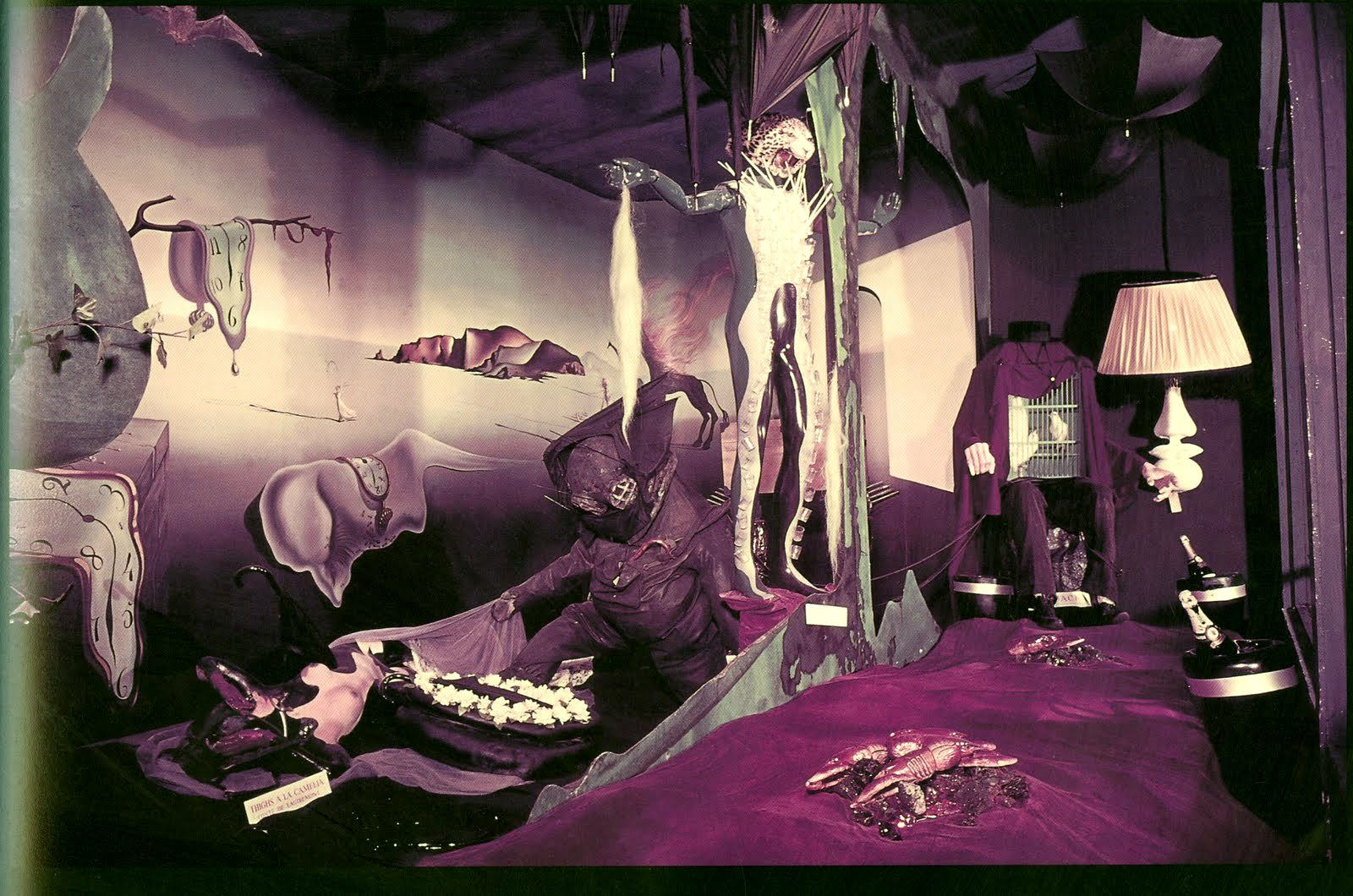
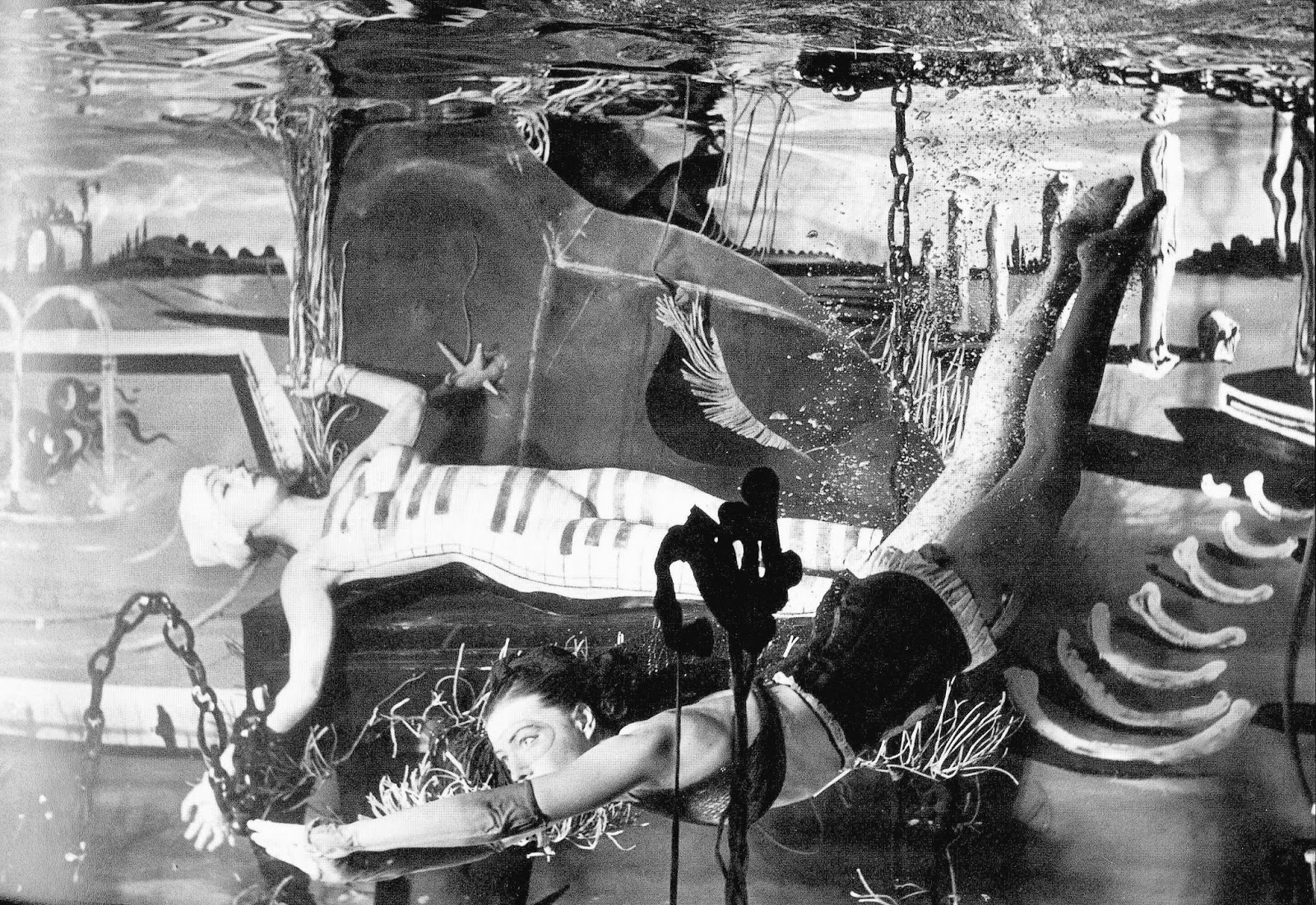
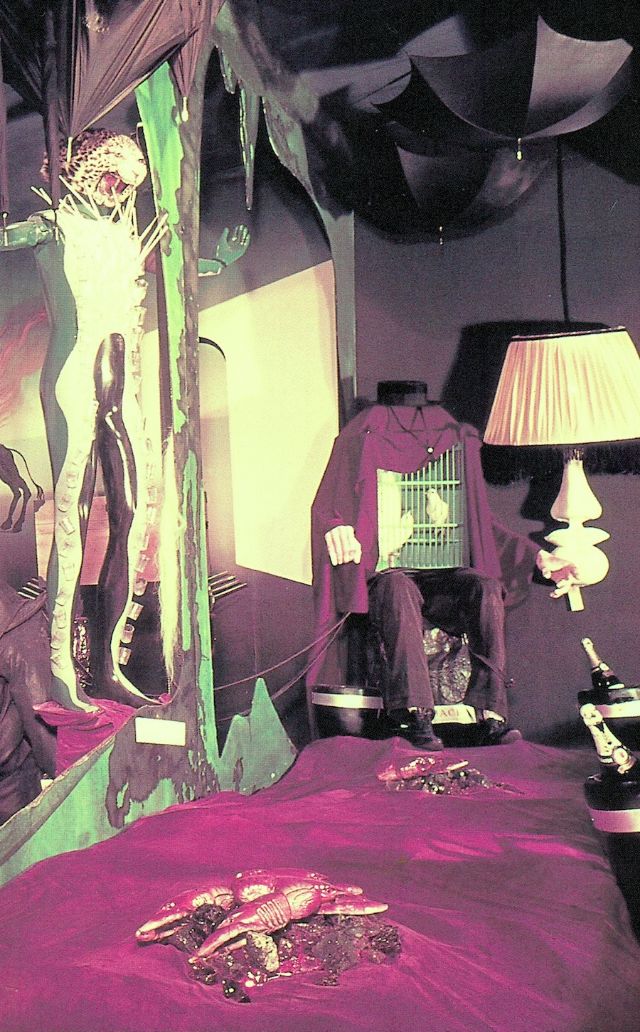
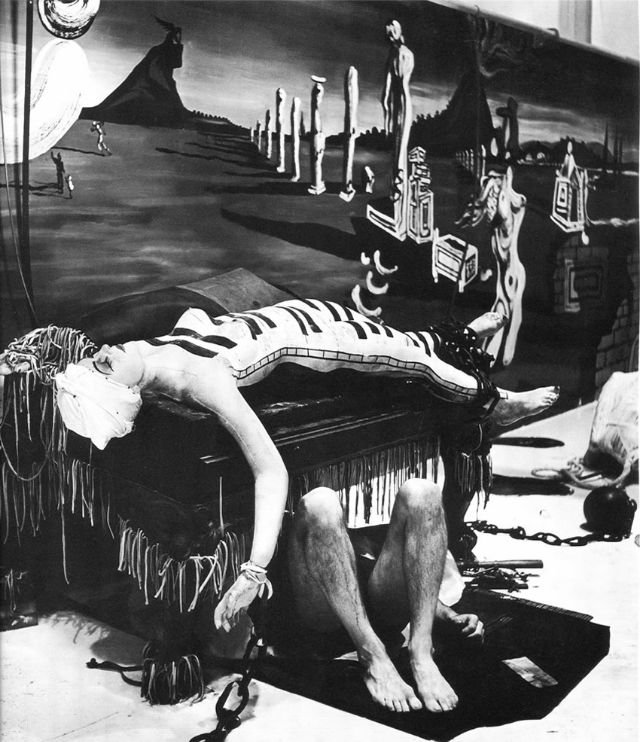
Two huge swimming pools featured partially nude models floating around in the water. In one of the pools, a woman dressed in a head-to-toe rubber suit that had been painted with piano keys cavorted around with other “mermaids” who “played” her imaginary piano. In fact, the place was filled with scantly-clad women lying in beds or perched on top of a taxi being driven by a female looking S&M batwoman. There were functional telephones made of rubber as well as an offputting life-size version of a cow’s udder that you could touch—if you wanted to, that is.
The exhibition had been coordinated by architect, artist, and collector Ian Woodner and New York art dealer Julien Levy. It was so popular “it reopened for a second season,” notes Messy Nessy, “but once torn down it faded from memory and its outlandishness became the stuff of urban myth.” In 2002, the photographs here by German-born photographer Eric Schaal were rediscovered and collected in a book titled Salvador Dalí’s Dream of Venus: The Surrealist Funhouse from the 1939 World’s Fair. See rare footage from the pavilion in the short documentary at the top and read Dalí’s manifesto here.

Related Content:
Salvador Dalí Explains Why He Was a “Bad Painter” and Contributed “Nothing” to Art (1986)
Josh Jones is a writer and musician based in Durham, NC. Follow him at @jdmagness
Read More...Keith Richards Shows Us How to Play the Blues, Inspired by Robert Johnson, on the Acoustic Guitar
To me Robert Johnson’s influence — he was like a comet or a meteor that came along and, BOOM, suddenly he raised the ante, suddenly you just had to aim that much higher.
As Keith Richards tells it, the first time he met Brian Jones, the two “went around to his apartment crash-pad,” where all Jones had was “a chair, a record player, and a few records, one of which was Robert Johnson.” Jones put on the record, and the moment changed Richards’ life. He wasn’t so much interested in the devil at the crossroads. The first question he asked — “Who’s that?” — was followed by, “Yeah, but who’s the other guy playing with him? That, too, was Robert Johnson, playing rhythm with his thumb while bending and sliding with his fingers, the fancy guitar work that earned him the envy of fellow bluesmen, and led to the rumor his skills came from hell.
“One of the staples of Johnson’s style is his ability to sound at times like two guitar players,” writes Andy Aledort at Guitar World, “combining driving rhythms on the lower strings with melodic figures with the higher strings.” Like every other British guitarist of his generation, Richards was enchanted. “I’ve never heard anybody before or since use the form and bend it quite so much to make it work for himself…. The guitar playing — it was almost like listening to Bach. You know, you think you’re getting a handle on playing the blues, and then you hear Robert Johnson….”
The legendary bluesman became not only Richards’ hero, but also his teacher. “We all felt there was a certain gap in our education,” he tells The Guardian, “so we all scrambled back to the 20s and 30s to figure out how Charlie Patton did this, or Robert Johnson, who, after all, was and still probably is the supremo.”
Figuring out what Johnson did still consumes his biggest fans. Since his recordings were intentionally sped up, interpreters of his music must make their best guesses about his tunings, which “can be broken down into four categories: standard tuning, open G, open D and drop D,” Aledort notes. (There are other arguments for alternate tunings.) Richards frequently used open tunings like Johnson’s before he learned 5‑string open G from Ry Cooder, on songs, for example, like “Street Fighting Man.” At the top, he gives us his interpretation of Johnson’s “32–20 Blues,” in standard tuning.
And just above, Keef offers a brief lesson on how to play the blues, mumbling and growling over a 12-bar vamp. The music took him over, he says, “it’s just something you’ve got to do. You have no choice. I mean, we had other things to do and everything, but once you got bitten by the bug, you had to find out how it’s done, and every three minutes of soundbite would be like an education.”
What did their blues heroes think of the Stones? The band never got to meet Robert Johnson, of course, but he might have been appreciative. “I got the chance to sit around with Muddy Waters and Bobby Womack,” says Keith, “and they just wanted to share ideas.” Johnson didn’t leave much behind to learn from, but his keenest students found exactly what they needed in his few haunting recordings.
Related Content:
Robert Johnson Finally Gets an Obituary in The New York Times 81 Years After His Death
Josh Jones is a writer and musician based in Durham, NC. Follow him at @jdmagness
Read More...Bass Sounds: One Song Highlights the Many Different Sounds Made by Different Bass Guitars
If you’re a seasoned bass player, the diversity of bass sounds in the “Bass Sounds” videos here will hardly surprise you. Most other people — including many musicians — have little understanding of the range of the bass, an instrument thought to just hold down the low end. Yes, it does do that, but it doesn’t always do it with bass frequencies. Bass tones and overtones fall anywhere in the range of 40hz — a low rumble more felt than heard — to a snappy 4000hz, the high-midrange frequency of snare drums and guitars.
That’s a lot of sonic territory for an instrument to explore. It includes the sound of Paul McCartney’s Hofner Violin Bass on “Penny Lane,” a “bass-heavy tone with almost no mids or treble,” Joel McIver writes at MusicRader; the smooth top end of Jaco Pastorious’ homemade fretless Fender Jazz bass; and the buzzsaw power chords of Lemmy Kilmister’s Rickenbacker 4001, which he played with midrange turned to 11 and bass controls completely off.
Of course, amplifiers and effects make all the difference in famous bassists’ tones, but it starts at the fingers, the body, the pickups, and the frets, as bass player Bart Soeters demonstrates with a series of classic, modern, and obscure bass guitars, accompanied by the music of Joris Holtackers. Basses here include such recognizable shapes as the Hofner, with its chambered body and f‑holes, the Fender Jazz and Precision basses, and the Gibson SG. They also include unusual or unique instruments like the NS Design Basscello and Soeters’ own Adamovic FBC signature bass.
Boomy, woody, even reedy — bass guitars can rumble and they can croon. They can be imitated by an electric cello — as Soeters demonstrates in the follow-up Bass Sounds II video at the top — make lovely acoustic thumps, and generally sound as percussive or melodic as you like. Will educating others about the range of bass guitar tones change unfortunate stereotypes about bass players (demonstrated below via interpretive dance and spoken word by The Kids in the Hall’s Kevin McDonald and Bruce McCulloch)? Only time will tell. But it can certainly sharpen the music appreciation skills of musicians and non-musicians alike. See all the different basses listed on the Bass Sounds YouTube pages here and here.
via Laughing Squid
Related Content:
The Neuroscience of Bass: New Study Explains Why Bass Instruments Are Fundamental to Music
The Story Behind the Iconic Bass-Smashing Photo on the Clash’s London Calling
Paul McCartney Offers a Short Tutorial on How to Play the Bass Guitar
Josh Jones is a writer and musician based in Durham, NC. Follow him at @jdmagness
Read More...De-Mystifying Mindfulness: A Free Online Course by Leiden University
From Chris Goto-Jones–now Dean of Humanities and Professor of Philosophy at the University of Victoria–comes a free course which was named ‘one of the best online courses of all time’ in 2020. The course description for De-Mystifying Mindfulness reads:
Interest in meditation, mindfulness, and contemplation has grown exponentially in recent years. Rather than being seen as mystical practices from ancient Buddhism or esoteric philosophy, they are increasingly seen as technologies rooted in evidence from psychology and neuroscience. Mindfulness has become the basis for numerous therapeutic interventions, both as a treatment in healthcare and as a means of enhancing well-being and happiness. For millions around the world, mindfulness has become a life-style choice, enhancing and enriching everyday experience. Mindfulness is big business.
But, what actually is mindfulness? Is it really good for you? Can anyone learn it? How can you recognize charlatans? Would you want to live in a mindful society, and would it smell like sandalwood? What does it feel like to be mindful? Are you mindful already, and how would you know?
Evolving from the popular Honours Academy course at Leiden University [in the Netherlands], this innovative course combines conventional scholarly inquiry from multiple disciplines (ranging from psychology, through philosophy, to politics) with experiential learning (including specially designed ‘meditation labs,’ in which you’ll get chance to practice and analyze mindfulness on yourself). In the end, the course aims to provide a responsible, comprehensive, and inclusive education about (and in) mindfulness as a contemporary phenomenon.
You can take De-Mystifying Mindfulness for free by selecting the audit option upon enrolling. If you want to take the course for a certificate, you will need to pay a fee.
De-Mystifying Mindfulness will be added to our list, 1,700 Free Online Courses from Top Universities.
Related Content:
Free Guided Meditations From UCLA: Boost Your Awareness & Ease Your Stress
Philosopher Sam Harris Leads You Through a 26-Minute Guided Meditation
Stream 18 Hours of Free Guided Meditations
Listen to Bill Murray Lead a Guided Meditation on How It Feels to Be Bill Murray
Read More...Real D‑Day Landing Footage, Enhanced & Colorized with Artificial Intelligence (June 6, 1944)
Steven Spielberg’s Saving Private Ryan drew great acclaim for its harrowing depiction of “D‑Day,” the 1944 Allied landing operation that proved a decisive blow against Nazi Germany. More specifically, Spielberg and his creators recreated the landing on Omaha Beach, one of five code-named stretches of the Normandy coast. The video above depicts the landing on another, Juno Beach. This, its uploader stresses, “is not the famous movie D‑day the Sixth of June but actual and real footage.” No wonder it feels more realistic than that 1956 Henry Koster spectacle — and, in another way, more so than Spielberg’s picture, whose use of not just color and widescreen dimensions but advanced visual effects made World War II visceral in a way even those who’d never seen combat could feel.
The taking of Omaha Beach was assigned to the United States Army, with support from the U.S. Coast Guard as well as the U.S., British, Canadian and Free French navies. As such, it made a suitable inclusion indeed for an American war story like Saving Private Ryan. Juno Beach, however, was primarily a Canadian job: that country’s army landed there under support from the Royal Canadian Navy (with additional help from several other Allied navies).
As on Omaha Beach, the troops who first landed on Juno Beach came under heavy German fire and sustained serious casualties. But within two hours the Allied forced managed to overcome these coastal defenses and began making their way inland — a direction in which the 3rd Canadian Infantry Division managed to push farther than any of D‑Day’s other landing forces.
These Juno Beach D‑Day clips benefit from a technology unavailable even in Saving Private Ryan’s day: artificial intelligence-based enhancement and colorization processes. Originally shot in black-and-white like most (but not all) Army footage of the 1940s, it’s been “motion-stabilized, contrast- and brightness-enhanced, de-noised, upscaled, restored to full HD and artificially colorized.” The result looks crisp enough that anyone without first-hand memories of the Western Front — a generation, alas, now fast leaving the stage — may well forget that it isn’t a war film but a film of war. None of the participants are re-enactors: not the Allied troops boarding their boats by the hundreds, not General Dwight D. Eisenhower, not the German prisoners of war, and certainly not the wounded and dead. What’s more, none of their actions are rehearsed: as the 77th anniversary of D‑Day approaches, we should remember that, whatever the bravery on their faces, not one of these men could have felt assured of victory.
Related Content:
The Normandy Invasion Captured on 16 mm Kodachrome Film (1944)
Photo Archive Lets You Download 4,300 High-Res Photographs of the Historic Normandy Invasion
Dramatic Color Footage Shows a Bombed-Out Berlin a Month After Germany’s WWII Defeat (1945)
David Lynch Recounts His Surreal Dream of Being a German Solider Dying on D‑Day
Based in Seoul, Colin Marshall writes and broadcasts on cities, language, and culture. His projects include the Substack newsletter Books on Cities, the book The Stateless City: a Walk through 21st-Century Los Angeles and the video series The City in Cinema. Follow him on Twitter at @colinmarshall or on Facebook.
Read More...De-Mystifying Mindfulness: A Free Online Course by Leiden University
From Chris Goto-Jones–now Dean of Humanities and Professor of Philosophy at the University of Victoria–comes a free course which was named ‘one of the best online courses of all time’ in 2020. The course description for De-Mystifying Mindfulness reads:
Interest in meditation, mindfulness, and contemplation has grown exponentially in recent years. Rather than being seen as mystical practices from ancient Buddhism or esoteric philosophy, they are increasingly seen as technologies rooted in evidence from psychology and neuroscience. Mindfulness has become the basis for numerous therapeutic interventions, both as a treatment in healthcare and as a means of enhancing well-being and happiness. For millions around the world, mindfulness has become a life-style choice, enhancing and enriching everyday experience. Mindfulness is big business.
But, what actually is mindfulness? Is it really good for you? Can anyone learn it? How can you recognize charlatans? Would you want to live in a mindful society, and would it smell like sandalwood? What does it feel like to be mindful? Are you mindful already, and how would you know?
Evolving from the popular Honours Academy course at Leiden University [in the Netherlands], this innovative course combines conventional scholarly inquiry from multiple disciplines (ranging from psychology, through philosophy, to politics) with experiential learning (including specially designed ‘meditation labs,’ in which you’ll get chance to practice and analyze mindfulness on yourself). In the end, the course aims to provide a responsible, comprehensive, and inclusive education about (and in) mindfulness as a contemporary phenomenon.
You can take De-Mystifying Mindfulness for free by selecting the audit option upon enrolling. If you want to take the course for a certificate, you will need to pay a fee.
De-Mystifying Mindfulness will be added to our list, 1,700 Free Online Courses from Top Universities.
Related Content:
Free Guided Meditations From UCLA: Boost Your Awareness & Ease Your Stress
Philosopher Sam Harris Leads You Through a 26-Minute Guided Meditation
Stream 18 Hours of Free Guided Meditations
Read More...Support Us
We're hoping to rely on loyal readers, rather than erratic ads. Please click the Donate button and support Open Culture. You can use Paypal, Venmo, Patreon, even Crypto! We thank you!

About Us

Open Culture scours the web for the best educational media. We find the free courses and audio books you need, the language lessons & educational videos you want, and plenty of enlightenment in between.
Advertise With Us

FREE UPDATES!
GET OUR DAILY EMAIL
Get the best cultural and educational resources on the web curated for you in a daily email. We never spam. Unsubscribe at any time.
FOLLOW ON SOCIAL MEDIA

Open Culture editor Dan Colman scours the web for the best educational media. He finds the free courses and audio books you need, the language lessons & movies you want, and plenty of enlightenment in between.
Advertise With Us

