Elvis Costello’s Musician Father (and Doppelgänger) Performing in 1963
If you were an English boy growing up in the 1960s, and your dad met the Queen mum, you’d come away with some pretty heavy duty bragging rights.
What if your dad didn’t just meet her, but commanded her attention for a full three minutes… an event you witnessed on the telly, along with 21.2 million others?
That’s what happened to young Declan Patrick McManus, or Elvis Costello as he’s more commonly known these days.
Unfortunately, his musician father Ross’s calypso-inflected, Trini Lopez-inspired rendition of Pete Seeger’s “If I Had a Hammer” at the Queen’s annual Royal Variety Performance was overshadowed by another act in the evening’s line up: The Beatles.
This was the performance where John Lennon famously solicited the audience’s participation on “Twist and Shout”:
For our last number, I’d like to ask your help. The people in the cheaper seats, clap your hands. And the rest of you, if you’d just rattle your jewelry.
https://vimeo.com/151903948?embedded=true&source=video_title&owner=47853706
So, Ross McManus played for the Queen Mum (and Princess Margaret) and all little Declan got was a great anecdote for his 2016 memoir Unfaithful Music & Disappearing Ink and a thoughtful souvenir:
Eventually I couldn’t pretend that I really cared whether he’d… shaken hands with the Queen Mum. I blurted out:
“Did you actually meet The Beatles?”
It had obviously been a long night or an early morning, as my Dad wasn’t that talkative. He mumbled something about them being very nice lads. Then he reached into a jacket slung over the back of his chair and pulled out a sheet of thin airmail paper and handed it to me.
I unfolded it, and there were the signatures of all four of The Beatles on one page. I’d seen reproductions of their signatures in enough magazines and fan club literature to know that these appeared to be the real thing.
The ink seemed barely dry.
What I did next will bring tears to the eyes of those who make a fetish of such objects, but I had only a small autograph book and the paper was too large to be mounted in it.
I carefully, if not so very carefully, cut around each of the signatures, lopping off the e of the “The” in “The Beatles” and pasting the four irregular scraps of paper into my album.
McManus the Elder took another crack at “If I Had a Hammer” when he and other members of the Joe Loss Orchestra were invited to reprise their royal performance in the 1965 short The Mood Man, excerpted at the top of this page.
Clearly, the acorn didn’t fall far from this tree!
Father and son seem more like twins here:
the horn-rimmed specs…
The vibrato…
That vintage style!
(Speaking of which, Costello confides that his father was obliged to wear long johns under his off-white suit “after the television director claimed that his flesh could be detected through the thin material … under the television lights, which would be bound to scandalize the royal party.”)
The two also shared a willingness to experiment with assumed names. Ross McManus found success in Australia with a cover of The Beatles’ “The Long and Winding Road” as “Day Costello” — surname compliments of his grandmother’s maiden name. (Other handles include “Hal Prince” and “Frank Bacon and the Baconeers.”)
Elvis Costello spent enough time in his old man’s orbit to recognize the disembodied hands playing the conga drums in the opening shot shot of McManus’s “If I Had a Hammer“ — Bill Brown’s, taking a bit of a busman’s holiday from the baritone saxophone.
And he acknowledges his own persona’s debt to his dad, citing the section where he “lip-synchs the hell out of the number, miming ‘hammer of justice’ for all it’s worth”:
The close-ups that come on the repeated line, “It’s a song about love between my brothers and my sisters” are eerie to behold for the similarity of our facial expression at about this age, and especially when singing particular words.
Where my Dad holds the advantage over me is in his dance moves.
Those are steps that I am yet to master.
Costello also notes that his father gave him a bit of a professional leg up in 1973, when he got him hired for backing vocals on a musical ad for R. Whites Lemonade:
For some reason, the producer asked my Dad to deliver the song in a mock Elvis Presley voice, while for the background part, they wanted “R. Whites” punched out so that it sounded like the “All right” on a Swinging Blue Jeans record. I suppose the advertising people thought the kids would dig it… given that my Dad and I could easily approximate a suitably nasal Mersey sound, we cut the parts in a couple of takes. It wasn’t exactly the big time, but there was still a thrill to hearing your voice come back off the tape, even if you were singing something farcical.
The ad made a lasting impression. If there’s a club for British people who watched TV in the 70’s “secret lemonade drinker” may well be the password. (Costello, understandably, was not pleased when a tabloid’s brass decided it made a fitting headline for his talented, well-known father’s obituary: “Secret Lemonade Drinker Dies.”)
The first Secret Lemonade Drinker ad’s popularity justified various sequels over the years, particularly when fans got hip to the 19-year-old Costello’s involvement.
He was, in fact, more involved than many would realize.
As he recalls in his memoir, the original recording session turned into an impromptu casting session for an alternate, albeit far harder to find online, take:
The ad men took a look around the studio and decided to cast this second version of the commercial from the musicians on the session. The drummer and hippie guitar player certainly looked the part, but the pianist and bass player were older more conservatively dressed and didn’t really fit the bill. Given our then more fashionable hairstyles, my Dad and I were recruited to mime the keyboard and bass parts, and we spent the day taking and retaking the thirty second clip, lip-synching the “R. Whites / All right” background part with as much animation as we could manage by take forty six.
Behold!
Costello’s relationship with his father — also the only son of a musician — is a prime topic of his 688-page memoir.
It’s not only easy, but worthwhile, to truffle up online evidence of Ross’s recording career. There’s even a rare, early 80s duet between father and son…
For some intel on Costello’s mother Lilian’s influence, read his moving tribute from earlier this year, written shortly after her death.
h/t to reader Greg Kotis.
Related Content:
See the First Ever Video of Elvis Costello Performing, Summer 1974
The Stunt That Got Elvis Costello Banned From Saturday Night Live (1977)
Elvis Costello’s List of 500 Albums That Will Improve Your Life
Ayun Halliday is the Chief Primaologist of the East Village Inky zine and author, most recently, of Creative, Not Famous: The Small Potato Manifesto. Follow her @AyunHalliday.
Read More...How Led Zeppelin Stole Their Way to Fame and Fortune
When Bob Dylan released his 2001 album Love and Theft, he lifted the title from a book of the same name by Eric Lott, who studied 19th century American popular music’s musical thefts and contemptuous impersonations. The ambivalence in the title was there, too: musicians of all colors routinely and lovingly stole from each other while developing the jazz and blues traditions that grew into rock and roll. When British invasion bands introduced their version of the blues, it only seemed natural that they would continue the tradition, picking up riffs, licks, and lyrics where they found them, and getting a little slippery about the origins of songs. This was, after all, the music’s history.
In truth, most UK blues rockers who picked up other people’s songs changed them completely or credited their authors when it came time to make records. This may not have been tradition but it was ethical business practice. Fans of Led Zeppelin, on the other hand, now listen to their music with asterisks next to many of their hits — footnotes summarizing court cases, misattributions, and downright thefts from which they profited. In many cases, the band would only admit to stealing under duress. At other times, they freely confessed in interviews to taking songs, tweaking them a bit, and giving themselves sole credit for composing and/or arranging.
A list of ten “rip offs” in a Rolling Stone piece on Led Zeppelin’s penchant for theft is hardly exhaustive. It does not include “Stairway to Heaven,” for which the band was recently sued for lifting a melody from Spirit’s “Taurus.” (An internet user saved the band’s case by finding that both songs used an earlier melody from the 1600s.)
During those recent court proceedings, the prosecution quoted from a 1993 interview Jimmy Page gave Guitar World:
“[A]s far as my end of it goes, I always tried to bring something fresh to anything that I used. I always made sure to come up with some variation. In fact, I think in most cases, you would never know what the original source could be. Maybe not in every case – but in most cases. So most of the comparisons rest on the lyrics. And Robert was supposed to change the lyrics, and he didn’t always do that – which is what brought on most of the grief. They couldn’t get us on the guitar parts of the music, but they nailed us on the lyrics.”
The blame shifting was “not quite fair to Plant,” the court found, “as Page repeatedly took entire musical compositions without attribution.” He stood accused of doing so, for example, in “The Lemon Song,” lifted from Howlin’ Wolf’s “Killing Floor.” After a lawsuit, the song is now co-credited to Chester Burnett (Howlin’ Wolf’s real name). For his part, Plant readily blamed Page when given the chance. In his book Led Zeppelin IV, Barney Hoskyns quotes the singer’s thoughts on the “Whole Lotta Love” controversy:
I think when Willie Dixon turned on the radio in Chicago twenty years after he wrote his blues, he thought, ‘That’s my song.’ … When we ripped it off, I said to Jimmy, ‘Hey, that’s not our song.’ And he said, ‘Shut up and keep walking.’
Led Zeppelin’s musical thievery does not make them less talented or ingenious as musicians. They took others’ material, some of it wholesale, but no one can claim they didn’t make it their own, melding American blues and British folk into a truly strange brew. The Polyphonic video above on their use of others’ music begins with a quote from “poet and famous anti-semite” T.S. Eliot, expressing a sentiment also attributed to Picasso, Faulkner, and Stravinsky:
Immature poets imitate, mature poets steal; bad poets deface what they take, and good poets make it into something better, or at least something different.
As far as copyright goes, Zeppelin didn’t always cross legal lines. But as Jacqui McShee said when Page reworked a composition by her Pentangle bandmate, Bert Jansch, “It’s a very rude thing to do. Pinch somebody else’s thing and credit it to yourself.” Maybe so. Still, nobody ever won any awards for politeness in rock and roll, most especially the band that helped invent the sound of heavy metal. See a scoreboard showing the number of originals, credited covers and uncredited thefts on the band’s first four albums here.’
Related Content:
Zeppelin Took My Blues Away: An Illustrated History of Zeppelin’s “Copyright Indiscretions”
When Led Zeppelin Reunited and Crashed and Burned at Live Aid (1985)
Josh Jones is a writer and musician based in Durham, NC. Follow him at @jdmagness
Read More...When John Belushi Booked the Punk Band Fear on SNL, And They Got Banned from the Show: A Short Documentary
Like many famous episodes in the lives of famous people, Andy Warhol’s 15 minutes quote turns out to be a garbling of what happened. Warhol simply said that everybody wants to be famous (and by implication, famous forever). To which the Factory’s “court photographer” Nat Finkelstein replied, “yeah, for 15 minutes.” Given the way the idea has come down to us, we’ve missed the ambiguity in this exchange. Do we all want to be famous for 15 minutes (and only 15 minutes), or do we only spend 15 minutes wanting to be famous before we move on and accept it as a sucker’s game?
Finkelstein himself might have felt the latter as he watched “pop die and punk being born” (he said in a 2001 interview). It was the death of Warhol’s fame ideal, and the birth of something new: music that loudly declared open hostilities against the gatekeepers of popular culture. Not every punk band reserved its punches for those above them. California hardcore legends Fear — led by confrontational satirist Lee Ving — swing wildly in every direction, hitting their audience as often as the powers that be.
When their first taste of Warholian fame came around — in Penelope Spheeris’ 1981 documentary The Decline of Western Civilization — Ving used the moment in front of the cameras to taunt and abuse audience members until a few of them rushed the stage to fight him. Had NBC executives seen this footage casual violence, profanity, and worrisome ebullience, it’s unlikely they would have let returning guest John Belushi book Fear on Halloween night of that same year.
The SNL appearance — for which Fear proudly earned a permanent ban — became the stuff of legend. Not only did Ving and band get up to their usual antics onstage, but the show brought in a crew of about 80 DC punks (including Dischord Records/Fugazi founder Ian MacKaye), who smashed up the set and joined the band in solidarity against New York and its saxophones. The network cut the broadcast short when one punk (identified as either MacKaye or John Brannon of the band Negative Approach) yelled “F*ck New York!” into an open mic during the last song, “Let’s Start a War.” NBC shelved the footage for years.
Although well-known in fan communities, the appearance might have faded from memory were it not for the internet, which not only has the Warholian power to make anyone famous (or “internet famous”) for no reason, but also routinely resurrects lost moments of fame and makes them last forever. Just so, the legend of Fear on SNL has grown over time on YouTube. It now warrants a short documentary — one made, no less, by Jeff Krulik, a filmmaker who, five years after the Fear appearance, documented another burgeoning Fear-like fandom in his cult short, “Heavy Metal Parking Lot.”
“Fear on SNL,” above, includes several interview clips from firsthand witnesses. DC “punk superfan” Bill MacKenzie listens to an old interview he gave about the show, in which he says the band asked him to come to the taping. As Ian MacKaye tells it, Lorne Michaels himself placed the call. (He must mean producer Dick Ebersol, as Michaels left the show in 1980 and wouldn’t return until 1985.) But both MacKaye and Ving remember that it was Belushi who really rounded up the audience of authentic punks, leveraging his own hard-won celebrity to stick it to the factory that made his fame.
Related Content:
The Stunt That Got Elvis Costello Banned From Saturday Night Live
Josh Jones is a writer and musician based in Durham, NC. Follow him at @jdmagness
Read More...Meet the Mysterious Genius Who Patented the UFO
American inventors never met a phenomenon — natural, manmade, or otherwise — they couldn’t try to patent. From impossible technologies to possible evidence of aliens visiting planet Earth, everything’s fair game if you can sell the idea. After highly-publicized UFO sightings in Washington State and Roswell, New Mexico, for example, patents for flying saucers began pouring into government offices. “As soon as there was a popular ‘spark,’” writes Ernie Smith at Atlas Obscura, “the saucer was everywhere.” It received its own classification in the U.S. Patent Office, with the indexing code B64C 39/001, for “flying vehicles characterized by sustainment without aerodynamic lift, often flying disks having a UFO-shape.”
Google Patents lists “around 192 items in this specific classification,” with surges in applications between 1953–56, 1965–71, and an “unusually dramatic surge… between 2001 and 2004.” Make of that what you will. The story of the UFO gets both stranger and more mundane when we learn that Alexander Weygers, the very first person to file a patent for such a flying vehicle, invented it decades before UFO-mania and patented it in 1945. He was not an American inventor but the Indonesian-born son of a Dutch sugar plantation family. He learned blacksmithing on the farm, received an education in Holland in mechanical engineering and naval architecture, and honed his mechanical skills while taking long sea voyages alone.
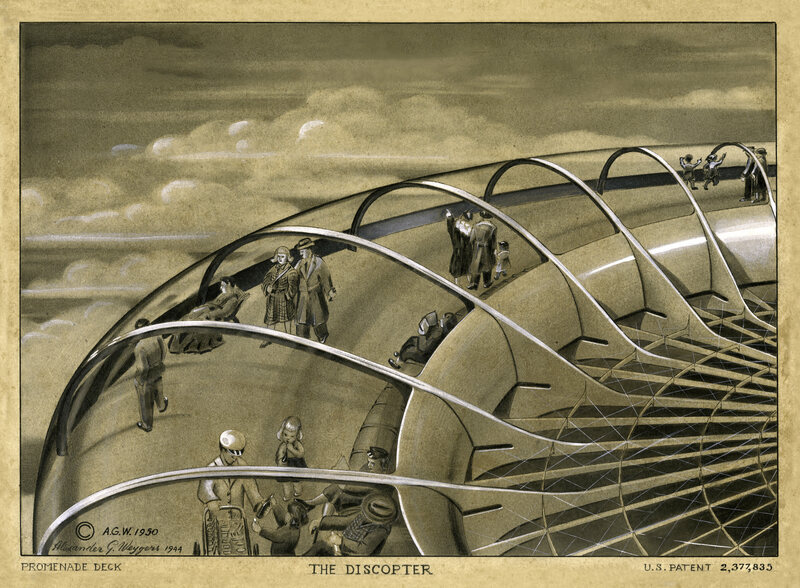
In 1926, Weygers and his wife Jacoba Hutter moved to Seattle, Ashlee Vance writes at Bloomberg Businessweek, “where he pursued a career as a marine engineer and ship architect and began inking drawings of the Discopter” — the flying-saucer-like vehicle he would patent after working for many years as a painter and sculptor, mourning the death of his wife, who died in childbirth in 1928. By the time Weygers was ready to revive the Discopter, the time was ripe, it seems, for a wave of technological convergent evolution — or a technological theft. Perhaps, as Weygers’ claimed, UFOs really were Army test planes: test pilots flying something based on the inventor’s design — which was not a UFO, but an attempt at a better helicopter.

Sightings of strange objects in the sky did not begin in 1947. “Tales of mysterious flying objects date to medieval times,” Vance writes, “and other inventors and artists had produced images of disk-shaped crafts. Henri Coanda, a Romanian inventor, even built a flying saucer in the 1930s that looked similar to what we now think of as the classic craft from outer space. Historians suspect that the designs of Coanda and Weygers, floating around in the public sphere, combined with the postwar interest in sci-fi technology to create an atmosphere that gave rise to a sudden influx of UFO sightings.” In the 1950s, NASA and the U.S. Navy even began testing vertical takeoff vehicles that looked suspiciously like the patented Discopter.
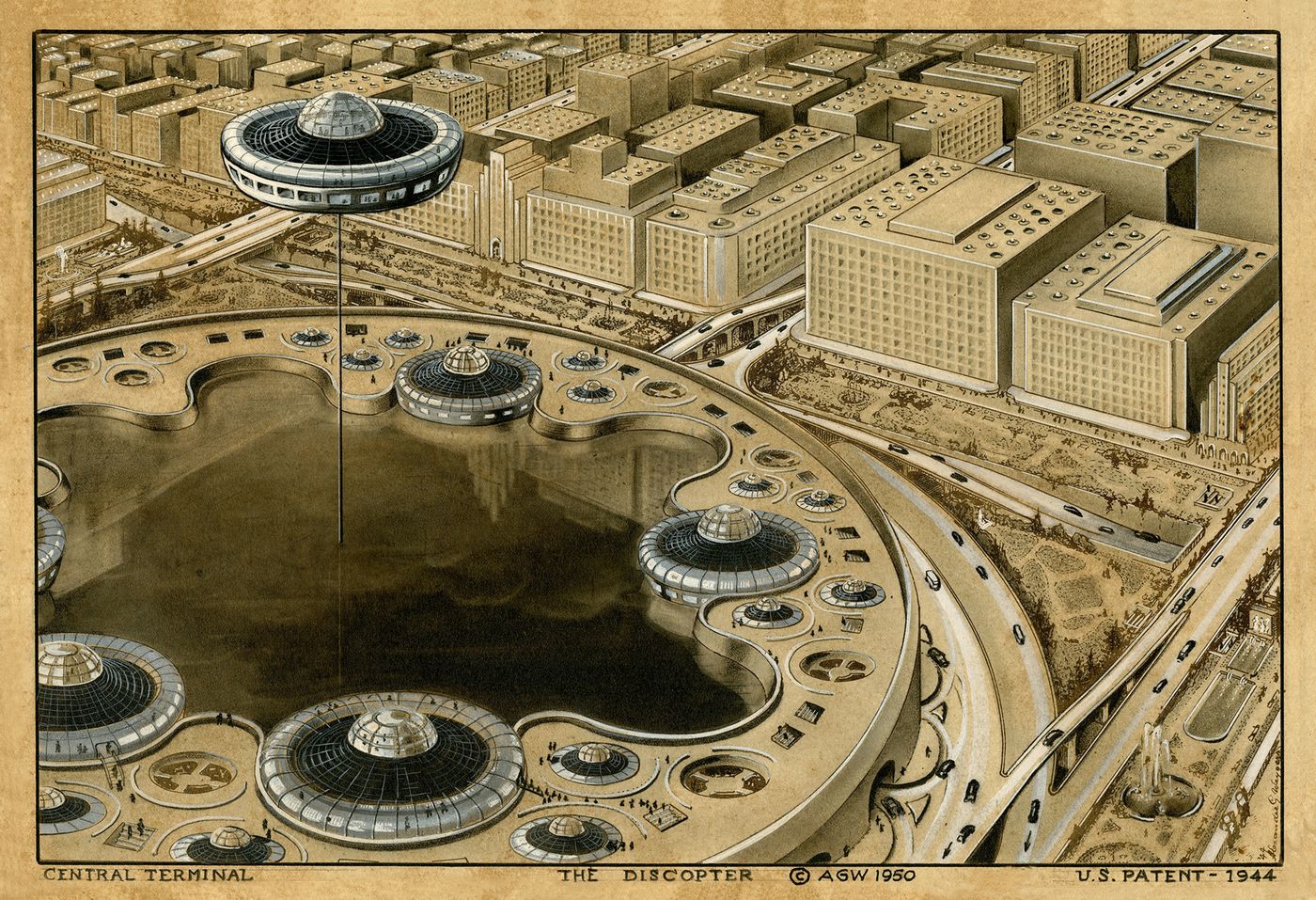
Weygers was livid and “convinced his designs had been stolen.” The press even picked up the story. In 1950 the San Francisco Chronicle ran an article headlined “Carmel Valley Artist Patented Flying Saucer Five Years Ago: ‘Discopter’ May Be What People Have Seen Lately.” Although Weygers never built a Discopter himself, the article goes on to note that “the invention became the prototype for all disk-shaped vertical take-off aircraft since built by the U.S. armed forces and private industry, both here and abroad.” Just how many such vehicles have been constructed, and have actually been air-worthy, is impossible to say.
Smith surveys many of the patents for flying saucers filed over the past 75 years by both individuals and large companies. In the latter category, we have companies like Airbus and startups created by Google co-founder Larry Page currently working on flying saucer-like designs. The history of such vehicles may not provide sufficient evidence to disprove UFO sightings, but it may one day lead to the technology for flying cars we thought would already have arrived this far into the space age. For that we have to thank, though he may never get the credit, the modern Renaissance artist and inventor Alexander Weygers.
Related Content:
Carl Jung’s Fascinating 1957 Letter on UFOs
Josh Jones is a writer and musician based in Durham, NC. Follow him at @jdmagness
Read More...John Cleese Presents His 5‑Step Plan for Shorter, More Productive Meetings (1976)
Let’s face it, meetings are boring at best and at worst, chaotic, volatile, and potentially violent. And let’s also face it: to get through life as functioning adults, we’re going to have to sit through one or two of them — or even one or two of them a week.
Maybe we’re the one who calls the meetings, and maybe they all feel like a waste of time. One solution is to have more informal meetings. This can be especially tempting in the age of work-from-home, when it’s impossible to know how many meeting attendees are wearing pants. Fewer rules can raise the spontaneity quotient, but allowing for the unexpected can invite disaster as well as epiphany.
On the other end of the scale, we have the formality of parliamentary rules of order, such as those introduced by U.S. Army officer Henry Martyn Robert in 1876. Robert, whose father was the first president of Morehouse College, gained a wealth of experience with unproductive meetings as he traveled around the country with the Army. One particular meeting became a defining experience, as one account has it:
While in San Francisco, the local leader of his community didn’t show up for a church meeting. Henry Robert was asked to preside over the town hall (without any prior notice). Let’s just say that on this particular evening in 1876, he did a bad job. An hour into the meeting, people were screaming and the church actually erupted into open conflict.
Sadly, this sort of thing has become almost routine at town halls and school board meetings. But it needn’t be so at the office. Nor, says John Cleese in the brief video above, do meetings need to follow the formality of parliamentary procedure.
Cleese’s rules are simpler even than the simplified Roberts or Rosenberg’s Rules of Order, an even more simplified version of Robert’s Rules. Furthermore, Cleese avoids using words like “Rules” which can be a turn-off in our egalitarian times. Instead, he presents us with a “5‑Step Plan” for holding better and shorter meetings.
1. Plan — Clear your mind about the precise objectives of the meeting. Be clear why you need it and list the subjects.
2. Inform — Make sure everyone knows exactly what is being discussed, why, and what you want from the discussion. Anticipate what information and people may be needed and make sure they’re there.
3. Prepare — Prepare the logical sequence items. Prepare the time allocation to each item on the basis of its importance not its urgency.
4. Structure and Control — Take the evidence stage before the interpretation stage and that before the action stage and stop people jumping ahead or going back over ground.
5. Summarize all decision and record them straight away with the name of the person responsible for any action
Easy, right? Well, maybe not so easy in practice, but these steps can, at the very least, illuminate what’s wrong with your meetings, which may currently resemble one of Cleese’s many parodies of business culture. Nobody videophoned it in at the time, but trying to figure out who’s supposed to be doing what can still take up an afternoon. Let Cleese’s five steps bring order to the chaos.
Related Content:
Monty Python’s John Cleese Creates Ads for the American Philosophical Association
John Cleese’s Very Favorite Comedy Sketches
Josh Jones is a writer and musician based in Durham, NC. Follow him at @jdmagness
Read More...An Introduction to the Chrysler Building, New York’s Art Deco Masterpiece, by John Malkovich (1994)
No old stuff for me, no bestial copyings of arches and columns and cornices. Me, I’m new.
— architect William Van Alen, designer of the Chrysler Building
Many people claim the Chrysler Building as their favorite New York City edifice and actor John Malkovich is one such:
It’s so crazy and vigorous in its execution, so breathtaking in its vision, so brilliantly eccentric.
Malkovich, who’s not shy about taking potshots at the city’s “violence and filth” in the BBC documentary short above, rhapsodizes over Detroit industrialist Walter P. Chrysler’s “latter day pyramid in Manhattan.”
Malkovich’s unmistakable voice, pegged by The Guardian as “wafting, whispery, and reedy” and which he himself poo poos as sounding like it belongs to someone who’s “labored under heavy narcotics for years,” pairs well with descriptions so plummy, one has to imagine he penned them himself. (No writer is credited.)
After showing us the open-to-the-public lobby’s “delicious Art Deco fittings,” ceiling mural, and intricate, veneered elevator doors, Malkovich gives us a tour of some off-limits upper floors.
Unlike the Empire State Building, which bested the Chrysler Building’s brief record as the world’s tallest building (1046 feet, 77 stories), you can’t purchase tickets to admire the view from the top.
But Malkovich has the star power to gain access to Celestial, the seventy-first floor observatory that has been closed to the public since 1945 and is currently occupied by a private firm.
He also has a wander around the barren Cloud Club, a supper club and speakeasy for gentleman one percenters. Its mishmash of styles represented a concession on architect Van Alen’s part. The building’s exterior was an elegant modernist homage to Chrysler’s hubcaps and hood ornaments, but between the 66th and 68th floor, the Cloud Club catered to the promiscuous tastes of the rich and powerful — Tudor, Olde English, Neo-Classical…
The New York Times reports that it boasted what “was reputed to be the grandest men’s room in all of New York.”
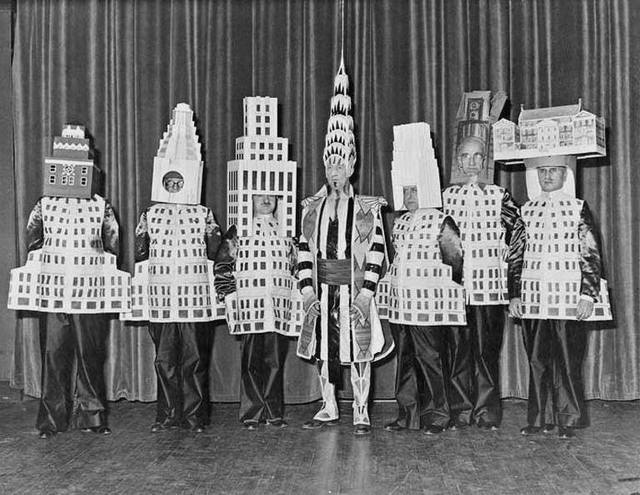
A Duke Ellington soundtrack and vintage footage featuring Van Alen costumed to resemble his famous creation supply a taste of the excitement that heralded the building’s 1930 opening, even if those with a fear of heights may swoon at the sight of pretty young things reclining on high beams and performing other feats of derring-do.
Malkovich, ever the cool customer, displays his lack of vertigo by casually propping a foot on the rooftop’s edge to commune with the iconic eagle-headed gargoyles.
The building’s unique flourishes caused a sensation, but not everyone was a fan.
Malkovich clearly savors his swipe at critics who decried the new building as too shiny:
Fortunately these critics are long dead so we can’t even call their offices and taunt them as they should be taunted.
He’s more temperate when it comes to author and social philosopher Lewis Mumford, whose beef with the skyscraper is understandable, given the historic context — the stock market crashed the day after the secretly constructed spire was riveted into place:
Such buildings show one of the real dangers of a plutocracy: it gives the masters of our civilization an unusual opportunity to exhibit their barbarous egos, with no sense of restraint or shame.
Nearly one hundred years later, barbarous egos continue to erect skyscraping temples to their own vanity, but as Malkovich points out, they’re far blander, if taller.
The Chrysler Building is now widely recognized as one of New York City’s most magnificent jewels, and the Landmarks Preservation Commission recently approved plans to construct a public observation deck on the Chrysler Building’s 61st floor, just above its iconic Art Deco eagles, though it’s too early to tell if it will be ready in time for a centennial celebration.
Until then, the general public must content itself with exploring the Chrysler Building’s lobby during weekday business hours.
Related Content:
Why Do People Hate Modern Architecture?: A Video Essay
Famous Architects Dress as Their Famous New York City Buildings (1931)
Ayun Halliday is the Chief Primatologist of the East Village Inky zine and author, most recently, of Creative, Not Famous: The Small Potato Manifesto. Follow her @AyunHalliday.
Read More...Watch Wes Anderson’s Animated Music Video for The French Dispatch, Featuring a Track by Jarvis Cocker
The French Dispatch came out nearly two weeks ago, after having been pushed back more than a year by COVID-19. But delaying the release of a Wes Anderson movie surely counts among the least regrettable harms of the pandemic, which has caused millions of deaths worldwide. Among the lives lost was that of Daniel Bevilacqua, known in France as the chanson singer Christophe. Set in that country — and more specifically, the fictional city of Ennui-sur-Blasé — in the 1960s, The French Dispatch features a reinterpretation of Christophe’s 1965 hit “Aline” that now plays as something of a tribute to the late pop-cultural icon. Sung by Pulp frontman Jarvis Cocker, it comes accompanied by the Anderson-directed animated music video above.
Cocker has worked with Anderson before. In the director’s 2009 stop-motion adaptation of Roald Dahl’s The Fantastic Mr. Fox he provided the voice of a singing farmer named Petey; in The French Dispatch he does the same for a pop star called Tip-Top, and has even recorded a full-length album in character.
Released on the very same day as The French Dispatch, Chansons d’Ennui Tip-Top contains a dozen covers of songs originally popularized by the likes of Serge Gainsbourg, Brigitte Bardot, Jacques Dutronc, and Françoise Hardy. (Attentive cinephiles, the core audience for all things Anderson, will also note the presence on the track list of Claude Channes’ “Mao Mao,” first heard in Jean-Luc Godard’s La Chinoise.)
Chansons d’Ennui Tip-Top exudes the retro-minded Cocker’s love of 1960s French pop music, just as The French Dispatch exudes Anderson’s love of… well, everything Anderson loves, much of which appears in the “Aline” music video. Its meticulously hand-drawn look comes from Javi Aznarez, who’d originally been hired to apply his art to the sets of the film itself. Following Tip-Top as he dances through an elaborate two-dimensional rendition of Ennui-sur-Blasé, it introduces not only the setting (in a stark cutaway manner reminiscent of The Life Aquatic) but all the major characters and the actors who play them. Owen Wilson, Anjelica Huston, Edward Norton, Bill Murray: the gang, it seems, is all here — “here” being a certain idea of postwar France best realized, perhaps, by imaginations like Anderson and Cocker’s.
Related Content:
Wes Anderson’s Animated Books
Wes Anderson’s Shorts Films & Commercials: A Playlist of 8 Short Andersonian Works
Based in Seoul, Colin Marshall writes and broadcasts on cities, language, and culture. His projects include the Substack newsletter Books on Cities, the book The Stateless City: a Walk through 21st-Century Los Angeles and the video series The City in Cinema. Follow him on Twitter at @colinmarshall or on Facebook.
Read More...9‑Year-Old Henry Thomas Delivers a Remarkable Screen Test for E.T.
I can guarantee almost every day I get someone going, ‘Hey, you’re the guy from E.T.’, usually followed by, ‘What are you doing now?’ And not a day has gone by when someone hasn’t shouted ‘E.T. phone home’ at me.” — Actor Henry Thomas
Should I ever bump into Henry Thomas, I may exclaim, “Okay, kid, you got the job,” just like director Steven Spielberg does at the end of the remarkable screen test, above.
Thomas, now — brace yourself — 50, was just 9 when Spielberg flew him in from Texas to audition for the role of Elliot in E.T. the Extra-Terrestrial on the strength of his single screen credit, playing Sissy Spacek’s son in Raggedy Man.
Before we go further, a cautionary tale.
Another youngster had the part of Elliot all sewn up until screenwriter Melissa Mathison hosted a Dungeons and Dragon game to get a feel for the chemistry between the film’s child actors.
“In about three minutes it became very clear that nobody liked this little boy,” casting director Marci Liroff recalls. Ouch.
That would be a heavy burden to carry through life, knowing that youthful bossiness cost you the role of a lifetime.
Enter Henry Thomas.
Spielberg’s longtime collaborator, producer Kathleen Kennedy, recalled that he was no great shakes reading from prepared sides of the script, but then came an improv with legendary casting director Mike Fenton.
If only every aspirant method actor shared Thomas’ knack for emotional recall. During the improv, as the pressure to give up the beloved alien creature hidden in his closet mounted, he drew on memories of his pet chihuahua, Urso, who had been killed by a neighbour’s dog in front of him.
“Poor Urso, it may have won me the role but it was a sad price to pay,” Thomas told The Mirror some 30 years later.
His performance reduced every adult in the room to tears.
It was also remarkable for its subtlety. As Spielberg remarked in a 1982 interview with Premiere magazine:
He’s a very controlled, methodical performer who measures what he does and feels what he does and yet broadcasts it in a totally subtle way. His performance is so controlled, unlike most kid performers, who seem to be giving you 150 percent on every shot. Henry’s performance is just a bread crumb at a time, but he takes you in a wonderful direction to a very, very rousing catharsis. He’s just a “once in a lifetime” kid.
The director likened Thomas’ tears in the final moments of E.T. to the arrival of the mother ship in Close Encounters of the Third Kind — “a super-colossal special effect” rooted in human emotion.
By then, Thomas no longer needed an assist from Urso:
I couldn’t stop crying because I worked with E.T. every day and he was real to me.
The connection was not immediate. Thomas’ laughing response to his first gander at the alien reassured Spielberg that the child actor could handle comedy but Thomas, a huge Raiders of the Lost Ark fan, had been hoping for something a bit more swashbuckling. As he told Esquire’s Paul Schrodt:
When I saw this alien with the weird feet and the telescopic neck, I was like, ‘What the hell is this? Where is my lightsaber?’ But I guess I got a flying bicycle, so I can’t complain.
It’s wasn’t exactly a Hollywood ending, perhaps because Thomas didn’t stay in Hollywood, but rather returned to school in San Antonio, where he fell prey to kids who resented the overnight sensation in their midst.
On the other hand, he has worked steadily as an actor since leaving home at 17, and abided by his resolution to avoid drugs and other pitfalls that plague some other child stars. (“I never wanted to give anyone the satisfaction of getting that picture of me robbing a liquor store.”)
In his interview with The Mirror, tongue firmly in cheek, he speculated about possible E.T. sequels and admitted that he’d hate to see someone other than himself playing Elliott:
It could be like an intergalactic reunion with Elliott and E.T. at a beach resort… I don’t think Spielberg will touch it, although I’d love to see Elliott and E.T. sitting at the end of the bar: “How’s it been for you man?” “Good, man, another beer?”
A few years later, the stars did indeed reunite for a holiday advert that owes a large debt to Peter Pan, and puts its thumb on the scale with a clip of Bing Crosby crooning “White Christmas.”
As if Henry Thomas needs help making us cry.
Related Content:
Watch the Original Audition Tapes for Breaking Bad Before the Final Season Debuts
Audrey Hepburn’s Moving Screen Test for Roman Holiday (1953)
Bruce Lee Auditions for The Green Hornet (1964)
Ayun Halliday is the Chief Primaologist of the East Village Inky zine and author, most recently, of Creative, Not Famous: The Small Potato Manifesto. Follow her @AyunHalliday.
Read More...Metallica Teaches a New Masterclass on How to Build & Sustain a Band
Since its launch in 2015, Masterclass has not only expanded the variety of its online course offerings but sought out ever-bigger names for its teachers. Names don’t come much bigger than Metallica in the world of heavy metal, and indeed in the world of rock music in general. Hence the broad title of the new Masterclass “Metallica Teaches Being a Band.” Having been a band for 40 years now, they presumably know more than a little about everything involved in that enterprise: not just recording hit albums like Master of Puppets and songs like “Enter Sandman,” but also weathering dramatic changes in both the music business and popular culture while cooperating for the good of the group.
Not that, to the men of Metallica, such cooperation has always come naturally. “There’ve been times when it’s been fractured and it looks like we were on the verge of breaking up,” says guitarist Kirk Hammett in the trailer for their Masterclass above.
He joined the band in 1983, which means he has very nearly as long a standing in the band as its founders, lead vocalist/rhythm guitarist James Hetfield and drummer Lars Ulrich. All of them, along with bassist Robert Trujillo, appear here as teachers to share their accumulated wisdom, have to do as it may with songwriting, performance, interpersonal communication, or the management of time and anger.
Like all Masterclasses, Metallica’s course is divided into many easily watchable video lessons, most with a practical slant. Musically inclined viewers, even those with no interest in becoming heavy-metal icons, will benefit from learning to work “From Riff to Song,” the principles of “Putting Together an Album,” and the art of “Navigating Egos.” But for Metallica fans in particular — whom, collectively, the band consider their fifth member — few lessons in any Masterclass could be as gripping as the deconstructions of “Enter Sandman,” “Master of Puppets,” and “One.” They do all this in a calmer, more reflective psychological place than the bitter, near-dysfunctional one in which the 2004 documentary Metallica: Some Kind of Monster found them — but not so calm and reflective that they can’t finish the course off with, as Hammett puts it, “a bad-ass performance.”
When you sign up to become a Masterclass member ($180 per year), you will have access to Metallica’s course plus 100 others.
Note: If you sign up for a MasterClass course by clicking on the affiliate links in this post, Open Culture will receive a small fee that helps support our operation.
Related Content:
Metallica Is Putting Free Concerts Online: 6 Now Streaming, with More to Come
Who Invented Heavy Metal Music?: A Search for Origins
Carlos Santana & Tom Morello Launch Online Courses on How to Play the Guitar
Herbie Hancock to Teach His First Online Course on Jazz
Based in Seoul, Colin Marshall writes and broadcasts on cities, language, and culture. His projects include the Substack newsletter Books on Cities, the book The Stateless City: a Walk through 21st-Century Los Angeles and the video series The City in Cinema. Follow him on Twitter at @colinmarshall or on Facebook.
Read More...The Story of the Edsel, Ford’s Infamously Failed Car Brand of the 1950s
For 60 years now, the name Edsel has been synonymous with failure. In a way, this vindicates the position of Henry Ford II, who opposed labeling a brand of cars with the name of his father Edsel Ford. The son of Ford Motor Company founder Henry Ford, Edsel Ford died young in 1943, and thus didn’t live to see “E Day,” the rollout of his namesake line of automobiles. It happened on September 4, 1957, the culmination of two years of research and development on what was for most of that time called the “E car,” the letter having been chosen to indicate the project’s experimental nature. Alas, all seven of Edsel’s first models struck the American public as too conventional to stand out — and at the same time, too odd to buy.
You can hear the story of Edsel in the two videos above, one from transportation enthusiast Ruairidh MacVeigh and another from Regular Car Reviews. Both offer explanations of how the brand’s cars were conceived, and what went wrong enough in their execution to make them a laughing stock still today. No Edsel postmortem can fail to consider the name itself, a choice made in desperation after the rejection of more than 6,000 other possibilities presented by the advertising firm of Foote, Cone & Belding.
Its manager of marketing research also unofficially sought the counsel of modernist poet Marianne Moore, whose suggestions included “Utopian Turtletop,” “Resilient Bullet,” “Mongoose Civique,” and “The Impeccable.”
Another factor cited as a cause of Edsel’s disappointing sales is its cars’ signature vertical grille, derided early on for its shape resembling a horse collar — among other, less mentionable things. Such aesthetic missteps may not have sunk the brand on their own, but they certainly didn’t counteract the effects of other, more mundane conditions. These included persistent assembly-line problems (without a dedicated factory, Edsels tended occasionally to come out with parts improperly installed or absent) and a 1957 economic recession that made upper-middle-tier automobiles of this kind unappealing to the American driver. Even the top-rated CBS television special The Edsel Show — despite its performances from the likes of Bing Crosby, Frank Sinatra, Rosemary Clooney, and Louis Armstrong — drummed up little public enthusiasm.
Edsel lasted only from 1958 to 1960, in which time Ford manufactured 118,287 of its cars in total. Six decades after the mark’s retirement, fewer than 10,000 Edsel cars survive — most of them as sought-after collector’s items. For Edsels now have their appreciators, as evidenced by the video above from professional mid-century Americana enthusiast Charles Phoenix, who marvels over every feature of a 1958 Citation, Edsel’s top-of-the-line model, from its Teletouch push-button gear selector to its customizable speed-warning indicator. (Seatbelts came standard, despite being optional extras on other cars of the day.) Current Edsel owners also include lifestyle guru Martha Stewart, who showed off her mint 1958 Roundup in a recent video with Jay Leno — though she seems rather prouder of also owning Edsel Ford’s house.
Related Content:
A Flying Car Took to the Skies Back in 1949: See the Taylor Aerocar in Action
A Hulking 1959 Chevy Bel Air Gets Obliterated by a Mid-Size 2009 Chevy Malibu in a Crash Test
178,000 Images Documenting the History of the Car Now Available on a New Stanford Web Site
Based in Seoul, Colin Marshall writes and broadcasts on cities, language, and culture. His projects include the Substack newsletter Books on Cities, the book The Stateless City: a Walk through 21st-Century Los Angeles and the video series The City in Cinema. Follow him on Twitter at @colinmarshall or on Facebook.
Read More...Support Us
We're hoping to rely on loyal readers, rather than erratic ads. Please click the Donate button and support Open Culture. You can use Paypal, Venmo, Patreon, even Crypto! We thank you!

About Us

Open Culture scours the web for the best educational media. We find the free courses and audio books you need, the language lessons & educational videos you want, and plenty of enlightenment in between.
Advertise With Us

FREE UPDATES!
GET OUR DAILY EMAIL
Get the best cultural and educational resources on the web curated for you in a daily email. We never spam. Unsubscribe at any time.
FOLLOW ON SOCIAL MEDIA

Open Culture editor Dan Colman scours the web for the best educational media. He finds the free courses and audio books you need, the language lessons & movies you want, and plenty of enlightenment in between.
Advertise With Us

