Ivan Reitman’s First Film “Orientation” (1968)
Last night, we sadly learned of the passing of Ivan Reitman, director of many beloved comedies–Meatballs (1979), Stripes (1981), Ghostbusters (1984), and beyond.
Born in Czechoslovakia in 1946–his mother an Auschwitz survivor and his father an underground resistance fighter–Reitman moved to Canada as a young child, where he eventually attended McMaster University. And there he “produced and directed Orientation [in 1968], the most successful student film ever made in Canada,” writes Macleans. “Produced at a cost of $1,800 while Reitman was president of the McMaster University Film Board, Orientation — the story of a freshman during his first week at university — was acquired by Twentieth CenturyFox of Canada as a “featurette” to accompany John And Mary in first-run engagements across the country.” “It earned $15,000 in rentals and continues to be in demand…” You can watch it above, or on McMaster’s website.
For anyone interested in hearing Reitman discuss his development as a filmmaker, we’d recommend listening to his 2014 interview with Marc Maron.
Related Content
Watch 3,000+ Films Free Online from the National Film Board of Canada
Listen to Bill Murray Lead a Guided Meditation on How It Feels to Be Bill Murray
Bill Murray Explains How a 19th-Century Painting Saved His Life
Read More...
Google’s UX Design Professional Certificate: 7 Courses Helps Prepare Students for an Entry-Level Job in 6 Months
During the pandemic, Google launched a series of Career Certificates that will “prepare learners for an entry-level role in under six months.” One such certificate focuses on User Experience Design, or what’s called UX Design, the process design teams use to create products that provide meaningful experiences to users.
Offered on the Coursera platform, the User Experience (UX) Design Professional Certificate features seven courses, including the Foundations of User Experience, Start the UX Design Process, Build Wireframes and Low-Fidelity Prototypes, and Conduct UX Research and Test Early Concepts. In total, this program “includes over 200 hours of instruction and hundreds of practice-based activities and assessments that simulate real-world UX design scenarios and are critical for success in the workplace. The content is highly interactive and developed by Google employees with decades of experience in UX design.” Upon completion, students can directly apply for jobs with Google and over 130 U.S. employers, including Walmart, Best Buy, and Astreya. You can start a 7‑day free trial and explore the courses. If you continue beyond that, Google/Coursera will charge $39 USD per month. That translates to about $235 after 6 months.
Explore the User Experience (UX) Design Professional Certificate by watching the video above. Learn more about the overall Google career certificate initiative here. And find other Google professional certificates here.
Note: Open Culture has a partnership with Coursera. If readers enroll in certain Coursera courses and programs, it helps support Open Culture.
Related Content:
Read More...Watch a Joyful Video Where 52 Renowned Choreographers Link Together to Create a Dance Chain Letter
Dance videos are having a moment, fueled in large part by TikTok.
Professionals and amateurs alike use the platform to showcase their work, and while the vast majority of performers seem to be in or barely out of their teens, a few dancing grandmas have become viral stars. (One such notable brushes off the attention, saying she’s just “an elderly lady making a fool of herself.”)
You’ll find a handful of dancers happy to make similar sport of themselves among the 52 celebrated, mostly middle-aged and older choreographers performing in And So Say All of Us, Mitchell Rose’s chain letter style dance film, above. Witness:
John Heginbotham’s spritely bowling alley turn, complete with refreshment stand nachos (4:10)…
Doug Varone’s determination to cram a bit of breakfast in before wafting out of a diner booth (5:15)…
And the responses David Dorfman, who both opens and closes the film, elicits aboard the 2 train and waiting on the platform at Brooklyn’s Atlantic Avenue stop … conveniently situated near commissioning body BAM (Brooklyn Academy of Music).
In the summer of 2017 — the same year TikTok launched in the international market — BAM asked filmmaker and former choreographer Rose to create a short film that would feature a number of choreographers whom outgoing Executive Producer Joseph V. Melillo had nurtured over the course of his 35-year tenure.
The result takes the form of an Exquisite Corpse, in which each performer picks up where the performer immediately before left off . Quite a feat when one considers that the contributors were spread all over the globe, and Rose had barely a year to ready the film for its premiere at a gala honoring Melillo.
To get an idea of the degree of coordination and precision editing this entailed, check out Rose’s detailed instructions for Globe Trot, a crowd-sourced “hyper match cut” work in which 50 filmmakers in 23 countries each contributed 2 second clips of non-dancers performing a piece choreographed by Bebe Miller (who appears fourth in And So Say All of Us).
A great pleasure of And So Say All of Us — and it’s a surprising one given how accustomed we’ve grown to peering in on work recorded in artists’ private spaces – is seeing the locations. Terraces and interior spaces still fascinate, though the lack of masks in populous public settings identify this as a decidedly pre-pandemic work.
Other highlights:
The comparative stillness of Eiko and Koma, the only performers to be filmed together (2:19)
Meredith Monk singing creekside in an excerpt of Cellular Songs, a nature-based piece that would also premiere at BAM in 2018 (5:51)
Mark Morris’ glorious reveal (6:59)
As with any Exquisite Corpse, the whole is greater than the sum of its (excellent) individual parts. Rose ties them together with a red through line, and an original score by Robert Een.
Participating choreographers in order of appearance:
David Dorfman
Reggie Wilson
Trey McIntyre
Bebe Miller
Kate Weare
Sean Curran
Faye Driscoll
David Rousseve
Gideon Obarzanek
Jodi Melnick
Jawole Willa Jo Zollar
Rodrigo Pederneiras
Eiko Otake
Koma Otake
Angelin Preljocaj
Brenda Way
Lin Hwai-min
Brian Brooks
Sasha Waltz
Donald Byrd
Stephen Petronio
William Forsythe
Nora Chipaumire
Karole Armitage
John Heginbotham
Miguel Gutierrez
Elizabeth Streb
Zvi Gotheiner
Ron K. Brown
Larry Keigwin
Annie‑B Parson
Doug Varone
Bill T. Jones
Rennie Harris
Ralph Lemon
Meredith Monk
Lucinda Childs
Meryl Tankard
Ohad Naharin
Daniele Finzi Pasca
Ivy Baldwin
Mark Morris
Susan Marshall
John Jasperse
Solo Badolo
Abdel Salaam
Martin Zimmermann
Aurélien Bory
Benjamin Millepied
Brenda Angiel
James Thierrée
Kenneth Kvarnström
Related Content:
Watch Awesome Human Choreography That Reproduces the Murmurations of Starling Flocks
The Mistake Waltz: Watch the Hilarious Ballet by Legendary Choreographer Jerome Robbins
A Dancer Pays a Gravity-Defying Tribute to Claude Debussy
Ayun Halliday is the Chief Primatologist of the East Village Inky zine and author, most recently, of Creative, Not Famous: The Small Potato Manifesto. Follow her @AyunHalliday.
Read More...The Origins of the Word “Gaslighting”: Scenes from the 1944 Film Gaslight
You’re not going out of your mind. You’re slowly and systematically being driven out of your mind. — Joseph Cotton to Ingrid Bergman in the 1944 film Gaslight.
Remember when the word “gaslighting” elicited knowing nods from black and white film buffs… and blank stares from pretty much everyone else?
Then along came 2016, and gaslighting entered the lexicon in a big way.
Merriam-Webster defines it as the “psychological manipulation of a person usually over an extended period of time that causes the victim to question the validity of their own thoughts, perception of reality, or memories and typically leads to confusion, loss of confidence and self-esteem, uncertainty of one’s emotional or mental stability, and a dependency on the perpetrator.”
Of course, you knew that already!
“Gaslighting” is unavoidable these days, five years after it was named 2016’s “most useful” and “likely to succeed” word by the American Dialect Society.
(“Normalize” was a runner up.)
As long as we’re playing word games, are you familiar with “denominalization”?
Also known as “verbing” or “verbification,” it’s the process whereby a noun is retooled as a verb.
Both figure prominently in Gaslight.
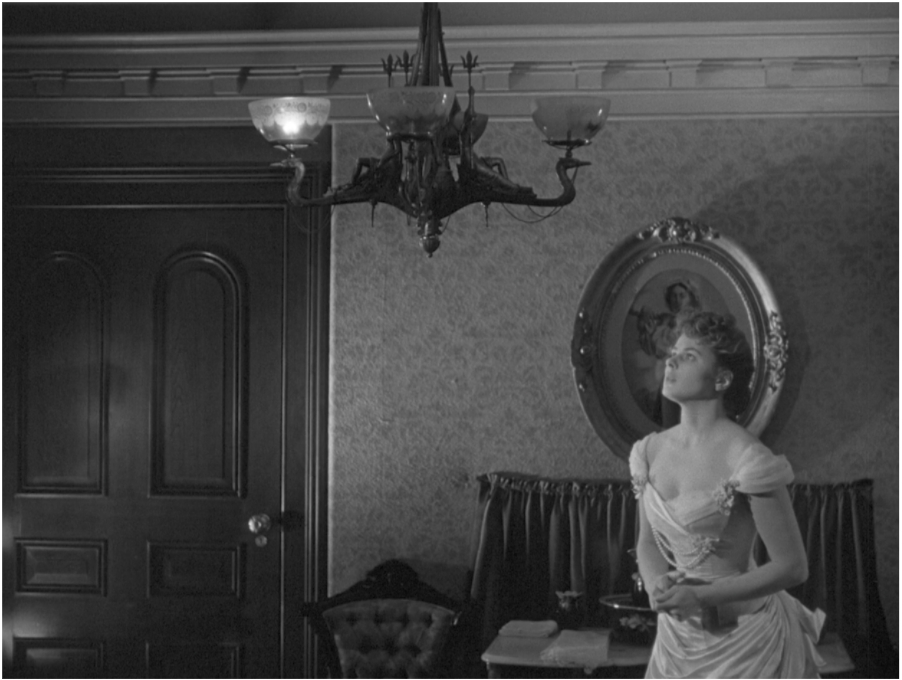
Have you seen the film?
Ingrid Bergman, playing opposite Charles Boyer, won an Academy award for her performance. A teenaged Angela Lansbury made her big screen debut.
In his review, The New York Times’ film critic Bosley Crowther steered clear of spoilers, while musing that the bulk of the theater-going public was probably already hip to the central conceit, following the successful Broadway run of Angel Street, the Patrick Hamilton thriller on which the film was based:
We can at least slip the information that the study is wholly concerned with the obvious endeavors of a husband to drive his wife slowly mad. And with Mr. Boyer doing the driving in his best dead-pan hypnotic style, while the flames flicker strangely in the gas-jets and the mood music bongs with heavy threats, it is no wonder that Miss Bergman goes to pieces in the most distressing way.
In the same review, Crowther sniped that Gaslight was “a no more illuminating title” than Angel Street.
Maybe that was true in 1944. Not anymore!
(Cunning linguists that we are, had the film retained the play’s title, 2022 may well have found us complaining that some villain tried to Angel Street us…)
In a column on production design for The Film Experience, critic Daniel Walber points out how Boyer destabilizes Bergman by fooling with their gas-powered lamps, and also how the film’s Academy Award-winning design team used the “constricting temporality” of a Victorian London lit by gas to set a foreboding mood:
Between the streetlights outside and the fixtures within, the mood is forever dimmed. The heaviness of the atmosphere brings us even closer to Paula’s mental state, trapping us with her. The detail is so precise, so committed that every flicker crawls under the skin, projecting terrible uncertainty and fear to the audience.
Readers who’ve yet to see the film may want to skip the below clip, as it does contain something close to a spoiler.
Those who’ve been on the receiving end of a vigorous gaslighting campaign?
Pass the popcorn.
Related Content:
Ingrid Bergman Remembers How Ernest Hemingway Helped Her Get the Part in For Whom the Bell Tolls
Ayun Halliday is the Chief Primatologist of the East Village Inky zine and author, most recently, of Creative, Not Famous: The Small Potato Manifesto. Follow her @AyunHalliday.
Read More...Why the U.S. Photographed Its Own World War II Concentration Camps (and Commissioned Photographs by Dorothea Lange)
During World War II, the United States put thousands and thousands of its own citizens into concentration camps. The wartime internment of Japanese Americans is a well-known historical event, and also an unusually well-documented one — not just in the sense of having been documented copiously, but also with exceptional power and artistry. Much of that owes to the astute photographic observer of early 20th-century America Dorothea Lange, who had already won acclaim for her Great Depression-symbolizing Migrant Mother.
Published in 1936, Migrant Mother was taken under the auspices of the U.S. Resettlement Administration and Farm Security Administration. In 1941, Lange abandoned a Guggenheim Fellowship to throw in with another government organization, the War Relocation Authority, and turn her lens on the interned. “After Japan’s bombing of the U.S. navy base at Pearl Harbor, a surprise attack that left over 2,000 Americans dead, Japanese Americans became targets of violence and increased suspicion,” says the narrator of the Vox Darkroom video above. Fearing the emergence of a “fifth column,” the government arranged the relocation of 120,000 Japanese Americans who had been living on the west coast into remote camps.
“The Roosevelt administration wanted to frame the removal as orderly, humane, and above all, necessary.” Hence the creation of the WRA, a department charged with handling the removal, “and more importantly, documenting it, through propaganda films, pamphlets and news photographs.” The project could hardly have made a more prestigious hire than Lange, who proceeded to photograph “the rapid changes happening in Japanese American communities, including Japanese-owned farms and businesses shutting down.” Her work (see various examples here) captured the final days, even hours, of an established multi-generational society about to be dismantled by the mass evacuation.
The Army disapproved of the narrative created by Lange’s candid photos, many of which were seized and impounded. The offending images depicted armed U.S. soldiers overseeing the removal process, “temporary prisons used while the concentration camps were built,” food lines at the assembly centers, and Japanese Americans in U.S. military uniform. Releasing Lange from the program after just four months, the WRA kept most of her photos out of the public eye. They stayed out of it until a series of exhibitions in the 1970s, which revealed the true nature of the concentration camps. That term is most associated with the Holocaust, to whose sheer destruction of humanity the Japanese American internment cannot, of course, be compared. But as Lange’s photographs show, just having the moral high ground over Nazi Germany is nothing to brag about.
Related Content:
478 Dorothea Lange Photographs Poignantly Document the Internment of the Japanese During WWII
How Dorothea Lange Shot Migrant Mother, Perhaps the Most Iconic Photo in American History
Dr. Seuss Draws Anti-Japanese Cartoons During WWII, Then Atones with Horton Hears a Who!
Based in Seoul, Colin Marshall writes and broadcasts on cities and culture. His projects include the book The Stateless City: a Walk through 21st-Century Los Angeles and the video series The City in Cinema. Follow him on Twitter at @colinmarshall or on Facebook.
Read More...The Matrix Regurgitated — Pretty Much Pop: A Culture Podcast #113

In light of the release of The Matrix Resurrections, we talk through the franchise as a whole. What made the first one remarkable, and does that a bar that any sequel can reach? We talk through the choices that fed into the new film, why people don’t seem to care about their matrix families, the endless fight scenes, and more. Who will choose the blue pill?
This very special holiday episode of Pretty Much Pop reunites the full season one panel: Mark Linsenmayer, Brian Hirt and Erica Spyres, and features the podcasting debut of Mark’s son Abe Linsenmayer.
Some articles we considered included:
- “ ‘The Matrix Resurrections’ Is a Crucial Keanu Reeves Movie” by Alex Pappademas
- “The Subversive Playfulness of the ‘The Matrix’” by Brian Phillips
- “Zion Is Inside The Matrix: How Resurrections Honors Warped Fan Theory” by Craig Elvy
- “The Matrix And Gender Identity: The Trans Narrative Behind The Wachowskis’ Sci-Fi Classic” by Sarah El-Mahmoud
- “The Matrix 4’s Video Game Reboot Scene Reveals the Original Films’ True Meaning” by Theo Kogod
- “Why The Matrix Never Stopped Being Relevant” by Emily VanDerWerff
This episode includes bonus discussion you can access by supporting the podcast at patreon.com/prettymuchpop or by choosing a paid subscription through Apple Podcasts. This podcast is part of the Partially Examined Life podcast network.
Pretty Much Pop: A Culture Podcast is the first podcast curated by Open Culture. Browse all Pretty Much Pop posts.
Read More...This Is What It Sounds Like When a Harpist Plays “Amazing Grace” and a String Suddenly Breaks
Lisa Warren was peacefully playing “Amazing Grace” on her harp, when suddenly the c string broke and–as she says–“scared the daylights out of me.” Harp playing, it’s not for the faint of heart…
If you would like to support the mission of Open Culture, consider making a donation to our site. It’s hard to rely 100% on ads, and your contributions will help us continue providing the best free cultural and educational materials to learners everywhere. You can contribute through PayPal, Patreon, and Venmo (@openculture). Thanks!
Related Content
A Harp Played with a Heavy Distortion Pedal
Visualizing Bach: Alexander Chen’s Impossible Harp
Hear the First Song Recorded on the Yazh, a 2,000 Year-Old Indian Instrument
Read More...How Jean Renoir’s Great Anti-War Film Grand Illusion Became “Cinematographic Enemy Number One” to the Nazis
Contrary to popular belief, Nazi propaganda minister Joseph Goebbels did not admit to spreading a “Big Lie.” As scholar of German propaganda Randall Bytwerk says, “Goebbels always maintained that propaganda had to be truthful. That doesn’t mean he didn’t lie, but it would be a pretty poor propagandist who publicly proclaimed that he was going to lie.” Still, Goebbels incessantly accused others of lying and spreading dishonest propaganda, and he brutally suppressed those truths he found inconvenient. He was particularly incensed at the 1937 release of a film by French director Jean Renoir (son of the painter Pierre-Auguste Renoir) called La Grande Illusion — a film that questioned several fantasies the Nazis seemed desperate to maintain.
Among these were the idea that war was inevitable and desirable, that a natural aristocracy should rise above the common horde — and that elites should have no solidarity or sympathy for Jews or other minorities. These beliefs were central to fascist ideology and to Goebbels’ propaganda project. Renoir’s Grand Illusion undermined them all, despite the fact that it was set in World War I and based on an even earlier British book, Norman Angell’s The Great Illusion, from 1909, which argued that war in Europe was economically destructive in contrast to mutual co-operation. Goebbels so feared Renoir’s anti-war film he called it “cinematographic enemy number one” and ordered every print turned over and burned and the original negatives destroyed.
Cinema Tyler explains in the video at the top how the effort to stamp out The Grand Illusion “had the full might of the Nazi propaganda machine on a mission to destroy every copy.” They failed. As Roger Ebert notes, the original negative, assumed destroyed in a 1942 Allied air raid, “had already been singled out by a German film archivist named Frank Hensel, then a Nazi officer in Paris, who had it shipped to Berlin.” In the 1960s, Renoir himself “supervised the assembly of a ‘restored’ print,” Then, thirty years later, at the time of Ebert’s writing in 1999, the original negative resurfaced and a sparkling new print circulated, renewing praise for a movie about which Franklin Roosevelt proclaimed, at the time of its release, “all the democracies in the world must see this film.”
The film came out as Nazi Germany and the Soviet Union squared off aggressively in monumental pavilions for the 1937 International Exposition of Arts and Technics in Modern Life in Paris. Germany was three years away from invading France, and while Renoir could not have known the future, the film uses its characters “to illustrate how the themes of the first war would tragically worsen in the second,” Ebert writes. It centers on three captured French officers: “De Boieldieu (Pierre Fresnay), from an old aristocratic family.… Marechal (Jean Gabin), a workingman, a member of the emerging proletariat, and Rosenthal (Marcel Dalio), a Jewish banker who has ironically purchased the chateau that de Boieldieu’s family can no longer afford.”
The French officers’ jailor, wounded pilot von Rauffenstein (played by great German silent director Erich von Stroheim), believes himself to have more in common with de Boieldieu than the latter does with his countrymen, and in many respects, this proves so. Still, the French aristocrat uses his privilege, as we might say today, to help the other prisoners escape, at the cost of his life. When Marechal and Rosenthal are given shelter by a German farm widow, “perhaps Renoir is whispering that the true class connection across enemy lines is between the workers, not the rulers,” writes Ebert. Perhaps it was also the national solidarity among the prisoners that unsettled Goebbels — their persistent, “single obsession: to escape,” despite the comforts of their captivity, as the film’s trailer says dramatically above. The war had not yet begun, and yet, writes A.O. Scott at The New York Times:
In France the late 1930s were the years of the Popular Front, an attempt by the left to counter the rise of fascism and overcome its own tendencies toward sectarianism and orthodoxy. The political face of the front was Léon Blum, a moderate Jewish Socialist whose two truncated, frustrating terms as prime minister coincided with the production and release of Renoir’s film.… The action takes place during World War I (in which Renoir had served as a pilot), when the Dreyfus Affair was still a recent memory, but it has an eye on contemporary anti-Semitism and labor militancy as well as a subtle, anxious premonition of global conflicts to come.
Grand Illusion not only inspired two of the most famous moments of film history — the tunnel in The Great Escape and the singing of “La Marseillaise” in Casablanca — but it remains in its own right one of the greatest films ever made. (Orson Welles claimed it as one of only two films he would take with him “on the ark.”) It continues in its “gently ironic” way, to “question all kinds of ‘illusions,’ ” writes David M. Lubin, “that, in [Renoir’s] view sustain modern warfare: that one side is morally superior to the other… that class divisions are natural, that men must be conventionally manly, that Jews are inferior to Gentiles, and so forth.” Rather than simply denounce Grand Illusion as a big, propagandistic lie, Goebbels tried to have it snuffed out of existence.
Related Content:
Education for Death: The Making of the Nazi–Walt Disney’s 1943 Film Shows How Fascists Are Made
Watch a Gripping 10-Minute Animation About the Hunt for Nazi War Criminal Adolf Eichmann
Josh Jones is a writer and musician based in Durham, NC. Follow him at @jdmagness
Read More...Dave Grohl & Greg Kurstin Cover Van Halen’s “Jump,” Celebrating David Lee Roth, One of the Hardest Rocking Jews, on the Fourth Night of Hannukah
For the second year in a row, Foo Fighters frontman Dave Grohl and producer Greg Kurstin have launched The Hanukkah Sessions, a festive music series where they cover a song–one for each night of Hanukkah–originally created by a Jewish musician. For the fourth night of Hanukkah this year, they celebrate “quite possibly the loudest and proudest of hard rocking Jews, David Lee Roth” with a rollicking version of Van Halen’s “Jump.” To watch their other celebratory tracks, click here.
If you would like to support the mission of Open Culture, consider making a donation to our site. It’s hard to rely 100% on ads, and your contributions will help us continue providing the best free cultural and educational materials to learners everywhere. You can contribute through PayPal, Patreon, and Venmo (@openculture). Thanks!
Related Content
Musical Comedian Reggie Watts Reinvents Van Halen’s Classic, “Panama”
Read More...The Drugs Used by the Ancient Greeks and Romans
Many of us living in the parts of the world where marijuana has recently been legalized may regard ourselves as partaking of a highly modern pleasure. And given the ever-increasing sophistication of the growing and processing techniques that underlie what has become a formidable cannabis industry, perhaps, on some level, we are. But as intellectually avid enthusiasts of psychoactive substances won’t hesitate to tell you, their use stretches farther back in time than history itself. “For as long as there has been civilization, there have been mind-altering drugs,” writes Science’s Andrew Lawler. But was anyone using them in the predecessors to western civilization as we know it today?
For quite some time, scholars believed that unlike, say, Mesoamerica or north Africa, “the ancient Near East had seemed curiously drug-free.” But now, “new techniques for analyzing residues in excavated jars and identifying tiny amounts of plant material suggest that ancient Near Easterners indulged in a range of psychoactive substances.”
The latest evidence suggests that, already three millennia ago, “drugs like cannabis had arrived in Mesopotamia, while people from Turkey to Egypt experimented with local substances such as blue water lily.” That these habits seem to have continued in ancient Greece and Rome is suggested by archaeological evidence summarized in the video above.
In 2019, archaeologists unearthed a few precious artifacts from a fourth-century Scythian burial mound near Stavropol in Russia. There were “golden armbands, golden cups, a heavy gold ring, and the greatest treasure of all, two spectacular golden vessels,” says narrator Garrett Ryan, who earned a PhD in Greek and Roman History from the University of Michigan. The interiors of those last “were coated with a sticky black residue,” confirmed in the lab to be opium with traces of marijuana. “The Scythians, in other words, got high” — as did “their Greek and Roman neighbors.” Ryan, author of Naked Statues, Fat Gladiators, and War Elephants: Frequently Asked Questions about the Ancient Greeks and Romans, goes on to make intriguing connections between scattered but relevant pieces of archaeological and textual evidence. We know that some of our civilizational forebears got high; how many, and how high, are questions for future scholastic inquiry.
Related Content:
Algerian Cave Paintings Suggest Humans Did Magic Mushrooms 9,000 Years Ago
Discover the Oldest Beer Recipe in History From Ancient Sumeria, 1800 B.C.
1,000-Year-Old Illustrated Guide to the Medicinal Use of Plants Now Digitized & Put Online
Beer Archaeology: Yes, It’s a Thing
Based in Seoul, Colin Marshall writes and broadcasts on cities and culture. His projects include the book The Stateless City: a Walk through 21st-Century Los Angeles and the video series The City in Cinema. Follow him on Twitter at @colinmarshall or on Facebook.
Read More...Support Us
We're hoping to rely on loyal readers, rather than erratic ads. Please click the Donate button and support Open Culture. You can use Paypal, Venmo, Patreon, even Crypto! We thank you!

About Us

Open Culture scours the web for the best educational media. We find the free courses and audio books you need, the language lessons & educational videos you want, and plenty of enlightenment in between.
Advertise With Us

FREE UPDATES!
GET OUR DAILY EMAIL
Get the best cultural and educational resources on the web curated for you in a daily email. We never spam. Unsubscribe at any time.
FOLLOW ON SOCIAL MEDIA

Open Culture editor Dan Colman scours the web for the best educational media. He finds the free courses and audio books you need, the language lessons & movies you want, and plenty of enlightenment in between.
Advertise With Us

