Clive James & Jonathan Miller (Both RIP) Talk Together About How the Brain Works
“Were they the last representatives of a special kind of public intellectual?” asks John Mullen in the Guardian. He writes of Clive James and Jonathan Miller, two figures who exemplified “the polymath as entertainer.” The Australian-born James became famous on the back of the television criticism that turned him into a television fixture himself. The combined TV critic and TV host also played the same dual role in the realm of poetry, and as his life and career went on — and his bibliography greatly expanded — it came to seem that there were few forms, traditions, time periods, or languages his cultural omnivorousness didn’t reach. Trained as a doctor before he redefined British comedy as a member of Beyond the Fringe, Miller retained his scientific interests, using his fame to write books and present a television show on anatomy, psychology, and language, and much more besides.
Since the deaths of both James and Miller were announced last Friday, the outpouring of tributes (most of them lamenting the seeming loss, in our time, of high-profile roles for entertaining polymaths free to move between “high” and “low”) has been accompanied by a renewed enthusiasm for both men’s considerable bodies of work.
Despite having known each other, James and Miller seem never to have explicitly collaborated on anything — except, that is, an episode of Talking in the Library, an early example of what we would now call an interview web series. Produced from 2006 to 2008, the show has James pioneering a form that has now become standard among podcasters: recording the conversations he wanted to have with his friends anyway.
In James’ case, his friends include the likes of not just Miller but Martin Amis, Ruby Wax, Ian McEwan, Stephen Fry, and Terry Gilliam. With Miller, James spends the half-hour talking science, and specifically neuroscience. Miller, who specialized in neurology while studying medicine (and who counted Oliver Sacks as a close friend since age 12), returned to the subject in the early 1980s for his book and BBC series States of Mind. Not long thereafter he returned at the age of 50 to his medical studies, diving into neuropsychology at McMaster University and becoming a research fellow at the University of Sussex.
Though James abandoned his own university studies in psychology by 1960, his curiosity about the workings of the human brain — and how it could produce all the art, literature, film, and indeed television to whose appreciation he dedicated his life — never abandoned him, as evidenced by the eagerness with which he asks questions of his more neuroscientifically savvy friend. “The brain is the most complicated thing in the universe,” says Miller, “so complicated, in fact, that by contrast the universe itself it not much more complicated than a cuckoo clock.” Fair to say that both Miller and James had the good luck to possess more complicated, or at least more interesting, brains than average — and that it’s our good luck to be able to enjoy their work in perpetuity.
Related Content:
Atheism: A Rough History of Disbelief, with Jonathan Miller
The Drinking Party, 1965 Film Adapts Plato’s Symposium to Modern Times
Join Clive James on His Classic Television Trips to Paris, LA, Tokyo, Rio, Cairo & Beyond
Your Brain on Art: The Emerging Science of Neuroaesthetics Probes What Art Does to Our Brains
Based in Seoul, Colin Marshall writes and broadcasts on cities and culture. He’s at work on a book about Los Angeles, A Los Angeles Primer, the video series The City in Cinema, and the crowdfunded journalism project Where Is the City of the Future? Follow him on Twitter at @colinmarshall or on Facebook.
Read More...London Calling: A New Museum Exhibition Celebrates The Clash’s Iconic Album
In 1983, Rolling Stone proclaimed it the year of the “second British Invasion,” a “golden age” of music from the likes of Duran Duran, Spandau Ballet, Culture Club, the Human League, Depeche Mode, and other radio-friendly synth pop hitmakers. The label stuck. Thirty years later, CBS News commemorated the year “a slew of [New Wave] acts came over to the states with their synthesizer-driven/R&B‑inspired music.”
Amidst this frenzy of praise, no one mentions the Clash, who played their final show in 1983. The year previous they hit number 8 on the Billboard Hot 100 with “Rock the Casbah.” Combat Rock arguably proved that punk was still relevant in the early 1980s, though a punk transfigured into dancefloor-friendly funk, dub, and spoken word experimentation. Just as arguably, the Clash should be properly seen as leaders of the true second British Invasion—an invasion of British punk and post-punk bands in the late 70s.
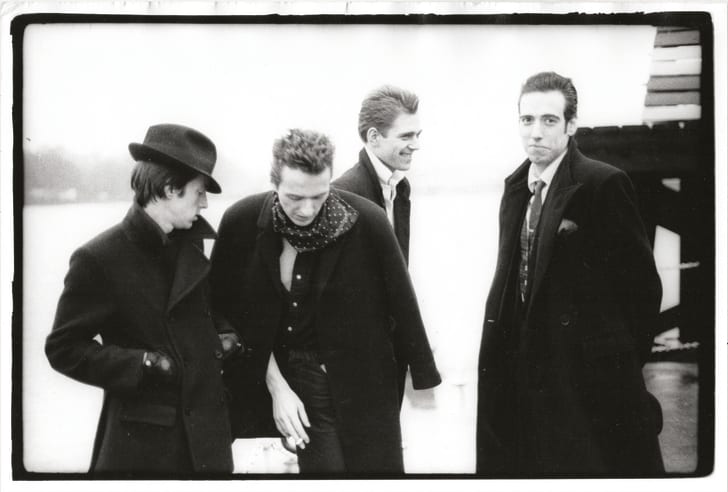
Four charming lads who’d grown up playing in the clubs, they spoke a working-class idiom, wrote in a number of different voices, took a consistently anti-war stance, and took punk where it had not gone before with studio and world music experiments. One needn’t compare their 1979 double album London Calling to Sgt. Pepper’s—though it does top several critics best-of-all-time lists—to see its similar influence on contemporary music.
Its title track even hit number 30 on the Billboard Disco Top 100 chart in 1980, a move that helped open the door for several dozen punk-inspired British New Wave bands to come. London Calling wasn’t universally beloved. The commercial aims and more polished delivery divided punk fans, and some critics panned the album. None of that has mattered at all to the millions of devoted fans worldwide. Its iconic cover has become just as recognizable as the original that inspired it.

Now, and until April 2020, truly devoted fans can experience that album as no one has before by seeing in person, the actual Fender Precision bass that Paul Simenon smashed in the cover photo—only one of the many historic artifacts on display at the Museum of London in a free exhibition celebrating the album’s 40th anniversary. Visitors can also see “Mick Jones’s 1950s Gibson ES-295,” writes Ellen Gotoskey at Mental Floss, “Joe Strummer’s white 1950s Fender Esquire,” and a pair of Topper Headon’s drumsticks.
Also on display are “sketches from artist Ray Lowry that depict scenes from the London Calling tour,” as well as an early sketch by Lowry of the album cover, and “photos taken by Pennie Smith (who snapped the London Calling cover image).” Viewers can see Strummer’s typewriter, his notebook from the rehearsal and recording of the record, and Simenon’s weathered late-70s leather jacket.
The exhibition may be free, but tickets to London are pricey. Still, fans can play along at home with the London Calling Scrapbook, a 120-page hardback book full of archival material and included in Sony’s anniversary re-release of the album. But no lover of the Clash is without their own copy of London Calling. Put it on in celebration and judge whether, as the Museum of London writes, its “music and lyrics remain as relevant today as they were on release.”
via Mental Floss
Related Content:
Hear The Clash’s Vanilla Tapes, Demos of Nearly Every Song From London Calling
“Stay Free: The Story of the Clash” Narrated by Public Enemy’s Chuck D: A New 8‑Episode Podcast
The Clash Play Their Final Show (San Bernardino, 1983)
Josh Jones is a writer and musician based in Durham, NC. Follow him at @jdmagness
Read More...How Blade Runner Captured the Imagination of a Generation of Electronic Musicians
“I feel that there is ‘Before Blade Runner’ and ‘After Blade Runner,’” says director Denis Villeneuve. “The movie was like a landmark in film history aesthetic.” The quote comes from this FACTmagazine promo released ahead of Villeneuve’s 2017 sequel Blade Runner 2049, which examines the impact the soundtrack had on science fiction films and electronic music, as well how its entire aesthetic echoed into the ‘90s and beyond.
Composer Vangelis and director Ridley Scott had worked together previously on a Chanel commercial, and the composer had thought the choice to use his music was “brave,” according to Villeneuve. A few years later Vangelis would be asked to compose the score, which he did, improvising over footage.
The gearheads in the doc point out the Lexicon 224 reverb, a great analog effects unit, as well as the “beast,” the Yahama CS80, which would often go out of tune. (Check out YouTube user Perfect Circuit trying out some of its features).
“The best time (the synth) found its voice was on that album,” says musician Kuedo.
The doc also interviews Tricky, Gary Numan, Ikonika, Abayomi, Clare Wieck, Kuedo, Mogwai’s Stuart Braithwaite, and music producer Hans Berg, all of whom have found Blade Runner creeping into their work intentionally or subliminally. Ikonika even calls her music alter-ego a “replicant,” after the film’s androids. But the film for her was a warning: “You could see the future taking over and it would be the good times,” she says about the early ‘80s. And “then Blade Runner was like, after that, this is going to happen.” The soundtrack has gone on to have its own series of re-releases, just like Scott has released a Director’s Cut of the film.
First, it was never properly released as an album until 1994. Immediately bootlegs appeared collecting much more of the score from the film. In 2002, the best of them, the “Esper Edition,” delivered 33 tracks from the score. (And there’s a further “Retirement Edition” of the “Esper” kicking around out there.) Then in 2007, Universal Music released a 25th anniversary edition, with an extra disc of music composed for the film and *another* disc of *new* music Vangelis composed for the release. All of which shows a work that is beloved and held dear by fans.
Now that we’ve hit the month depicted in the film, and Los Angeles doesn’t exactly look like the opening scene (smoke and fire, yes; rain, not so much), it’s time to take stock of its dystopian vision.
As musician Kuedo says, “Almost 40 years later we’re still chasing it, but it’s still there ahead of us.”
Note: Villeneuve chose Christopher Nolan favorite Hans Zimmer to compose the sequel’s score, working with Benjamin Wallfisch…both much safer choices than Vangelis.
Related Content:
Stream 72 Hours of Ambient Sounds from Blade Runner: Relax, Go to Sleep in a Dystopian Future
Ted Mills is a freelance writer on the arts who currently hosts the artist interview-based FunkZone Podcast and is the producer of KCRW’s Curious Coast. You can also follow him on Twitter at @tedmills, read his other arts writing at tedmills.com and/or watch his films here.
Read More...Every Nuclear Bomb Explosion in History, Animated
I suspect many fewer people are assigned John Hersey’s Hiroshima, a book most everyone in my cohort read at some stage in their education. And certainly, far fewer people are subjected to the kind of alarmist (and reasonably so) propaganda films that dramatized the grisly details of fallout and nuclear winter. Even the recent HBO miniseries Chernobyl, with its grotesque depiction of radiation poisoning, prompted a wave of tourism to the site, drawing Instagram generation gawkers born too late to have heard the terrifying news firsthand.
Yet, the threat of a nuclear disaster and its attendant horrors has hardly gone away. The UN General Assembly issued a statement this year warning of the highest potential for a devastating incident since the Cuban Missile Crisis. We are entering a new era of nuclear proliferation, with many countries who have no love for each other joining the race. “As the risk of nuclear confrontation grows,” writes Simon Tisdall at The Guardian, “the cold war system of treaties that helped prevent Armageddon is being dismantled, largely at Trump’s behest.” Calls for a No-First-Use policy in the U.S. have grown more urgent.
Living memory of the period in which two global superpowers almost destroyed each other, and took everyone else with them, has not deterred the architects of today’s geopolitics. But remembering that history should nonetheless be required of us all. In the Business Insider video above, you can get a sense of the scope of nuclear testing that escalated throughout the Cold War, in an animated timeline showing every single explosion in Japan and the various testing sites in Russia, New Mexico, Australia, and the Pacific Islands from 1945 into the 1990s, when they finally drop off. As the decades progress, more countries amass arsenals and conduct their own testing.
Despite the expert warnings, something certainly has changed since the fall of the Soviet Union. Over a forty year period, the U.S. and the U.S.S.R. trained to annihilate the other, and the prospect of nuclear war became an extinction-level event. That may not be the case in a fragmented, multipolar world with many smaller countries vying for regional supremacy. But a nuclear event, intention or accidental, could still be catastrophic on the order of thousands or millions of deaths. The animation shows us how we got here, through decades of normalizing the stockpiling and testing of the ultimate weapons of mass destruction.
Related Content:
53 Years of Nuclear Testing in 14 Minutes: A Time Lapse Film by Japanese Artist Isao Hashimoto
Protect and Survive: 1970s British Instructional Films on How to Live Through a Nuclear Attack
Josh Jones is a writer and musician based in Durham, NC. Follow him at @jdmagness
Read More...John Cleese’s Eulogy for Monty Python’s Graham Chapman: ‘Good Riddance, the Free-Loading Bastard, I Hope He Fries’
The British comedian Graham Chapman delighted in offending people. As a writer and actor with the legendary Monty Python troupe, he pushed against the boundaries of propriety and good taste. When his writing partner John Cleese proposed doing a sketch on a disgruntled man returning a defective toaster to a shop, Chapman thought: Broken toaster? Why not a dead parrot? And in one particularly outrageous sketch written by Chapman and Cleese in 1970, Chapman plays an undertaker and Cleese plays a customer who has just rung a bell at the front desk:
“What can I do for you, squire?” says Chapman.
“Um, well, I wonder if you can help me,” says Cleese. “You see, my mother has just died.”
“Ah, well, we can ‘elp you. We deal with stiffs,” says Chapman. “There are three things we can do with your mother. We can burn her, bury her, or dump her.”
“Dump her?”
“Dump her in the Thames.”
“What?”
“Oh, did you like her?”
“Yes!”
“Oh well, we won’t dump her, then,” says Chapman. “Well, what do you think? We can bury her or burn her.”
“Which would you recommend?”
“Well, they’re both nasty.”
From there, Chapman goes on to explain in the most graphic detail the unpleasant aspects of either choice before offering another option: cannibalism. At that point (in keeping with the script) outraged members of the studio audience rush onto the stage and put a stop to the sketch.
Chapman and Cleese had been close friends since their student days at Cambridge University, and when Chapman died of cancer at the age of 48 on October 4, 1989, Cleese was at his bedside. Out of respect for Chapman’s family, the members of Monty Python decided to stay away from his private funeral and avoid a media circus. Instead, they gathered for a memorial service on October 6, 1989 in the Great Hall at St. Bartholomew’s Hospital in London. When Cleese delivered his eulogy for Chapman, he recalled his friend’s irreverence: “Anything for him, but mindless good taste.” So Cleese did his best to make his old friend proud. His off-color but heartfelt eulogy that evening has become a part of Monty Python lore, and you can watch it above. To see a longer clip, with moving words from Michael Palin and a sing-along of “Always Look on the Bright Side of Life” led by Eric Idle, watch below:
Note: An earlier version of this post appeared on our site in February 2013.
Related Content:
John Cleese’s Advice to Young Artists: “Steal Anything You Think Is Really Good”
Read More...
Watch the Serpentine Dance, Created by the Pioneering Dancer Loie Fuller, Performed in an 1897 Film by the Lumière Brothers
Whatever their views on copyright, artists and inventors of all kinds can agree on one thing: all dread having their ideas stolen without so much as a footnote of credit. Such thefts have led to tanked careers, lifelong resentments, homicidal rivalries, and lawsuits to fill libraries. They have allowed many a thief to prosper and many an injured party to surrender.
But not legendary modern dance pioneer Loie Fuller.
“Short, plump, and thirty years old,” the dancer from Illinois arrived in Paris in 1892, fresh off the “mid-level vaudeville” circuit, writes Rhonda K. Garelick at Public Domain Review, and bent on proving herself to Édouard Marchand, director of the Folies-Bergère. She scored an interview within days of her arrival.
Alighting from her carriage in front of the theater, she stopped short at the sight of the large placard depicting the Folies’ current dance attraction: a young woman waving enormous veils over her head, billed as the “serpentine dancer.” “Here was the cataclysm, my utter annihilation,” Fuller would later write, for she had come to the Folies that day precisely to audition her own, new “serpentine dance,” an art form she had invented in the United States.
The imposter, an American named Maybelle Stewart, had seen Fuller perform in New York and had lifted her act and taken it to Paris. Rather than succumb to rage or despair, Fuller sat through the matinee performance and was moved from a cold sweat to renewed confidence. “The longer she danced,” she wrote, “the calmer I became.” After Stewart left the stage, Fuller ascended in her serpentine costume and auditioned for Marchand, who agreed to take her on and fire Stewart.
The story gets stranger. The show had been promoted with Stewart’s name, and so, to avoid bad publicity, Fuller agreed to perform the first two nights as Stewart, “dancing her own imitation of Stewart’s imitation of the serpentine dance,” a “triple-layer simulation,” Garelick writes, “worthy of an essay by Jean Baudrillard”—and emblematic of a career in dance marked by “self-replication, mirrored images, and identity play.”
Thus did the woman named Loie Fuller (born Mary-Louise Fuller), begin “what was to become an unbroken thirty-year reign as one of Europe’s most wildly celebrated dancers.” Fuller was “the only female entertainer to have her own pavilion” at the 1900 Exposition Universelle, writes Natalie Lemie at Artsy. “Henri de Toulouse-Lautrec featured her in a number of prints; Auguste Rodin commissioned a series of photographs of the dancer with plans to sculpt her; and the Lumière brothers released a film about her in 1897.”
Fuller’s dance personified Art Nouveau, expressing its elegant, flowing lines in her billowing silk gowns, which she moved by means of bamboo sewn into her sleeves. As she danced “colored lights were projected onto the flowing fabric, and as she twirled, she seemed to metamorphose into elements from the natural world: a flower, a butterfly, a tongue of flame.” Everyone came to see her. The Folies, which “typically attracted working class patrons,” now had aristocratic newcomers lining up outside.
See the serpentine dance that launched her career at the top in the Lumière Brothers’ 1897 film and below it in a colorized excerpt, with the bewitching music of Sigur Ros added for effect. Other films and clips here from other early cinema pioneers show the medium’s embrace of Fuller’s choreography. Ironically, none of this footage, it seems, shows Fuller herself, but only her imitators. “Unfortunately none of the surviving films seem to contain a performance by the original dancer/choreographer,” notes cinema history channel Magical Motion Museum, “despite some of them carrying her name in the title or otherwise crediting her as the dancer.”
Her name carried a lot of weight. Fuller was not only a celebrated dancer, but also a manager, producer, and lighting designer with “over a dozen patents related to her costumes and innovations in stage lighting.” (She was so interested in the “luminous properties” of radium that she sought out and “befriended its discoverers, Pierre and Marie Curie.”) By 1908, however, she had left behind some of these elaborate stage effects to focus on “natural dancing’—dance inspired by nature, which was the forerunner of modern dance.”
And she had taken on a young dancer in her company named Isadora Duncan, often referred to as the “Mother of Modern Dance.” Fuller deserves credit, too, but she didn’t seem to care about this overmuch. She was, notes Oberlin College dance professor Ann Cooper Albright, “way more interested in making things happen than creating a name for herself.” Fame came as a byproduct of her creativity rather than its sought-after reward. She was still renowned after she left the stage, and given a retrospective at The Louvre in 1924.
Fuller continued to work behind the scenes after the Art Nouveau movement gave way to new modernisms and supported and inspired younger artists until her death in 1928. Her work deserves a prominent place in the history of modern dance, but Fuller herself “was—and remains—elusive,” Lemie writes, “something of a phantom.” Others might have stolen, borrowed, or imitated the serpentine dance, but Lois Fuller became it, going beyond competition and into a realm of magic.
Related Content:
The Graceful Movements of Kung Fu & Modern Dance Revealed in Stunning Motion Visualizations
Josh Jones is a writer and musician based in Durham, NC. Follow him at @jdmagness
Read More...A Schoolhouse Rock-Inspired Guide to Impeachment
How does a bill become a law? You can’t hear the question and not hum a few bars from Schoolhouse Rock’s “I’m Just a Bill.” The groovy cartoon civics lesson was for millions the first they learned about the legislative process. Ask another question, however, like “how does impeachment work,” and you may hear more crickets than 70’s educational TV jingles.
Surely we took something from Bill Clinton’s impeachment trial besides cigars, stained blue dresses, and the spectacle of morally compromised politicians wagging their fingers at a morally compromised politician? Surely we’ve all read the Watergate transcripts, and can quote more from that history than Richard Nixon’s “I am not a crook” (muttered before he resigned instead of facing the charges)?
Maybe not. Despite the talk of closed-door hearings and conflicted jurors, many of us have not paid close attention to the particulars of the process, given that impeachment trials can make for such compellingly broad political theater. And we never got our Schoolhouse Rock impeachment episode. Until now.
Seeing as how the president faces public, televised impeachment hearings next week, there may be no more opportune time to get caught up on some details with Jonathan Coulton’s Schoolhouse Rock-inspired “The Good Fight.” Its animation style and catchy tune recalls the 70s educational series, but Coulton doesn’t address the kids at home as his primary audience.
“Your tiny hands may scratch and claw,” sings Coulton, “but nobody’s above the law.” You won’t win any prizes for guessing who this means—a person in need of a childlike explainer on basic government, it seems. More verbal jabs are thrown, and the alleged crimes enumerated, ending with treason (and a misplaced, anachronistic hammer and sickle by animators Head Gear Animation). The video finally gets into the impeachment process over a minute in, past the halfway mark.
Viewers might find the first half emotionally satisfying, with its characterization of impeached presidents as wayward children in need of correction by a swaggering Constitution and a sassy band of founders. It’s cute but leaves precious little time for learning how this accountability process is supposed to work. Coulton rushes through the explanation, and you may find yourself skipping back to hear it several times.
Never fear: Google—or the search engine of your choice—is here to ferry you to thousands of guides to the impeachment process. “The Good Fight” isn’t, after all, actually a Schoolhouse Rock ad, but a fun civic-minded reminder to everyone that the president is not above the law, and that Congress is entitled by the Constitution to hold the holder of that office, whomever they may be, accountable. An explainer by Vox appears below:
Related Content:
Schoolhouse Rock: Revisit a Collection of Nostalgia-Inducing Educational Videos
Conspiracy Theory Rock: The Schoolhouse Rock Parody Saturday Night Live May Have Censored
Josh Jones is a writer and musician based in Durham, NC. Follow him at @jdmagness
Read More...An MRI Shows How a Singer Sings Two Tones at Once (With the Music of Mozart and Brian Eno)
When people hear Anna-Maria Hefele sing, they wonder how she does it, and not just because of her impressive traditional chops. “While most of us struggle to voice one clear, distinct note,” writes the Independent’s Christopher Hooton, the polyphonic overtone singer Hefele “can sing two at once, and move them around in separate scales.” Also known as “throat singing,” this technique “allows her to establish a fundamental note and then move the overtone above it through different notes, creating an astounding, ethereal effect.” With nothing more than what nature gave her, in other words, Hefele manages to achieve a vocal effect more striking than most anything heard as a result of even today’s most complicated digital processes.
But what, exactly, is going on when she sings? These two videos, recorded with Hefele performing inside a magnetic resonance imaging machine at the Institute for Musician’s Medicine at the University Medical Center Freiburg, shed light on the mechanics of polyphonic overdone singing. “What you see in this dynamic MRI-recording is the tongue movement in the vocal tract while doing overtone singing and normal singing,” says the description.
“The positions of the tongue forms the resonance cavities which delete all not-wanted overtones in the sound of the voice at a certain point in time, and then amplify a single overtone that is left, which can be heard as a separate note above the fundamental.” It has, in other words, as much to do with suppressing all the tones you don’t want to sing as with emphasizing the ones you do. Hardly the easiest musical trick to pull off, much less inside an environment as unforgivingly noisy as an MRI machine.
But you can still learn the basic techniques, and from Hefele herself at that: previously here on Open Culture we’ve featured Hefele’s own demonstration of and how-to lessons on overtone singing. No matter how well we ourselves learn to sing two notes at once, though, we’d nevertheless have little idea what’s going on to let us make such sounds without these revealing MRI videos. (Others have similarly exposed the inner workings of beatboxing and opera singing.) The footage also underscores the respectable musical taste of Hefele herself or her collaborators in this research project, selecting as they have the musical examples of “Sehnsucht nach dem Frühlinge” by Hefele’s countryman Wolfgang Amadeus Mozart and “By This River” from singing advocate Brian Eno’s classic LP Before and After Science — though you might call this an example of music made during science.
Related Content:
Musician Shows How to Sing Two Notes at Once in Mesmerizing Video
What Beatboxing and Opera Singing Look Like Inside an MRI Machine
Based in Seoul, Colin Marshall writes and broadcasts on cities, language, and culture. His projects include the book The Stateless City: a Walk through 21st-Century Los Angeles and the video series The City in Cinema. Follow him on Twitter at @colinmarshall or Facebook.
Read More...
Comic Sans Turns 25: Graphic Designer Vincent Connare Explains Why He Created the Most Hated Font in the World
What we write reveals who we are, but so, and often more clearly, does how we write. And in an age when handwriting has given way to typing, how we write has much to do with which font we use. Many of us play it safe, rarely straying from the realm of twelve-point Times New Roman hypernormality, but even there “type is a voice; its very qualities and characteristics communicate to readers a meaning beyond mere syntax.” That observation comes from the Ban Comic Sans Manifesto, drawn up two decades ago by graphic designers Holly and David Combs as a strike against the font that, 25 years after its creation, remains a hate object of choice for the visually literate everywhere.
“You don’t like that your coworker used me on that note about stealing her yogurt from the break room fridge?” asks Comic Sans itself, ventriloquized in McSweeney’s by Mike Lacher. “You don’t like that I’m all over your sister-in-law’s blog? You don’t like that I’m on the sign for that new Thai place? You think I’m pedestrian and tacky?” Well, tough: “People love me. Why? Because I’m fun. I’m the life of the party. I bring levity to any situation. Need to soften the blow of a harsh message about restroom etiquette? SLAM. There I am. Need to spice up the directions to your graduation party? WHAM. There again. Need to convey your fun-loving, approachable nature on your business’ website? SMACK.”
In the Great Big Story video above, Comic Sans creator Vincent Connare tells his side of the story. While employed at Microsoft in the early 1990s, he saw a prototype version of Microsoft Bob, a kind of add-on to the Windows interface designed for maximum user friendliness. It featured onscreen animal characters that spoke in speech bubbles, but the words in those speech bubbles appeared in what was everyone’s default font. When it hit him that “dogs don’t talk in Times New Roman,” Connare, a graphic-novel fan, got to work on a typeface for the speech bubbles modeled on the lettering by John Costanza in The Dark Knight Returns and by Dave Gibbons in Watchmen.
Comic Sans didn’t make it into Microsoft Bob, it did make it into a somewhat more successful Microsoft product: Windows 95, which David Kadavy at Design for Hackers calls “the first operating system to really hit it big. Just as computers were starting to pop up in nearly every home in America, Windows 95 was finding itself installed on all of those computers, and with it, the font Comic Sans. So now, nearly every man, woman, child, and bake sale organizer find themselves armed with publishing power unlike civilization had ever seen; and few of them really had any design sense.” Then came the internet boom, which meant that “instead of flyers posted in break rooms, Comic Sans was showing up on websites, and even as the default font for many people’s emails. Now, any one person could write a message that could potentially be read by millions, in Comic Sans.”
What makes Comic Sans so reviled? Kadavy points to several reasons having to do with typographical aesthetics, including awkward weight distribution (“weight” being the thickness of its lines) and poor letterfit (meaning that its letters don’t, or can’t, sit well next to each other). But the problem most of us notice is that “Comic Sans isn’t used as intended”: A typeface meant only for speech bubbles in Microsoft Bob has somehow become one of the most popular in the world, appearing unsuitably in everything from Cleveland Cavaliers owner Dan Gilbert’s open letter on the departure of LeBron James to CERN’s announcement of evidence of the Higgs boson particle to, just last month, a letter from Donald Trump’s lawyer’s to the House Intelligence Committee.
Through it all, Connare himself — who has designed such relatively respectable typefaces as Trebuchet, and has famously only used Comic Sans once, in a complaint letter to his cable company — has kept his sense of humor, as evidenced by his talk entitled “Comic Sans Is the Best Font in the World.” Even the Combs’ movement has changed its name, if not without irony, into “Use Comic Sans.” Pieces marking the font’s 25th anniversary include “Hating Comic Sans Is Not a Personality” by The New York Times’ Emma Goldberg and “In Bad Taste or Not, I’ll Keep My Comic Sans” by The Washington Post’s Joseph Epstein (published, entirely and courageously, in Comic Sans). If you love the font, Connare often says, you don’t know much about typography, but if you hate it, “you should get another hobby.” Besides, the story of Comic Sans also contains an important life lesson: “You have to do things that aren’t beautiful sometimes.”
Related Content:
The History of Typography Told in Five Animated Minutes
Download Iconic National Park Fonts: They’re Now Digitized & Free to Use
How to Write Like an Architect: Short Primers on Writing with the Neat, Clean Lines of a Designer
Based in Seoul, Colin Marshall writes and broadcasts on cities, language, and culture. His projects include the book The Stateless City: a Walk through 21st-Century Los Angeles and the video series The City in Cinema. Follow him on Twitter at @colinmarshall, on Facebook, or on Instagram.
Read More...Watch the Opening of Kubrick’s 2001: A Space Odyssey with the Original, Unused Score
How does a movie become a “classic”? Explanations, never less than utterly subjective, will vary from cinephile to cinephile, but I would submit that classic-film status, as traditionally understood, requires that all elements of the production work in at least near-perfect harmony: the cinematography, the casting, the editing, the design, the setting, the score. Outside first-year film studies seminars and deliberately contrarian culture columns, the label of classic, once attained, goes practically undisputed. Even those who actively dislike Stanley Kubrick’s 2001: A Space Odyssey, for instance, would surely agree that its every last audiovisual nuance serves its distinctive, bold vision — especially that opening use of “Thus Spake Zarathustra.”
But Kubrick didn’t always intend to use that piece, nor the other orchestral works we’ve come to closely associate with mankind’s ventures into realms beyond Earth and struggles with intelligence of its own invention. According to Jason Kottke, Kubrick had commissioned an original score from A Streetcar Named Desire, Spartacus, Cleopatra, and Who’s Afraid of Virginia Woolf composer Alex North.
At the top of the post, you can see 2001’s opening with North’s music, and below you can hear 38 minutes of his score on Spotify. As to the question of why Kubrick stuck instead with the temporary score of Strauss, Ligeti, and Khatchaturian he’d used in editing, Kottke quotes from Michel Ciment’s interview with the filmmaker:
However good our best film composers may be, they are not a Beethoven, a Mozart or a Brahms. Why use music which is less good when there is such a multitude of great orchestral music available from the past and from our own time? [ … ] Although [North] and I went over the picture very carefully, and he listened to these temporary tracks and agreed that they worked fine and would serve as a guide to the musical objectives of each sequence he, nevertheless, wrote and recorded a score which could not have been more alien to the music we had listened to, and much more serious than that, a score which, in my opinion, was completely inadequate for the film.
North didn’t find out about Kubrick’s choice until 2001’s New York City premiere. Not an enviable situation, certainly, but not the worst thing that ever happened to a collaborator who failed to rise to the director’s expectations.
For more Kubrick and classical music, see our recent post: The Classical Music in Stanley Kubrick’s Films: Listen to a Free, 4 Hour Playlist
Note: An earlier version of this post appeared on our site in December 2014.
If you would like to support the mission of Open Culture, consider making a donation to our site. It’s hard to rely 100% on ads, and your contributions will help us continue providing the best free cultural and educational materials to learners everywhere. You can contribute through PayPal, Patreon, and Venmo (@openculture). Thanks!
Related Content:
4,000+ Free Movies Online: Great Classics, Indies, Noir, Westerns, Documentaries & MoreWatch a Newly-Created “Epilogue” For Stanley Kubrick’s 2001: A Space Odyssey
1966 Film Explores the Making of Kubrick’s 2001: A Space Odyssey (and Our High-Tech Future)
James Cameron Revisits the Making of Kubrick’s 2001: A Space Odyssey
Rare 1960s Audio: Stanley Kubrick’s Big Interview with The New Yorker
Colin Marshall hosts and produces Notebook on Cities and Culture and writes essays on cities, language, Asia, and men’s style. He’s at work on a book about Los Angeles, A Los Angeles Primer. Follow him on Twitter at @colinmarshall or on Facebook.
Read More...Support Us
We're hoping to rely on loyal readers, rather than erratic ads. Please click the Donate button and support Open Culture. You can use Paypal, Venmo, Patreon, even Crypto! We thank you!

About Us

Open Culture scours the web for the best educational media. We find the free courses and audio books you need, the language lessons & educational videos you want, and plenty of enlightenment in between.
Advertise With Us

FREE UPDATES!
GET OUR DAILY EMAIL
Get the best cultural and educational resources on the web curated for you in a daily email. We never spam. Unsubscribe at any time.
FOLLOW ON SOCIAL MEDIA

Open Culture editor Dan Colman scours the web for the best educational media. He finds the free courses and audio books you need, the language lessons & movies you want, and plenty of enlightenment in between.
Advertise With Us

