Watch 700 Videos Nostalgia-Inducing Videos from the Early Days of MTV
‘We’re gonna do for TV what FM did for radio’–Mark Goodman, the first ever MTV VJ.
When I was growing up, MTV was that rare commodity. Not all cable providers had it, and those that did charged an extra fee to get it. That meant there were certain kids in school that we were friends with just because their parents had it. (Sorry Tom, no hard feelings!)
This exhaustive (and sometimes exhausting) YouTube playlist offers 710 videos that were staples of the channel in its 1980s heyday, right through the ‘90s when it slowly morphed into a lifestyle channel and VH‑1 and then M2 picked up the slack of endlessly rotating memories.
Music videos had been around long before MTV. From Scopitones to the Beatles’ promo films for “Penny Lane” and such, visuals and pop music were natural allies. And through the ‘70s and early ‘80s, music programs mixed live studio performances with videos often. But not 24/7 often. And not, as the the first VJs proclaimed on August 1, 1981, in *stereo*. This was a big deal for a lot of people.
After introducing the crew one at a time–Mark Goodman, Alan Hunter, Martha Quinn, J.J. Jackson, and Nina Blackwood, all soon to become household names–the first video rolled: The Buggles’ “Video Killed the Radio Star.”
Early viewers soon discovered this however: MTV didn’t really have a lot of videos, and in that first year, certain ones got played more than their popularity deserved. (They seemed to play Saga’s “On the Loose” once every hour.) The other thing viewers noticed: there was a lot, a LOT of hard rock and Adult Oriented Rock as they used to say in radio marketing. After the new wave of the Buggles came Pat Benatar, Rod Stewart, REO Speedwagon, Styx, .38 Special, April Wine, Gerry Rafferty. (To be fair, there was also The Cars, Split Enz (!), and The Pretenders.
And then there were the predominantly white faces in all the videos. MTV was designed to appeal to rock fans and not, ahem, “urban listeners”. Electronic music, dance music, r’n’b, and other genres were noticeably absent. (It took public shaming by David Bowie and the undeniable pop juggernauts of Michael Jackson and Prince to change that.)
By 1982, the channel had expanded for many reasons. One of them was the amount of brilliant videos coming out of the UK, shot by directors who seemed to really get the potential of the art form. Tim Pope, Russell Mulcahy (who shot most of Duran Duran’s videos), and the duo of Annabel Jankel and Rocky Morton brought in a knowledge of film history, animation, and surrealism to their videos, which complemented the mix and match fashion of the New Romantics.
But on both sides of the Atlantic, artists were realizing the potential of the visual element to their entire identities. Plus, there was money. Lots and lots of money. (Some of it even went to the musicians!)
As the ‘80s came to a close, MTV had changed music culture for better and for worse. It had dedicated programs to rap music, to alternative music, to heavy metal, and turned Spring Break into a rite of passage. And there were still some good years left in it.
Music videos are everywhere on YouTube now, but atomized just like everything else. You forge your own path as you go down the rabbit hole. They still have the power to shock, like last year’s “This Is America” by Childish Gambino, or unite the country very briefly like “Old Town Road” by Lil NasX. But what is missing, really, is that repetition. We all knew what Michael Jackson looked like because “Billy Jean” and “Thriller” were on our TVs all the time. Same with Madonna. Now we know our stars from their social media, from their magazine spreads, from their live shows, and sometimes, just sometimes, from these little music films that used to be the center of the universe.
Watch the complete playlist of 700 early MTV videos here.
Related Content:
Watch David Bowie Take MTV to Task for Failing to Play Music Videos by Black Artists (1983)
Michel Gondry’s Finest Music Videos for Björk, Radiohead & More: The Last of the Music Video Gods
David Fincher’s Five Finest Music Videos: From Madonna to Aerosmith
Ted Mills is a freelance writer on the arts who currently hosts the artist interview-based FunkZone Podcast and is the producer of KCRW’s Curious Coast. You can also follow him on Twitter at @tedmills, read his other arts writing at tedmills.com and/or watch his films here.
Read More...A Flowchart of Philosophical Novels: Reading Recommendations from Haruki Murakami to Don DeLillo
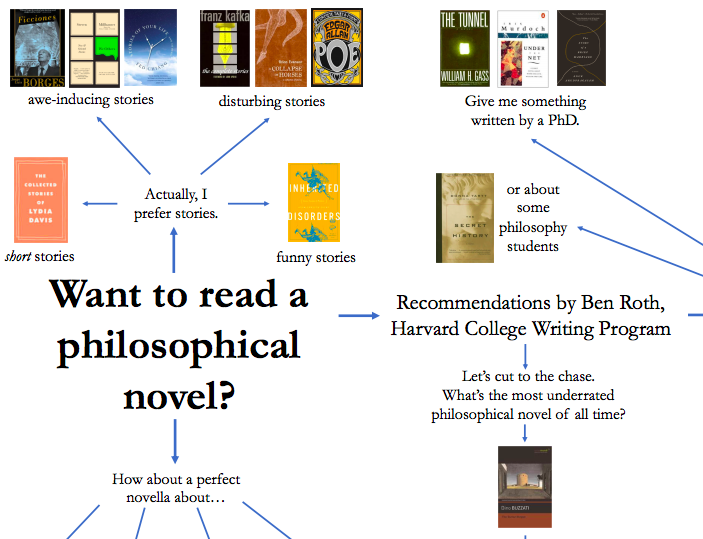
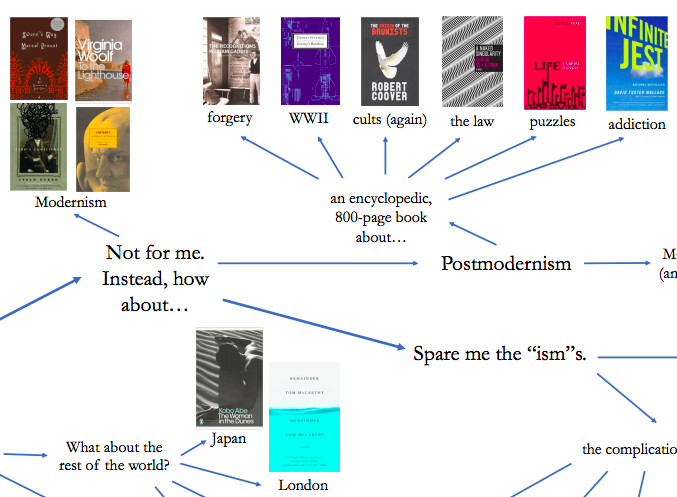
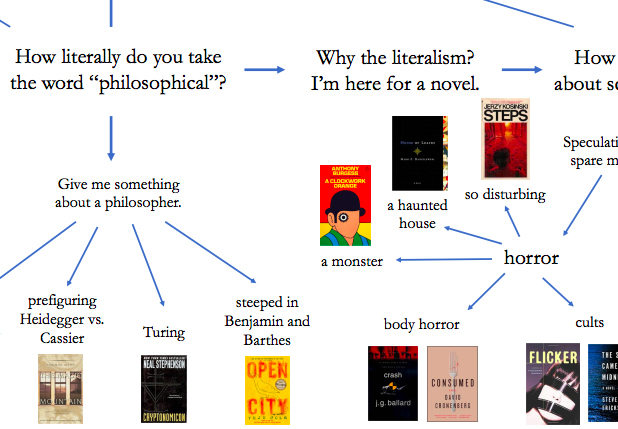
Do you want to read a philosophical novel? Sure, we all do. But the question of exactly what kind of philosophical novel you want to read, let alone which individual book, isn’t quite so easily answered. But now a professional has come to the rescue: “Ben Roth, a philosopher who teaches in the Harvard College Writing Program, has put together a kind of flowchart recommending philosophical novels and stories,” reports Daily Nous’ Justin Weinberg. “With categories like ‘about a philosopher,’ ‘by a Ph.D.,’ ‘horror,’ ‘the complications of history,’ and many more, the chart is pretty big.”
The choices you make in navigating it could land you on the work of a writer from one of a variety of countries, one of several eras, and one of a capacious range of definitions of “philosophical.” If you take the word in the sense of a novel’s being about or steeped in the work of a particular philosopher, Roth recommends books like Thomas Bernhard’s Correction (Wittgenstein) and Teju Cole’s Open City (Benjamin and Barthes). Elsewhere on the map he also includes novels written by philosophically credentialed academics like William Gass, Iris Murdoch, and Anuk Arudpragasam.
If you prefer novels where “fiction writers drop into straight essayistic mode,” Roth offers a choice between the easy mode of Milan Kundera’s The Unbearable Lightness of Being and the hard mode of Robert Musil’s The Man Without Qualities. (If you just wanted to read about a bunch of philosophy students, well, there’s always Donna Tartt’s The Secret History.)
To those who go in for more “novelly novels,” as Geoff Dyer (a known Bernhard enthusiast and author of some pretty philosophical fiction himself) memorably put it, Roth presents more forks in the road: Would you like to read science fiction? Existentialism? Postmodernism? A book free of ‑isms entirely, or anyway as free as possible?
Your answers to those questions and others could have you reading anything from J.G. Ballard’s Crash (“body horror”) to Jean-Paul Sartre’s Nausea (“mid-century French classic”) to David Foster Wallace’s Infinite Jest (postmodern, encyclopedic, on addiction). Other choices may lead you to selections less obviously involved with philosophy: J.M. Coetzee’s Waiting for the Barbarians, or Virginia Woolf’s To the Lighthouse, Haruki Murakami’s Hard-Boiled Wonderland and the End of the World. Of course, you may not want to read a philosophical novel at all: you may want to read philosophical short stories, in which case Roth recommends such form-defining figures as Edgar Allan Poe, writer of “disturbing stories”; Lydia Davis, writer of “short stories” (emphasis his); and Jorge Luis Borges, writer of “awe-inducing stories.”
Borges and quite a few other names on Roth’s philosophical-novel flowchart also appear in critic David Auerbach’s “Inquest on Left-Brained Literature,” a revealing look at the authors read by “engineers with a literary bent.” Both also include Don DeLillo, whose work Auerbach characterizes as making “heavy use of phantasmagoria, complemented by very sophisticated narrative construction,” and “simple, visceral, classical themes approached in [a] flashy, novel way.” Roth, for his part, describes DeLillo’s White Noise as his “favorite book ever.” Elsewhere on the flowchart, to the philosophical literature enthusiast who’s read everything he offers “the most underrated philosophical novel of all time,” Dino Buzzati’s The Tartar Steppe. No, I haven’t heard of it either, but I have to admit that it keeps good company.
Related Content:
Jorge Luis Borges Selects 74 Books for Your Personal Library
R. Crumb Illustrates Jean-Paul Sartre’s Nausea: Existentialism Meets Underground Comics
44 Essential Movies for the Student of Philosophy
Based in Seoul, Colin Marshall writes and broadcasts on cities, language, and culture. His projects include the book The Stateless City: a Walk through 21st-Century Los Angeles and the video series The City in Cinema. Follow him on Twitter at @colinmarshall or on Facebook.
Read More...Where Did Human Beings Come From? 7 Million Years of Human Evolution Visualized in Six Minutes
One vulgar conception of human evolution holds that we “come from monkeys.” You don’t have to be a bona fide evolutionary biologist to know that’s not quite how we currently understand it to have happened, but how clearly do you grasp the real story? The animation from the American Museum of Natural History above goes over seven million years of evolution in a mere six minutes, and it’s certainly not a straight line down from “monkeys” to us. The video does, however, start its story with apes, and specifically chimpanzees, “our closest living relatives” with whom “we share a common ancestor that lived seven million years ago.”
But we once had “much closer relatives, hominins, who are no longer living.” These we know about through the fossils they left behind in Africa, from which the first known hominin emerged those seven million years ago. Different bones from different species of hominins found elsewhere on the continent suggest small teeth, upright walking, and bipedalism, some of the qualities that distinguish humans from apes.
And though hominins may have walked upright, they also climbed trees, but eventually lost the grasping feet needed to do so. Later they compensated with the very human-like development of making and using stone tools. Two million years ago, the well-known Homo erectus, with their large brains, long legs, and dextrous hands, made the famous migration out of Africa.
We know that by 1.2 million years thereafter Homo erectus’ brains had grown larger still, fueled by new cooking techniques. Only about 200,000 years ago do we, Homo sapiens, enter the picture, but not long after, we interbreed with the various hominin species already in existence as we spread outward to fill “every geographic niche” of the Earth. Ultimately, hominins couldn’t keep up: “Climate pressures and competition with Homo sapiens may have wiped them out.” Now that we’ve seen their story and ours recapitulated, let’s pour one out for the once-mighty hominin who preceded us, lived alongside us, and influenced us in ways genetic and otherwise — at least if it hasn’t given us too much pause wondering when the evolutionarily inevitable successor to Homo sapiens will appear in our midst.
Related Content:
Watch 570 Million Years of Evolution on Earth in 60 Seconds
550 Million Years of Human Evolution in an Illustrated Flipbook
Carl Sagan Explains Evolution in an Eight-Minute Animation
New Animated Web Series Makes the Theory of Evolution Easy to Understand
Richard Dawkins Explains Why There Was Never a First Human Being
10 Million Years of Evolution Visualized in an Elegant, 5‑Foot Long Infographic from 1931
Based in Seoul, Colin Marshall writes and broadcasts on cities, language, and culture. His projects include the book The Stateless City: a Walk through 21st-Century Los Angeles and the video series The City in Cinema. Follow him on Twitter at @colinmarshall or on Facebook.
Read More...The Simulation Theory Explained In Three Animated Videos
The idea that we are software emanations in a vast, unimaginably complex computer simulation may carry more dizzying philosophical, ethical, and psychological implications than any other metaphysical assumption. It is not, however, quite a new idea, even if machines sophisticated enough to make worlds are only now conceivable. We see ancient sages speculate that solid matter is no more than some sort of graphical (tactile, etc.) user interface originating from the mind of a master coder.
We see a similar idea in the immaterialism of 18th century British empiricist George Berkeley. And where would science fiction be—especially the hallucinatory sci-fi of Philip K. Dick—without varieties of the simulation theory? The TED-Ed lesson on simulation theory, above, by University of Maryland physicist Zohreh Davoudi (animated by Eoin Duffy) opens with a quote from Dick: “This is a cardboard universe, and if you lean too long or too heavily against it, you fall through.”
In Dick’s world, this happens frequently. But if our reality were a simulation, how could we possibly step outside it to confirm? Provable or not, the theory is endlessly compelling. Davoudi walks us through a couple of fascinating scientific attempts to “fall through” by theorizing the evidence we might expect to find if the universe is made of code.
For one thing, there would probably be glitches. To correct for errors, “the simulators could adjust the constants in the laws of nature.” Tiny shifts, perhaps undetectable with current instruments, could signal heuristic revisions. Other theoretical approaches involve using subatomic particles to detect the finite limits of the godlike computer’s power.
Would finding shifts in physical laws prove a simulation. No. And in any case, our entire species could have come and gone before any such shifts have taken place. We cannot presume that humans are the chosen beneficiaries of the simulated universe. Maybe we’re prototypes. Maybe our solar system is someone’s side project. Wouldn’t the simulators notice us figuring it out and prevent us from doing so? (They would, presumably, be watching.)
And why should the great computer have anything resembling the computational limitations of our own machines, Davoudi asks. After all, if it exists outside the universe as we know it and created its physical laws, it’s safe to assume that it exists in a different universe with entirely different laws, which we might never begin to understand. If your mind falls into pools of infinite regress when contemplating the idea—aided by consciousness-raising substances or otherwise—you won’t find anywhere safe to land in the other simulation videos here, from Vox and philosophy YouTube channel Kurzgesagt. But you might begin to see the concept as a little more plausible, and maybe more unsettling, than before.
Elon Musk, for example, drawing on the work of Oxford philosopher Nick Bostrom, suggests that the simulators are not extra-dimensional beings (or whatever), but hyper-sophisticated future humans running Sim versions of their past. This version also becomes the philosophical equivalent of mise en abyme as ancestor simulations, run on other planets, create their own simulations, ship them offworld, and so forth.…
You can go as far down this rabbit hole as you like. Or, you can do as Samuel Johnson supposedly did when he heard Bishop Berkeley claim that matter didn’t exist. Kick the nearest heavy object and shout, “I refute it thus!”
Related Content:
Josh Jones is a writer and musician based in Durham, NC. Follow him at @jdmagness.
Read More...The Appeal of UFO Narratives: Investigative Journalist Paul Beban Visits Pretty Much Pop #14

TV news reporter Paul Beban (ABC, Al Jazeera, Yahoo, and now featured on the Discovery Network’s Contact) joins your hosts Mark Linsenmayer, Erica Spyres, and Brian Hirt to discuss the public fascination with UFOs, both at the peak of their popularity in the 50s and in the current resurgence. Do accounts of sightings necessarily make for good TV? Do you have to believe to be entertained? Is belief in UFOs related to religious belief? To beliefs in conspiracy theories and anti-government venom? To humor?
We get into the mechanics of Contact, the Area 51 hubbub,and also touch on the show Project Blue Book, films like Arrival (2016) and UFO (2018), the documentary Unacknowledged (2017), the short story “Roadside Picnic,” and more. To learn more about UFO lore in America, check out some of these podcasts.
Some of the resources we used for this episode included:
- “The New American Religion of UFOs” by Sean Illing
- “Why Are Area 51 Conspiracy Theories So Popular? Here’s What Psychologists Say” by Jeffrey Kluger
- “35 of the Most Popular Conspiracy Theories in the US” by Frank Olito
- “More UFOs Than Ever Before” by Rich Cohen
- “What Kucinich Saw: Witnesses Describe His Close Encounter” by Michael M. Phillips
- “Those UFO videos are real, the Navy says, but please stop saying ‘UFO’” by Kayla Epstein
Plus, here are some stats from Gallup about UFO sightings and belief, you might want to pick up the book Nostalgia for the Absolute that Paul refers to, and here’s the 2014 talk by Robbie Graham that Brian referred to describing “hyper-reality” and the Hollywood UFO conspiracy. Here’s a list of UFO documentary series.
This episode includes bonus discussion that you can only hear by supporting the podcast at patreon.com/prettymuchpop. This podcast is part of the Partially Examined Life podcast network.
Pretty Much Pop is the first podcast curated by Open Culture. Browse all Pretty Much Pop posts or start with the first episode.
Read More...An Animated Michael Sandel Explains How Meritocracy Degrades Our Democracy
Imagine if governments and institutions took their policy directives straight from George Orwell’s 1984 or Jonathan Swift’s “A Modest Proposal.” We might veer distressingly close to many a literary dystopia in these times, with duckspeak taking over all the discourse. But some lines—bans on thinking or non-procreative sex, or seriously proposing to eat babies—have not yet been crossed.
When it comes, however, to meritocracy—a term that originated in a 1958 satirical dystopian novel by British sociologist Michael Young—it can seem as if the political class had taken fiction as manifesto. Young himself wrote in 2001, “much that was predicted has already come about. It is highly unlikely the prime minister has read the book, but he has caught on to the word without realizing the dangers of what he is advocating.”
In Young’s historical analysis, what began as an allegedly democratic impulse, a means of breaking up hereditary castes, became itself a way to solidify and entrench a ruling hierarchy. “The new class has the means at hand,” wrote Young, “and largely under its control, by which it reproduces itself.” (Wealthy people bribing their children’s way into elite institutions comes to mind.) Equal opportunity for those who work hard and play by the rules doesn’t actually obtain in the real world, meritocracy’s critics demonstrate—prominent among them the man who coined the term “meritocracy.”
One problem, as Harvard’s Michael Sandel frames it in the short RSA animated video above, is an ancient one, characterized by a very ancient word. “Meritocratic hubris,” he says, “the tendency of winners to inhale too deeply of their success,” causes them to “forget the luck and good fortune that helped them on their way.” Accidents of birth are ignored in a hyper-individualist ideology that insists on narcissistic notions of self-made people and a just world (for them).
“The smug conviction that those on the top deserve their fate” comes with its inevitable corollary—“those on the bottom deserve theirs too,” no matter the historical, political, and economic circumstances beyond their control, and no matter how hard they might work or how talented they may be. Meritocracy obviates the idea, Sandel says, that “there but for the grace of God or accidents of fortune go I,” which promoted a healthy degree of humility and an acceptance of life’s contingency.
Sandel sees meritocratic attitudes as corrosive to democracy, describing their effects in his upcoming book The Tyranny of Merit. Yale Law Professor Daniel Markovits, another ivy league academic and heir to Michael Young’s critique, has also just released a book (The Meritocracy Trap) decrying meritocracy. He describes the system as a “trap” in which “upward mobility has become a fantasy, and the embattled middle classes are now more likely to sink into the working poor than to rise into the professional elite.”
Markovitz, who holds two degrees from Yale and a doctorate from Oxford, admits at The Atlantic that most of his students “unnervingly resemble my younger self: They are, overwhelmingly, products of professional parents and high-class universities.” Once an advocate of the idea of meritocracy as a democratic force, he now argues that its promises “exclude everyone outside of a narrow elite…. Hardworking outsiders no longer enjoy genuine opportunity.”
According to Michael Young, meritocracy’s tireless first critic and theorist (he adapted his satire from his 1955 dissertation), “those judged to have merit of a particular kind,” whether they truly have it or not, always had the potential, as he wrote in The Guardian, to “harden into a new social class without room in it for others.” A class that further dispossessed and disempowered those viewed as losers in the endless rounds of competition for social worth.
Young died in 2002. We can only imagine what he would have made of the exponential extremes of inequality in 2019. A utopian socialist and tireless educator, he also became an MP in the House of Lords and a baron in 1978. Perhaps his new position gave him further vantage to see how “with the coming of the meritocracy, the now leaderless masses were partially disfranchised; a time has gone by, more and more of them have been disengaged, and disaffected to the extent of not even bothering to vote. They no longer have their own people to represent them.”
Related Content:
Michael Sandel’s Famous Harvard Course on Justice Launches as a MOOC on Tuesday
Piketty’s Capital in a Nutshell
Josh Jones is a writer and musician based in Durham, NC. Follow him at @jdmagness
Read More...The Sex Pistols Riotous 1978 Tour Through the U.S. South: Watch/Hear Concerts in Dallas, Memphis, Tulsa & More
The Sex Pistols “started out as an elaborate Situationist-inspired performance art piece dreamed up by megalomaniac manager Malcolm McLaren,” wrote Jonathan Crow in a post here at Open Culture about one of the band’s storied, disastrous final shows in Dallas of 1978. After beginning as the creation of McLaren and partner Vivienne Westwood, however, they “evolved beyond just being a stunt.”
The statement is objectively true by music history standards. The band’s earliest gigs were directly responsible for almost every major band that took British punk in subsequent post-punk, goth, new wave, dub, etc. directions, including the Buzzcocks, Siouxsie and the Banshees, The Clash, Joy Division, Wire, and too many others to list.
Later came the hugely influential post-punk of John Lydon’s (formerly Rotten) own project, Public Image Limited, which reflected his serious interest in making experimental, cerebral, music with oblique lyrics deriving as much from symbolist poetry as the “deep simmering well of cultural discontent” he’d tapped into with the Pistols.
Lydon retired the character of Johnny Rotten when the band broke up at the end of their first and last U.S. tour, famously ending things at San Francisco’s Winterland Ballroom by sneering “ever get the feeling you’ve been cheated?”—a bitter comment on the band’s collapse, its very existence, and a press and audience willing to buy the act. No matter how influential they may have been, the Sex Pistols’ architects always maintained they were a cynical prank to the end.
The “one-time hippie haven of the Winterland in San Francisco,” as Ultimate Classic Rock describes it, may have been the perfect venue for their demise, a final screw you to the self-satisfied 60s rock culture Rotten loathed. But it was their tour through Atlanta, Memphis, San Antonio, Baton Rouge, Tulsa and the formerly Jack Ruby-owned Longhorn Ballroom in Dallas that made the most press, just as McLaren had designed it to do, booking country & western venues expressly to provoke, enrage, and scandalize.
Rotten had more complicated feelings about what would become a series of violent spectacles. He seemed half in on the joke, and half hoping that “real people” outside of coastal cities would become real fans. “We’re playing these cities because these are the people who will either accept us or hate us,” he said at the time. “They’re not as pretentious as they are in New York.”
He maintained in his autobiography that McLaren had also foreseen the U.S. tour as savvy marketing. “It wasn’t a question of throwing the band to the wolves when we chose to just play the South…. We felt that if we were ever going to be taken seriously in America, it would be from a base we built down south. The cowboys seemed to take it for the joke it was meant to be. We weren’t there to destroy their way of life or anything like that.”
Of course, he must have seen the U.S. press accuse the band of doing just that before their arrival—corrupting the youth, etc. Did he really hope for a warmer welcome from “the cowboys”? Was it all the glorious train wreck everyone thinks it was? Reports from eyewitnesses vary widely, as Altpress and The Dallas Morning News point out, with some expressing serious disappointment and others awe. Noel Monk’s book 12 Days on the Road describes “outrageous behavior, and concerts that frequently degenerated into near-riots.”
You can see for yourself what those unprecedented, at the time, shows looked and sounded like in the recordings here from the entire seven-city run. (Begun after a cancelled December 1977 gig in Pittsburgh). At the top we have “Anarchy in the U.K.” from the January 1978 tour opener in Atlanta; then audio of the entire show in Memphis days later; film from Randy’s Rodeo in San Antonio (in which Sid Vicious hits a fan with his bass); audio of the Baton Rouge concert; film of the entire performance at the Longhorn; film from Cain’s Ballroom in Tulsa, OK, with audio from the Winterland finale, and, finally, the Winterland itself.
After their flame-out in the first month of 1978, and Sid’s alleged murder of Nancy Spungeon and his overdose and death, John Lydon “claimed the Pistols had ‘killed’ rock and roll,” notes the site Randy’s Rodeo (named for the riotous Texas show further up). The whole tour “was a perverse, provocative joke.” McLaren’s “intent was not to sell tickets, but to incite controversy and mayhem.” The band, fractious, burned out, and eager to escape McLaren’s machinations, would have been more than happy to make some money for their trouble. Ever get the feeling you’ve been cheated?
Related Content:
The Sex Pistols Play in Dallas’ Longhorn Ballroom; Next Show Is Merle Haggard (1978)
Watch the Sex Pistols’ Very Last Concert (San Francisco, 1978)
Malcolm McLaren: The Quest for Authentic Creativity
Josh Jones is a writer and musician based in Durham, NC. Follow him at @jdmagness
Read More...Watch 16 Hours of Historic Live Aid Performances: Queen, Led Zeppelin, Neil Young & Much More
12 pm — 2 pm | Wembley Stadium, London
As Live Aid geared up for its momentous series of concerts of both sides of the Atlantic, famous concert promoter Bill Graham compared it to Woodstock: “What we’re doing now is entirely different. The reason for the event is more important than the event itself.”
Three decades later, the memory of the event has eclipsed its reason (and one Queen performance has eclipsed most of the concert). It was a gathering of the best of mainstream ‘80s rock–still trying to justify itself alongside acts from the 60s and the ‘70s–and the zenith of the fundraising telethon: broadcast live in 140 countries to raise $50 million for victims of a relentless African famine. (Fun fact: the concerts raised about $560 million in 2019 money, about two days’ worth of Jeff Bezos’ current earnings!)
If you have a day to spare, you can recreate that amazing July 13th in 1985 with this series of YouTube playlists.
The day started at London’s Wembley Stadium (up top), with the Regimental Band of the Coldstream Guards performing the Royal Salute for Queen and Country and all that, and then things really started with Status Quo, those grizzled ol’ blokes playing “Rockin’ All Over the World.” Yanks might have said “who?” but it was the Brits who either bopped along or said, “Not this bloody Dad rock!” (Okay, not true, the phrase hadn’t been invented, but something similar was uttered.)
2 pm — 4 pm | Wembley Stadium, London
The British side was indeed a mixed bag, reflecting the idiosyncrasies of its own singles chart compared to the more steadfast American charts. Elvis Costello sang “All You Need Is Love”; the Style Council sang their hits; Nik Kershaw played his chart-topper. Phil Collins performed “Against All Odds,” then jumped on a Concorde for New York, arriving to sing it again for a different audience.
4 pm — 6 pm | Wembley Stadium, London
There’s so much more to explore in these playlists: the Led Zeppelin reunion, The Cars at the height of their powers (RIP Ric Ocasek), Neil Young (and his reunion with Crosby, Stills, and Nash), Bob Dylan, The Four Tops, Run D.M.C., the list really goes on and on.
6 pm — 8 pm | Wembley Stadium, London
8 pm — 10 pm | Wembley Stadium, London
2 pm — 5 pm | John F. Kennedy Stadium, Philadelphia
5 pm — 8 pm | John F. Kennedy Stadium, Philadelphia
8 pm — 11 pm | John F. Kennedy Stadium, Philadelphia
Live Aid | 11 pm- 2 am | John F. Kennedy Stadium, Philadelphia
Live Aid | 2 am — 4 am | John F. Kennedy Stadium, Philadelphia
Find a complete list of Live Aid performances here.
Related Content:
Ted Mills is a freelance writer on the arts who currently hosts the artist interview-based FunkZone Podcast and is the producer of KCRW’s Curious Coast. You can also follow him on Twitter at @tedmills, read his other arts writing at tedmills.com and/or watch his films here.
Read More...Art Trips: Visit the Art of Cities Around the World, from Los Angeles & London, to Venice and New York
When first we visit a city, even a small one, we can’t hope to see all of it. Hence the need for strategies of approach and exploration: do we walk its main streets? Eat its food and drink its drinks? Visit its most beloved bookstores? Sarah Urist Green gets into cities through their art, hardly a surprising habit for the creator of the PBS Digital Studios series The Art Assignment. We first featured The Art Assignment five years ago here on Open Culture, and Green and her collaborators have kept up the good work ever since. In that time their mission of “traveling around the country, visiting artists and asking them to give you an art assignment” has expanded, taking them outside America as well. On the road they’ve collected not just material for regular episodes, but for special Art Trips as well.
Their first Art Trip to Los Angeles, for instance, takes Green and company to the Hammer Museum, the galleries of Culver City (one of which has a show up of Andy Warhol’s shadow paintings), the Los Angeles County Museum of Art (where they walk under Michael Heizer’s Levitated Mass and through Chris Burden’s much-Instagrammed Urban Light), and the then-newly-opened Broad Art Museum. In between they take side trips for refreshment at the noted ice cream sandwich shop Coolhaus (named in honor of the Dutch architect) and deep into the Inland Empire city of Bakersfield. This combination of places expected and unexpected comes not without the occasional tourist cliche, such as Green’s description of “the most quintessential of Los Angeles experiences: driving.”
The Art Assigment’s return visit to the southern Californian metropolis focuses on “the Los Angeles hiding in plain sight” with Pacific Standard Time: LA/LA, a series of exhibitions all over the city on Latino and Latina artists at institutions like the Craft and Folk Art Museum, the Los Angeles Central Library, and the Geffen Contemporary. All the while Green and her team eat plenty of tacos, as any Angeleno would advise, and the final night of their stay finds them in Grand Park among the shrine-like handmade offerings set up for Día de los Muertos, all of them crafted with an eeriness matched only by their good humor.
Los Angeles has become an acknowledged art capital over the past half-century, but London, fair to say, has a bit more history behind it. The Art Assignment’s time in the English capital coincides with Frieze Week, when galleries from all over the world descend on Regent’s Park to show off their most striking artistic wares. Not coincidentally, the museums and galleries based in the city use the same part of the year to schedule some of their most anticipated shows, turning the few days of this Art Trip in London into a mad rush from Trafalgar Square to the National Portrait Gallery to the Royal Academy of Arts to the Courtauld Institute of Art, by which point Green admits the onset of “masterpiece overload ” — but also has several galleries, not to mention the main event of Frieze itself, to go.
Frieze Week doesn’t come to Detroit, the onetime capital of American auto manufacturing whose population peaked in the middle of the 20th century and whose subsequent hard times, culminating in the city’s 2013 bankruptcy, have been chronicled with both fascination and despair. But The Art Assignment finds a Detroit apart from the ruined factories, theaters, and train stations, the stuff of so many internet slideshows, at the Motown Museum and the Detroit Institute of Arts (home to Diego Rivera’s Detroit Industry Murals), as well as in folk-art environments like the famous Heidelberg Project and public-art environments like downtown Detroit, whose recent revival has proven as compelling as its long decline. But many ruins remain, and artists like Scott Hocking have found in them not just their subjects but their materials as well.
More striking than Detroit’s urban desolation is that of another unlikely The Art Assignment destination, Marfa, Texas. In his essay “The Republic of Marfa,” Sean Wilsey describes it as “a hardscrabble ranching community in the upper Chihuahuan desert, sixty miles north of the Mexican border, that inhabits some of the most beautiful and intransigent countryside imaginable.” In the mid-1970s “the minimalist artist Donald Judd moved to Marfa, exiling himself from what he termed the ‘glib and harsh’ New York art scene, in order to live in a sort of high plains laboratory devoted to building, sculpture, furniture design, museology, conservation, and a dash of ranching,” and his influence — as well as the presence of his large-scale installations — helped to make Marfa “a sort of city-state of cattlemen, artists, writers, fugitives, smugglers, free-thinkers, environmentalists, soldiers and secessionists.”
In Marfa Green explores the monumental work Judd left behind as well as the monumental work other artists have since contributed, including a project in a converted military barracks by neon artist Dan Flavin and a fake Prada store. Other Art Trip destinations include the likes of Chicago and Columbus, Indiana (modern-architecture mecca and setting of the recent feature film by video essayist Kogonada) as well as Tijuana and the Venice Biennale, all of which you can find on one playlist. Green has even done an Art Trip right where she lives, the “bland-leaning, chain restaurant-loving” Midwestern city of Indianapolis — which boasts the Museum of Psychphonics, an under-freeway art installation by Vito Acconci, and a fair few bike-share book-share stations as well. We can never fully know the cities we don’t live in, but nor can we ever fully know the cities we do live in either — which, if we nevertheless enjoy the attempt as much as Green does, is no bad thing at all.
Related Content:
Tour the World’s Street Art with Google Street Art
Electric Guitars Made from the Detritus of Detroit
Based in Seoul, Colin Marshall writes and broadcasts on cities, language, and culture. His projects include the book The Stateless City: a Walk through 21st-Century Los Angeles and the video series The City in Cinema. Follow him on Twitter at @colinmarshall or on Facebook.
Read More...Bob Moog Demonstrates His Revolutionary Moog Model D Synthesizer
There are far better players of Bob Moog’s wonderous analog synthesizers than Bob Moog himself–from Wendy Carlos, who reinterpreted Bach for the newfangled instrument in the 60s to Rick Wakeman and Richard Wright to Giorgio Moroder to Gary Numan, to virtually anyone who has ever recorded music with a Moog. Bob Moog was not a musician, he was an engineer who took piano lessons before earning his B.A. in physics, M.A. in electrical engineering, and Ph.D. in engineering physics from Cornell.
Academic credentials have no bearing on what moves us musically, but it’s always worth noting that the Moog synthesizers—which did more to change the sound of modern music than perhaps any instrument since the electric guitar—came out of decades of dogged scientific research, beginning when Moog was only 14 years old and built a homemade Theremin from plans he found printed in the magazine Electronics World. That was 1949. Almost thirty years later, the Minimoog Model D appeared, the revolutionary portable version of studio-sized machine Carlos used to reimagine classical music in the late 60s.
“It’s an analogue monophonic synthesizer,” says Moog in the video above. “That means it makes the waveforms by electronic means and it plays one note at a time.” Sounds rather primitive by our standards, but watch the demonstration below by Marc Doty, who walks us through the sweeping range of functions in the compact machine, made between 1970 and 1981 (and reissued for a limited run in 2016). Its banks of waveform selectors, oscillators, filters, and envelopes produce “something sweeter,” says Doty, than your average synthetic sounds, though he can’t quite put his finger on what it is.
We’ve all heard the difference, whether we know it or not, and discriminating ears can pick a Minimoog out of any lineup of analogue synths. It is, Doty declares in the description for his video, “perhaps the most beautiful, beautiful sounding, and functional synthesizer ever produced.” Called the Model D because it was the fourth iteration of previous versions made in-house between 1969–70, it was truly, says author and composer Albert Glinsky, “the first portable synthesizer where everything is contained in one unit. It really is the prototype, the ancestor, of every portable keyboard in every music shop today.”
One of its innovations, the pitch wheel, now standard issue on almost all of those mass-produced successors of the Minimoog, was the first of its kind. If Moog “had patented [the pitch wheel],” says David Borden, one of the first musicians to play the Minimoog live, “he would have been an extremely wealthy man.” Others have made similar observations about Moog’s pioneering sound-shaping technologies, but as Richard Leon points out at Sound on Sound, it’s a good thing for us all that the inventor wasn’t motivated by profit.
Competition nearly buried the company Moog sold in the mid-70s (only reacquiring rights to his own name in 2002), but had Moog “tried to create a monopoly on these fundamentals,” Leon writes, “it’s likely the synth industry as we know it today would never have happened.”
Related Content:
How the Moog Synthesizer Changed the Sound of Music
Josh Jones is a writer and musician based in Durham, NC. Follow him at @jdmagness
Read More...Support Us
We're hoping to rely on loyal readers, rather than erratic ads. Please click the Donate button and support Open Culture. You can use Paypal, Venmo, Patreon, even Crypto! We thank you!

About Us

Open Culture scours the web for the best educational media. We find the free courses and audio books you need, the language lessons & educational videos you want, and plenty of enlightenment in between.
Advertise With Us

FREE UPDATES!
GET OUR DAILY EMAIL
Get the best cultural and educational resources on the web curated for you in a daily email. We never spam. Unsubscribe at any time.
FOLLOW ON SOCIAL MEDIA

Open Culture editor Dan Colman scours the web for the best educational media. He finds the free courses and audio books you need, the language lessons & movies you want, and plenty of enlightenment in between.
Advertise With Us

