How Eric Clapton Created the Classic Song “Layla”
The story of Eric Clapton and “Layla” has always bothered me because to understand it is to understand how fallible and crazed any of us can be when it comes to love. We understand that our rock gods are human, but there’s something about Clapton falling in love with the wife (Pattie Boyd) of one of his best mates (George Harrison, a freakin’ Beatle, man!) and then writing a whole album about it, that is just unsettling. Is this something tawdry writ epic? Or is this something epic that has the wafting aroma of tawdriness?
Polyphonic takes on the behind the scenes story of this rock masterpiece and rewinds several centuries to the source of Layla’s name: “Layla and Majnun,” a romantic poem from 12th century Persian poet Niẓāmi Ganjavi based on an actual woman from the 6th Century who drove her poet paramour mad. Lord Byron called the tragic poem “The Romeo and Juliet of the East,” as unrequited love leaves both Majnun and Layla dead after the latter’s father forbids her to be with the poet.
Eric Clapton heard of the poem from his Sufi friend Abdalqadir as-Sufi (formerly Ian Dallas), and so when he wrote a slow ballad about his unrequited love for Patti, “Layla” made perfect sense as a name.
The song might have stayed a ballad–think of Clapton’s slowed down version from his MTV “Unplugged” special–if it wasn’t for Duane Allman of the Allman Brothers. The two had yet to meet, but were aware of each other. Allman had grabbed Clapton’s attention with his fiery solo work at the end of Wilson Pickett’s cover of “Hey Jude”:
When Clapton and Allman did meet, the two set to jamming and Allman made the history-changing decision to speed up Clapton’s ballad and use a riff taken from Albert King. “Layla” was born. Allman’s bottleneck slide style met Clapton’s string bending, and the track is a conversation between the two, where no words are needed.
“It’s in the tip of their fingers,” says engineer Tom Dowd, listening to the isolated tracks in the video below. “It’s not in a knob, it’s not in how loud they play, it’s touch.”
Over this, Clapton delivers his desperate lyrics, sung by a man at his wits end, much like Majnun of the poem.
And then, that coda, which takes up half the song. Drummer Jim Gordon was working on the piano piece for a solo album in secret. When Clapton discovered Gordon was recording on the sly, he wasn’t angry. Instead he insisted it be added to the end of the rocking first half. The song is a perfect balance between frantic rock and romantic ballad.
But in the real world, “Layla” didn’t do the job. Clapton played the album for Pattie Boyd three weeks later, and though she understood its beauty, Boyd was embarrassed by its message.
“I couldn’t believe I was the inspiration for putting this together,” she said in an interview. “I didn’t want this to happen.” She was also mortified thinking that everybody would know exactly who “Layla” was about.
“It didn’t work,” Clapton recalled. “It was all for nothing.”
The song was a flop in the charts, especially as it was cut in half for the single. It would find its audience three years later when the full version appeared on both a Clapton anthology and a best of collection of Duane Allman’s work. Finally it rocketed up the charts, and it’s kind of stayed in classic rock playlists ever since.
And as for Boyd, she actually did leave George Harrison in 1974 to marry Clapton in 1979, a marriage that lasted 10 years. Not all marriages last. The original flame dies out. It’s just that, in “Layla“ ‘s case, the flame is there every time the needle drops into the groove.
Related Content:
23-Year-Old Eric Clapton Demonstrates the Elements of His Guitar Sound (1968)
Ted Mills is a freelance writer on the arts who currently hosts the artist interview-based FunkZone Podcast and is the producer of KCRW’s Curious Coast. You can also follow him on Twitter at @tedmills, read his other arts writing at tedmills.com and/or watch his films here.
Read More...How E.E. Cummings Writes a Poem
Most of us encounter E.E. Cummings at an early age; his poems for adults regularly appear in poetry anthologies for children. We derive great pleasure from his brazen misspellings, portmanteaus, neologisms, and “typographical high jinks,” as Paul Muldoon writes at The New Yorker. Look at this famous writer breaking all the rules, and thereby giving us occasion to talk about the rules, about how poetry is different, about how, among poets, E.E. Cummings stands alone.
Only someone with a keen facility for language can bend it to their individual will, something we may recognize when reading Cummings in high school, when we also recognize the irony and grim satire in his poems. The inventive whimsy had veiled something darker. In 1960, then-high-school student Peter Carlton got the chance to interview Cummings about his poem “Humanity, I love you,” then posted the exchange online 37 years later. “I, for one, do not love humanity,” the poet told him, “I feel that humanity itself is cruel and unjust.”
A common sentiment among modernists, especially those, like Cummings, who had served in World War I. But few of his contemporaries, who included James Joyce, T.S. Eliot, and Ezra Pound, had his ability to speak to so many different audiences. It’s almost shocking to see the shift in voice between Cummings’ interview with young Carlton and a letter he wrote to Pound 20 years earlier, full of the usual Cummings coinages (“innulluxuls”) and vicious literary barbs (Archibald MacLeish becomes “the macarchibald maclapdog macleash”).
Was Cummings a radical? A romantic? A literary naïf? An outsider? A savvy, cynical player of the game? He contained multitudes. From Eliot he “learned to distrust the hierarchical in every aspect of life,” writes Muldoon, “beginning with his own being. In his poetry, ‘I’ becomes ‘i.’” Whatever attitudes he expresses, Cummings always forces us to wrestle with language—its durability and malleability, its familiar strangenesses—first.
In his most accessible poem, “i carry your heart with me (i carry it in,” Cummings draws our attention to the simplicity of his archetypal images, as if to smirkingly announce, “this is a universal love poem.” Standard fare. But such obvious mirroring of form and content does not diminish the poem’s accomplishment, argues Evan Puschak, the Nerdwriter, in the video above. On the contrary, simple repetitions lead us into far more complicated recursions inside the poem.
Puschak quotes lines from Yeats to illustrate the deftness of Cummings’ deceptive simplicity: “A line will take us hours maybe; / yet if it does not seem a moment’s thought, / Our stitching and unstitching has been naught.” While many a poet has made the art seem easy, few have made it seem so playful or irreverent as Cummings, or have delighted so many people of so many ages and walks of life—so few of whom may suspect the conceptual heft and rigor that went into his work.
To read Cummings’ poetry yourself, pick up a copy of his complete poems.
Related Content:
Two Childhood Drawings from Poet E.E. Cummings Show the Young Artist’s Playful Seriousness
Celebrate Valentine’s Day with a Charming Stop Motion Animation of an E.E. Cummings’ Love Poem
E.E. Cummings Recites ‘Anyone Lived in a Pretty How Town,’ 1953
Josh Jones is a writer and musician based in Durham, NC. Follow him at @jdmagness
Read More...How Marion Stokes, an Activist Librarian, Recorded 30 Years of TV News on 70,000 Video Tapes: It’s All Now Being Digitized and Put Online
“Nothing is more important than television,” said J.D. Salinger (as impersonated, that is, in an episode of Bojack Horseman). A passive, pacifying medium—“cool,” as Marshall McLuhan called it—TV has also long been an easy target for punditry, for many decades before the perpetrator du jour, video games. Television spread ignorance, was “the drug of the nation,” said Michael Franti, peddled fake heroes on “channel zero,” said Public Enemy, and would lead to an “electrical re-tribalization of the West,” McLuhan predicted (and further explained in this interview).
Marion Stokes set out to do more than any of the men above who made pronouncements about television. She dedicated her life to preserving the evidence, taping television news for over 33 years, from 1979 “until the day she died,” writes the Internet Archive, who now hold Stokes’ “unique 71k+ video cassette collection” and intend to digitize all of it. Stokes “was a fiercely private African American social justice champion, librarian, political radical, TV producer, feminist, Apple Computer super-fan and collector like few others.”
She “questioned the media’s motivations and recognized the insidious intentional spread of disinformation…. Ms. Stokes was alarmed. In a private herculean effort, she took on the challenge of independently preserving the news record of her times in its most pervasive and persuasive form—TV.” She also preserved three decades of televised critiques of television. She began making her archive at the beginning of the Iran Hostage Crisis on November 14, 1979. “She hit record and never stopped,” her son Michael Metelits says in Recorder: The Marion Stokes Project, “a newly released documentary,” reports Atlas Obscura, “about [Stokes] and the archival project that became her life’s work.”
In one remarkable example of TV critique, at the top, we see William Davidon, professor of Physics at Haverford College, decrying television for spreading ignorance, social irresponsibility, and passive consumption, making people unable to participate in the political process. The roundtable discussion took place on a 1968 episode of Input. A little over a year later, writes the Internet Archive, Davidon “would take an action of great social consequence,” breaking into an FBI field office with seven others and stealing the evidence that “revealed COINTELPRO.” (They were never caught, and Davidon’s role only came out posthumously.)
Then known as Marion Metelits, Stokes co-produced Input, a local Philadelphia Sunday morning talk show, with her future husband John S. Stokes Jr., and both of them appear on the program above (both credited as representing the Wellsprings Ecumenical Center). The conversation ranges widely, with Ms. Metelits and Davidon spiritedly defending “human potential” against too-rigid systems of classification and manipulation. There are a few dozen more episodes of Input currently at the Internet Archive, with panels featuring academics, activists, and clergy (such as the episode explaining, sort of, the “Wellsprings Ecumenical Center.”)
It’s a hard-hitting, controversial show for a local broadcast, and it gives us a detailed view of a range of both popular and radical positions of the time, including Stokes’, which we can learn more about in the journals, notes, lists, newspaper and magazine clippings, pamphlets, leaflets, handbills, and more she collected since 1960, many of which have also been digitized at the Internet Archive. Stokes backed her views with action. She was “surveilled by the government for her early political activism,” Atlas Obscura writes, and “attempted to defect to Cuba” with her first husband Melvin Metelits. She kept her recording project private, “eschewed Tivo” and “never sent an email in her life.”
She also made a small fortune in Apple stock, which funded her project and “the massive storage space she required as the sole force behind it.” Stokes left us no doubt as to why she documented thirty years of TV news. But those documents get to speak for themselves—or they will, at least. Stokes recorded far more than her own program, three decades more. And the Internet Archive is currently “endeavoring to help make sure” the entire collection “is digitized and made available online to everyone, forever, for free.”
If television had, and maybe still has, the power ascribed to it by its many astute critics, then Marion Stokes’ painstaking archive offers an invaluable means of understanding how we got to where we are, if not how to change course. Stokes’ collection, and the documentary about her life, show “how the news was going to evolve into an addiction,” as Owen Gleiberman writes at Variety. The project took over her life and fractured her relationships. “Even if you’re obsessed with the inaccuracy of TV news, it has still entrapped you, like a two-way mirror that won’t let you see the other side.” If the medium is the message, the other side might always be more television.
via Atlas Obscura
Related Content:
Hear Marshall McLuhan’s The Medium is the Massage (1967)
Josh Jones is a writer and musician based in Durham, NC. Follow him at @jdmagness
Read More...The Glorious Poster Art of the Soviet Space Program in Its Golden Age (1958–1963)
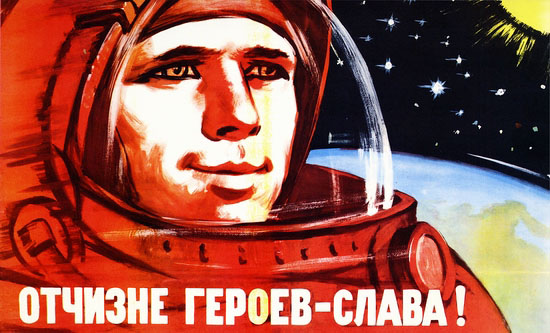
How do you sell a government program that spends tens of millions of dollars on research and development for space travel? While the average taxpayer may love the idea of braving new frontiers, far fewer are apt to vote for funding scientific research, the space program’s ostensible reason for being.
During the Cold War, however, when the biggest breakthroughs in space flight occurred, selling the program didn’t involve sophisticated methods, only the broadest themes of heroism, patriotism, futurism, and, in more or less subtle ways, militarism. The appeal to science always went hand-in-hand with an appeal to the sublimely austere beauty of the heavens (which we’d hate to lose to the other guys.)
All of these were strategies NASA utilized, and then some. In addition to planting a U.S. flag on the moon, they delivered the first color image of Earth from space. On the ground, they enlisted artists like Andy Warhol, Norman Rockwell, and Laurie Anderson and actors like Star Trek’s Nichelle Nichols to sell the program.
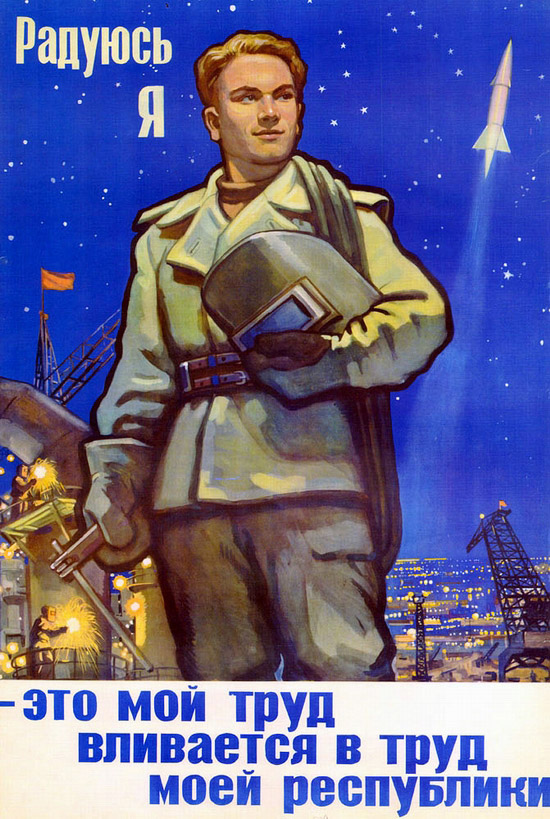
Recently, NASA has seemed to be in a reflective mood, from its antiquarian preparations for the 50th anniversary of the moon landing to its ad campaign of retro posters that resemble not only vintage sci-fi book jackets and movie ads, but also the futuristic social realism of their former Soviet rivals.
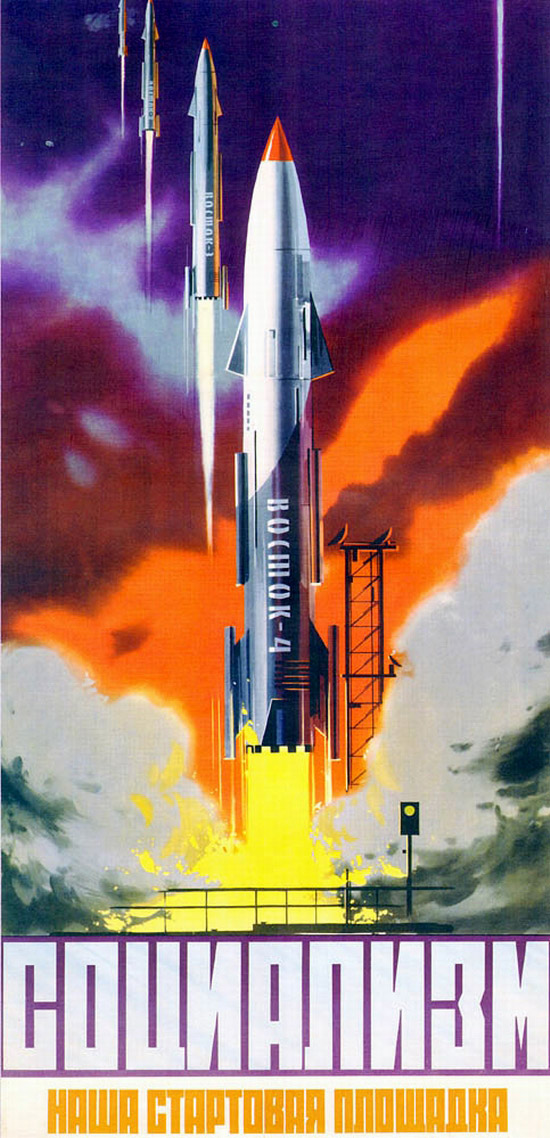
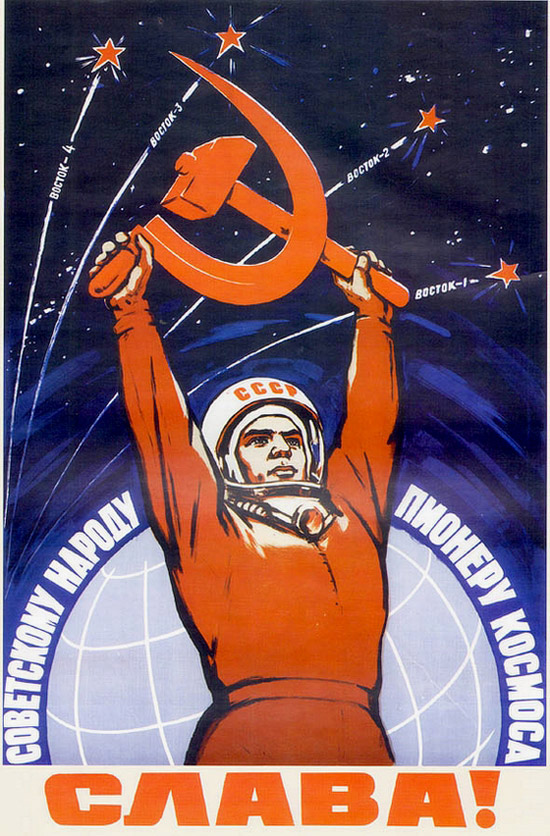
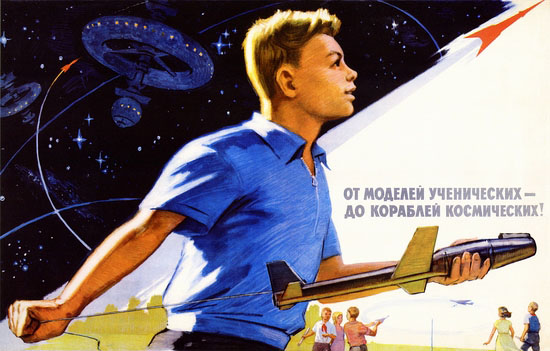
There’s almost something of an admission in NASA’s retro posters: we may have won the “space race,” but it wasn’t winner take all. There were some things the Soviets just did better—and when it came to making space travel look like the most monumentally heroic and exciting thing ever, they excelled, as you can see in this early collection of Soviet space posters from 1958–1963.
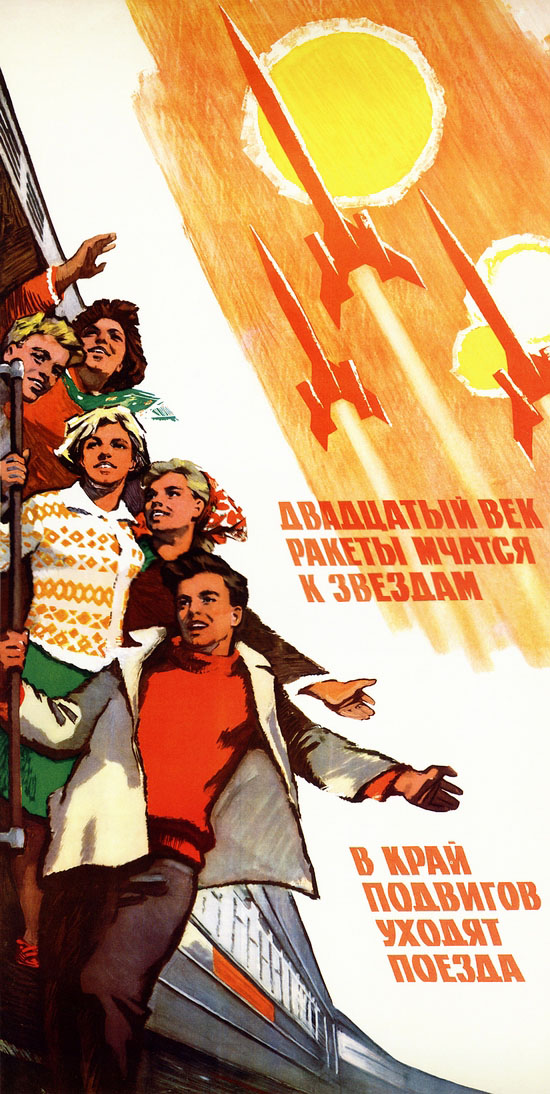
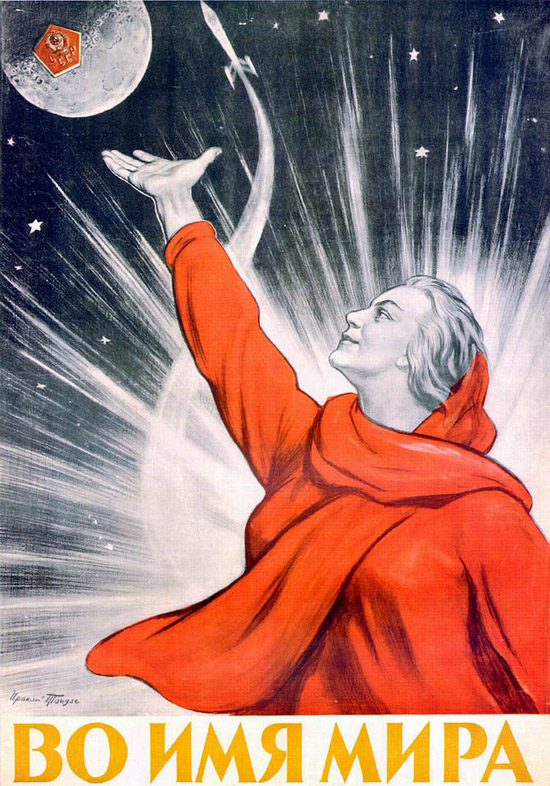
There’s something for, well, not everyone, but for men, women, young, old, young adults. Sci-fi geeks and model builders, people celebrating the new year, children celebrating the new year, a gaggle of young students who somehow all look just like Mary Tyler Moore. The artists are not celebrities, they’re fellow workers who “foresaw a Utopia in space,” writes Flashbak.
The Communists would bring peace and prosperity not only to the people of Earth but also to the technology-enabled, God-free Great Beyond. The artists created Soviet Space posters, vivid, energising and inspiring visions of the rosy-fingered dawn of tomorrow. They’re terrific.
They’re maybe even more terrific when we consider that ordinary citizens didn’t have much say, at all, in the funding and direction of the U.S.S.R.’s space program. (Whether American citizens did is another question.) It was important that Soviets know, however, that “We will open the distant worlds!” as one poster reads, and, as the sixties teenage cigarette ad on a train above proclaims, “In the 20th century, the rockets race to the stars, the trains are going to the lands of achievements!”
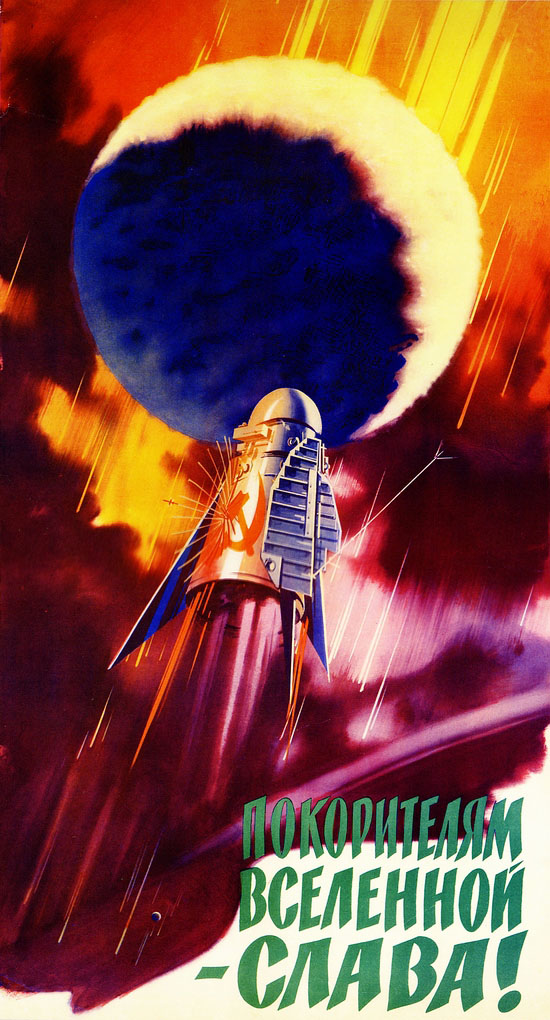
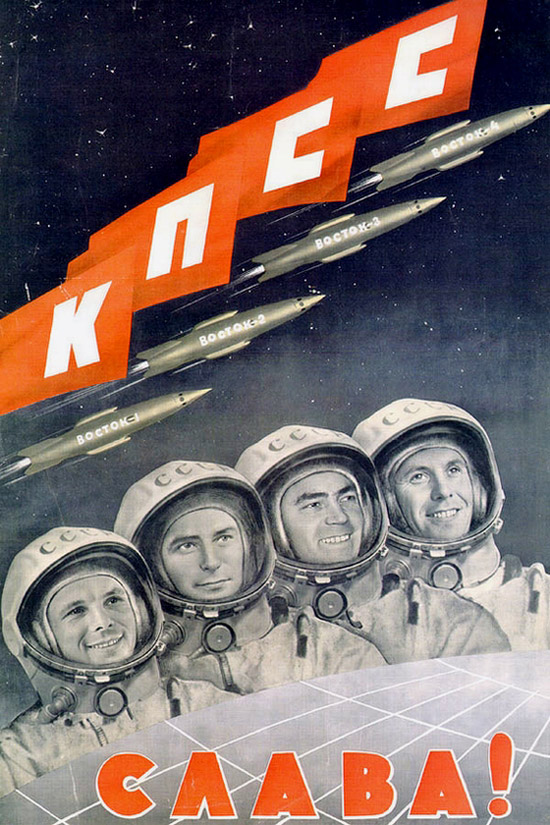
The number of posters here is but a smattering of those posted on All about Russia (here and here) and Flashbak. Each poster has its own enchanting quality: emulating the propaganda of the 1930s; turning industrial laborers into anonymous towering heroes; and reaching some very heavy metal heights of bombast, as in the ad above, which declares, “Glory to the conquerors of the universe!”
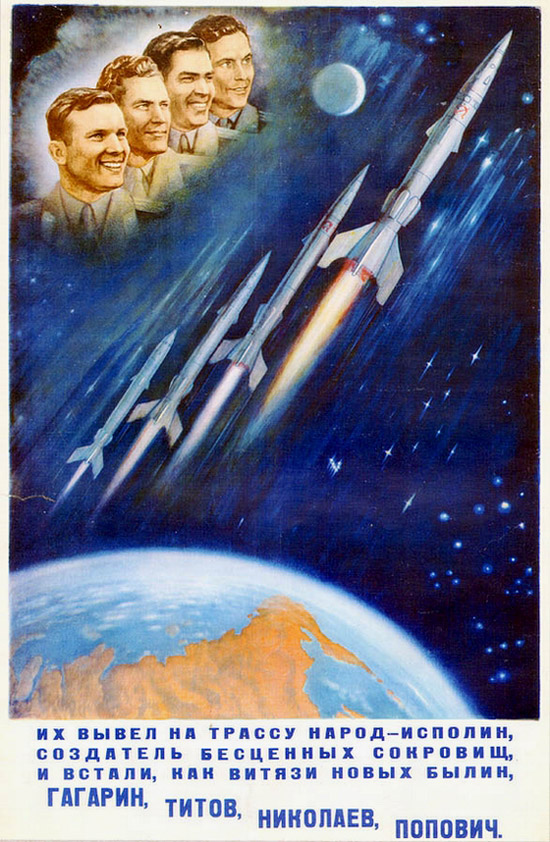
One poster superimposes the beaming faces of four cosmonauts, lined up like Kraftwerk, over a scene of four rockets leaving the earth. “Gagarin, Titov, Nikolaev, Popoviich—the mighty knights of our days.” (I’m not sure how that pun works in Russian.) The Soviets could also proclaim “Glory to the first woman cosmonaut!,” Valentina Tereshkova, who became the first woman to fly in space in 1963.
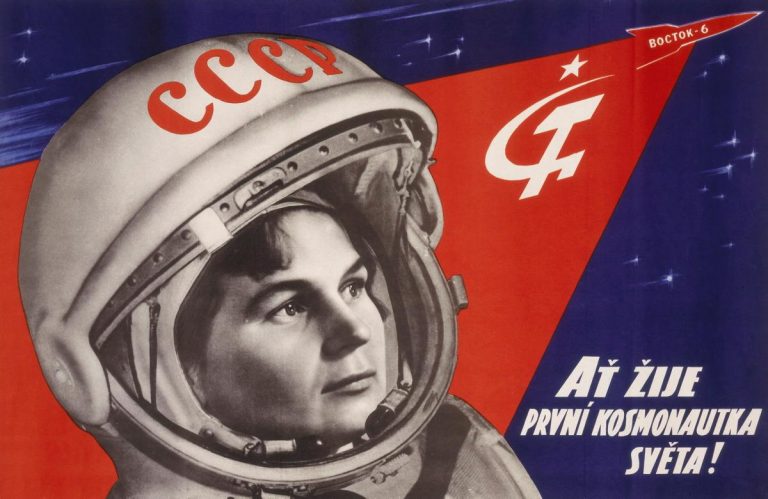
The Soviet space program deserves plenty of recognition for its many historic firsts, and also for the wildly enthusiastic optimism of its ad campaigns. They sold grand ideas about the exploration and, yes, conquest of space (and “the universe”) with the same verve and populist appeal as U.S. companies sold cars, cigarettes, and washing machines. Glory to the unsung Mad Men of the Soviet space poster!
Related Content:
Soviet Artists Envision a Communist Utopia in Outer Space
Josh Jones is a writer and musician based in Durham, NC. Follow him at @jdmagness
Read More...What Happens To Your Body & Brain If You Don’t Get Sleep? Neuroscientist Matthew Walker Explains
As an insomniac in a morning person’s world, I wince at sleep news, especially from Matthew Walker, neuroscientist, Berkeley professor, and author of Why We Sleep. Something of a “sleep evangelist,” as Berkeley News calls him (he prefers “sleep diplomat”), Walker has taken his message on the road—or the 21st century equivalent: the TED Talk stages and animated explainer videos.
One such video has Walker saying that “sleep when you’re dead” is “mortally unwise advice… short sleep predicts a shorter life.” Or as he elaborates in an interview with Fresh Air’s Terry Gross, “every disease that is killing us in developed nations has causal and significant links to a lack of sleep.”

Yeesh. Does he lay it on thick? Nope, he’s got the evidence and wants to scare us straight. It’s a psychological tactic that hasn’t always worked so well, although next to “sleep or die” sermons, there’s good news: sleep, when harnessed properly (yes, somewhere in the area of 8 hours a night) can also be a “superpower.” Sleep does “wonderfully good things… for your brain and for your body,” boosting memory, concentration, and immunity, just for starters.
But back to the bad.…
In the Tech Insider video above, Walker delivers the grim facts. As he frequently points out, most of us need to hear it. Sleep deprivation is a serious epidemic—brought on by a complex of socio-economic-politico-technological factors you can probably imagine. See Walker’s comparisons (to the brain as an email inbox and a sewage system) animated, and learn about how lack of sleep contributes to a 24% increase in heart attacks and numerous forms of cancer. (The World Health Organization has recently “classified nighttime shift work as a probable carcinogen.”)
On the upside, rarely is health science so unambiguous. If nutritionists could only give us such clear-cut advice. Whether we’d take it is another question. Learn more about the multiple, and sometimes fatal, consequences of sleep deprivation in the animated TED-Ed video above.
Related Content:
10 Hours of Ambient Arctic Sounds Will Help You Relax, Meditate, Study & Sleep
Josh Jones is a writer and musician based in Durham, NC. Follow him at @jdmagness.
Read More...Watch Some of the Most Powerful Bass Guitar Solos Ever: Geddy Lee, Flea, Bootsy Collins, John Deacon & More
At her site Ari’s Bass Blog, bass player and teacher Ariane Cap shoots down many of the arguments against solo bass music—that is, music played solely on bass guitar. To the objection that “basses have a job to do in a band context,” she writes, “what this ‘job’ is can vary greatly!” To another complaint, she responds, “even when imitating guitar techniques on the bass, it is still bass playing.” Her defenses of solo bass (and her fine instructions on how to play it well) work equally for the bass solo, when the often least-noticed member of the band steps out and takes the lead for a few moments.
The idea that bass players are all wallflowers or invisible, less-talented members of the band is, of course, a bad rock and roll stereotype. Naturally, the best bass soloists in rock are some of the players who have drawn the most attention to the instrument and shown how critical it is.
But not all great bass players are great soloists. The solo requires a particular combination of power and agility. The bass soloist is something of a musical athlete.
A guitar solo can coast, so to speak, on tone, on perfectly-chosen notes played with just the right vibrato and sustain. A bass solo is another monster. Whether plucked, picked, or slapped, bass solos usually involve a lot of notes attacked very hard and very fast, up and down the neck—a feat anyone who’s held a bass guitar will know requires a lot of dexterity and strength.
Marvel as you watch the shoulders, arms, and fingers on left and right hands of these players move with uncanny precision, in clips from some of the all-time bass solo greats here. At the top, John Entwistle wins top prize for succinctness. His bored expression may seem to give away the pre-recorded TV game, but even live onstage he never seemed to raise an eyebrow when pulling off licks like these.
Below him, Geddy Lee stretches out, and makes your arms tired from watching him move all over the fretboard, building from one figure to another before a final explosive shred. Further up, Stuart Hamm, onstage with Joe Satriani in 1988, gives a solo bass performance at the Montreux Jazz Festival, moving effortlessly from Beethoven’s “Moonlight Sonata” to a series of gorgeous arpeggios to some genre-hopping theatrics the crowd devours.
Though he made his bones as one of the fastest bass soloists on the block, Fleas’s solo bass performance uses delay and echo effects to slow things down significantly and expand the possibilities of solo bass, bringing it into the tonal realm of the guitar while still demonstrating the tremendous physicality bass playing requires. Just above, see Bootsy Collins pull off a similar feat in a full band context, proving that bass solos can be made of slow, soulful melodicism and heavy, fuzzed-out licks.
Collin’s tour-de-force performance is hard to top, but for contrast, and to reemphasize the versatility of the bass as a solo instrument, whether playing all alone or taking a brief turn in the spotlight, see Queen’s John Deacon pull out a flawless, short and seriously sweet bass solo live on “Liar,” just above, looped for ten minutes straight so you can memorize every note.
Related Content:
The Story of the Bass: New Video Gives Us 500 Years of Music History in 8 Minutes
What Makes Flea Such an Amazing Bass Player? A Video Essay Breaks Down His Style
Josh Jones is a writer and musician based in Durham, NC. Follow him at @jdmagness
Read More...The Importance of Film Editing Demonstrated by the Bad Editing of Major Films: Bohemian Rhapsody, Suicide Squad & More
It’s one of cinema’s greatest ironies that editing can make or break a film, but few moviegoers understand what an editor actually does. Editing involves taking shots and assembling them in the right order, yes, but what makes an order — all the transitions from moment to moment and scene to scene — “right”? Even if we can’t explain good editing, we know bad editing when we see it, and even more so when when we feel it. The hard-to-pin-down sensation of a movie being “off” or “wrong” often comes out of incompetent editing, and by breaking down the bad editing in a variety of recent pictures, these three videos throw into contrast what it takes for editing to be good.
Most of the nine “Movies that Were Ruined by Really Bad Editing” in the Looper video at the top of the post are part of high-profile franchises. Given the size of their budgets and the importance of their box-office performance, you might think such films wouldn’t permit technical sloppiness of any kind. Yet in Alien: Covenant everything happens in an order that kills the dramatic tension; the chaotic Taken 3, “a severe case of death by a thousand cinematic cuts,” plays out “at the speed any other movie would run if you accidentally hit the fast-forward button several times”; Transformers: Age of Extinction goes heavy on the wrong scenes and “treats its robot aliens as a subplot”; and Suicide Squad provides an example of “a studio publicly advertising a movie as one thing, panicking, then completely reshaping the same film all inside of one frantic marketing blitz.”
“Editing is going down the crapper these days,” says Folding Ideas host Dan Olson in his in-depth examination of Suicide Squad’s incompetent cutting. “The editing was shockingly awful in every way,” he says, turning it into a kind of negative showcase of the editor’s art: “I would seriously advise anyone with an interest in the art of cinematic editing to do their own full autopsy to see just how much went wrong and plain old doesn’t work.” Olson points to examples of Suicide Squad’s often inexplicable choices, such as filling the first half of the film with hyperkinetic character introductions that play more like trailers, developing characters only to suddenly drop them, losing track of the physical locations of characters, and repeatedly abusing the Kuleshov Effect in a way that feels like the “cinematic equivalent of putting the emphasis on the wrong syllable.”
But then, it would have been more of a surprise for a critical disaster like Suicide Squad to have been well-edited. What about the Freddie Mercury biopic Bohemian Rhapsody, which won an Academy Award specifically for its editing? Its reception of that particular Oscar is interesting, says video essayist Thomas Flight, “because the movie contains several scenes that are master classes in poor editing.” In one offending sequence, “many of the cuts are unmotivated,” which mean that the editor made them for no apparent reason, at least none serving story or the drama. Others “ignore spatial continuity,” which makes it difficult or impossible for the audience to understand who and what is supposed to be where. And “the pace is simply too fast,” meaning that the lengths of the shots are too short for the action: editing that suits a rock concert doesn’t suit a conversation.
Even viewers who otherwise enjoyed Bohemian Rhapsody will have sensed something the matter with the cuts in the scene Flight highlights. But nobody could have a worse reaction to it than John Ottman, the man who edited the film, and whose work has been credited with making (rather than further breaking) the troubled production. As mentioned in March here on Open Culture, that particular scene was cut not by Ottman but director Dexter Fletcher, who came in to take Bohemian Rhapsody’s reins after the departure of Bryan Singer. “Whenever I see it, I want to put a bag over my head,” Ottman told the Washington Post. Most moviegoers don’t see editing when it’s good, only when it’s bad — but when it’s especially bad, it makes editors themselves long for invisibility.
Related Content:
The Dark Knight: Anatomy of a Flawed Action Scene
Alfred Hitchcock’s 7‑Minute Master Class on Film Editing
Hitchcock on the Filmmaker’s Essential Tool: The Kuleshov Effect
A Visual Introduction to Soviet Montage Theory: A Revolution in Filmmaking
Bohemian Rhapsody’s Bad Editing: A Breakdown
Based in Seoul, Colin Marshall writes and broadcasts on cities, language, and culture. His projects include the book The Stateless City: a Walk through 21st-Century Los Angeles and the video series The City in Cinema. Follow him on Twitter at @colinmarshall or on Facebook.
Read More...Legendary Protest Songs from Woodstock: Hendrix, Jefferson Airplane, Country Joe & More Perform Protest Songs During the Music Festival That Launched 50 Years Ago This Week
This year’s big event to celebrate the 50-year anniversary of the most famous music festival in the world has died an ignominious death. As Variety wrote in a scathing “obituary” last month, “Woodstock 50 passed away today at the age of 7 months, following a brave and very, very long battle with cancel.”
Not a few people have said good riddance. What could the tribute—to take place not in Woodstock but in Baltimore—have in common with its namesake, save a small handful of the still-living original performers? The use of “Woodstock” as a brand seems cynical, but then again, we’ve also grown leery of the legend of Woodstock 1. What was it about? Classic rock stars on a farm? Stoned, naked hippies flailing in the mud? What justifies the fifty years of hype?
Woodstock was about much more than druggy flower children shagging in bedraggled tents, yet this stereotype was propagated from the start. The festival “was a stridently antiwar spectacle,” online history project All About Woodstock explains. “Its message was diluted by the media. Rather than focus on the political statements made, mainstream cultural commentators talked about hippies, long hair, and nudity.” A belated wedding party, Woodstock symbolized “the merger and ambivalence of the counterculture and protest.”
The marriage may be in shambles in the time of Woodstock 50 but it held on for several decades. Woodstock “was the ‘coming out’ party of the rock ‘n’ roll generation,” writes NPR. Folk singer Richie Havens, the festival’s first performer, remembers it as “the beginning of the world, as far as I was concerned.” Booked for a 20-minute set, Havens ended up playing for much longer when Santana couldn’t be found, ad-libbing “Freedom (Motherless Child)” as his closer.
“The word ‘freedom came out of my mouth because this was our real particular freedom,” he says in an interview with NPR’s Tony Cox. “We’d finally made it to above ground.” A few months later, in December, the decade closed on a much darker note, symbolized by the Rolling Stones’ bloody Altamont Free Concert. But for three days that year, August 15–17, 1969, it seemed like music festivals might change the world.
Maybe they did. Woodstock organizer Michael Lang thinks so. “I think Woodstock proved the world that it was possible for people to live peacefully,” he said in a 2015 interview. “It gave credence to the positions we as a young generation took on personal freedoms, ending a war we felt unjust, respect for the planet, the fight for civil rights, women’s rights, and human rights in general. The impact on society continues to this day.”
The festival was also, of course, a massively star-studded event filled with career highlight performances like Hendrix’s radical, blistering “Star-Spangled Banner.” Not every act showed up to make a statement. The Who were pretty sour about the gig, Lang remembers. “They were not part of the ‘hippie’ thing and Pete Townsend had to be talked into taking the date.” But those who came to make a statement weren’t shy about it. Jefferson Airplane called for volunteers for the revolution in their anti-war anthem “Volunteers.” Country Joe and the Fish ended the second set on Saturday with their satirical “I‑Feel-Like‑I’m‑Fixin’-to-Die Rag,” an explicitly anti-Vietnam War song that asked, “what are we fighting for”?
Joan Baez, six months pregnant at the time, sang traditional folk songs, Dylan’s “I Shall Be Released,” and Gram Parson’s “Hickory Wind.” Her closer, spiritual “We Shall Overcome,” bridged the music of the Civil Rights movement with that of the anti-war movement, proclaiming in her glorious soprano, “We shall live in peace someday.” The moment, fifty years ago this week, can never be recreated, no matter how much money organizers throw at Woodstock retreads. But we don’t need millions to remember what the original Woodstock stood for. Sex, drugs, and mud got all the press, but the festival’s intentions were to protest war overseas and hatred and murder at home with three days of peace and music—a vision, as Havens extemporaneously sang out, of another kind of freedom.
The original festival, “essentially a mass movement promoting peace,” gets yet another look in a new American Experience documentary, Woodstock: Peace, Love and Music, which premiered last Tuesday on PBS. (Stream it free here.) With “never-before-seen footage” and testimonials from “those who experienced it firsthand,” the film documents the event’s highs and lows, including the many “near disasters” that “put the ideals of the counterculture to the test.” Also see the New York Times article, “How to Relive Woodstock From the Comfort of Your Couch,” which features “six movies, 12 album collections, two songs and 17 books that will take willing travelers back to August 1969.” This includes, of course, Michael Wadleigh’s iconic documentary, Woodstock: 3 Days of Peace and Music.
Related Content:
Jimi Hendrix Live at Woodstock: Historic Concert Captured on Film
David Crosby & Graham Nash at Occupy Wall Street; Echoes of Woodstock
Wattstax Documents the “Black Woodstock” Concert Held 7 Years After the Watts Riots (1973)
Josh Jones is a writer and musician based in Durham, NC. Follow him at @jdmagness.
Read More...Enjoy Dazzling & Dizzying 360° Virtual Tours of Los Angeles Landmarks
Remember when armchair travel meant a book, a magazine, a handful of postcards, or the occasional after-dinner slideshow of the neighbors’ vacation photos?
Those were the days.
The throngs of travel “influencers”—both professional and aspirant—have taken much of the fun out of living through others’ visits to far-flung locales. The focus seems to have shifted from imagining ourselves in their shoes to feeling oppressed by their highly-staged, heavily-filtered Instagram-perfect existence.
Photographer Jim Newberry’s dazzling, dizzying 360° photos of Los Angeles, like the views of Echo Park, Chinatown, East L.A., and Downtown, above, offer armchair travelers transportation back to those giddy pre-influencer days.
(Angelinos and other LA-versed visitors will enjoy swooping through City of Angels landmarks as if rotating on the no-parallax point, too.)
The Chicago transplant admits that it took a while for him to find his Los Angeles groove:
After being disabused of my Midwestern, anti‑L.A. views, I’ve found that the city has much more to offer than I had imagined, but the gems of Los Angeles often don’t reveal themselves readily; it takes a bit of legwork to seek out the best spots, and well worth it. Mountains, beaches, vibrant urban life, tons of museums, gorgeous nature.
While easy-to-use “one-shot” 360 cameras exist, Newberry prefers the quality afforded by using a high-resolution non-360 camera with a wide angle lens, mounted on a panoramic tripod head that rotates it in such a way as to prevent perspective errors.
With the equipment set up in the center of the room, he shoots four photos, spaced 90° apart. Another shot is aimed directly downward toward the floor.
Panoramic software helps to stitch the images together for a “spherical panorama,” giving viewers an experience that’s the digital equivalent of swiveling their heads in awe.
Newberry’s roving lens turns Lee Lawrie’s Zodiac Chandelier, Dean Cornwell’s California history murals, and the decorative ceiling stencils of the Central Public Library’s Grand Rotunda into a gorgeous kaleidoscope.
The Taoist Thien Hau Temple in Chinatown is a more recent attraction, founded in the 1980s in a former Christian church. Community members raised funds to build the larger temple, above, dedicating it in 2006 as a shrine to Mazu, the goddess of the sea, protector of fisherman and sailors.
The Museum of Jurassic Technology, a self-described “educational institution dedicated to the advancement of knowledge and the public appreciation of the Lower Jurassic,” served as Newberry’s point of entry, when management okayed his request to shoot 360° photos there:
It’s a very special place—my panoramic photos are no match for an in-person visit. Unlike many other museums these days, the Museum of Jurassic Technology doesn’t normally allow photography, and there’s not many photos of the place to be found.
(In return for permission to shoot the museum’s Fauna of Mirrors murals, rooftop courtyard, and Tula Tea Room, Newberry agreed to maintain its mysterious aura by limiting the publication of those photos to his Panoramic Eye site. Feast your eyes here.)
The photographer is looking forward to working with more museums, creating 3‑dimensional documentation of exhibits.
His interest in the ephemeral has also spurred him to create virtual tours of local landmarks on the verge of being torn down. Entries in the ongoing Lost Landmarks series include Los Feliz’s Good Luck Bar (RIP), Tom Bergin’s Pub (above, spared at the last minute when the Los Angeles Conservancy declared it an Historic-Cultural Monument), and the Alpine Village, currently for sale in neighboring Torrance.
Begin your explorations of Jim Newberry’s Panoramic Eye 360° virtual tours of Los Angeles, including the Griffith Park Observatory, the St. Sophia Cathedral, and the Everything Is Terrible! store here.
Related Content:
Take a 360° Virtual Tour of Taliesin, Frank Lloyd Wright’s Personal Home & Studio
Five Cultural Tours of Los Angeles
Ayun Halliday is the author of seven books, including No Touch Monkey! And Other Travel Lessons Learned Too Lateand the Chief Primatologist of the East Village Inkyzine. Join her in NYC on Monday, September 9 for another season of her book-based variety show, Necromancers of the Public Domain. Follow her @AyunHalliday.
Read More...The Authentic Vivaldi’s The Four Seasons: Watch a Performance Based on Original Manuscripts & Played with 18th-Century Instruments
Last week we featured a performance of Pachelbel’s Canon as faithful as possible to how Pachelbel originally composed it, as well as to the instruments and playing styles of the era in which he lived. Today we offer another performance by the same ensemble, San Francisco’ Voices of Music, this one of an even more beloved piece: Antonio Vivaldi’s The Four Seasons. In the video above, violinist Cynthia Miller Freivogel joins Voices of Music to play the suite’s “Winter” concerto on such genuinely early 18th-century instruments as the baroque organ, the Italian single manual harpsichord, and the archlute.
“Of the many composers who helped to bring the Italian Baroque style to its zenith at the beginning of the 18th century, Antonio Vivaldi stands out as perhaps the most creative,” says the web site of the Redlands Symphony. “Like Bach, his energy was primarily directed toward perfecting existing forms rather than creating new ones. Within the works of Vivaldi, we see a perfection of the 17th century Italian concerto and opera forms.”
And in the case of The Four Seasons, made up as it is of one concerto representing each quarter of the year accompanied by a sonnet on the spirit of that season, Vivaldi made “a conscious attempt to write programmatic works. They are, in fact, one of the earliest attempts to compose music of this type.”
For this video, Voices of Music’s official notes explain, a “new edition” of The Four Seasons “was prepared from the original sources, prints and manuscripts for Vivaldi’s music. In addition, a digital overlay has been created for Vivaldi’s sonnets which were inlaid into the original engraving: click the CC button to view the sonnet and the gear icon to choose your preferred language.” This performance of one part of Vivaldi’s best-known compositions, sounding as close as we can possibly get today to the way Vivaldi himself must have heard it, will be seasonally appropriate for southern-hemisphere Open Culture readers now in the middle of their own winter. As for readers in the summertime of the northern hemisphere — well, nine and a half minutes of 17th-century wintertime may be just what they need to cool down.
Related Content:
Why We Love Vivaldi’s “Four Seasons”: An Animated Music Lesson
Vivaldi’s Four Seasons Brought to Life in Sand Animations by the Hungarian Artist Ferenc Cakó
14-Year-Old Girl’s Blistering Heavy Metal Performance of Vivaldi
Based in Seoul, Colin Marshall writes and broadcasts on cities, language, and culture. His projects include the book The Stateless City: a Walk through 21st-Century Los Angeles and the video series The City in Cinema. Follow him on Twitter at @colinmarshall, on Facebook, or on Instagram.
Read More...Support Us
We're hoping to rely on loyal readers, rather than erratic ads. Please click the Donate button and support Open Culture. You can use Paypal, Venmo, Patreon, even Crypto! We thank you!

About Us

Open Culture scours the web for the best educational media. We find the free courses and audio books you need, the language lessons & educational videos you want, and plenty of enlightenment in between.
Advertise With Us

FREE UPDATES!
GET OUR DAILY EMAIL
Get the best cultural and educational resources on the web curated for you in a daily email. We never spam. Unsubscribe at any time.
FOLLOW ON SOCIAL MEDIA

Open Culture editor Dan Colman scours the web for the best educational media. He finds the free courses and audio books you need, the language lessons & movies you want, and plenty of enlightenment in between.
Advertise With Us

