Pretty Much Pop #3: CONFORM with Yakov Smirnoff
Is media trying to brainwash us into being ALL THE SAME? Are the excesses of the mob scaring us into conformity? And does this in turn keep us from being actually creative, with healthy relationships?
Mark Linsenmayer, Erica Spyres, and Brian Hirt muse on cultural homogenization and a few sci-fi takes on forced sameness and then bring out our first celebrity guest, beloved comedian and now psychology Ph.D. Yakov Smirnoff, who tells us about growing up in a repressive society and his fears that political correctness and a lack of appreciation for the “reciprocal opposites” necessary for authentic communication is leading us in that direction. We conclude with a bit of host-ful response.
We touch on Cat’s Cradle, Aladdin, Rosanne Barr, The Twilight Zone, Brian’s wearing a Cubs hat in Missouri, and performing comedy in the U.S.S.R. as well as various sensitive audiences here. Will you not join us and dress as Devo every day?
Here’s that article that comes up on Kurt Vonnegut Jr.‘s terms “karass” (voluntary, organic grouping) and “granfalloon” (inherited, basically meaningless grouping).
No, we are not a politics podcast, but sometimes when we reflect on the dynamics involved with our being entertained, politics is hard to avoid! You may enjoy listening to The Partially Examined Life (Mark’s philosophy podcast) discuss Adorno on the Culture Industry, or perhaps their discussion of the world of technological unemployment.
Get more at prettymuchpop.com. Subscribe on Apple Podcasts, Stitcher, or Google Play. Pretty Much Pop: A Culture Podcast is produced by the Partially Examined Life Podcast Network.
Follow Yakov: @Yakov_Smirnoff. Not enough Yakov? Well, of course there are scads of YouTube clips and other podcast appearances that he’s done that you can check out with a mere web search, but if you want to hear EVERY SINGLE WORD he said to us, we did post an entirely unedited version of the interview for $5 supporters at patreon.com/prettymuchpop.
Read More...Bryan Magee (RIP) Presents In-Depth, Uncut TV Conversations With Famous Philosophers
Note: We woke this morning to the news that Bryan Magee, academic and popularizer of philosophy, has passed away. He was 89. Below, we bring you a post from our archive that highlights Magee’s many televised interviews with influential philosophers. You can watch them online.
Bryan Magee comes from a tradition that produced some of the twentieth century’s most impressive media personalities: that of the scholarship-educated, Oxbridge-refined, intellectually omnivorous, occasionally office-holding, radio- and television-savvy man of letters. Students and professors of philosophy probably know him from his large print oeuvre, which includes volumes on Popper and Schopenhauer as well as several guides to western philosophy and the autobiographical Confessions of a Philosopher. He also wrote another memoir called The Television Interviewer, and philosophically inclined laymen may fondly remember him as just that. When Magee played to both these strengths at once, he came up with two philosophical television shows in the span of a decade: Men of Ideas, which began in 1978, and The Great Philosophers, which ran in 1987. Both series brought BBC viewers in-depth, uncut conversations with many of the day’s most famous philosophers.
You can watch select interviews of Men of Ideas and The Great Philosophers on YouTube, including:
- Herbert Marcuse on the Frankfurt School
- Bernard Williams on the Spell of Linguistic Philosophy
- Bernard Williams on Descartes
- Miles Burnyeat on Plato
- Martha Nussbaum on Aristotle
- Anthony Kenny on Medieval Philosophy
- Iris Murdoch on Philosophy and Literature
- Geoffrey Warnock on Kant
- J.P. Stern on Nietzsche
- Hubert Dreyfus on Husserl and Heidegger
- Anthony Quinton on Spinoza and Leibniz
- Peter Singer on Hegel and Marx
- Michael Ayers on Locke and Berkeley
- John Passmore on Hume
- Sidney Morgenbesser on the Pragmatists
- A.J. Ayer on logical Positivism
- A.J. Ayer on Frege and Russell
- Anthony Quinton on Wittgenstein
- Hilary Putnam on the Philosophy of Science
- Frederick Copelston on Schopenhauer
At the top of the post, you’ll find Magee talking with A.J. Ayer, a well-known specialist in “logical positivism,” about the development of, and challenges to, that philosophical sub-field. Two philosophers, relaxed on a couch, sometimes smoking, enthusiastically engaged in a commercial-free back-and-forth about the most important thinkers and thoughts in the field — watch something like that, and you can’t possibly think of now as a golden age of television.
Oodles of free philosophy courses, many thought by famous philosophers, can be found in the Philosophy section of our list of 1,300 Free Online Courses from Top Universities.
Colin Marshall hosts and produces Notebook on Cities and Culture. Follow him on Twitter at @colinmarshall.
Related Content:
Free Online Philosophy Courses
44 Essential Movies for the Student of Philosophy
Read More...Watch an Animated Documentary About the Pioneering Journalist & Feminist Icon Nellie Bly
While no longer a household name, the trailblazing journalist Nellie Bly (1864–1922) is definitely an enduring American icon.
Her likeness has graced a postage stamp and a finger puppet.
Her life has been the subject of numerous books and a made-for-TV movie.
Some hundred years after its completion, her record-breaking, 72-day round-the-world trip inspired an episode of The American Experience, a puzzle-cum-boardgame, and a rollicking song by history fans the Deedle Deedle Dees.
And now? Meet Nellie Bly, cartoon action hero. (Heroine? Hard to say which honorific the opinionated and forward-thinking Bly, born in 1864, would prefer…)
Filmmaker Penny Lane’s “Nellie Bly Makes the News,” above, is not the first to recognize this sort of potential in the pioneering journalist, whose 151st birthday was celebrated with an animated Google Doodle and accompanying song by Karen O, but Lane (no relation to Lois, the fictional reporter modeled on you-know-who) wisely lets Bly speak for herself.
Not only that, she brings her into the studio for a 21st-century interview, in which an eye-rolling Bly describes the resistance she encountered from the male elite, who felt it was not just unseemly but impossible that a young woman should pursue the sort of journalistic career she envisioned for herself.
She also touches on some of her most famous journalistic stunts, such as the undercover stints in a New York City “insane asylum”and box-making factory that led to exposés and eventually, social reform.
Biographer Brooke Kroeger and brief glimpses of archival materials touch on some of the other highlights in Bly’s audacious, self-directed career.
The cartoon Bly’s hairdo and attire are period appropriate, but her vocal inflections, courtesy of broadcast reporter and voiceover artist Sammi Jo Francis, are closer in spirit to that of Broad City’s Ilana Glazer.
(Interesting to note, given Bly’s complaints about how prominently the one dress she took on her round the world trip featured in outside stories about that adventure, that dress is a preoccupation of The Appreciation of Booted Newswomen blog. Respectful as that site is, the focus there is definitely not on journalistic achievement.)
Related Content:
74 Essential Books for Your Personal Library: A List Curated by Female Creatives
New Web Project Immortalizes the Overlooked Women Who Helped Create Rock and Roll in the 1950s
Ayun Halliday is an author, illustrator, theater maker and Chief Primatologist of the East Village Inkyzine. Join her in NYC on Monday, September 9 for another season of her book-based variety show, Necromancers of the Public Domain. Follow her @AyunHalliday.
Read More...Neil Armstrong, Buzz Aldrin & Michael Collins Go Through Customs and Sign Immigration Form After the First Moon Landing (1969)
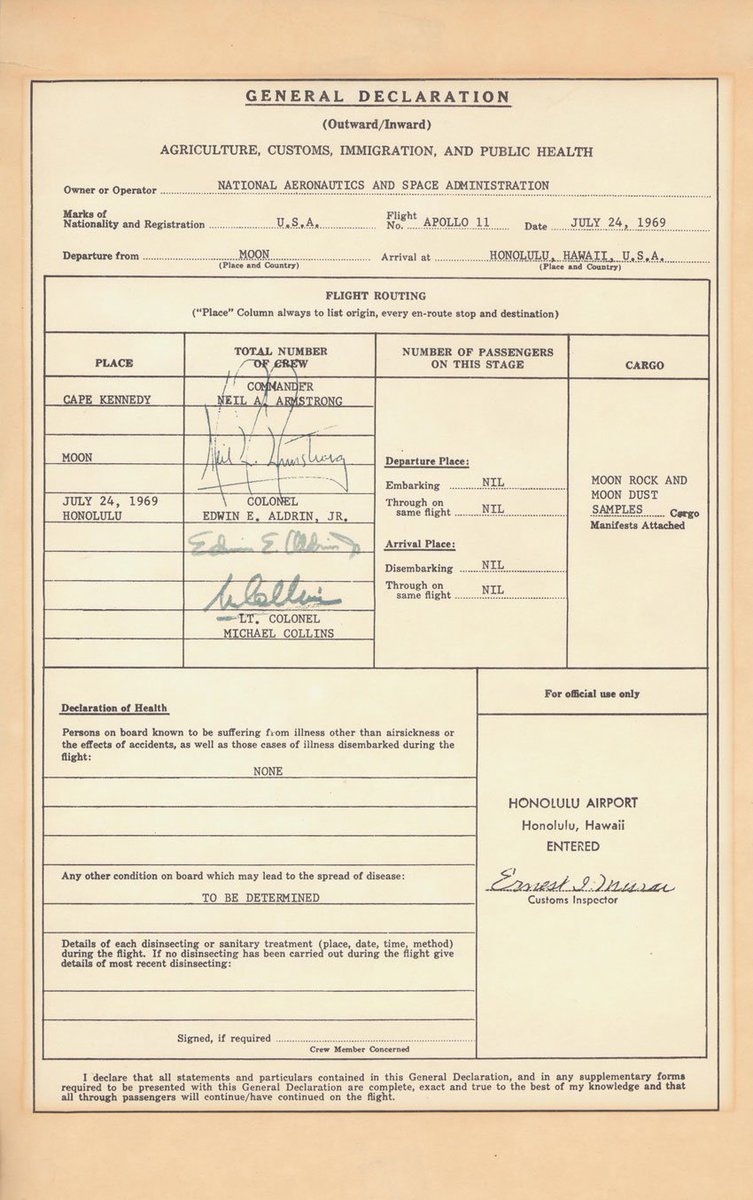
Above, find a document signed 50 years ago by Neil Armstrong, Buzz Aldrin, and Michael Collins after they returned from the first manned trip to the moon. The three astronauts came down in the Pacific Ocean and were taken to Honolulu on July 24, 1969, where they supposedly signed this immigration form, declaring a cargo of moon rocks and dust. President Nixon was good enough to let them back into the country.
The form, NASA spokesperson John Yembrick told Space.com, is authentic. And, he says, it was a joke. He does not, however, say exactly when the form was signed, either on the day the crew splashed down or sometime afterward. They did not actually arrive in Honolulu until the 26th. After their return,
The astronauts were trapped inside a NASA trailer as part of a quarantine effort just in case they brought back any germs or disease from the moon. They even wore special biological containment suits when they walked out on the deck of the USS Hornet after being retrieved.
NASA transported them to Houston, quarantine trailer and all, and they emerged from isolation three weeks later.
Astronauts these days mostly just need a shower when they touch down, although internet savvy International Space Station astronaut Chris Hadfield did tell some customs related stories on a Reddit AMA—maybe nothing so weird as the current space snorkeling up there, but still a pretty great read.
Note: An earlier version of this post originally appeared on our site in December 2013.
Related Content:
“Moon Hoax Not”: Short Film Explains Why It Was Impossible to Fake the Moon Landing
Dark Side of the Moon: A Mockumentary on Stanley Kubrick and the Moon Landing Hoax
Find Astronomy Courses in our Collection of 1300 Free Courses Online
Josh Jones is a writer and musician based in Durham, NC. Follow him at @jdmagness
Read More...The Jane Austen Fiction Manuscript Archive Is Online: Explore Handwritten Drafts of Persuasion, The Watsons & More
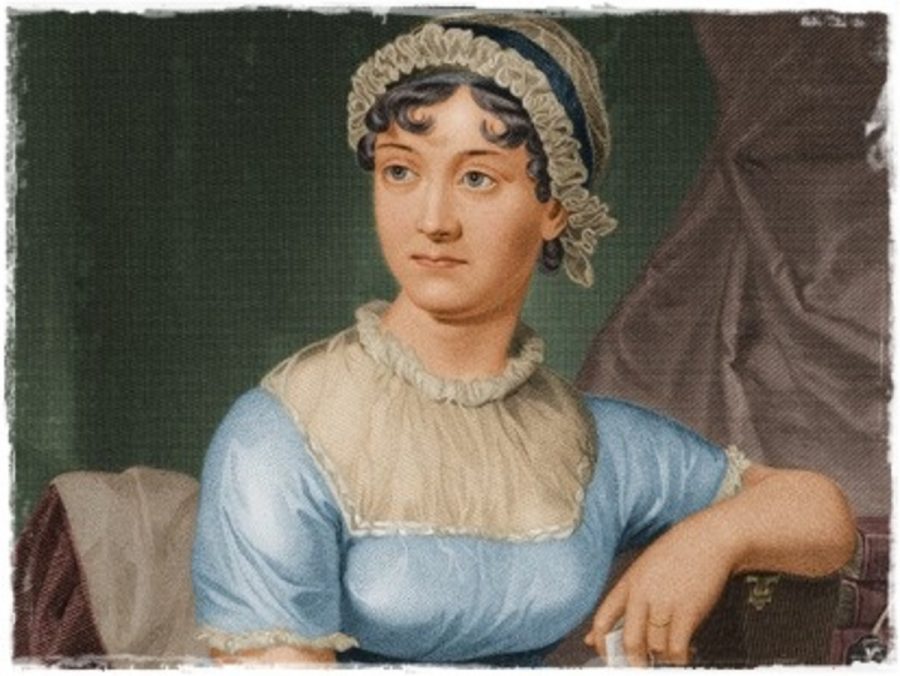
I first came to Jane Austen prepared to dislike her, reared as I had been to think of good fiction as socially transgressive, experimental, full of heavy, life-or-death moral conflicts and existentialist anti-heroes; of extremes of dread and sorrow or alienated extremes of their lack. Austen’s characters seemed too perky and perfect, too circumscribed and wholesome, too untroubled by inner despair or outer calamity to offer much in the way of interest or example.
This is an opinion shared by more perceptive readers than myself, including Charlotte Brontë, who called Pride and Prejudice “an accurate daguerreotype portrait of a commonplace face.” Brontë “disliked [Austen] exceedingly,” writes author Mary Stolz in an introduction to Emma. The author of Jane Eyre pronounced that “Miss Austen is only shrewd and observant,” where a novelist like George Sand is “sagacious and profound.”
A cursory reading of Austen can seem to confirm Brontë’s faint praise. Consider the first description of her heroine matchmaker, Emma:
Emma Woodhouse, handsome, clever, and rich, with a comfortable home and happy disposition, seemed to unite some of the best blessings of existence, and had lived nearly twenty-one years in the world with very little to distress or vex her.
No great, shocking disasters befall Emma. She is buffeted neither by war nor poverty, crime, disease, oppression or any other essentially dramatic conflict. She ends the novel joining hands in marriage with charming gentleman farmer Mr. Knightly, content, maybe ever-after, in “perfect happiness.”
Rarely if ever in Austen do we find the torments, spiritual strivings, sublime and grotesque imaginings, proto-science-fiction, and world-historical consciousness of contemporaries like William Blake, Samuel Taylor Coleridge, or Mary Shelley. Austen is “famous,” writes Stolz, “for having lived through the period of the French Revolution without ever mentioning it in her writings.”
To see this as a critique, however, is to seriously misjudge her. “She did not deal in revolutions of this order. Not a traveled woman, she wrote only of what she knew”: life in English country villages, the travails of “love and money,” as she put it, the everyday longings, courtesies, and discourtesies that make up the majority of our everyday lives.
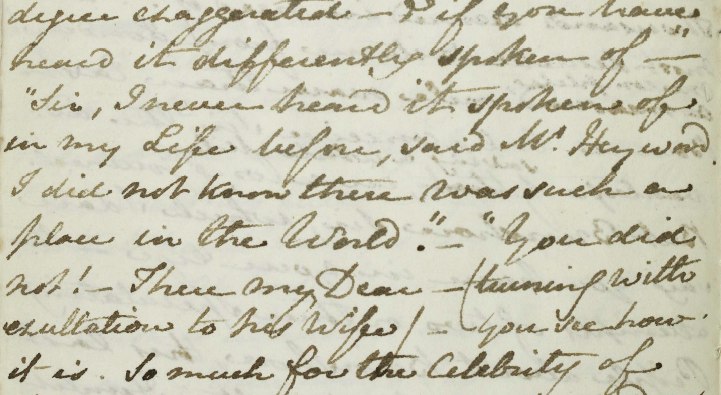
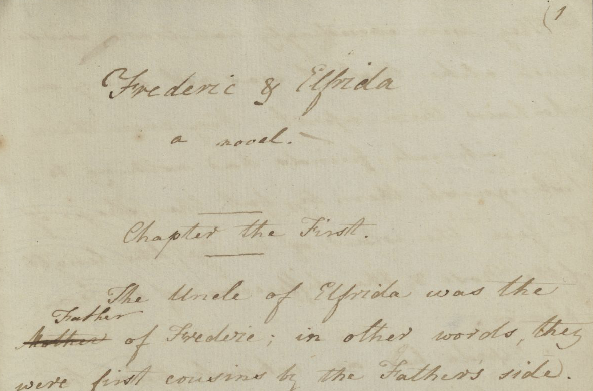
We can see Austen doing just that in her own hand at the Jane Austen’s Fiction Manuscripts Digital Edition. A collection of scanned manuscripts from the Bodleian, British Library, Pierpont Morgan Library, private collectors, and King’s College, Cambridge, this project “represents every stage of her writing career and a variety of physical states: working drafts, fair copies, and handwritten publications for private circulation.”
This is primarily a resource for scholars; much of this work has been published in printed editions, including the Juvenilia (read some of that writing here) and unfinished drafts like The Watsons and her last, uncompleted, novel, Sanditon. (One still-in-print 1975 edition collects the three unfinished novels found at the digital collection). Each digital edition of the manuscript includes a head note on the textual history, provenance, and physical structure, as well as a transcription of the text. There is also an option to view a “diplomatic edition” that transcribes the text with all of Austen’s corrections and additions.
Yet any Austen fan will appreciate seeing her witty, incisive style change and take shape in her own neat script. In an age of superheroes, historical and fantasy epics, and dystopian fantasies, we are beset by “the big Bow-Wow strain,” as Walter Scott self-effacingly called his own novels. In Austen’s writing, we find what Scott described as an “exquisite touch which renders commonplace things and characters interesting from the truth of the description and the sentiment.” She wraps her truths in wicked irony and a satirical voice, but they are truths we recognize as wise and compassionate in her domestic dramas and our own.
Austen knew well that her settings and characters were limited. She made no apologies for it and clearly needn’t have. “Three or four families in a country village,” she wrote to her niece Anna, “is the very thing to work on.” She also knew well the universal tendencies that blind us to the variety found within the everyday, whether our everyday is a sleepy country village life or a tech-laden, 21st-century city.
She almost seems to sigh wearily in Emma when she observes, “human nature is so well disposed toward those who are in interesting situations” … so much so that we fail to notice what’s going on all around us all the time. She wrote neither for money nor fame, and her work wasn’t even published with her name until after her death in July 1817, but she has since become fiercely beloved for the very qualities Brontë disparaged.
Austen didn’t miss a thing, which makes her novels as canny and insightful (and big-screen and fan-fiction adaptable) as when they were first written over two-hundred years ago. Enter the Jane Austen’s Fiction Manuscripts Digital Edition here.
Related Content:
An Animated Introduction to Jane Austen
Download the Major Works of Jane Austen as Free eBooks & Audio Books
Jane Austen Used Pins to Edit Her Manuscripts: Before the Word Processor & White-Out
Josh Jones is a writer and musician based in Washington, DC. Follow him at @jdmagness
Read More...George Herriman’s Krazy Kat, Praised as the Greatest Comic Strip of All Time, Gets Digitized as Early Installments Enter the Public Domain
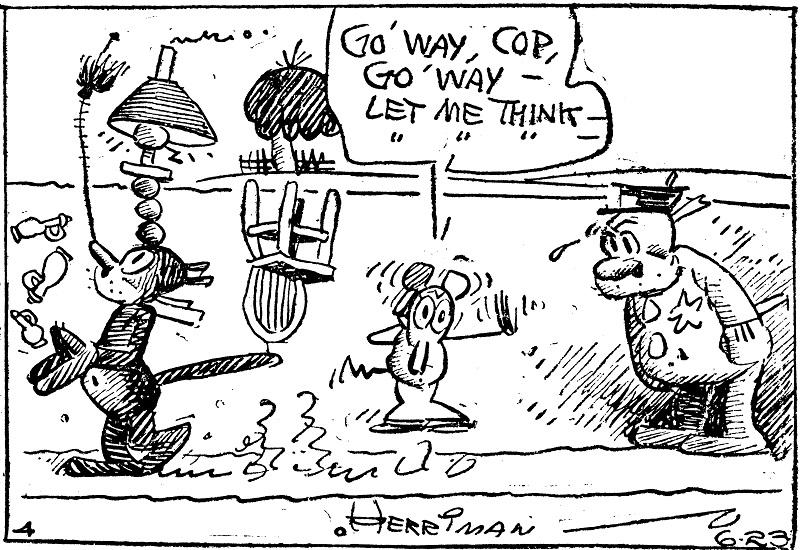
“As a cartoonist, I read Krazy Kat with awe and wonder,” writes Calvin and Hobbes creator Bill Watterson in his introduction to The Komplete Kolor Krazy Kat. The creator of quite possibly the most beloved comic strip of the past thirty years calls Krazy Kat “such a pure and completely realized personal vision that the strip’s inner mechanism is ultimately as unknowable as George Herriman,” the artist who wrote and drew it for its entire three-decade run from 1913 to 1944. “I marvel at how this fanciful world could be so forcefully imagined and brought to paper with such immediacy. THIS is how good a comic strip can be.”
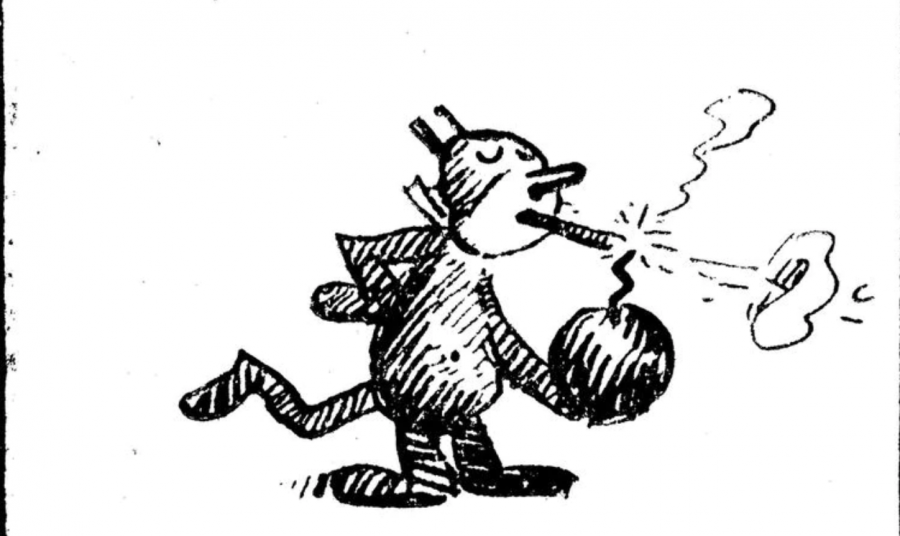
High praise, especially from the hyperbole-resistant Watterson, a sharp-eyed critic of his art form and perceiver of its unrealized potential. “Quirky, individual, and uncompromised, Krazy Kat is one of the very few comic strips that takes full advantage of its medium. There are some things a comic strip can do that no other medium, not even animation, can touch, and Krazy Kat is a virtual essay on comic strip essence.”
The “self-consciously baroque narrations and monologues” show that “words can be funny in themselves”; “the sky turns from black to white to zigzags and plaids simply because, in a comic strip, it CAN”; its surreal Arizona desert setting “is a character in the story, and the strip is ‘about’ that landscape as much as it is about the animals who populate it,” Ignatz Mouse, Offissa Pupp, and the titular Krazy Kat.
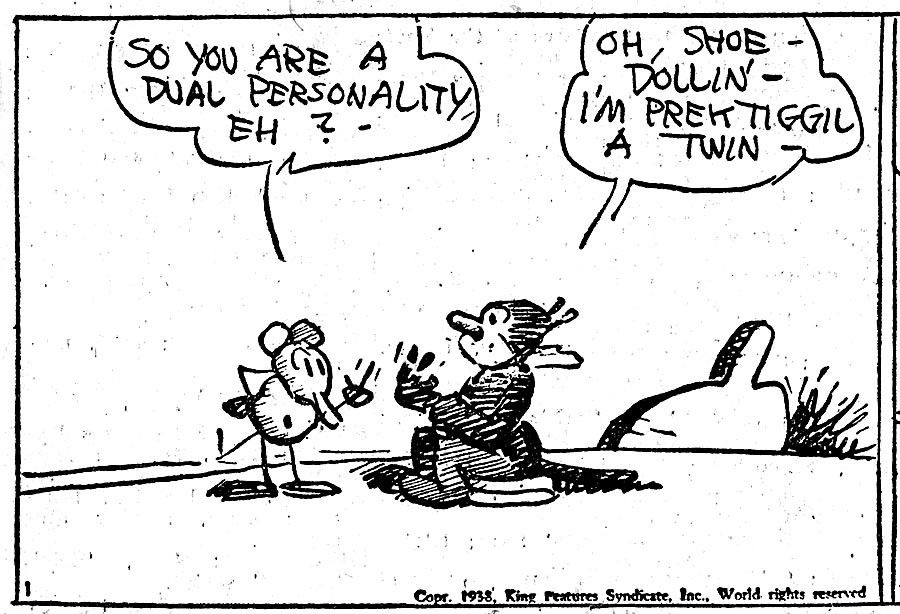
Ignatz Mouse “demonstrates his contempt for Krazy by throwing bricks at her” (though their genders, so modern observers note, were never quite stable), “Krazy reinterprets the bricks as signs of love,” and Offissa Pupp, the desert’s lone lawman, is “obliged by duty (and regard for Krazy) to thwart and punish Ignatz’s ‘sin,’ thereby interfering with a process that’s satisfying to everyone for all the wrong reasons.”
Now readers everywhere can feel that satisfaction for themselves at the web site of Krazy Kat fan Joel Franusic, who has launched a project to find and digitize (using Machine Learning) all of Herriman’s strips that have so far fallen into the public domain. Franusic writes of having got into Krazy Kat in the first place because of the presence of Calvin and Hobbes in his childhood: “I remembered how Bill Watterson referenced Krazy Kat as a big reason why he insisted on getting a larger full color format for his Sunday comic strips.”
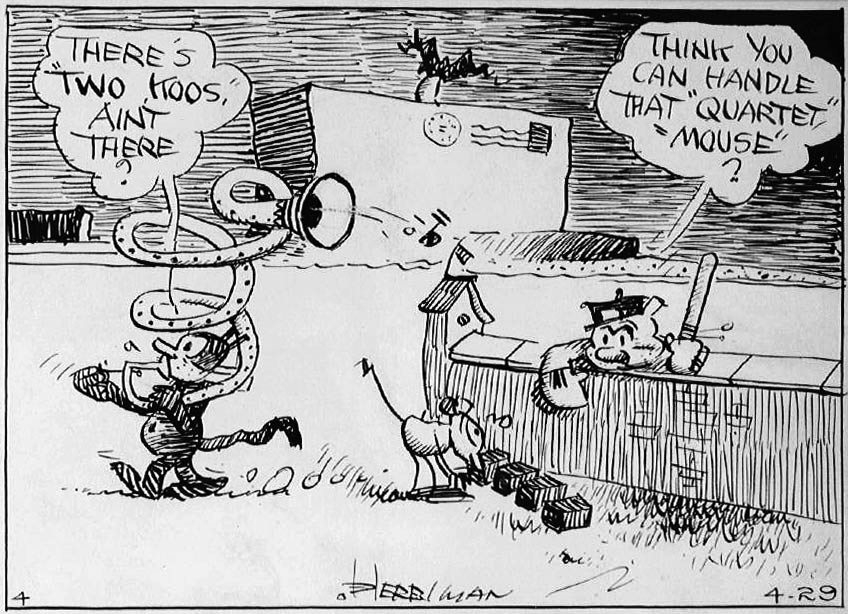
I myself first picked up a Krazy Kat collection as a Calvin and Hobbes-loving elementary schooler, and soon found myself captivated by the sheer density of strangeness in its pages. But read enough of Herriman’s masterwork, and that strangeness takes on a strong meaning that nevertheless differs from reader to reader. “Krazy Kat has been described as a parable of love, a metaphor for democracy, a ‘surrealistic’ poem, unfolding over years and years,” writes Chris Ware, another of the most respected comic-strip artists alive. “It is all of these, but so much more: it is a portrait of America, a self-portrait of Herriman, and, I believe, the first attempt to paint the full range of human consciousness in the language of the comic strip.” And now, 75 years after its conclusion, much more of humanity can enjoy Krazy Kat than ever. Explore digitized scans at Franusic’s web site. Or pick up a copy of the new edition of The Complete Krazy Kat in Color, a color facsimile of the complete pages of Krazy Kat 1935–44.
via BoingBoing
Related Content:
Umberto Eco Explains the Poetic Power of Charles Schulz’s Peanuts
Download 15,000+ Free Golden Age Comics from the Digital Comic Museum
Download Over 22,000 Golden & Silver Age Comic Books from the Comic Book Plus Archive
Based in Seoul, Colin Marshall writes and broadcasts on cities, language, and culture. His projects include the book The Stateless City: a Walk through 21st-Century Los Angeles and the video series The City in Cinema. Follow him on Twitter at @colinmarshall, on Facebook, or on Instagram.
Read More...Watch The Velvet Underground Perform in Rare Color Footage: Scenes from a Vietnam War Protest Concert (1969)
There are many reasons to think of The Velvet Underground forever in black and white: Nico’s Nordic monotone; John Cale and Moe Tucker’s monochromatic drones; Lou Reed’s perpetual invocation of rock and roll’s black and white 50s origins. White Light/White Heat and its stark black-and-white cover; “The Black Angel’s Death Song,” from their debut; pallid, sun-starved faces and a penchant for black sunglasses; an indelible association with Warhol’s black and white Factory scene….
Then there’s literally the fact that we’ve almost aways seen the band filmed and photographed in black and white, until now. “Yes, you read that right,” announces Dangerous Minds, “previously unseen color film of the Velvet Underground has been discovered!” and boy is it groovy.
Always walking an avant-garde line between proto-punk and psychedelic folk/rock, this footage from 1969 seems to catch the band leaning in the latter direction for Dallas Peace Day, a Vietnam War Protest held on the grounds of the Winfrey Point building overlooking White Rock Lake.
“There were likely between 600 and 3,000 people in attendance,” and the performers that day included Lou Rawls and groups like Velvet Dream, Stone Creek, and Bradley & David. “The VU were in town for a week of shows at a Dallas club.… These were the first concerts they ever played in the south. It’s unknown how the group became involved with Dallas Peace Day.” They were a band in transition. Bassist Doug Yule had recently taken over for the departed John Cale. They were leaving behind their Warhol/Nico/Factory days.
The unearthed film here includes some performance footage, at the top. The band plays “I’m Wating for the Man,” “Beginning to the See the Light,” and “I’m Set Free.” There’s also an interview with Sterling Morrison, who talks about the “tone of anarchy” at New York anti-war rallies and the violence in Chicago the previous year. Above, see some silent B‑roll and below, a little more footage, with some unrelated, overdubbed music. All of this film comes courtesy of the G. William Jones Film & Video Collection.
The footage “was uncovered only by chance and the archive doesn’t know the original motives for recording it, or even know how they came to obtain the film.” It’s a side of the band we don’t often see. While hardcore fans may be familiar with the post-John Cale—and post-Lou Reed—years, most people tend to associate The Velvet Underground with black leather and white… um… substances… not paisley and peace rallies.
Related Content:
Hear Lost Acetate Versions of Songs from The Velvet Underground & Nico (1966)
Josh Jones is a writer and musician based in Durham, NC. Follow him at @jdmagness
Read More...The First Museum Dedicated Exclusively to Poster Art Opens Its Doors in the U.S.: Enter the Poster House
How times have changed since our late 80s college days. Undergrads do research online, upload assignments to a server, stream music, download affirmative sexual consent contracts, and turn to Facebook when it’s time to find a ride home for the holidays.
But one aspect of the collegiate lifestyle remains unchanged.
They still festoon their dorm rooms with posters—the actual paper article, affixed to the walls with blue putty, a carefully curated collection of taste and aspiration.
As Cait Munro writes in Refinery 29:
Freshman, already scrambling to find and loudly articulate an identity, can leave the poster sale with two or three plastic tubes housing scrolls that represent the very essence of their new, parent-free, on-campus selves. Posters become an affordable, demonstrable expression of who they are as a person — or, in the tradition of people eager to leave behind their hometown selves, who they want to be.
Legions of style blogs have decreed that these posters should be given the heave-ho along with the plastic milk crate shelving, come graduation.
Personally, I would rather gaze upon the tattered reproduction of the first painting that spoke to me at the Art Institute of Chicago than anything the design experts float as an acceptably grown up alternative.
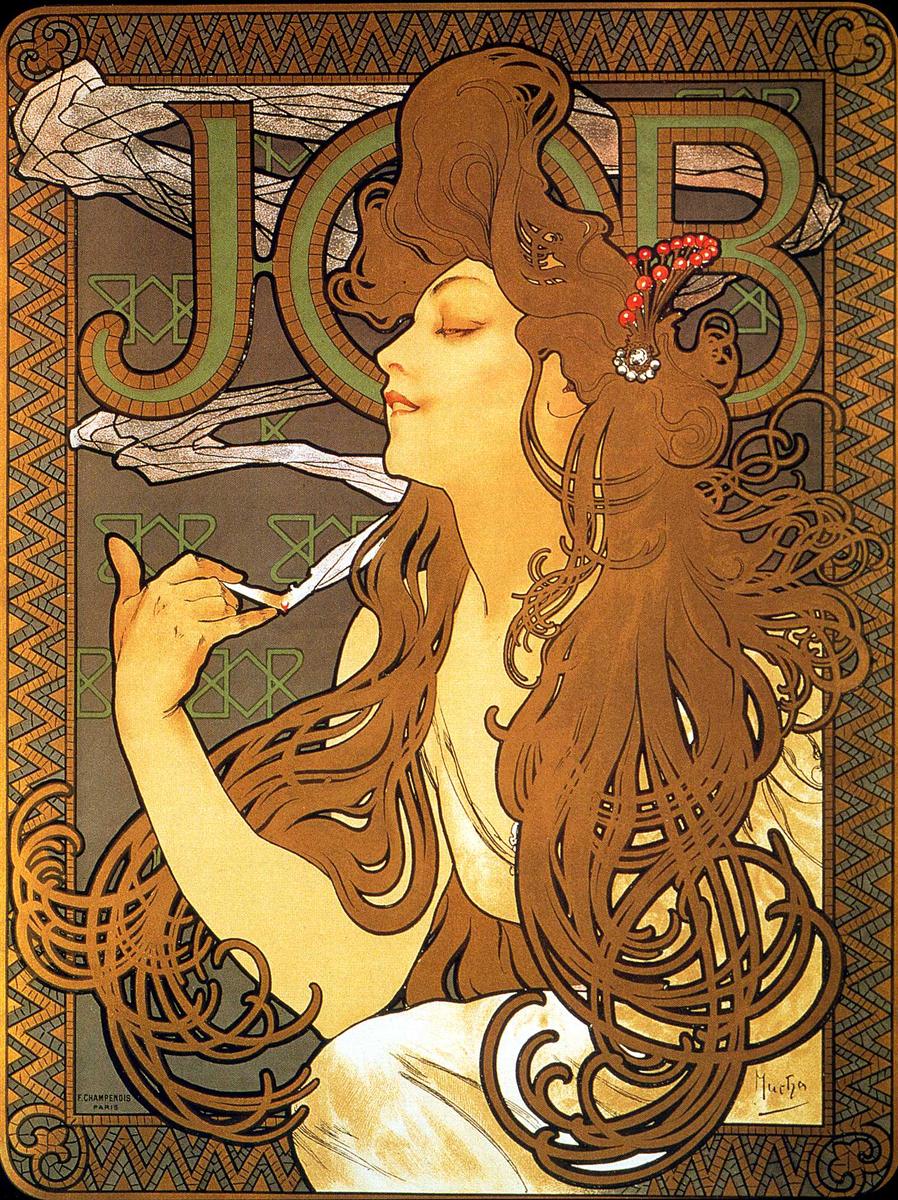
Is Alphonse Mucha’s Byzantine 1896 ad for Job rolling papers somehow unworthy because legions of dewy eyed undergrads have given it a perennial place of unframed honor?
The driving forces behind the newly opened Poster House in New York City would say no. The first American museum dedicated exclusively to poster art, its curators cast a wide net through the form’s 160 year history, whether the end goal of the work was war bond sales, public health education, or straight-up box office sales. As the Poster House writes:
For a poster to succeed, it must communicate. By combining the power of images and words, posters speak to audiences quickly and persuasively. Blending design, advertising, and art, posters clearly reflect the place and time in which they were made.
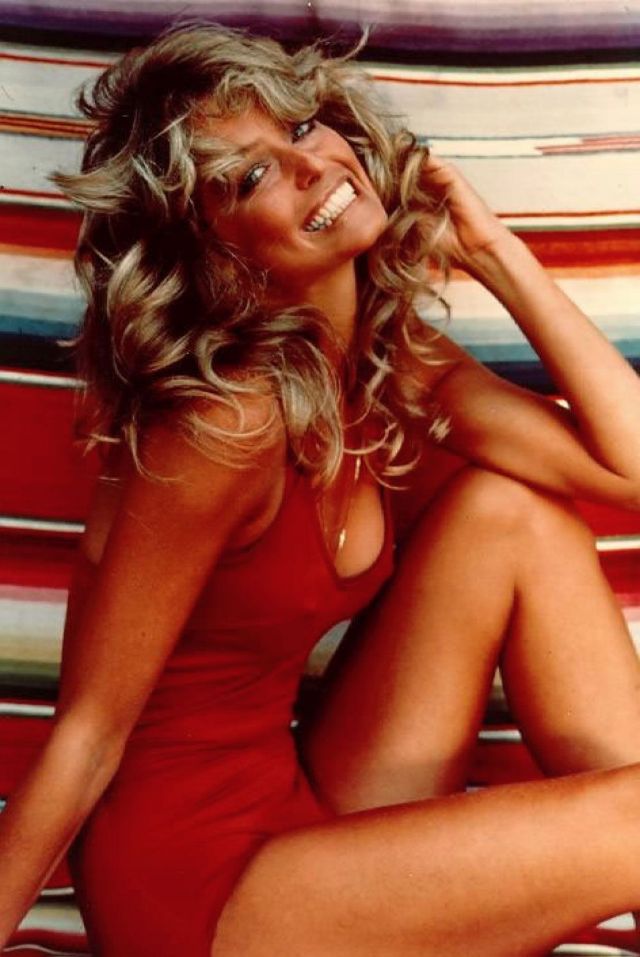
What did the best-selling poster of actress Farrah Fawcett in a red tank suit say to—and about—teenage boys in 1976? What did it say about American values and gender norms in that Bicentennial year? Why no posters of Betsy Ross?
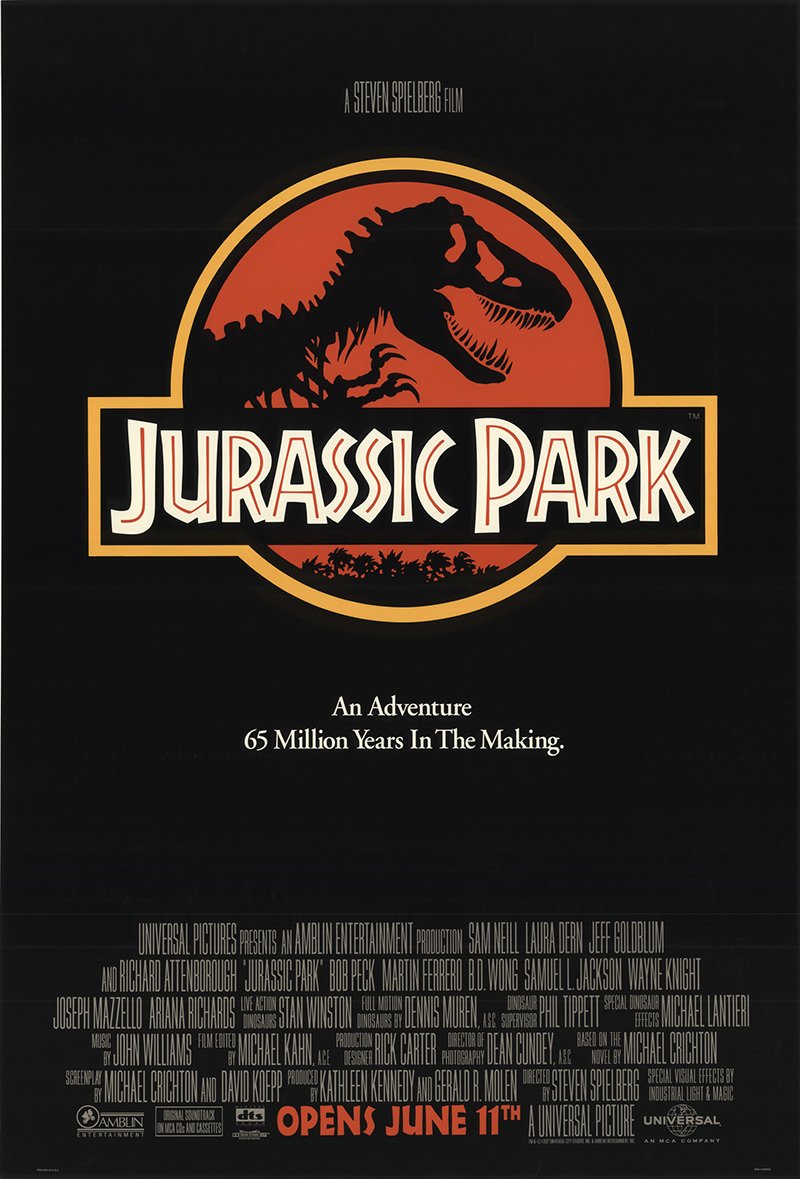
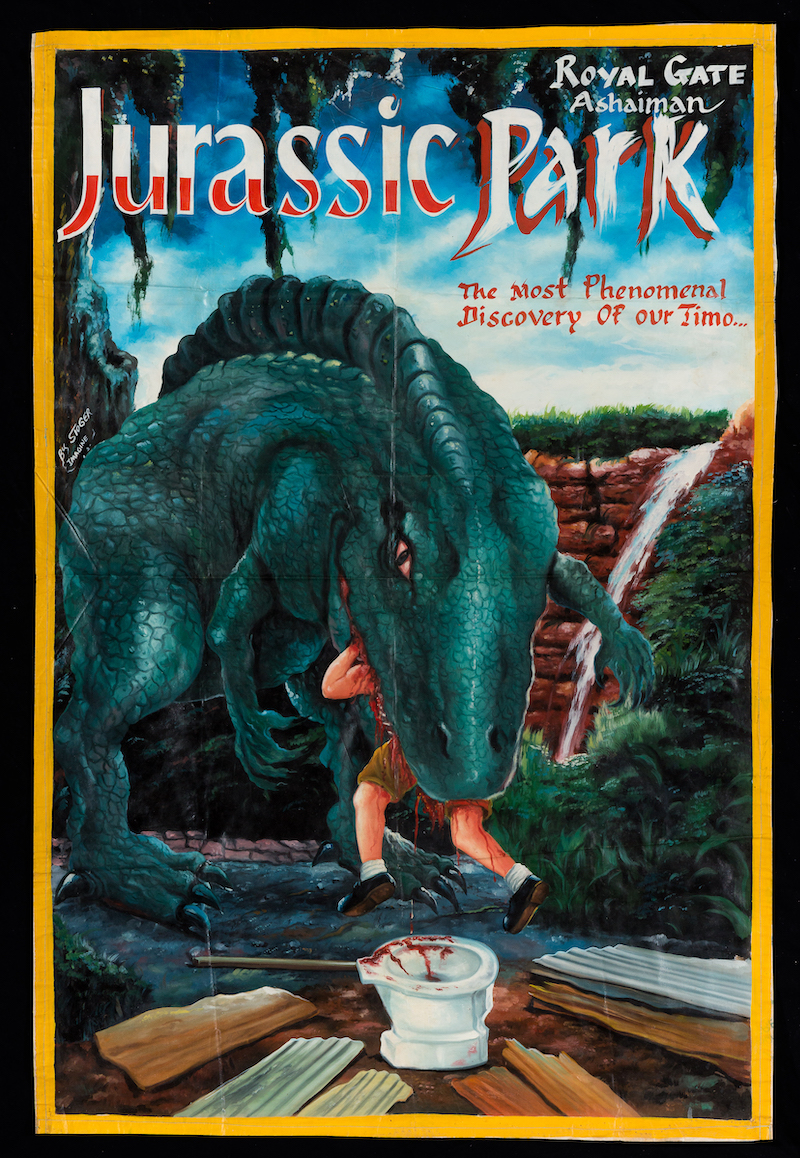
How does the official poster for Jurassic Park, above, compare to the hand-painted, presumably unauthorized image used to market it to audiences in Ghana?
(Endless gratitude to illustrator and monster movie fan Aeron Alfrey for bringing this and other Ghanian spins on American film releases to our attention.)
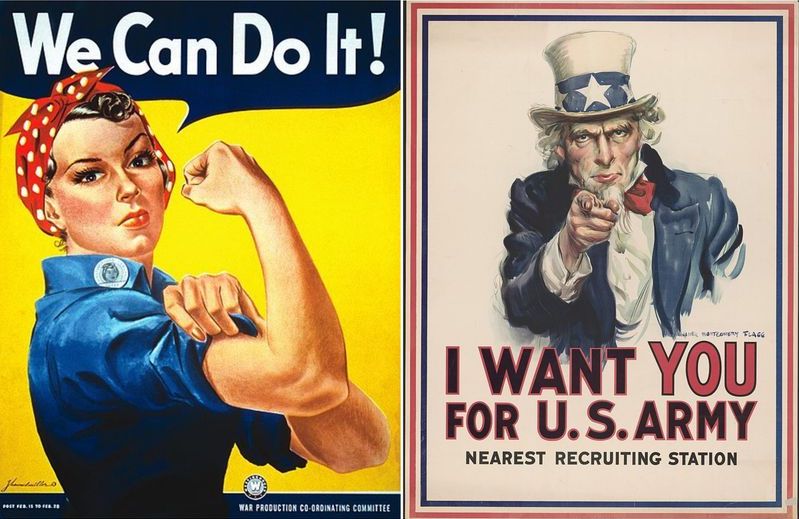
Some posters have remarkable staying power, reappearing in a number of guises. Witness Rosie the Riveter and James Montgomery Flagg’s Uncle Sam-themed WWI recruitment poster, to say nothing of the Barack Obama “Hope” poster by Shepard Fairey, the poster that launched a thousand parodies, mostly digital, but even so.

To learn more about visiting Poster House, its inaugural Alphonse Mucha exhibit and upcoming events such as Drink and Draw, click here.
via Hyperallergic
Related Content:
The Film Posters of the Russian Avant-Garde
Chilling and Surreal Propaganda Posters from the NSA Are Now Declassified and Put Online
Vintage 1930s Japanese Posters Artistically Market the Wonders of Travel
100 Greatest Posters of Film Noir
Ayun Halliday is an author, illustrator, theater maker and Chief Primatologist of the East Village Inkyzine. Follow her @AyunHalliday.
Read More...
A Quick Six Minute Journey Through Modern Art: How You Get from Manet’s 1862 Painting, “The Luncheon on the Grass,” to Jackson Pollock 1950s Drip Paintings
Even those not intimately familiar with Jackson Pollock’s work know to file him under a category called “abstract expressionism,” but somehow his massive paintings — and the layer upon layer of drips that constitute their visual and textural surface — still seem to slip categorization. Some of the painter’s fans would surely claim that, more than sixty years after his death, he does indeed still stand apart. But how far apart, really? Evan Puschak, better known as the Nerdwriter, takes on that question in the video essay above, “How Art Arrived at Jackson Pollock.”
Puschak considers a particular Pollock painting from 1950, “the only abstract work of art that has ever floored me in person as soon as my eyes caught it,” and asks why appreciation comes so much more easily for him with it than with other non-figurative works of art. “I don’t think the power of this Pollock depends on its place in the history of art.” he says. “Its style, its use of color, its hyperactivity are intrinsic qualities, but I do think the history of art has a lot to say.” In many ways, “they’re the culmination of something that has a foggy beginning about a century or two before, with the gradual end of church and noble patronage of the arts and the dawn of painters painting what was important to them.”
This line of thinking sets Puschak in search of the beginning of modern art itself, which some find in the early 1860s in the highly figurative work of Edouard Manet, with its “flattened” imagery and “scandalous subject matter.” Monet and his colleagues brought about the movement known as Impressionism, “concerning themselves not with the objects they see in the world but how the light plays off them.” From then on the degree of abstraction intensifies with each subsequent movement in painting, and by the turn of the 20th century “art has unraveled. Its centuries-long aim of reproducing the physical world in perspective, color and form is rapidly being abandoned.”
The highly compressed six-minute journey that Puschak takes through art history to get him to Pollock’s “drip paintings,” which the artist began creating in the 1940s, also includes stops at post impressionism; the work of Vincent Van Gogh (notably his “ugliest masterpiece” Night Cafe, subject of a previous Nerdwriter analysis); Wassily Kandinsky and Pablo Picasso; Dada and the Surrealist Manifesto, all in the span of less than a hundred years. “A fast-changing world contributed hugely, of course, but beyond that I do believe there’s a drive in us to take things as far as they can go, and the century of modern art is an exhilarating example of that” — and the oeuvre of Pollock himself remains an example of “how irrepressible human creativity can be.”
Related Content:
Jackson Pollock 51: Short Film Captures the Painter Creating Abstract Expressionist Art
Watch Portrait of an Artist: Jackson Pollock, the 1987 Documentary Narrated by Melvyn Bragg
The MoMA Teaches You How to Paint Like Pollock, Rothko, de Kooning & Other Abstract Painters
Dripped: An Animated Tribute to Jackson Pollock’s Signature Painting Technique
Based in Seoul, Colin Marshall writes and broadcasts on cities, language, and culture. His projects include the book The Stateless City: a Walk through 21st-Century Los Angeles and the video series The City in Cinema. Follow him on Twitter at @colinmarshall, on Facebook, or on Instagram.
Read More...The Recorder Played Like You’ve Never Heard it Before: Hear a Stunning Solo from Vivaldi’s Recorder Concerto in C Major
Owing to its simplicity and inexpensiveness, the recorder has become one of the most commonly taught instruments in grade-school music classes. But that very position has also, perhaps, made it a less respected instrument than it could be. We may vividly remember the hours spent fumbling with the holes on the front of our plastic recorders in an attempt to master the basic melodies assigned to us as homework, but did we ever learn anything of the instrument’s long history — or, for that matter, anything of what it can sound like in the hands of a virtuoso instead of those of a frustrated ten-year-old?
The recorder goes back at least as far as the Middle Ages, and with its pastoral associations it remained a popular instrument throughout the Renaissance and Baroque periods. But then came a period of widespread disinterest in the recorder that lasted at least until the 20th century, when musicians started performing pieces with instruments from the same historical periods as the music itself.
Despite the instrument’s going in and out of style, the list of composers who have written for the recorder does boast some formidable names, including Johann Sebastian Bach, George Frideric Handel, Claudio Monteverdi, Henry Purcell, and Antonio Vivaldi, whose Recorder Concerto in C Major you can see performed in the video at the top of the post.
“After a few measures, musician Maurice Steger stepped up to the microphone and with amazing skill, shredded several serious solos on the recorder,” Laughing Squid’s Lori Dorn reports of the spectacle. “Steger rested for a few bars to catch his breath and then start all over again. Simply a wonder to behold.” We also, in the video just above, have Lucie Horsch’s also-virtuosic performance of Vivaldi’s Flautino Concerto in C Major, albeit transposed to G major transposition for soprano recorder. Even among those who learned to despise the recorder in school, there will be some who now can’t get enough. But even if it hasn’t become your favorite instrument, you’ve got to admit that we’re a long way indeed from “Hot Cross Buns.”
via Laughing Squid
Related Content:
14-Year-Old Girl’s Blistering Heavy Metal Performance of Vivaldi
Why We Love Vivaldi’s “Four Seasons”: An Animated Music Lesson
Stream 58 Hours of Free Classical Music Selected to Help You Study, Work, or Simply Relax
The World Concert Hall: Listen To The Best Live Classical Music Concerts for Free
Hear the World’s Oldest Instrument, the “Neanderthal Flute,” Dating Back Over 43,000 Years
Based in Seoul, Colin Marshall writes and broadcasts on cities, language, and culture. His projects include the book The Stateless City: a Walk through 21st-Century Los Angeles and the video series The City in Cinema. Follow him on Twitter at @colinmarshall, on Facebook, or on Instagram.
Read More...Support Us
We're hoping to rely on loyal readers, rather than erratic ads. Please click the Donate button and support Open Culture. You can use Paypal, Venmo, Patreon, even Crypto! We thank you!

About Us

Open Culture scours the web for the best educational media. We find the free courses and audio books you need, the language lessons & educational videos you want, and plenty of enlightenment in between.
Advertise With Us

FREE UPDATES!
GET OUR DAILY EMAIL
Get the best cultural and educational resources on the web curated for you in a daily email. We never spam. Unsubscribe at any time.
FOLLOW ON SOCIAL MEDIA

Open Culture editor Dan Colman scours the web for the best educational media. He finds the free courses and audio books you need, the language lessons & movies you want, and plenty of enlightenment in between.
Advertise With Us

