Andy Warhol Explains Why He Decided to Give Up Painting & Manage the Velvet Underground Instead (1966)
In Good Omens—the six-episode adaptation of Terry Pratchett and Neil Gaiman’s satirical fantasy about the Biblical end of the world—a running joke relies on the viewer’s offhand knowledge of the Velvet Underground’s significance. A refined, rare bookshop-owning angel calls the band “bebop” and has no idea who they are or what they sound like, a forgivable sin in the 70s, but seriously out of touch decades later in the 21st century.
The scheming supernatural agent should probably know that the Lou Reed (and briefly Nico)-fronted, Andy Warhol-managed late-1960s-70s experimental New York art rock band had an outsized influence on human affairs. Bridging a divide no one even knew existed between beat poetry, avant-garde jazz, psychedelic garage rock, doo-wop, and European folk music, the band is anecdotally credited with launching thousands of others—having as much impact, perhaps, on modern rock as Charlie Parker had on modern jazz.
Warhol could not have known any of this when he decided to sponsor and promote the Velvet Underground in 1966. He only managed the band for a year, in what seemed like both a stunt and a performance art project, part of his traveling multimedia show Exploding Plastic Inevitable, which he calls “the biggest discotheque in the world” in the 1966 interview above. Warhol acted, and the band reacted, shaping themselves around his provocations. He projected high-contrast films at them onstage, they put on sunglasses. He pushed deadpan German model and singer Nico on them, they wrote and recorded what some consider the greatest debut album in history.
Warhol couldn’t have known how any of it would pan out, but in hindsight his patronage can seem like a prescient, almost metaphysical, act of cultural subversion—and the work of a guileless savant compelled by vague intuitions and whims. He preferred to give off the latter impression, then let critics infer the former. Warhol explains that he has abandoned painting and started managing the band because “I hate objects, and I hate to go to museums and see pictures of the world, because they look so important and they don’t really mean anything.”
Few people doubt the management of his public persona was at least partially calculated. But so much of it clearly wasn’t—as evidenced by his own exhaustive recording of every detail of his life. Despite the amount of calculation ascribed to him, a quality the interviewer awkwardly tries to ask him about, he seems to have been stupefied about his own motivations much of the time, beyond the fact that he strongly liked and disliked certain simple things—Elvis, Campbell’s Soup, obscure blonde femme fatales. At other times, Warhol issued aphorisms as cryptic and profound as an ancient sage or post-war critical theorist.
Was the Velvet Underground more like Warhol’s uncomplicated love of cheeseburgers and Batman or more like his sophisticated deconstruction of film, media, and fashion, or are these not mutually exclusive ways of looking at his work? The question may not really concern music historians, for whom Warhol’s early influence was formative, but maybe musically marginal. But if we think of him as a motive force behind the band’s look and early sound—a kind of conscious creative reagent—we might be curious about what he meant by it, if anything.
Related Content:
The Big Ideas Behind Andy Warhol’s Art, and How They Can Help Us Build a Better World
Three “Anti-Films” by Andy Warhol: Sleep, Eat & Kiss
Josh Jones is a writer and musician based in Durham, NC. Follow him at @jdmagness
Read More...The Story of Pure Hell, the “First Black Punk Band” That Emerged in the 70s, Then Disappeared for Decades
In the mid-seventies, many people felt excluded from and disdained by the mainstream of rock and roll, which had largely come to represent itself as a straight white boys and girls club full of superrich rock stars. The narrow image fostered attitudes of implicit racism and homophobia that exploded in the 1979 “Disco Sucks” backlash. This despite the fact that rock and roll began as interracial music built on the flamboyantly ambiguous sexuality of Little Richard, the racy short stories of Chuck Berry, the grooves of Chubby Checker, the edgy beats of Bo Diddley, and a great many unsung black female performers.
Now we tend to remember 70s rock differently, not so much as the era of KISS or the Eagles, but as the transgressive time of David Bowie, Iggy Pop, Lou Reed, and Freddie Mercury, of the huge commercial and creative triumphs of women-led bands like Fleetwood Mac and Heart, of punk and new wave outsiders setting the template for four decades of alternative rock: The Ramones, Patti Smith, the Sex Pistols, Blondie, The Clash, Joy Division, Talking Heads, Gary Numan, Kraftwerk…. We remember it, still, as a time when rock was mostly white, and when black artists mostly recorded disco, funk, soul, and R&B.
The record industry and radio markets had segregated, and it would stay that way into the 80s, though jazz artists like Miles Davis made serious inroads into rock experimentation, bands like Parliament/Funkadelic released hard rock psychedelia, Prince channeled both Little Richard and Chuck Berry, and early punks like Detroit’s Death and Philadelphia’s Pure Hell made groundbreaking punk and metal. The former escaped critical notice, but the latter became famous, then disappeared from rock history for decades.
Death, the visionary trio of brothers who were recently rediscovered and celebrated, never really made it in their time outside of a small circle. Pure Hell, on the other hand, were an integral part of the New York punk scene and stars in Europe, and have been forgotten by most official punk histories. They “lived with the New York Dolls and played with Sid Vicious,” writes Cassidy George at Dazed, “but they’ve been largely written out of cultural history.” They are sometimes written back in, just as, to their dismay, they were promoted: as the “first black punk band.” But there’s far more to their history than that.
“I don’t want to be remembered just because we were black,” says singer Kenny “Stinker” Gordon. “I want to be remembered for being a part of the first tier of punk in the 70s.” He is not exaggerating. New York Dolls guitarist Johnny Thunders promoted the band, leading to gigs as Max’s Kansas City and a feature in Andy Warhol’s Interview magazine, “marking their ‘place’ in a scene of cultural influencers.” They appeared in a 1978 issue of Melody Maker during their UK tour, in a photo with Sid Vicious, who wears his swastika t‑shirt and padlock and chain. (Gordon also wore a swastika t‑shirt onstage.) Just one of many second-page write-ups in Melody Maker, NME, and the European press.
All of the hype surrounding the band is part of the historical record, for those who look through backpages and archives, but their music has mostly gone unheard for over a generation, largely because their album Noise Addiction only came out in 2006. After they released their first single in ‘78, then refused to change their sound for a record deal, their manager Curtis Knight absconded with the master tapes and refused to release them. Listen to their debut single, a cover of “These Boots Are Made for Walking,” above. Melody Maker called it, with a wink, “the former Nancy Sinatra hit.” The song reached number four on the UK alternative charts.
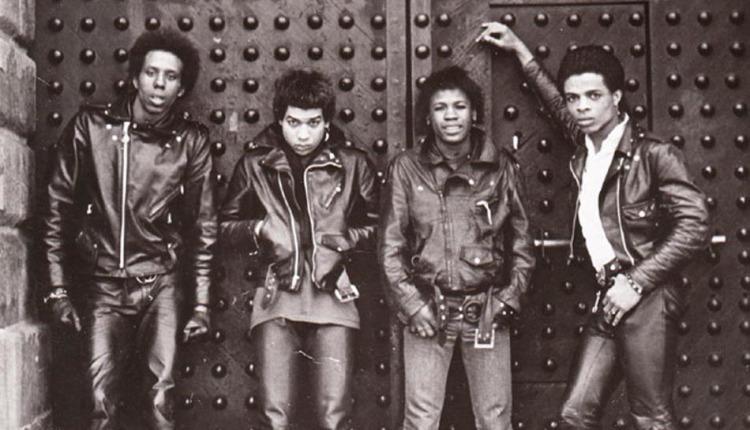
Pure Hell describe their journey through the mid-seventies New York punk scene in the montage of interview clips at the top, scored by wicked, riff-laden recordings of their songs. The story began with four friends from a tough neighborhood in West Philadelphia. “We dressed in drag and wore wigs, basically daring people to bother us. People in the neighborhood would say, ‘Don’t go into houses with those guys, you may not come out!’” They were pressured to join a gang, says bassist Lenny “Steel” Boles, but refused. They packed up a U‑Haul and moved into the Chelsea Hotel, then played their first show across the street at Mother’s.
Legendary stories about the band abound. (They played Sid Vicious’ last appearance onstage and were caught up in the media circus surrounding Nancy Spungen’s death). What’s most interesting about them is the music and their lasting influence, despite what Boles describes as being “snubbed” by record labels unless they agreed to “do this Motown thing, saying like, ‘You guys are black so you’ve gotta do something that’s danceable.” After losing their manager and their masters, they settled in L.A., where they played with the Germs and the Cramps but “lost their momentum,” writes George.
“It was totally over by 1980,” says Gordon. All the same, their heavy proto-metal sound, drawing from reggae and Hendrix as much as from Bowie and Nancy Sinatra, sparked the admiration of many emerging punk bands, including Washington, DC legends Bad Brains, who acknowledge the debt their furious reggae/metal thrash owes to Pure Hell. Bad Brains broke color barriers in New York a few years later, and got most of the credit for it, largely because Pure Hell left behind nothing but a mysterious single and a “rumor,” says Henry Rollins, “that they had made an album and that it was sitting in a closet.”
After the tapes resurfaced, nearly everyone who heard the record became an instant fan, including Rollins. “If the album had come out when they made it, that would have been a game changer,” he says. “I believe [it] would have had a tremendous impact. It’s one of those missed opportunity stories.” But it is also a found opportunity story. They are now getting recognition for their music and historical role. In 2012 they reformed to play their first show since 1979, with Rancid, Buzzcocks, Public Image Ltd, and Social Distortion. Pure Hell will find their way back into the story of New York punk, and it will be a more interesting story for their rediscovery.
Related Content:
New Documentary Brings You Inside Africa’s Little-Known Punk Rock Scene
Four Female Punk Bands That Changed Women’s Role in Rock
Josh Jones is a writer and musician based in Durham, NC. Follow him at @jdmagness
Read More...How Led Zeppelin’s “Stairway to Heaven” Recreates the Epic Hero’s Journey Described by Joseph Campbell
Wayne’s World kind of ruined “Stairway to Heaven” for me. Yes, it’s been 27 years, but I still can’t help but think of Wayne turning to the camera with his stoner grin, saying “Denied!” when the guitar store clerk points out a “No Stairway to Heaven” sign. It was not a song I took particularly seriously, but I respected the fact that it took itself so seriously… and threaded my way out of the room if someone picked up a guitar, earnestly cocked an ear, and played those gentle opening notes.
Now I giggle even when I hear the magisterial original intro. This is not the fault of Zeppelin but of the many who approach the Zeppelin temple of rock grandiosity unprepared, attempting riffs that only Jimmy Page could pull off with authority. At least the joke gave us a way to talk about the phenomenon: in lesser hands than Led Zeppelin’s “Stairway” can sound… well, a bit ridiculous (with apologies to Dolly Parton.) Although accused (and acquitted) of ripping off the opening notes to Spirit’s instrumental “Taurus,” the song is all Zeppelin in every possible way.
“Stairway” is a representative sampler pack of the band’s signature moves: mixing folk rock and heavy metal with a Delta blues heart; exploding in thunderheads of John Bonham drum fills and a world-famous Page solo; Plant screaming cryptic lyrics that vaguely reference Tarot, Tolkien, English folk traditions and “a bustle in your hedgerow”; John Paul Jones’ wildly underrated multi-instrumental genius; bizarre charges of Satanic messages encoded backwards in the record…. (bringing to mind another Wayne’s World actor’s character.)
“Stairway… crystallized the essence of the band,” said Page later. “It had everything there and showed us at our best. It was a milestone.” It set a very high bar for big, emotional rock songs. “All epic anthems must measure themselves against ‘Stairway to Heaven,’” writes Rolling Stone. It is “epic in every sense of the word,” says the Polyphonic video at the top, including the literary sense. It can “make you feel like you’re part of a different time, part of a different world. It can make you feel like you’re part of a story.”
That story? “One of the greatest narrative structures in human history,” the Hero’s Journey, as so famously elaborated by Joseph Campbell in The Hero With a Thousand Faces—an archetypal mythological arc that has “permeated stories for as long as humans have told them.” Not only do Robert Plant’s mystical lyrics reflect this ancient narrative, but the song’s composition also enacts it, building stage by stage, from questioning to questing to battling to returning with the wisdom of how “to be a rock and not to roll.”
The song’s almost classical structure is, of course, no accident, but it is also no individual achievement. Hear the story of its composition, and why it has been so influential, despite the jokes at the expense of those it influenced, in the Polyphonic video at the top and straight from Jimmy Page himself in the interview above.
Out of all of Zeppelin’s many epic journeys, “Stairway” best represents “the reason,” as cultural critic Steven Hyden writes, “why that band endures… the mythology, that Joseph Campbell idea of an epic journey into the wild that Zeppelin’s music represents, the sense that when you listen to this band, you feel like you’re plugging into something bigger and more profound than a band.” Or that the band is opening a doorway to something bigger and more profound than themselves.
Related Content:
48 Hours of Joseph Campbell Lectures Free Online: The Power of Myth & Storytelling
Jimmy Page Describes the Creation of Led Zeppelin’s “Whole Lotta Love”
What Makes John Bonham Such a Good Drummer? A New Video Essay Breaks Down His Inimitable Style
Josh Jones is a writer and musician based in Durham, NC. Follow him at @jdmagness
Read More...When The New York Times Got Duped into Publishing “The Lexicon of Grunge” in 1992–Words Like “Lamestain,” “Wack Slacks,” “Harsh Realm” & More
What if everything you thought you knew about grunge was a lie? Maybe you’ve suspected all along! But even if you were there, or somewhere, in that time of abysmally low internet literacy and connectivity, when every traditional media outlet was flannel, floppy hair, mopey half-protests, festivals, Seattle.… When you could save $6-$13 on “women’s grunge” and “$5 on kids’ grunge too!” at major department store chains…
But we may still remember grunge as a movement—with charismatic leaders and tragic heroes. A movement to reclaim serious, heavy, emotional hair rock from the profoundly unserious hair bands of the 80s. The first wave of Pacific Northwest bands to emerge with Nirvana, Soundgarden, and Pearl Jam were earnest and well-meaning and “primal,” says Bruce Pavitt, co-founder of the legendary Seattle record label Sub Pop.
Sub Pop midwifed the scene by signing so many of the bands that made it big, cultivating the sound and look of dirty, angry backwoodsmen with guitars. “Grunge Made Blue-Collar Culture Cool,” wrote Steven Kurutz in The New York Times Style Section just a few days ago, an implicit acknowledgment that the mostly-white and largely male scene sold a particular image of blue-collar that resonated, says Pavitt, because it represented an “ ‘American archetype.”
Pavitt and co-founder Jonathan Poneman were diehard fans of the music but they were no starry-eyed idealists—they understood exactly how to sell the region’s quirks to a national and international media. “It could have happened anywhere,” Poneman has said, “but there was a lucky set of coincidences. [Photographer] Charles Peterson was here to document the scene, [producer] Jack Endino was here to record the scene. Bruce and I were here to exploit the scene.”
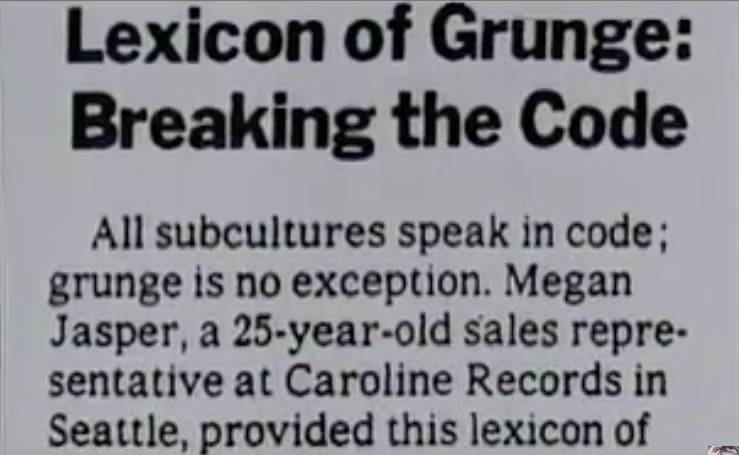
But what was the scene? Was it “Grunge”? What is “Grunge”? How do you pronounce “Grunge”? What do “Grunge” people eat? After being peppered with one too many questions when the shockwave of Nirvana’s major label debut Nevermind hit in 1992, Poneman referred a reporter to a former Sub Pop employee, Megan Jasper, then working as a sales rep for Caroline records. The reporter, Rick Marin, was calling from The New York Times’ Style Section, asking for help compiling a grunge lexicon. What kinds of things do “Grunge” people say?
“By then,” writes Alan Siegel at The Ringer, “only outsiders earnestly used the term ‘grunge’ as a noun.” It was, says Charles Cross, former editor of alternative paper The Rocket, “an overhyped, inflated word that doesn’t have actual meaning in Seattle.” As for grunge slang, such a thing “didn’t exist.” The only thing to do, Jasper decided, was “react by trying to make fun of it,” she says. She had done the very same thing months earlier, when British magazine Sky made the same request. “I gave them a bunch of fake shit.”
As she says in the interview clip at the top, she asked Marin to toss out normal words and she would give him “grunge” equivalents. “I kept escalating the craziness of the translations because anyone in their right mind would go, ‘Oh, come on, this is bullshit.’… but it never happened because he was concentrating so hard on getting the information right.” Thus, the grunge lexicon below, published in The New York Times in 1992. (“All subcultures speak in code,” goes the caption. This one would be appearing in malls nationwide.)
- bloated, big bag of bloatation – drunk
- bound-and-hagged – staying home on Friday or Saturday night
- cob nobbler – loser
- dish – desirable guy
- fuzz – heavy wool sweaters
- harsh realm – bummer
- kickers – heavy boots
- lamestain – uncool person
- plats – platform shoes
- rock on – a happy goodbye
- score – great
- swingin’ on the flippity-flop – hanging out
- tom-tom club – uncool outsiders
- wack slacks – old ripped jeans
It’s unlikely Marin ever traveled to Seattle and tried to bond with fellow kids, or he would not have published Jasper’s hoax glossary in an article otherwise critical of the mainstreaming of grunge. Marin compared the phenomenon to “the mass-marketing of disco, punk and hip-hop. Now with the grunging of America, it’s happening again. Pop will eat itself, the axiom goes.” It’s a thorough, well-sourced piece that quotes many of the scene’s founders, including Poneman, never suspecting they might be having a laugh.
The fake news grunge lexicon was a huge hit in Seattle, where Jasper was celebrated by her friends and family. “I got a very nice pat on the back,” she says. People clipped the lexicon to their shirts at shows. Indie label C/Z records then printed t‑shirts. “Lamestain” appeared on one. “Harsh Realm” on another. Mudhoney spread around Jasper’s slang in a Melody Maker interview with straight faces. It should have been debunked immediately “but this was 1992,” writes Siegel, “Snopes wasn’t around yet. Hell, The New York Times was still four years away from launching a website.”
Then, writer and reporter Thomas Frank called Jasper and asked, “there’s no way this is real, right?” Immediately, she responded, “Of course it’s not real.” Frank published the scoop in 1993; the Times smeared him as a hoaxer to discredit the revelation. The Baffler faxed the Times this note: “When The Newspaper of Record goes searching for the Next Big Thing and the Next Big Thing piddles on its leg, we think that’s funny.” These days, we might expect a Twitter war.
No one Siegel interviews seems to have been particularly upset about the whole thing. Marin’s “eyebrow is totally raised” throughout his piece, says his former editor Penelope Green. (Marin himself declined to be interviewed.) But the story has far less to do with one credulous reporter working a deadline and more to do with his argument—grunge had been rapidly packaged and sold, and by The Times, no less! But maybe its image was sort of a joke to begin with, one that now gets such straight-faced, reverent, sealed-behind-glass-cases treatment that you have to laugh.
Related Content:
The Power of Eddie Vedder’s Voice: Hear Isolated Vocal Tracks from Three Classic Pearl Jam Songs
A Massive 800-Track Playlist of 90s Indie & Alternative Music, in Chronological Order
Josh Jones is a writer and musician based in Durham, NC. Follow him at @jdmagness
Read More...When Dracula Author Bram Stoker Wrote a Gushing Fan Letter to Walt Whitman (1870)
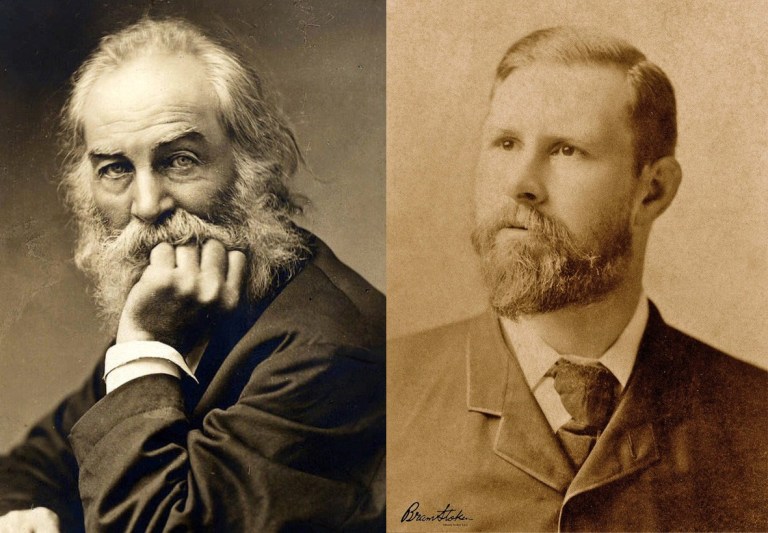
Every artist starts out as a fan, and in general we see the marks of early fandom on their mature work. The best, after all—as figures from Igor Stravinsky to William Faulkner have remarked—steal without compunction, taking what they like from their heroes and making it their own. But what exactly, we might wonder, did Dracula author Bram Stoker steal from his literary hero, Walt Whitman? I leave it to you to read the 1897 Gothic novel that spawned innumerable undead franchises and fandoms next to Whitman’s Leaves of Grass, the book that most inspired Stoker when it made its British debut in 1868.
First published in 1855, then rewritten over the rest of Whitman’s life, the book of poetry boldly celebrated the same pleasure and sensuality that Stoker’s novel made so dangerous. But Dracula was the work of a 50-year old writer. When Stoker first read Whitman, he was only 22, wide-eyed and romantic, and “grown from a sickly boy into a brawny athlete,” writes Meredith Hindley at the National Endowment for the Humanities magazine.
Whitman—himself a champion of robust masculine health (he once penned a manual called “Manly Health & Training”)—so appealed to the young Irish writer’s deep sensibilities that he wrote the older poet a gushing letter two years later in 1870.
Stoker’s fan letter certainly shows the Whitmanian influence, “a long stream of sentiment cascading through various emotions,” as Brain Pickings’ Maria Popova describes it, including “surging confidence bordering on hubris, delicate self-doubt, absolute artist-to-artist adoration.” Whitman, flattered and charmed, wrote a reply, but only after four years, during which Stoker sat on his letter, ashamed to mail it. “For four years, it haunted his desk, part muse and part goblin.” When he finally gathered the courage in 1876 to rewrite the emotional letter and put it in the mail, he was rewarded with the kind of praise that must have absolutely thrilled him.
“You did so well to write to me,” Whitman replied, “so unconventionally, so fresh, so manly, and affectionately too.” Thus began a literary friendship that lasted until Whitman’s death in 1892 and seems to have been as welcome to Whitman as to his biggest fan. A stroke had nearly incapacitated the poet in 1873 and sapped his health and strength for the last two decades of his life, leaving him, as he wrote, with a physique “entirely shatter’d—doubtless permanently—from paralysis and other ailments.” But “I am up and dress’d,” he added, “and get out every day a little, live here quite lonesome, but hearty, and good spirits.”
One also wonders if Stoker would have received such a warm response if he had mailed his original letter unchanged. The “previously unsent effusion,” notes Popova, “opens with an abrupt directness unguarded even by a form of address.” Put another way, it’s blunt, melodramatic, and overly familiar to the point of rudeness: “If you are the man I take you to be,” he begins, “you will like to get this letter. If you are not I don’t care whether you like it or not and only ask that you put it in to the fire without reading any farther.” Contrast this with the revised communication, which begins with the respectful salutation, “My dear Mr. Whitman,” and continues in relatively formal, though still highly spirited, vein.
Stoker had mellowed and matured, but he never left behind his adoration for Whitman and Leaves of Grass. When he eloquently sums up the effect reading the book and its original 1855 preface had on him—he echoes the feelings of millions of fans throughout the ages who have found a voice that speaks to them from far away of feelings they know intimately but cannot express at home:
Be assured of this Walt Whitman—that a man of less than half your own age, reared a conservative in a conservative country, and who has always heard your name cried down by the great mass of people who mention it, here felt his heat leap towards you across the Atlantic and his soul swelling at the words or rather the thoughts.
Read Stoker’s original and revised letters and Whitman’s brief, touching response at Brain Pickings.
Related Content:
Mark Twain Writes a Rapturous Letter to Walt Whitman on the Poet’s 70th Birthday (1889)
Horror Legend Christopher Lee Reads Bram Stoker’s Dracula
Josh Jones is a writer and musician based in Durham, NC. Follow him at @jdmagness
Read More...Learn Philosophy with a Wealth of Free Courses, Podcasts and YouTube Videos
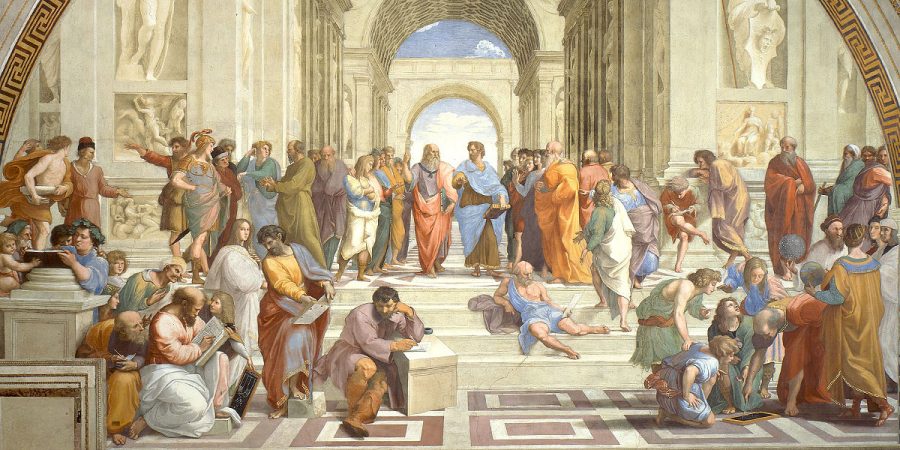
Used to be, a few thousand years ago, if you wanted to learn philosophy, you’d hang out in the agora, the public space in ancient Greece whose name turned into verbs meaning both “to shop” and “to speak in public.” Politics and metaphysics mingled freely with commerce. If a Socrates-like sage took a liking to you, you might follow him around. If not, you might pay a sophist—a word meaning wise teacher before it became a term of abuse that Plato lobbed at rivals who charged for their services. Only certain people had the means and leisure for these pursuits. Nonetheless, philosophy was a public activity, not one sequestered in libraries and seminar rooms.
Even though philosophy moved indoors—to monasteries, colleges, and the libraries of aristocrats—it did not stay cooped up for long. With the modern age arrived new public squares, centered around coffeehouses where all sorts of people gathered, rubbed elbows, formed discussion groups. Philosophy may not have been the public spectacle it seemed to have been in antiquity, but neoclassical thinkers tried to recreate its character of free and open inquiry in public spaces.
Widespread literacy and publishing brought philosophy to the masses in new ways. Philosophical works trickled down in affordable editions to the intellectually curious, who might read and discuss them with like-minded laypeople. But philosophy also became a professional discipline, governed by associations, conferences, journals, and arcane vocabularies. Outside of France, philosophers rarely acted as public intellectuals addressing public issues. They were academics whose primary audiences were other academics.
The culture suffered immensely, one might argue, in the withdrawal of philosophy from public life.
The broad outline above does not pretend to be a history of philosophy, but rather a sketch of some of the ways Western culture has engaged with philosophy, treating it as a public good and resource, or a domain of specialists and an activity divorced from ordinary life. Unfortunately for us in the 21st century, dreams of a digital agora have collapsed in the dystopian surveillance schemes of social media and the toxic sludge of comments sections. But the internet has also, in a way, returned philosophy to the public square.
Philosophers can once again share knowledge freely and openly, and anyone with access can stream and download hundreds of lessons, courses, entertaining explainers, interviews, podcasts, and more. We have featured many of these resources over the years in hopes that more people will discover the art of thinking deeply and critically. Today, we gather them in a master list, below.
Learn the in-depth history of philosophy from Peter Adamson’s acclaimed series The History of Philosophy… Without Any Gaps; listen in on roundtable discussions on famous thinkers and theories with the Partially Examined Life podcast, or “repave the Agora with the rubble of the Ivory Tower!” with the accessible, comprehensive philosophy videos of Carneades. These are but a few of the many quality resources you’ll find below. Technology may never recreate the early atmosphere of public philosophy—for that you’ll need to get out and mingle. But it can deliver more philosophy than anyone has ever had before, literally right into the palms of our hands.
Courses
187 Free Philosophy Courses: In a neat, handy list, we’ve amassed a collection of free philosophy courses recorded at great universities. Pretty much every facet of philosophy gets covered here.
YouTube
Wireless Philosophy: Learn about philosophy with professors from Yale, Stanford, Oxford, MIT, and more. 130+ animated videos introduce people to the practice of philosophy. The videos are free, entertaining, interesting and accessible to people with no background in the subject.
School of Life: This collection of 35 animated videos offers an introduction to major Western philosophers—Wittgenstein, Foucault, Camus and more. The videos were made by Alain de Botton’s School of Life.
Gregory Sadler’s Philosophy Videos: After a decade in traditional academic positions, Gregory Sadler started bringing philosophy into practice, making complex classic philosophical ideas accessible for a wide audience of professionals, students, and life-long learners. His YouTube channel includes extensive lecture series on Kierkegaard, Sartre, Hegel and more.
A History of Philosophy in 81 Video Lectures: Watch 81 video lectures tracing the history of philosophy moving from Ancient Greece to modern times. Arthur Holmes presented this influential course at Wheaton College for decades and now it’s online for you.
Carneades: Repave the Agora with the rubble of the Ivory Tower! Put your beliefs to the test! Learn something about philosophy! Doubt something you thought you knew before. Find on this channel 400 videos on the subjects of philosophy and skepticism.
What the Theory?: This collection provides short introductions to theories and theoretical approaches in cultural studies and the wider humanities. Covers semiotics, phenomenology, postmodernism, marxist literary criticism, and much more.
Crash Course Philosophy: In 46 episodes, Hank Green will teach you philosophy. This course is based on an introductory Western philosophy college level curriculum. By the end of the course, you will be able to examine topics like the self, ethics, religion, language, art, death, politics, and knowledge. And also craft arguments, apply deductive and inductive reasoning, and identify fallacies.
Podcasts:
Partially Examined Life: Philosophy, philosophers and philosophical texts. This podcast features an informal roundtable discussion, with each episode loosely focused on a short reading that introduces at least one “big” philosophical question, concern, or idea. Recent episodes have focused on Nietzsche, Sartre and Aldous Huxley, and featured Francis Fukuyama as a guest.
Hi-Phi-Nation: Created by Barry Lam (Associate Professor of Philosophy at Vassar College), Hi-Phi Nation is a philosophy podcast “that turns stories into ideas.” Consider it “the first sound and story-driven show about philosophy, bringing together narrative storytelling, investigative journalism, and soundtracking.”
The History of Philosophy … Without Any Gaps: Created by Peter Adamson, Professor of Ancient and Medieval Philosophy at King’s College London, this podcast features more than 300 episodes, each about 20 minutes long, covering the PreSocratics (Pythagoras, Zeno, Parmenides, etc) and then Socrates, Plato, Aristotle, and much more.
Philosophy Bites: David Edmonds (Uehiro Centre, Oxford University) and Nigel Warburton (freelance philosopher/writer) interview top philosophers on a wide range of topics. Two books based on the series have been published by Oxford University Press. There are over 400 podcasts in this collection.
In Our Time: Philosophy: In Our Time is a live BBC radio discussion series exploring the history of ideas, presented by Melvyn Bragg since October 1998. It is one of BBC Radio 4’s most successful discussion programmes, acknowledged to have “transformed the landscape for serious ideas at peak listening time.’”
Related Content:
Free Courses in Ancient History, Literature & Philosophy
Introduction to Indian Philosophy: A Free Online Course
Josh Jones is a writer and musician based in Durham, NC. Follow him at @jdmagness
Read More...Watch “Critical Living,” a Stop-Motion Film Inspired by the 1960s Movement That Rejected Modern Ideas About Mental Illness
Along with Michel Foucault’s critique of the medical model of mental illness, the work of Scottish psychiatrist R.D. Laing and other influential theorists and critics posed a serious intellectual challenge to the psychiatric establishment. Laing’s 1960 The Divided Self: An Existential Study in Sanity and Madness theorized schizophrenia as a philosophical problem, not a biological one. Other early works like Self and Others and Knots made Laing something of a star in the 1960s and early 70s, though his star would fade once French theory began to take over the academy.
Glasgow-born Laing is described as part of the so-called “anti-psychiatry movement”—a loose collection of psychiatrists and characters like L. Ron Hubbard, Gilles Deleuze and Felix Guattari, Foucault, and Erving Goffman, pioneering sociologist and author of The Presentation of Self in Everyday Life. For his part, Laing did not deny the existence of mental illness, nor oppose treatment. But he questioned the biological basis of psychological disorders and opposed the prevailing chemical and electroshock cures. He was seen not as an antagonist of psychiatry but as a “critical psychiatrist,” continuing a tradition begun by Freud and Jung: “the alienist or ‘head shrinker’ as public intellectual,” as Duquesne University’s Daniel Burston writes.
Like many other philosophically-minded intellectuals in his field, Laing not only offered compelling alternative theories of mental illness but also pioneered alternative therapies. He was inspired by Existentialism; the many hours he had spent “in padded cells with the men placed in his custody” while apprenticed in psychiatry in the British Army; and to a large extent by Foucault. (Laing edited the first English translation of Foucault’s Madness and Civilization.) Armed with theory and clinical experience, he co-founded the Philadelphia Association in 1965, an organization “centred on a communal approach to wellbeing,” writes Aeon, “where people who are experiencing acute mental distress live together in a Philadelphia Association house, with routine visits from therapists.”
Based not in the Pennsylvania city, but in London, the Philadelphia Association still operates—along with several similar orgs influenced by Laing’s vision of therapeutic communities. In “Critical Living,” the animated stop-motion film above, filmmaker Alex Widdowson excerpts interviews with “a current house therapist, a former house resident, and the UK author and cultural historian Mike Jay, to explore the thinking behind the organization’s methodology and contextualize its legacy.” For Laing, mental illnesses, even extreme psychoses like schizophrenia, are personal struggles that can best be worked through in interpersonal settings which eliminate distinctions between doctor and patient and abolish methods Laing called “confrontational.”
Laing’s work began to be discredited in the mid-seventies, as breakthroughs in brain imaging provided neurological evidence for mainstream psychiatric theories, and as the culture changed and left his theories behind. A friend of Timothy Leary, Ram Dass, and Allen Ginsberg, and an intellectual hero to many in the counterculture, Laing began to move into stranger territory, holding workshops for “rebirthing” therapies and giving people around him reason to doubt his own grasp on reality. Burston lists a number of other reasons his experiments with “therapeutic community” largely fell into obscurity, including the significant investment of time and effort required. “We want a quick fix: something clean and cost-effective, not messy and time consuming.”
But for many, Laing’s ideas of mental illness as an existential problem—one which could be just as much a breakthrough as a breakdown—continue to resonate, as do the many political and social critiques he and his contemporaries raised. “In the system of psychiatry,” says one interviewee in the video above, “there’s a huge emphasis on goals, and on an ending. In the more in-depth therapies, they’re more sensitive to the fact that the psyche can’t be rushed, it takes time.”
via Aeon
Related Content:
Free Online Psychology & Neuroscience Courses
Josh Jones is a writer and musician based in Durham, NC. Follow him at @jdmagness
Read More...The Artistry of the Mentally Ill: The 1922 Book That Published the Fascinating Work of Schizophrenic Patients, and Influenced Paul Klee, Wassily Kandinsky & Other Avant Garde Artists

It’s an enduring irony of art history: artists whose work has come to define high culture are often characterized by various mental health issues. But the artwork of ordinary, anonymous people who struggle with those same issues is regarded as therapy, maybe, or a diversion, or a meaningless form of busy work. Though the art world has created a market for “outsider art,” it can seem like such work and its creators get viewed through an ethnographic lens rather than humanizing portraits of the artist.
As Michel Foucault demonstrated in Madness and Civilization, institutions sprung over the course of modern European history to quarantine certain classes of people from the rest of society, even if it is troublingly clear to many of us that the distinctions cannot hold—hence, perhaps, the morbid fascination with the madness of famous professional artists. In 1922, German psychiatrist Hans Prinzhorn challenged this reigning orthodoxy with the publication of Artistry of the Mentally Ill.
The book, writes the Public Domain Review, “reflected a breakdown of high culture’s claim to ‘civilization,’ exposing the misery and turmoil at the heart of modern life.… Against the grain, the book granted voice to the previously marginalised: those incarcerated, those deemed insane, those suffering under poverty, those untrained, those in the wrong type of institution.”
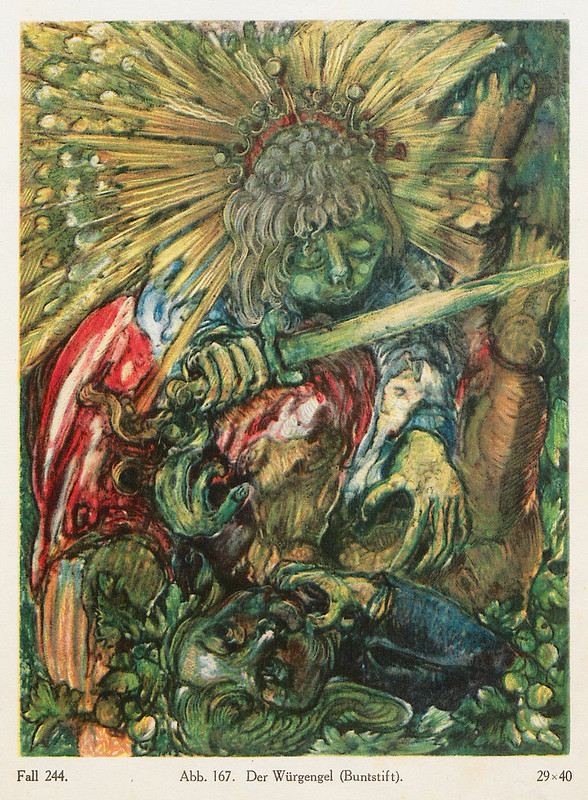
It granted those artists an audience, more to the point, of appreciative fellow artists like Paul Klee, Max Ernst, and Jean Debuffet (who would coin the term Art Brut in response). As should be abundantly clear from the small sampling of images here from the book, modernists took much from the images they saw in Prinzhorn’s book, most of it the unattributed and anonymous work of schizophrenic artists, some of whom themselves draw from earlier modernist trends.
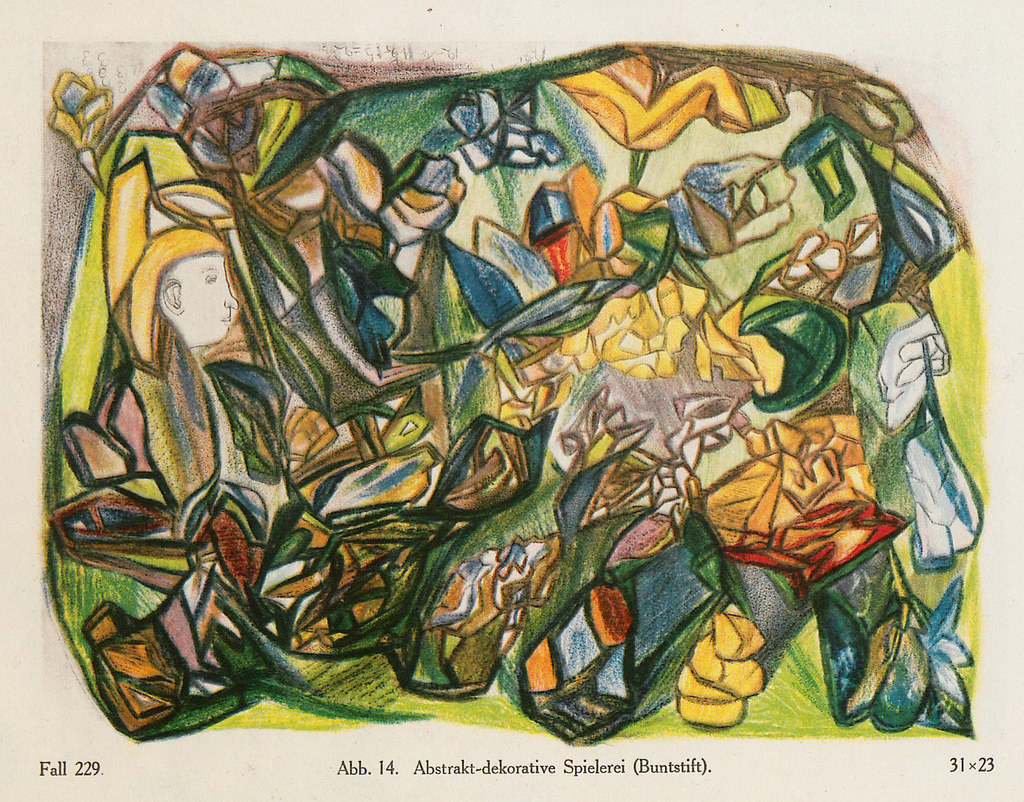
When the Nazis held their “Degenerate Art” exhibitions in 1937, a portion of Prinzhorn’s collection of “over 5000 paintings, drawings, and carvings” was included next to the avant-garde artists it influenced. Art historian Stephanie Barron argues that “one quarter of the illustration pages in the [Degenerate Art Exhibiton’s] guide featured reproductions of the work of these psychiatric patients.” Modernists identified, in complicated ways, with those excluded from civilization, and they were subjected to the same treatment—“the insane and the avant-garde were here equated, both equally pathologized.”
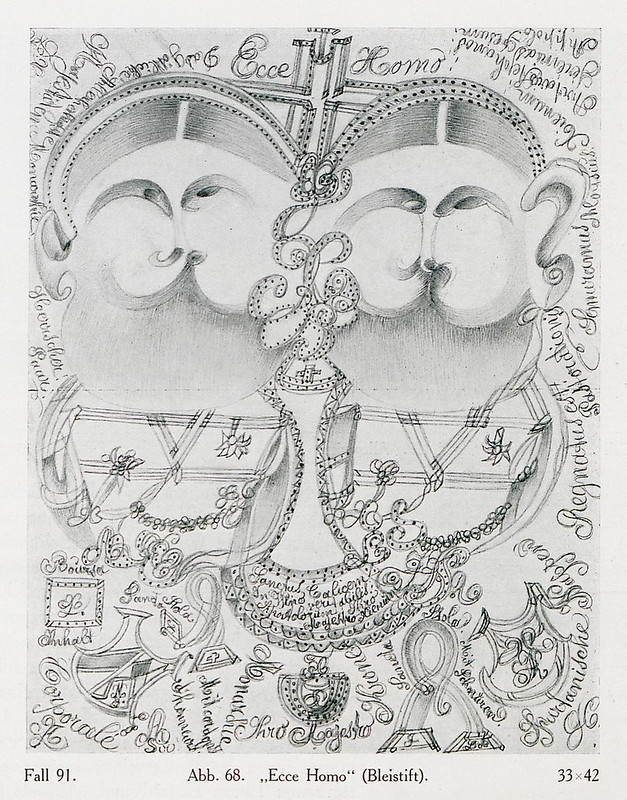
Prinzhorn’s book receded into obscurity, along with the artists it carefully collected and published. It deserves to be far better known, both for its own sake and for its significant influence on the early 20th century avant-garde, and hence all subsequent avant-garde art. The book takes the work it presents seriously—not as childlike attempts or therapeutic interventions, but as expressions of six basic drives “that give rise to image making,” as the Public Domain Review summarizes.
Those universal drives include “an expressive urge, the urge to play, an ornamental urge, an ordering tendency, a tendency to imitate, and the need for symbols. For Prinzhorn, image making is driven by our intense desire to leave traces.” Art, wrote Prinzhorn, represents “an urge in man not to be absorbed passively into his environment, but to impress on it traces of his existence beyond those of purposeful activity.”
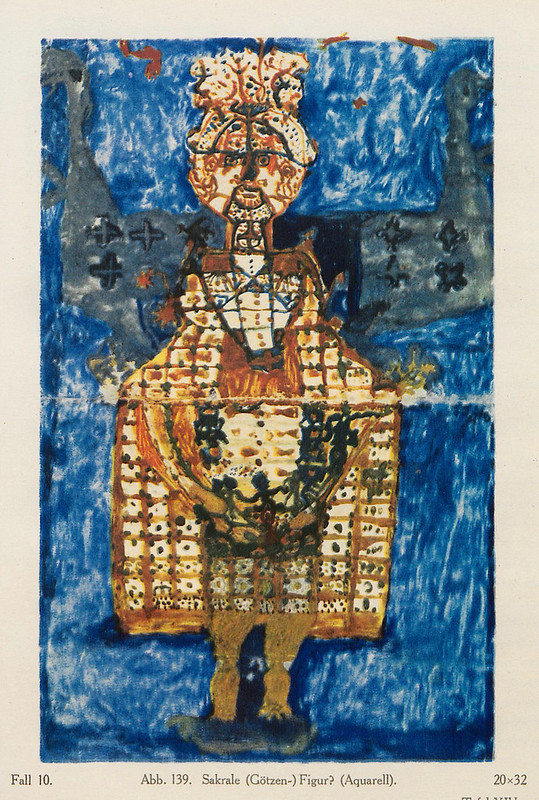
The theories of artists like Kandinsky and Debuffet expressed some similar ideas. The former ascended to the realm of spirit and symbol, and the latter acerbically castigated the empty, out-of-touch veneration of high culture. Who knows what the artists here had in mind when creating their work? In Prinzhorn’s analysis, theoretical concerns may be largely irrelevant. The creation of art, by anyone, is a universal human drive that requires no special training, no social sanction, no web of brokers, curators, and collectors. Maybe this is a threatening message to people who police the boundaries of culture.
The middle classes of his day, wrote Debuffet, were “convinced that [their] fashionable knowledge legitimizes the preservation of their caste. They work at persuading the lower classes of this, at convincing some of them of the necessity to safeguard art, that is to say armchairs, that is to say the bourgeois who know with which silk it is proper to upholster these armchairs.” Reducing art to a status symbol turns it into so much furniture, he argued; a “recourse to antique styles takes the place of good taste.” In the “raw art” of the mentally ill, Debuffet and other modernists saw a renewal of a primal human drive, the creative act.
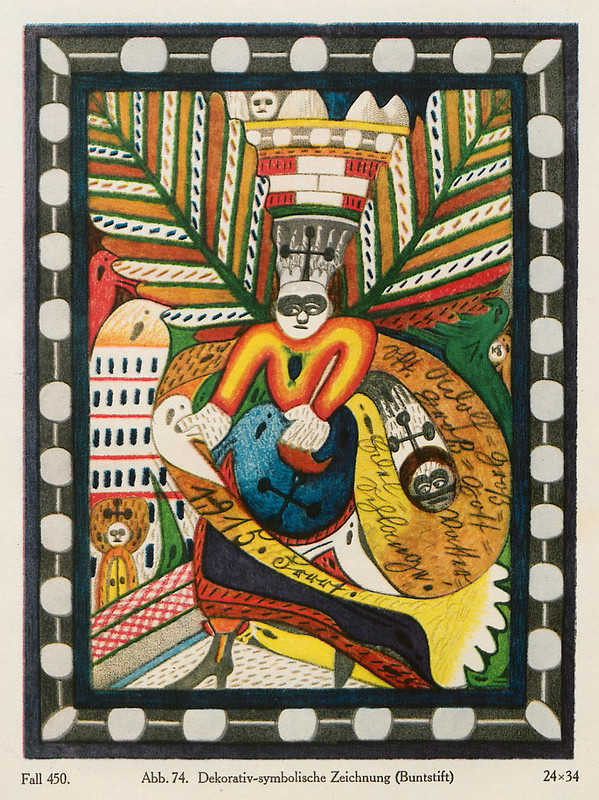
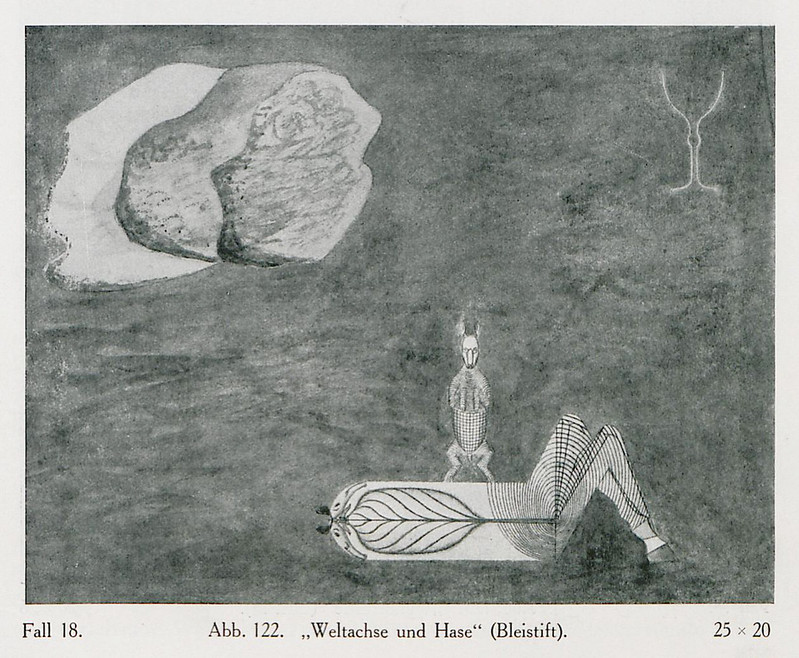
Prinzhorn’s neglected book is out of print, though you can purchase an expensive 1972 edition on Amazon, and even an expensive Kindle version. See much more of this incredible artwork at the Public Domain Review and read brief profiles from the ten schizophrenic artists Prinzhorn identified in a later section of the book. Artists like Karl Brendel, an amputee former bricklayer from Turingian, who carved haunting wood sculptures and began his art career sculpting with chewed bread, and August Neter, to whom 10,000 figures once appeared in a single vision that later became the subject of enigmatic pencil drawings like World Axis and Rabbit, below.
Related Content:
Artist Draws Nine Portraits on LSD During 1950s Research Experiment
Josh Jones is a writer and musician based in Durham, NC. Follow him at @jdmagness
Read More...How David Bowie Used William S. Burroughs’ Cut-Up Method to Write His Unforgettable Lyrics
Why do David Bowie’s songs sounds like no one else’s, right down to the words that turn up in their lyrics? Novelist Rick Moody, who has been privy more than once to details of Bowie’s songwriting process, wrote about it in his column on Bowie’s 2013 album The Next Day: “David Bowie misdirects autobiographical interpretation, often, by laying claim to reportage and fiction as songwriting methodologies, and he cloaks himself, further, in the cut-up.” Anyone acquainted with the work of William S. Burroughs will recognize that term, which refers to the process of literally cutting up existing texts in order to generate new meanings with their rearranged pieces.
You can see how Bowie performed his cut-up composition in the 1970s in the clip above, in which he demonstrates and explains his version of the method. “What I’ve used it for, more than anything else, is igniting anything that might be in my imagination,” he says. “It can often come up with very interesting attitudes to look into. I tried doing it with diaries and things, and I was finding out amazing things about me and what I’d done and where I was going.”
Given what he sees as its ability to shed light on both the future and the past, he describes the cut-up method as “a very Western tarot” — and one that can provide just the right unexpected combination of sentences, phrases, or words to inspire a song.
As dramatically as Bowie’s self-presentation and musical style would change over the subsequent decades, the cut-up method would only become more fruitful for him. When Moody interviewed Bowie in 1995, Bowie “observed that he worked somewhere near to half the time as a lyricist in the cut-up tradition, and he even had, in those days, a computer program that would eat the words and spit them back in some less referential form.” Bowie describes how he uses that computer program in the 1997 BBC clip above: “I’ll take articles out of newspapers, poems that I’ve written, pieces of other people’s books, and put them all into this little warehouse, this container of information, and then hit the random button and it will randomize everything.”
Amid that randomness, Bowie says, “if you put three or four dissociated ideas together and create awkward relationships with them, the unconscious intelligence that comes from those pairings is really quite startling sometimes, quite provocative.” Sixteen years later, Moody received a startling and provocative set of seemingly dissociated words in response to a long-shot e‑mail he sent to Bowie in search of a deeper understanding of The Next Day. It ran as follows, with no further comment from the artist:
Effigies
Indulgences
Anarchist
Violence
Chthonic
Intimidation
Vampyric
Pantheon
Succubus
Hostage
Transference
Identity
Mauer
Interface
Flitting
Isolation
Revenge
Osmosis
Crusade
Tyrant
Domination
Indifference
Miasma
Pressgang
Displaced
Flight
Resettlement
Funereal
Glide
Trace
Balkan
Burial
Reverse
Manipulate
Origin
Text
Traitor
Urban
Comeuppance
Tragic
Nerve
Mystification
“Chthonic is a great word,” Moody writes, “and all art that is chthonic is excellent art.” He adds that “when Bowie says chthonic, it’s obvious he’s not just aspiring to chthonic, the album has death in nearly every song” — a theme that would wax on Bowie’s next and final album, though The Next Day came after an emergency heart surgery ended his live-performance career. “Chthonic has personal heft behind it, as does isolation, which is a word a lot like Isolar, the name of David Bowie’s management enterprise.” Moody scrutinizes each and every one of the words on the list in his column, finding meanings in them that, whatever their involvement in the creation of the album, very much enrich its listening experience. By using techniques like the cut-up method, Bowie ensured that his songs can never truly be interpreted — not that it will keep generation after generation of intrigued listeners from trying.
Related Content:
How to Jumpstart Your Creative Process with William S. Burroughs’ Cut-Up Technique
How David Bowie, Kurt Cobain & Thom Yorke Write Songs With William Burroughs’ Cut-Up Technique
How Leonard Cohen & David Bowie Faced Death Through Their Art: A Look at Their Final Albums
Based in Seoul, Colin Marshall writes and broadcasts on cities, language, and culture. His projects include the book The Stateless City: a Walk through 21st-Century Los Angeles and the video series The City in Cinema. Follow him on Twitter at @colinmarshall or on Facebook.
Read More...Pioneering Computer Scientist Grace Hopper Shows Us How to Visualize a Nanosecond (1983)
Human imagination seems seriously limited when faced with the cosmic scope of time and space. We can imagine, through stop-motion animation and CGI, what it might be like to walk the earth with creatures the size of office buildings. But how to wrap our heads around the fact that they lived hundreds of millions of years ago, on a planet some four and a half billion years old? We trust the science, but can’t rely on intuition alone to guide us to such mind-boggling knowledge.
At the other end of the scale, events measured in nanoseconds, or billionths of a second, seem inconceivable, even to someone as smart as Grace Hopper, the Navy mathematician who invented COBOL and helped built the first computer. Or so she says in the 1983 video clip above from one of her many lectures in her role as a guest lecturer at universities, museums, military bodies, and corporations.
When she first heard of “circuits that acted in nanoseconds,” she says, “billionths of a second… Well, I didn’t know what a billion was…. And if you don’t know what a billion is, how on earth do you know what a billionth is? Finally, one morning in total desperation, I called over the engineering building, and I said, ‘Please cut off a nanosecond and send it to me.” What she asked for, she explains, and shows the class, was a piece of wire representing the distance a signal could travel in a nanosecond.
Now of course it wouldn’t really be through wire — it’d be out in space, the velocity of light. So if we start with a velocity of light and use your friendly computer, you’ll discover that a nanosecond is 11.8 inches long, the maximum limiting distance that electricity can travel in a billionth of a second.
Follow the rest of her explanation, with wire props, and see if you can better understand a measure of time beyond the reaches of conscious experience. The explanation was immediately successful when she began using it in the late 1960s “to demonstrate how designing smaller components would produce faster computers,” writes the National Museum of American History. The bundle of wires below, each about 30cm (11.8 inches) long, comes from a lecture Hopper gave museum docents in March 1985.

Photo via the National Museum of American History
Like the age of the dinosaurs, the nanosecond may only represent a small fraction of the incomprehensibly small units of time scientists are eventually able to measure—and computer scientists able to access. “Later,” notes the NMAH, “as components shrank and computer speeds increased, Hopper used grains of pepper to represent the distance electricity traveled in a picosecond, one trillionth of a second.”
At this point, the map becomes no more revealing than the unknown territory, invisible to the naked eye, inconceivable but through wild leaps of imagination. But if anyone could explain the increasingly inexplicable in terms most anyone could understand, it was the brilliant but down-to-earth Hopper.
via Kottke
Related Content:
Free Online Computer Science Courses
Josh Jones is a writer and musician based in Durham, NC. Follow him at @jdmagness
Read More...Support Us
We're hoping to rely on loyal readers, rather than erratic ads. Please click the Donate button and support Open Culture. You can use Paypal, Venmo, Patreon, even Crypto! We thank you!

About Us

Open Culture scours the web for the best educational media. We find the free courses and audio books you need, the language lessons & educational videos you want, and plenty of enlightenment in between.
Advertise With Us

FREE UPDATES!
GET OUR DAILY EMAIL
Get the best cultural and educational resources on the web curated for you in a daily email. We never spam. Unsubscribe at any time.
FOLLOW ON SOCIAL MEDIA

Open Culture editor Dan Colman scours the web for the best educational media. He finds the free courses and audio books you need, the language lessons & movies you want, and plenty of enlightenment in between.
Advertise With Us

