Venerable Female Artists, Musicians & Authors Give Advice to the Young: Patti Smith, Laurie Anderson & More
To the Louisiana Channel and the Louisiana Museum of Modern Art, on behalf of mature women everywhere: Thank you. You have excellent taste.
We’ve weathered invisibility and Mom jeans jokes, as representatives from our demographic are judged more harshly in categories that never seem to apply to their male counterparts in politics and the performing arts.
You’ll find plenty of celebrated male artists contributing advice to emerging artists in the Louisiana Project’s video series, but the Guerilla Girls will be gratified to see how robustly represented these working women are.
Nothing beats authority conferred by decades of professional experience.
And while young women are sure to be inspired by these venerable interviewees, let’s not sell anyone short.
We may have assembled a playlist titled Women Artists’ Advice to the Young (watch it from front to back at the bottom of the post), but let’s agree that their advice is good for emerging artists of all genders.
Author, poet, and Godmother of Punk Patti Smith (born 1946) serves up her version of to thine own self be true.
Avant-garde composer and musician Laurie Anderson (born 1947) counsels against the sort of narrow self-definition that discourages artistic exploration. Be loose, like a goose.
Author Herbjørg Wassmo (born 1942) wants young artists to prepare for the inevitable days of low motivation and self-doubt by resolving to work regardless.
Other notables include filmmaker Shirin Neshat (born 1957), author Lydia Davis (born 1947), artist Joyce Pensato (born 1941), and performance artist Marina Abramović (born 1946).
The oldest interviewee in the collection, artist Yayoi Kusama (born 1929), refuses to saddle up and come up with any teacherly advice, but could certainly be considered a walking example of what it means to be “living as an artist with a wish to create a beautiful world with human love.”
Enjoy the full playlist here:
Related Content:
Toni Morrison Dispenses Sound Writing Advice: Tips You Can Apply to Your Own Work
74 Essential Books for Your Personal Library: A List Curated by Female Creatives
Ayun Halliday is an author, illustrator, theater maker and Chief Primatologist of the East Village Inkyzine. Join her in New York City May 13 for the next installment of her book-based variety show, Necromancers of the Public Domain. Follow her@AyunHalliday.
Read More...Herbie Hancock’s Joyous Soundtrack for the Original Fat Albert TV Special (1969)
Millions of kids grew up with the groovy yet educational cartoon comedy of Fat Albert, and millions of adults may find it difficult or impossible now to watch the show without thinking of the crimes of its creator. Such is life in the 21st century, but so it was too at the end of the 1960s when the first iteration of Fat Albert debuted. There were plenty of reasons to feel terrible about the culture. Yet the music that came out of the various jazz/funk/fusion/soul scenes seemed like it couldn’t let anyone feel too bad for long.
In 1969, Herbie Hancock had just been let go from the Miles Davis quintet and left historic Blue Note. During this pivotal time, he signed on to compose the soundtrack for the TV special Hey, Hey, Hey, It’s Fat Albert, the precursor to the episodic cartoon Fat Albert and the Cosby Kids, which ran from 1972 to 1985 and taught serious ethical lessons about such subjects as kindness, respect, stealing, drugs, scams, kidnapping, smoking, racism, and more with original songs.
The later show’s unforgettable theme song (“na, na, na, gonna have a good time!”) was not penned by Hancock, nor were any of its other tunes. Only the original special used his music, which is maybe why the soundtrack is not better known, as well it should be. “It’s a deeply soulful affair,” writes Boing Boing, “that presaged Hancock’s 1973 jazz-funk classic Head Hunters.” The album, Fat Album Rotunda, had gone out of print, but has now been reissued on the label Antarctica Starts Here.
After listening to the tracks (hear samples above and below), you might find it difficult to resist buying a copy. Whether or not you still enjoy the cartoon, the incredible grooves here evoke much more than its adolescent characters and their junkyard mishaps. This is such an expansive, joyous album, one “in which Hancock,” Superior Viaduct writes, “clearly had a great time.” So too did the rest of the band, “which by the time of recording in late 1969 was both razor-sharp and confidently loose from rehearsing and touring.”
The band included three horn players, “Joe Henderson on sax and flute, Garnett Brown on trombone and Johnny Coles on trumpet and flugelhorn.” Hancock’s solos run fluidly through each song, held in place by the rock-solid swing of Albert Heath’s drums. The compositions are complex and catchy, with lilting melodies, mean hooks, and big refrains.
The album is instantly classic, whether you heard it fifty years ago or just now for the first time. Warner Brothers agreed, and gave Hancock and his band a deal on the strength of the album. So did Quincy Jones, who recorded his own version of the track “Tell Me a Bedtime Story,” a mellow, dynamic slow burn that builds to some of the finest Fender Rhodes playing Hancock put to tape. Fat Albert Rotunda was hardly his first or his last soundtrack album, but while it has fallen into obscurity, it should rank as one of his best.
Related Content:
How Innovative Jazz Pianist Vince Guaraldi Became the Composer of Beloved Charlie Brown Music
Josh Jones is a writer and musician based in Washington, DC. Follow him at @jdmagness
Read More...Hear Debbie Harry’s Stunning Ethereal Vocal Tracks from “Heart of Glass,” “Call Me,” “Rapture,” and “One Way or Another”
Punk rock “shocked the world” when it arrived in the late 70s, one mainstream news outlet remembers. Bands like The Ramones inspired “a generation of wannabe rockers to buy guitars and form their own bands…. They proved that you didn’t have to be the next Jimmy Page or Paul McCartney to be a rock star.”
The idea is common—that punk bands’ amateurishness gave license to remake musical culture with attitude and style… talent and ability be damned. There’s a sense in which this is true, but there’s also a sense in which it’s a generalization that ignores the various organs—early metal, avant-garde art rock, new wave, etc.—that made up the larger body of punk.
The scene was built on some serious ability, beginning with the primitivist Velvet Underground, who relied on the talents of classically-trained multi-instrumentalist John Cale. In James Williamson, The Stooges had one of the finest guitarists not only in punk (or “heavy metal,” as Lester Bangs called 1973’s Raw Power), but in rock and roll writ large.
Talking Heads had one of punk’s best bass players in Tina Weymouth, a huge influence on contemporary bass guitar. When punk arrived on the radio, it did so in the sultry, chilling tones of Debbie Harry’s two-and-a-half octave-range voice: in the icy, high-pitched echoes of “Heart of Glass,” Call Me,” and “Rapture.”
Before Blondie, Harry was stripped down in the punk band The Stilettos. And before that, her ethereal voice elevated the work of late sixties folk rock band, Wind in the Willows. As one of seven singers, she honed her instrument in the demanding environment of a vocal ensemble. In her best-known Blondie songs, Harry harmonizes with herself in huge trails of reverb, recalling the dreamy psychedelia of earlier years.
Hear her multi-tracked, heavily effected isolated vocals in three huge Blondie hits further up, and her much more stripped-down, rawer vocal track from “One Way or Another,” below. There’s a lot of underground punk and indie and alternative music that did abandon musicianship, with mixed but often brilliant results. But when it comes to what most people remember when they remember the sound of early punk, the genre was just as much driven forward by musical ability and dedication, as evidenced by the career of Debbie Harry.
Related Content:
Blondie Plays CBGB in the Mid-70s in Two Vintage Clips
Josh Jones is a writer and musician based in Washington, DC. Follow him at @jdmagness
Read More...What Is a Zen Koan? An Animated Introduction to Eastern Philosophical Thought Experiments
If you know anything at all about Zen, you know the famous question about the sound of one hand clapping. While the brain teaser did indeed originate with a Zen master, it does not fully represent the nature of the koan. Between the 9th and 13th centuries, when Chan Buddhism, as Zen was known in China, flourished, koans became widely-used, explains the TED-Ed animated video above, as objects of meditation. “A collection of roughly one thousand, seven hundred bewildering philosophical thought experiments,” koans were ostensibly tools to practice living with the unexplainable mysteries of existence.
The name, notes the lesson, “originally gong-an in Chinese, translates to ‘public record or case.’ But unlike real-world court cases, koans were intentionally incomprehensible.” Koans are “Surprising, surreal, and frequently contradicted themselves.” The lessons in ambiguity and paradox have their analogue, perhaps, in certain trains of thought in Medieval Catholic philosophy or the idealism of thinkers like George Berkeley, who might have first come up with the one about the tree falling in the forest.
But is the purpose of the koan simply to break the brain’s reliance on reason? It was certainly used this way. Zen Master Eihei Dogen, founder of Japanese Soto Zen traveled to China to study under the Chan Masters, and later criticized this kind of koan practice and other aspects of Chan, though he also collected 300 koans himself and they became integral to Soto tradition. Koans are not just absurdist zingers, they are, as the name says, cases—little stories, often about two monks in some kind of teacher and student relationship. Many of the students and teachers in these stories were patriarchs of Chan.
Like the sayings and doings of other religious patriarchs in other world religions, these “cases” have been collected with copious commentary in books like The Blue Cliff Record and The Book of Serenity. They show in snapshots the transmission of the teaching directly from teacher to student, rather than through sacred texts or rituals (hundreds of koans, rules, and rituals notwithstanding). That they are puzzling and ambiguous does not mean they are incomprehensible. Many seem more or less like fables, such as the oft-told story of the monk who carries a beautiful woman across a mud patch, then chastises his younger companion for bringing it up miles down the road.
Other koans are like Greek philosophical dialogues in miniature, such as the story in which two monks argue about the nature of a flag waving in the wind. A third steps in, Socrates-like, with a seemingly “right” answer that transcends both of their positions. The longevity of these vignettes lies in their subtlety—surface meanings only hint at what the stories are up to. Koans force those who take up their study to struggle with uncertainty and irresolution. They also frequently undermine the most common expectation that the teacher knows best.
Often posed as a kind of oblique verbal combat between teacher and student, koans include extremely harsh, even violent teachers, or teachers who seem to admit defeat, tacitly or otherwise, when a student gets the upper hand, or when both confront the speechless awe of not knowing. Attitudes of respect, reverence, humility, candor, and good humor prevail. Perhaps under all koan practice lies the idea of skillful means—the appropriate action to take in the moment, which can only be known in the moment.
In his short, humorous discussion of Zen koans above, Alan Watts tells the story of a Zen student who tricks his master and hits him with his own stick. The master responds with approval of the student’s tactics, but the koan does not suggest that everyone should do the same. That, as Dogen would argue, would be to have an idea about reality, rather than a wholly-engaged response to it. Whatever else koans show their students, they point again and again to this central human dilemma of thinking about living—in the past, present, or future—versus actually experiencing our lives.
Related Content:
The World’s Largest Collection of Tibetan Buddhist Literature Now Online
Josh Jones is a writer and musician based in Durham, NC. Follow him
Read More...When the Nazis Declared War on Expressionist Art (1937)
The 1937 Nazi Degenerate Art Exhibition displayed the art of Paul Klee, Wassily Kandinsky, Georg Grosz, and many more internationally famous modernists with maximum prejudice. Ripped from the walls of German museums, the 740 paintings and sculptures were thrown together in disarray and surrounded by derogatory graffiti and hell-house effects. Right down the street was the respectable Great German Art Exhibition, designed as counterprogramming “to show the works that Hitler approved of—depicting statuesque blonde nudes along with idealized soldiers and landscapes,” writes Lucy Burns at the BBC.
Viewers were supposed to sneer and recoil at the modern art, and most did, but whether they were gawkers, Nazi sympathizers, or art fans in mourning, the exhibit drew massive crowds. Over a million people first attended, three times more than saw the exhibition of state-sanctioned art—or more specifically, art sanctioned by Hitler the failed artist, who had endured watching “the realistic paintings of buildings and landscapes,” of sturdy peasants and suffering poets, “dismissed by the art establishment in favour of abstract and modern styles.” The Degenerate Art Exhibition “was his moment to get his revenge,” and he had it. Over a hundred artists were denounced as Bolsheviks and Jews bent on corrupting German purity.
Afterwards, thousands of works of art were destroyed or disappeared, as did many of their creators. Many artists fled, many could not. Enraged by the eclipse of sentimental academic styles and by his own ignorance, Hitler railed against “works of art which cannot be understood in themselves,” as he put it in a speech that summer. These “will never again find their way to the German people.” Many such quotations surrounded the offending art. The 1993 documentary above, written, produced, and directed by David Grubin, tells the story of the exhibition, which has in time proven Hitler’s greatest culture war folly. It accomplished its immediate purpose, but as Jonathan Petropoulos, professor of European History at Claremont McKenna College points out, “this artwork became more attractive abroad…. I think that over the longer run it was good for modern art to be viewed as something that the Nazis detested and hated.”
Not every anti-Nazi critic saw modern art as subverting fascism. Ten years after the Degenerate Art Exhibition, philosopher Theodor Adorno, himself a refugee from Nazism, called Expressionism “a naïve aspect of liberal trustfulness,” on a continuum between fascist tools like Futurism and “the ideology of the cinema.” Nonetheless, it was Hitler who most bore out Adorno’s general observation: “Taste is the most accurate seismograph of historical experience…. Reacting against itself, it recognizes its own lack of taste.” The hysterical performance of disgust surrounding so-called “degenerate art” turned the exhibit into a sensation, a blockbuster that, if it did not prove the virtues of modernism, showed many around the world that the Nazis were as crude, dim, and vicious as they alleged their supposed enemies to be.
In the documentary, you’ll see actual footage of the theatrical exhibition, juxtaposed with film of a 1992 Berlin exhibition of much of that formerly degenerate art. Restaged Degenerate Art Exhibitions have become very popular in the art word, bringing together artists who need no further exposure, in order to historically reenact, in some fashion, the experience of seeing them all together for the first time. From a recent historical review at New York’s Neue Gallerie to the digital exhibit at MoMA.org, degenerate art retrospectives show, as Adorno wrote, that indeed “taste is the most accurate seismograph of historical experience.”
The original exhibition “went on tour all over Germany,” writes Burns, “where it was seen by a million more people.” Thousands of ordinary Germans who went to jeer at it were exposed to modern art for the first time. Millions more people have learned the names and styles of these artists by learning about the history of Nazism and its cult of pettiness and personal revenge. Learn much more in the excellent documentary above and at our previous post on the Degenerate Art Exhibition.
Degenerate Art — 1993, The Nazis vs. Expressionism will be added to our list of Free Documentaries, a subset of our collection, 4,000+ Free Movies Online: Great Classics, Indies, Noir, Westerns, Documentaries & More
Related Content:
The Nazi’s Philistine Grudge Against Abstract Art and The “Degenerate Art Exhibition” of 1937
Josh Jones is a writer and musician based in Durham, NC. Follow him at @jdmagness
Read More...Neurons as Art: See Beautiful Anatomy Drawings by the Father of Neuroscience, Santiago Ramón y Cajal
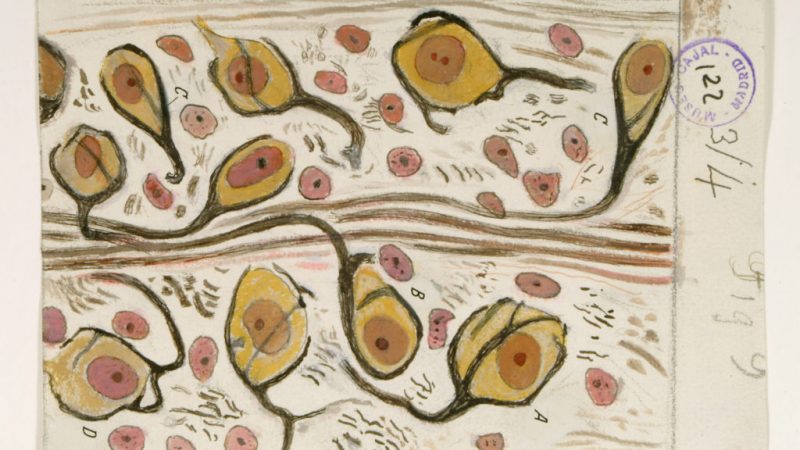
Art depends on popular judgments about the universe, and is nourished by the limited expanse of sentiment. . . . In contrast, science was barely touched upon by the ancients, and is as free from the inconsistencies of fashion as it is from the fickle standards of taste. . . . And let me stress that this conquest of ideas is not subject to fluctuations of opinion, to the silence of envy, or to the caprices of fashion that today repudiate and detest what yesterday was praised as sublime.
The above drawing is the sort of sublime rendering that attracts throngs of visitors to the world’s great modern art museums, but that’s not the sort of renown the artist, Nobel Prize-winning father of modern neuroscience Santiago Ramón y Cajal (1852 ‑1934), actively sought.
Or rather, he might have back before his father, a professor of anatomy, coerced his wild young son into transferring from a provincial art academy to the medical school where he himself was employed.
After a stint as an army medical officer, the artist-turned-anatomist concentrated on inflammation, cholera, and epithelial cells before zeroing in on his true muse—the central nervous system.
At the time, reticular theory, which held that everything in the nervous system was part of a single continuous network, prevailed.
Ramón y Cajal was able to disprove this widely held belief by using Golgi stains to support the existence of individual nervous cells—neurons—that, while not physically connected, communicated with each other through a system of axons, dendrites, and synapses.
He called upon both his artistic and medical training in documenting what he observed through his microscope. His meticulous freehand drawings are far more accurate than anything that could be produced by the microscopic-image photographic tools available at the time.
His precision was such that his illustrations continue to be published in medical textbooks. Further research has confirmed many of his suppositions.
As art critic Roberta Smith writes in The New York Times, the drawings are “fairly hard-nosed fact if you know your science”:
If you don’t, they are deep pools of suggestive motifs into which the imagination can dive. Their lines, forms and various textures of stippling, dashes and faint pencil circles would be the envy of any modern artist. That they connect with Surrealist drawing, biomorphic abstraction and exquisite doodling is only the half of it.
The drawings’ pragmatic titles certainly take on a poetic quality when one considers the context of their creation:

Axon of Purkinje neurons in the cerebellum of a drowned man
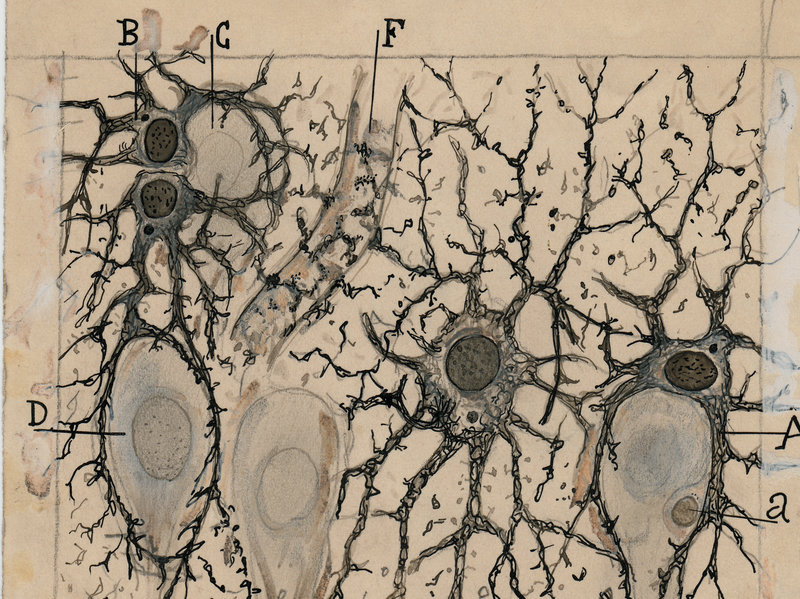
The hippocampus of a man three hours after death

Glial cells of the cerebral cortex of a child
His specimens were not limited to the human world:
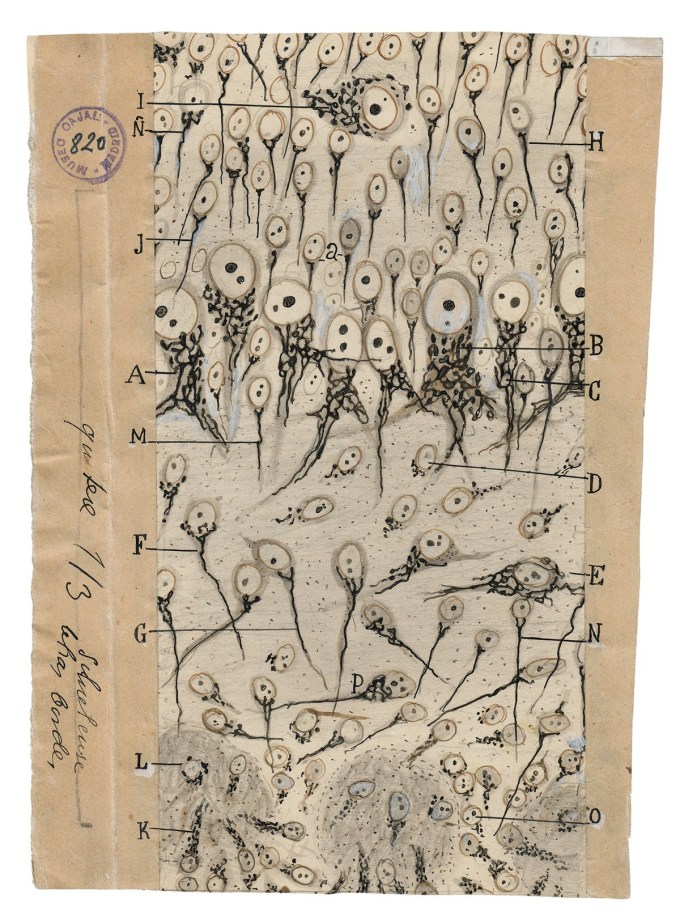
Retina of lizard
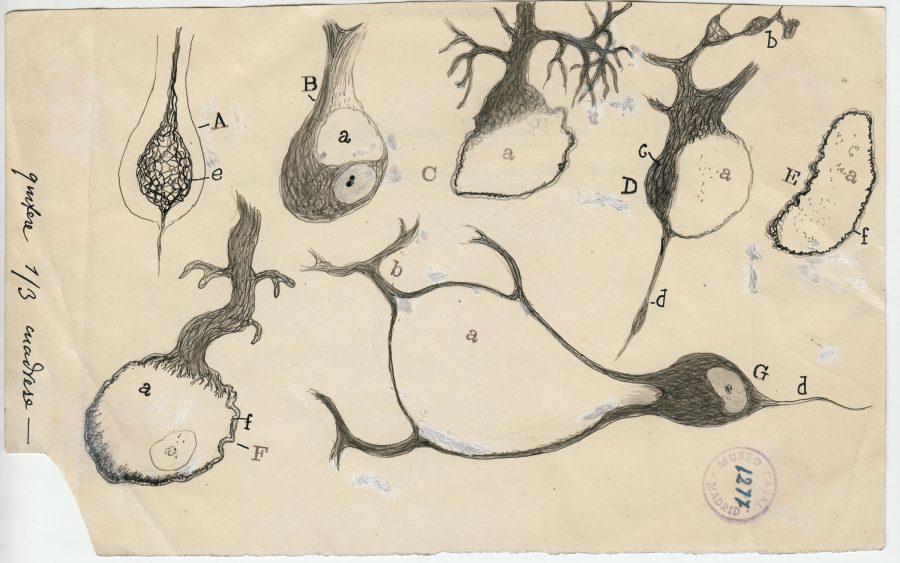
The olfactory bulb of the dog
In his book Advice for a Young Investigator, Ramón y Cajal took a holistic view of the relationship between science and the arts:
The investigator ought to possess an artistic temperament that impels him to search for and admire the number, beauty, and harmony of things; and—in the struggle for life that ideas create in our minds—a sound critical judgment that is able to reject the rash impulses of daydreams in favor of those thoughts most faithfully embracing objective reality.
Explore more of Ramón y Cajal’s cellular drawings in Beautiful Brain: The Drawings of Santiago Ramón y Cajal, the companion book to a recent traveling exhibition of his work. Or immerse yourself at the neural level by ordering a reproduction on a beach towel, yoga mat, cell phone case, shower curtain, or other necessity on Science Source.
Related Content:
Leonardo da Vinci’s Visionary Notebooks Now Online: Browse 570 Digitized Pages
Two Million Wondrous Nature Illustrations Put Online by The Biodiversity Heritage Library
Ayun Halliday is an author, illustrator, theater maker and Chief Primatologist of the East Village Inky zine. Join her in New York City April 15 for the next installment of her book-based variety show, Necromancers of the Public Domain. Follow her @AyunHalliday.
Read More...Deconstructing Steely Dan: The Band That Was More Than Just a Band
How do you explain Steely Dan to someone who’s never heard of them? Two pretentious, perfectionistic, and very talented white guys who love Bebop and R&B meet in passing at Bard College in 1967. They start a series of bands, one of them featuring Chevy Chase on drums. They rub everyone the wrong way and write songs too complicated for pop and TV but too good to go away, so they become a celebrated studio unit, named after a fictional steam-powered dildo in a William S. Burroughs’ Naked Lunch.
They obsess over studio production, putting together a revolving cast of high-end session musicians and pushing them through take after take. They carefully edit songs together from hours and hours of tape. And somehow, they end up creating some of the funkiest music of the 70s—the smoothest of smooth jazz, the yacht-iest of yacht rock… then, a generation later, they become perhaps the most sampled band of all time, their grooves a sine qua non of hip hop’s evolution….
Hardly sounds plausible. But there it is: Donald Fagen and Walter Becker—two super-fans of the genres they creatively appropriated—made some incredible, snarling, cynical, viciously groovy easy listening music, and it has more than held up over the decades since they released their debut album Can’t Buy a Thrill in 1972. Despite decades of critical praise and hit after hit, they also remain a profoundly misunderstood band.
That is, if we can even call them a band. The Polyphonic video above convincingly argues otherwise. Becker and Fagen maintained total control at all times over the project, and mostly resisted touring to focus on building albums out of thousands of perfect takes. They were curating “an aesthetic… one that relied on intense perfectionism” and satirical, oblique lyricism. Something of a conceptual art project that never once broke character.
The elements were there from the beginning—in “Do it Again,” for example, from their first album—and they grew more sophisticated and calculated throughout the decade. The band’s obsession with quality culminated in their masterpiece Aja and their swan song (before re-uniting 20 years later), the slick and bitter Gaucho. Their hyper-critical detachment can be off-putting to people who prefer to see musicians telegraph passionate authenticity, but for Steely Dan fans, the aloofness is part of the appeal.
Major guitar-rock hit “Reelin’ in the Years,” a song Fagen called “dumb, but effective,” satirizes 60s nostalgia long before that became a major cultural phenomenon. The song mocks the very people who most respond to it, like Springsteen’s “Born in the U.S.A.” tips the sacred cows of many of its biggest fans. Even Steely Dan’s detractors can’t help but admire their ability to choose the perfect players for every song and to coax, or browbeat, out of them the best possible performances.
Their perfectionism and studio polish, qualities you’ll learn much more about in the video, masked a dark, subversive core. “For Fagen and Becker,” writes Chris Morris at Variety, “the beautifully tooled music they made with their studio cohorts served as the ultimate alienation effect. The true import of their work, which addressed forbidden impulses that moved to the edge of crime and frequently beyond, was always garbed in satiny elegance; its sardonic and horrific essence was marketed as the purest ear candy.”
Or, maybe, put differently, if you get the dark humor of Patrick Bateman earnestly extolling the virtues of Huey Lewis and the News, Whitney Houston, and Phil Collins before a captive audience of his murder victims in Mary Harron’s American Psycho, there’s a good chance you get Steely Dan. As Jay Black, lead singer of Jay and the Americans, once said, Becker and Fagen were “the Manson and Starkweather of rock ‘n’ roll,” referring, of course, to Charles Manson and spree killer Charles Starkweather. With that in mind, you might never hear “Rikki Don’t Lose that Number” the same way again.
Related Content:
How Steely Dan Wrote “Deacon Blues,” the Song Audiophiles Use to Test High-End Stereos
Josh Jones is a writer and musician based in Durham, NC. Follow him at @jdmagness
Read More...Noam Chomsky Makes His First Power Point Presentation
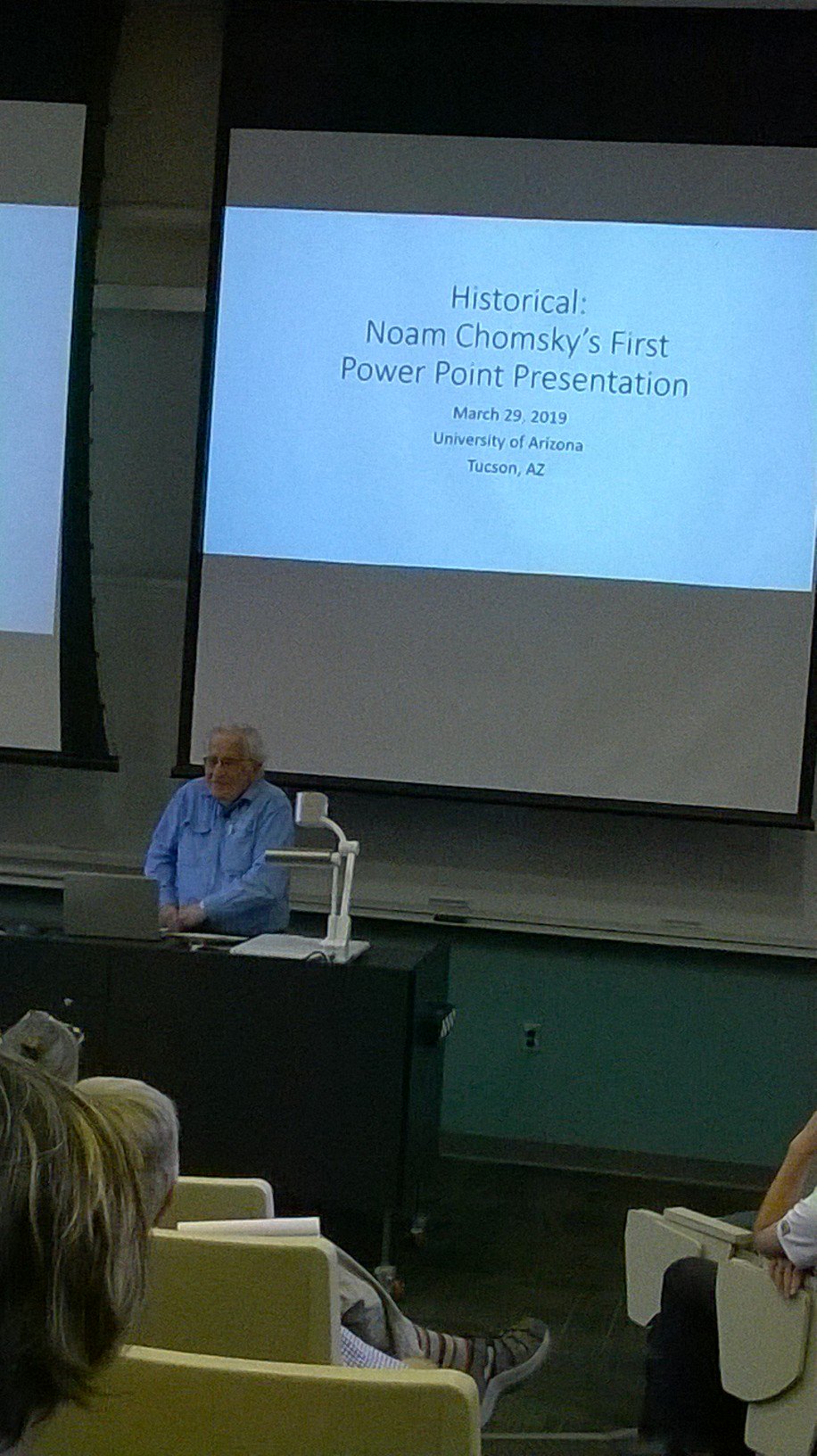
90 years old, and still going strong…
Related Content:
The Ideas of Noam Chomsky: An Introduction to His Theories on Language & Knowledge (1977)
Noam Chomsky Defines What It Means to Be a Truly Educated Person
Read More...Everything You Ever Wanted to Know About the Beauty of Brutalist Architecture: An Introduction in Six Videos
Some people hate the massive concrete buildings known as Brutalist, but they at least approve of the style’s name, resonant as it seemingly is with associations of insensitive, anti-humanist bullying. Those who love Brutalism also approve of the style’s name, but for a different reason: they know it comes from the French béton brut, referring to raw concrete, that material most generously used in Brutalist buildings’ construction. We’ve all seen Brutalist architecture, massively embodied by Boston City Hall, London’s Barbican Centre, UC Berkeley’s Wurster Hall, the University of Toronto’s Robarts Library, FBI Headquarters in Washington, D.C., or any other of the examples that have stood since the style’s 1960s and 70s heyday. But now, as more get slated for demolition each year, it has fallen to Brutalism’s enthusiasts to defend an architecture easily seen as indefensible.
The aesthetic of Brutalism, says host Roman Mars in an episode of the podcast 99% Invisible on the style, “can conjure up associations with bomb shelters, Soviet-era or ‘third-world’ construction, but as harsh as it looks, concrete is an utterly optimistic building material.” In the 1920s “concrete was seen as being the material that would change the world. The material seemed boundless — readily available in vast quantities, and concrete sprang up everywhere — on bridges, tunnels, highways, sidewalks, and of course, massive buildings.”
It “presented the most efficient way to house huge numbers of people, and government programs all over the world loved it — particularly Soviet Russia, but also later in Europe and North America.” Philosophically, “concrete was seen as humble, capable, and honest—exposed in all its rough glory, not hiding behind any paint or layers.”
However noble the intentions behind these works of architecture, though, it didn’t take humanity long to turn on Brutalism. Part of the problem had to do with the disrepair into which many of the highest-profile Brutalist buildings — social housing complexes, transit centers, government offices — were allowed to fall immediately after the ideologies that drove their construction passed out of favor. But Brutalism also fell victim to a predictable cycle of fashion: as architecture critics often point out, the public of any era consistently admires hundred-year-old buildings, but condemns (often literally) fifty-year-old buildings. New Yorkers still lament the loss of their grand old Penn Station, but its ornate Beaux-Arts style no doubt looked as heavy-handed and out-of-touch to as many people in the early 1960s, the time of its demolition, as Brutalism does today.
What, then, is the case for Brutalist architecture? “It’s a sense of place. It’s a sense of the drama of the space that they surround,” says This Brutal World author Peter Chadwick the BBC clip at the top of the post. “It is sculpture. It’s gone beyond being just functional. It’s just beautiful sculpture that mirrors its environment.” In the DW Euromaxx video below, Deutsches Architekturmuseum curator Oliver Elser sees in Brutalism a valuable lesson for building today: “Make more from less. I think this way of thinking, spatial generosity with simpler materials, is a timely stance for architecture.” Architectural historian Elain Harwood calls Brutalism “a particular architecture for ambitious times gripped by a fervor for change. Whatever style you call it, the results are unique and have a heroic beauty than sets them apart from the architecture of any other era.” (In fact, some Brutalism enthusiasts who dislike the label have put up the term “Heroic” instead.)
Whatever the articulacy of Brutalism’s defenders, the most effective arguments for its preservation have been made with not words but images. Chadwick first made his mark with his This Brutal House accounts on Twitter and Instagram, and a search on the latter for the hashtag #brutalism reveals the astonishing range and intensity of the style’s 21st-century fandom. A fair few videos have also taken individual works of Brutalism as their subjects, from a reflexively loathed survivor like Boston City Hall to the unlikely upper-middle-class oasis of the Barbican Centre to a high-minded projects now under the wrecking ball like Robin Hood Gardens. Despite how many people seem happy to see Brutalist buildings go, some, like Australian architect Shaun Carter in his TEDx Sydney Salon talk below, remind us of the value of keeping our history concretized, as it were, in the built environment around us.
Bunkers, Brutalism and Bloodymindedness: Concrete Poetry writer Jonathan Meades puts it more forcefully: “The destruction of Brutalist buildings is more than the destruction of a particular mode of architecture. It is like burning books. It’s a form of censorship of the past, a discomfiting past, by the present. It’s the revenge of a mediocre age on an age of epic grandeur.” To his mind, it’s the destruction of evidence of “a determined optimism that made us more potent than we have become,” of the fact that “we don’t measure up against those who took risks, who flew and plunged to find new ways of doing things, who were not scared to experiment, who lived lives of perpetual inquiry.” If Brutalism has to go, it has to go because it reminds us that “once upon a time, we were not scared to address the Earth in the knowledge that the Earth would not respond, could not respond.”
Related Content:
Bauhaus, Modernism & Other Design Movements Explained by New Animated Video Series
1,300 Photos of Famous Modern American Homes Now Online, Courtesy of USC
Based in Seoul, Colin Marshall writes and broadcasts on cities, language, and culture. His projects include the book The Stateless City: a Walk through 21st-Century Los Angeles and the video series The City in Cinema. Follow him on Twitter at @colinmarshall or on Facebook.
Read More...Isaac Asimov’s Guide to the Bible: A Witty, Erudite Atheist’s Guide to the World’s Most Famous Book

Rochester Institute of Technology, via Wikimedia Commons
Everyone should read the Bible, and—I’d argue—should read it with a sharply critical eye and the guidance of reputable critics and historians, though this may be too much to ask for those steeped in literal belief. Yet fewer and fewer people do read it, including those who profess faith in a sect of Christianity. Even famous atheists like Christopher Hitchens, Richard Dawkins, and Melvyn Bragg have argued for teaching the Bible in schools—not in a faith-based context, obviously, but as an essential historical document, much of whose language, in the King James, at least, has made major contributions to literary culture. (Curiously—or not—atheists and agnostics tend to score far higher than believers on surveys of religious knowledge.)
There is a practical problem of separating teaching from preaching in secular schools, but the fact remains that so-called “biblical illiteracy” is a serious problem educators have sought to remedy for decades. Prominent Shakespeare scholar G.B. Harrison lamented it in the introduction to his 1964 edited edition, The Bible for Students of Literature and Art. “Today most students of literature lack this kind of education,” he wrote, “and have only the haziest knowledge of the book or of its contents, with the result that they inevitably miss much of the meaning and significance of many works of past generations. Similarly, students of art will miss some of the meaning of the pictures and sculptures of the past.”
Though a devout Catholic himself, Harrison’s aim was not to proselytize but to do right by his students. His edited Bible is an excellent resource, but it’s not the only book of its kind out there. In fact, no less a luminary, and no less a critic of religion, than scientist and sci-fi giant Isaac Asimov published his own guide to the Bible, writing in his introduction:
The most influential, the most published, the most widely read book in the history of the world is the Bible. No other book has been so studied and so analyzed and it is a tribute to the complexity of the Bible and eagerness of its students that after thousands of years of study there are still endless books that can be written about it.
Of those books, the vast majority are devotional or theological in nature. “Most people who read the Bible,” Asimov writes, “do so in order to get the benefit of its ethical and spiritual teachings.” But the ancient collection of texts “has a secular side, too,” he says. It is a “history book,” though not in the sense that we think of the term, since history as an evidence-based academic discipline did not exist until relatively modern times. Ancient history included all sorts of myths, wonders, and marvels, side-by-side with legendary and apocryphal events as well as the mundane and verifiable.
Asimov’s Guide to the Bible, originally published in two volumes in 1968–69, then reprinted as one in 1981, seeks to demystify the text. It also assumes a level of familiarity that Harrison did not expect from his readers (and did not find among his students). The Bible may not be as widely-read as Asimov thought, even if sales suggest otherwise. Yet he does not expect that his readers will know “ancient history outside the Bible,” the sort of critical context necessary for understanding what its writings meant to contemporary readers, for whom the “places and people” mentioned “were well known.”
“I am trying,” Asimov writes in his introduction, “to bring in the outside world, illuminate it in terms of the Biblical story and, in return, illuminate the events of the Bible by adding to it the non-Biblical aspects of history, biography, and geography.” This describes the general methodology of critical Biblical scholars. Yet Asimov’s book has a distinct advantage over most of those written by, and for, academics. Its tone, as one reader comments, is “quick and fun, chatty, non-academic.” It’s approachable and highly readable, that is, yet still serious and erudite.
Asimov’s approach in his guide is not hostile or “anti-religious,” as another reader observes, but he was not himself friendly to religious beliefs, or superstitions, or irrational what-have-yous. In the interview above from 1988, he explains that while humans are inherently irrational creatures, he nonetheless felt a duty “to be a skeptic, to insist on evidence, to want things to make sense.” It is, he says, akin to the calling believers feel to “spread God’s word.” Part of that duty, for Asimov, included making the Bible make sense for those who appreciate how deeply embedded it is in world culture and history, but who may not be interested in just taking it on faith. Find an old copy of Asimov’s Guide to the Bible at Amazon.
Related Content:
Introduction to the Old Testament: A Free Yale Course
Christianity Through Its Scriptures: A Free Course from Harvard University
Josh Jones is a writer and musician based in Durham, NC. Follow him at @jdmagness
Read More...Support Us
We're hoping to rely on loyal readers, rather than erratic ads. Please click the Donate button and support Open Culture. You can use Paypal, Venmo, Patreon, even Crypto! We thank you!

About Us

Open Culture scours the web for the best educational media. We find the free courses and audio books you need, the language lessons & educational videos you want, and plenty of enlightenment in between.
Advertise With Us

FREE UPDATES!
GET OUR DAILY EMAIL
Get the best cultural and educational resources on the web curated for you in a daily email. We never spam. Unsubscribe at any time.
FOLLOW ON SOCIAL MEDIA

Open Culture editor Dan Colman scours the web for the best educational media. He finds the free courses and audio books you need, the language lessons & movies you want, and plenty of enlightenment in between.
Advertise With Us


