Download Beautiful Free Posters Celebrating the Achievements of Living Female STEM Leaders

Remember the posters that decorated your childhood or teenaged bedroom?
Of course you do.
Whether aspirational or inspirational, these images are amazingly potent.
I’m a bit embarrassed to admit what hung over my bed, especially in light of a certain CGI adaptation…
No such worries with a set of eight free downloadable posters honoring eight female trailblazers in the fields of science, technology, engineering, and math.
These should prove evergreen.

Commissioned by Nevertheless, a podcast that celebrates women whose advancements in STEM fields have shaped—and continue to shape—education and learning, each poster is accompanied with a brief biographical sketch of the subject.
Nevertheless has taken care that the featured achievers are drawn from a wide cultural and racial pool.
No shame if you’re unfamiliar with some of these extraordinary women. Their names may not possess the same degree of household recognition as Marie Curie, but they will once they’re hanging over your daughter’s (or son’s) bed.

It’s worth noting that with the exception of the undersung mother of DNA Helix Rosalind Franklin, these are living role models. They are:
Astronaut Dr. Mae Jemison
Robotics pioneer Dr. Cynthia Breazeal
Mathematician Gladys West
Tech innovator Juliana Rotich
Pharmaceutical chemist Tu Youyou
Biopharmacist and women rights advocate Maria da Penha
Biotechnologist Dr. Hayat Sindi
Kudos, too, to Nevertheless for including biographies of the eight female illustrators charged with bringing the STEM luminaries to aesthetically cohesive graphic life: Lidia Tomashevskaya,Thandiwe Tshabalala, Camila Rosa, Xu Hui, Karina Perez, Joana Neves, Geneva B, and Juliette Brocal

Listen to Nevertheless’ episode on STEM Role Models here.
Download Nevertheless’ free posters in English here. You can also download zipped folders containing all eight posters translated into Brazilian Portuguese, French, French Canadian, German, Italian, Spanish, and Simplified Chinese.

Related Content:
Women Scientists Launch a Database Featuring the Work of 9,000 Women Working in the Sciences
Ayun Halliday is an author, illustrator, theater maker and Chief Primatologist of the East Village Inky zine. Join her in NYC on Monday, January 6 when her monthly book-based variety show, Necromancers of the Public Domaincelebrates Cape-Coddities (1920) by Roger Livingston Scaife. Follow her @AyunHalliday
Read More...Hear Every Sample on the Beastie Boys’ Acclaimed Album, Paul’s Boutique–and Discover Where They Came From
How would the Beastie Boys follow their debut, Licensed to Ill, wondered critics when the album rose to number one after its 1986 release. The cross-over appeal of their hip hop/frat rock solidified a fan base whose devotion often mirrored their parents’ revulsion. Like many of their later imitators, the Beastie Boys could have played overgrown delinquents till their fans aged out of the act.
Few critics expected more from them. “Rolling Stone entitled their review ‘Three Idiots Create a Masterpiece’ and gave more credit to producer Rick Rubin,” writes Colleen Murphy at Classic Album Sundays. Three years later, they far surpassed expectations with their experimental second album, 1989’s Paul’s Boutique, though it took a little while for the fans to catch up.
It’s a record so dense with allusions both musical and lyrical, so original in its verbal interplay and comic storytelling, that the Beastie Boys were suddenly hailed as serious artists. As Murphy puts it:
Paul’s Boutique gave the Beastie Boys the critical acclaim they desperately desired. Rolling Stone maneuvered a U‑turn and brazenly called it, “the Pet Sounds / The Dark Side of the Moon of hip hop.” But more importantly, it also earned the group respect with their peers and idols. Miles Davis claimed he never got tired of listening to it, and Public Enemy’s Chuck D even said, ‘The dirty secret among the Black hip hop community at the time of the release was that Paul’s Boutique had the best beats.”
They spat absurdly hilarious rhymes by the dozen in mock epic narratives brimming with rhythmic and melodic complexity, thanks to the high-concept production by the Dust Brothers. The two producers pieced the album’s soundscape together from an estimated 150-odd samples, a method that “would be prohibitively expensive if not impossible” today, notes Kottke. In the video above, you can hear every sample on the album, “from the soundtrack to Car Wash to the Sugarhill Gang to the Eagles to the Ramones to the Beatles.”
For legal and creative reasons, nothing has ever sounded quite like Paul’s Boutique (except, perhaps, De La Soul’s Three-Feet High and Rising, a similarly groundbreaking, sample-heavy album released the same year). Thirty years after it came out, “it’s still not out of the ordinary to discover something you never heard before across this 15-track odyssey into a thrift story rack full of weird vinyl,” Billboard points out in a list of 10 deep cuts sampled on the record.
Like every classic album, Paul’s Boutique repays endless re-listens, both for its surreal lyrical playfulness and library of musical references. Hearing the breadth of samples that built the album drives home how much those two features are interwoven. Head over to Kottke for more Paul’s Boutique goodies, including a remix with source tracks and audio commentary and a Spotify playlist of all the sampled songs.
Related Content:
‘Beastie Boys on Being Stupid’: An Animated Interview From 1985
Josh Jones is a writer and musician based in Durham, NC. Follow him at @jdmagness.
Read More...Hear the Trippy Mystical Sounds of Giant Gongs
Growing up I thought there were only two uses for gongs. One was for making one large bonnnnnnng sound for something important, like the announcement of a royal banquet or the beginning of a J. Arthur Rank production. The other was as a weapon against cartoon animals–it would make a funny sound and their heads would be turned into a pancake. How was I to know there was so much more to gongs, especially 80-inch wide gongs that cost around $27,000? Thank goodness for YouTube, then.
The above video features Sven aka Gong Master Sven aka Paiste Gong Master Sven (it’s not very clear in the description) very gingerly playing this monster symphonic gong, coaxing out of it menacing, echoing groans and wails straight out of a horror movie.
Just a gentle stroke can cause the metal to vibrate and feed back onto itself. Using a smaller mallet produces sounds like whale songs. That something so large can make such a stunning array of tones, and react to such delicacy is fascinating. (Watch with headphones on or a good sound system, by the way).
If that whets your whistle, here’s more gong action with musician Bear Love, who manages to make his gong sound like something out of science fiction, incredibly creepy. If there’s a ghost story movie out there with a one-gong soundtrack, I’d believe it.
Michael Bettine plays the same Paiste gong in a more familiar way, by whacking it with a big mallet. It’s impressive, and he doesn’t really hit it that hard. “You can feel your internal organs being massaged by the vibrations,” he says.
Finally, Tom Soltron Czartoryski, slims it down to a 62 inch “earth gong” with its array of indentations, and creates a nearly 10 minute ambient work, which is one expansive dose of space music. Groovy and sometimes stressful, fascinating and all-encompassing. Enjoy!
(Note to self: Resolve to find a local giant gong and have a go.)
via Kottke.org
Related Content:
A Modern Drummer Plays a Rock Gong, a Percussion Instrument from Prehistoric Times
Hear a 9,000 Year Old Flute—the World’s Oldest Playable Instrument—Get Played Again
Punk Dulcimer: The Ramones’ “I Wanna Be Sedated” Played on the Dulcimer
Ted Mills is a freelance writer on the arts who currently hosts the artist interview-based FunkZone Podcast and is the producer of KCRW’s Curious Coast. You can also follow him on Twitter at @tedmills, read his other arts writing at tedmills.com and/or watch his films here.
Read More...Radiohead Puts Every Official Album on YouTube, Making Them All Free to Stream
There are those who say that Radiohead was the last of the great rock bands before the internet crushed the record industry and popular music fragmented into a proliferation of microgenres. Maybe it’s fair to say some of those people have been humming Radiohead songs since the band’s debut, Pablo Honey, in 1992.
And maybe rock isn’t a thing of the past, it’s just evolved, thanks in no small part to Radiohead, who also helped usher in the very streaming and downloading revolution that killed the rock star system. They did so with several groundbreaking experimental albums that seemed to uncannily coincide with major shifts in digital technology.
Now you can stream all of those albums on YouTube, from Pablo Honey to 2016’s Moon Shaped Pool. Revisit not only the songs on their debut besides “Creep” but the albums that devastated, then reshaped, the industry, and irrevocably changed the sound of popular music.
Go back to 1997, after Windows 95 had put millions more people behind a PC, and hear Radiohead deconstruct the sound of massive guitar rock and reassemble it into a Futurist machine called OK Computer. Other bands were forced to reevaluate their whole approach. The industry held on to the old ways for a few more years, but Radiohead needed to change as well.
“There were other guitar bands out there trying to do similar things,” said bassist Colin Greenwood. “We had to move on.” Thom Yorke believed rock had “run its course.” Then came the devastating dual attack of Napster and Kid A, The sharing service sent labels into a panic. By the time of the album’s release in 2000, it had been illegally downloaded over a million times.
Not only did Kid A “kick off the streaming revolution,” as Steven Hyden writes at Grantland, but young internet-savvy indie artists just beginning to put their own compositions online looked to the record’s warped, glitchy dread for inspiration, spinning its electronic experimentation into webs of loosely-related genre hybrids.
As Yorke had predicted, Napster encouraged “enthusiasm for music in a way that the music industry has long forgotten to do.” The industry began to collapse. File sharing may have been utopian for listeners, but it was potentially ruinous for artists. 2007’s In Rainbows showed a way forward.
Released on a pay-what-you-want model, with a “digital tip jar,” the release was met with bemusement and contempt. (The Manic Street Preacher’s Nicky Wire wrote that it “demeans music.”) Two years later, the jury was still out on the “Radiohead experiment.”
Yet it wouldn’t be long before both musicians and small labels started selling music through Bandcamp, which debuted in 2008 with a similar business model, combating piracy with a kind of online honor system that lets fans determine their own sliding scale. (The “digital tip jar” has become a standard feature of all online promotion.)
Radiohead’s release strategies have allowed them to keep surprising fans with rarities, like the single “Ill Wind” at the top, and Scotch Mist, a 2007 film in which they played songs from In Rainbows for a New Year’s Eve webcast (see “Weird Fishes/Arpeggio” further up). All of these are free to stream, in addition to their nine studio albums and re-releases like OKNOTOK, a remastered OK Computer.
They may be following industry trends this time, especially the Billboard move to include YouTube video plays in its official rankings. But in its scope, this offering is uniquely generous, and allows a generation too young to remember “Creep,” Windows 95, and the shock generated by Kid A to discover the band’s evolution and take it in even more radical directions.
Related Content:
The Secret Rhythm Behind Radiohead’s “Videotape” Now Finally Revealed
Josh Jones is a writer and musician based in Durham, NC. Follow him at @jdmagness
Read More...Neil Gaiman Talks Dreamily About Fountain Pens, Notebooks & His Writing Process in His Long Interview with Tim Ferriss
Last February, Neil Gaiman sat down for a 90-minute interview with author, entrepreneur and podcaster Tim Ferriss. At the 13:30 mark, the conversation turns to Gaiman’s writing process, and there begins a long and lovely detour into the world of fountain pens (the Pilot 823, Viscontis, and the New York Fountain Pen Hospital in NYC), notebooks (why he prefers Leuchtturm German notebooks to Moleskines), and how he writes his novels out by hand. It’s all carefully thought out:
Tim Ferriss: Are there any other rules or practices that you also hold sacred or important for your writing process?
Neil Gaiman: Some of them are just things for me. For example, most of the time, not always, I will do my first draft in fountain pen, because I actually enjoy the process of writing with a fountain pen. I like the feeling of fountain pen. I like uncapping it. I like the weight of it in my hand. I like that thing, so I’ll have a notebook, I’ll have a fountain pen, and I’ll write. If I’m doing anything long, if I’m working on a novel, for example, I will always have two fountain pens on the go, at least, with two different colored inks, at least, because that way I can see at a glance, how much work I did that day. I can just look down and go, “Look at that! Five pages in brown. How about that? Half a page in black. That was not a good day. Nine pages in blue, cool, what a great day.”
You can just get a sense of are you working, are you making forward progress? What’s actually happening. I also love that because it emphasizes for me that nobody is ever meant to read your first draft. Your first draft can go way off the rails, your first draft can absolutely go up in flames, it can — you can change the age, gender, number of a character, you can bring somebody dead back to life. Nobody ever needs to know anything that happens in your first draft. It is you telling the story to yourself.
Then, I’ll sit down and type. I’ll put it onto a computer, and as far as I’m concerned, the second draft is where I try and make it look like I knew what I was doing all along.
Tim Ferriss: Do you edit, then, as you’re looking or translating from the first draft on the page to the computer, or do you get it all down as is in the computer and then edit —
Neil Gaiman: No, that’s my editing process. I figure that’s my second draft is typing into the computer. Also, I love — backing up a bit here. When I was, what was I? 27, 28? In the days when we were still in typewriters and we were just a handful of people with word processors, which were clunky things with disks which didn’t hold very much and stuff, I edited an anthology and enjoyed editing my anthology.
Most of the stories that came in were about 3,000 words long. Move forward in time, not much, five, six, seven years. Mid ‘90s, everybody is now on computer, and I edited another short story anthology. The stories that were coming in tended to be somewhere between six- and 9,000 words long. They didn’t really have much more story than the 3,000 word ones, and I realized that what was happening is it’s a computer‑y thing, is if you’re typing, putting stuff down is work. If you’ve got a computer, adding stuff is not work. Choosing is work. It expands a bit, like a gas. If you have two things you could say, you say both of them. If you have the stuff you want to add, you add it, and I thought, “Okay, I have to not do that, because otherwise my stuff is going to balloon and it will become gaseous and thin.”
What I love, if I’ve written something on a computer, and I decide to lose a chunk, it feels like I’ve lost work. I delete a page and a half, I feel like there’s a page and half that just went away. That was a page and a half’s worth of work I’ve just lost. If I’ve been writing in a notebook and I’m typing it up, I can look at something and go, “Oh, I don’t need this page and a half.” I leave it out, I just saved myself work, and it feels like I’m treating myself.
I’m just trying to always have in my head the idea that maybe I’m somehow, on some cosmic level, paying somebody by the word in order to be allowed to write, but if they’re there, they should matter, they should mean something. It’s always important to me.
Tim Ferriss: You mentioned distraction earlier and your dangerously adorable son, which I certainly agree with. I had read somewhere, actually, before I get to that, this might seem like a very, very mundane question, but what type of notebooks do you prefer? Are they large legal pads or are they leather bound? What type of notebooks?
Neil Gaiman: When they came out, I really liked — I’ve used a whole bunch of different ones. I bought big drawing ones, which actually turned out to be a bit too big, though I liked how much I could see on the page. Those are the ones I wrote Stardust and American Gods in, big size, but they weren’t terribly portable. I went over to the Moleskines, and I loved them when they first came out, and then they dropped their paper quality. Dropping paper quality doesn’t matter, unless you’re writing in fountain pen, because all of a sudden it’s bleeding through, and all of a sudden you’re writing on one page, leaving a page blank because it’s bled through and then writing on the next page.
Joe Hill, about six or seven years ago, Joe Hill, the wonderful horror fantasy writer, suggested the Leuchtturm to me. My usual notebook right now is a Leuchtturm, because I really like the way you can paginate stuff in them and the thickness of the paper, and they’re just like Moleskines, but the Porsche of Moleskines. They’re just better.
I also have been writing, I wrote The Graveyard Book and I’m writing the current novel in these beautiful books that I bought in a stationery shop in Venice, built into a bridge. Somewhere in Venice there’s a little stationery shop on a bridge, and they have these beautiful leather-bound blank books that just look like hardback books, but they’re blank pages. I wrote The Graveyard Book in one of those. I bought four of them, and now I’m using the next one on the next novel, and it may well go into another one. I’m not sure.
Then, at home, I say at home, my house in Wisconsin, which is where my stuff is, I’ve got my — we live in Woodstock, but I have an entire life’s worth of stuff still sitting in my house in Wisconsin, and it’s become archives. It’s actually kind of fabulous having a house that is an archive, but waiting for me in that house is a book that I bought for myself about 25 years ago, and before I die, I plan to write a novel in it. It’s an accounts book from the mid-19th century. It’s 500 pages long. Every page is numbered. It’s lined with accounts lines, but really faint so it would be nice to write a book in it, and it is engineered so that every single page lies flat.
It’s huge and it’s heavy and it just looks like a book that Dickens or somebody would’ve written a novel in and I’ve just been waiting until I have an idea that is huge and weird and Dickensian enough, and whether or not I actually get to write it in dip pen, I’m not sure, but I definitely want to write it in an old Victorian, something slightly copper plating. One of those old flex nib pens that they stopped making when carbon paper came in, just so I can get that spidery Victorian handwriting.
Tim Ferriss: I’m just imagining you putting pen to the first page. When you finish the first page and what that will feel like. That’s going to be a good day.
Neil Gaiman: It will be either a good day or an incredibly bad day. When you get to the end of the first page, it’s “Oh no! I had this pristine — ” it is the thing that I tell young writers, and by young writers, a young writer can be any age. You just have to be starting out, which is anything you do can be fixed. What you cannot fix is the perfection of a blank page. What you cannot fix is that pristine, unsullied whiteness of a screen or a page with nothing on it, because there’s nothing there to fix.
Tim Ferriss: You mentioned a word, and it might be that I’m a little slow moving because I’m from Long Island, but Leuchtturm? What is that word?
Neil Gaiman: L‑E-I-C‑H, I think it’s T‑U-R‑M, and then 1917, I think is — their Twitter handle is definitely Leuchtturm1917.
Tim Ferriss: Leuchtturm, and I’ll put that in the show notes for folks, so you’ll be able to find it. Since you gave me — I’m not intending to turn this episode into a shopping list, but I’ve never used fountain pens.
Neil Gaiman: Really?
Tim Ferriss: I have not. My assistant, my dear assistant does. She loves using fountain pens. She enjoys the act. I’ve had a few sloppy false starts and then been rather impatient, but if I wanted to give it a shot, are there any particular fountain pens or criteria that you would use in picking a good pen?
Neil Gaiman: The biggest criteria I would use in picking, if you have the choice, is go somewhere like New York’s Fountain Pen Hospital.
Tim Ferriss: Is that a real place?
Neil Gaiman: It’s a real place. It’s called The Fountain Pen Hospital. They sell lots of new pens, they recondition old pens, they look after pens for you. And try them out, because the lovely thing about fountain pens is they are personal. You go, “No, no, no.” And then you find the one. I tend to suggest to people who are just nervously — “I’ve never used a fountain pen, what should I do?” I will point them at Lamy, L‑A-M‑Y, who have some fabulous starter pens, and they’re not very expensive, and they’re good. They do a pen called The Safari, but they have a bunch of good starter pens, and they’re just nice to get into the idea of, “Do I like doing this?”
Let’s see, what am I using right now? What have I got in here? This one here is a Pilot. It’s a Namiki, and it’s a flexing nib ever so slightly when you put down weight on it, the nib will spread. It’s a beautiful, beautiful pen. That one’s a Pilot. I think this one here is the Namiki. It’s really weird because Namiki is Pilot, so I don’t quite understand that.
Tim Ferriss: Maybe it’s a Toyota/Lexus thing?
Neil Gaiman: I think it is. It’s that kinda thing. This one here is called a Falcon, and again, you put a little bit of weight on it, and the line will just spread and thicken, which is part of the fun of fountain pens. I’ll go and play. There’s a lovely Italian one. I’ve got my agent, I did a thing some years ago when I realized that I was losing a lot of actual writing time to signing foreign contracts.
Tim Ferriss: This is for books?
Neil Gaiman: This is for books, or occasionally for stories or things being reprinted around the world. The contracts would come in and there would be big sheaves of them because they get printed all around the world, and foreign contracts, a lot of them you have to sign a lot. You have to do a lot of initialing and I would sit there going, “I have just spent 90 minutes signing a pile of contracts, and I love that I got to sign it, but —” I contacted my agent. I said, “Can I give you power of attorney? Would you mind? Would you just sign these things for me?”
She was like, “Absolutely!” Great. I got her — she’d never used a fountain pen and I got her a fountain pen. I actually went to The New York Fountain Pen Hospital with her, and did the thing of showing her pens, “What do you like?” I got her a Visconti, which are just these lovely Italian pens. Mostly I love, there’s a slightly fetishistic bit of having bottles of beautifully colored ink. When you start talking to fountain pen people, they really — they pretend to be interested in what pen you like, but they don’t care, because they’ve found their own pens that they love.
They say, “What do you use?”
I use Pilot 823s for signing. Actually now, I’ve got a Pilot 823, ’cause it’s just a fantastic signing pen. It’s a workhorse, it keeps going, and I got one in 2012 and it was my signing pen. I signed through Ocean at the End of the Lane. Before the book had come out, I had already pre-signed, written my signature 20,000 times with this pen.
Tim Ferriss: I have some footage of you icing your hand after said signings.
Neil Gaiman: That was a signing tour that I really got into icing my hand and wrist and arm. I did the numbers, and as far as I can tell, I’ve signed about one and a half million signatures with that pen, which remained, and I had to send it off to Pilot at one point, not because the nib was in trouble, because the plunger mechanism was starting to stick, and they fixed it for me and sent it back. Then my three-year-old son found a place behind a cast iron fireplace in our house in Woodstock where if you just insert your father’s Pilot 823 pen, which you have found on the table, just to see if it would go in there, you can actually guarantee that without disassembling the house, we actually have to take the entire house apart to uninstall a cast iron fireplace from 1913 to get at the pen. That pen now has been given as a sacrifice to the house gods, so I need to get a new one.
Tim Ferriss: Its strikes me, at least it seems as we’re talking that many of the decisions you’ve made, the tools you’ve found and enlisted, act to make not writing unappealing, or at least boring after five minutes, and to enhance the act of writing to make it something that is enjoyable. I don’t know if that’s true.
Neil Gaiman: That is true, but they also exist for another reason, which is kind of weird, which is to try and trivialize what I’m doing and not make it important and freighted down with weight, because that paralyzes me. When I started writing I had a typewriter. It was a manual typewriter. When I sold my first book, I had the money to buy an electric typewriter.
Tim Ferriss: What was that first book?
Neil Gaiman: Gosh. I actually don’t remember whether I bought the electric typewriter with the money from a book called Ghastly Beyond Belief, a book of science fiction and fantasy quotations I did with Kim Newman, or whether it was for the Duran Duran biography that I did. Either way, I was just 23. What I would do back then is I would do my rough draft on scrap paper, single spaced so that it couldn’t be used, and also so that I could get as many words on. Paper was expensive. I could always do that. I remember the joy of getting my first computer, and just the idea that I wasn’t making paper dirty. Nothing mattered until I pressed print, and that was absolutely and utterly liberating.
And then, a decade on, picking up a notebook, it was for Stardust, which I’d decided that I wanted the rhythms of Stardust to be very antiquated rhythms, and I thought there’s probably a difference to the way that one writes with a fountain pen. 17 century writing, 17th, 18th century writing, you notice tends to go in very, very long sentences and long paragraphs. My theory about this is that one reason why you get this is because you’’re using dip pens, and if you pause, they dry up. You just have to keep going. It forces you to do a kind of writing where you’re going for a very long sentence and you’re going to go for a long paragraph and you’re going to keep moving in this thing, and you’re thinking ahead.
If you’re writing on a computer, you’ll think of the sort of thing that you mean, and then write that down and look at it and then fiddle with it and get it to be the thing that you mean. If you’re writing in fountain pen, if you do that, you just wind up with a page covered with crossings out, so it’s actually so much easier to just think a little bit more. You slow up a bit, but you’re thinking the sentence through to the end, and then you start writing.
You write that, and then you pause and then you write the next one. At least that was the way that I hypothesized that I might be writing, and I wanted Stardust to feel like it had been written in the late 1920s. I thought to do that I should probably get myself a fountain pen and a book, so that was how I started writing that. Again, what I loved was suddenly feeling liberated. Saying, “Ah, I’m not actually making words that are not going down in phosphor on a computer screen.”
Watch the full interview above. Stream it as a podcast. Or read the complete transcript here.
Related Content:
18 Stories & Novels by Neil Gaiman Online: Free Texts & Readings by Neil Himself
Where Do Great Ideas Come From? Neil Gaiman Explains
Neil Gaiman Teaches the Art of Storytelling in His New Online Course
Amanda Palmer Animates & Narrates Husband Neil Gaiman’s Unconscious Musings
Read More...Traditional Inuit Thoat Singing and the Modern World Collide in This Astonishing Video
Let’s just get this out of the way…
Musically speaking, Inuit throat singing—or katajjaq—is not going to be everyone’s cup of tea.
For all those who find this traditional form mesmerizing, there are others who get antsy with no lyrics or easily discernible melody on which to hang their hat, or who experience the bleak sound of the Arctic wind coupled with the singers’ preliminary breathing as a horror movie soundtrack.
If, as a member of one of the latter camps, you feel inclined to bail after a minute or so of Wapikoni Mobile’s Sundance-endorsed video above—you get it, it’s something akin to Mongolian or Tuvan throat-singing, it’s circular breathing, there’s a lot of picturesque snow up there—we beg you to reconsider, on two counts.
1) In an era of autotuned “everyone’s‑a-star” perfection, Katajjaq is a hearty hold-out, a community-spirited singing game whose competitors seek neither stardom nor riches, but rather, to challenge themselves and amuse each other without screens throughout the long winter nights.
Practitioner Evie Mark breaks it down thusly:
One very typical example is when the husbands would go on hunting trips. The women would gather together when they have nothing to do, no more sewing to do, no more cleaning to do, they would just have fun, and one of the ways of entertaining themselves is throat-singing.
It goes like this. Two women face each other very closely, and they would throat sing like this:
If I would be with my partner right now, I would say A, she would say A, I would say A, she would say A, I say C, she says C. So she repeats after me. It would be a sort of rolling of sounds. And, once that happens, you create a rhythm. And the only way the rhythm would be broken is when one of the two women starts laughing or if one of them stops because she is tired. It’s a kind of game. We always say the first person to laugh or the first person to stop is the one to lose. It’s nothing serious. Throat singing is way of having fun. That’s the general idea, it’s to have fun during gatherings. It is also a way to prove to your friends around you or your family that if you are a good throat-singer, you’re gonna win the game.
Throat-singing is a very accurate technique in a sense that when you are singing fast, the person who is following the leader has to go in every little gap the leader leaves for her to fill in. For instance, if I was to say 1 + 1 + 1 + 1, the ones being what I sing and the pluses the gaps, she would go in-between the ones, singing on the pluses. Then, if I change my rhythm, this woman has to follow that change of rhythm and fill in the gaps of that new rhythm. She has to be very accurate. She has to have a very good ear and she has to follow visually what I am doing.
Throat singing is not exactly easy on your diaphragm. You are using a lot of your muscles in your diaphragm for breathing in and breathing out. I have to find a space between sounds to breath in in order for me to throat-sing for 20 minutes or more. 20 minutes has been my maximum length of time to throat-sing. You have to focus on your lungs or your diaphragm. If you throat-sing using mainly breathing, you are gonna hyperventilate, you’re gonna get dizzy and damage your throat.
2) The video, starring Eva Kaukai and Manon Chamberland from Kangirsuk in northern Québec (population: 394), deflates conventional notions of traditional practices as the provenance of somewhere quaint, exotic, taxidermied…
Beginning around the 90-second mark, the singers are joined by a drone that surveys the surrounding area. Viewers get a glimpse of what their Arctic homeland looks like in the warm season, as well as some hunters flaying their kill prior to loading it into a late model pick up, presumably bound for a building in a wholly suburban seeming neighborhood, complete with telephone poles, satellite dishes, and—gasp—electric light.
Via Aeon
Related Content:
An MRI Shows How a Singer Sings Two Tones at Once (With the Music of Mozart and Brian Eno)
Ayun Halliday is an author, illustrator, theater maker and Chief Primatologist of the East Village Inky zine. Join her in NYC for the new season of her monthly book-based variety show, Necromancers of the Public Domain. Follow her @AyunHalliday
Read More...
Steve Martin on How to Look at Abstract Art
The standard “anyone could do that” response to abstract art generally falls apart when the person who says it tries their hand at making something like a Kandinsky or Miró. Not only were these artists highly trained in techniques and materials, but both possessed their own specific theories of abstract art—the role of line, color, shape, negative space, etc., along with grander ideas about the role of art itself. Few of us walk around with such considered opinions and the ability to turn them into artworks. The abstraction begins in the mind before it reaches the canvas.
For his appearance on the Museum of Modern Art and BBC web series The Way I See It, Steve Martin chose two obscure American abstract artists who perfectly illustrate the relationship between the theory and practice of abstraction.
“I don’t generally care about theories,” Martin says. “They kind of get in the way of looking at the picture. But I think the result of working from a theory can be fantastic.” We may not need to know that these two artists, Morgan Russell and Stanton Macdonald Wright, painted in accordance with a theory they called Synchromism, but it certainly helps.
“The resulting paintings, called Synchromies,” explains The Art Story, “used the color scale in the way notes might be arranged in a musical piece. As the two artists wrote, ‘Synchromism simply means ‘with color’ as symphony means ‘with sound’.…” And as composer and pianist Jason Moran demonstrates in his The Way I See It episode, above, Piet Mondrian went even further in this direction with his Broadway Boogie Woogie, which represents, in its arrangement of colored squares, the very essence of the musical form from which it takes its title. Moran can even play the painting like a musical score.
The kind of abstraction Martin and Moran gravitate toward turns sound into visual pleasure and stimulates the thinking mind. Commenting on one of his selections, Martin says, “I think of this as an intellectual painting.” When it came time for John Waters to make his choice, he went for the gut (and the unconscious), with “a giant, two-paneled painting of a hammer,” he says, “a very butch painting by a heterosexual woman. I love the idea of how scary it is and how powerful.” It’s an image, he says, that reminds him of personal trauma—though nothing so gruesome as one might think.
Waters seeks a kind of catharsis from art by looking at work that scares him. Lee Lozano’s untitled 1963 painting, he says, is “threatening…. All the art I like makes me angry at first…. That’s part of its job, to make you angry.” Paintings of this size have traditionally been “reserved for lofty subjects,” notes the MoMA. “In this painting—and in others, of wrenches, clamps, and screwdrivers—Lozano weds the mundane with the grand.” As Waters delightedly points out, her work, like his own, deals a heavy blow, pun intended, to canons of taste.
The Way I See It series acts as a teaser for a BBC podcast of the same name, which interviews 30 creatives and scientists on their responses to pieces of art in the MoMA’s collection. See more of these short videos at the MoMA’s YouTube channel. Download episodes of the podcast here.
Related Content:
Steve Martin Teaches His First Online Course on Comedy
Josh Jones is a writer and musician based in Durham, NC. Follow him at @jdmagness
Read More...Bill Gates Recommends Books for the Holidays
For the holiday season, Bill Gates has selected five book titles that you’ll hopefully enjoy reading. Here they are, listed in his own words:
An American Marriage, by Tayari Jones. My daughter Jenn recommended that I read this novel, which tells the story of a black couple in the South whose marriage gets torn apart by a horrible incident of injustice. Jones is such a good writer that she manages to make you empathize with both of her main characters, even after one makes a difficult decision. The subject matter is heavy but thought-provoking, and I got sucked into Roy and Celestial’s tragic love story.
These Truths, by Jill Lepore. Lepore has pulled off the seemingly impossible in her latest book: covering the entire history of the United States in just 800 pages. She’s made a deliberate choice to make diverse points of view central to the narrative, and the result is the most honest and unflinching account of the American story I’ve ever read. Even if you’ve read a lot about U.S. history, I’m confident you will learn something new from These Truths.
Growth, by Vaclav Smil. When I first heard that one of my favorite authors was working on a new book about growth, I couldn’t wait to get my hands on it. (Two years ago, I wrote that I wait for new Smil books the way some people wait for the next Star Wars movie. I stand by that statement.) His latest doesn’t disappoint. As always, I don’t agree with everything Smil says, but he remains one of the best thinkers out there at documenting the past and seeing the big picture.
Prepared, by Diane Tavenner. As any parent knows, preparing your kids for life after high school is a long and sometimes difficult journey. Tavenner—who created a network of some of the best performing schools in the nation—has put together a helpful guidebook about how to make that process as smooth and fruitful as possible. Along the way, she shares what she’s learned about teaching kids not just what they need to get into college, but how to live a good life.
Why We Sleep, by Matthew Walker. I read a couple of great books this year about human behavior, and this was one of the most interesting and profound. Both Jenn and John Doerr urged me to read it, and I’m glad I did. Everyone knows that a good night’s sleep is important—but what exactly counts as a good night’s sleep? And how do you make one happen? Walker has persuaded me to change my bedtime habits to up my chances. If your New Year’s resolution is to be healthier in 2020, his advice is a good place to start.
Previous books recommended by Gates can be found in the relateds below.
Related Content:
Bill Gates Names 5 Books You Should Read This Summer
Bill Gates Recommends Five Books for Summer 2017
5 Books Bill Gates Wants You to Read This Summer (2016)
Bill Gates, Book Critic, Names His Top 5 Books of 2015
Read More...82 Vintage Cookbooks, Free to Download, Offer a Fascinating Illustrated Look at Culinary and Cultural History
With the holidays fast approaching, two interns at the Sallie Bingham Center for Women’s History and Culture at Duke University’s Rubenstein Library turned to the center’s collection of vintage advertising cookbooks for inspiration.
Their labors, and the fruits thereof—a queasy-looking Crown Jewel Dessert and a savory fish-shaped “salad” as per the Joys of Jell‑O Gelatin Dessert cookbook—are showcased above.
While the library has yet to digitize that particular early-60’s gem, there are plenty of other options from the Nicole Di Bona Peterson Advertising Cookbook Collection available for free download, including several that are gelatin based.
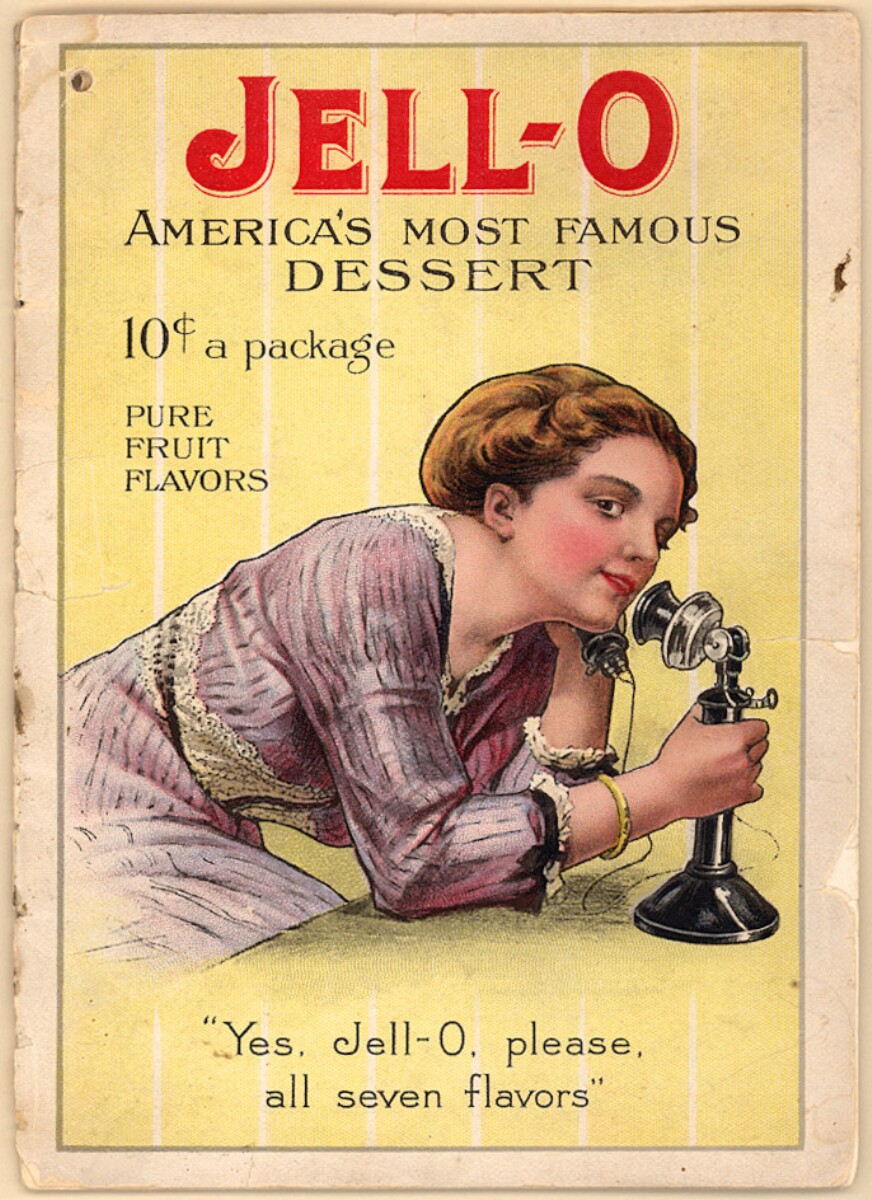
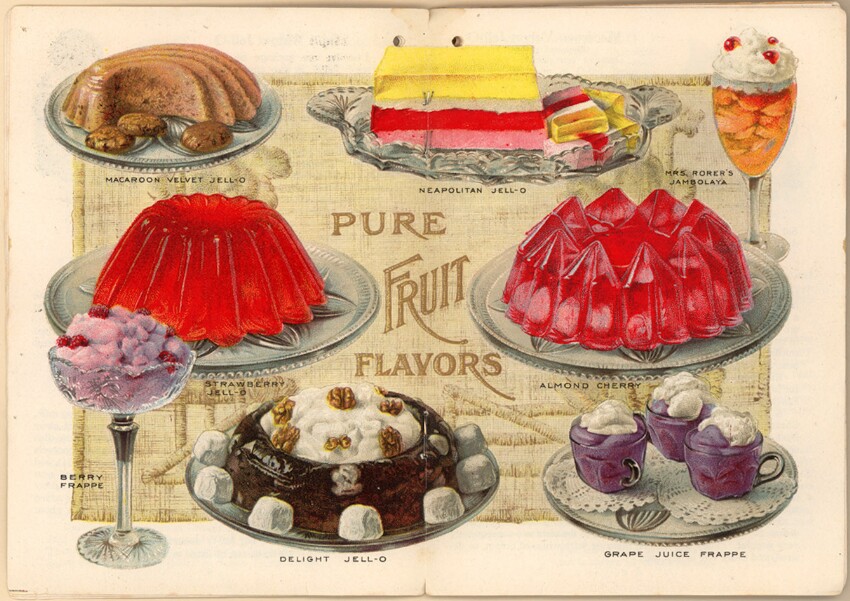
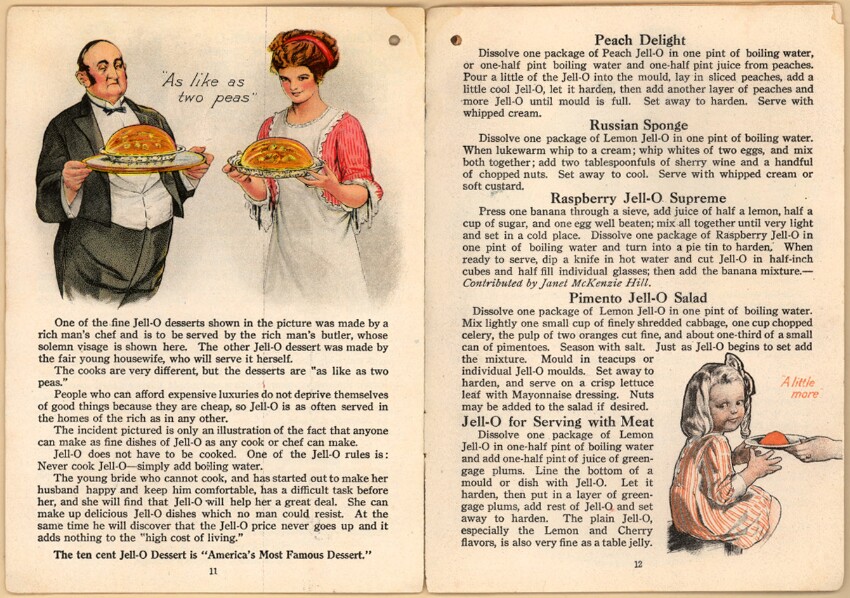
The authors of the pre-Women’s‑Suffrage Jell‑O: America’s Most Famous Dessert, would have boggled at our 21st-century abundance of flavors (and our godlike telephones), just as our eyes widen at their lush full-color illustrations and hundred-year-old social norms.
As one might expect, given the Sallie Bingham Center’s mission of preserving printed materials that reflect the public and private lives of women, past and present, these vintage cookbooks speak to far more than just culinary trends.

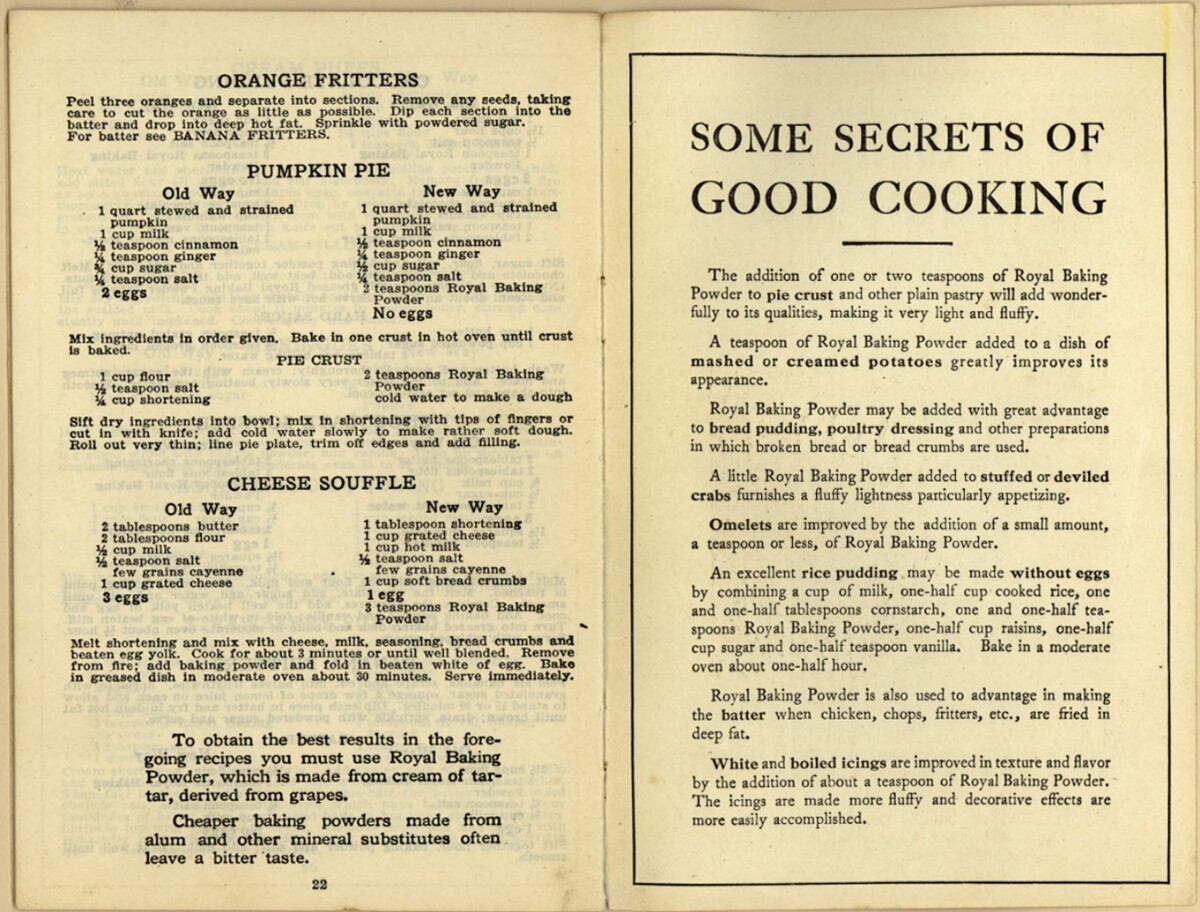
Royal Baking Powder’s 55 Ways to Save Eggs puts a positive spin on wartime economies by framing cheap ingredient substitutions as something clever and modern, attributes the young housewife depicted on the cover would surely wish to embody.
(Shout out to any home bakers who were aware that cream of tartar is derived from grapes…)
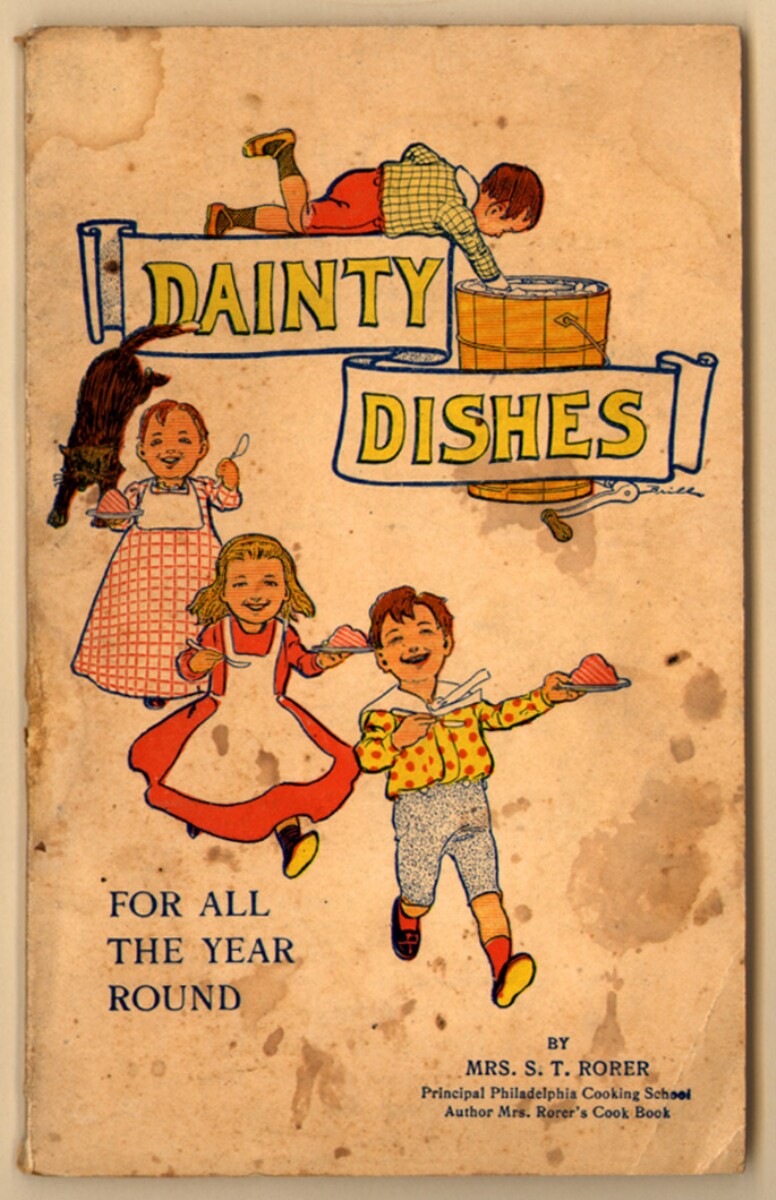
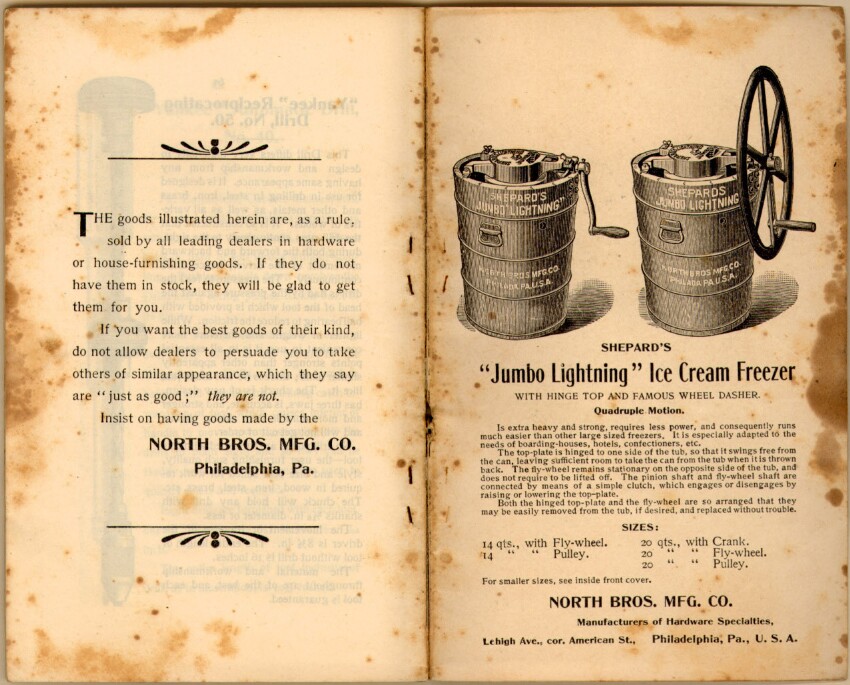
Dainty Dishes for All the Year Round (1900) finds its publisher, North Brothers Manufacturing Co., sitting pretty, unable to imagine a future some twenty years hence, in which technological advances would result in the commercial mass production of ice cream, thus damning their star item, Shephard’s “Lightning” Ice Cream Freezer, to the category of inessential countertop clutter.
Sadly, not all of the delicious-sounding ice cream recipes by Mrs. S. T. Rorer, a leading culinary author and educator and America’s first dietician, are included, but you can browse many illustrated ads for North Brothers’ built-to-last goods, including a meat cutter, a number of screwdrivers, and a magnificently steampunk Christmas tree stand.
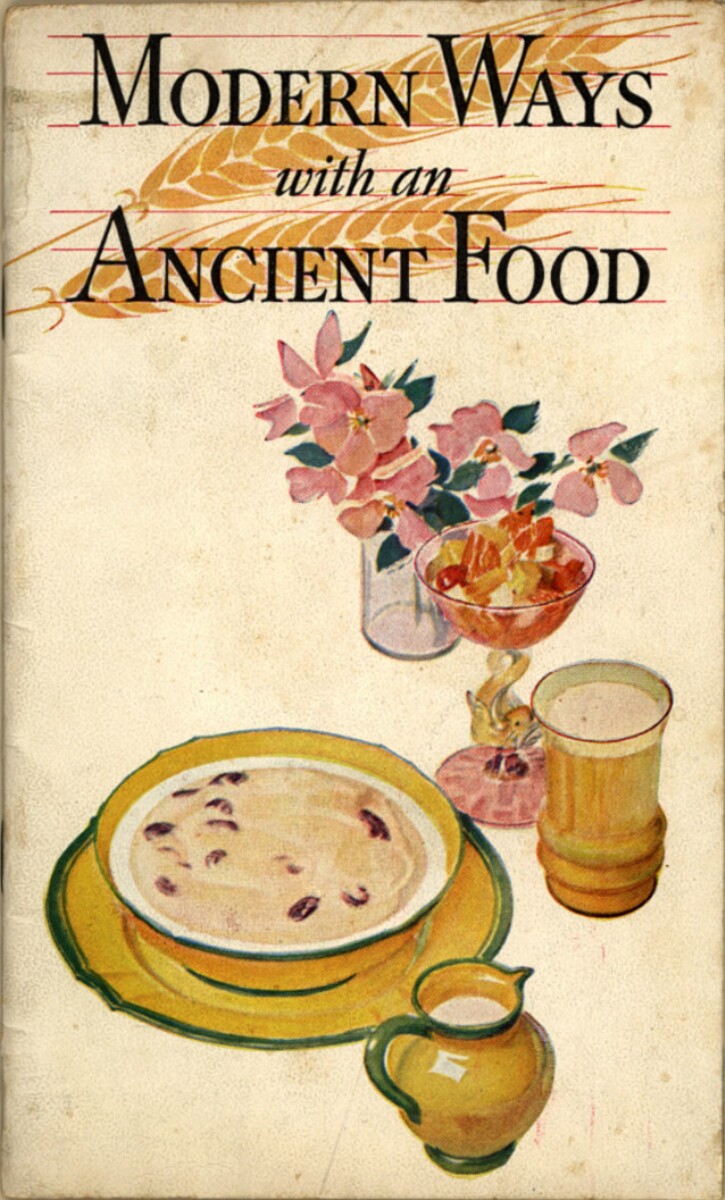
Would it surprise you to learn that our current preoccupation with ancient grains is far from a new thing?
1929’s Modern Ways with an Ancient Food was aimed squarely at mothers anxious, then as now, that their children were properly nourished.
The grain in question was not quinoa or freekeh, but rather farina, referred to by most Americans by its most popular brand name Cream of Wheat, a fact not lost on this volume’s publisher, Cream of Wheat competitor Hecker H‑O Company.
History shows that Cream of Wheat trounced Hecker’s Cream-Farina.
Given the blandness of the grain in question, chalk it up to Cream of Wheat’s muscular advertising approach, and robust licensing of products featuring the iconic image of Rastus, a smiling black spokeschef whose palpably offensive, dialect-heavy endorsements are one pitfall Hecker seems to have skirted.

Begin your explorations of the Sallie Bingham Center’s Nicole Di Bona Peterson Advertising Cookbook Collection here, and let us know in the comments if there’s a recipe you’re intending to try.
Related Content:
An Archive of 3,000 Vintage Cookbooks Lets You Travel Back Through Culinary Time
400 Ways to Make a Sandwich: A 1909 Cookbook Full of Creative Recipes
The Futurist Cookbook (1930) Tried to Turn Italian Cuisine into Modern Art
Ayun Halliday is an author, illustrator, theater maker and Chief Primatologist of the East Village Inky zine. Join her in NYC tonight, Monday, December 9, as her monthly book-based variety show, Necromancers of the Public Domain celebrates another vintage advertising pamphlet, Dennison’s Christmas Book (1921). Follow her @AyunHalliday
Read More...How Maslow’s Hierarchy of Needs Helps Us Understand the Meaning of Life
Abraham Maslow’s 1943 paper “A Theory of Human Motivation” was “written as pure psychology,” notes the BBC, but “it has found its main application in management theory.” It has also become one of the best-known theories of human well-being. But whether you first encountered it in an Intro Psych class or a business training seminar, you’ll immediately recognize the triangular scheme of the “hierarchy of needs,” leading upward from basic physical necessities to full self-actualization.
Maslow’s theory had great explanatory power, offering what he called a “third force” between idealism and materialism. He was in line, he wrote, with the more spiritually-minded pragmatists, or what he called “the functionalist tradition of James and Dewey… fused with the holism of Wertheimer, Goldstein, and Gestalt Psychology, and with the dynamicism of Freud and Adler.” Against the general trend in psychology to pathologize, Maslow offered his paper as “an attempt to formulate a positive theory of motivation.”
His work helped inspire managers to “shape the conditions that create people’s aspirations,” says Gerald Hodgkinson, psychologist at the Warwick Business School,” in order to influence productivity and loyalty in their employees. If this seems manipulative, perhaps Maslow can be held no more responsible than can Freud for the use of his work by his nephew Edward Bernays, who almost single-handedly invented modern advertising and propaganda using Freudian appeals.
Maslow had in mind something grander than managing human capital—“no less,” says Alain de Botton in the School of Life video above, “than the meaning of life.” His quest came itself from a personal motivation. “I was awfully curious,” he once remarked, “to find out why I didn’t go insane.” Or, as de Botton says, he wanted to know “what could make life purposeful for people, himself included, in modern-day America, a country where the pursuit of money and fame seemed to have eclipsed any more interior or authentic aspirations.”
De Botton walks us through the hierarchy, which divides into two dimensions, the material—basic biological needs (including sex) and the need for safety—and the psychological. In this last category, we find the social needs for belonging (“the love needs,” Maslow called them) and esteem, capped with the apex need—self-actualization—the realization of one’s true purpose. “A musician must make music,” wrote Maslow, “an artist must paint, a poet must write, if he is to be ultimately happy. What a man can be, he must be.”
“How do we arrange our priorities and give due regard to the different and competing claims we have on our attention?” De Botton asks. In an increasingly disembodied culture, we may ignore or neglect the needs of the body, even if we have the means to meet them, an unsustainable course over the long term. Even those on the path of the “starving artist” will sadly have to reevaluate after a time, Maslow argued, giving priority to their need to eat over their creative aspirations. But Maslow’s is not, or not only, a theory of rational choice.
On the contrary, he had a compassionate response to alienation and poverty of all kinds: “the bold postulation,” he wrote “that a man who is thwarted in any of his basic needs may fairly be envisaged simply as a sick man…. Who is to say that a lack of love is less important than a lack of vitamins?” The material needs in Maslow’s scheme must be consistently met in order to create a stable base for all the others. Yet, while self-actualization may sit at the top, its lack, according to Maslow, may still affect us as much as much if we suffered from “pellagra or scurvy.”
It’s possible to read in the hierarchy of needs a psychological elaboration of Marx’s slogan “from each according to his ability, to each according to his needs,” but Maslow was no dialectical materialist. He valued spirituality, and if he was “ambivalent about business,” he also held out hope that companies would market products to meet consumers’ higher desires as well as their needs for food, shelter, and physical comfort. Maslow died in 1970, and in the ensuing decades, his wish has become a hugely profitable reality.
From religious broadcasting companies to social media to dating and meditation apps, marketers find ever-new ways to sell promises of belonging, esteem, and self-actualization. Perhaps Maslow would see this as progress. In any case, commerce aside, his theory continues to address pressing sociological and existential problems. And as an aid to personal reflection, it can help us notice how we “haven’t arranged and balanced our needs as wisely and elegantly as we might,” says de Botton. We may have denied ourselves, or been denied, important experiences we need in order to become who we truly are.
Related Content:
The Causes & Prevalence of Suicide Explained by Two Videos from Alain de Botton’s School of Life
The Neuroscience & Psychology of Procrastination, and How to Overcome It
Josh Jones is a writer and musician based in Durham, NC. Follow him at @jdmagness
Read More...Support Us
We're hoping to rely on loyal readers, rather than erratic ads. Please click the Donate button and support Open Culture. You can use Paypal, Venmo, Patreon, even Crypto! We thank you!

About Us

Open Culture scours the web for the best educational media. We find the free courses and audio books you need, the language lessons & educational videos you want, and plenty of enlightenment in between.
Advertise With Us

FREE UPDATES!
GET OUR DAILY EMAIL
Get the best cultural and educational resources on the web curated for you in a daily email. We never spam. Unsubscribe at any time.
FOLLOW ON SOCIAL MEDIA

Open Culture editor Dan Colman scours the web for the best educational media. He finds the free courses and audio books you need, the language lessons & movies you want, and plenty of enlightenment in between.
Advertise With Us

