The Dark Side of the Moon Project: Watch an 8‑Part Video Essay on Pink Floyd’s Classic Album
Recorded at Abbey Road studios by Alan Parsons, who had previously worked on The Beatles’ Abbey Road and Let It Be, Pink Floyd’s The Dark Side of the Moon broke almost as much sonic ground as those albums. “The band chose the world-renowned studio, as it was home to, at the time, some of the most advanced recording technology ever produced – including the EMI TG12345 mixing console,” writes Anthony Sfirse at Enmore Audio.
Parsons made tasteful yet totally spaced-out use, as the Polyphonic video above shows, of synthesizers, stereo multitrack recording, and tape loops. Then there’s David Gilmour’s legendary guitar tone—so essential to a certain kind of music (and to Pink Floyd cover bands) that guitar pedal designer Robert Keeley has built an entire “workstation” around the guitar sounds on the album, even though most players, including Gilmour, will tell you that tone lives in the fingers.
The album is a perfect synthesis of the band’s strengths: epic songwriting meets epic experimentation meets epic musicianship—three musical directions that don’t always play well together. The late sixties and seventies brought increasing complexity and theatricality to rock and roll, but Pink Floyd did something extraordinary with Dark Side. They wrote accessible, riff-heavy, blues-based tunes that also set the bar for philosophically existential, wistful, melancholy, sardonic, funky, soulful, psychedelia, without sacrificing one for the other.
How the band went from cultivating a cult underground to spending 741 weeks—or 14 years—at the top of Billboard’s albums chart after the release of their “high concept lyrical masterpiece” in 1973 is the subject of a series of eight videos produced by Polyphonic. See the first, which covers “Speak to Me/Breath,” at the top, and others below. New videos will be released on the Polyphonic YouTube channel soon.
The approach is an admirable one. Too often the greatness of classic albums like Dark Side of the Moon is taken for granted and glossed too quickly. The album’s massive commercial and critical success seems proof enough. We may not know much about Pink Floyd ourselves, but we acknowledge they’ve been thoroughly vetted by the experts.
But if we want to know ourselves why critics, musicians, and fans alike have heaped so much praise on the 1973 album—and shelled out hard-earned cash by the millions for records, concerts, and merchandise—we might learn quite a lot from this series.
Related Content:
Josh Jones is a writer and musician based in Durham, NC. Follow him at @jdmagness
Read More...These Boots Are Made for Walkin’: The Story Behind Nancy Sinatra’s Enduring #1 Hit (1966)
You put on your boots
And I’ll put on mine
And we’ll sell a million records
Any old time
- Lee Hazlewood
Musicians!
Looking to increase your chances of a hit song, one that will worm its way into the public’s hearts and ears, earning fat royalty checks for half a century or more?
Try starting with a killer bass line.
According to singer Nancy Sinatra, songwriter Lee Hazlewood and arranger Billy Strange swung by her parents’ living room to preview a selection of tunes they thought she might want to record.
The moment she heard “These Boots Are Made For Walkin’ ”s memorable lick, she knew it was a winner.
(As did her famous father, who looked up from his newspaper after Hazlewood and Strange departed, to remark, “The song about the boots is best.”)
Originally conceived of as a song from the male POV, the 25-year-old, just-divorced Sinatra felt its message would be less “harsh and abusive” delivered by a “little girl.”
Hazlewood agreed, but hedged his bets by directing engineer Eddie Brackett to beef up Sinatra’s vocals with some light reverb.
As biographer James Kaplan describes in Sinatra: The Chairman, Hazlewood also offered some discreet direction, insinuating that the vibe to strive for was that of “a 14-year-old girl in love with a 40-year-old man.”
When Sinatra failed to receive his meaning, he shucked all pretense of delicacy. Nancy shared his marching orders in her 1985 biography Frank Sinatra, My Father:
…I was still singing like Nancy NiceLady. Lee hit the talk-back switch in the booth and his deep voice blew my ears off. ‘For chrissake, you were a married woman, Nasty, you’re not a virgin anymore. Let’s do one for the truck drivers. Say something tough at the end of this one… Bite the words.’
Or something to that effect…
Kaplan includes how several sources claim that Hazlewood’s actual instruction was to sing it like “a sixteen-year-old girl who f**ks truck drivers.”
(Editor’s note: instructing a young woman to do that in 2020 is far likelier to result in a law suit than a hit record.… and given that most of the sources who abide by this version of Boots’ creation myth preface their statements with the word “apparently,” it may not have flown in 1966 either.)
The song’s immense popularity was given an assist by the 1966 Color-Sonics film, above, shot in 16mm for the public’s enjoyment on 26-inch Scopitone jukebox screens.
It also put a match to the American tinder where go-go boots were concerned. Young women in Britain had already adopted them as the perfect footwear to accompany Youthquake designer Mary Quant’s miniskirts and hot pants. Sinatra and her maxi sweater-wearing back up dancers get the bulk of the credit on this side of the pond.
While “These Boots Are Made for Walkin’” has been covered by everyone from Ella Fitzgerald and Duke Ellington to Billy Ray Cyrus and Megadeth, the sweetest cover remains songwriter Hazlewood’s, below, in which he namechecks the collaborators of his most famous hit with nary a mention of truckers or teenaged girls.
Related Content:
Meet Carol Kaye, the Unsung Bassist Behind Your Favorite 60s Hits
How the Vietnam War Shaped Classic Rock–And How Classic Rock Shaped the War
The Sex Pistols’ Sid Vicious Sings Frank Sinatra’s “My Way”: Is Nothing Sacred?
Ayun Halliday is an author, illustrator, theater maker and Chief Primatologist of the East Village Inky zine. Join her in NYC TONIGHT, Monday, February 3, as her monthly book-based variety show, Necromancers of the Public Domain celebrates New York, The Nation’s Metropolis (1921). Follow her @AyunHalliday.
Read More...How the Psychedelic Mellotron Works: An In-Depth Demonstration
Recorded music history is filled with instruments that appeared for a brief time, then were never heard from again—relegated to the dustbin of too-quirky, heavy, awkward, tonally-unpleasant, or impossible-to-tune-and-maintain. Then there are instruments—once they assumed their basic shape and form—that have persisted largely unchanged for centuries. The Mellotron falls into neither of these categories. But it may in time transcend them both in a strange way.
“Of all of the strange instruments that’ve worked the edges of popular music,” writes Gareth Branwyn at Boing Boing, “the Mellotron is probably the oddest. Basically an upright organ cabinet filled the tape heads and recorded tape strips that you trigger through the keyboard, the Mellotron is like some crazy one-off contraption that caught on and actually got manufactured.”
First made in England in 1963, it appeared in various models throughout the seventies and eighties. It has reappeared in the nineties and 2000s in improved and upgraded versions, all leading up to what Sound on Sound called “the most technologically sophisticated Mellotron ever,” the 2007 M4000. In the video above Allison Stout from Bell Tone Synth Works, a music shop in Philadelphia, PA, demonstrates a much earlier, far less advanced M400 from 1976.
Not only did the Mellotron beat the odds of remaining an unworkable prototype; the proto-sampler became a psychedelic signature: from “Strawberry Fields Forever” to the Moody Blues and David Bowie’s “Space Oddity.” It populated early prog rock, thanks to Yes’s Rick Wakeman, who played on Bowie’s space rock classic in 1969, and to Ian McDonald, who fell for the instrument that same year as a founding member of King Crimson. (See enthusiastic YouTuber “Doctor Mix” play Mellotron parts from well-known songs above.)
The instrument’s slightly cheesy, Lawrence-Welk-orchestra-like sounds somehow fit perfectly with the loose, spacious instrumentation of prog and psych rock; its sound will live as long as the music of The Beatles, Bowie, and everyone else who put a microphone in front of a Mellotron. Yet in most of its iterations, the Mellotron has lacked the characteristics of a melodic instrument that survives the test of time. It is finicky and prone to frequent breakdowns. It is limited in its tonal range to a series of tape recordings of a limited number of instruments.
In the case of the Mellotron M400 at the top, those instruments are violin, flute, and cello. Do the sounds coming from the Mellotron in any way improve upon or even approximate the qualities of their originals? Of course not. Why would musicians choose to record with a Mellotron at a time when analogue synthesizers were becoming affordable, portable, and capable of an expressive range of tones? The answer is simple. Nothing else makes the weird, warm, warbly, whirring, and entirely otherworldly sound of a Mellotron, and nothing ever will.
Related Content:
Visit an Online Collection of 61,761 Musical Instruments from Across the World
Josh Jones is a writer and musician based in Durham, NC. Follow him at @jdmagness
Read More...Monty Python’s Terry Jones (RIP) Was a Comedian, But Also a Medieval Historian: Get to Know His Other Side
Monty Python’s surreal, slapstick parodies of history, religion, medicine, philosophy, and law depended on a competent grasp of these subjects, and most of the troupe’s members, four of whom met at Oxford and Cambridge, went on to demonstrate their scholarly acumen outside of comedy, with books, guest lectures, professorships, and serious television shows.
Michael Palin even became president of the Royal Geographical Society for a few years. And Palin’s onetime Oxford pal and early writing partner Terry Jones—who passed away at 77 on January 21 after a long struggle with degenerative aphasia—didn’t do so badly for himself either, becoming a respected scholar of Medieval history and an authoritative popular writer on dozens of other subjects.
Indeed, as the Pythons did throughout their academic and comedic careers, Jones combined his interests as often as he could, either bringing historical knowledge to absurdist comedy or bringing humor to the study of history. Jones wrote and directed the pseudo-historical spoofs Monty Python and the Holy Grail and Life of Brian, and in 2004 he won an Emmy for his television program Terry Jones’ Medieval Lives, an entertaining, informative series that incorporates sketch comedy-style reenactments and Terry Gilliam-like animations.
In the program, Jones debunks popular ideas about several stock medieval European characters familiar to us all, while he visits historical sites and sits down to chat with experts. These characters include The Peasant, The Damsel, The Minstrel, The Monk, and The Knights. The series became a popular book in 2007, itself a culmination of decades of work. Jones first book, Chaucer’s Knight: The Portrait of a Medieval Mercenary came out in 1980. There, notes Matthew Rozsa at Salon:
[Jones] argued that the concept of Geoffrey Chaucer’s knight as the epitome of Christian chivalry ignored an uglier truth: That the Knight was a mercenary who worked for authoritarians that brutally oppressed ordinary people (an argument not dissimilar to the scene in which a peasant argues for democracy in The Holy Grail).
In 2003, Jones collaborated with several historians on Who Murdered Chaucer? A speculative study of the period in which many of the figures he later surveyed in his show and book emerged as distinctive types. As in his work with Monty Python, he didn’t only apply his contrarianism to medieval history. He also called the Renaissance “overrated” and “conservative,” and in his 2006 BBC One series Terry Jones’ Barbarians, he described the period we think of as the fall of Rome in positive terms, calling the city’s so-called “Sack” in 410 an invention of propaganda.
Jones’ work as a popular historian, political writer, and comedian “is not the full extent of [his] oeuvre,” writes Rozsa, “but it is enough to help us fathom the magnitude of the loss suffered on Tuesday night.” His legacy “was to try to make us more intelligent, more well-educated, more thoughtful. He also strove, of course, to make us have fun.” Python fans know this side of Jones well. Get to know him as a passionate interpreter of history in Terry Jones’ Medieval Lives, which you can watch on YouTube here.
For an academic study of Jones’ medieval work, see the collection: The Medieval Python The Purposive and Provocative Work of Terry Jones.
Related Content:
Monty Python’s Eric Idle Breaks Down His Most Iconic Characters
Josh Jones is a writer and musician based in Durham, NC. Follow him at @jdmagness
Read More...A Concise Breakdown of How Time Travel Works in Popular Movies, Books & TV Shows
As least since H.G. Wells’ 1895 novel The Time Machine, time travel has been a promising storytelling concept. Alas, it has seldom delivered on that promise: whether their characters jump forward into the future, backward into the past, or both, the past 125 years of time-travel stories have too often suffered from inelegance, inconsistency, and implausibility. Well, of course they’re implausible, everyone but Ronald Mallett might say — they’re stories about time travel. But fiction only has to work on its own terms, not reality’s. The trouble is that the fiction of time travel can all too easily stumble over the potentially infinite convolutions and paradoxes inherent in the subject matter.
In the MinutePhysics video above, Henry Reich sorts out how time-travel stories work (and fail to work) using nothing but markers and paper. For the time-travel enthusiast, the core interest of such fictions isn’t so much the spectacle of characters hurtling into the future or past but “the different ways time travel can influence causality, and thus the plot, within the universe of each story.” As an example of “100 percent realistic travel” Reich points to Orson Scott Card’s Ender’s Game, in which space travelers at light speed experience only days or months while years pass back on Earth. The same thing happens in Planet of the Apes, whose astronauts return from space thinking they’ve landed on the wrong planet when they’ve actually landed in the distant future.
But when we think of time travel per se, we more often think of stories about how actively traveling to the past, say, can change its future — and thus the story’s “present.” Reich poses two major questions to ask about such stories. The first is “whether or not the time traveler is there when history happens the first time around. Was “the time-traveling version of you always there to begin with?” Or “does the very act of time traveling to the past change what happened and force the universe onto a different trajectory of history from the one you experienced prior to traveling?” The second question is “who has free will when somebody is time traveling” — that is, “whose actions are allowed to move history onto a different trajectory, and whose aren’t?”
We can all look into our own pasts for examples of how our favorite time-travel stories have dealt with those questions. Reich cites such well-known time-travelers’ tales as A Christmas Carol, Groundhog Day, and Bill & Ted’s Excellent Adventure, as well, of course, as Back to the Future, the most popular dramatization of the theoretical changing of historical timelines caused by travel into the past. Rian Johnson’s Looper treats that phenomenon more complexly, allowing for more free will and taking into account more of the effects a character in one time period would have on that same character in another. Consulting on that film was Shane Carruth, whose Primer — my own personal favorite time-travel fiction — had already taken time travel “to the extreme, with time travel within time travel within time travel.”
Harry Potter and the Prisoner of Azkaban, Reich’s personal favorite time-travel fiction, exhibits a clarity and consistency uncommon in the genre. J.K. Rowling accomplishes this by following the rule that “while you’re experiencing your initial pre-time travel passage through a particular point in history, your time-traveling clone is also already there, doing everything you’ll eventually do when you time-travel yourself.” This single-time-line version of time travel, in which “you can’t change the past because the past already happened,” gets around problems that have long bedeviled other time-travel fictions. But it also demonstrates the importance of self-consistency in fiction of all kinds: “In order to care about the characters in a story,” Reich says, “we have to believe that actions have consequences.” Stories, in other words, must obey their own rules — even, and perhaps especially, stories involving time-traveling child wizards.
Related Content:
Professor Ronald Mallett Wants to Build a Time Machine in this Century … and He’s Not Kidding
What Happened When Stephen Hawking Threw a Cocktail Party for Time Travelers (2009)
Based in Seoul, Colin Marshall writes and broadcasts on cities, language, and culture. His projects include the book The Stateless City: a Walk through 21st-Century Los Angeles and the video series The City in Cinema. Follow him on Twitter at @colinmarshall or on Facebook.
Read More...The Flute of Shame: Discover the Instrument/Device Used to Publicly Humiliate Bad Musicians During the Medieval Period
Since humanity has had music, we’ve also had bad music. And bad music can come from only one source: bad musicians. Despite such personal technologies of relatively recent invention as noise-canceling headphones, bad music remains nigh unavoidable in the modern world, issuing as it constantly does from the sound systems installed in grocery stores, gyms, passing automobiles, and so on. And against the bad musicians responsible we have less recourse than ever, or at least less than medieval Europeans did, as shown by the Ripley’s Believe It or Not video above on the “shame flute,” a non-musical instrument used to punish crimes against the art.
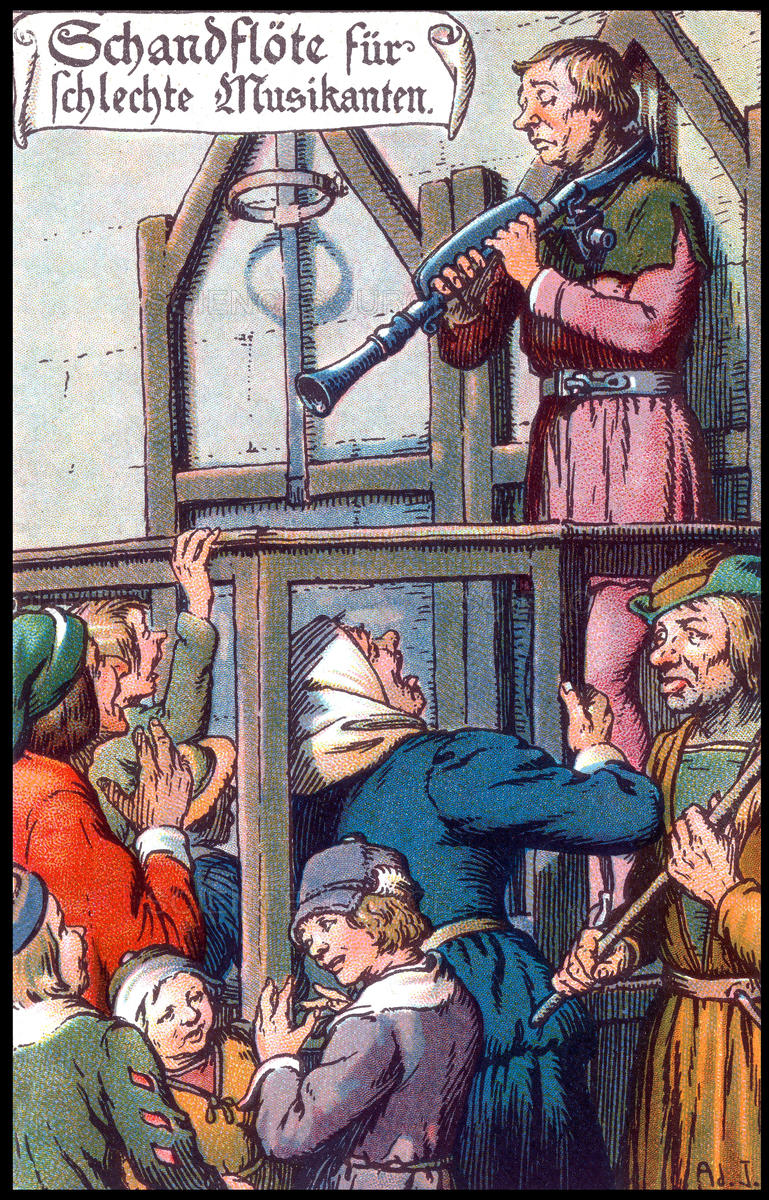
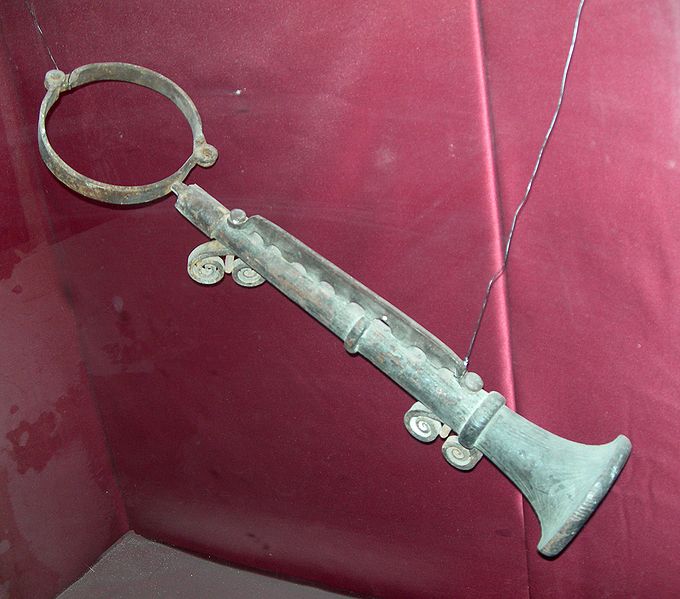
“The contraption, which is essentially a heavy iron flute – although you probably wouldn’t want play it – was shackled to the musician’s neck,” writes Maddy Shaw Roberts at Classic FM. “The musician’s fingers were then clamped to the keys, to give the impression they were playing the instrument. Finally, just to further their humiliation, they were forced to wear the flute while being paraded around town, so the public could throw rotten food and vegetables at them.” Surely the mere prospect of such a fate made many music-minded children of the olden days think twice about slacking on their practice sessions.
The sight of this flute of shame, which you can take in at either the equally stimulating-sounding Medieval Crime Museum in Rothenburg or the Torture Museum in Amsterdam, would get any of us moderns thinking about considering which musicians of our own day deserve to be shackled to it. The Guardian’s Dave Simpson suggests, among others, “all bands with silly names,” “any musician called Sir who is over 60,” and “anyone who has ever appeared on The X Factor, ever.” In this day and age they would all probably complain of cruel and unusual punishment, but as music-related torture devices go, the shame flute certainly seems preferable to ancient Greece’s “brazen bull.”
Though still a little-known historical artifact, the shame flute has regained some cultural currency in recent years. It even inspired the name of a Finnish rock group, Flute of Shame. As the band members put it in an interview with Vice’s Josh Schneider, “We were having a night out in Amsterdam and found ourselves in a torture museum whilst looking for the Banana Bar,” a well-known spot in the city’s red-light district. “We saw the device and the rest is history.” Of course, any rock group that names itself after a torture device will draw comparisons to Iron Maiden, and journalistic diligence compels Schneider to ask Flute of Shame which band would win in a shredding contest. “Probably Iron Maiden,” the Finns respond, “but are they happy?”
via Classic FM
Related Content:
Meet the Hurdy Gurdy, the Hand-Cranked Medieval Instrument with 80 Moving Parts
Hear the World’s Oldest Instrument, the “Neanderthal Flute,” Dating Back Over 43,000 Years
Based in Seoul, Colin Marshall writes and broadcasts on cities, language, and culture. His projects include the book The Stateless City: a Walk through 21st-Century Los Angeles and the video series The City in Cinema. Follow him on Twitter at @colinmarshall or on Facebook.
Read More...How to Draw Like an Architect: An Introduction in Six Videos
That we pass through life without really perceiving our surroundings has long been a commonplace. How can we cure ourselves of this regrettable condition? Before we can learn to notice more of what’s around us, we must have a process to test how much we already notice. Many artists and all architects already have one: drawing, the process of recording one’s perceptions directly onto the page. But while artists may take their liberties with physical reality — it isn’t called “artistic license” by coincidence — architects draw with more representationally rigorous expectations in mind.
Though we can heighten our awareness of the built environment around us by practicing architectural drawing, we need not learn only from architects. In the video at the top of the post, a Youtuber named Shadya Campbell who deals with creativity more generally offers a primer on how to draw buildings — or, perhaps less intimidatingly, on “architectural doodles for beginners.” As an example, she works through a drawing of Paris’ Notre-Dame cathedral (mere weeks, incidentally, before the fire of last April so dramatically altered its appearance), using a simple head-on viewpoint that nevertheless provides plenty of opportunity to practice capturing its shapes and filling in its details.
Below that, architect Llyan Austria goes a step further by introducing a few drawing practices from the profession under the banner of his “top six architecture sketching techniques.” Much of his guidance has to do with drawing something as simple — or as seemingly simple — as a line: he recommends beginning with the most general outlines of a space or building and filling in the details later, emphasizing the start and end of each line, and letting the lines that meet overlap. To get slightly more technical, he also introduces the methods of perspective, used to make architectural drawings look more realistically three-dimensional.
When you introduce perspective to your drawings, you have three types to choose from, one-point, two-point, and three-point. A drawing in one-point perspective, the simplest of the three, has only a single “vanishing point,” the point at which all of its parallel lines seem to converge, and is most commonly used to render interiors (or to compose shots in Stanley Kubrick movies). In two-point perspective, two vanishing points make possible more angles of viewing, looking not just straight down a hall, for example, but at the corner of a building’s exterior. With the third vanishing point incorporated into three-point perspective, you can draw from a high angle, the “bird’s eye view,” or a low angle, the “worm’s eye view.”
You can learn how to draw from all three types of perspective in “How to Draw in Perspective for Beginners,” a video from Youtube channel Art of Wei. Below that comes the more specifically architecture-minded “How to Draw a House in Two Point Perspective” from Tom McPherson’s Circle Line Art School. After a little practice, you’ll soon be ready to enrich your architectural drawing skills, however rudimentary they may be, with advice both by and for architecture professionals. At his channel 30X40 Design Workshop, architect Eric Reinholdt has produced videos on all aspects of the practice, and below you’ll find his video of “essential tips” on how to draw like an architect.”
In this video and another on architectural sketching, Reinholdt offers such practical advice as pulling your pen or pencil instead of pushing it, moving your arm rather than just pivoting at the wrist, and making “single, continuous, confident strokes.” He also goes over the importance of line weight — that is, the relative darkness and thickness of lines — and how it can help viewers to feel what in a drawing is supposed to be where. But we can’t benefit from any of this if we don’t also do as he says and make drawing a habit, switching up our location and materials as necessary to keep our minds engaged. That goes whether we have a professional or educational interest in architecture or whether we just want to learn to see the ever-shifting mixture of manmade and natural forms that surrounds us in all its richness.
Related Content:
How to Write Like an Architect: Short Primers on Writing with the Neat, Clean Lines of a Designer
How to Draw the Human Face & Head: A Free 3‑Hour Tutorial
Cartoonist Lynda Barry Teaches You How to Draw
Milton Glaser Draws Shakespeare & Explains Why Drawing is the Key to Understanding Life
The Elements of Drawing: A Free Course from Oxford
Based in Seoul, Colin Marshall writes and broadcasts on cities, language, and culture. His projects include the book The Stateless City: a Walk through 21st-Century Los Angeles and the video series The City in Cinema. Follow him on Twitter at @colinmarshall or on Facebook.
Read More...How a Philip Glass Opera Gets Made: An Inside Look
Most fever dreams require very little pre-planning and coordination. All it takes is the flu and a pillow, and perhaps a shot of Ny-Quil.
A fever dream on the order of composer Philip Glass’ 1984 opera, Akhnaten, is a horse of an entirely different color, as “How An Opera Gets Made,” above, makes clear.
For those in the performing arts, the revelations of this eyepopping Vox video will come as no surprise, though the formidable resources of New York City’s Metropolitan Opera, where the piece was recently restaged by director Phelim McDermott, may be cause for envy.
The costumes!
The wigs!
The set!
The orchestra!
The jugglers!
… wait, jugglers?
Yes, a dozen, whose carefully coordinated efforts provide a counterpoint to the stylized slow motion pace the rest of the cast maintains for the duration of the three and half hour long show.
This maximalist approach to minimalist modern opera has proved a hit, though the New York Times’ critic Anthony Tommasini opined that he could have done with less juggling…
We presume everyone gets that bringing an opera to the stage involves many more departments, steps, and heavy labor than can be squeezed into a 10-minute video.
Perhaps the biggest surprise awaiting the uninitiated is the playful offstage manner of Anthony Roth Costanzo, the supremely gifted countertenor in the title role. As the pharaoh who reduced ancient Egypt’s pantheon to a single god, Aten, aka the sun, he makes his first entrance completely nude, head shaved, flecked in gold, facing the audience for the entirety of his four-minute descent down a 12-step staircase.
(One step the video doesn’t touch on is the workout regimen he embarked on in preparation for his nude debut, a 6‑day-a-week commitment that inspired him to found one of the first American businesses to offer fitness buffs training sessions using Electrical Muscle Stimulation.)
His dedication to his craft is obviously extraordinary. It has to be for him to handle the score’s demanding arpeggios and intricate repetitions, notably the six-minute segment whose only lyric is “ah.” His breath control on that section earns high praise from his longtime vocal coach Joan Patenaude-Yarnell.
But—and this will come as a shock to those of us whose concept of male opera stars is informed nearly exclusively by Bugs Bunny cartoons and the late Luciano Pavarotti—his outsized talent does not seem to be reflected in outsized self-regard.
He treats viewers to a self-deprecating peek inside the Met’s wig room while clad in a decidedly anti-primo uomo sweatshirt, gamely dons his styrofoam khepresh for close range inspection, and cracks himself up by high-fiving his own pharaonic image in the lobby.
There’s incredible lightness to this being.
As such, he may be more effective at attracting a new generation of admirers to the art form than any discounts or pre-show mixer for patrons 35-and-under.
For further insights into how this musical sausage got made, have a gander at the Metropolitan Opera’s pre-production videos and read star Anthony Roth Costanzo’s essay in the Guardian.
Related Content:
Is Opera Part of Pop Culture? Pretty Much Pop #15 with Sean Spyres
Hear the Highest Note Sung in the 137-Year History of the Metropolitan Opera
Hear Singers from the Metropolitan Opera Record Their Voices on Traditional Wax Cylinders
Ayun Halliday is an author, illustrator, theater maker and Chief Primatologist of the East Village Inky zine. Join her in NYC on Monday, January 6 when her monthly book-based variety show, Necromancers of the Public Domain celebrates New York: The Nation’s Metropolis (1921). Follow her @AyunHalliday.
Read More...How Cartoons Saved R. Crumb’s Life, and How R. Crumb Turned Cartoons into an Art Form (NSFW)
Robert Crumb, the iconic, founding figure of the underground and alternative comix scene, began his career as the ultimate outsider. “I was so alienated when I was young that drawing was like my only connection to society,” he says in the video interview above from the Louisiana Channel, “the only thing I could see that was gonna save me from a really dismal fate of god knows what.” He had no social skills and no other abilities to speak of. He was debilitated by self-doubt yet inflated by the buoyant ego of the lone artist determined to “make [his] mark on the world.”
What Crumb calls his “two sides” have never been reconciled, although he has left behind certain racial caricatures in more recent work and he claims, in a recent interview with Nadja Sayej, that he is “no longer a slave to a raging libido.” But his shameless indulgence in exaggerated stereotypes was always a blunt instrument that both pulled readers in and pushed them away from the more subtle satire and pathos in his comics. As an editor at a London gallery put it, “there’s something irreconcilable at the heart of the work that doesn’t resolve towards a single vision of beauty.”
Crumb’s comics are “about seduction and repulsion. You are drawn into the work and you are judging yourself as you look at it.” We are also judging the artist. Crumb has been called racist, misogynist, a bitter, hateful loner with a nihilistic streak five miles wide. These descriptions happen to apply to a significant number of convicted and potential terrorist killers these days, the very people we seek to marginalize from public discourse with hate speech laws and public shaming and shunning.
As you might expect, Crumb has no tolerance for such things as fall under the heading “political correctness.” Suppressing art that offends “can even lead to censorial policies in the government,” he says, defending the rights of the artist to say whatever they deem necessary. His work, he says, even at its most extreme, was necessary. It saved his life. “The artwork I did that used those images and expressed those kinds of feelings, I stand by it…. I still think that’s something that needed to be said and needed to be done…. It probably hurts some people’s feelings to see those images, but still, I had to put it out there.”
Some of Crumb’s imagery is hard to defend, such as his use of blackface imagery from the 1920s and 30s, and his sometimes violent objectification of women, from the point of view of characters nearly impossible to separate from their creator. But why, if his art is confessional, should he not confess? In so doing, he reveals not only his own teeming desires. Crumb illustrated the male hippie unconscious as well as his own.
After starting a relative mass movement in underground comix in the 60s (and becoming a reluctant legend for “Keep on Truckin’”), he says, “I decided I don’t want to be America’s best-loved hippie cartoonist. I don’t want that role. So I’ll just be honest about who I am, and the weirdness, and take my chances.” Crumb’s candor happened to lay bare many of the attitudes he observed not only in himself but in the denizens of the San Francisco scene, as he told Jacques Hyzagi in a very revealing Observer interview (which prompted a very bitter feud between the two).
The hippie culture of Haight-Ashbury, where it all started for me, was full of men doing nothing all day and expecting women to bring them food. The ‘chick’ had to provide a home for them, cook meals for them, even pay the rent. It was still very much ingrained from the earlier patriarchal mentality of our fathers, except that our fathers, generally, were providers. Free love meant free sex and food for men. Sure, women enjoyed it, too, and had a lot of sex, but then they served men. Even among left-wing political groups, women were always relegated to secretarial, menial jobs. We were all on LSD, so it took a few years for the smoke to dissipate and for women to realize what a raw deal they were getting with the ne’er-do-well hippie male.
Do we see in Crumb’s work, in which burly, huge-calved women dominate weak-willed men, a celebration or a condemnation of these attitudes? We can say, “it’s complicated,” which sounds like a cop out, or we can go back to the source. Hear Crumb himself explain his work, as a product of two warring selves and a need to draw himself into the world without holding anything back. He showed other artists and writers who were also “born weird,” as he says, that they could tell their stories entirely their own way too.
Related Content:
R. Crumb Illustrates Genesis: A Faithful, Idiosyncratic Illustration of All 50 Chapters
Josh Jones is a writer and musician based in Durham, NC. Follow him at @jdmagness
Read More...The History of the Fisheye Photo Album Cover
Like gothic script in heavy metal, the fisheye album cover photo seems like a naturally occurring feature of certain psychedelic strains of music. But it has a history, as does the fisheye photograph itself. The Vox video above begins in 1906 with Johns Hopkins scientist and inventor Robert Wood, a somewhat eccentric professor of optical physics who wanted to duplicate the way fish see the world: “the circular picture,” he wrote, “would contain everything within an angle of 180 degrees in every direction, i.e. a complete hemisphere.”
Rather than putting them to underwater use, later scientists employed Wood’s ideas in astronomical observation. Their next stop was the professional photography market: the first mass-produced fisheye lens, made by Nikon, cost $27,000 in 1957. From academic journals to the pages of Life magazine: mass media brought fisheye photography into popular culture. An affordable, consumer-grade lens in 1962 brought it within the reach of the masses. For the way it compresses angles, the fisheye lens “was, and always has been, a handy tool to capture tight quarters, as well as huge spaces.”
The fisheye lens suited the Beatles phenomenon perfectly, compressing backstage hallways and stadium-sized crowds into the same hypnotically circular dimensions. “Perhaps its greatest strength was making rock stars appear larger than life.”
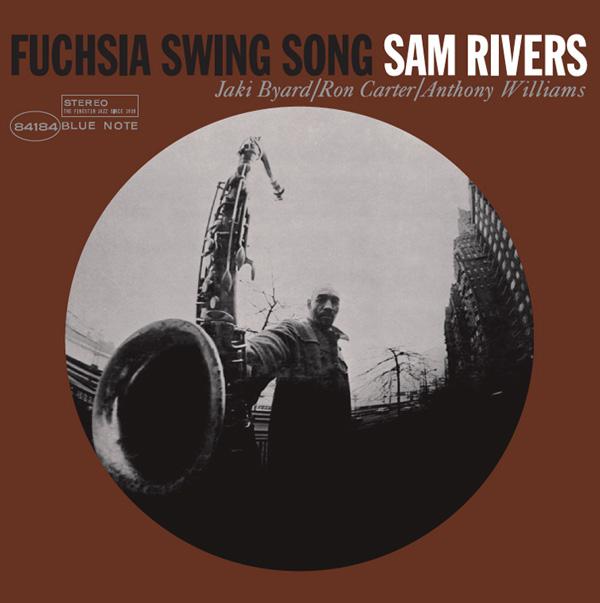
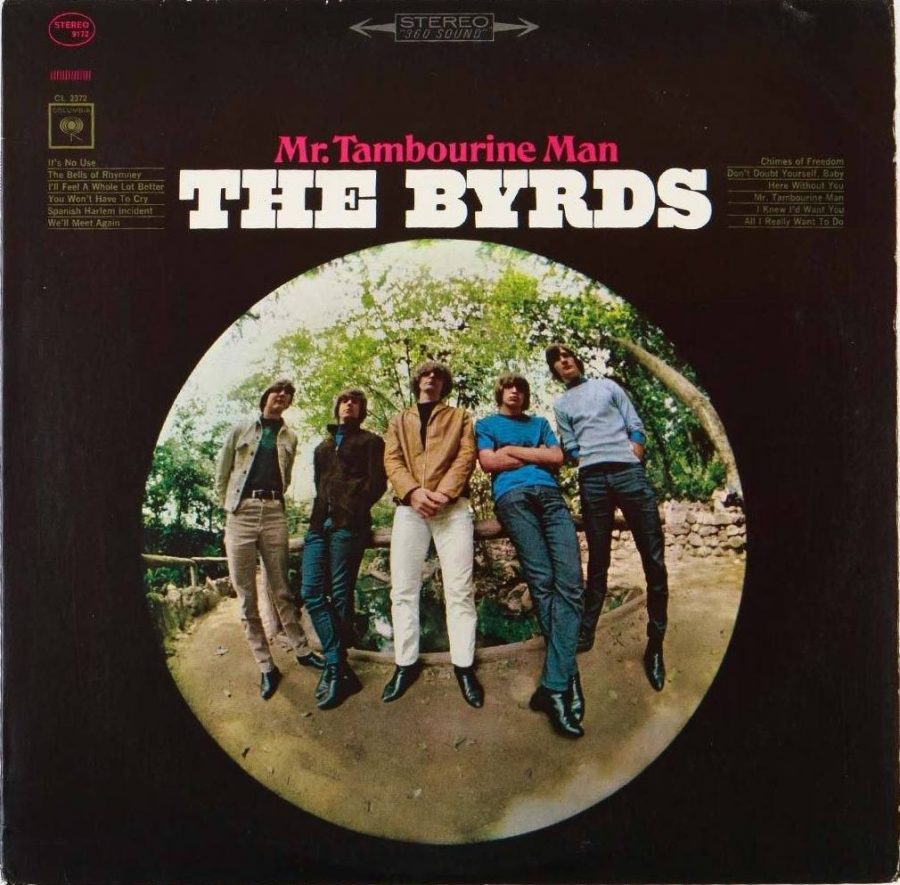
The fisheye photo “reflected the trippiness of the psychedelic era.” Although one of the earliest uses on an album cover was Sam Rivers’ Fuschia Swing Song, it soon adorned the Byrds Mr. Tambourine Man and—of course—the cover of Jimi Hendrix’s Are You Experienced. The iconic band photo of the Experience, taken by graphic designer Karl Ferris, inspired hundreds of psychedelic imitators.
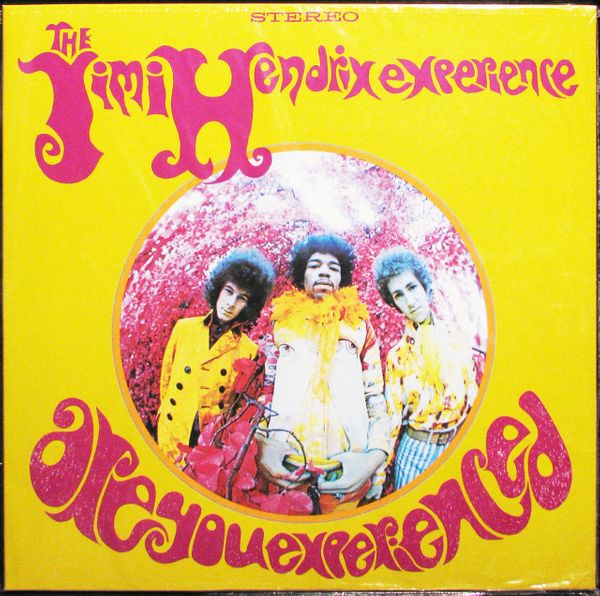
Ferris thought of the fisheye photo with reference, again, not to the ocean but the stars: Hendrix’s music, he said, was “so far out that it seemed to come from outer space.” In order to introduce the band to audiences who hadn’t heard of them yet, he conceived of them as a “group traveling through space in a Biosphere on their way to bring their otherworldly space music to earth.” Inseparable from space travel after NASA’s many fisheye photos of the Apollo missions, the fisheye album cover contains entire worlds in a single droplet, and promises to transport us to the outer reaches of sound.
Related Content:
People Pose in Uncanny Alignment with Iconic Album Covers: Discover The Sleeveface Project
Josh Jones is a writer and musician based in Durham, NC. Follow him at @jdmagness
Read More...Support Us
We're hoping to rely on loyal readers, rather than erratic ads. Please click the Donate button and support Open Culture. You can use Paypal, Venmo, Patreon, even Crypto! We thank you!

About Us

Open Culture scours the web for the best educational media. We find the free courses and audio books you need, the language lessons & educational videos you want, and plenty of enlightenment in between.
Advertise With Us

FREE UPDATES!
GET OUR DAILY EMAIL
Get the best cultural and educational resources on the web curated for you in a daily email. We never spam. Unsubscribe at any time.
FOLLOW ON SOCIAL MEDIA

Open Culture editor Dan Colman scours the web for the best educational media. He finds the free courses and audio books you need, the language lessons & movies you want, and plenty of enlightenment in between.
Advertise With Us

