The CIA’s Former Chief of Disguise Show How Spies Use Costumes in Undercover Operations
Think on this as you ready your Halloween finery. Sometimes it’s not a case of winning a costume contest, or impressing your friends with your witty take on current events or pop culture.
Sometimes, masquerade is a thin line between life and death.
The CIA’s former Chief of Disguise, Jonna Mendez, rose up through the ranks, having signed on as receptionist shortly after her fiancé revealed—three days before the wedding—that he was actually an undercover agent.
As Chief of Disguise, her mission was to protect case officers in dangerous situations, as well as foreign sources who routinely put their lives at risk by meeting with American operatives.
Transforming their appearance was an additive proposition—while it’s difficult to make someone shorter, slimmer, or younger, it’s not difficult to render them taller, heavier, older…
In her experience, women are easily disguised as men. (She shared with The New York Times’ Matthew Rosenberg how she herself passed undetected in male mufti, thanks primarily to a lit cigar.)
Men have a tougher time passing as women. Fans of RuPaul’s Drag Race might take exception to this position, were it not for the assertion that blending in is key.
The goal is to be forgettable, not fabulous.
For Americans abroad, this poses certain cultural challenges.
Mendez stresses that disguise is much more than a simple facial transformation, involving makeup, false hair, and prosthetics.
It’s dress, carriage, gait, jewelry, scent…
The biggest American giveaway is our shoes. An Italian civilian can peg ‘em with one swift glance.
Passing requires further behavioral modifications in the realms of table manners, gait, and even hanging out. (Europeans distribute their weight evenly, whereas Americans lean.)
To fly beneath the radar, the disguised operative must shoot to transform every aspect of their appearance. Imagine a survey wherein the participant recalls every physical aspect of someone they’ve just encountered. The goal is to nudge that participant into answering every question incorrectly.
What color are your eyes? Your hair? How much do you weigh? How tall are you? How old? How would you describe your nose? Your voice? Your clothing?
Change it.
Change it all.
You can do so by low tech methods, using whatever is on hand. Mendez once maneuvered an agent out of a tight spot on the Sub-Continent, by improvising a quick change with Dr. Scholl’s powder and cosmetics collected from local CIA wives.
She credits her own second husband, CIA “master of disguise” Tony Mendez (the inspiration for Ben Affleck’s character in Argo) with many trade secrets she put into regular practice: dental facades, speech-altering artificial palettes, prosthetics…
At the high end is the mask she wore to brief former CIA Chief, President George HW Bush, on developments within the disguise program. The President was none the wiser.
Meanwhile, a masked American agent chucked his mask under a Moscow rock when danger compelled him to scupper his mission midway through. That mask now resides in the KGB museum where Mendez cannot visit it.
Check out the Mendezes’ book Spydust for more information on their adventures in the field.
Related Content:
Ayun Halliday is an author, illustrator, theater maker and Chief Primatologist of the East Village Inky zine. Join her in NYC on Monday, November 12 for another monthly installment of her book-based variety show, Necromancers of the Public Domain. Follow her @AyunHalliday.
Read More...The Lenny Bruce Archive: Brandeis Digitally Preserves the Legacy of the Pathbreaking Comedian
Edgy, smart, aggressive, unapologetically Jewish, Lenny Bruce mixed Yiddishisms, hipster slang, colorful terms for various sex acts, and social, political, and religious satire in a high-wire improvisatory act he thought of as “verbal jazz.” Marketed as a “sick comedian,” Bruce got his start playing strip clubs, and ended up—bitter, defeated, blacklisted, and addicted—ranting and reading court transcripts from his various obscenity trials. It was a sad end to a brilliant and too-short career.
When Bruce died of an overdose at 40, “his widow and their daughter,” Kitty, “started archiving all that he had left behind,” notes NPR. Now that archive resides at Brandeis University, acquired in 2014 by librarian for archives and special collections Sarah Schoemaker. An episode of The Kitchen Sisters Present podcast called “The Keepers” tells the story of that collection, kept for decades in Kitty’s attic, with backup copies in Michigan and L.A. in case of fire. “10 linear feet” of material, as Kitty Bruce remembers it.
The story of that archive involves not only Bruce’s daughter and Shoemaker but also one of Bruce’s biggest champions, Hugh Hefner, his daughter Christie, and his lawyer Martin Garbus. It also features Steve Krief, who wrote the first Ph.D. thesis on Bruce. When Krief visited Kitty in Pennsylvania, she told him “you know what I don’t know what I’m going to do with my father’s things. They’re going to get destroyed.” Krief advised her to call Hefner, who eventually made a donation to Brandeis to fund the archive.
Some of the material, the collection notes, “has been previously released in edited form. Most of these recordings are of Lenny Bruce’s stand-up comedy performances…. Some of the recordings are of a personal nature, such as the ‘phone letters’ and private conversations between Bruce and his friends and family.” At the collection’s site, you can hear frustratingly short, 10-second clips of several routines, but to hear the tapes in full, you need to contact the university and set up an in-person appointment. But the archive is fully open to the public, and Bruce’s considerable legacy is secure. Note: you can hear some longer recordings on this page: Click here and then scroll down.
It’s a legacy that really should be better known. Bruce considered himself “a soldier fighting for the Constitution” and against government censorship. Without him, it’s hard to imagine the careers of George Carlin or Richard Pryor ever happening, and he even left his imprint on American literature, as Garbus tells it. At his obscenity trial in New York, for which he was given two years probation, a sentence only overturned after his death, Philip Roth sat in the courtroom. Roth later said that without Bruce, he couldn’t have written Portnoy’s Complaint.
“Lenny broke down so many barriers,” says Garbus, and though his humor may seem tame today—though his comedy still holds up—in the early 1960s few people dared to say the things he did, the way he did. Bruce railed against the hypocritical puritanism of American culture and paid a heavy price for telling truths we might take for granted now—and many we still don’t want to hear. (See Dustin Hoffman doing one of Bruce’s more serious bits above in a clip from the 1974 Bob Fosse biopic Lenny.) Browse the contents of the Lenny Bruce Audio Files here and learn more about Bruce’s life and influence at his official website.
Related Content:
George Carlin Performs His “Seven Dirty Words” Routine: Historic and Completely NSFW
Bill Hicks’ 12 Principles of Comedy
Josh Jones is a writer and musician based in Durham, NC. Follow him at @jdmagness
Read More...Stephen Hawking’s Final Book and Scientific Paper Just Got Published: Brief Answers to the Big Questions and “Information Paradox”
How did it all begin? Is there a god? Can we predict the future? Is there other intelligent life in the universe? For decades, many of us turned to Stephen Hawking for answers to those questions, or at least supremely intelligent suggestions as to where the answers might lie. But the celebrated astrophysicist’s death earlier this year — after an astonishingly long life and career, given the challenges he faced — took that option away. It turns out, though, that we haven’t actually heard the last of him: his last book, Brief Answers to the Big Questions (whose trailer you can watch just above), came out just this week.
“The book is quintessential Hawking,” writes physics professor Marcelo Gleiser at NPR. “He starts by addressing the questions in physics and cosmology that he dedicated his intellectual life to answer, using easy-to-follow arguments and drawing from everyday images and thought experiments.” Hawking’s answers to the big questions figure into his view of not just the world but all existence: he believes, writes Gleiser, “that humanity’s evolutionary mission is to spread through the galaxy as a sort of cosmic gardener, sowing life along the way. He believes, even if not without worry, that we will develop a positive relationship with intelligent machines and that, together, we will redesign the current fate of the world and of our species.”
In parallel with his career as a public figure and writer of popular explanatory books, which began with 1988’s A Brief History of Time, Hawking performed scientific research on black holes. The Guardian’s science editor Ian Sample describes it as a “career-long effort to understand what happens to information when objects fall into black holes,” capped off by a posthumously published paper titled “Black Hole Entropy and Soft Hair.” “Toss an object into a black hole and the black hole’s temperature ought to change,” writes Sample. “So too will a property called entropy, a measure of an object’s internal disorder, which rises the hotter it gets.” In the paper Hawking and his collaborators show that “a black hole’s entropy may be recorded by photons that surround the black hole’s event horizon, the point at which light cannot escape the intense gravitational pull. They call this sheen of photons ‘soft hair’.”
If that sounds tricky to understand, all of us who have appreciated Hawking’s writing know that we can at least go back to his books to get a grip on black holes and the questions about them that get scientists most curious. Much remains for future astrophysicists to work on about that “information paradox,” to do with where, exactly, everything that seemingly gets sucked into a black hole actually goes. “We don’t know that Hawking entropy accounts for everything you could possibly throw at a black hole, so this is really a step along the way,” Hawking’s collaborator Malcolm J. Perry tells Sample. “We think it’s a pretty good step, but there is a lot more work to be done.” As Hawking surely knew, the big questions — in physics or any other realm of existence — never quite get fully answered.
Related Content:
Watch A Brief History of Time, Errol Morris’ Film About the Life & Work of Stephen Hawking
The Big Ideas of Stephen Hawking Explained with Simple Animation
Based in Seoul, Colin Marshall writes and broadcasts on cities, language, and culture. His projects include the book The Stateless City: a Walk through 21st-Century Los Angeles and the video series The City in Cinema. Follow him on Twitter at @colinmarshall or on Facebook.
Read More...A New Academic Hoax–Complete with Fake Articles Published in Academic Journals–Ventures to Show the “Corruption” of Cultural Studies
We should be suspicious when researchers assume their conclusion; when the results of an academic study merely confirm the author’s pre-existing biases. Humans are wired to seek confirmation, a cognitive deficit so deeply engrained that it can be exploited among laypeople and specialists alike. Art historians have been fooled by forgeries, historians by fake manuscripts, and paleontologists by phony fossils. Physicist Steven Weinberg referenced such high-level hoaxes in a 1996 essay in The New York Review of Books, and he placed that year’s academic scandal—known as the “Sokal Hoax”—among them.
The gist of the Sokal affair runs as follows: NYU mathematical physicist Alan Sokal suspected that post-structuralist-influenced cultural studies was jargon-laden, obfuscating BS, and he set out to prove it by authoring his own “postmodernist” text, an article full of misused terminology from quantum physics. He sent it off to the journal Social Text, who published it in their Spring/Summer issue. Sokal then revealed in another journal, Lingua Franca, that the article had been a fraud, “liberally salted with nonsense,” and had only been accepted because “(a) it sounded good and (b) it flattered the editor’s ideological preconceptions.”
Sokal’s hoax, it was roundly claimed, demonstrated that certain fashionable quarters of the academic humanities had deteriorated into babble, signifying nothing more than rigid ideological commitments and a general disregard for the actual meanings of words and concepts. Weinberg wasn’t so sure. At most, perhaps, it showed the editorial failings of Social Text. And while humanists may abuse scientific ideas, Weinberg points out that scientists of the stature of Werner Heisenberg have also been prone to slipshod, quasi-mystical thinking.
But the Sokal hoax did expose to the wider public a tendency among a coterie of academics to indulge in mystifying language, including the misuse of jargon from other fields of study, usually in imitation of French theorists like Jacques Lacan, Julia Kristeva, or Jacques Derrida—whom, it must be said, all wrote in a very different intellectual culture (one that expects, Michel Foucault once admitted, at least “ten percent incomprehensible”). For a good many people in the academic humanities, this wasn’t much of a revelation. (Sokal has since published a more thoroughly critical book with the apt title Beyond the Hoax.)
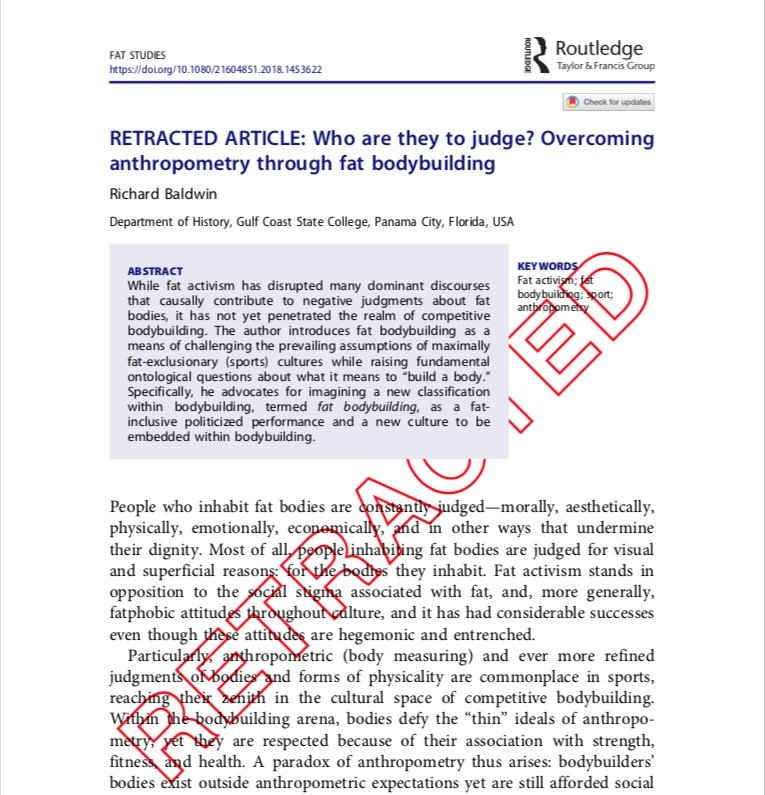
Part of the problem with his hoax as a serious critique is that it began with its conclusion. Cultural studies are rife with crap arguments, ideology, and incomprehensible nonsense, Sokal believed. And so, when his paper was accepted, he simply rested his case, making no effort to engage charitably with good scholarship while he ridiculed the bad. Which brings us to the current state of the academic humanities, and to a contemporary, Sokal-like attack on them by a trio of writers who rest their case on a slightly broader base of evidence—20 fraudulent articles sent out to various niche cultural studies journals over a year: four published (since retracted), three accepted but not published, seven under review, and six rejected.
The authors—academic philosopher Peter Boghossian and writers Helen Pluckrose and James A. Lindsay—revealed the hoax this week in an article published at the Pluckrose-edited Areo magazine. One needn’t read past the title to understand the authors’ take on cultural studies in general: “Academic Grievance Studies and the Corruption of Scholarship.” While all three hoaxers identify as left-leaning liberals, the broad-brush characterization of whole fields as “grievance studies” reveals a prejudicial degree of contempt that seems unwarranted. In the article, they reveal their motivations and methods, outline the successes of the project, and post the comments of the articles’ referees, along with a video of themselves having a good laugh at the whole thing.
This last bit is unnecessary and obnoxious, but does the new hoax—“Sokal Squared” as it’s been called—genuinely undermine the credibility of cultural studies as a whole? Is it “’hilarious and delightful,’” asks Alexander C. Kafka at The Chronicle of Higher Education, or “an ugly example of dishonesty and bad faith?” Harvard political scientist Yascha Mounk tactfully finds in it a serious case for concern: “Some academic emperors—the ones who supposedly have the most to say about these crucial topics [discrimination, racism, sexism]—have no clothes.”
This is a point worth pursuing, and certain recent scandals should give everyone pause to consider how bullying and groupthink manifest on the academic left at the highest level of prestige. But the great majority of academics are not “emperors” and have very little social or economic power. And Mounk is careful not to overstate the case. He points out how the hoax has unfortunately given welcome “ammunition” to right-wing conservative axe-grinders:
Many conservatives who are deeply hostile to the science of climate change, and who dismiss out of hand the studies that attest to deep injustices in our society, are using Sokal Squared to smear all academics as biased culture warriors. The Federalist, a right-wing news and commentary site, went so far as to spread the apparent ideological bias of a few journals in one particular corner of academia to most professors, the mainstream media, and Democrats on the Senate Judiciary Committee.
The Federalist specializes in irresponsible conspiracy-mongering, the kind of thing that sells ads and wins elections but doesn’t belong in academic debate. The question Mounk doesn’t ask is whether the hoaxers’ own attitudes encourage and share in such hostility, an issue raised by several of their critics. As physicist Sean Carroll wrote on Twitter, “What strikes me about stunts like this is their fundamental meanness. No attempt to intellectually engage with ideas you disagree with; just trolling for the lulz.” McGill University political theorist Jacob T. Levy expressed similar reservations in an interview, notes The New York Times, saying
even some colleagues who are not fans of identity-oriented scholarship are looking at the hoax and saying ‘this is potentially unethical and doesn’t show what they think it is showing.’ Besides, he added, “We all recognized that this kind of thing could also be done in our disciplines if people were willing to dedicate a year to do it.”
Therein lies another problem with Sokal Squared. Hoaxes have been perpetuated by smart, dedicated forgers, con-artists, and pranksters in nearly every field, showing up all sorts of experts as potential dupes. The singling out of cultural studies for particular ridicule—the characterization of studies of race, gender, disability, etc. as “grievance studies”—reveals an aggrieved agenda all its own, one that ignores the serious problems corrupting other disciplines (e.g. industry funding in academic sciences, or the gross overuse of undergraduate students as the main subjects of studies—groups that hardly represent the general population.)
Some, but not all, of the successfully-published hoax papers sound ludicrous and terrible. Some, in fact, do not, as Justin Weinberg shows at Daily Nous, and should not shame the editors who published them. Some of the journals have much higher editorial standards than others. (An early hoax attempt by Boghossian targeted an ill-reputed, pay-to-play publication.) The whole affair may speak to broader failures in academic publishing that go beyond a tiny corner of the humanities. In part, those failures may stem from a general trend toward overworked, underpaid, increasingly precarious scholars whose disciplines, and funding, have been under relentless political attack since at least the 1990s and who must keep grinding out publications, sometimes of dubious merit, as part of the overall drive toward sheer productivity as the sole measure of success.
Related Content:
John Searle on Foucault and the Obscurantism in French Philosophy
Noam Chomsky Slams Žižek and Lacan: Empty ‘Posturing’
Josh Jones is a writer and musician based in Durham, NC. Follow him at @jdmagness
Read More...The Origins of the Death Growl in Metal Music
When Arab-Spanish Sephardi Jewish merchant Abraham ben Jacob first encountered the Vikings in Denmark, he had this to say:
“Never before I have heard uglier songs than those of the Vikings in Slesvig. The growling sound coming from their throats reminds me of dogs howling, only more untamed.”
Now what Mr. ben Jacob actually heard we will never know, but the description does sound a lot like the “Death Growl” familiar to fans of death metal. (The appearance of Vikings and the preponderance of Scandinavians within the genre certainly make this tale sound true.)
Cheekily referred to by non-metal fans as the “Cookie Monster Voice,” this particular style has evolved over time as metal changed in the 1980s, from the piercing screams of Dio and Iron Maiden to the growl of Sepultura and Cannibal Corpse. And that’s matched by the demonic and doom-laden sound of the music and the Grand Guignol horror of the lyrics, which delight fans with its depravity and disgust, the grosser the better.
Whether it’s your cup of tea or not, you have to admit that the ‘80s and ‘90s saw the growth of a brand new vocal style that seemed to come out of nowhere.
YouTuber Polyphonic tries to unravel its origins in the video above, which, we have to admit, follows the Wikipedia article on the Death Growl point by point. But that’s okay–imagine if all Wikipedia articles had their own videos…would that be a bad thing?
On the other hand, Polyphonic’s video does leave out some antecedents to this style, all of who get named checked by various folks in the comments. (Yes, YouTube comments that are worth reading!)
In particular, there’s no mention of African-American artists like Howlin’ Wolf, Screamin’ Jay Hawkins, or Clarence Frogman Henry. Wolf in particular became a huge influence on another incredibly gruff and guttural singer, Tom Waits, who often sings like the Devil has his larynx.
And do the distorted vocals on Black Sabbath’s “Iron Man” or on King Crimson’s “21st Century Schizoid Man” really count? Or the various screams on Pink Floyd songs?
When Polyphonic returns to the 1980s, he’s on firmer ground. Lemmy from Motörhead makes more sense as an influence, and by the time we get to Venom, then Death, then Mantas, it is easier to see where the Death Growl came from. (But come on, no mention of Napalm Death? They were the first growling band I ever heard, and hats off to BBC DJ John Peel for not only playing them when the debuted, but he had them in session.)
If interested, I would recommend exploring the YouTube comments further and make up your own mind. And if you are interested in learning this technique, there are folks who will teach you.
Related Content:
96-Year-Old Holocaust Survivor Fronts a Death Metal Band
1980s Metalhead Kids Are All Right: New Study Suggests They Became Well-Adjusted Adults
Ted Mills is a freelance writer on the arts who currently hosts the artist interview-based FunkZone Podcast and is the producer of KCRW’s Curious Coast. You can also follow him on Twitter at @tedmills, read his other arts writing at tedmills.com and/or watch his films here.
Read More...Banksy Shreds His $1.4 Million Painting at Auction, Taking a Tradition of Artists Destroying Art to New Heights
The first time vandals defaced his sculpture, Dirty Corner, at Versailles, artist Anish Kapoor wrote an essay in which he considered his options:
Should the paint that has been thrown all over the sculpture be removed? Or should it remain and be part of the work? Does the political violence of the vandalism make Dirty Corner “dirtier”? Does this dirty political act reflect the dirty politics of exclusion, marginalisation, elitism, racism, Islamophobia?
The question I ask of myself is: can I, the artist, transform this crass act of political vandalism and violence into a creative act? Would this not be the best revenge?
Sometimes artists are the ones behind the vandalism.
Ai Weiwei starred in a 1995 black-and-white photo triptych that documents his intentional destruction of a Han Dynasty urn from his private collection.
Brothers Jake and Dinos Chapman purchased a mint condition set of Goya’s The Disasters of War, painstakingly re-rendered the victims’ heads as grotesquely cute, colorful cartoons, and exhibited the altered etchings under the title Insult to Injury.
Robert Rauschenberg sought and received permission to erase a drawing that his fellow Abstract Expressionist Willem de Kooning had given him, at his request.
Certainly, artists of all stripes have been known to eradicate their own work in fits of pique, passion, and self-reproach.
But until last week, no artist had ever vandalized their own work with such a dispassionate, pre-meditated sense of fun as Banksy, the anonymous clown prince of street art and massive scale pranks.
As you’ve likely heard by now, within seconds of his iconic Girl With Balloon (2006) selling at Sotheby’s for £1,042,000—$1.4 million—the painting began to self-destruct, thanks to a custom-built shredder the artist had pre-loaded into its frame.
No one seemed particularly distressed about it.
Auction attendees quickly scrambled to capture the moment with their cell phones.
Auctioneer Oliver Barker looks on in admirably mild confusion.
No self-appointed hero rushed forward to jam the works with an umbrella or broom handle.
The as-yet-unidentified buyer was not in the room, no doubt to their ever-lasting regret. Imagine losing out on those bragging rights!
While Sotheby’s and the buyer hammer out their unprecedented next steps, some art experts have stated that it would be possible, given the clean geometry of the cuts, to restore the canvas.
Though who would want to, given the speculation that this stunt immediately increased the value of the work, anywhere from 50% to near double the purchase price?
Perhaps the buyer will choose to finish the job and sell it off strip-by-strip.
Office supply stores will see an uptick in shredder sales to vendors selling Banksy knock-offs stencilled on subway maps.
Sotheby’s senior director, Alex Branczik, insisted that no one there was in on the joke, but The New York Times smells a rat:
The frame would presumably have been rather heavy and thick for its size, something an auction house specialist or art handler might have noticed. Detailed condition reports are routinely requested by the would-be buyers of high-value artworks. Unusually, this relatively small Banksy had been hung on a wall, rather than placed by porters on a podium for the moment of sale.
The fact that Girl with Balloon was the final item on the block is either a great piece of luck, or a bit of canny stage management on the auction house’s part. Recapturing the attendees’ attention after that stunt would be an uphill battle.
It’s doubtful that buyers will shy away from Sotheby’s as a place where highly valued artwork starts to devour itself the moment the gavel comes down. That kind of lightning strikes but once.
What may circle back to bite the venerable firm in its well padded rear is the ease with which someone in the crowd was able to activate the mayhem, using a device concealed in his bag. What’s worse, lax security or maybe lying about foreknowledge of the prank? It’s hard not to raise those as possibilities.
The man with the bag was escorted out. Not even the conspiracy theorists are pegging him as Banksy.
As for the steady-handed fellow another attendee caught calmly zooming in on his phone from the perfect angle… well, let’s just say the tabloids have picked up on his resemblance to Robin Gunningham, oft thought to be Clark Kent to Banksy’s Superman.
Banksy’s post-mortem, unlike Kapoor’s, does not suggest a man tortured by unresolved questions.
“A few years ago I secretly built a shredder into a painting, in case it was ever put up for auction,” he wrote on his Instagram. “Going, going, gone.”
Related Content:
Patti Smith Presents Top Webby Award to Banksy; He Accepts with Self-Mocking Video
Ayun Halliday is an author, illustrator, theater maker and Chief Primatologist of the East Village Inky zine. Join her in NYC on Monday, October 15 for another monthly installment of her book-based variety show, Necromancers of the Public Domain. Follow her @AyunHalliday.
Read More...Was Jackson Pollock Overrated? Behind Every Artist There’s an Art Critic, and Behind Pollock There Was Clement Greenberg
Abstract expressionist Jackson Pollock is one of the few painters whose work is easily identified by people who don’t care much for modern art.
More often than not, they’ll cite him as a prime reason they don’t want to spend a sunny Saturday at MoMA with you.
They’re entitled to their opinions, just as author Phil Edwards, host of the Vox series Overrated and a Pollock fan, is entitled to his.
In the most recent episode of Overrated, above, Edwards examines the driving force behind Pollock’s enduring fame.
His conclusion?
The muscular support of a highly influential art critic, Clement Greenberg, who was chummy enough with Pollock and his wife, Lee Krasner, to frolic with them in the Hamptons.
(Jeffrey Tambor appeared to have a ball playing him in Ed Harris’ Pollock biopic.)
Greenberg said one glimpse of Pollock’s 1943 “Mural” was all it took to realize that “Jackson was the greatest painter this country has produced.”
Greenberg was interested in what he called “American-Type” painting and Pollock, with his highly physical, booze-soaked macho swagger, was a “radically American” poster boy.
He was one of the first to mention Pollock in print:
He is the first painter I know of to have got something positive from the muddiness of color that so profoundly characterizes a great deal of American painting.
His cheerleading resulted in a LIFE magazine profile, “Jackson Pollock: Is he the greatest living painter in the United States?,” that took a travelogue approach to the artist’s drip painting process.
Their stars rose together. Though Greenberg’s attention eventually wandered away to newer favorites, Pollock’s career owed much to his forceful early champion.
We remember the artist better than the critic because of those giant, splattered canvases—so accessible to those looking for illustrations of why they hate modern art. The critic’s art is more ephemeral, and unlikely to show up on umbrellas, tote bags, and other gift shop swag.
Those with an interest in Pollock—pro or con—would do well to follow Edwards’ suggestion to bolster their understanding of Greenberg’s taste, and his role in promoting both Pollock and his fellow Abstract Expressionists.
Watch Seasons 1 and 2 of Overrated free online.
Related Content:
Jackson Pollock 51: Short Film Captures the Painter Creating Abstract Expressionist Art
Watch Portrait of an Artist: Jackson Pollock, the 1987 Documentary Narrated by Melvyn Bragg
The MoMA Teaches You How to Paint Like Pollock, Rothko, de Kooning & Other Abstract Painters
Ayun Halliday is an author, illustrator, theater maker and Chief Primatologist of the East Village Inky zine. Join her in NYC on Monday, October 15 for another monthly installment of her book-based variety show, Necromancers of the Public Domain. Follow her @AyunHalliday.
Read More...How Youtube’s Algorithm Turned an Obscure 1980s Japanese Song Into an Enormously Popular Hit: Discover Mariya Takeuchi’s “Plastic Love”
Spend time listening to 1980s hits, Japanese pop, or disco classics on Youtube, and you’ll almost certainly encounter Mariya Takeuchi’s addictive song “Plastic Love.” Though first released in 1985 in Japan, it remained almost entirely unknown in the rest of the world until a few years ago, when it all of a sudden attained an enormous popularity. Now, having racked up more than 20 million views, the song has quite a few people — even many of those who have put it into heavy rotation on their personal playlists — asking what it is and where it came from. The video essay above, by explainer of animation and Japanese music Stevem, breaks down the history of “Plastic Love,” both as an obscure 80s Japanese pop song and an internet-era phenomenon.
“Plastic Love” has become the best-known example of “city pop,” a genre we’ve previously featured here on Open Culture and one Stevem describes as “a type of music that was reflective of the new, shiny, modern Japan” that emerged as the country’s rebuilt economy boomed in the 1970s and 80s. “Considering Japan didn’t, nor could they, have a military, some of this money was funneled into new technology: cassettes, Walkmans, VHSs, cars, TVs, video game consoles.”
The soundtrack to “the cosmopolitan lifestyle in full swing” took “bits and pieces from New Wave, synth pop, disco, jazz, and whatever else was relevant at the time and shoved them into a blender to make what could be some of the sharpest pop music to come out of the Land of the Rising Sun.”
The young Mariya Takeuchi was one of the era’s first defining pop idols. Scoring a number-one album in 1980, she lowered her profile over the next few years, marrying the singer-songwriter Tatsuro Yamashita (now recognized as a city pop icon in his own right) and collaborating with him on an album called Variety, with which she re-emerged in 1984, retaking the top spots on the Japanese charts. “Plastic Love” comes as its second track, laying down a “shimmering hypnotic groove, striking you with its beat and never letting go.” Not only “a meditation on heartbreak, it really speaks to the hollow, plastic feeling of what people do to fill in the sorrows of their life and loneliness,” acts such as “buying commercial goods in the hopes that they will make us feel more and avoid dealing with our own personal anguish.”
Whatever the song’s musical strengths, it took an algorithm to bring them to worldwide attention. Youtube, which 80s Japanese pop enthusiasts discovered early as a way of sharing their music, has become a veritable “record store in the digital space, affecting how people define their taste in the modern era, mass-producing the feeling of finding these obscure gems on your own in a way that feels natural, doing it so well with the puppet strings that you don’t even see them.” “Plastic Love,” as Vice’s Ryan Basil puts it, “is a rare tune that doesn’t exactly need words to expertly describe a specific, defined feeling – one of lust, heartbreak, love, fear, adventure, loss, all caught up in the swirling midst of a night out on the town.” Countless music fans here in the 21st century — living in Takeuchi’s homeland Japan, elsewhere in Asia as I do, in the West, or anywhere besides — can now make the surprising declaration he does: “It is, at the moment, my favorite pop song in the world.”
Related Content:
Based in Seoul, Colin Marshall writes and broadcasts on cities, language, and culture. His projects include the book The Stateless City: a Walk through 21st-Century Los Angeles and the video series The City in Cinema. Follow him on Twitter at @colinmarshall or on Facebook.
Read More...The Joy of Experiencing Queen’s Bohemian Rhapsody for the Very First Time: Watch Three Reaction Videos
Remember when you first encountered Queen’s “Bohemian Rhapsody”?
I suspect many of us don’t. It’s not the Kennedy assassination. Nor does it take long for Freddy Mercury’s soaring vocals and monumental lyrics to leach into the blood stream, creating the impression that we were born knowing every note, every word, every staggering transition…
(Note to those unfamiliar with this impossible to categorize 1975 masterpiece: Go give it a listen RIGHT NOW, while the rest of us wait for you here. Here’s the official video. But first, set up whatever equipment you need to film your reaction in real time, as Pennsylvania based YouTuber AFRO REACT, does above.)
He’ll definitely remember where he was when he first heard this wonderful, seminal song, as will over 1000 viewers, most of whom gave him an encouraging thumbs up.
So what if he mispronounces both “bohemian” and “rhapsody”? That he’s unclear whether Queen is the name of the singer or the band? He can cringe later…or not. Such documented boo boos may be a generational hazard, the way crimped and moussed 80s hair was for mine.
(I was surprised, and grateful, that neither he, nor any of the video reaction masters featured today, sniped at the ridiculous coiffures of the artists they were watching.)
Perhaps AFRO REACT’s appreciation will lead him to investigate those unfamiliar words and more: Scaramouche, Bismillah, fandango (No, not the popular movie time site…)
I appreciated how he consulted his mom prior to listening, to see if she thought he’d enjoy the full song as much as he liked the snippet he’d heard in a movie trailer.
My son never asks my opinion like that.
Hold up a sec there, AFRO REACT. Why not leave Mom out of it and just give it a spin (as we used to say)?
I suspect what he was really eager to find out was whether she thought this track would be worthy of a reaction video.
The answer, resoundingly, is yes.
I confess that his habit of pausing the video to interject his own thoughts was driving me out of my gourd. My son does the same thing.
I have since learned this is more than just a symptom of being born into a world where pretty much everything can be paused and restarted at will, at least as far as practitioners of the reaction video arts are concerned.
Taking frequent breaks like that is a solid way to get around copyright claim when including the official videos alongside the reaction. (Other techniques include lowering the volume while offering one’s response or fast forwarding 5 seconds a couple of times per minute.)
I suspect many older fans will feel a lump at the 4:15 mark, as the appreciative first-timer muses, “This man has a beautiful voice. Like, what happened to him?”
Ask your mother, kid.
The real treat comes at 6:15. Scaramouche, scaramouche, whatever our young listener was expecting, it surely wasn’t that!
Thusly another Queen fan is forged. Just a few days ago, he shared his virgin response to “Under Pressure (Live at Wembley)”
Tuscaloosa-based musician Joey Da Prince takes a more understated approach to reaction videos. Watching him bob from side to side, brow furrowed, appreciative involuntary smiles blooming now and again, reminds me of coming home, stripping the cellophane from a just-purchased album (or CD) and giving it a good hard listen, eyeballs glued to the liner notes.
He only hits pause once, shocked by the opening line of the famous first verse:
Mama just killed a man…
Oh, wait a minute. In a just posted 25-minute lyric breakdown, Joey reveals that he misheard that line, and was, understandably, taken aback by the idea of the singer’s mother murdering someone.
(Mercury’s technique was impeccable, so let’s take this as proof that commas are easier to see than hear…)
Like AFRO REACT, Joey quickly queued up the live version of “Under Pressure”…and “Somebody to Love,” “Fat Bottomed Girls,” “We Will Rock You,” the list goes on…
He’s obsessed to such a degree that he’s even filmed his reaction to pop culture essayist Polyphonic’s The Secrets Behind Freddie Mercury’s Legendary Voice, below. This is what lifelong learners do.
It’s worth noting that Joey Da Prince tried “Bohemian Rhapsody” on a commenter’s suggestion.
At the rate he’s going, he’s going to burn through Queen’s sizable catalogue pretty quickly, so toss him some suggestions, people!
I’m gonna go out on a limb and nominate Kate Bush’s “Wuthering Heights.”
Gamer Quamax, aka Qua, did not come to “Bohemian Rhapsody” as a total Queen newbie. By his own admission, he was somewhat familiar with “We Will Rock You,” “We Are the Champions,” “Another One Bites the Dust,” and “Under Pressure” from their appearances in movies and “other pop culture” (which presumably does not cover someone else’s reaction videos.)
As he listens in an intent forward-facing hunch, he seems the most keyed-in to the humor that is a definite part of this song’s listening experience (and possibly performance). He laughs merrily at the phrase “Mama Mia, Mama Mia” and avails himself of some truly delightful after effects in the editing process. (Those in a rush may fast forward to 4:32.)
Final pronouncement? It’s “dope and funny” and he really liked the transitions from one musical style to another.
Welcome to the Queen Army, Quamax! You should try listening to “Under…” oh, you already did.
Readers, if these young men’s open-mindedness and open ears have inspired you to shoot a reaction video of your own, you’ll find a good primer here.
What haven’t you heard?
And what do you wish you could hear again for the very first time?
via Metafilter
Related Content:
Hip Hop Fan Freaks Out When He Hears Rage Against the Machine’s Debut Album for the Very First Time
Queen’s “Bohemian Rhapsody” Played by 28 Trombone Players
Ayun Halliday is an author, illustrator, theater maker and Chief Primatologist of the East Village Inky zine. Join her in NYC on Monday, October 15 for another monthly installment of her book-based variety show, Necromancers of the Public Domain. Follow her @AyunHalliday.
Jurassic Park Without Dinosaurs: Watch Humans Stare in Amazement at a World Stripped of CGI Creations
How many times have you encountered an otherwise perfect view spoiled by a newly erected high rise, a construction crane, or a CGI brachiosaurus?
Constantly, right?
Video editor William Hirsch makes light work of Jurassic Park’s primary attractions’ first appearance, literally erasing them from the scene.
Hirsch estimated that it took him about a week to get rid of those pesky ‘saurs using nothing fancier than After Effects’s built in tools, which include the motion tracking software Mocha.
It’s equal parts ridiculous and lovely to see humans suddenly thunderstruck by the unspoiled landscape they’ve been driving through.
These days, of course, Laura Dern would have to glance up from her phone, not a paper map.
Though it’s not such a stretch to imagine Jurassic Park’s author’s successor, the late Michael Crichton’s literary heir, hard at work on a dystopian novel titled Park.
At the time of its release, Jurassic Park’s dinosaurs were a special effects game changer. Their numbers were supplemented by some non-computer-generated animatronic models, though no doubt Spielberg was apprehensive given the way his robotic sharks acted up on the set of Jaws. The human players may have had more screen time, but the dinosaurs’ 15 minutes of footage has resulted in a lasting fame, extending decades beyond the expected 15 minutes.
Unexpectedly, Hirsch’s dinosaurs, or rather, lack thereof, have generated the most excitement with regard to his project. But his attention to detail is also laudable. Above, he reveals how he tweaked the access badge dangling from the rear view mirror of the park’s all-terrain vehicle.
Are we wrong to think that John Williams’ swelling original score feels more organic in this dinosaur-free context? Rivers, trees, and vast amounts of skies have been known to spur composers to such heights.
The potentially lethal prehistoric beasts are out of the way, but that line “We’re gonna make a fortune with this place” retains an air of ominous foreshadowing, given the plentiful natural resources on display. Sometimes humans can do more damage than dinosaurs.
If that feels too intense, you can also retreat to the escapist pleasures of the original, below.
Related Content:
Captivating GIFs Reveal the Magical Special Effects in Classic Silent Films
Game of Thrones: A Great Behind-the-Scenes Look at The Show’s Visual Effects
The Blade Runner Promotional Film
Ayun Halliday is an author, illustrator, theater maker and Chief Primatologist of the East Village Inky zine. Join her in NYC on Monday, October 15 for another monthly installment of her book-based variety show, Necromancers of the Public Domain. Follow her @AyunHalliday.
Read More...Support Us
We're hoping to rely on loyal readers, rather than erratic ads. Please click the Donate button and support Open Culture. You can use Paypal, Venmo, Patreon, even Crypto! We thank you!

About Us

Open Culture scours the web for the best educational media. We find the free courses and audio books you need, the language lessons & educational videos you want, and plenty of enlightenment in between.
Advertise With Us

FREE UPDATES!
GET OUR DAILY EMAIL
Get the best cultural and educational resources on the web curated for you in a daily email. We never spam. Unsubscribe at any time.
FOLLOW ON SOCIAL MEDIA

Open Culture editor Dan Colman scours the web for the best educational media. He finds the free courses and audio books you need, the language lessons & movies you want, and plenty of enlightenment in between.
Advertise With Us

