Tom Waits Releases a Timely Cover of the Italian Anti-Fascist Anthem “Bella Ciao,” His First New Song in Two Years
“La Complaine du Partisan,” a song about the French Resistance written in 1943 by Emmanuel d’Astier de la Vigerie with music by Anna Marly, was adapted into English as “The Partisan” by Hy Zaret, author of the Righteous Brother’s “Unchained Melody.” Covered by artists like Joan Baez and, most famously, Leonard Cohen, the song’s folk melody and melancholy lyricism have become so closely associated with Cohen that it has often been credited to him. Even Cohen himself remarked “I kind of re-introduced [“The Partisan”] into the world of popular music. I feel I wrote it, but I actually didn’t.”
Now another artist of Cohen’s stature, Tom Waits, may do the same for those who have never heard the World War II Italian anti-fascist song, “Bella Ciao,” which has been covered for decades in many languages and now appears as the first release on guitarist and composer Marc Ribot’s Songs of Resistance: 1942–2018, an album of protest music that comes out today and features guest vocals by Waits, Steve Earle, Meshell Ndegeocello, Justin Vivian Bond, and more. You can stream and buy the album here at Ribot’s Bandcamp page. Waits’ track is the first song he has released in two years, and it’s a helluva return.
The song comes from an old Italian folk ballad that was “revised and re-written during World War II for the Italian anti-fascist resistance fighters,” notes Sam Barsanti at The Onion’s A.V. Club. It has “since become an anthem of sorts for anyone looking to stick it to fascists.” Ribot and his collaborators fit the description. Waits’ “Bella Ciao” was released with a video, directed by Jem Cohen, “that makes its parallels with modern life very explicit,” Barsanti writes, “pairing Waits’ vocals with footage of police and soldiers guarding barricades at anti-Trump protests. It may sound heavy-handed, but fuck it, nobody said fighting fascists had to be subtle.”
Subtle it isn’t, but neither is the banning of Muslim refugees, the kidnapping and detention in camps of hundreds of migrant children, the transfer of $169 million dollars from other programs—including FEMA and the Coast Guard during yet another fatal hurricane season—for even more camps and ICE raids, the lying denial that thousands were left to die in Puerto Rico last year, and so on and so on.
Other songs on the album draw from the U.S. civil rights movement and Mexican protest ballads. At his site, Ribot acknowledges the perennial problem of the protest song. “There’s a lot of contradiction in doing any kind of political music, how to act against something without becoming it, without resembling what you detest… I imagine we’ll make mistakes,” he avows, but says the stakes are too high not to speak out. “From the moment Donald Trump was elected,” he decided “I’m not going to play downtown scene Furtwangler to any orange-comb-over dictator wannabe.” (The reference is to Wilhelm Furtwängler, leading classical conductor in Germany under the Nazi regime.)
Like so many folk songs, “Bella Ciao” has a complex and murky history: the original version, a peasant work song, may have a Yiddish origin, or in any case—explains the blog Poemas del rio wang—emerged from a region “where Jews, Romanians, Rusyns, Gypsies, Ukranians, Hungarians, Italians, Russians, Slovakians, Polish, Czech, Armenians, [and] Taters lived together” and where “melodies did not remain the exclusive property of only one ethnic group.” This submerged background gives the re-written “Bella Ciao” an even deeper resonance with the anti-fascism of the 1940s and that of today.
See the video and hear Waits and Ribot’s haggard yet determined “Bella Ciao (Goodbye Beautiful)” at the top; hear Italian singer Giovanna Daffini’s recording above (hear her version of the original folk song here); read more about the song’s long history here; and read Waits’ lyrics, slightly revised from earlier versions to be even more explicitly anti-fascist, below. All proceeds from Ribot’s album will be donated to the Indivisible Project.
One fine morning
I woke up early
o bella ciao, bella ciao
bella ciao, ciao, ciao
One fine morning
I woke up early
to find the fascists at my doorOh partigiano
take me with you
bella ciao, bella ciao
goodbye, beautiful
oh partigiano
please take me with you
I’m not afraid anymoreAnd if I die
a partigiano
bella ciao, bella ciao
goodbye, beautiful
Bury me
up on that mountain
beneath the shadow of the flowerSo all the people
the people passing
bella ciao, bella ciao
goodbye, beautiful
So all the people
the people passing
will say: “What a beautiful flower”This is the flower
of the partisan
bella ciao, bella ciao
bella ciao
this is the flower
of the partisan
who died for freedomthis is the flower
of the partisan
who died for freedom
Related Content:
Stream All of Tom Waits’ Music in a 24 Hour Playlist: The Complete Discography
Josh Jones is a writer and musician based in Durham, NC. Follow him at @jdmagness
Read More...“The Long Tomorrow”: Discover Mœbius’ Hard-Boiled Detective Comic That Inspired Blade Runner (1975)
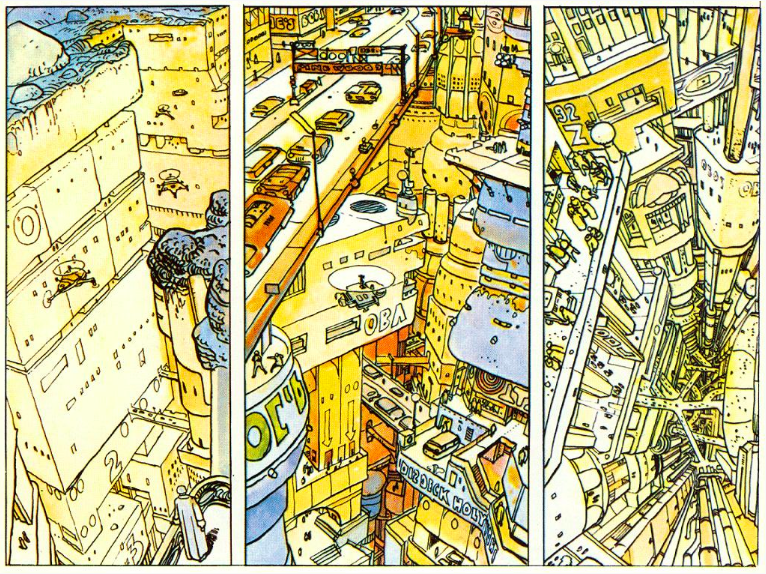
Alejandro Jodorowsky may never have made his film adaptation of Frank Herbert’s Dune, but plenty came out of the attempt — including, one might well argue, Blade Runner. Making that still hugely influential adaptation of Philip K. Dick’s Do Androids Dream of Electric Sheep?, Ridley Scott and his collaborators looked to a few key visual sources, one of them a two-part short story in comic form called “The Long Tomorrow.”
Illustrated by none other than French artist Mœbius, one of the richest visual imaginations of our time, it tells the futuristic hard-boiled story of a private detective in a dense, vertical underground city filled with androids, rowdy bars, assassins, and flying cars. “I’m a confidential nose,” says the protagonist by way of introduction. “My office is on the 97th level. Club’s the name, Pete Club.”
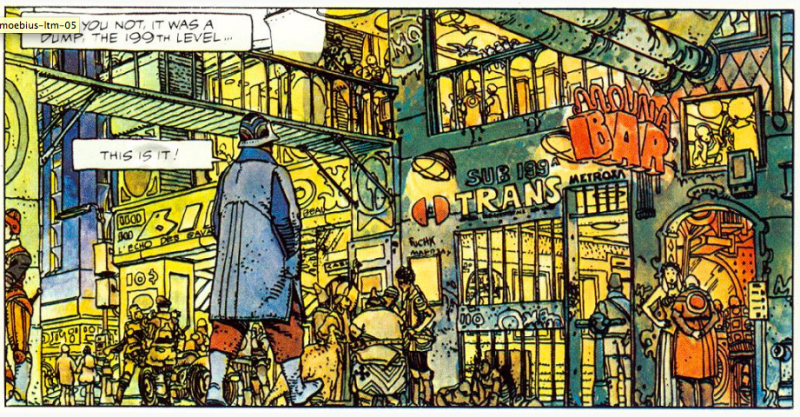
Then comes the fateful piece of narration that begins any detective story worth its salt: “It started out a day like any other day.” But by the end of that day, Club has taken a job from a classic dame in need, fended off both a four-armed thug and a hired assassin, slain an alien monster with whom he finds himself in bed, and recovered the president’s missing brain.
The story was written written by Dan O’Bannon, then known mainly for the film Dark Star, a science-fiction comedy he’d made with his University of Southern California classmate John Carpenter. On the strength of that, Jodorowsky had brought him onto Dune to work on its special effects, just as he’d brought Mœbius on to create its storyboards and concept art. With nothing to do before shooting began — which it never did — O’Bannon first drew “The Long Tomorrow” himself as a way of keeping busy. Mœbius took one look at it and immediately saw its promise.
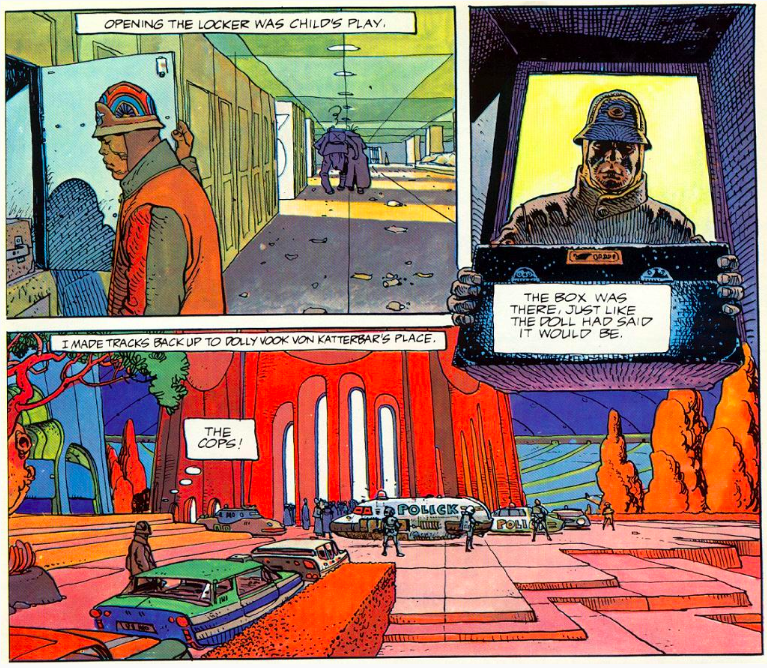
The French may have coined the term film noir, but this early work of future noir benefited from having an American writer. “When Europeans try this kind of parody, it is never entirely satisfactory,” Mœbius writes in the introduction to the book version of “The Long Tomorrow.” “The French are too French, the Italians are too Italian … so, under my nose was a pastiche that was more original than the originals.” It also, with Mœbius’ art, laid the visual groundwork for generations of sci-fi stories to come.
“The way Neuromancer-the-novel ‘looks’ was influenced in large part by some of the artwork I saw in Heavy Metal,” said William Gibson, referring to the English version of Métal hurlant, the magazine that popularized Mœbius’ work. (O’Bannon also worked on the animated Heavy Metal anthology film, released in 1981.) But perhaps Ridley Scott, who started working with the artist on 1979’s O’Bannon-scripted Alien, described the influence of Mœbius’ art on our visions of the future best: “You see it everywhere, it runs through so much you can’t get away from it.” In a cultural sense, all of us live in Pete Club’s city now.
Related Content:
Moebius’ Storyboards & Concept Art for Jodorowsky’s Dune
The Blade Runner Sketchbook Features The Original Art of Syd Mead & Ridley Scott (1982)
Based in Seoul, Colin Marshall writes and broadcasts on cities and culture. His projects include the book The Stateless City: a Walk through 21st-Century Los Angeles and the video series The City in Cinema. Follow him on Twitter at @colinmarshall or on Facebook.
Read More...Classic Songs by Bob Dylan Re-Imagined as Pulp Fiction Book Covers: “Like a Rolling Stone,” “A Hard Rain’s A‑Gonna Fall” & More
Screenwriter Todd Alcott has been very busy since we introduced you to his hilarious Mid-Century Pulp Fiction Cover project last month.
To restate what should be obvious from the second, if not first glance, none of Alcott’s titles are real. His aesthetically convincing mock-ups pay tribute to favorite songs by favorite artists: David Bowie, Talking Heads, Joy Division, Elvis Costello…
The start of the school year finds him in a Dylan mood, rendering some of his best known hits in a variety of pulp genre formats:
Bob Dylan is the perfect subject for this project, because his work has always been all about quotation and repurposing. From the very beginning, he took old songs, changed the lyrics and called them his own…. And it’s not just the melodies, he’s also not shy about lifting phrases and whole lines from other sources. One of the fun things about being a Bob Dylan fan is being able to spot the influences. It’s not just lifting lines from classic blues songs, where we don’t really know who “wrote” the originals, it’s real, identifiable, copyright-protected material. And you never know where it’s going to come from, a book about the Yakuza from Japan, a cookbook, an old Time Magazine article, or 1940s noir pictures.
I was watching a classic Robert Mitchum noir, Out of the Past, and Mitchum is talking to someone, and they mention San Francisco, and Mitchum says “I always liked San Francisco, I was there for a party once.”
And I was like “Wait, what?” Because that’s a line from a really obscure Dylan song, “Maybe Someday,” off his album Knocked-Out Loaded.
I was like “Wait, why did that line stick in Dylan’s mind? Why did he decide to quote that? Is it just the way Mitchum says it? What happened there?” And suddenly a song I hadn’t thought about much became a lot more interesting.
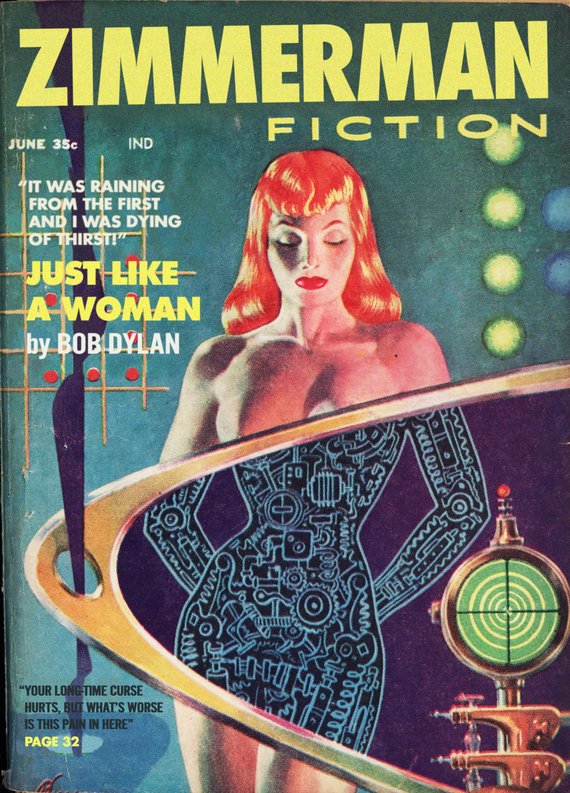
So for my Dylan covers, I try to carry on that tradition of taking quotes and repurposing them. So “Just Like a Woman” becomes a story in a science-fiction pulp, and “Like a Rolling Stone” becomes an expose on juvenile delinquency, and “Rainy Day Women” becomes a post-apocalyptic adventure story.
In a way, it’s what this project is all about, taking discarded pieces of culture and sticking them back together with new references to make them breathe again.
“Just Like a Woman”’s lyrics have never sat particularly well with feminists. (“There’s no more complete catalogue of sexist slurs,” author Marion Meade wrote in The New York Times.)
I think it’s fair to say that Alcott’s buxom flame-haired cyborg leans in to that criticism. The cover of this faux science fiction mag also harkens back to a time when the depiction of sexy female robots left something to the imagination.
From a design standpoint, it’s a great illustration of the heavy lifting a single well-chosen punctuation change can do.
The magazine’s title is an extra gift to Dylan fans.
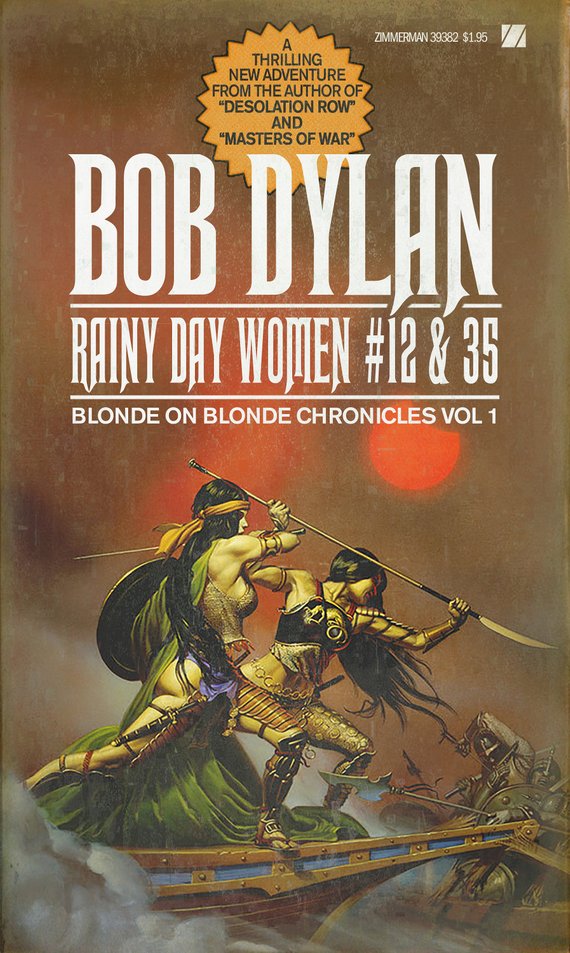
The Blonde-on-Blonde Chronicles continue with Rainy Day Women #12 & 35. Does it matter that the breast-plated, and for all practical purposes bottomless warriors are raven tressed?
Only if tongue’s not firmly in cheek.
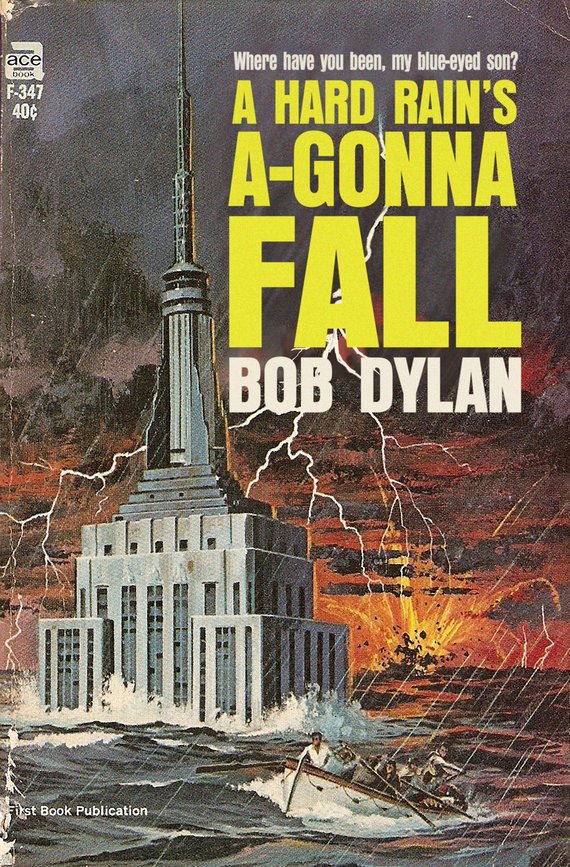
The nightmare vision of Dylan’s seven-minute protest song “A Hard Rain’s A‑Gonna Fall” makes for a smooth transition to a disaster novel of the 1970s.
In a 1963 radio interview with author Studs Terkel, Dylan asserted that the song wasn’t directly related to the nuclear fears all-pervasive at the time:
It’s not the fallout rain. It isn’t that at all. The hard rain’s gonna fall is in the last verse…That means all the lies, you know, that people get told on their radios and in newspapers. All you have to think for a minute, you know. Trying to take people’s brains away, you know. Which maybe has been done already. I hate to think it’s been done. All the lies, which I consider poison.
This writer can think of another reason citizens might find themselves fighting for their lives in a rowboat level with the very tippy top of the Empire State Building. So, I suspect, can Alcott.
Or maybe we’re wrong and climate change is nothing but fake news.
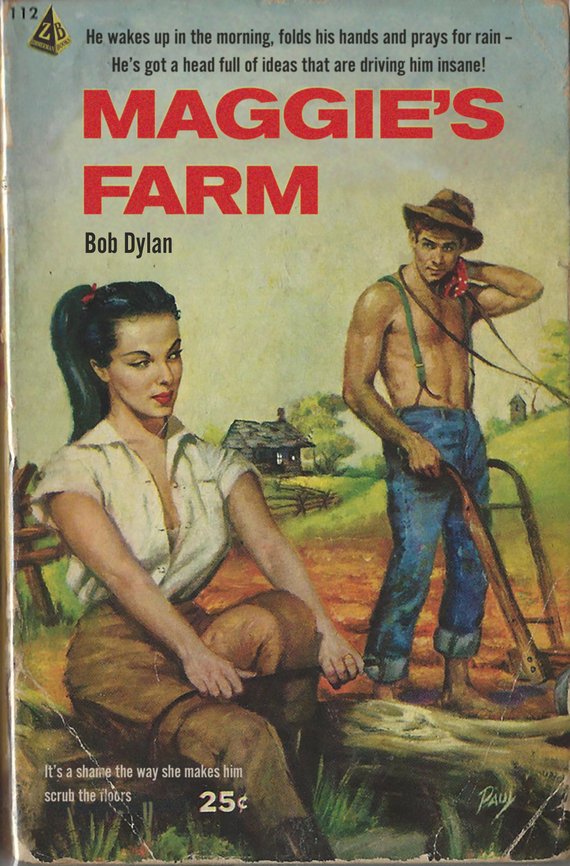
Alcott gets some mileage out of another rain-based lyric on Maggie’s Farm, a steamy rural romp whose creased cover is also part and parcel of the genre.
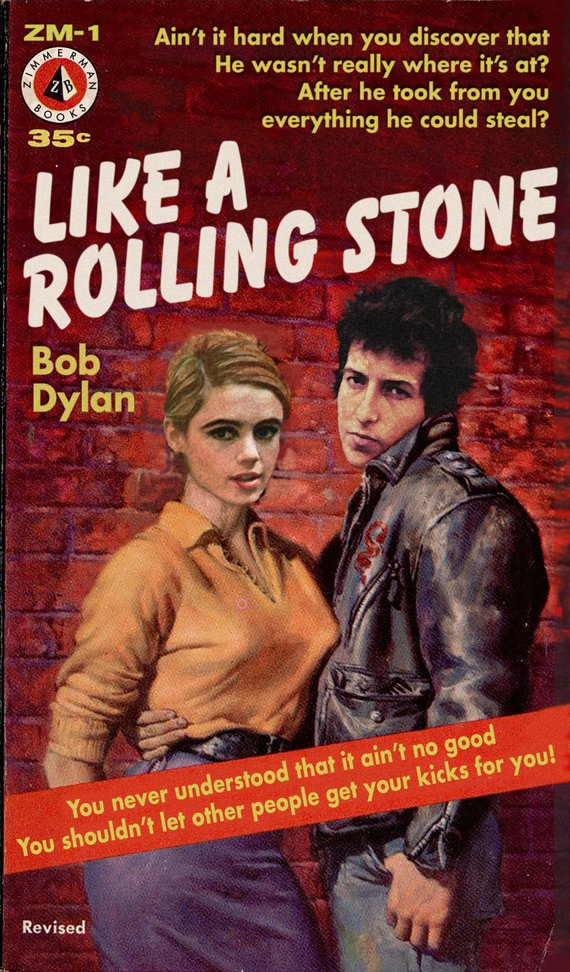
Who’s that young punk on the cover of Like a Rolling Stone? Beats me, but the girl’s a dead ringer for Warhol superstar, Edie Sedgwick, the purported inspiration for the song that shares the novel’s name. Ms. Sedgwick’s real life figure was much less voluptuous, but if the genre covers that sparked this project demonstrate anything, it’s that sex sells.
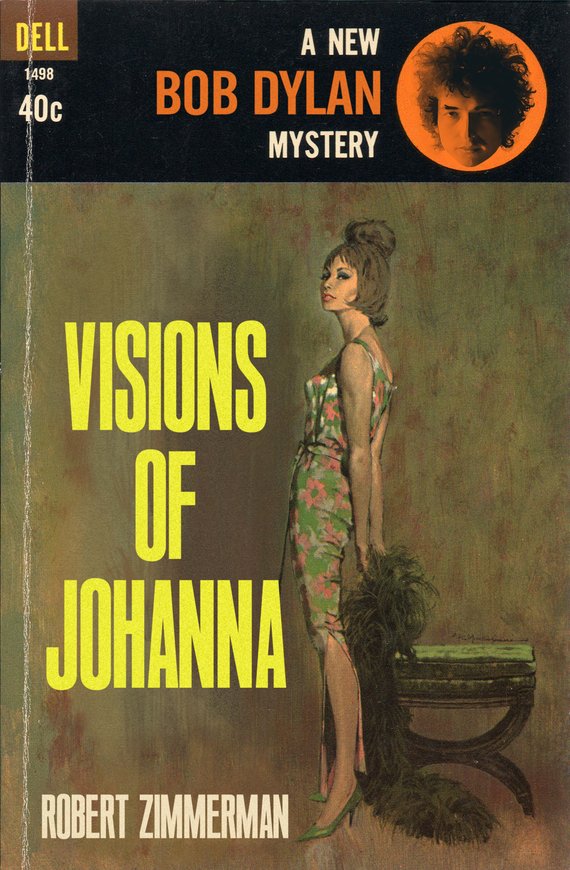
Visions of Johanna is positively understated in comparison. While many pulp authors toiled in obscurity, let us pretend that Nobel Prize winner and (faux) pulp-novelist Dylan wouldn’t have. Especially if he had a series like the pseudonymous Brett Halliday’s popular Mike Shayne mysteries. At that level, the cover wouldn’t really need quotes.
Though what harm would there be? There’s plenty of negative space here. Readers, which line would you splash across the cover if you were this prankster, Alcott?
Ain’t it just like the night to play tricks when you’re tryin’ to be so quiet?
We sit here stranded, though we’re all doin’ our best to deny it
And Louise holds a handful of rain, temptin’ you to defy it
Lights flicker from the opposite loft
In this room the heat pipes just cough
The country music station plays soft
But there’s nothing, really nothing to turn off
Just Louise and her lover so entwined
And these visions of Johanna that conquer my mind
In the empty lot where the ladies play blindman’s bluff with the key chain
And the all-night girls they whisper of escapades out on the “D” train
We can hear the night watchman click his flashlight
Ask himself if it’s him or them that’s really insane
Louise, she’s all right, she’s just near
She’s delicate and seems like the mirror
But she just makes it all too concise and too clear
That Johanna’s not here
The ghost of ’lectricity howls in the bones of her face
Where these visions of Johanna have now taken my place
Now, little boy lost, he takes himself so seriously
He brags of his misery, he likes to live dangerously
And when bringing her name up
He speaks of a farewell kiss to me
He’s sure got a lotta gall to be so useless and all
Muttering small talk at the wall while I’m in the hall
How can I explain?
Oh, it’s so hard to get on
And these visions of Johanna, they kept me up past the dawn
Inside the museums, Infinity goes up on trial
Voices echo this is what salvation must be like after a while
But Mona Lisa musta had the highway blues
You can tell by the way she smiles
See the primitive wallflower freeze
When the jelly-faced women all sneeze
Hear the one with the mustache say, “Jeeze
I can’t find my knees”
Oh, jewels and binoculars hang from the head of the mule
But these visions of Johanna, they make it all seem so cruel
The peddler now speaks to the countess who’s pretending to care for him
Sayin’, “Name me someone that’s not a parasite and I’ll go out and say a prayer for him”
But like Louise always says
“Ya can’t look at much, can ya man?”
As she, herself, prepares for him
And Madonna, she still has not showed
We see this empty cage now corrode
Where her cape of the stage once had flowed
The fiddler, he now steps to the road
He writes ev’rything’s been returned which was owed
On the back of the fish truck that loads
While my conscience explodes
The harmonicas play the skeleton keys and the rain
And these visions of Johanna are now all that remain
You can see more of Todd Alcott’s Mid-Century Pulp Fiction Cover project, and pick up archival quality prints from his Etsy shop.
Related Content:
Bob Dylan Potato Chips, Anyone?: What They’re Snacking on in China
Bob Dylan Hates Me: An Animation
Ayun Halliday - no relation to Brett — is an author, illustrator, theater maker and Chief Primatologist of the East Village Inky zine. Join her in NYC on Monday, September 24 for another monthly installment of her book-based variety show, Necromancers of the Public Domain. Follow her @AyunHalliday.
Read More...Songs by David Bowie, Elvis Costello, Talking Heads & More Re-Imagined as Pulp Fiction Book Covers
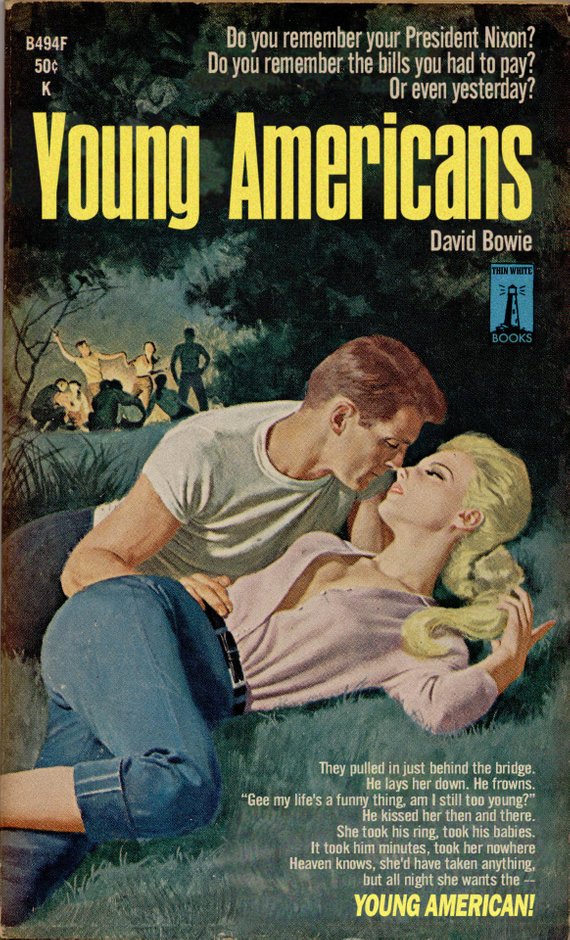
As David Bowie himself implied in a 1975 interview, “Young Americans” doesn’t have much of a narrative.
Rather, it’s a portrait of ambivalence, viewed at some remove.
The same cannot be said for Young Americans, the wholly imaginary midcentury pulp novel.
One look at the lurid cover, above, and one can guess the sort of steamy passages contained within. Bowie’s sweaty palmed classmates at Bromley Technical High School could probably have recited them from memory!
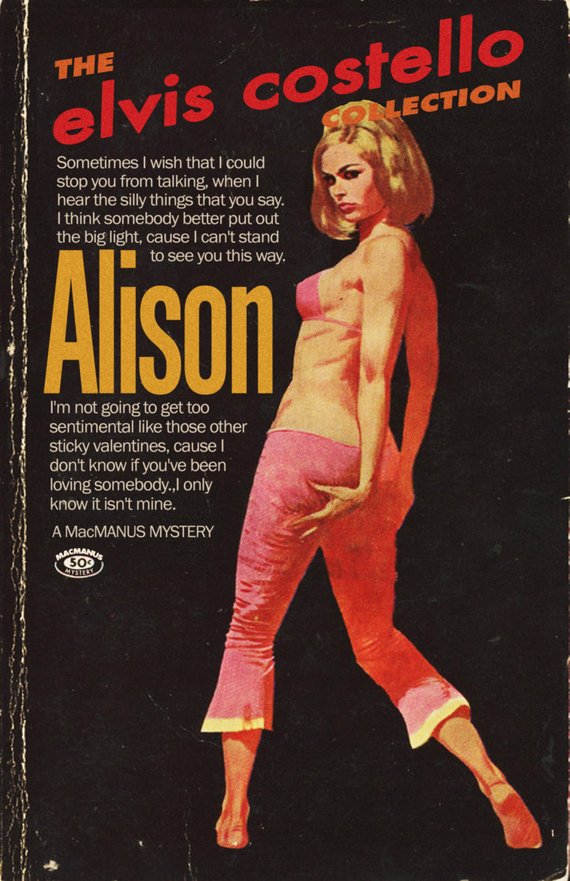
Ditto Alison. The tawdry paperback, not Elvis Costello’s evergreen 1977 ballad. There’s a reason its spine is falling apart, and it’s not because young lads like Elvis Costello are fearful their hearts might prove untrue. That skimpy pink bikini top and hip huggers get-up is appealing to an entirely different organ.
Here we must reiterate that these books do not exist and never did.
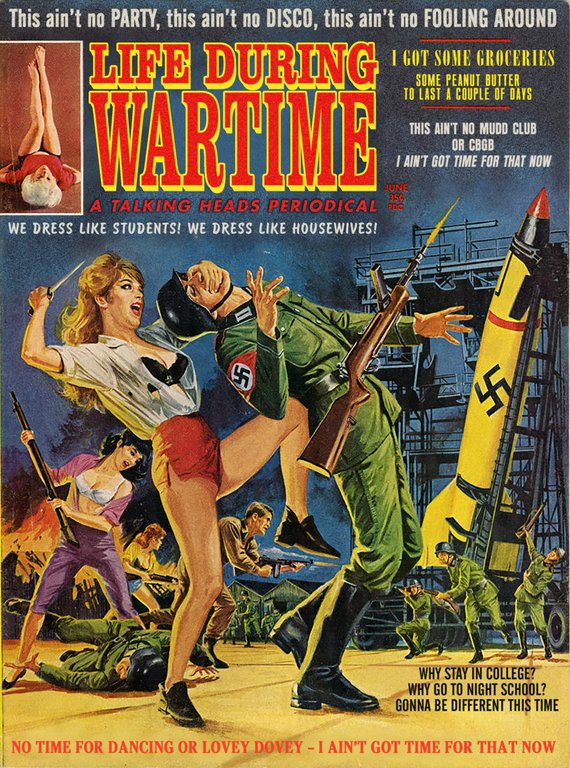
Though there’s a lot of fun to be had in pretending that they do.
Screenwriter Todd Alcott, the true author of these digital mashups, is keenly attuned to the overripe visual language of midcentury paperbacks.
He’s also got quite a knack for extracting lyrics from their original context and rendering them in the period font, magically retooling them as the sort of suggestive quotes that once beckoned from drugstore book racks.
Font has been important to him since the age of 13, when a school art project required him to combine text with an image:
I decided that I wanted the text to look like the text I’d seen in an ad for a John Lennon album, so I copied that font style. I didn’t know that the font style had a name, but I knew that my instincts for how to draw those letters didn’t match how the letters ended up looking. The font, as it turns out, was Franklin Gothic, and, as a 13-year-old, all I remember was that I would start to draw the “S” and then realize that my “S” didn’t look like Franklin Gothic’s “S,” and that the curvy letters, like “G” and “O,” didn’t look right when they sat on the lines I’d made for the other letters, because of course for a font, the curvy letters have to be a little bit bigger than the straight letters, or else they end up looking too small. I became fascinated with that kind of thing, how one font would give off one kind of feeling, and other one would give off a completely different feeling. And it turns out there’s a reason for all of that, that every font carries with it a specific cultural connotation whether the reader is aware of it or not. When I drive down the street in LA, I see billboards and I can’t just look at one and say “Okay, got it,” I get a whole other layer of meaning from them because their design and font choices tell me a whole history of the people who designed them.
While Alcott discovers many of his visuals online, he has a soft spot for the battered originals he finds in second hand shops. Their wear and tear confers the sort of verisimilitude he seeks. The rest is equal parts inspiration, Photoshop, and a growing understanding of a design form he once dismissed as the tawdry fruit of Low Culture:
I’d never understood pulp design until I started this project. As I started looking at it, I realized that the aesthetic of pulp is so deeply attached to its product that it’s impossible to separate the two. And that’s what great design is, a graphic representation of ideas. When I started examining the designs, to see why some work and some don’t, I was overwhelmed with the sheer amount of artistry involved in the covers. Pulp was a huge cultural force, there were dozens of magazines and publishers, cranking out stuff every month for decades, detective stories and police stories and noir stories and mysteries. It employed thousands of artists, writers and painters and illustrators. And the energy of the paintings is just off the charts. It had to be, because any given book cover had to compete with the ten thousand other covers that were on display. It had to grab the viewer fast, and make that person pick up the book instead of some other book. I love all kinds of midcentury stuff, but nothing grabs you the way a good pulp cover does.
Not all of his mash ups traffic in mid-century drugstore rack nymphomania.
New Order’s “Bizarre Love Triangle” is the ideal recipient of the abstract approach so common to psychology and philosophy titles of the period.
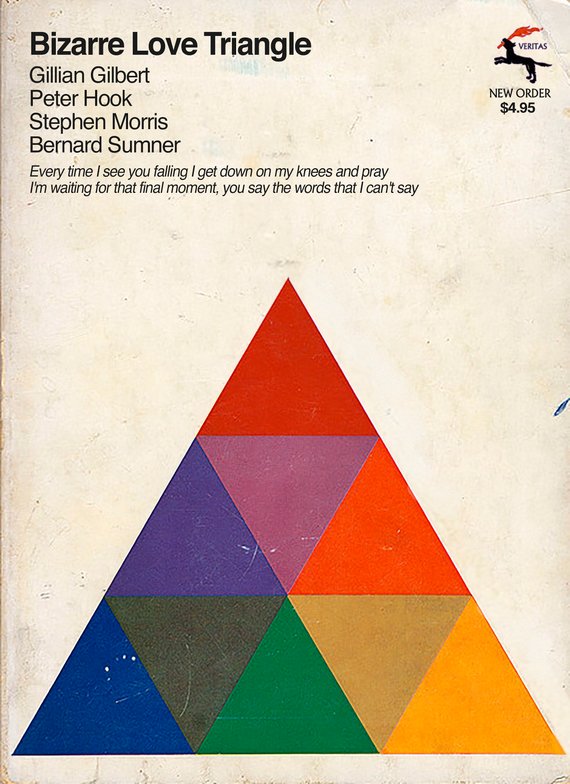
Needless to say, Alcott’s covers are also a tribute to the musicians he lists as authors, particularly those dating to his New Wave era youth—Bowie, Costello, Joy Division, Talking Heads, King Crimson…
I know I could find more popular contemporary artists to make tributes for, but these are the artists I love, I connect to their work on a deep level, and I try to make things that they would see and think “Yeah, this guy gets me.”
My favorite thing is when people think the pieces are real. That’s the highest compliment I can receive. I’ve had band members contact me and say “Where did you find this?” or “I don’t even remember doing this album” or “Where did you find this?” That’s when I know I’ve successfully combined ideas.
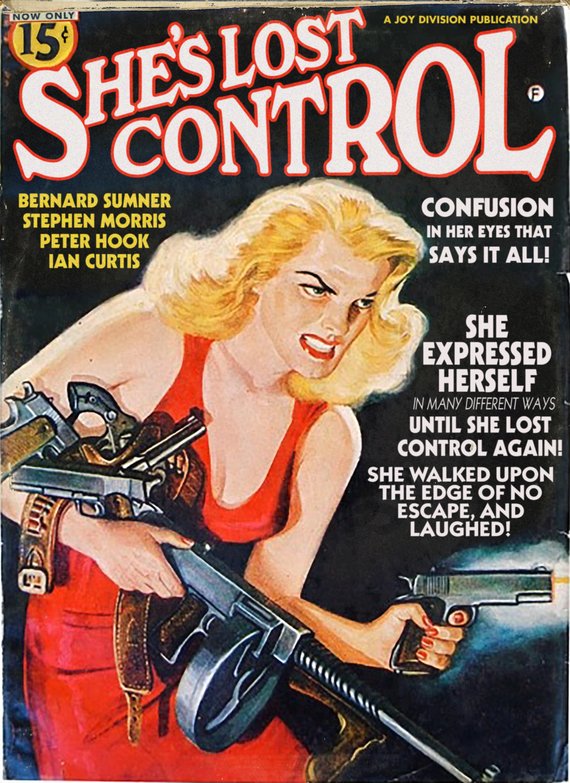
Todd Alcott’s Mid-Century Mash Up Book Covers can be purchased as prints from his Etsy store.
All images published with the permission of Todd Alcott.
Related Content:
French Bookstore Blends Real People’s Faces with Book Cover Art
Ayun Halliday is an author, illustrator, theater maker and Chief Primatologist of the East Village Inky zine. Join her in NYC on Monday, September 24 for another monthly installment of her book-based variety show, Necromancers of the Public Domain. Follow her @AyunHalliday.
Read More...How Leonard Cohen Wrote a Love Song
So many songs take love as their topic, almost by default, that we hardly even think of the “love song” as a distinct type of musical work anymore. And when we do, we often do it out of a desire for alternatives: lyrics and compositions of a more complex, cerebral, and iconic nature, escapes from the simple paeans to infatuation, romance, and couplehood with which we can easily feel fed up. Few singer-songwriters in recent history would seem more capable of providing such escapes than Leonard Cohen, who never shied away from looking at life (and when the time came, death) straight on, refusing to shrink from its infinite emotional chiaroscuro.
But Leonard Cohen, too, wrote love songs now and again. In “How Leonard Cohen Writes a Love Song,” the video essay from Polyphonic above, we learn just how he tackled that most common of all musical subjects without abandoning his inimitable sensibility. It first examines Cohen’s song “Suzanne,” which has its origins in a poem he wrote in 1966 and appeared on his debut album Songs of Leonard Cohen the following year. Unlike almost all love songs, “Suzanne” deals with a Platonic relationship, in this case the one between Cohen and a woman with whom he regularly drank tea and took walks around his native Montreal.
From “Suzanne” the analysis moves on to “Famous Blue Raincoat” from Cohen’s 1971 album Songs of Love and Hate. The necessary balance between those forces implied in the album’s title reflects Cohen’s worldview, which in the 1970s led him into an involvement with Buddhism. But he’d also looked into Scientology, which explains the song’s then-cryptic question “Did you ever go clear?” That counts as only one of the many cultural references with which Cohen layers “Famous Blue Raincoat,” as he layered so much of his work; even a song ostensibly about love was also about much else in the world besides love.
After an unpromising initial release in 1984, “Hallelujah,” would go on to become Cohen’s signature song. (Malcolm Gladwell tells the story on his podcast Revisionist History). Despite the religious themes on its surface, “Hallelujah” has a deeper meaning, so the video reveals, as a love song, albeit a love song of a multivalent kind. Last comes “I’m Your Man,” the title track from Cohen’s uncharacteristically synthesizer-heavy 1988 album, and itself an uncharacteristically love song-like love song. But, in the words of Pitchfork’s Dorian Lynksey, it takes its “sentimental clichés — I’m addicted to love, I’ll do anything for love — to brutal extremes.” Though Cohen ultimately had to admit his inability to fully understand, much less tame, the forces of love, never did he give up trying to master it in song, approaching it in all the ways typical love songs teach us never to expect.
Related Content:
How Leonard Cohen & David Bowie Faced Death Through Their Art: A Look at Their Final Albums
Hear Leonard Cohen’s Final Interview: Recorded by David Remnick of The New Yorker
Listen to Nick Cave’s Lecture on the Art of Writing Sublime Love Songs (1999)
Based in Seoul, Colin Marshall writes and broadcasts on cities and culture. His projects include the book The Stateless City: a Walk through 21st-Century Los Angeles and the video series The City in Cinema. Follow him on Twitter at @colinmarshall or on Facebook.
Read More...Frank Zappa’s 1980s Appearances on The David Letterman Show
I’ve never been a huge fan of Frank Zappa’s music and gravitated more toward the bizarre yet bluesy sonic world of his sometime collaborator and lifelong frenemy Captain Beefheart. But I get the appeal of Zappa’s wildly virtuoso catalog and his sardonic, even caustic, personality. The phrase may have devolved into cliché, but it’s still worth saying of Zappa: he was a real original, a truly independent musician who insisted on doing things his way. Most admirably, he had the talent, vision, and strength of will to do so for decades in a business that legendarily chews up and spits out artists with even the toughest of constitutions.
Zappa, notes the Rock and Roll Hall of Fame in its profile, “was rock and roll’s sharpest musical mind and most astute social critic… the most prolific composer of his age,” who “bridged genres—rock, jazz, classical, avant-garde and even novelty music—with masterful ease.” Recording “over sixty albums’ worth of material in his fifty-two years,” he famously discovered, nurtured, and collaborated with some of the most technically proficient and accomplished of players. He was indie before indie, and “confronted the corrupt politics of the ruling class” with ferocious wit and unsparing satire, holding “the banal and decadent lifestyles of his countrymen to unforgiving scrutiny.”
Needless to say, Zappa himself was not prone to banality or decadence. He stood apart from his contemporaries with both his utter hatred of trends and his commitment to sobriety, which meant that he was never less than totally lucid, if never totally clear, in interviews and TV appearances. Unsurprisingly, David Letterman, champion of other fiercely talented musical oddballs like Warren Zevon, was a Zappa fan. Between 1982 and 83, Zappa came on Letterman three times, the first, in August of 82, with his daughter Moon (or “Moon Unit,” who almost ended up with the name “Motorhead,” he says).
The younger Zappa inherited her father’s deadpan. “When I was little,” she says, “I wanted to change my name to Beauty Heart. Or Mary.” But Zappa, the “musical and a sociological phenomenon,” as Letterman calls him, gets to talk about more than his kids’ weird names. In his June, 83 appearance, further up, he promotes his London Symphony Orchestra album. As he explains, the experience of working with cranky classical musicians on a very tight schedule tested his perfectionistic (some might say controlling) temperament. The album gave rise, writes Eduardo Rivadavia at Allmusic, “to his well-documented love/hate (mostly hate) relationship with symphony orchestras thereafter.”
But no matter how well or badly a project went, Zappa always moved right along to the next thing. He was never without an ambitious new album to promote. (In his final Letterman appearance, on Halloween, above, he had a musical, which turned into album, the triple-LP Thing-Fish.) Since he never stopped working for a moment, one set of ideas generating the next—he told Rolling Stone in answer to a question about how he looked back on his many records—“It’s all one album.” See a supercut below of all of Zappa’s 80s visits to the Letterman set, with slightly better video quality than the individual clips above.
Related Content:
Frank Zappa Explains the Decline of the Music Business (1987)
Hear the Musical Evolution of Frank Zappa in 401 Songs
Hunter S. Thompson’s Many Strange, Unpredictable Appearances on The David Letterman Show
Josh Jones is a writer and musician based in Durham, NC. Follow him at @jdmagness
Read More...A Modern Drummer Plays a Rock Gong, a Percussion Instrument from Prehistoric Times
Rock Gong. It sounds like a B‑52s song. But a rock gong is not a New Wave surf-rock party groove. It’s not a neo-synthpop act, hip hop group, or indie band (not yet). It’s a prehistoric instrument—as far away in time as one can get from synthesizers and electric guitars. Rock gongs are ancient, maybe as old as humankind. But they’re still groovy, in their way. As they say, the groove is in the player, not the instrument.
Rock gongs, or “lithophones,” if you want to get technical, have been found all over the African continent, in South America, Australia, Azerbaijan, England, Hawaii, Iceland, India, and everywhere else prehistoric people lived. Not the cultural property of any one group, the rock gong came, rather, from a universal human insight into the natural sonic properties of stone. (One theory even speculates that Stonehenge might have been a massive collection of rock gongs.)
Though some scholars have suggested that the term “rock gong” should be reserved for stationary, rather than portable, rocks that were used as instruments, the British Museum seems untroubled by the distinction. In the video above, archaeologist Cornelia Kleinitz explains the principles of rock gongs found in Sudan to modern rock drummer Liam Williamson of the band Cats on the Beach.
You can hear one of those Nubian rock gongs in its natural habitat, before it was moved to the British Museum, in the clip just above. The rock, the narrator tells us, has been “worn smooth by the action of people playing it more than 7,000 years ago. Long before the Romans, long before the Pharaohs.” Early humans would have searched long and hard for rocks that resonated at particular frequencies, for ringing rocks that could be combined into scales for early xylophones or produce a variety of tones like a steel drum.
Despite their antiquity, the study of rock gongs is a rather recent phenomenon, part of the emerging field of archaeoacoustics. “Methodologically,” write the authors of a 2016 paper on the subject, “this field of research is still in its infancy,” and there is much researchers do not know about the uses and varieties of rock gongs around the world. As Kleinitz explains to Williamson in the video at the top, archaeologists are trying to understand the context in which the Nubian gongs at the British Museum would have been played, whether as instruments for rituals, signaling, fun, or all of the above.
As for the techniques involved in rock gong playing, we can only guess, but Williamson does his best to adapt his drum chops to the ancient stone kit. One critical difference between our modern human musical instruments and this ancient kind, Kleinitz notes, is that the latter were integrated into the landscape; their distinctive sound depended not only on the rock itself, but on its interaction with the wild and unpredictable environment around it.
Related Content:
Hear a 9,000 Year Old Flute—the World’s Oldest Playable Instrument—Get Played Again
What Did Ancient Greek Music Sound Like?: Listen to a Reconstruction That’s ‘100% Accurate’
Visit an Online Collection of 61,761 Musical Instruments from Across the World
Josh Jones is a writer and musician based in Durham, NC. Follow him at @jdmagness
Read More...The Believer Magazine Has Put Its Entire Archive Online for Free
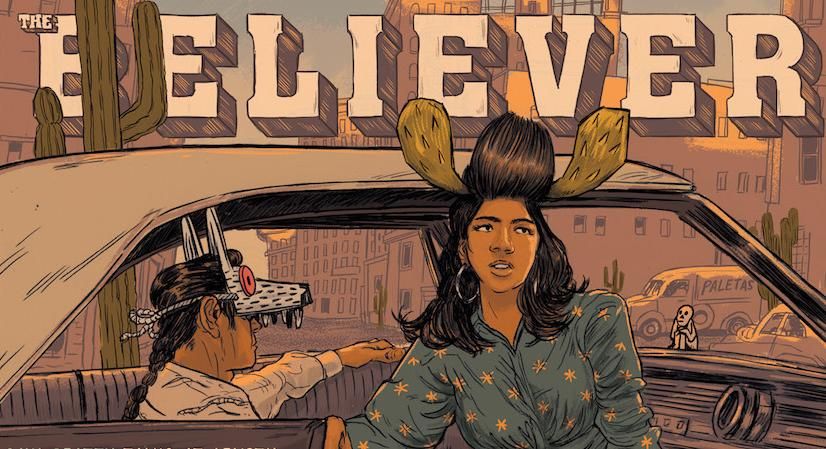
Founded in 2003, The Believer magazine gained a reputation for being an off-beat literary magazine with a commitment “to journalism and essays that are frequently very long, book reviews that are not necessarily timely, and interviews that are intimate, frank and also very long.” Founded by authors Vendela Vida, Ed Park and Heidi Julavits, and originally published Dave Eggers’ McSweeney’s, The Believer has featured contributions by Nick Hornby, Anne Carson, William T. Vollmann; columns by Amy Sedaris and Greil Marcus; and also interviews–like this one where director Errol Morris talks with filmmaker Werner Herzog.
Now published by the Black Mountain Institute at the University of Nevada, Las Vegas, The Believer has entered a new era. It has launched a brand new web site and made its 15-year archive freely available online. It’s a first for the publication. Enter the archive of the “highbrow but delightfully bizarre” magazine here.
If you would like to support the mission of Open Culture, consider making a donation to our site. It’s hard to rely 100% on ads, and your contributions will help us continue providing the best free cultural and educational materials to learners everywhere. You can contribute through PayPal, Patreon, and Venmo (@openculture). Thanks!
Related Content:
Enter “The Magazine Rack,” the Internet Archive’s Collection of 34,000 Digitized Magazines
Read 1,000 Editions of The Village Voice: A Digital Archive of the Iconic New York City Paper
Read More...Pianist Plays Beethoven, Bach, Chopin, Ravel & Debussy for Blind Elephants in Thailand
Romsai the elephant wore a red rope around his neck to warn approaching humans that he was a danger to both them and elephants. A dark patch on his head from a temporin secretion indicated that he was in the musth cycle, which only heightened his aggression. His mahouts at the ElephantsWorld sanctuary in Kanchanaburi, Thailand observed that the old, blind elephant was growing more dangerous with age.
And yet, he is the personification of sweetness, as pianist Paul Barton serenades him with a performance of Beethoven’s Sonata Pathétique, repeating the melody section several times “as he seems to like it.”
In lieu of applause, Romsai places his trunk over the top of Barton’s upright piano again and again, in no way aggressive, more the gesture of a grateful audience member.
As Barton, a Yorkshireman who went to Thailand over twenty years ago for what he thought would be a short piano teaching stint only to wind up marrying a local artist and animal rights activist, said in an interview with YourStory:
All animals like music. Dogs, cats, etc. But elephants are the closest to human beings in the sense that they have the same neurons in the brains as us. Also they have a very good memory. If you are treated badly as a child, you are going to remember that all your life. It’s the same with elephants. The elephant shares that part of the brain with us which has flashbacks. They can never forget the terrible things they have seen and suffered… If you play classical music to an elephant, something soft and beautiful, something that human beings have been listening to for hundreds for hundreds of years, something that is timeless—and you play that to an elephant that is blind and they’ve never heard music before—the reaction is priceless. There is a special bond between you and the elephant. You are communicating with them in a different language. That language is neither ours nor theirs. There is something infinitesimally wonderful in a piece of Beethoven that connects me to that elephant and that feeling is otherworldly.
The impulse to play live concerts for Romsai and other blind sanctuary dwellers was partly born from seeing the positive effect music had on some blind children with whom Barton worked.
He also wanted to make amends for the deforestation of the elephant’s homeland, and the way the teak industry exploited their labor. It was while thus employed that many of them suffered scratched corneas and other eye injuries that blinded them, rendering them doubly vulnerable when the Thai government enacted a ban on commercial timber logging in 1989:
The elephant has worked for humans for too long. It was used in wars, it was used to deforest its own home. What is the little thing I can do as a human to say sorry, for my species for what we have done to them? I’ll carry this heavy thing myself and play some music for the elephant while it is having some breakfast.
Removed from the plush seats of a concert hall, Ravel feels right at home. A rooster crows, a nearby child pipes up, and Romsai wanders in and out of the frame, at times appearing to keep time with his trunk.
Cicadas underscore Schubert’s Serenade.
Another ElephantsWorld resident, Lam Duan’s (aka “Tree with Yellow Flowers”) stillness as she listens to Bach is reminiscent of Barton’s first musical outing with the elephants:
Elephants eat a lot of food. A lot. It is exhausting trying to procure that much food for so many elephants. When an elephant gets to eat, it’s a bit like a dog. A dog will eat its food so quickly because it’s not sure if it will ever eat again. And elephants are the same. Once they get their hands on some juicy leaves, they will eat and eat and nothing can tear them away from their food. That morning I brought the piano in early to the sanctuary. Pla-Ra was taken to a field full of juicy bamboo shoots and she began eating with a single minded dedication. I started to play Beethoven and she stopped eating. There was this half eaten bamboo shoot sticking out of her trunk while she stared at me. That was a reaction never seen before. An elephant stopped eating because of music.
Barton’s latest recording features 80-year-old Ampan, blind in one eye and near blind in the other, enjoying Debussy’s Clair de Lune.
Support Paul Barton’s Patreon here. Learn about volunteer opportunities or make a donation to ElephantsWorld here
via Laughing Squid
Related Content:
Stream 58 Hours of Free Classical Music Selected to Help You Study, Work, or Simply Relax
Watch Classical Music Get Perfectly Visualized as an Emotional Roller Coaster Ride
Ayun Halliday is an author, illustrator, theater maker and Chief Primatologist of the East Village Inky zine. Follow her @AyunHalliday.
Read More...96-Year-Old Holocaust Survivor Fronts a Death Metal Band
As we get older, family and friends may pass away or leave us somehow, but for many of us creativity can be our solace. (Yes, it could also make us immortal, like Bach or Shakespeare, but we won’t be around to find out.) In the case of nonagenarian Inge Ginsberg that has been the case in the unlikeliest of outlets: death metal.
This charming New York Times documentary by Leah Galant details the unlikely team-up between Ginsberg–who spends her time between Switzerland and New York City–and the young musicians who became her friends and got her into performing her poems live with full death metal accompaniment.
Half earnest and half good-natured stunt, the center of it all is Ginsberg’s poems, which she has been writing for years, and only a tiny glimpse of which we get to hear. The poems take on heavy subjects of mortality, our destruction of the earth, loneliness. At one point Ginsberg was writing these with no audience, and, as she says in the doc, society is not interested in hearing from the elderly (especially when it’s this dark.) It took her younger friends to make the connection between her poems and the usual preoccupations of death metal and insist Ginsberg perform them in that hectoring, doom laden-style of the genre. She was game.
Galant’s mini doc rewinds history halfway through to explain Ginsberg’s upbringing: a “Jewish princess” who survived the Holocaust, fled to America, and wound up writing songs with her husband (Dean Martin’s “Try Me” was one of their hits). Tired of the war, they moved back to Zurich, and, well, fast forward three husbands and several decades later, Ginsberg was back in the spotlight, performing on the Swiss version of America’s Got Talent.
We won’t spoil the ending of the doc, as the band try to get Ginsberg to try out for the actual America’s Got Talent, because we’ve already said enough. But we’ll leave you with this quote from the singer herself: “My concept of heaven and hell is that in the moment of death you realize your life was full and good–that is heaven. And if you think, ‘Oh, I should have done this or that,’ I think that’s hell.”
Related Content:
John Cage’s Silent, Avant-Garde Piece 4’33” Gets Covered by a Death Metal Band
Ted Mills is a freelance writer on the arts who currently hosts the artist interview-based FunkZone Podcast and is the producer of KCRW’s Curious Coast. You can also follow him on Twitter at @tedmills, read his other arts writing at tedmills.com and/or watch his films here.
Read More...Support Us
We're hoping to rely on loyal readers, rather than erratic ads. Please click the Donate button and support Open Culture. You can use Paypal, Venmo, Patreon, even Crypto! We thank you!

About Us

Open Culture scours the web for the best educational media. We find the free courses and audio books you need, the language lessons & educational videos you want, and plenty of enlightenment in between.
Advertise With Us

FREE UPDATES!
GET OUR DAILY EMAIL
Get the best cultural and educational resources on the web curated for you in a daily email. We never spam. Unsubscribe at any time.
FOLLOW ON SOCIAL MEDIA

Open Culture editor Dan Colman scours the web for the best educational media. He finds the free courses and audio books you need, the language lessons & movies you want, and plenty of enlightenment in between.
Advertise With Us

