Movie Accent Expert Analyzes 31 Actors Playing Other Famous People: Jamie Foxx as Ray Charles, Natalie Portman as Jackie Kennedy, Cate Blanchett as Bob Dylan, and More
Well-known figures’ voices are often as distinctive as their thousand-watt smiles and influential hairdos.
While there is some evidence as to the accents and idiosyncratic speech patterns of such historical heavy hitters as Thomas Edison, Florence Nightingale, and Harry Houdini, technological improvements have really upped the ante for those charged with impersonating real life people from the mid 20th-century onward.
Natalie Portman had to sustain her Jackie Kennedy impersonation for an entire feature-length biopic, a performance dialect coach Erik Singer gives high marks, above. Portman, he explains, has truly internalized Jackie’s idiolect, the individual quirks that add yet another layer to such signifiers as class and region.
As evidence, he submits a side-by-side comparison of the First Lady’s famous 1962 televised tour of the White House renovations she had spearheaded, and Portman’s recreation thereof.
Portman has done her homework with regard to breath pattern, pitch, and the refinement that strikes most 21st century ears as a bit stilted and strange. Most impressive to Singer is the way Portman transfers Kennedy’s oddly musical elongation of certain syllables to other words in the script. Tis no mere parrot job.
Jamie Foxx’s Oscar-winning turn as Ray Charles succeeds on copious research and his ability to inhabit Charles’ habitual smile. Obviously, the posture in which an individual holds their mouth has a lot to do with the sound of their voice, and Foxx was blessed with plenty of source material.
The 1982 epic Gandhi provided the versatile Ben Kingsley with the opportunity to showcase not one, but two, idiolects. The adult Gandhi underwent a dramatic and well documented evolution from the British accent he adopted as a young law student in London to a proudly Indian voice better suited to inspiring a nation to unify against its British colonizers.
It’s likely that many of us have never considered the speech-related building blocks Singer scrutinizes while analyzing 29 other performances for the WIRED video, above—epenthesis, tongue positions, relative degrees of emphatic muscularity, and retroflex consonants—but it’s easy to see how they play a part.
Singer invites you to expand his research and teaching library by recording yourself speaking extemporaneously and reading from two sample texts here. Pray that whoever plays you in the biopic gets it right.
Related Content:
Peter Sellers Gives a Quick Demonstration of British Accents
Why Do People Talk Funny in Old Movies?, or The Origin of the Mid-Atlantic Accent
Watch Meryl Streep Have Fun with Accents: Bronx, Polish, Irish, Australian, Yiddish & More
Ayun Halliday is an author, illustrator, theater maker and Chief Primatologist of the East Village Inky zine. See her onstage in New York City through December 20th in the 10th anniversary production of Greg Kotis’ apocalyptic holiday tale, The Truth About Santa, and the book-based variety show, Necromancers of the Public Domain. Follow her @AyunHalliday.
Read More...How David Lynch Manipulates You: A Close Reading of Mulholland Drive
David Lynch messes with your mind. You’ve probably heard variations on that observation before, as likely to come from people who love Lynch’s films as from those who can’t stand them. Unlike most “normal” filmmakers, who tell stories comfortably ensconced in the reality that the tradition of cinema has built, Lynch has always told his stories in a cinematic reality of his own, built out of the existing elements of cinema but bolted together by him in surprising and often unsettling ways. Hence his name’s long-ago conversion into an adjective: David Lynch movies are Lynchian, and it falls to we who watch them to deal with the psychological effects — frightening, thrilling, completely disorienting, or some combination of those and more — that Lynchianness stirs within us.
In the video essay “Mulholland Drive: How Lynch Manipulates You,” Evan Puschak, better known at the Nerdwriter, breaks down Lynch’s process of mind-messing, at least as it works in one particular scene of one of his best-known and most acclaimed films, Mulholland Drive. Lynch, Puschak explains, “uses expectation as a tool. He wields expectation — the expectation that comes from what we know about film, about its history, the history of stories, and from our humanity — with the same nuance and power as someone else might use light to create a variety of moods in a space.”
Mulholland Drive, which seems to begin as the story of a would-be blonde ingenue arriving in Hollywood with dreams of making it big, gets further and further off kilter as it goes, leveraging the ostensible stiffness and even corniness it dares to present at the beginning to deliver a much darker and more complex cinematic experience in the end. “All throughout the film, from the overdubbed dialogue on down, David Lynch has made us privy to the veneer of things,” says Puschak. “It’s all curiously two-dimensional, and that puts us on our guard, since surfaces are what we get. Lynch encourages us to examine those surfaces, always remaining detached enough for a disinterested, critical view of what we’re seeing.”
But “as with everything that Lynch does, this two-dimensionality, this flatness, is also a deception. While we think we’re on our guard, superior to the cloying emotions of Hollywood wish-fulfillment, Lynch relishes dropping the bottom out, showing us just how unprepared for and susceptible we are to emotions that our society treasures or deeply fears.” In Mulholland Drive he accomplishes this over and over again by using ancient Hollywood stereotypes, film noir tropes, a nightclub singer lip-syncing to a Roy Orbison song in Spanish, a caveman living behind a Sunset Strip diner, Angelo Badalamenti spitting out an espresso, Billy Ray Cyrus, and much more besides. And as both Lynch’s fans and detractors must suspect, he no doubt has a few more ways to drop the bottoms out from under his audiences in his toolbox yet.
Related Content:
The Surreal Filmmaking of David Lynch Explained in 9 Video Essays
What Makes a David Lynch Film Lynchian: A Video Essay
An Animated David Lynch Explains Where He Gets His Ideas
David Lynch Muses About the Magic of Cinema & Meditation in a New Abstract Short Film
Based in Seoul, Colin Marshall writes and broadcasts on cities, language, and culture. His projects include the book The Stateless City: a Walk through 21st-Century Los Angeles and the video series The City in Cinema. Follow him on Twitter at @colinmarshall or on Facebook.
Read More...Watch “The Midnight Parasites,” a Surreal Japanese Animation Set in the World of Hieronymus Bosch’s The Garden of Earthly Delights (1972)
Hieronymus Bosch’s bizarre paintings might have looked perfectly ordinary to his contemporaries, argues Stanley Meisler in “The World of Bosch.” Modern viewers may find this very hard to believe. We approach Bosch through layers of Freudian interpretation and Surrealist appreciation. We cannot help “regarding the scores of bizarre monsters”—allegories for sins and punishments far more legible in 15th-century Netherlands—“as a kind of dark and cruel comic relief.”
While Bosch might have intended his work as serious sermonizing, it is impossible for us to inhabit the medieval consciousness of his time and place. There’s just no getting around the fact that Bosch is really weird—weirder even (or more imaginatively allegorical) than nearly any other artist of his time. In some very important ways, he belongs to a 20th-century aesthetic of post-Freudian dream logic as much as he belonged to peculiar medieval visions of heaven and hell.
Bosch “described terrible, unbearable holocausts crushing mankind for its sins,” writes Meisler, visions that seemed both stranger and more familiar in the wake of so many man-made holocausts whose absurdities defy reason. What modern horrors does famed Japanese animator Yōji Kuri invoke in his psychedelic 1972 film “The Midnight Parasites,” above, a surrealist short set in the world of Bosch?
Dangerous Minds’ Paul Gallagher describes the plot, such as it is:
Here Kuri imagines what would life might be like if we all lived in Bosch’s painting “Garden of Earthly Delights.” It’s a basically shit and death or rather a cycle of life where blue figures live and die; eat shit and shit gold; are skewered, and devoured; are regurgitated and reborn to carry on the cycle once again.
Kuri’s satirical vision, in films long favored by counter-cultural audiences, has “bite,” writes Animation World Network’s Chris Robinson: “he helped lift Japanese animation out of decades of cozy narrative cartoons into a new era of graphic and conceptual experimentation. His films mock and shock, attacking technology, population expansion, monotony of modern society… Witnessing the surrender of Japan during WW2, the devastation of his country followed by the quick rise of Western inspired materialist culture and rampant consumption, Kuri, like many of his colleagues at the time, questioned the state and direction of his society and world.”
His creative appropriation of Bosch, “dark, dirty, oddly beautiful, with a groovy soundtrack,” Gallagher writes, may not, as Meisler worries of many modern takes, get Bosch wrong at all. Though the Dutch artist’s symbolism may never be comprehensible—or anything less than hallucinatory—to us moderns, Kuri’s half-playful reimagining uses Boschian figures for some serious moralizing, showing us a hell world governed by grave lapses and cruelties Bosch could never have imagined.
Related Content:
Josh Jones is a writer and musician based in Durham, NC. Follow him at @jdmagness
Read More...At Folsom Prison: A Mini-Doc on Johnny Cash’s Historic & Career-Changing Concert
It was the opposite of superstar rock concerts, or even a sweaty, dark stage like that at CBGB’s in New York. But the dining hall at Folsom Prison was the setting for a concert that would give Johnny Cash, on the verge of a career collapse, a second chance on life. And it would become one of the unlikeliest venues in the history of country music.
Nothing was the same after this unlikeliest of turnarounds. After the album recorded at this gig, Cash would be hurtled into superstardom. He’d get his own national TV show. And instead of being a drug and alcohol casualty, he’d take on the mantel of elder statesman with a hint of danger. No, he’d never killed a man in Reno just to watch him die, but when he sang it in that long drawl, you could believe so. None of the original artists that played on Sun Records had a second act quite like Cash.
And that’s all down to the decision to play a concert at California’s Folsom Prison, in which he had set one of his most famous songs from 1953.
In Polyphonic’s nine minute mini-doc above on the making of this classic album, he tries to piece together what makes the Folsom Prison album so special.
You might not think of the album as a radical piece of late ‘60s music similar to The White Album or Beggar’s Banquet, but it is. For it was birthed with the help of producer Bob Johnston, who had a try-anything attitude that was very much in the air in 1968. The recording is raw and very, very live sounding. The audience of prisoners is a part of the mix. Cash’s voice is similarly raw and flubs and mistakes were kept in. (But as the video points out, some of the audience noises were edited for greater impact, like a ‘whoop’ after Cash’s infamous “Reno” line.) June Carter’s sweet voice contrasts with Cash’s, but there’s an air of tension to the duets, as these men probably haven’t seen a young woman in the flesh for a very long time.
There’s also the empathy of the entire project. Cash sings like he’s one of them, and his songs are of isolation and loneliness. He even sings a song written by an inmate called “Greystone Chapel.” While so many acts at this time were stripping away artifice–think of Bob Dylan’s turn away from his psychedelic mid-‘60s height–Cash beat them all to it with unadorned honesty, humor, and in the middle of a prison, a sense of joy.
This year marks the 50th anniversary of the album, and the racial make-up of Folsom has changed–it’s gone from a majority white prison to one populated by African-Americans, Latinos, and Asians.
And while country music would not get the same reception now as it did then, the biggest change is that prisoners make the music themselves. In a Los Angeles Times article about the prison, “the musicians at Folsom have formed hip-hop, hard rock/heavy metal, Latin rock, alt-rock, smooth jazz and progressive rock ensembles within Folsom’s walls.” One recent artist to visit and perform was hip-hop musician Common.
But none of that would have happened without Cash’s historic visit. As he told the Times’ Robert Hilburn about that moment, “I knew this was it. My chance to make up for all the times when I had messed up. I kept hoping my voice wouldn’t give out again. Then I suddenly felt calm. I could see the men looking over at me. There was something in their eyes that made me realize everything was going to be okay. I felt I had something they needed.”
Related Content:
Johnny Cash Sings “Man in Black” for the First Time, 1971
Johnny Cash’s Short and Personal To-Do List
Ted Mills is a freelance writer on the arts who currently hosts the artist interview-based FunkZone Podcast and is the producer of KCRW’s Curious Coast. You can also follow him on Twitter at @tedmills, read his other arts writing at tedmills.com and/or watch his films here.
Read More...The First House Powered by Coffee
Since 2006, Dunkin’ Donuts has used the tagline “America Runs on Dunkin’,” presumably alluding to the coffee and donuts that get millions of Americans through each morning. But maybe, all along, they’ve had something more in mind. Above, Dunkin’ presents a tiny home powered by biofuel made from spent coffee grounds, a process masterminded by a company called Blue Marble Biomaterials. Working with luxury tiny homebuilder New Frontier Tiny Homes, they’ve created a process–notes a Dunkin’ press release–that works something like this:
- Step 1: Extract excess oils in the spent coffee grounds. There can be natural oils left in spent coffee grounds, all depending on the coffee bean type and original processing methods.
- Step 2: Mix and react. These oils are then mixed with an alcohol to undergo a chemical reaction known as transesterification. This produces biodiesel and glycerin as a byproduct.
- Step 3: Refine. The biodiesel is washed and refined to create the final product.
When all is said and done, 170 pounds of used coffee grounds translates into one gallon of fuel. From 65,000 pounds of coffee grounds, you got enough juice to power a 275 square foot home, at least for a while.
Take a 360 degree interactive tour of the tiny home here.
Related Content:
How to Make the World’s Smallest Cup of Coffee, from Just One Coffee Bean
A Rollicking French Animation on the Perils of Drinking a Little Too Much Coffee
Philosophers Drinking Coffee: The Excessive Habits of Kant, Voltaire & Kierkegaard
David Lynch Directs a Mini-Season of Twin Peaks in the Form of Japanese Coffee Commercials
“The Virtues of Coffee” Explained in 1690 Ad: The Cure for Lethargy, Scurvy, Dropsy, Gout & More
Read More...What Are the Most Influential Books Written by Scholars in the Last 20 Years?: Leading Academics Pick “The New Canon”
It’s a fraught time to be an academic. Budgets have been slashed, departments decimated, political battles sensationalized by partisan opportunists, social media posts intensified into test cases for speech. Yet as corporatism and culture wars have pushed their way into academia in the past twenty plus years, more scholarship has seemed to make its way out into the mainstream, with books by academic historians like Eric Foner and Ibram X. Kendi, literary scholars like Stephen Greenblatt and bell hooks, sociologists like Robert Putnam, scientists like Richard Dawkins, economists like Thomas Piketty, legal scholars like Michelle Alexander, and so on, topping bestseller lists and winning National Book Awards.
Such books distill difficult ideas without dumbing them down, in accessible and often urgent prose. Their popularity speaks to how they address the pressing issues of their times, and undercuts the stereotype of academics as jargon-spewing, out-of-touch inhabitants of ivory towers. And they often have the power to not only radically alter public discourse, but to inspire mass movements and shift public policy.
Most of the more than 15,000 academic books published each year—by university presses or tiny independents—reach only “their core audience of disciplinary specialists.” A few resonate outside their fields yet still fail to find an audience outside higher education circles (nor are they really meant to).
But some books by scholars, like those by the authors named above, “enter the public consciousness,” writes The Chronicle of Higher Education, and thus deserve to be described as “influential” in a broad sense, “like On the Origin of Species or Das Kapital or The Interpretation of Dreams,” as Yale professor of psychology Paul Bloom writes (while also pointing out that none of these books’ authors were professional academics). Under the banner of forming a “New Canon,” the Chronicle asked Bloom and a number of other scholars—including Deborah Tannen, professor of linguistics and author of several best-selling popular books—to name what they believed were the most influential scholarly books of the past 20 years.
Each respondent was asked “to select books—academic or not, but written by scholars—from within or outside their own fields.” Each wrote a brief defense of their choice and, in some cases, of their criteria for “influence.” You can read these blurbs at the Chronicle’s site, and just below, see a full list of the picks. Some of the books, the Chronicle concedes, fall “slightly outside our time frame, but we included them anyway.”
Some of them are typically academic works, like Mark Greif’s choice of Eve Kosofsky Sedgwick’s Touching Feeling, a book unlikely to inspire a Netflix documentary. Others, like Michelle Alexander’s The New Jim Crow, an impetus for Ava DuVernay’s 13th, were written for the widest of readerships. Do these distinctions make books like Alexander more “influential” than those like Sedgewick’s? It all depends, I suppose, on what we mean by the word—and by what, or whom, or how, or why, or how many we think need to be influenced.
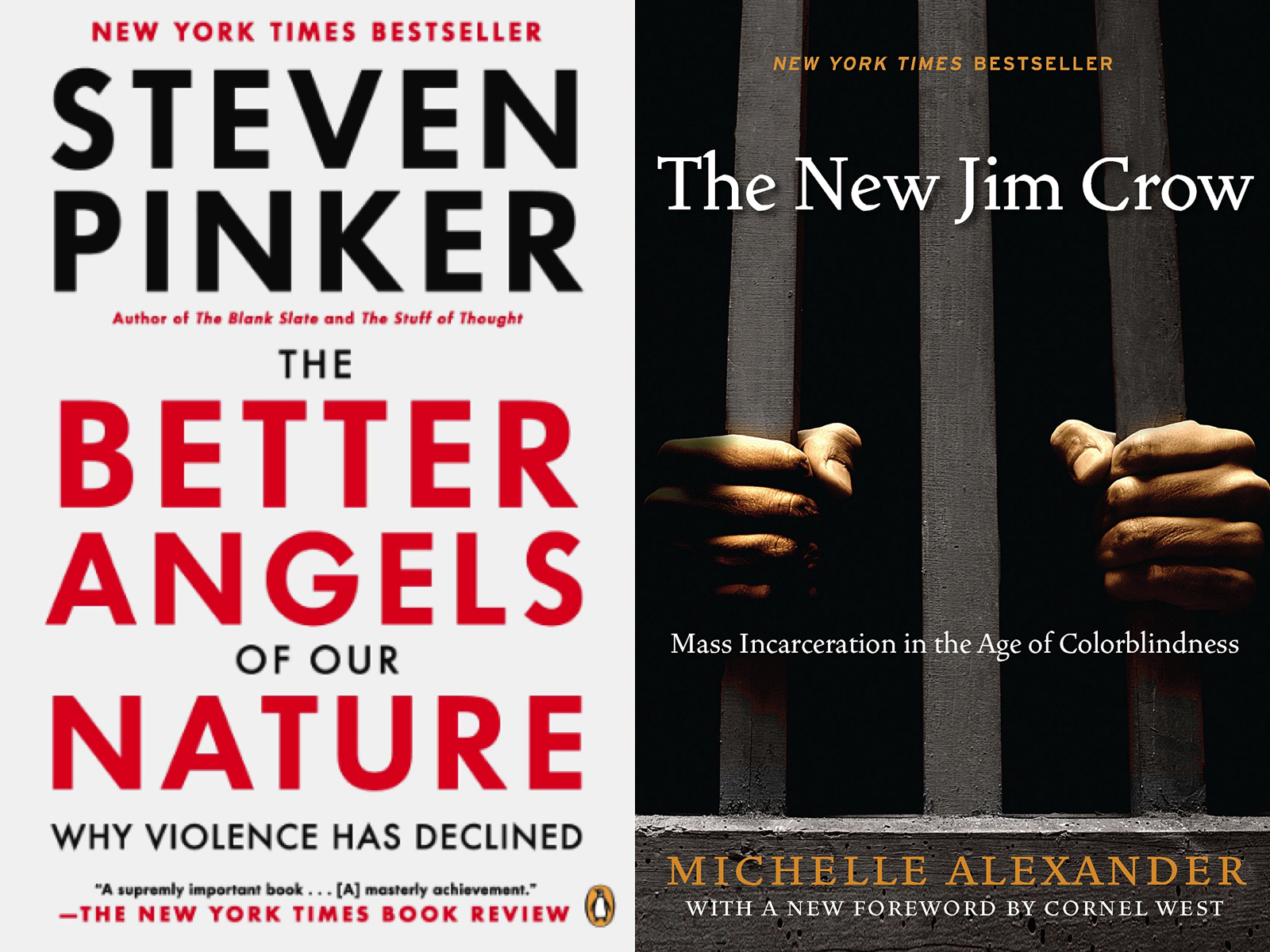
The Better Angels of our Nature, by Steven Pinker
Bowling Alone: The Collapse and Revival of American Community, by Robert Putnam
The New Jim Crow: Mass Incarceration in the Age of Colorblindness, by Michelle Alexander
The History Manifesto, by Jo Guldi and David Armitage
Freaks of Fortune: The Emerging World of Capitalism and Risk in America, Jonathan Levy
What Art Is, by Arthur Danto
Homo Deus: A Brief History of Tomorrow, by Yuval Noah Harari
Killing the Black Body: Race, Reproduction, and the Meaning of Liberty, by Dorothy Roberts
The Feeling of What Happens: Body and Emotion in the Making of Consciousness, by Antonio R. Damasio
Paying for the Party: How College Maintains Inequality, by Elizabeth A. Armstrong and Laura T. Hamilton
A Brief History of NeoLiberalism, by David Harvey
Critical Race Theory: The Key Writings That Formed The Movement, by Kimberle Crenshaw and Neil Gotanda
The Restless Clock: A History of the Centuries-Long Argument over What Makes Living Things Tick, by Jessica Riskin
Touching Feeling: Affect, Pedagogy, Performativity, by Eve Kosofsky Sedgwick
Ella Baker and the Black Freedom Movement: A Radical Democratic Vision, by Barbara Ransby
Truth and Truthfulness: An Essay in Genealogy, by Bernard Williams
War Powers: How the Imperial Presidency Hijacked the Constitution, by Peter Irons
Age of Fracture, by Daniel T. Rodgers
Shapeshifters: Black Girls and the Choreography of Citizenship, by Daniel T. Rodgers
The Argonauts, by Maggie Nelson
Read about all of the books at the Chronicle of Higher Education.
Related Content:
The 20 Most Influential Academic Books of All Time: No Spoilers
74 Essential Books for Your Personal Library: A List Curated by Female Creatives
Umberto Eco Explains Why We Make Lists
Read More...
Edward Gorey Talks About His Love Cats & More in the Animated Series, “Goreytelling”
My childhood discovery of Edward Gorey proved revelatory. I recognized my own bewilderment in the blank expressions of his obsessively-rendered Edwardian children. His characters, imprisoned in starched collars and stays, stared at the world through hollow eyes, struck dumb by alternating currents of absurdity and horror. Every youngster with budding goth and New Romantic sensibilities found themselves drawn into Gorey’s weird worlds. Confessed Goreyphiles like Tim Burton and Neil Gaiman took much from a style Steven Kurutz describes as “camp-macabre, ironic-gothic or dark whimsy.”
He gave his readers permission to be odd and haunted, and to laugh about it, but he never seemed to have needed such permission himself. He was as sui generis as he was mysterious, the scowling older gentleman with the long white beard assumed the role of an anti-Santa, bestowing gifts of guilt-free, solitary indulgence in dark fantasy.
But the man himself remained shrouded, and that was just as well. Learning more about him as an adult, I have been struck by just how closely he resembles some of his characters, or rather, by how much he was, in work and life, entirely himself.
A fashionably bookish hermit and Wildean aesthete, a man to whom, “by his own admission… nothing happened,” Gorey organized his life in New York around reading, seeing films, and attending George Balanchine’s ballets. (He rarely missed a performance over the course of three decades, then moved to his famed Cape Cod house when Balanchine died in the mid-80s.) “Despite being a lifelong Anglophile, he made just one brief visit to Scotland and England,” writes Kurutz, “his only trip abroad.”
In a Proust Questionnaire he answered for Vanity Fair, Gorey wrote that his favorite journey was “looking out the window.” The supreme love of his life, he wrote: his cats. Those beloved creatures are the subject of the third episode of Goreytelling, at the top, an animated web series consisting of short excerpts from an upcoming documentary simply titled Gorey, directed by Christopher Seufert, who spent several years recording his conversations with Gorey. The very Gorey-like animations are by Benjamin and Jim Wickey.
If you’ve ever wondered what Edward Gorey sounded like, wonder no more. Hear his solidly Midwestern accent (Gorey grew up in Chicago) as he describes the travails of living with adorable, frustrated predators who destroy the furniture and throw themselves on his drawing table, ruining his work. Further up, he tells the story of a mummy’s head he kept wrapped up in his closet, and just above he tells a story about The Loathesome Couple a 1977 book he wrote based a series of real-life murders of British children by a married couple. “A lot people,” he says, would tell him “this one book of yours, I really find a little… much.”
Goreyphiles out there, and they number in the millions, will thoroughly enjoy these animations. Gorey the documentary promises to bring us even closer to the curmudgeonly author and artist. His life makes for a quirky series of vignettes, but ultimately Gorey was a “Magellan of the imagination,” says cultural critic and biographer Mark Dery. “He journeyed vastly between his ears…. So that’s where you have to look for the life. On the psychic geography of his unconscious,” and in the pages of his over 100 satisfyingly unsettling books.
via Laughing Squid
Related Content:
Edward Gorey Illustrates H.G. Wells’ The War of the Worlds in His Inimitable Gothic Style (1960)
Alfred Hitchcock Meditates on Suspense & Dark Humor in a New Animated Video
Josh Jones is a writer and musician based in Durham, NC. Follow him at @jdmagness
Read More...Watch/Hear Led Zeppelin’s Earliest Performances from 1968–69 & Celebrate the 50th Anniversary of the Band’s Birth
For metalheads and lovers of guitar rock dark, heavy, and chock full of references to sex, demons, tarot cards, and fantasy novels, the birth of Led Zeppelin should be celebrated like Christmas. The 50th anniversary of the band should be a nonstop global cacophony of awkward “Stairway to Heaven” covers. Yes, there are other things going on in the world, terrible things—things that would be that much harder to bear without music as fiery and bombastic as that concocted by the combo of Page/Plant/Jones/Bonham.
In 1968, the band seemed to rocket out of nowhere—erroneously billed as “Len Zefflin” in its earliest taped gig at a Gonzaga University Gymnasium as an opening act for “The Vanilla Fudge” (hear the bootleg above).
But kids in the know knew them as recently-ex-Yardbird Jimmy Page’s new project, originally intended to be a supergroup starring Jeff Beck and The Who’s Keith Moon and John Entwistle. This “dry run,” notes music journalist Keith Shadwick, was Page’s “first attempt to put something together that was really heavyweight.”
Page’s friend from his session days, John Paul Jones, ended up on bass for the only recording session, the project fell apart, and instead Page recruited two not-yet-superstars, Plant and Bonham from Band of Joy, to form what was first known as the New Yardbirds before a cease and desist letter. Accounts of who came up with the replacement name—first “Led Balloon,” a variation on the phrase for a big flop—vary. “But it was said afterwards that that’s what it could have been called,” remembers Page. “Because Moony wanted to get out of The Who, and so did John Entwistle…. Instead, it didn’t happen.”
Yet, it happened. Less determined musicians might have scrapped the idea and joined another band. Page, known as “Mister Cool” for his professionalism, had a distinct vision for what he wanted and was hellbent on manifesting it. “Page said he had Led Zeppelin’s sound, and first songs, fully formed in his mind before the Yardbirds were even done,” Andrew Dalton writes at The Chicago Tribune.“I just knew what way to go,” said Page. “It was in my instinct.”
He conjured the magic with a ceremonial instrument—a 1959 Fender Telecaster he got from Jeff Beck, on which he painted a psychedelic dragon. He called the guitar “the Excalibur” (now a signature guitar that you can buy in replica next year).
After tours of Scandinavia and England as the New Yardbirds, Led Zeppelin made their formal debut at the University of Surrey on October 25th, 1968, then they toured the U.S. and released their debut album in January. Here, you can hear and see some of the band’s first introductions to the world, in the bootleg Gonzaga concert recording at the top, a filmed 1968 performance of “Dazed and Confused,” further up, and, just above, a killer live set from March of ’69 at the Gladsaxe Teen Club in Denmark.
It’s no great surprise that they sounded as good as they did from the start, nor that they had such savvy and poise. Zeppelin was “typical,” writes Shadwick, “of this third wave [of British bands] in that… all were experienced and thoroughly professional even though they were still very young, and they had more than a passing knowledge of how the industry worked before they even signed their first deal as a unit.” But what continues to astonish about Led Zeppelin’s debut is just how heavy it still sounds, 50 years later. Their distant progeny may have taken the template to absurd extremes, but even in the bleakest, most blistering black metal we hear Zeppelin’s musical DNA.
As one early fan who caught them at that early Gonzaga show later remarked, “It was like, after that, psychedelia was dead and heavy metal was born, all in a three-hour show.”
Related Content:
Hear Led Zeppelin’s First Recorded Concert Ever (1968)
Josh Jones is a writer and musician based in Durham, NC. Follow him at @jdmagness.
Read More...36 Artists Give Advice to Young Creators: Wim Wenders, Jonathan Franzen, Lydia Davis, Patti Smith, David Byrne, Umberto Eco & More
“Whatever you do, nobody else can do that better than you. You have to find what you can do better than anyone else, what you have in yourself that nobody else has in them. Don’t do anything that you know, deep in your heart, that somebody else can do better, but do what nobody else can do except for you.” That sounds like fine advice, but when receiving advice we should always consider the source. In this case we could hardly do better: the source is Wim Wenders, director of Alice in the Cities, Paris, Texas, Wings of Desire, and many other films besides, an auteur seldom accused of making movies anyone else could make.
Wenders’ interview clip and the others here come from “Advice to the Young,” a video series created by the Louisiana Museum in Denmark (which has quite an impressive gift shop, incidentally, if you happen to need advice on gift-shopping). Jonathan Franzen, author of novels like The Corrections, Freedom, and Purity, admits to feeling embarrassment about “giving advice to the young writer,” but he still has valuable words for creators in any domain: “The most important advice I have is to have fun, to try to create something that is fun to work on.”
And by fun he means fun like you have on a tennis court, where “you’re not just messing around, you’re not just hitting the ball wherever you want — you are focused on having a game, and once you are in it you are having fun. That’s the kind of focused fun I’m talking about, and if you are having that kind of focused fun, there’s a good chance that the reader will too.”
The range of writers from which Louisiana Museum has sought advice also includes Lydia Davis, whose sensibility may differ from Franzen’s but who has garnered an equal (or even greater) degree of respect from her readership. “You learn from models and you analyze them, you study them, you analyze them very closely, one thing at a time,” she says, beginning her more expansive advice based on her own method. “You don’t just sort of read the paragraph and say, ‘Oh, that really flows, you know? That’s good.’ You say, ‘What kind of adjectives? How many? What kind of nouns? How long are the sentences? What’s the rhythm?’ You know, you pick it apart, and that’s very helpful.” Her other suggestions include to “be very patient, even patient with chaos” and to keep a notebook (“it takes some of the tension and the worry away, because if you write it down, it may just be a note. It doesn’t have to be the beginning of anything”).
“Do what you want to do,” Davis concludes, “and don’t worry if it’s a little odd or doesn’t fit the market.” That bit of guidance seems to have worked for her, and in the great variety of forms it can take seems to have worked for seemingly every other artist. Take Ed Ruscha, for instance, whose canvasses of gas stations, corporate signage, and other icons of American blankness must hardly have seemed geared toward any particular “market” when first he painted them. For the young he has only one piece of advice, received second-hand and briefly delivered: “No one could ever beat this thing that Max Ernst said. They asked him what a young artist should do, and he said, ‘cut off an ear.’ That’s good advice to follow. You can’t beat that.”
Other artists featured in the video playlist include Laurie Anderson, David Byrne, Umberto Eco, Patti Smith & more.
Related Content:
Brian Eno’s Advice for Those Who Want to Do Their Best Creative Work: Don’t Get a Job
John Cleese’s Advice to Young Artists: “Steal Anything You Think Is Really Good”
Ursula Le Guin Gives Insightful Writing Advice in Her Free Online Workshop
Based in Seoul, Colin Marshall writes and broadcasts on cities, language, and culture. His projects include the book The Stateless City: a Walk through 21st-Century Los Angeles and the video series The City in Cinema. Follow him on Twitter at @colinmarshall or on Facebook.
Read More...Radiohead’s Thom Yorke Performs Songs from His New Soundtrack for the Horror Film, Suspiria
It’s a strange time to remake a Dario Argento movie. The master of giallo (Italian for “yellow”), the crime, thriller, and horror genre films that flourished in the 60s and 70s, took particular pleasure in torturing his female characters, often in scenes involving rape and starring his topless daughter. Luca Guadagnino’s 2018 Suspiria “opens its eyes in a world where female power has never been stronger or more under attack,” writes Wired’s Angela Watercutter, who advises those who haven’t seen the original to save it until they’ve watched the modern homage.
Aiming to “de-victimize” Argento’s women, the remake takes the original story of a coven of witches operating a dance studio in Berlin but emphasizes its characters as figures of mysterious power who are both “fear and revered.” Where Argento goes for the maximal amount of luridness—in blazing reds and yellows echoed in the first scenes in a neon McDonald’s sign—Guadagnino’s approach “is more muted in both palatte and tone, opting for insidious weirdness over shock and gore,” as David Roony writes at The Hollywood Reporter.
Contributing heavily to the shift in tone is a score from Radiohead’s Thom Yorke that could “hardly be more dissimilar to the cacophonous prog-rock of Goblin that was such an essential part of the original’s sensory assault.” To call the first Suspiria and its glorious score an “assault” is not at all pejorative, but a purely accurate description of their style. But Guadagnino wisely sensed that the grim beauty of Yorke’s songwriting would best speak to a contemporary version, so he hounded the Radiohead singer until he agreed.
Though he’d never scored a film before, and was intimated by the challenge, Yorke found his way in through the script. “There was this melancholy which I was really surprised about. Not like a normal horror film at all,” he says in the BBC interview at the top with Mary Anne Hobbs. He calls the film’s mood “a weird form of darkness,” which could equally describe the evocations of dread underlying all of his work. The process of scoring Suspiria, he says, was “freeing… because there’s no sense of my identity on it at all…. I’m whoever he wanted me to be at the moment, for whatever particular section of the film.”
These live performances for the BBC, especially “Suspirium” further up, might seem to belie that assessment. The songs draw deeply from Yorke’s familiar well of spare, atmospheric angst, which is all to the good. They also see him moving in unexpected directions. “Open Again” builds on a gently finger-picked acoustic guitar figure, and “Unmade,” above, almost channels Burt Bacharach’s moodier film pieces, with its lounge‑y piano and yearning vocal melody.
The score became a family project; Yorke’s son played drums on some of the tracks and his daughter helped design the artwork. On a BBC Radio 6 appearance, Yorke also played an hour-long mix of his favorite atmospheric records and debuted a previously unreleased track called “Suspiria Solo Glass Harmonica.” Listen here and see the new Suspiria trailer below.
Related Content:
The Secret Rhythm Behind Radiohead’s “Videotape” Now Finally Revealed
Thom Yorke’s Isolated Vocal Track on Radiohead’s 1992 Classic, ‘Creep’
Josh Jones is a writer and musician based in Durham, NC. Follow him at @jdmagness
Read More...Support Us
We're hoping to rely on loyal readers, rather than erratic ads. Please click the Donate button and support Open Culture. You can use Paypal, Venmo, Patreon, even Crypto! We thank you!

About Us

Open Culture scours the web for the best educational media. We find the free courses and audio books you need, the language lessons & educational videos you want, and plenty of enlightenment in between.
Advertise With Us

FREE UPDATES!
GET OUR DAILY EMAIL
Get the best cultural and educational resources on the web curated for you in a daily email. We never spam. Unsubscribe at any time.
FOLLOW ON SOCIAL MEDIA

Open Culture editor Dan Colman scours the web for the best educational media. He finds the free courses and audio books you need, the language lessons & movies you want, and plenty of enlightenment in between.
Advertise With Us

