Cab Calloway’s “Hepster Dictionary,” a 1939 Glossary of the Lingo (the “Jive”) of the Harlem Renaissance
The lists are in. By overwhelming consensus, the buzzword of 2014 was “vape.” Apparently, that’s the verb that enables you to smoke an e‑cig. Left to its own devices, my computer will still autocorrect 2014’s biggest word to “cape,” but that could change.
Hopefully not.
Hopefully, 2015 will yield a buzzword more piquant than “vape.”
With luck, a razor-witted teen is already on the case, but just in case, let’s hedge our bets. Let’s go spelunking in an era when buzzwords were cool, but adult…insouciant, yet substantive.
Lead us, Cab Calloway!
The charismatic bandleader not only had a way with words, his love of them led him to compile a “Hepster’s Dictionary” of Harlem musician slang circa 1938. It featured 200 expressions used by the “hep cats” when they talk their “jive” in the clubs on Lenox Avenue. It was also apparently the first dictionary authored by an African-American.
If only every amateur lexicographer were foxy enough to set his or her definitions to music, and creep them out like the shadow, as Calloway does above. The complete list is below.
What a blip!
By my calculation, we’ve got eleven months to identify a choice candidate, resurrect it, and integrate it into everyday speech. With luck some fine dinner whose star is on the rise will beef our word in public, preferably during a scandalous, much analyzed performance.
It’s immaterial which one we pick. Gammin’? Jeff? Hincty? Fruiting? Whatever you choose, I’m in. Let’s blow their wigs.
Bust your conks in the comments section. I’m ready.
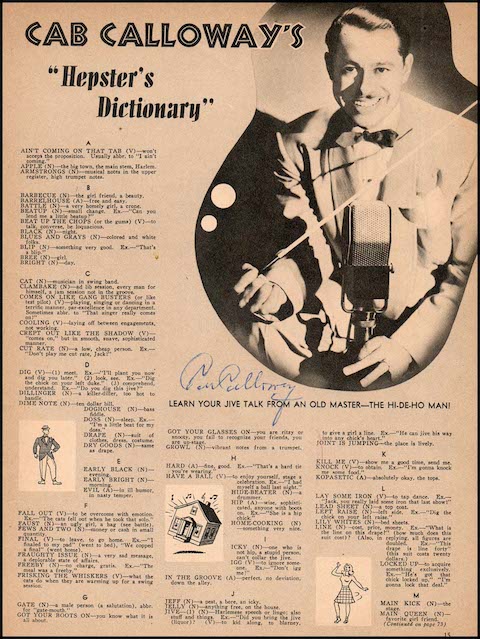
HEPSTER’S DICTIONARY
A hummer (n.) — exceptionally good. Ex., “Man, that boy is a hummer.”
Ain’t coming on that tab (v.) — won’t accept the proposition. Usually abbr. to “I ain’t coming.”
Alligator (n.) — jitterbug.
Apple (n.) — the big town, the main stem, Harlem.
Armstrongs (n.) — musical notes in the upper register, high trumpet notes.
Barbecue (n.) — the girl friend, a beauty
Barrelhouse (adj.) — free and easy.
Battle (n.) — a very homely girl, a crone.
Beat (adj.) — (1) tired, exhausted. Ex., “You look beat” or “I feel beat.” (2) lacking anything. Ex, “I am beat for my cash”, “I am beat to my socks” (lacking everything).
Beat it out (v.) — play it hot, emphasize the rhythym.
Beat up (adj.) — sad, uncomplimentary, tired.
Beat up the chops (or the gums) (v.) — to talk, converse, be loquacious.
Beef (v.) — to say, to state. Ex., “He beefed to me that, etc.”
Bible (n.) — the gospel truth. Ex., “It’s the bible!”
Black (n.) — night.
Black and tan (n.) — dark and light colored folks. Not colored and white folks as erroneously assumed.
Blew their wigs (adj.) — excited with enthusiasm, gone crazy.
Blip (n.) — something very good. Ex., “That’s a blip”; “She’s a blip.”
Blow the top (v.) — to be overcome with emotion (delight). Ex., “You’ll blow your top when you hear this one.”
Boogie-woogie (n.) — harmony with accented bass.
Boot (v.) — to give. Ex., “Boot me that glove.”
Break it up (v.) — to win applause, to stop the show.
Bree (n.) — girl.
Bright (n.) — day.
Brightnin’ (n.) — daybreak.
Bring down ((1) n. (2) v.) — (1) something depressing. Ex., “That’s a bring down.” (2) Ex., “That brings me down.”
Buddy ghee (n.) — fellow.
Bust your conk (v.) — apply yourself diligently, break your neck.
Canary (n.) — girl vocalist.
Capped (v.) — outdone, surpassed.
Cat (n.) — musician in swing band.
Chick (n.) — girl.
Chime (n.) — hour. Ex., “I got in at six chimes.”
Clambake (n.) — ad lib session, every man for himself, a jam session not in the groove.
Chirp (n.) — female singer.
Cogs (n.) — sun glasses.
Collar (v.) — to get, to obtain, to comprehend. Ex., “I gotta collar me some food”; “Do you collar this jive?”
Come again (v.) — try it over, do better than you are doing, I don’t understand you.
Comes on like gangbusters (or like test pilot) (v.) — plays, sings, or dances in a terrific manner, par excellence in any department. Sometimes abbr. to “That singer really comes on!”
Cop (v.) — to get, to obtain (see collar; knock).
Corny (adj.) — old-fashioned, stale.
Creeps out like the shadow (v.) — “comes on,” but in smooth, suave, sophisticated manner.
Crumb crushers (n.) — teeth.
Cubby (n.) — room, flat, home.
Cups (n.) — sleep. Ex., “I gotta catch some cups.”
Cut out (v.) — to leave, to depart. Ex., “It’s time to cut out”; “I cut out from the joint in early bright.”
Cut rate (n.) — a low, cheap person. Ex., “Don’t play me cut rate, Jack!”
Dicty (adj.) — high-class, nifty, smart.
Dig (v.) — (1) meet. Ex., “I’ll plant you now and dig you later.” (2) look, see. Ex., “Dig the chick on your left duke.” (3) comprehend, understand. Ex., “Do you dig this jive?”
Dim (n.) — evening.
Dime note (n.) — ten-dollar bill.
Doghouse (n.) — bass fiddle.
Domi (n.) — ordinary place to live in. Ex., “I live in a righteous dome.”
Doss (n.) — sleep. Ex., “I’m a little beat for my doss.”
Down with it (adj.) — through with it.
Drape (n.) — suit of clothes, dress, costume.
Dreamers (n.) — bed covers, blankets.
Dry-goods (n.) — same as drape.
Duke (n.) — hand, mitt.
Dutchess (n.) — girl.
Early black (n.) — evening
Early bright (n.) — morning.
Evil (adj.) — in ill humor, in a nasty temper.
Fall out (v.) — to be overcome with emotion. Ex., “The cats fell out when he took that solo.”
Fews and two (n.) — money or cash in small quatity.
Final (v.) — to leave, to go home. Ex., “I finaled to my pad” (went to bed); “We copped a final” (went home).
Fine dinner (n.) — a good-looking girl.
Focus (v.) — to look, to see.
Foxy (v.) — shrewd.
Frame (n.) — the body.
Fraughty issue (n.) — a very sad message, a deplorable state of affairs.
Freeby (n.) — no charge, gratis. Ex., “The meal was a freeby.”
Frisking the whiskers (v.) — what the cats do when they are warming up for a swing session.
Frolic pad (n.) — place of entertainment, theater, nightclub.
Fromby (adj.) — a frompy queen is a battle or faust.
Front (n.) — a suit of clothes.
Fruiting (v.) — fickle, fooling around with no particular object.
Fry (v.) — to go to get hair straightened.
Gabriels (n.) — trumpet players.
Gammin’ (adj.) — showing off, flirtatious.
Gasser (n, adj.) — sensational. Ex., “When it comes to dancing, she’s a gasser.”
Gate (n.) — a male person (a salutation), abbr. for “gate-mouth.”
Get in there (exclamation.) — go to work, get busy, make it hot, give all you’ve got.
Gimme some skin (v.) — shake hands.
Glims (n.) — the eyes.
Got your boots on — you know what it is all about, you are a hep cat, you are wise.
Got your glasses on — you are ritzy or snooty, you fail to recognize your friends, you are up-stage.
Gravy (n.) — profits.
Grease (v.) — to eat.
Groovy (adj.) — fine. Ex., “I feel groovy.”
Ground grippers (n.) — new shoes.
Growl (n.) — vibrant notes from a trumpet.
Gut-bucket (adj.) — low-down music.
Guzzlin’ foam (v.) — drinking beer.
Hard (adj.) — fine, good. Ex., “That’s a hard tie you’re wearing.”
Hard spiel (n.) — interesting line of talk.
Have a ball (v.) — to enjoy yourself, stage a celebration. Ex., “I had myself a ball last night.”
Hep cat (n.) — a guy who knows all the answers, understands jive.
Hide-beater (n.) — a drummer (see skin-beater).
Hincty (adj.) — conceited, snooty.
Hip (adj.) — wise, sophisticated, anyone with boots on. Ex., “She’s a hip chick.”
Home-cooking (n.) — something very dinner (see fine dinner).
Hot (adj.) — musically torrid; before swing, tunes were hot or bands were hot.
Hype (n, v.) — build up for a loan, wooing a girl, persuasive talk.
Icky (n.) — one who is not hip, a stupid person, can’t collar the jive.
Igg (v.) — to ignore someone. Ex., “Don’t igg me!)
In the groove (adj.) — perfect, no deviation, down the alley.
Jack (n.) — name for all male friends (see gate; pops).
Jam ((1)n, (2)v.) — (1) improvised swing music. Ex., “That’s swell jam.” (2) to play such music. Ex., “That cat surely can jam.”
Jeff (n.) — a pest, a bore, an icky.
Jelly (n.) — anything free, on the house.
Jitterbug (n.) — a swing fan.
Jive (n.) — Harlemese speech.
Joint is jumping — the place is lively, the club is leaping with fun.
Jumped in port (v.) — arrived in town.
Kick (n.) — a pocket. Ex., “I’ve got five bucks in my kick.”
Kill me (v.) — show me a good time, send me.
Killer-diller (n.) — a great thrill.
Knock (v.) — give. Ex., “Knock me a kiss.”
Kopasetic (adj.) — absolutely okay, the tops.
Lamp (v.) — to see, to look at.
Land o’darkness (n.) — Harlem.
Lane (n.) — a male, usually a nonprofessional.
Latch on (v.) — grab, take hold, get wise to.
Lay some iron (v.) — to tap dance. Ex., “Jack, you really laid some iron that last show!”
Lay your racket (v.) — to jive, to sell an idea, to promote a proposition.
Lead sheet (n.) — a topcoat.
Left raise (n.) — left side. Ex., “Dig the chick on your left raise.”
Licking the chops (v.) — see frisking the whiskers.
Licks (n.) — hot musical phrases.
Lily whites (n.) — bed sheets.
Line (n.) — cost, price, money. Ex., “What is the line on this drape” (how much does this suit cost)? “Have you got the line in the mouse” (do you have the cash in your pocket)? Also, in replying, all figures are doubled. Ex., “This drape is line forty” (this suit costs twenty dollars).
Lock up — to acquire something exclusively. Ex., “He’s got that chick locked up”; “I’m gonna lock up that deal.”
Main kick (n.) — the stage.
Main on the hitch (n.) — husband.
Main queen (n.) — favorite girl friend, sweetheart.
Man in gray (n.) — the postman.
Mash me a fin (command.) — Give me $5.
Mellow (adj.) — all right, fine. Ex., “That’s mellow, Jack.”
Melted out (adj.) — broke.
Mess (n.) — something good. Ex., “That last drink was a mess.”
Meter (n.) — quarter, twenty-five cents.
Mezz (n.) — anything supreme, genuine. Ex., “this is really the mezz.”
Mitt pounding (n.) — applause.
Moo juice (n.) — milk.
Mouse (n.) — pocket. Ex., “I’ve got a meter in the mouse.”
Muggin’ (v.) — making ‘em laugh, putting on the jive. “Muggin’ lightly,” light staccato swing; “muggin’ heavy,” heavy staccato swing.
Murder (n.) — something excellent or terrific. Ex., “That’s solid murder, gate!”
Neigho, pops — Nothing doing, pal.
Nicklette (n.) — automatic phonograph, music box.
Nickel note (n.) — five-dollar bill.
Nix out (v.) — to eliminate, get rid of. Ex., “I nixed that chick out last week”; “I nixed my garments” (undressed).
Nod (n.) — sleep. Ex., “I think I’l cop a nod.”
Ofay (n.) — white person.
Off the cob (adj.) — corny, out of date.
Off-time jive (n.) — a sorry excuse, saying the wrong thing.
Orchestration (n.) — an overcoat.
Out of the world (adj.) — perfect rendition. Ex., “That sax chorus was out of the world.”
Ow! — an exclamation with varied meaning. When a beautiful chick passes by, it’s “Ow!”; and when someone pulls an awful pun, it’s also “Ow!”
Pad (n.) — bed.
Pecking (n.) — a dance introduced at the Cotton Club in 1937.
Peola (n.) — a light person, almost white.
Pigeon (n.) — a young girl.
Pops (n.) — salutation for all males (see gate; Jack).
Pounders (n.) — policemen.
Queen (n.) — a beautiful girl.
Rank (v.) — to lower.
Ready (adj.) — 100 per cent in every way. Ex., “That fried chicken was ready.”
Ride (v.) — to swing, to keep perfect tempo in playing or singing.
Riff (n.) — hot lick, musical phrase.
Righteous (adj.) — splendid, okay. Ex., “That was a righteous queen I dug you with last black.”
Rock me (v.) — send me, kill me, move me with rhythym.
Ruff (n.) — quarter, twenty-five cents.
Rug cutter (n.) — a very good dancer, an active jitterbug.
Sad (adj.) — very bad. Ex., “That was the saddest meal I ever collared.”
Sadder than a map (adj.) — terrible. Ex., “That man is sadder than a map.”
Salty (adj.) — angry, ill-tempered.
Sam got you — you’ve been drafted into the army.
Send (v.) — to arouse the emotions. (joyful). Ex., “That sends me!”
Set of seven brights (n.) — one week.
Sharp (adj.) — neat, smart, tricky. Ex., “That hat is sharp as a tack.”
Signify (v.) — to declare yourself, to brag, to boast.
Skins (n.) — drums.
Skin-beater (n.) — drummer (see hide-beater).
Sky piece (n.) — hat.
Slave (v.) — to work, whether arduous labor or not.
Slide your jib (v.) — to talk freely.
Snatcher (n.) — detective.
So help me — it’s the truth, that’s a fact.
Solid (adj.) — great, swell, okay.
Sounded off (v.) — began a program or conversation.
Spoutin’ (v.) — talking too much.
Square (n.) — an unhep person (see icky; Jeff).
Stache (v.) — to file, to hide away, to secrete.
Stand one up (v.) — to play one cheap, to assume one is a cut-rate.
To be stashed (v.) — to stand or remain.
Susie‑Q (n.) — a dance introduced at the Cotton Club in 1936.
Take it slow (v.) — be careful.
Take off (v.) — play a solo.
The man (n.) — the law.
Threads (n.) — suit, dress or costuem (see drape; dry-goods).
Tick (n.) — minute, moment. Ex., “I’ll dig you in a few ticks.” Also, ticks are doubled in accounting time, just as money isdoubled in giving “line.” Ex., “I finaled to the pad this early bright at tick twenty” (I got to bed this morning at ten o’clock).
Timber (n.) — toothipick.
To dribble (v.) — to stutter. Ex., “He talked in dribbles.”
Togged to the bricks — dressed to kill, from head to toe.
Too much (adj.) — term of highest praise. Ex., “You are too much!”
Trickeration (n.) — struttin’ your stuff, muggin’ lightly and politely.
Trilly (v.) — to leave, to depart. Ex., “Well, I guess I’ll trilly.”
Truck (v.) — to go somewhere. Ex., “I think I’ll truck on down to the ginmill (bar).”
Trucking (n.) — a dance introduced at the Cotton Club in 1933.
Twister to the slammer (n.) — the key to the door.
Two cents (n.) — two dollars.
Unhep (adj.) — not wise to the jive, said of an icky, a Jeff, a square.
Vine (n.) — a suit of clothes.
V‑8 (n.) — a chick who spurns company, is independent, is not amenable.
What’s your story? — What do you want? What have you got to say for yourself? How are tricks? What excuse can you offer? Ex., “I don’t know what his story is.”
Whipped up (adj.) — worn out, exhausted, beat for your everything.
Wren (n.) — a chick, a queen.
Wrong riff — the wrong thing said or done. Ex., “You’re coming up on the wrong riff.”
Yarddog (n.) — uncouth, badly attired, unattractive male or female.
Yeah, man — an exclamation of assent.
Zoot (adj.) — exaggerated
Zoot suit (n.) — the ultimate in clothes. The only totally and truly American civilian suit.
BONUS MUSICAL INSTRUMENT SUPPLEMENT
Guitar: Git Box or Belly-Fiddle
Bass: Doghouse
Drums: Suitcase, Hides, or Skins
Piano: Storehouse or Ivories
Saxophone: Plumbing or Reeds
Trombone: Tram or Slush-Pump
Clarinet: Licorice Stick or Gob Stick
Xylophone: Woodpile
Vibraphone: Ironworks
Violin: Squeak-Box
Accordion: Squeeze-Box or Groan-Box
Tuba: Foghorn
Electric Organ: Spark Jiver
Related Content:
A 1932 Illustrated Map of Harlem’s Night Clubs: From the Cotton Club to the Savoy Ballroom
Duke Ellington’s Symphony in Black, Starring a 19-Year-old Billie Holiday
Ayun Halliday is an author, homeschooler, and Chief Primatologist of the East Village Inky zine. Follow her @AyunHalliday
Read More...Neil deGrasse Tyson Ponders the Big Question “Does the Universe Have a Purpose” in a Simple Animation
The Templeton Foundation asked some heavy-hitter thinkers to answer the question, “Does the Universe Have a Purpose”. Some said “Yes” and “Certainly.” Others concluded “Unlikely” and “No.” Neil deGrasse Tyson — astrophysicist, director of the Hayden Planetarium, and popularizer of science — gave an answer that falls technically in the “Not Certain” camp.
Above, you can watch a video where Tyson reads his answer aloud, and the makers of Minute Physics provide the rudimentary animation. One thing astrophysicists have is a knack for putting things into a deeper context, often making “big” human questions look remarkably small (if not somewhat absurd). Carl Sagan did it remarkably well in his famous ‘The Pale Blue Dot’ speech. And Tyson picks up right where Sagan left off.
We still live in a world where, despite Copernicus, we think the world revolves essentially around us. And, to the extent that that’s true, some will find Tyson’s data points disorienting. Others might wonder whether we should angst so much about the questions we perennially ask in the first place. I guess I am kind of there today.
Related Content:
Neil deGrasse Tyson Lists 8 (Free) Books Every Intelligent Person Should Read
Carl Sagan’s Undergrad Reading List: 40 Essential Texts for a Well-Rounded Thinker
Carl Sagan Writes a Letter to 17-Year-Old Neil deGrasse Tyson (1975)
Free Online Astronomy Courses, part of our larger collection, 1,700 Free Online Courses from Top Universities
Read More...Three Films Capture 1940s New York, Chicago & Los Angeles in Vivid Color
“Citizenship of this city in itself made for a bond beyond class,” writes the redoubtable Welsh writer of place Jan Morris in Manhattan ’45, her book-length love letter to New York City in the immediate aftermath of the Second World War. “To be a citizen of Manhattan was an achievement in itself — it had taken guts and enterprise, if not on your own part, at least on your forebears.’ The pressures of the place, its competition, its pace, its hazards, even the fun of it, demanded special qualities of its people, and gave them a particular affinity for one another. They were all an elite!”
Four years into the time of which Morris so rapturously writes, out came Metro Goldwyn Mayer’s Mighty Manhattan – New York’s Wonder City, a fine Technicolor accompaniment to her textual appreciation. The clip at the top of the post, narrated by “Voice of the Globe” James Patrick, shifts straight into full midcentury triumphal gear, extolling such classic works of Manhattan Man as Wall Street, the Flatiron Building, the elevated train, the Brooklyn Bridge, the New York Public Library, and of course, the Empire State Building. (It also shows a sight that, for all the gee-whizzing it must have elicited at the time, we all hope will never return: Central Park with cars in it.)
“Not so long ago Chicagoans were convinced that their city would soon be the greatest and most famous on Earth, outranking New York, London, and Paris, the centre of a new world, the boss city of the universe,” Morris writes elsewhere. Today, “the blindest lover of Chicago would not claim for the place the status of a universal metropolis. Too much of the old grand assertiveness has been lost. Nobody pretends Chicago has overtaken New York; instead there is a provincial acceptance of inferiority, a resignation, coupled with a mild regret for the old days of brag and beef.”
For a sense of that brag and beef — and given the footage of the stockyards, take the latter literally — have a look at the half-hour film above: Chicago, produced by the Chicago board of education in 1945 or 1946. After Chicagoan Jeff Altman, who works in film post-production, found it at a south side estate sale, he did a bit of a restoration on it and posted it to the internet. “It’s hard to say the purpose of the film,” Altman writes. “It could be geared towards tourism or to entice companies to come to Chicago. This film could have just been used in the classroom. I’m not entirely sure. The great thing is all the different views of the city they give.”
“Los Angeles is the know-how city,” Morris writes in another essay. “Remember know-how? It was one of the vogue words of the forties and fifties, now rather out of fashion. It reflected a whole climate and tone of American optimism. It stood for skill and experience indeed, but it also expressed the certainty that America’s particular genius, the genius for applied logic, for systems, was inexorably the herald of progress.” At that time, Los Angeles didn’t need so much boosterism — it was boosterism. The Southern Californian metropolis began booming in the early 20th century, and that boom wouldn’t end until well after the war, if indeed it has ended yet.
Many of its new arrivals, the vast majority of whom came from elsewhere in the United States until the late 1960s, couldn’t have helped but felt enticed by scenes like the ones in the clip just above, which shows off the Sunset Strip in the late 40s or early 50s. Los Angeles has changed, as has every American city: buildings have grown taller, populations have densified, and you see a wider variety of faces and hear a wider variety of languages on the streets than ever before. Some, especially Youtube commenters, bemoan this, but to my mind, things have got considerably more interesting as a result. Vintage footage like this — and especially vintage footage in unusually vivid color like this — reminds us that, as fascinating a past as our cities have, their future looks richer still.
Related Content:
Prize-Winning Animation Lets You Fly Through 17th Century London
London Mashed Up: Footage of the City from 1924 Layered Onto Footage from 2013
Paris Through Pentax: Short Film Lets You See a Great City Through a Different Lens
Berlin Street Scenes Beautifully Caught on Film (1900–1914)
1927 London Shown in Moving Color
A Drone’s Eye View of Los Angeles, New York, London, Bangkok & Mexico City
Colin Marshall hosts and produces Notebook on Cities and Culture as well as the video series The City in Cinema and writes essays on cities, language, Asia, and men’s style. He’s at work on a book about Los Angeles, A Los Angeles Primer. Follow him on Twitter at @colinmarshall or on Facebook.
Read More...Susan Sarandon Reads an Animated Version of Good Night Moon … Without Crying
One’s never too old to be read a story. There’s no shame in stealing a couple of minutes from your busy, stress-filled day to let actress Susan Sarandon read you one, above.
Goodnight Moon was never a part of my childhood, but it came into heavy rotation when my own kids were little. It wasn’t a title they clamored for—in my experience, the intended demographic favors the junky and cringe-inducing over classics of children’s literature, but no matter.
All day, I indulged their hankering for tales of preschool-aged dinosaurs who had to be taught how to share, giant silly cookies, and a certain television character who reacted poorly to being passed over as flower girl. In return, I ruled the night.
I treasured Goodnight Moon not so much because it made them fall asleep—there are shelves upon shelves of dependable choices in that department—but rather for its simplicity. There were no moral lessons. Nothing sparkly or magic or forced. Nothing that catered to their supposed whims. Author Margaret Wise Brown’s stated aim with regard to the child reader was “to jog him with the unexpected and comfort him with the familiar.”
I approve. But there’s not a lot of jogging in Goodnight Moon. Just that comb and that brush and that bowlful of mush. What a blessed relief.
As one approaches the end, Goodnight Moon begins to rival Charlotte’s Web as children’s literature’s great meditation on death. The catalogue of all those things we’re saying goodnight to harkens to the final scene in Our Town, when the newly dead Emily, revisiting her childhood home, cries, “All that was going on in life and we never noticed.”
Every time my small crew made it to “goodnight stars, goodnight air, goodnight noises everywhere,” I was croaking. (Not figuratively, though a little research reveals I am not the only one to think this lovely phrase would make a great epitaph.)
This emotional collapse was equal parts cathartic and embarrassing. What can I say? My cup ranneth over. I was glad to learn that E. B. White’s voice betrayed him, too, recording Charlotte’s Web’s most poignant scene.
“Oh, earth, you’re too wonderful for anybody to realize you.”
Narrating the lightly animated story for 1999’s Goodnight Moon & Other Sleepytime Tales, Sarandon exhibits astonishing self control. It’s probably a good thing for children everywhere to see that there’s at least one adult out there with the steel to soldier through. Her youngest child was still little when she went into the recording booth. If she’d wanted, she could’ve milked it for every last drop of pathos, but I’m glad she played it straight, because most of us can’t.
(And few of us can write a book so elegant on a topic so profound. Sarandon’s would-be publishers rejected her children’s book about a “very funny raccoon” who dies.”)
Find other great stories in our collection, 1,000 Free Audio Books: Download Great Books for Free.
Related Content:
Christopher Walken Reads Where The Wild Things Are
Free Audio: Go the F–k to Sleep Narrated by Samuel L. Jackson
Download Bryan Cranston’s Reading of You Have to F–king Eat as a Free Audio Book (NSFW)
Ayun Halliday is an author whose sole contribution to the picture book canon is Always Lots of Heinies at the Zoo. Follow her @AyunHalliday
Read More...Watch the Opening of Kubrick’s 2001: A Space Odyssey with the Original, Unused Score
How does a movie become a “classic”? Explanations, never less than utterly subjective, will vary from cinephile to cinephile, but I would submit that classic-film status, as traditionally understood, requires that all elements of the production work in at least near-perfect harmony: the cinematography, the casting, the editing, the design, the setting, the score. Outside first-year film studies seminars and deliberately contrarian culture columns, the label of classic, once attained, goes practically undisputed. Even those who actively dislike Stanley Kubrick’s 2001: A Space Odyssey, for instance, would surely agree that its every last audiovisual nuance serves its distinctive, bold vision — especially that opening use of “Thus Spake Zarathustra.”
But Kubrick didn’t always intend to use that piece, nor the other orchestral works we’ve come to closely associate with mankind’s ventures into realms beyond Earth and struggles with intelligence of its own invention. According to Jason Kottke, Kubrick had commissioned an original score from A Streetcar Named Desire, Spartacus, Cleopatra, and Who’s Afraid of Virginia Woolf composer Alex North.
At the top of the post, you can see 2001’s opening with North’s music, and below you can hear 38 minutes of his score on Spotify. As to the question of why Kubrick stuck instead with the temporary score of Strauss, Ligeti, and Khatchaturian he’d used in editing, Kottke quotes from Michel Ciment’s interview with the filmmaker:
However good our best film composers may be, they are not a Beethoven, a Mozart or a Brahms. Why use music which is less good when there is such a multitude of great orchestral music available from the past and from our own time? [ … ] Although [North] and I went over the picture very carefully, and he listened to these temporary tracks and agreed that they worked fine and would serve as a guide to the musical objectives of each sequence he, nevertheless, wrote and recorded a score which could not have been more alien to the music we had listened to, and much more serious than that, a score which, in my opinion, was completely inadequate for the film.
North didn’t find out about Kubrick’s choice until 2001’s New York City premiere. Not an enviable situation, certainly, but not the worst thing that ever happened to a collaborator who failed to rise to the director’s expectations.
For more Kubrick and classical music, see our recent post: The Classical Music in Stanley Kubrick’s Films: Listen to a Free, 4 Hour Playlist
If you would like to support the mission of Open Culture, consider making a donation to our site. It’s hard to rely 100% on ads, and your contributions will help us continue providing the best free cultural and educational materials to learners everywhere. You can contribute through PayPal, Patreon, and Venmo (@openculture). Thanks!
Related Content:
4,000+ Free Movies Online: Great Classics, Indies, Noir, Westerns, Documentaries & MoreKubrick’s 2001: A Space Odyssey Gets a Brand New Trailer to Celebrate Its Digital Re-Release
1966 Film Explores the Making of Kubrick’s 2001: A Space Odyssey (and Our High-Tech Future)
James Cameron Revisits the Making of Kubrick’s 2001: A Space Odyssey
Rare 1960s Audio: Stanley Kubrick’s Big Interview with The New Yorker
Colin Marshall hosts and produces Notebook on Cities and Culture and writes essays on cities, language, Asia, and men’s style. He’s at work on a book about Los Angeles, A Los Angeles Primer. Follow him on Twitter at @colinmarshall or on Facebook.
Read More...Joe Cocker Sings “With A Little Help From My Friends,” Live in 2013 and At Woodstock in 1969
Today as we say goodbye to British singer Joe Cocker, who died at 70 after a struggle with lung cancer, we’ll remember him most for that 1969 Woodstock performance of The Beatles’ “With a Little Help From My Friends.” It was without a doubt a career-defining moment. He never stopped performing the song in his inimitably gruff style, his raspy voice partly a product of too many cigarettes and some pretty hard living over the decades. Known also for his air guitar proficiency, Cocker successfully covered other famous bands like Traffic and The Box Tops, and made many songs—like Billy Preston’s “You Are So Beautiful to Me”—uniquely his.
But yes, it’s that 1969 debut album, also titled With a Little Help from My Friends, with its mix of originals and big-name covers from The Beatles and Bob Dylan, that first brought us the Joe Cocker we fondly pay tribute to this holiday week. I overheard someone describe Cocker as the only person who could do The Beatles better than they could, which is going a bit too far. But he may be the only artist whose covers of the band are as well-known and well-loved as their originals. Paul McCartney, who will lead memorials this week with Ringo Starr, said of Cocker’s “A Little Help,” “it was just mind-blowing, [he] totally turned the song into a soul anthem and I was forever grateful to him for doing that.” Indeed. At the top of the post, see Cocker and band above play “With a Little Help” in Cologne, Germany in 2013, and just above, watch again that gripping Woodstock performance.
Related Content:
Jimi Hendrix at Woodstock: The Complete Performance in Video & Audio (1969)
Dick Cavett’s Epic Woodstock Festival Show (August, 1969)
Josh Jones is a writer and musician based in Durham, NC. Follow him at @jdmagness
Read More...Lou Reed Sings “Blue Christmas” with Laurie Anderson, Rufus Wainwright & Friends (2008)
Elvis Presley recorded “Blue Christmas” for his Christmas album in 1957 and made the song something of a holiday classic. In the years to come, “Blue Christmas” would be covered by Johnny Mathis, Johnny Cash, The Misfits, Springsteen, Ringo Starr, Bon Jovi and eventually Lou Reed too. Above, we have Lou performing the song at the Knitting Factory in December 2008. He’s joined on stage by Rufus Wainwright, Martha Wainwright, the McGarrigle sisters, his wife Laurie Anderson, Chaim Tannebaum, and Joel Zifkin. Below, find Lou providing the musical background for Sean Lennon and a host of musicians, who play a stirring version of John Lennon’s “Happy Xmas (War Is Over).” Both clips appear on the DVD A Not So Silent Night.
Follow Open Culture on Facebook and Twitter and share intelligent media with your friends. Or better yet, sign up for our daily email and get a daily dose of Open Culture in your inbox. And if you want to make sure that our posts definitely appear in your Facebook newsfeed, just follow these simple steps.
Read More...
Johnny Cash’s Christmas Specials, Featuring June Carter, Steve Martin, Andy Kaufman & More (1976–79)
Johnny Cash, outlaw country singer and defiant man in black, comes carefully packaged for many people through the merchandising of his life and image. From t‑shirts to posters, documentaries to award-winning biopics, we know about his ornery prison concerts, drug use and arrests, noble championing of the disenfranchised, and dramatic story of pain and redemption. We marveled at the mystique around the aged Cash in his late-life revival. But many of us know little about another side of the man—Johnny Cash, genial TV personality.
If you happened to have been glued to the tube during the seventies and eighties, however, you would know this Johnny Cash well from his cameo appearances on Columbo and Little House on the Prairie. You’d have seen him shilling for Amoco during the gas crisis of the early 70s—a gig he took on during a serious career slump. You’d have maybe caught his recurring role on Dr. Quinn Medicine Woman, his turn on 1985 mini-series North and South (as John Brown, naturally), as well as a number of film appearances. And that’s not to mention Cash’s own, short-lived variety show, which ran from 1969–71.
If this rather commercial, mainstream Cash seems at odds with the legend, wait till you see The Johnny Cash & Family Christmas Show, which ran each year from 1976–79. Here, writes Dangerous Minds, “Cash gamely refashioned himself as a family-friendly country music TV host” in the vein of Porter Wagoner. It is decidedly “far from the middle-finger Johnny Cash or Folsom Prison Blues”—closer instead to Hee Haw’s Buck Owens and Roy Clark (who appears in the first special at the top). After his marriage to June Carter in 1968, many of his ventures featured the two as a singing duo. Here, they aren’t just man and wife, but “family,” meaning “many of June and Johnny’s wide-ranging clan of relatives are featured.
We’re also treated to appearances from Tony Orlando and Cash’s spiritual mentor Billy Graham (’76), Jerry Lee Lewis (’77), Kris Kristoferson and Steve Martin (’78), and even Andy Kaufman, in character as Taxi’s Latka Gravas (’79). Yes, these may be country corny as all get-out, but they’re also really fun. We get charming, informal goof-offs with June and Johnny, lots of Vegas style comedy bits and lounge routines, and, of course, some stellar musical performances. After his dramatic late-sixties conversion, Cash remained staunchly evangelical to the end of his days. (Hear him read The New Testament here.) But rather than rail at secularists in his Christmas specials, he treats the holiday as a laid-back occasion for food (“snake ‘n’ potatoes”), laughs, friends and family, and all-star sing alongs by the fire. Hop on over to Dangerous Minds to see all four specials.
Related Content:
The First Episode of The Johnny Cash Show, Featuring Bob Dylan & Joni Mitchell (1969)
Johnny Cash: Singer, Outlaw, and, Briefly, Television Host
The First Episode of The Johnny Cash Show, Featuring Bob Dylan & Joni Mitchell (1969)
Johnny Cash Reads the Entire New Testament
Josh Jones is a writer and musician based in Durham, NC. Follow him at @jdmagness
Read More...David Lynch’s Music Videos: Nine Inch Nails, Moby, Chris Isaak & More
David Lynch gets sound like few other directors. There’s an unforgettable scene in Twin Peaks: Fire Walk With Me where Laura Palmer leads her best friend Donna Hayward into what looks like a den of iniquity for lumberjacks. It’s filled with burly men and cheap women grinding to music blaring from the speakers. Lynch lets the music roll right over top the dialogue. It was a shocking choice back in 1992 but it was the right one. The banter was intentionally banal and obscure. The grotesque faces, the ominous crimson lighting and, most of all, that utterly hypnotic music are all you need to tell the story, creating a mood of dread and decadence. The scene is a stunning fusion of image, sound and editing in an otherwise flawed work.
Since that movie, Lynch became more and more interested in the possibilities of sound design. He eventually ditched film altogether for a career in music. So perhaps it shouldn’t come as a surprise that, along with creating at least three cinematic masterpieces, one of the most influential TV series ever made, and a string of television commercials, Lynch has also made a handful of music videos. You can watch them above and below.
Lynch’s first music video was for “I Predict” by the band The Sparks. It was made back in 1982 when MTV was still in its infancy and Lynch’s career was just taking off. Perhaps for that reason, the video has little of the stylistic obsessions that mark his later work. No weird flashing lights. No smoke or fire. No hollow-eyed models. Instead Lynch goes for a more direct, if silly, form of surrealism – a guy (band member Ron Mael) with a Hitler mustache in drag doing a striptease. Does it feel Lynchian? No, not really. But it’s still kind of distressing.
There are two videos for Chris Isaak’s “Wicked Games.” One, which was on heavy rotation on MTV, was shot by Herb Ritts and featured Isaak and supermodel Helena Christensen rolling around half-naked in the Hawaiian surf. And then there is Lynch’s video made as a tie-in to his strange, Wizard of Oz obsessed noir Wild at Heart, which has much less nudity – which is odd considering the movie is pretty much non-stop boinking. Instead, the video is pretty straightforward – just Isaaks and the band playing the tune intercut with shots from the flick.
After Mulholland Drive, Lynch turned his back on celluloid film, preferring the endless possibilities of digital. His enthusiasm for this new technology resulted in a flurry of projects including Dumbland, a crudely animated series presented in stark black and white. The video of Moby’s “Shot in the Back of the Head” is a moodier animated work but it is definitely in the same vein. Check it out above.
Lynch’s video for Nine Inch Nail’s “Came Back Haunted” can quite literally mess with your head. The piece is packed with flashing red and white lights and as a result comes with the following warning: “This video has been identified by Epilepsy Action to potentially trigger seizures for people with photosensitive epilepsy. Viewer discretion is advised.” You have been warned.
And finally here’s a music video for Lynch’s own song called appropriately “Crazy Clown Time.” Not only is the video a catalogue Lynch’s obsessions – Americana, naked women, fire – but it also features Lynch singing, who, after a bunch of effects, sounds like a castrated Keebler Elf.
Related Content:
David Lynch’s Unlikely Commercial for a Home Pregnancy Test (1997)
David Lynch Teaches You to Cook His Quinoa Recipe in a Weird, Surrealist Video
What David Lynch Can Do With a 100-Year-Old Camera and 52 Seconds of Film
Jonathan Crow is a Los Angeles-based writer and filmmaker whose work has appeared in Yahoo!, The Hollywood Reporter, and other publications. You can follow him at @jonccrow. And check out his blog Veeptopus, featuring lots of pictures of badgers and even more pictures of vice presidents with octopuses on their heads. The Veeptopus store is here.
Read More...Alfred Hitchcock Conducts a Politically Incorrect Sound Test on the Set of Blackmail (1929)
Above we have a young Alfred Hitchcock on the set of Blackmail (1929), conducting a rather naughty sound test with actress Anny Ondra (1929).
In case you don’t know the backstory, Blackmail was originally meant to be a silent film. However, with talkies becoming the rage, Hitchcock decided mid-stream to make the film a talkie. That decision didn’t come without its own problems. Anny Ondra, a Czech actress, spoke English with a heavy accent and couldn’t pass as a Londoner in the film. So Hitchcock performed some cinema magic and had English actress Joan Barry dub Ondra’s lines. In those days, dubbing couldn’t take place in post-production. It all had to happen in real-time. Thus, as the camera rolled, Barry stood outside the frame and spoke the dialogue into a microphone, while Ondra pantomimed the words. Throughout, Hitchcock directed Ondra while listening to Barry through a pair of headphones.
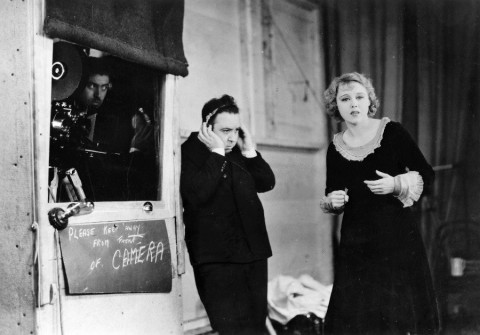
You can watch Blackmail (Britain’s first talkie feature film) online here or find it in our collection of 23 Free Hitchcock Films Online.
Related Content:
37 Hitchcock Cameo Appearances Over 50 Years: All in One Video
Listen to François Truffaut’s Big, 12-Hour Interview with Alfred Hitchcock (1962)
The Pleasure Garden, Alfred Hitchcock’s Very First Feature Film (1925)
Read More...
Support Us
We're hoping to rely on loyal readers, rather than erratic ads. Please click the Donate button and support Open Culture. You can use Paypal, Venmo, Patreon, even Crypto! We thank you!

About Us

Open Culture scours the web for the best educational media. We find the free courses and audio books you need, the language lessons & educational videos you want, and plenty of enlightenment in between.
Advertise With Us

FREE UPDATES!
GET OUR DAILY EMAIL
Get the best cultural and educational resources on the web curated for you in a daily email. We never spam. Unsubscribe at any time.
FOLLOW ON SOCIAL MEDIA

Open Culture editor Dan Colman scours the web for the best educational media. He finds the free courses and audio books you need, the language lessons & movies you want, and plenty of enlightenment in between.
Advertise With Us

