Download Pink Floyd’s 1975 Comic Book Program for The Dark Side of the Moon Tour
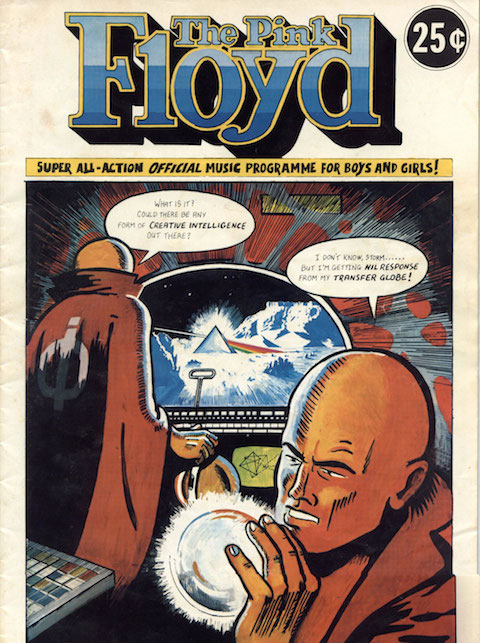
For all their serious brooding and biting digs at the establishment, the members of Pink Floyd were not above having a little fun with their image. Take this 1975 comic book, created by their record cover designer Storm Thorgerson’s company Hipgnosis for the Dark Side of the Moon tour. A “Super, All-Action Official Music Programme for Boys and Girls,” the 15-page oddity—pitched, writes Dangerous Minds, “somewhere halfway between ‘professional promotional item’ and ‘schoolboy’s notebook scribbling’”—includes several short comic stories: Roger (“Rog”) Waters is an “ace goal-scorer” for the “Grantchester Rovers” football club. Floyd drummer Nick Mason becomes “Captain Mason, R.N.,” a “courageous and smart” WWII naval hero, and David Gilmour gets cast as stunt cyclist “Dave Derring.” The juiciest part goes to keyboardist Richard Wright, whose salacious exploits as high roller “Rich Right” complete the proto-Heavy Metal vibe of the whole thing.

Perhaps most fun is a silly questionnaire called “Life Lines” that asks each band member about such trivia as age, weight, height, “philosophical beliefs,” “sexual proclivities,” “political leanings,” and “musical hates.” Most of the answers are of the flippant, smartass variety, but I think they’re all sincere when they name their favorite movies: Beyond the Valley of the Dolls, The Seventh Seal, Cool Hand Luke, and El Topo. I’ll let you figure out who chose which one. (Click the image above, then click again, to enlarge.) The penultimate page includes the lyrics to three new songs the band was working on at the time and playing live during the Dark Side of the Moon Tour: “Shine on You Crazy Diamond,” and two unreleased tracks, “Raving and Drooling” and “Gotta Be Crazy”—which later turned into “Sheep” and “Dogs,” respectively, on the Animals album.
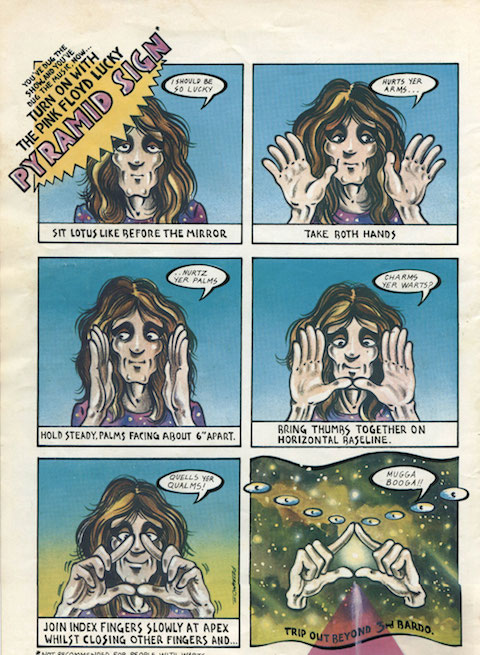
The comic takes the goofiness of Beatlemania-like merch to a much farther out place—somewhere “beyond the 3rd Bardo.” One member of the International Roger Waters Fanclub, who kept his program comic book for decades after seeing the Dark Side show in San Francisco, writes “I was so wasted on acid at the show, I don’t know how I held on to anything.” Hipgnosis, and Floyd, surely knew their audience. You can download the whole thing here, in high resolution images. See much more Pink Floyd tour memorabilia at the fansite Pinfloydz.com.
Related Content:
Watch Documentaries on the Making of Pink Floyd’s Dark Side of the Moon and Wish You Were Here
Pink Floyd Plays With Their Brand New Singer & Guitarist David Gilmour on French TV (1968)
Dark Side of the Rainbow: Pink Floyd Meets The Wizard of Oz in One of the Earliest Mash-Ups
Josh Jones is a writer and musician based in Durham, NC. Follow him at @jdmagness
Read More...The New Yorker Presents: Watch the 30 Minute Pilot of the New Docu-Series from The New Yorker
Note: Anyone with an Amazon account (at least in the US) can watch this pilot in HD for free here.
This week, The New Yorker officially celebrates its 90th anniversary with an expanded edition that revisits its many accomplishments since it first printed copies on February 21, 1925. Led by David Remnick, only the magazine’s fifth editor, The New Yorker has a rich past. But it has a future to consider too. Recently, the magazine launched the pilot of The New Yorker Presents — a “docu-series” that brings The New Yorker aesthetic to film. The 30-minute pilot (above, and also free on Amazon here) “features a doc from Oscar winner Jonathan Demme based on Rachel Aviv’s article ‘A Very Valuable Reputation,’ writer Ariel Levy interviewing artist Marina Abramovic, a sketch from Simon Rich and Alan Cumming, poetry read by Andrew Garfield, and cartoons by Emily Flake.”
If you like what you see, you’re in luck. The show, produced by Amazon Studios, has been greenlit for a full season. According to Real Screen, the new episodes will debut exclusively on Amazon Prime’s video-on-demand service in the U.S., UK and Germany later this year. When the episodes are out, we’ll let you know.
Follow us on Facebook, Twitter and Google Plus and share intelligent media with your friends. Or better yet, sign up for our daily email and get a daily dose of Open Culture in your inbox.
Read More...7 Rock Album Covers Designed by Iconic Artists: Warhol, Rauschenberg, Dalí, Richter, Mapplethorpe & More
The art of the album cover is ground we cover here often enough, from the jazz deco creations of album art inventor Alex Steinweiss to the bawdy burlesques of underground comix legend R. Crumb. We could add to these American references the iconic covers of European graphic artists like Peter Saville of Joy Divisions’ Unknown Pleasures and Storm Thorgerson of Pink Floyd’s Dark Side of the Moon. These names represent just a small sampling of the many renowned designers who have given popular music its distinctive look over the decades, and without whom the experience of record shopping—perhaps itself a bygone art—would be a dreary one. Though these creative personalities work in a primarily commercial vein, there’s no reason not to call their products fine art.
But in a great many cases, the images that grace the covers of records we know well come directly from the fine art world—whether appropriated from pieces that hang on museum walls or commissioned from famous artists by the bands. Such, of course, was the case with the much-ballyhooed cover of Lady Gaga’s Artpop, a candy-colored collaboration with pop art darling Jeff Koons, who gets a namecheck in the Gaga single “Applause.” Gaga has put a unique spin on the mélange of pop and pop art, but she hardly pioneered such collaborations.
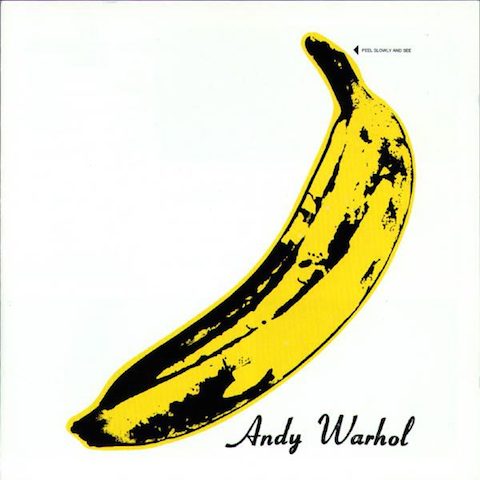
Long before Artpop, there was Warhol, whose promotion of the Velvet Underground included his own design of their 1967 debut album, The Velvet Underground & Nico. The cover originally featured a yellow banana record buyers could peel away, as Flavorwire writes, “to reveal a suggestively pink flesh-toned banana.” The “saucy covers” required “special machinery, extra costs, and the delay of the album release,” but Warhol’s name persuaded MGM the added overhead was worth it. It’s a gamble that hardly paid off for the label, but pop music is infinitely better off for Warhol’s promotion of Lou Reed and company’s dark, droning art rock.
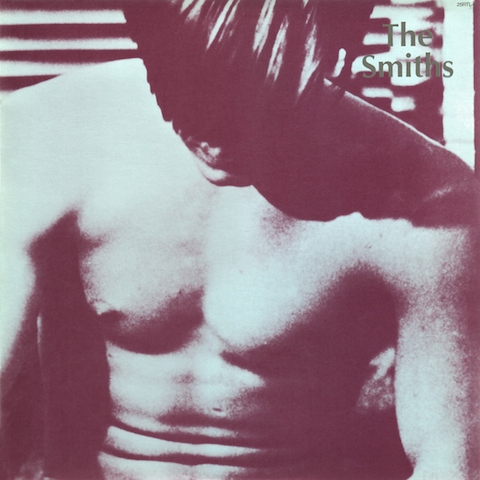
Of the many millions of bands inspired by that first Velvets’ release, The Smiths also looked to Warhol for inspiration when it came to the even more suggestive album cover (above) for their first, self-titled record in 1984. This time, the image comes not from the pop artist himself, but from his protégée Paul Morrissey—a still from his salacious, Warhol-produced film Flesh. Just one of many savvy uses of monochromatic film stills and photographs by the image-conscious Steven Patrick Morrissey and band.
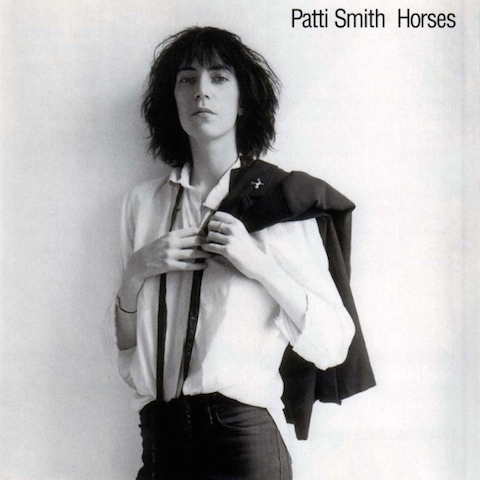
Ten years earlier, another Smith, Patti, posed for the photograph above, a Polaroid taken by her close friend, Robert Mapplethorpe. At the time, the two were roommates and “just kids” struggling jointly in their starving artisthood. In her National Book Award-winning memoir of their time together, Smith describes the “exquisitely androgynous image” as deliberately posed in a “Frank Sinatra style,” writing, “I was full of references.” Mapplethorpe, of course, would go on to infamy as the focus of a conservative congressional campaign against “obscene” art in 1989, which tended to make his name synonymous with sensationalism and scandal and obscured the breadth of his work.
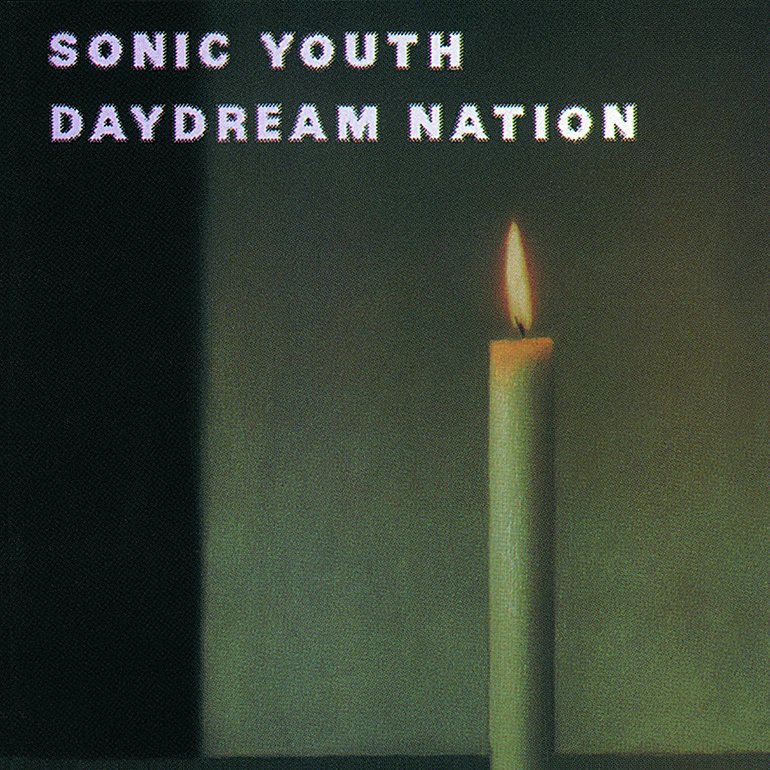
Like the Velvets and Patti Smith, the members of Sonic Youth have had a long and fruitful relationship with the art world, pursuing several art projects of their own and collaborating frequently with famous fine artists. The relationship between their noisy art rock and the visual arts crystalizes in their many iconic album covers. My personal favorite, and perhaps the most recognizable of the bunch, is Raymond Pettibon’s cover for 1990’s Goo, inspired from a photograph of two witnesses to a serial killer case. Pettibon, brother to Black Flag founder and guitarist Greg Ginn, is much better known in the punk rock world than the fine art world, but Sonic Youth has also collaborated with established high art figures like Gerhard Richter, whose painting Kerze (“Candle”) graces the cover of their acclaimed 1988 album Daydream Nation (above).
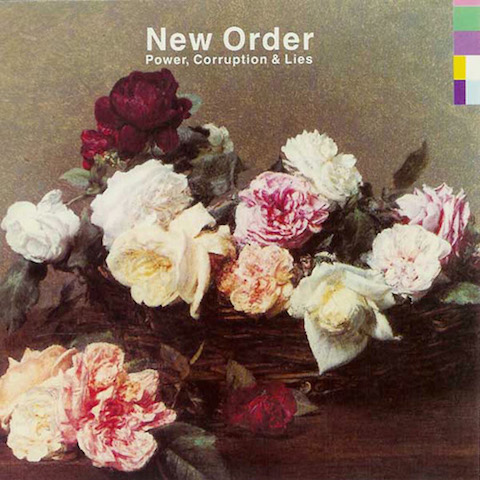
Another example of a band using already existing artwork—this time from a painter long dead—the cover of New Order’s Power, Corruption & Lies comes from the still life A Basket of Roses by 19th century French realist Henri Fantin-Latour. Designer Peter Saville, who, as noted above, created the look of New Order’s previous incarnation, chose the image on a whim. Writes Artnet, “the art director for the post-punk band… had originally planned to use a Renaissance portrait of a dark prince to tie in with the Machiavellian theme of the title, but failed to find anything he liked. While visiting [the National Gallery in London], Saville picked up a postcard of the Fantin-Latour work, and his girlfriend joked that he should use it as the cover.” Saville thought it was “a wonderful idea.” As Saville explains his choice, “Flowers suggested the means by which power, corruption and lies infiltrate our lives. They’re seductive.”
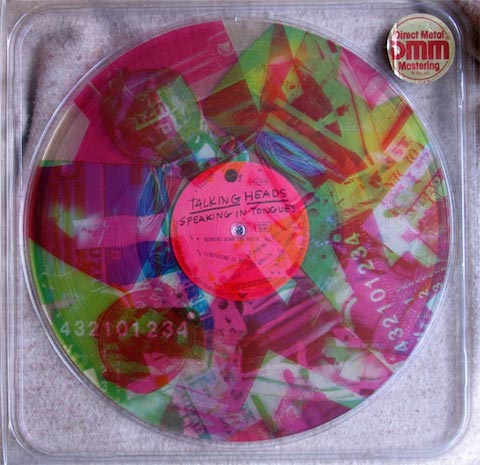
Another art-rock band, the Talking Heads—formed at the Rhode Island School of Design and originally called “The Artistics”—went in a very high art direction for 1983’s new wave masterpiece Speaking in Tongues, their fifth album. Though we’re probably more familiar with frontman David Byrne’s cover art for the album, the band also produced a limited edition LP featuring the work of artist Robert Rauschenberg, which you can see above. Byrne, writes Artnet, approached Rauschenberg “after seeing his work at the Leo Castelli Gallery” and Rauschenberg agreed on the condition that he could “do something different.” He certainly did that. The cover is a “transparent plastic case with artwork and credits printed on three 12 inch circular transparent collages, one per primary color. Only by rotating the LP and the separate plastic discs could one see—and then only intermittently—the three-color images included in the collage.” The artist won a Grammy for the design.
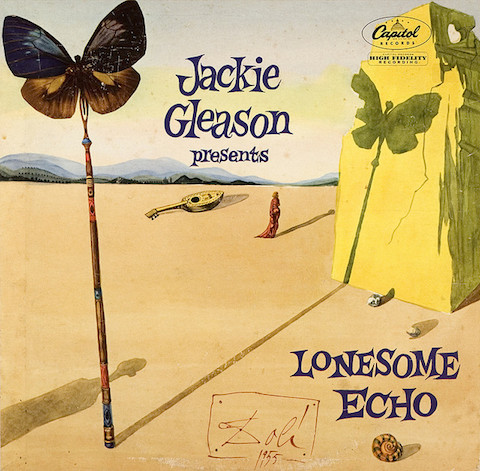
You can see many more fine art album covers by painters like Banksy, Richard Prince, and Fred Tomaselli and photographers like Duane Michaels and Nobuyoshi Araki at Artnet and Flavorwire. The selection of enticing album covers above will hopefully also propel you to revisit, or hear for the first time, some of the finest art-pop of the last four decades. Finally, we leave you with a bizarre and seemingly unlikely collaboration, above, between pop-surrealist Salvador Dalí and Honeymooners comedian Jackie Gleason for Gleason’s 1955 album Lonesome Echo. No weirder, perhaps, than Dalí’s work with Walt Disney, it’s still a rather unexpected look for the comedian, in his role here as a kitschy easy listening composer. Gleason’s many album covers tended toward the Mad Men-esque cheap and tawdry. Here, he gets conceptual. Dalí himself explained the work thus:
The first effect is that of anguish, of space, and of solitude. Secondly, the fragility of the wings of a butterfly, projecting long shadows of late afternoon, reverberates in the landscape like an echo. The feminine element, distant and isolated, forms a perfect triangle with the musical instrument and its other echo, the shell.
Make of that what you will. I’d say it’s the one album on this list with a cover much more interesting by far than the music inside.
via Artnet
Related Content:
The Groundbreaking Art of Alex Steinweiss, Father of Record Cover Design
Andy Warhol Creates Album Covers for Jazz Legends Thelonious Monk, Count Basie & Kenny Burrell
Underground Cartoonist R. Crumb Introduces Us to His Rollicking Album Cover Designs
A Short Film on the Famous Crosswalk From the Beatles’ Abbey Road Album Cover
Josh Jones is a writer and musician based in Durham, NC. Follow him at @jdmagness
Read More...An Animated Lou Reed Explains The Velvet Underground’s Artistic Goals, and Why The Beatles Were “Garbage”
Blank on Blank returns this week with another one of their groovy animations. This time, we find Lou Reed recalling the goals and ambitions of his avant-garde rock band, The Velvet Underground. We wanted, he says, “to elevate the rock n’ roll song, to take it where it hadn’t been taken before.” And, in his humble opinion, they did just that, far exceeding the musical output of contemporary bands like The Doors and The Beatles, which he respectively calls “stupid” and “garbage.” If you listen to the complete interview recorded in 1987 (web — iTunes), you’ll hear Lou diss a lot of bands. But which one did he give props to? U2. Go figure.
If you would like to support the mission of Open Culture, consider making a donation to our site. It’s hard to rely 100% on ads, and your contributions will help us continue providing the best free cultural and educational materials to learners everywhere. You can contribute through PayPal, Patreon, and Venmo (@openculture). Thanks!
Related Content:
Lou Reed Reads Delmore Schwartz’s Famous Story “In Dreams Begin Responsibilities”
Teenage Lou Reed Sings Doo-Wop Music (1958–1962)
Watch Red Shirley, Lou Reed’s Short Documentary on His Fascinating 100-Year-Old Cousin (2010)
Read More...The Mastermind of Devo, Mark Mothersbaugh, Shows Off His Synthesizer Collection
Mark Mothersbaugh’s studio is located in a cylindrical structure painted bright green — it looks more like a festive auto part than an office building. It’s a fitting place for the iconoclast musician. For those of you who didn’t spend your childhoods obsessively watching the early years of MTV, Mark Mothersbaugh was the mastermind behind the band Devo. They skewered American conformity by dressing alike in shiny uniforms and their music was nervy, twitchy and weird. They taught a nation that if you must whip it, you should whip it good.
In the years since, Mothersbaugh has segued into a successful career as a Hollywood composer, spinning scores for 21 Jump Street and The Royal Tenenbaums among others.
In the video above, you can see Mothersbaugh hang out in his studio filled with synthesizers of various makes and vintages, including Bob Moog’s own personal Memorymoog. Watching Mothersbaugh pull out and play with each one is a bit like watching a precocious child talk about his toys. He just has an infectious energy that is a lot of fun to watch.
Probably the best part in the video is when he shows off a device that can play sounds backward. It turns out that if you say, “We smell sausage” backwards it sounds an awful lot like “Jesus loves you.” Who knew?
Below you can see Mothersbaugh in action with Devo, performing live in Japan during the band’s heyday in 1979.
Related Content:
Thomas Dolby Explains How a Synthesizer Works on a Jim Henson Kids Show (1989)
Watch Herbie Hancock Rock Out on an Early Synthesizer on Sesame Street (1983)
All Hail the Beat: How the 1980 Roland TR-808 Drum Machine Changed Pop Music
Jonathan Crow is a Los Angeles-based writer and filmmaker whose work has appeared in Yahoo!, The Hollywood Reporter, and other publications. You can follow him at @jonccrow. And check out his blog Veeptopus, featuring lots of pictures of badgers and even more pictures of vice presidents with octopuses on their heads. The Veeptopus store is here.
Read More...600+ Covers of Philip K. Dick Novels from Around the World: Greece, Japan, Poland & Beyond
I envy book designers tasked with putting together covers for Philip K. Dick novels, and yet I don’t envy them. On one hand, they get the chance to visually interpret some of the most unusual, indescribable genre fiction ever written; on the other hand, they bear the burden of visually representing some of the most unusual, indescribable genre fiction ever written.
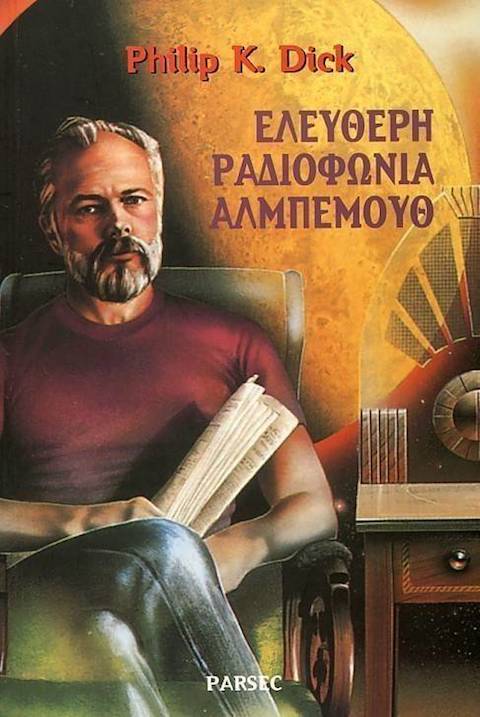
Dick wrote interesting books, to put it mildly, and as book-lovers know, certain countries’ publishing industries tend to put out more interesting book covers than others. So what happens at the intersection? Here we present to you a selection of Philip K. Dick covers from around the world, beginning with a Greek cover of his posthumously published novel Radio Free Albemuth that features the man himself, relaxing in his natural interplanetary environment beside his vintage radio.

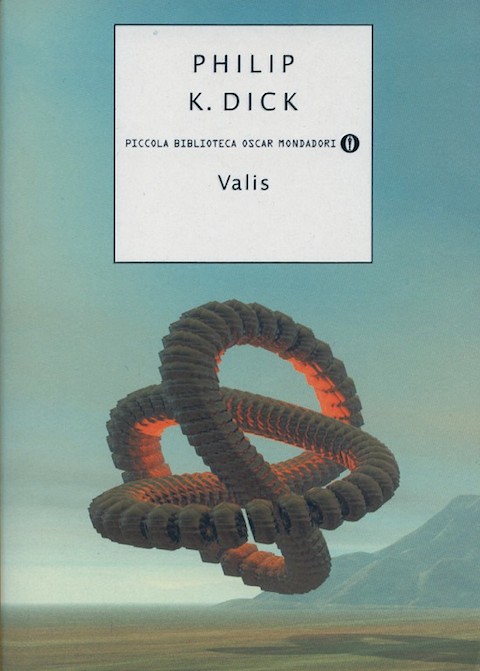
That book put a barely fictional gloss on Dick’s own psychological experiences, as did Valis, whose Italian edition you also see pictured here. But his more fantastical novels, such as the I Ching-driven story of an America that lost the Second World War, have received equally compelling international covers, such as the one from Chile just above.

You can usually trust Japanese publishers to come up with book designs neither too abstract nor too literal for the contents within, as one of their editions of Flow My Tears, the Policeman Said quite literally illustrates just above. And if you can rely on Japan for that sort of cover, you can rely on France for understatement; half the French novels I’ve seen have nothing on the front but the name of the work, the author, and the publisher, but behold how Dick’s untamed experimental spirit allowed Robert Laffont to cut loose:
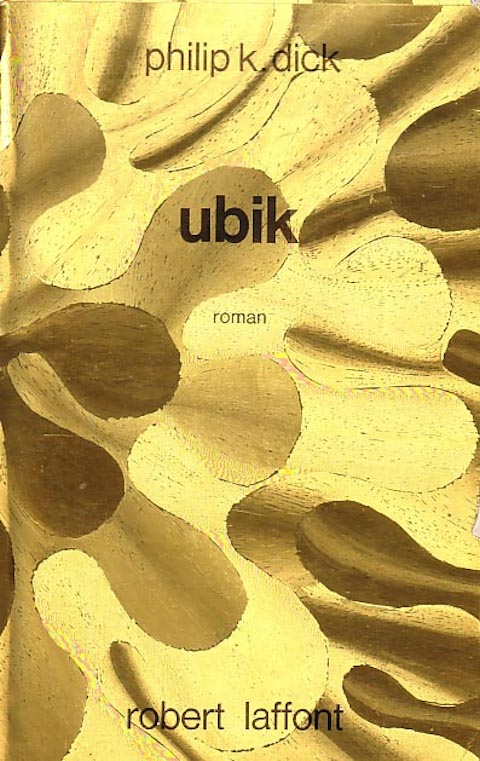
But if you really want to see an unusual graphic design culture, you’ve got to look to Poland. We featured that country’s distinctive movie posters a few years ago, but their books also partake of the very same delightfully askew visual tradition, one I imagine that would have done Dick himself proudest. Below we have Polish cover art for Confessions of a Crap Artist, his novel of midcentury suburban strife, composed with materials few of us would have thought to use:

You can see 600+ international Philip K. Dick covers at philipkdick.com’s cover gallery, which has for some reason gone offline, but which mostly survives through the magic of the Internet Wayback Machine — a device Dick never imagined even in his farthest-out, trickiest-to-represent fantasies.
Related Content:
Philip K. Dick Takes You Inside His Life-Changing Mystical Experience
Robert Crumb Illustrates Philip K. Dick’s Infamous, Hallucinatory Meeting with God (1974)
Download 14 Great Sci-Fi Stories by Philip K. Dick as Free Audio Books and Free eBooks
50 Film Posters From Poland: From The Empire Strikes Back to Raiders of the Lost Ark
Colin Marshall hosts and produces Notebook on Cities and Culture as well as the video series The City in Cinema and writes essays on cities, language, Asia, and men’s style. He’s at work on a book about Los Angeles, A Los Angeles Primer. Follow him on Twitter at @colinmarshall or on Facebook.
Read More...Watch 570 Million Years of Evolution on Earth in 60 Seconds
570 millions years of evolution. That’s a lot of ground to cover. And it could be like watching paint dry. But not when it flies by in 60 seconds, with a groovy soundtrack by I‑Konic. First come the arthropods. Next some friendly fish, all followed by land plants, flying insects, amphibians, and reptiles. Way down the line, at the very end, the first humans arrive on the scene. But don’t blink, you might miss it.
To get a little more detail on how this all happened, I’d suggest watching Carl Sagan explain evolution in a classic 8‑minute animation.
Related Content:
New Animated Web Series Makes the Theory of Evolution Easy to Understand
Richard Dawkins Explains Why There Was Never a First Human Being
Free Online Biology Courses
16,000 Pages of Charles Darwin’s Writing on Evolution Now Digitized and Available Online
Read More...Romantic Poets Samuel Taylor Coleridge & Robert Southey Write About Their Experiments with Laughing Gas (1799)
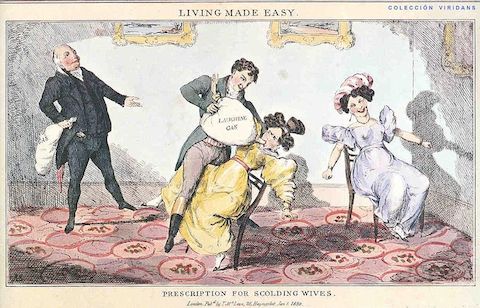
A hundred years before Sigmund Freud used himself as a test subject for his experiments with cocaine, another scientist, Humphry Davy, English chemist and future president of the Royal Society, began “a very radical bout of self experimentation to determine the effects of” another drug—nitrous oxide, better known as “laughing gas.” Davy’s findings — Researches, Chemical and Philosophical Chiefly Concerning Nitrous Oxide, or Diphlogisticated Nitrous Air, And Its Respiration By Humphry Davy—published in 1800, come to us via The Public Domain Review, who describe the 1799 experiments thus:
With his assistant Dr. Kinglake, he would heat crystals of ammonium nitrate, collect the gas released in a green oiled-silk bag, pass it through water vapour to remove impurities and then inhale it through a mouthpiece. The effects were superb. Of these first experiments he described giddiness, flushed cheeks, intense pleasure, and “sublime emotion connected with highly vivid ideas.”
Though we don’t typically think of nitrous oxide as an addictive substance, like Freud’s experiments, Davy’s progressed rapidly from curiosity to recreation: “He began to take the gas outside of laboratory conditions, returning alone for solitary sessions in the dark, inhaling huge amounts, ‘occupied only by an ideal existence,’ and also after drinking in the evening.” Fortunately for us, however, also like Freud, Davy “continued to be meticulous in his scientific records throughout.” Eventually, the twenty-year-old Davy constructed an “air-tight breathing box.” Sealing himself inside, writes Mike Jay, Davy had Dr. Kinglake “release twenty quarts of nitrous oxide every five minutes for as long as he could retain consciousness.”
Also, like Freud’s use of cocaine, Davy’s research briefly led to a faddish recreational use of the drug, well into the early part of the nineteenth century, as you can see in the caricatures at the top and below, from 1830 and 1829, respectively. But despite what these humorous images suggest, “laughing gas” became known not only as a party drug, but also as a means of achieving heightened states of consciousness conducive to philosophical reflection and poetic creation (hence the “Philosophical” reference in the title of Davy’s research). During his own experiences “under the influence of the largest does of nitrous oxide anyone had ever taken,” Davy “’lost all connection with external things,’ and entered a self-enveloping realm of the senses,” writes Jay, finding himself “‘in a world of newly connected and modified ideas,’ where he could theorise without limits and make new discoveries at will.”
The appeal of this state to a scientist may be obvious, and to a poet even more so. Davy’s friend Robert Southey, the future Poet Laureate, became “as effusive” as Davy after taking the gas, exclaiming, “the atmosphere of the highest of all possible heavens must be composed of this gas.” In addition to Southey, Davy’s “freewheeling program of consciousness expansion… co-opted some of the most remarkable figures of his day”—including Samuel Taylor Coleridge, who is already well-known for finding some of his poetic inspiration under the influence of opium. Coleridge at the time had just published to great acclaim The Lyrical Ballads with William Wordsworth and had returned from a brief sojourn in Germany, where he had become heavily influenced by the German Idealist philosophy of Immanuel Kant and Friedrich Schelling.
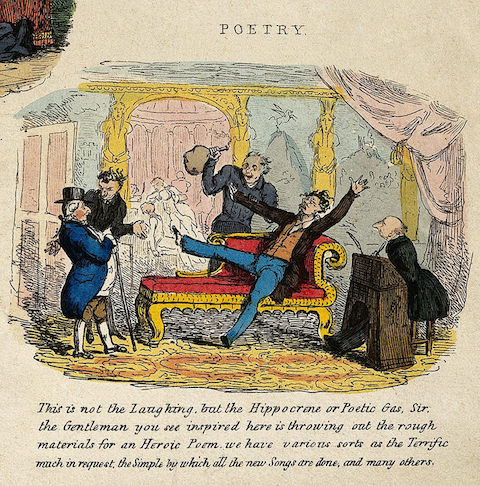
Coleridge, who was “captivated by the young chemist” Davy, described his experience of taking nitrous oxide for the first time in very precise terms, avoiding the “extravagant metaphors” others tended to rely on. He recalled the sensations as resembling “that which I remember once to have experienced after returning from the snow into a warm room,” and, in a later trial, said he was “more violently acted upon” and that “towards the last I could not avoid, nor felt any wish to avoid, beating the ground with my feet; and after the mouthpiece was removed, I remained for a few seconds motionless, in great ecstacy.” Under the influence of both nitrous oxide and philosophical metaphysics, Coleridge had come to believe “the material world only an illusion projected by” the mind.
Davy, who fully endorsed this view, claiming “nothing exists but thoughts,” brought his “chaotic mélange of hedonism, heroism, poetry and philosophy” to heel in the “coherent and powerful” 580-page monograph above, which makes the case for laughing gas’s scientific and poetic worth. The report, writes Jay, combines “two mutually unintelligible languages—organic chemistry and subjective experience—to create a groundbreaking hybrid, a poetic science.” Like Freud’s use of cocaine or Timothy Leary’s experiments with LSD decades later, Davy’s experiments further demonstrate, perhaps, that the few times the sciences, philosophy, and poetry communicate with each other, it’s generally under the influence of mind-altering substances.
For more on Davy and nineteenth century England’s fascination with laughing gas, see Mike Jay’s Public Domain Review essay here and read this New York Review of Books article on his book-length treatment of the subject, The Atmosphere of Heaven: The Unnatural Experiments of Dr. Beddoes and His Sons of Genius.
Related Content:
How a Young Sigmund Freud Researched & Got Addicted to Cocaine, the New “Miracle Drug,” in 1894
Beyond Timothy Leary: 2002 Film Revisits History of LSD
Carl Sagan Extols the Virtues of Cannabis (1969)
Josh Jones is a writer and musician based in Durham, NC. Follow him at @jdmagness
Read More...Listen to 60+ Free, High-Quality AudioBooks of Classic Literature on Spotify: Austen, Dickens, Tolstoy & More
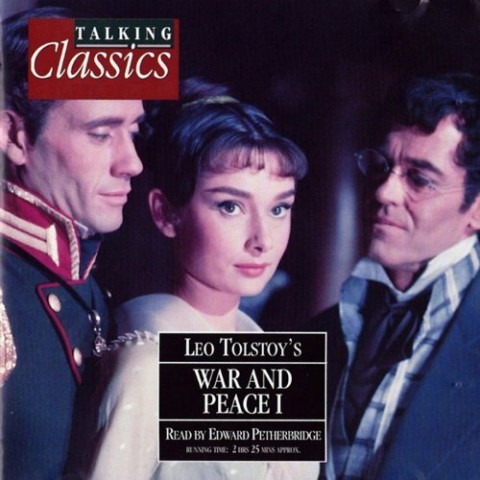
Where music goes, technologically speaking, audio books soon follow. We’ve had audio books on vinyl LP, on cassette tape, on CD, and on MP3, just like we’ve had music. Now that so many of us pull up our daily jams on Spotify, it shouldn’t come as a surprise that we can do a fair bit of our “reading” there as well. We’ve found a few lists that gather up the best audio book available on Spotify, including 21 classics and a collection of Shakespeare plays and sonnets at Gnarl’d, ten evergreen literary picks from Lifehacker, and a Spotify forum thread dedicated to subject.
Below, you’ll find Spotify links to more than 60 classic works of literature that, even if you struggled on getting them read in your English classes, you can now revisit in a perhaps much more lifestyle-compatible medium. If you find more audio books on Spotify, definitely let us know in the comments section below and we’ll add them to our list.
To listen to any of these, you will of course need Spotify’s software and account, both easy to come by: you just download and register.
- Jane Austen, Pride and Prejudice
- Charlotte Brontë, Jane Eyre
- Emily Brontë, Wuthering Heights
- Lewis Carroll, Alice’s Adventures in Wonderland
- James Fenimore Cooper, Last of the Mohicans
- Daniel Defoe, Robinson Crusoe
- Charles Dickens, A Christmas Carol
- Charles Dickens, David Copperfield
- Charles Dickens, Great Expectations
- Charles Dickens, Oliver Twist
- Charles Dickens, A Tale of Two Cities
- Fyodor Dostoyevsky, Crime & Punishment
- George Eliot, Middlemarch
- T.S. Eliot, T.S. Eliot Reads Poems and Choruses
- William Faulkner, Reads From His Works
- F. Scott Fitzgerald, The Curious Case of Benjamin Button
- F. Scott Fitzgerald, The Great Gatsby
- Gustave Flaubert, Madame Bovary
- Thomas Hardy, Far from the Madding Crowd
- Ernest Hemingway, Reading His Own Work
- James Joyce, The Dead
- Jack London, Call of the Wild
- Herman Melville, Billy Budd
- Herman Melville, Moby Dick
- Harold Pinter: The Caretaker
- William Shakespeare, As You Like It
- William Shakespeare, Coriolanus
- William Shakespeare, Hamlet
- William Shakespeare, Henry IV Part 1
- William Shakespeare, Henry IV Part 2
- William Shakespeare, Julius Caesar
- William Shakespeare, King John
- William Shakespeare, Macbeth
- William Shakespeare, Measure for Measure
- William Shakespeare, Much Ado About Nothing Part 1
- William Shakespeare, Much Ado About Nothing Part 2
- William Shakespeare, Othello
- William Shakespeare, Richard II
- William Shakespeare, Richard III
- William Shakespeare, Romeo & Juliet
- William Shakespeare, Sonnets
- William Shakespeare, The Taming of the Shrew Pt 1
- William Shakespeare, The Taming of the Shrew Pt 2
- William Shakespeare, The Merchant of Venice
- William Shakespeare, The Tempest
- William Shakespeare, The Two Gentlemen of Verona
- William Shakespeare, Troilus and Cressida
- William Shakespeare, Twelfth Night
- Bram Stoker, Dracula
- Robert Louis Stevenson, Dr. Jeckyll and Mr Hyde
- Jonathan Swift, Gulliver’s Travels
- Leo Tolstoy, Anna Karenina
- Leo Tolstoy, War & Peace Part 1 — Part 2
- Mark Twain, A Connecticut Yankee in King Arthur’s Court
- Mark Twain, A Double Barreled Detective Story
- Mark Twain, Short Stories
- H.G. Wells, The Invisible Man
- H.G. Wells, The Time Machine
- H.G. Wells, The War of the Worlds
- Jules Verne, 20,000 Leagues Under the Sea
- Jules Verne, Around the World in 80 Days
- Oscar Wilde: The Importance of Being Earnest
For more great audio, don’t forget to visit our collection, 1,000 Free Audio Books: Download Great Books for Free. Also remember that you can download a free audiobook (including many contemporary books) from Audible.com’s Free Trial program.
Related Content:
630 Free Audio Books: Download Great Books for Free
Download 55 Free Online Literature Courses: From Dante and Milton to Kerouac and Tolkien
Colin Marshall hosts and produces Notebook on Cities and Culture as well as the video series The City in Cinema and writes essays on cities, language, Asia, and men’s style. He’s at work on a book about Los Angeles, A Los Angeles Primer. Follow him on Twitter at @colinmarshall or on Facebook.
Read More...How “America’s First Drug Czar” Waged War Against Billie Holiday and Other Jazz Legends
The U.S. government’s so-called “War on Drugs” predates Richard Nixon’s coinage of the term in 1971 by many decades, though it is under his administration that it assumed its current scope and character. Before Woodstock and Vietnam, before the creation of the DEA in 1973, the Federal Bureau of Narcotics—headed by “America’s first drug czar,” Commissioner Harry J. Anslinger, from 1930 to 1962—waged its own war, at first primarily on marijuana, and, to a great degree, on jazz musicians and jazz culture. Anslinger came to power in the era of Reefer Madness, the title of a rather ridiculous 1938 anti-drug film that has come to stand in for hyperbolic anti-pot paranoia of the ’30s and ’40s more generally. Much of that madness was the Commissioner’s special creation.
Like so much of the post-Nixon drug war, Anslinger staged his campaign as a moral crusade against certain kinds of users: dissidents, the counterculture, and especially immigrants and blacks. According to Alexander Cockburn’s Whiteout: The CIA, Drugs, and the Press, Anslinger’s “first major campaign was to criminalize the drug commonly known as hemp. But Anslinger renamed it ‘marijuana’ to associate it with Mexican laborers,” and claimed that the drug “can arouse in blacks and Hispanics a state of menacing fury or homicidal attack.” Anslinger “became the prime shaper of American attitudes to drug addiction.” And like later despisers of rock ‘n’ roll and hip-hop, Anslinger’s hatred of jazz motivated many of his targeted attacks.
Ansligner linked marijuana with jazz and persecuted many black musicians, including Thelonious Monk, Dizzy Gillespie and Duke Ellington. Louis Armstrong was also arrested on drug charges, and Anslinger made sure his name was smeared in the press. In Congress he testified that “[c]oloreds with big lips lure white women with jazz and marijuana.”
“Marijuana is taken by… musicians,” he told Congress in 1937, “And I’m not speaking about good musicians, but the jazz type.” Although the La Guardia Committee would refute almost everything Anslinger testified to about the effects of smoking pot, the damage was already done. (Anslinger’s prosecution of jazz musicians, particularly Louis Armstrong—paralleled that of another power-mad, paranoid bureaucrat, J. Edgar Hoover.)
Anslinger did not simply dislike jazz. He feared it. “It sounded,” he wrote, “like the jungles in the dead of night.” In jazz, “unbelievably ancient indecent rites of the East Indies are resurrected.” And the lives of jazz musicians “reek of filth.” And yet, writes Johann Hari in his book Chasing the Scream (excerpted in Politico), his campaign largely failed because of the jazz world’s “absolute solidarity” in opposition to it. “In the end,” writes Hari, “the Treasury Department told Anslinger he was wasting his time.” And so, “he scaled down his focus until it settled like a laser on one single target—perhaps the greatest female jazz vocalist there ever was,” Billie Holiday.
Anyone with even the most cursory knowledge about Holiday knows she had a drug problem in desperate need of treatment. And, of course, Holiday wasn’t addicted to a relatively harmless substance like marijuana, but to heroin, which—along with alcohol abuse—eventually lead to her death. Yet, as Cockburn writes, Anslinger had “hammer[ed] home his view that [drug addiction] was not… treatable,” but “could only be suppressed by harsh criminal sanctions.” Accordingly, he “hunted” Holiday—in Hari’s apt description—sending agents after her when he heard “whispers that she was using heroin, and—after she flatly refused to be silent about racism.”
Recruiting a black agent, Jimmy Fletcher, for the job, Anslinger began his attacks on Holiday in 1939. Fletcher shadowed Holiday for years, and became protective, eventually, “it seems,” writes Hari, “fall[ing] in love with her.” But Anslinger broke the case through Holliday’s viciously abusive husband, Louis McKay, who agreed to inform on her—something no fellow musician would do. In May of 1947, Holiday was arrested and put on trial for possession of narcotics. “Sick and alone,” writes Hettie Jones in Big Star Fallin’ Mama: Five Women in Black Music, “she signed away her right to a lawyer and no one advised her to do otherwise.” Promised a “hospital cure in return for a plea of guilty,” she was instead “convicted as a ‘criminal defendant,’ and a ‘wrongdoer,’ and sentenced to a year and a day in the Federal Women’s Reformatory at Alderson, West Virginia.”
After her release, Holiday was stripped of her cabaret license, restricted from singing in “all the jazz clubs in the United States… on the grounds,” writes Hari, “that listening to her might harm the morals of the public.” Two years after her first conviction, Anslinger recruited another agent, a sadist named George White, who was all too happy take Holiday down. He did so in 1949 at the Mark Twain Hotel in San Francisco—“one of the few places she could still perform”—arresting her without a warrant and with what were very likely planted drugs. White apparently “had a long history of planting drugs on women” and “may well have been high when he busted Billie for getting high.” (See the declassified case against her here. Her manager John Levy is erroneously referred to as her “husband” and called “Joseph Levy.”)
A jury refused to convict, but Anslinger gloried in the toll his campaign had taken. “She had slipped from the peak of her fame,” he wrote, “her voice was cracking.” After her death in 1959, he wrote callously, “for her, there would be no more ‘Good Morning Heartache.’” For her part, though Holiday “didn’t blame Anslinger’s agents as individuals; she blamed the drug war,” writing in her autobiography, “Imagine if the government chased sick people with diabetes, put a tax on insulin and drove it into the black market… then sent them to jail…. We do practically the same thing every day in the week to sick people hooked on drugs.”
Many jazz musicians, but especially Holiday, paid dearly for Anslinger and the Federal Bureau of Narcotics’ “war on drugs.” Hari documents the “race panic” that underlay most of Anslinger’s actions and the egregious double standard he applied, including a “friendly chat” he had with Judy Garland over her heroin addiction and kid gloves treatment of a “Washington society hostess,” in contrast to his relentless prosecution of Holiday. His persecution of Holliday and others was accompanied by a propaganda campaign that demonized “the Negro population” as dangerous addicts. As Hari points out, Anslinger “did not create these underlying trends,” but he promoted racist fictions and manipulated them to his advantage. And his singling out of cultures and groups he personally disliked and feared as special targets for vigorous, prejudicial prosecution helped set the agenda for anti-drug legislation and cultural attitudes in every decade since he decided to go after jazz and Billie Holiday.
Hari’s book, Chasing the Scream, is now available on Amazon.
Related Content:
Billie Holiday — The Life and Artistry of Lady Day: The Complete Film
Duke Ellington’s Symphony in Black, Starring a 19-Year-old Billie Holiday
Louis Armstrong Plays Historic Cold War Concerts in East Berlin & Budapest (1965)
Josh Jones is a writer and musician based in Durham, NC. Follow him at @jdmagness
Read More...Support Us
We're hoping to rely on loyal readers, rather than erratic ads. Please click the Donate button and support Open Culture. You can use Paypal, Venmo, Patreon, even Crypto! We thank you!

About Us

Open Culture scours the web for the best educational media. We find the free courses and audio books you need, the language lessons & educational videos you want, and plenty of enlightenment in between.
Advertise With Us

FREE UPDATES!
GET OUR DAILY EMAIL
Get the best cultural and educational resources on the web curated for you in a daily email. We never spam. Unsubscribe at any time.
FOLLOW ON SOCIAL MEDIA

Open Culture editor Dan Colman scours the web for the best educational media. He finds the free courses and audio books you need, the language lessons & movies you want, and plenty of enlightenment in between.
Advertise With Us