The Talking Heads’ First TV Appearance Was on American Bandstand, and It Was a Little Awkward (1979)
“I guess he’s…organically shy.”–Tina Weymouth
As Talking Heads went from CBGBs (see some vintage video) to college radio to a European tour opening for The Ramones in 1977, the band was slowly making its way out of New York City poverty while their art school rock was seeping into American culture at large. When “Take Me To the River,” their airy, nervous but still funky Eno-produced cover of the Al Green song became their first Billboard Top 30 hit, the band took a step towards national recognition.
And that leads us to this awkward March 17, 1979 appearance of the band on ABC’s American Bandstand, their first on American TV. Longtime host Dick Clark was pretty square–rock critic Nik Cohn described him as “a disc jockey who looked like an all-American choirboy”–but American Bandstand was a prime opportunity. In 1979, the New Wave and Post-Punk scenes were raging at the show’s doors. Talking Heads were one of the few acts that year from NYC’s creative cauldron of a music scene, apart from Blondie and Grace Jones, to make it onto Bandstand.
In the above clip, Clark apologizes for getting Tina Weymouth’s name wrong, then jumps in to interview David Byrne, who responds to Clark’s questions by shutting them down with embarrassed looks and matter-of-fact answers. Clark then turns back to Tina for some psychoanalytic help. “Is he always this enthusiastic?” he asks. It crumbles from there.
Weymouth remembered it slightly differently in this recent (2014) interview in New York Magazine:
I couldn’t explain to the record-label people why David’s behavior could be so incredibly odd. He had a freak-out on our first television appearance, on Dick Clark, on American Bandstand. David sort of froze, and Dick Clark sort of whirled around, and hands the microphone to me. And there were other things going on, too. I don’t think any person is one thing, or defined by a condition that they might have.
It’s not exactly freezing, but it is odd…for rock frontmen. And asking Byrne “Do you flog yourself into this?” tells you a bit more about Clark’s state of mind than anything else.
You can see the mimed performance of their hit here:
The other song they performed on the broadcast “Thank You for Sending Me an Angel” has not popped up on YouTube…yet.
Parting note: The other guest that night on Bandstand was twee, blue-eyed disco act Brooklyn Dreams with their single Make It Last.
Related content:
Hear the Earliest Known Talking Heads Recordings (1975)
Talking Heads Live in Rome, 1980: The Concert Film You Haven’t Seen
Jim Jarmusch’s Anti-MTV Music Videos for Talking Heads, Neil Young, Tom Waits & Big Audio Dynamite
The Talking Heads Play CBGB, the New York Club that Shaped Their Sound (1975)
Ted Mills is a freelance writer on the arts who currently hosts the FunkZone Podcast. You can also follow him on Twitter at @tedmills and/or watch his films here.
Read More...Google Puts Online 10,000 Works of Street Art from Across the Globe

Circling Birdies by Cheko, Granada Spain
Since last we wrote, Google Street Art has doubled its online archive by adding some 5,000 images, bringing the tally to 10,000, with coordinates pinpointing exact locations on all five continents (though as of this writing, things are a bit thin on the ground in Africa). Given the temporal realities of outdoor, guerrilla art, pilgrims may arrive to find a blank canvas where graffiti once flourished. (RIP New York City’s 5 Pointz, the “Institute of Higher Burning.”)
A major aim of the project is virtual preservation. As with performance art, documentation is key. Not all of the work can be attributed, but click on an image to see what is known. Guided tours to neighborhoods rich with street art allow armchair travelers to experience the work, and interviews with the artists dispel any number of stereotypes.
Cultural institutions like Turkey’s Pera Museum and Hong Kong’s Art Research Institute, and street art projects based in such hubs as Rome, Paris, Sydney, and Bangkok, have pulled together official collections of photos and videos, but you can play curator too.
It’s easy to add images to a collection of your own making that can be shared with the public at large or saved for private inspiration. Careful, you could lose hours…it’s like Pinterest for people who gravitate toward spray paint and rubbish strewn vacant lots over gingham wrapped Mason jars.
It’s been a long and brutal winter here on the east coast, so for my first foray, I prowled for Signs of Spring. One of my first hits was “Circling Birdies” by Cheko, above. Located in Granada, Spain, it’s one of the existing works Google has turned into a GIF with some light, logical animation.
Behold a bit of what typing “flower,” “baby animals,” “plants,” and “trees” into a search box can yield! You can enter Google Street Art here.
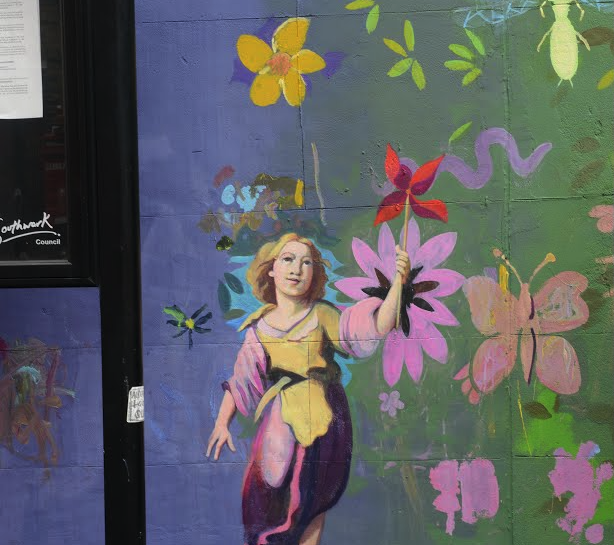
Artist: Walter Kershaw
London UK

Artists: Thrashbird and Renee Gagnon
Los Angeles, California.
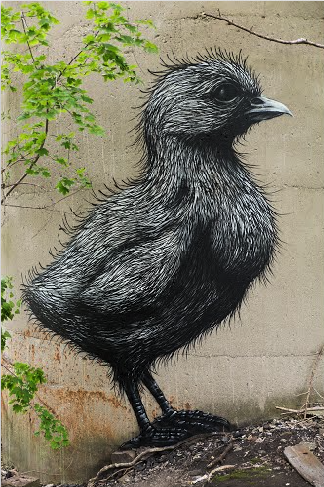
Artist: unknown
Rochester, NY

Icy and Sot
Rochester NY
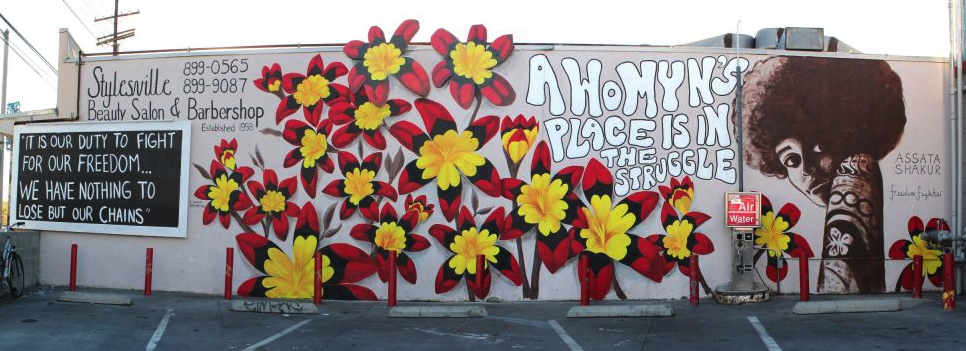
Artist: Kristy Sandoval
Los Angeles, CA

Artists: Regg and Violant
Alfragide Portugal

Artist: Klit
Alfragide, Portugal
A giant colorful beetle tries to fly between the ceiling and the floor of this parking lot. His wings seem filled with flower petals. So, the “Living Nature” project brought a set of huge insects that carry a note of living spirit to the space.

Artist: Rai Cruz
Manila, Philippines
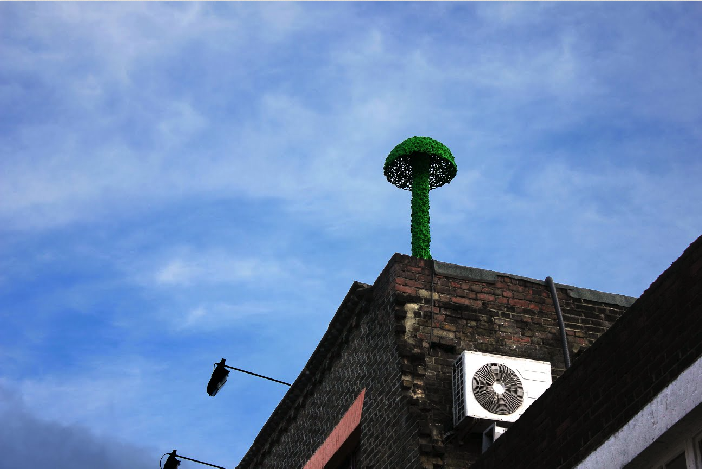
Artist: Christiaan Nagel
London, England
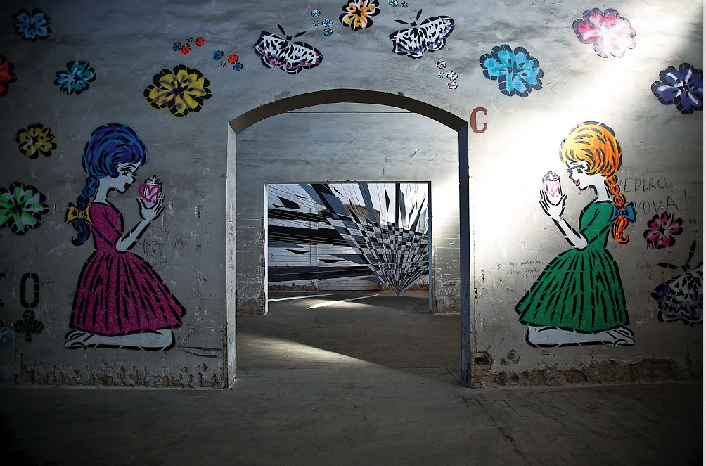
Artist: Lady Aiko
Rome, Italy

Artist: Andrew Kentish
Nepal
Related Content:
Tour the World’s Street Art with Google Street Art
Obey the Giant: Short Film Presents the True Story of Shepard Fairey’s First Act of Street Art
Big Bang Big Boom: Graffiti Stop-Motion Animation Creatively Depicts the Evolution of Life
Ayun Halliday is an author, illustrator, and Chief Primatologist of the East Village Inky zine. Follow her @AyunHalliday
Read More...Watch the “Youngest String Quartet Ever” Perform Vivaldi, Michael Jackson & Katy Perry
They’re billed as “the youngest string quartet ever.” The kids began playing in The Joyous String Quartet when they were four years old. Now, fast forward four more years, and they find themselves performing 20 concerts a year around the globe — in places like South Korea and China, and on the Ellen DeGeneres Show. Above you can watch them perform Summer “Presto” by Vivaldi. Below, they give you a classical version of Katy Perry’s “Firework:
And finally Michael Jackson’s “Smooth Criminal.” In case you’re wondering, the students come out of The Joyous Music School in Hicksville, NY.
Related Content:
Fourteen-Year-Old Girl’s Blistering Heavy Metal Performance of Vivaldi
Elementary School Students Perform in a Play Inspired by David Lynch’s Twin Peaks
Follow us on Facebook, Twitter, Google Plus and LinkedIn and share intelligent media with your friends. Or better yet, sign up for our daily email and get a daily dose of Open Culture in your inbox.
Read More...Take a “Breath” and Watch Samuel Beckett’s One-Minute Play
As Samuel Beckett’s writing progressed through the ’60s, it became even more minimal, despairing, and bleak. It was as if he was paring away as much as he could to see if theater was left standing. If a painting could be one color like Ad Reinhardt, what would be the Reinhardt of theater? Jonathan Crow mentioned yesterday how Beckett’s 1969 play Breath, for instance, “runs just a minute long and features just the sound of breathing.” There is a bit more to it than that. Not a lot more, but yes, more. Here’s the play’s script in full:
Curtain.
1. Faint light on stage littered with miscellaneous rubbish. Hold for about five seconds.
2. Faint brief cry and immediately inspiration and slow increase of light together reaching maximum together in about ten seconds. Silence and hold about five seconds.
3. Expiration and slow decrease of light together reaching minimum together (light as in I) in about ten seconds and immediately cry as before. Silence and hold for about five seconds.
Beckett adds some notes:
Rubbish. No verticals, all scattered and lying.
Cry. Instant of recorded vagitus. Important that two cries be identical, switching on and off strictly synchronized light and breath.
Breath. Amplified recording.
Maximum light. Not bright. If 0 = dark and 10 = bright, light should move from about 3 to 6 and back.
The play came about when one of the most important English theater critics of his time Kenneth Tynan asked for short skits for an erotic revue he was putting on in 1969, called Oh! Calcutta. Others invitees included Jules Feiffer, John Lennon, Edna O’Brien, Jacques Levy, Sam Shepard, and Leonard Melfi. The plan was to perform each skit but keep each writer’s name a secret. Beckett reportedly wrote the play on a postcard and sent it to Tynan, then became enraged when he heard that instead of rubbish on stage, Tynan had used naked bodies *and* in fact had explicitly credited Beckett in the program. Breath wouldn’t get a proper staging until 1999 in London’s West End, as part of an evening with Beckett’s more substantial Krapp’s Last Tape. You can read reports of how the audience reacted.
Several directors have brought Breath to life. Artist Damien Hirst had a go for the 2002 Beckett on Film project. As seen above, his version has very spectacular rubbish gathered from a hospital and, glimpsed in the final seconds, a cigarette butt swastika.
Below, check out a more “traditional” interpretation of the play from the National Theatre School of Canada’s Tech Production class. After that comes a repeat of Hirst’s version, and then one more alternative, Darren Smyth’s 2009 TV static-filled attempt. (The rest of the video is a mixed bag of the Alan Parsons Project and a Tim Burton short, don’t ask why.)
Despite Beckett’s morose reputation, there’s always a black humor underneath it all. And if you’re going to ask the man to write an “erotic skit,” this is what you get, the futility of life from womb to tomb in a minute.
Finally, you can watch an informative mini lecture on the play, presented by Dr. Catherine Brown for the New College of the Humanities.
Related Content:
Watch the Opening Credits of an Imaginary 70s Cop Show Starring Samuel Beckett
Samuel Beckett Directs His Absurdist Play Waiting for Godot (1985)
Monsterpiece Theater Presents Waiting for Elmo, Calls BS on Samuel Beckett
Ted Mills is a freelance writer on the arts who currently hosts the FunkZone Podcast. You can also follow him on Twitter at @tedmills and/or watch his films here.
Read More...Say What You Really Mean with Downloadable Cindy Sherman Emoticons
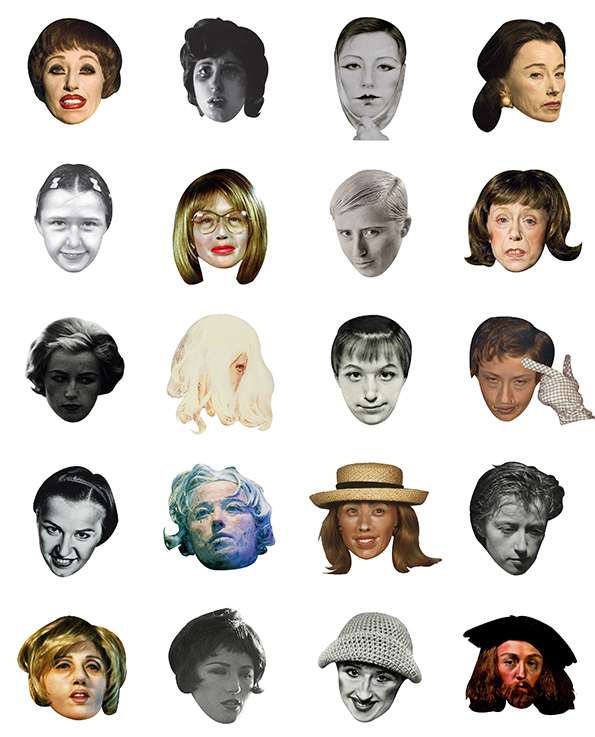
As the world becomes increasingly dependent on virtual communication, the potential for misunderstanding is ever present. I resisted the use of emoticons and stickers at first. They struck me as the pictorial equivalent of LOL. If that’s the best you can manage, why try at all?
I’ve since reversed my position. Several things contributed to this change in attitude:
- The peace of mind that comes from any kind of confirmation that one’s message has indeed been received.
- The unsupportably terse communication style of a colleague. Whether intentional or not, his monosyllabic replies to my flurry of texts and emails seemed to indicate disdain… for me! Hey Buster, I’m busy too…
- My discovery that my phone’s built-in emoji vocabulary included an alien, a demonic Namahage, and a friendly looking pile of poo.
By curating my emotions and Facebook stickers carefully, I’ve cobbled together a visual shorthand vocabulary that works for me. It’s a matter of self respect. (And self preservation. My wardrobe’s already running afoul of the Secret Internet Police. Why give them ammo to accuse me of unseemly clinging to a long gone sticker-obsessed girlhood?)
If you think I’m overthinking this, you likely won’t be interested in downloading artist Hyo Hong’s Cindy Sherman-icons for your personal use.
Or maybe they’re exactly what you’ve been waiting for, you old art snob, you!
Either way… enjoy!
The Sherman-icons are a logical extension of other Hong projects that play with perceptions of non-face-to-face interactions, including the Upside Down Facebook Page, the New York Taxi Guestbook, and Hand-Written Facebook Comment.
If the purpose of an emoticon is to convey a certain feeling or attitude on the part of the respondent, the chameleonic Sherman is well suited to carry the burden. The photographer has served as her own model for four decades worth of portraits. She has embodied such archetypes as housewife, prostitute, dancer, actress, damsel in distress, and socialite. Her pursuit of certain truths often leads her to embrace the grotesque. Her willingness to look like hell in the service of her art continues to shock and sometimes offend. (Let’s just say my late mother-in-law was not a fan.)
How wonderful that this radical artist’s work is now available to you in a form that may prove every bit as useful as a gift shop tote bag or umbrella.
 Feeling beaten down by life?
 Suspicious of another’s motives?

Hopeful in a situation where hopes are almost certain to be dashed?
Do you really want to depend on a cartoon smiley face to get that across for you? (See below.)
No guarantee that Sherman-icon users’ impulses will be correctly interpreted on the receiving end, but it seems a risk worth taking.
Click here for easy 3‑step instructions for downloading and using Cindy Sherman-icons.

Related Content:
Cindy Sherman and the Art of Impersonation
Art for the One Percent: 60 Minutes on the Excess & Hubris of the International Art Market
Ayun Halliday is an author, illustrator, and performer whose next mission is portraying a decidedly Cindy Shermanesque business woman in a free reading of Lunchtime, Greg Kotis’ play of office romance in the time of the New York Deli Wars. Follow her @AyunHalliday
Read More...Hear John Lennon’s Final Interview, Taped on the Last Day of His Life (December 8, 1980)
(Note: The clip above is the first of six parts. Hear the remaining parts here: 2, 3, 4, 5, 6)
John Lennon’s last days were filled with professional and domestic routines characteristic of both a typical wealthy New Yorker and a legendary rock star and activist: making breakfast and watching Sesame Street with his son Sean, going on epic shopping sprees, spending late nights in the studio, staging demonstrations, arguing with his retinue of servants and hangers-on. After five years in semi-retirement, or “siegelike retreat,” spent raising Sean, John Lennon seemed ready to emerge from seclusion and renew his career. On his final day, December 8, 1980, he was feeling hopeful about his creative future. He had just learned that his album with Yoko, Double Fantasy, had gone gold, and he and Yoko were engaged in promotion, and were looking forward to their next musical endeavor.
That morning, Annie Leibovitz and her assistant came to the Lennon’s apartment building, The Dakota, to shoot those now iconic photographs for Rolling Stone of the Lennons in bed. Meanwhile, a devoted fan named Paul Goresh, and Lennon’s murderer Mark David Chapman, started to hang around outside the building. Less than two hours later, a crew from San Francisco’s RKO radio arrived at The Dakota to interview John and Yoko. Interviewer Dave Sholin remembers meeting Lennon, who was getting dressed after the nude photo shoot: “the door opens and John jumps in with his arms extended, like ‘here I am folks!’ We were meeting John Lennon and we were all maybe a little nervous but that just put us right at ease in probably less than a minute.” “He was a regular guy, very, very sharp and extremely quick witted,” Sholin continued. “And he connected with all of us. He had been out of the public eye for five years and he was open to speaking about anything. He did not hold back.”
You can hear that interview, in six parts, above, and read a transcript here at Beatles Archive. John and Yoko talk in great detail about Double Fantasy, about parenting, about meeting, falling in love, and working together. Lennon also talks about his social vision and the need for “holistic” solutions to “stop this paranoia of 90-year old men playing macho games with the world and possibly the galaxy.” Notably, he offers his assessment of the cultural shifts from the sixties through the seventies.
The bit about the sixties we were all full of hope and then everybody got depressed and the seventies were terrible – that attitude that everybody has; that the sixties was therefore negated for being naïve and dumb. And the seventies is really where it’s at, which means, you know, putting makeup on and dancing in the disco – which was fine for the seventies – but I don’t negate the sixties. I don’t negate the seventies. The … the seeds that were planted in the sixties – and possibly they were planted generations before – but the seed… whatever happened in the sixties the… the flowering of that is in the feminist, feminization of society. The meditation, the positive learning that people are doing in all walks of life. That is a direct result of the opening up of the sixties. Now, maybe in the sixties we were naïve and like children everybody went back to their room and said, ‘Well, we didn’t get a wonderful world of just flowers and peace and happy chocolate and, and, and it wasn’t just pretty and beautiful all the time’ and that’s what everybody did, ‘we didn’t get everything we wanted’ just like babies and everybody went back to their rooms and sulked. And we’re just gonna play rock and roll and not do anything else . We’re gonna stay in our rooms and the world is a nasty, horrible place ’cause it didn’t give us everything we cried for’, right? Cryin’ for it wasn’t enough. The thing the sixties did was show us the possibility and the responsibility that we all had. It wasn’t the answer. It just gave us a glimpse of the possibility, and the seventies everybody gone ‘Nya, nya, nya, nya’. And possibly in the eighties everybody’ll say, ‘Well, ok, let’s project the positive side of life again’, you know? The world’s been goin’ on a long time, right? It’s probably gonna go on a long time… ”
After the interview, Sholin boarded a plane back to San Francisco, and John and Yoko went back to work, meeting with producer Jack Douglas. When they returned home that night, they found Mark David Chapman still waiting outside The Dakota with his .38. At 11:15 that night, Lennon was pronounced dead at Roosevelt Hospital. Sholin tells the story in a lengthy intro to the interview above. You can also listen to a streamlined version of the interview without the intro below.
Related Content:
What We Heard 34 Years Ago on the Night John Lennon Was Shot: TV & Radio
Bed Peace Revisits John Lennon & Yoko Ono’s Famous Anti-Vietnam Protests
Download the John Lennon/Yoko Ono “War is Over (If You Want It)” Poster in 100+ Languages
Josh Jones is a writer and musician based in Durham, NC. Follow him at @jdmagness
Read More...The Visual Art of William S. Burroughs: Book Covers, Portraits, Collage, Shotgun Art & More
As an artist, William S. Burroughs was undoubtedly his own man, beholden to no particular aesthetic, movement, or school, always independent even as a frequent collaborator with many other notable writers and artists. It didn’t hurt that he came from money—Burroughs’ grandfather invented the adding machine, and the writer’s inheritance, writes the Daily Beast, “left the young scion free to pursue education and drugs at his leisure.” Yet, although he pursued the latter without reservation, he also worked harder than most of his contemporaries, constantly innovating and pursuing new paths. Burroughs’ “entire creative project,” writes blogger Dan Shelalevy, “encompassed art, graphics, calligraphy, type, photography, film, assemblage, poetry, spoken word, and music…. Culture itself was his medium.”
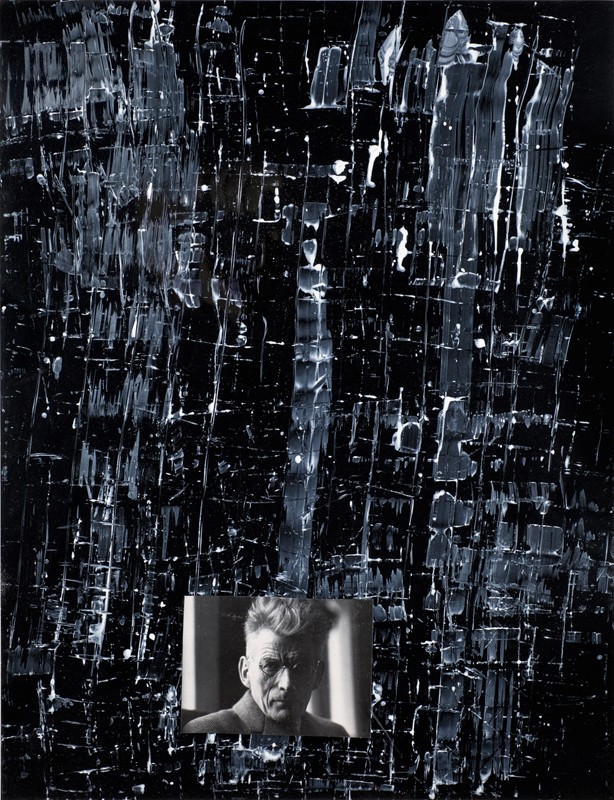
He may be associated primarily with the Beats, but Burroughs himself rejected the label, saying, “We’re not doing at all the same thing, either in writing or in outlook.” As a visual artist, London’s October Gallery informs us, he “collaborated with Keith Haring, George Condo, Robert Rauschenberg, and others.” As in his writing, Burroughs experimented throughout his art career with collage, incorporating photographs and pop culture ephemera like comic strips and advertising into paintings richly textured—as in the thick impasto surrounding the portrait of Samuel Beckett above—and often violent, as below.
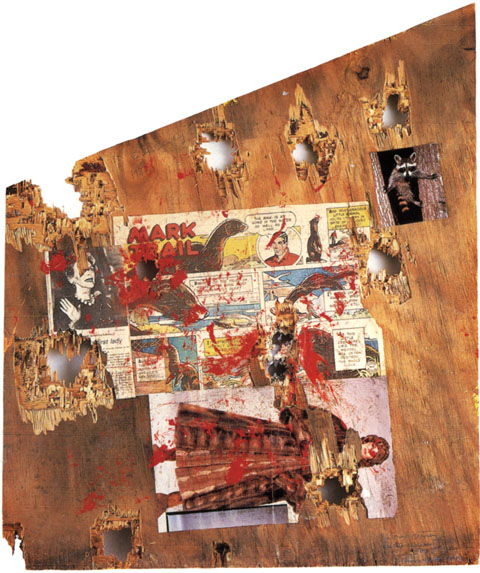
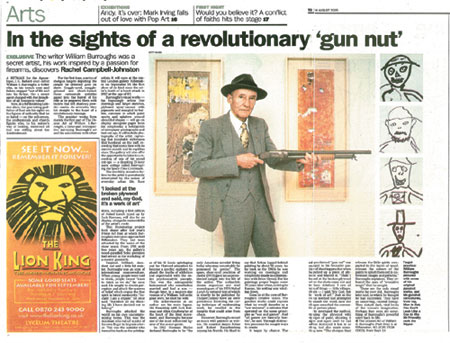
The notorious gun enthusiast often blasted holes through his canvasses and even experimented with shotgun painting. (See him with his shotgun below, on the front page of a Times article covering a 2005 exhibit of his work.) Burroughs also incorporated gun imagery into his paintings—often made on slabs of plywood—and used pop art techniques like stencils and spray paint, as below.
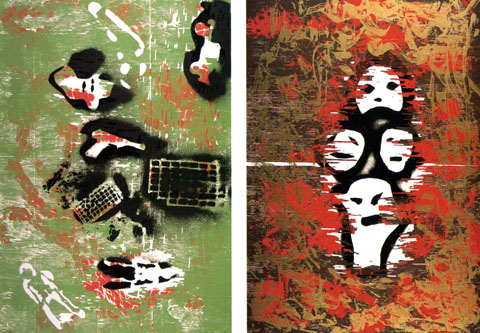
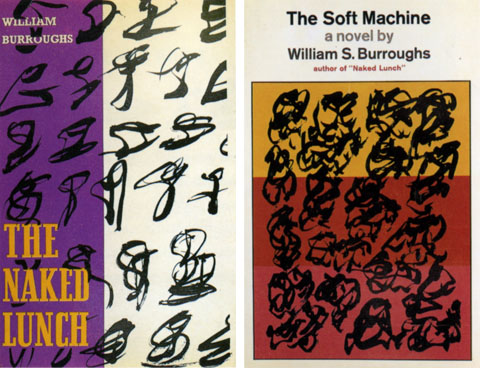
Burroughs even designed his own book covers, as you can see at the top of the post in the relatively austere paperback covers for Naked Lunch and The Soft Machine, both featuring repeating patterns of symbols. His visual art reflects the same obsessions we find in all of his work. These recurring motifs are what Paul Pieroni, co-organizer of the 2005 gallery show at The Riflemaker gallery in London, describes as a “hetero-ontology of forces at work,” including the “central themes” of “vice, violence and passion.”
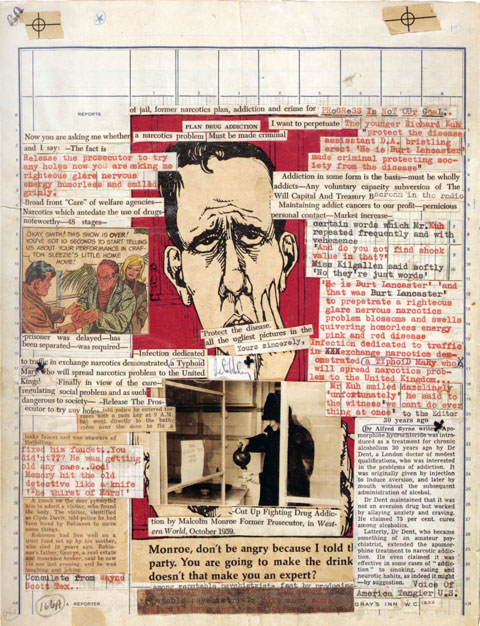
The same imagery that recurs in hallucinatory novels like Junky, Naked Lunch, and The Western Lands appears in the writer’s artwork: “thus, as in his literature,” says Pieroni, “we find war, cocks, violence, dirt, parasites, guns—junk.” In Burroughs’ hands the detritus of American culture—the contents of advertisements, foreign policy briefs, and seedy motel rooms—takes on an ominous, mythic significance that shows us as much about ourselves as it does about the artist.
Related Content:
William S. Burroughs Shows You How to Make “Shotgun Art”
William S. Burroughs on the Art of Cut-up Writing
Josh Jones is a writer and musician based in Durham, NC. Follow him at @jdmagness
Read More...The Metamorphosis of Mr. Samsa: A Wonderful Sand Animation of the Classic Kafka Story (1977)
At home I often watch EBS, essentially Korea’s equivalent of PBS, which often airs short interstitial segments drawn in sand to fill the time between programs. Only recently have I learned that sand actually has a genuine history as a medium for animation, one that has produced a work as striking as Caroline Leaf’s The Metamorphosis of Mr. Samsa back in 1977. Astute (or even not-very-astute) Kafka fans will recognize this as an adaptation of The Metamorphosis, far and away the writer’s best-known story, in which the young salesman Gregor Samsa wakes up transformed into a giant bug. Find it in our Free Audio Books and Free eBooks collections.
We see this bug writhing his way out of bed before we see any other action in Leaf’s ten-minute sand short, whose (yes) ever-shifting visual texture lends itself well to the theme of the tale. Not that this convergence of form and substance came easily: “What makes [Leaf’s] work stand out is the control of the material,” writes Johnny Chew, About Tech’s animation expert. “The Metamorphosis of Mr. Samsa is an awesome short film on its own, and a great adaptation of the Kafka work, but when you consider the style in which it was made and the control that would have to go into each frame, it’s unbelievable.”
“The medium of animation, and specifically certain animated techniques, offer an ability to faithfully reproduce in part both the content and the perceptual experience of a literary work,” writes Geoffrey Beatty in his paper “The Problem of Adaptation Solved!.” In it, he quotes the animator on why she chose this particular story: “ ‘Kafka’s stories give this kind of room to invent,’ she says. This was an important value for Leaf as she was establishing a body of work based on a unique visual approach. The Metamorphosis, suggested to her by a friend and mentor, was a good fit, as her own ‘black and white sand images had the potential to have a Kafka-esque feel – dark and mysterious.’ ”
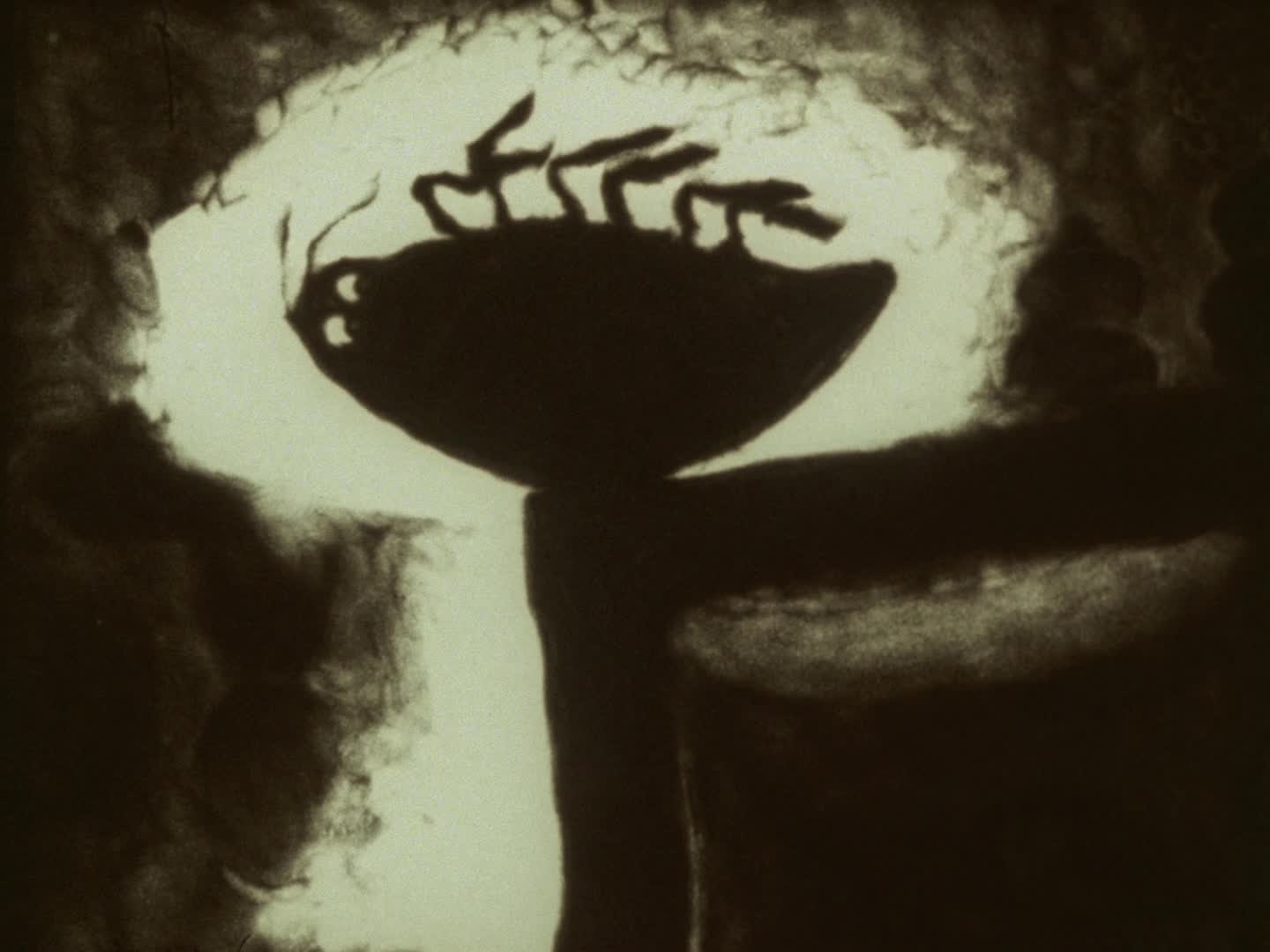
Any worthwhile artistic medium imposes limitations — and sand, as you’d imagine, imposes some pretty serious ones. Working with it, Leaf “would not be able to create highly detailed images [such as] the festering wound on Gregor’s back or his overall deterioration and decay. However, this limitation was not necessarily a problem. ‘I think that the limitations of drawing in sand, the simplifications that it requires, made me inventive in the storytelling in the ways I mentioned above. Sand forced me to adapt the story to sand, which is interesting.’ ”
Those readers who apply the word “Kafkan” to any pointlessly difficult task (like, say, getting out the door to work when you’ve become a giant bug) might also use it to describe Leaf’s labor-intensive sand animation process. But unlike a truly Kafkan labor, Leaf’s generated a result — and a delightful one at that. Now if only the next generation of sand animators would step foward to adapt the rest of Kafka’s oeuvre. Maybe we could interest PBS in airing it?
Find more literary animations in our collection, 4,000+ Free Movies Online: Great Classics, Indies, Noir, Westerns, Documentaries & More.
Related Content:
Watch Franz Kafka, the Wonderful Animated Film by Piotr Dumala
The Art of Franz Kafka: Drawings from 1907–1917
Colin Marshall hosts and produces Notebook on Cities and Culture as well as the video series The City in Cinema and writes essays on cities, language, Asia, and men’s style. He’s at work on a book about Los Angeles, A Los Angeles Primer. Follow him on Twitter at @colinmarshall or on Facebook.
Read More...Cult Films by Kubrick, Tarantino & Wes Anderson Re-imagined as 8‑Bit Video Games
Now closing in on 50 episodes, David Dutton’s 8‑Bit Cinema series for CineFlix celebrates and critiques the increasing video game qualities of action films. Or maybe it’s a nostalgic do-over of a childhood spent watching great films turned into terrible games and your favorite games turned into terrible films. 8‑Bit Cinema imagines popular and classic movies turned into NES-era console games, with the movie’s plot imagined as a “perfect run,” as gamers call it.
Their version of Guardians of the Galaxy (watch it here) quotes Megaman, Capcom’s 1987 hit game that is still spawning sequels, and confines its action to a platform shooter, which, in a way, describes James Gunn’s film. (But dig that 8‑bit version of “The Pina Colada Song,” man!). The film adapts too well to a video game, and that may be its problem.
Things get more interesting when Dutton’s creative team tackles films in the cult canon. One of their favorites, Pulp Fiction combines several game genres: Dance Dance Revolution for the Jack Rabbit Slim sequence, side scrollers for the gun (and samurai sword)-heavy action, and more. But what 8‑Bit Cinema had to do was straighten out Tarantino’s non-linear narrative, allowing the “player” to change characters from Vince to Butch after their unfortunate meeting, and ditch all that wonderful dialog. This 2 1/2 minute version quotes plenty of rare video games, just like Tarantino quotes movies.
The Shining is one of two Kubrick films the team has attempted, the other one being A Clockwork Orange. The Shining one works better as Kubrick’s examinations of domestic violence are rendered even icier (no pun intended) through typical violent gameplay, and tense confrontations between Jack and Wendy are reduced to emotionless exchanges. The video references 1987’s Maniac Mansion, appropriately enough, which itself was a tribute to horror movie cliches.
Wes Anderson’s ship set from The Life Aquatic with Steve Zissou was designed much like a platform game, so the 8‑Bit Cinema team had an easier job with this one, and threw in references to Metal Gear Solid to boot. Judging from the comments, the 8‑Bit death of Ned still manages to pull the ol’ heartstrings, but the narrative remains just as inscrutable.
The takeaway here might be this: The better the film, the less it can conform to the simplistic plots, puzzle play, and point-scoring violence that make video games fun to play. And while video games are undoubtedly a form of art, there’s a large gulf between them and cinema.
Currently Dutton’s crew manages one 8‑Bit Cinema short a month. For a behind-the-scenes look at what it takes to put three minutes of nostalgic bliss together, check this out:
Ted Mills is a freelance writer on the arts who currently hosts the FunkZone Podcast. You can also follow him on Twitter at @tedmills and/or watch his films here.
Related Content:
8‑Bit Philosophy: Plato, Sartre, Derrida & Other Thinkers Explained With Vintage Video Games
The Internet Arcade Lets You Play 900 Vintage Video Games in Your Web Browser (Free)
Andrei Tarkovsky’s Masterpiece Stalker Gets Adapted into a Video Game
Read More...Kids Orchestra Plays Ozzy Osbourne’s “Crazy Train” and Zeppelin’s “Kashmir”
The Louisville Leopard Percussionists — they’re a performing ensemble made up of 60 students, all between the ages of 7 and 14, from schools around the Louisville, Kentucky area. Each musician plays several instruments, such as the marimbas, xylophone, vibraphone, drum set, timbales, congas, bongos and piano. And they can rock with the best of them. Perhaps you’ve seen a viral video of the young percussionists playing Led Zeppelin’s “Kashmir,” which Jimmy Page called “too good not to share” on his Facebook page.
If your inner 16-year-old is asking “what about Ozzy?,” well then, we’ve got you covered. Above you can watch The Fabulous Leopard Percussionists rehearsing a version of Ozzy Osbourne’s “Crazy Train,” the heavy metal classic from 1980. Founded in 1993 by the elementary school teacher Diane Downs, the ensemble has certainly explored other musical forms too. Here, you can see them perform Chick Corea’s “Spain” and Benny Goodman’s “Sing Sing Sing” at the International Association of Jazz Educators’ concert in New York City. And Latin-inspired versions of Low Rider/Oye Como Va. Not a bad way to start your day, I must say.
Follow us on Facebook, Twitter and Google Plus and share intelligent media with your friends. Or better yet, sign up for our daily email and get a daily dose of Open Culture in your inbox.
Related Content:
Thomas Dolby Explains How a Synthesizer Works on a Jim Henson Kids Show (1989)
Read More...Support Us
We're hoping to rely on loyal readers, rather than erratic ads. Please click the Donate button and support Open Culture. You can use Paypal, Venmo, Patreon, even Crypto! We thank you!

About Us

Open Culture scours the web for the best educational media. We find the free courses and audio books you need, the language lessons & educational videos you want, and plenty of enlightenment in between.
Advertise With Us

FREE UPDATES!
GET OUR DAILY EMAIL
Get the best cultural and educational resources on the web curated for you in a daily email. We never spam. Unsubscribe at any time.
FOLLOW ON SOCIAL MEDIA

Open Culture editor Dan Colman scours the web for the best educational media. He finds the free courses and audio books you need, the language lessons & movies you want, and plenty of enlightenment in between.
Advertise With Us


