Martin Scorsese Introduces Filmmaker Hong Sangsoo, “The Woody Allen of Korea”
In the clip above, Martin Scorsese talks about a group of films that, in his words, have “enriched me, educated me, disturbed me, moved me in a way that have awakened me to new possibilities in cinema.” Those words will remind many of us of our experiences with Scorsese’s own pictures, which raises a big question: what movement could possibly have enough power to enrich, educate, disturb, move, and cinematically awaken a man who has done so much enriching, educating, disturbing, moving, and cinematic awakening himself?
Scorsese speaks of the cinema of South Korea, especially the wave that, over the past twenty years, has brought the global film scene such auteurs as Park Chan-wook (Joint Security Area, Oldboy, Stoker), Lee Chang-dong (Oasis, Secret Sunshine, Poetry), and Kim Ki-duk (Spring, Summer, Fall, Winter… and Spring, 3‑Iron, Pietà). But he adds that, “for me, there’s something especially interesting about the films of Hong Sangsoo. It’s got to do with his masterful sense of storytelling. In each of his films that I’ve managed to see, everything kind of starts unassumingly” — but then things “unpeel like an orange.”
Only in one respect can I compare myself to Martin Scorsese: a love of Hong Sangsoo movies. I even wrote an essay for The Quarterly Conversation a few years back trying to explain the artistry of this most prolific Korean director, who has put out sixteen alcohol-soaked, cigarette-clouded, social and sexual awkwardness-saturated features to date. Some call Hong “the Korean Woody Allen,” which gets at the fact that his many comedies of manners pass through more moods than comedy and deal with more than manners, but that doesn’t capture his penchant for rich formal and structural experimentation — stories told multiple times, through different perspectives, using clashing sets of facts, and so on — which delights cinephiles everywhere.
This has made Hong a big name on the festival circuit — he usually has a project or two making the rounds at any given time — on which his latest movie Hill of Freedom received much critical acclaim. Telling of a Japanese man’s trip to Seoul to track down his Korean ex-girlfriend through a disordered pile of letters he sent her all at once, the mostly English-language movie shows the internationalization of not just Hong’s appeal, but of his work itself. It allows few of its characters to speak their native language, resulting in the kind of meaningful inarticulacy that he’d previously had to get his all-Korean casts drunk to achieve.
You can take the plunge into Hong’s cut-up and meticulously rearranged cinematic world of inept, jealously idealistic men, women that I’ve elsewhere described as “eerily unrepentant studies in blank calculation and frigid pliability,” and the catastrophes into which they lead themselves by starting with his debut The Day the Pig Fell into a Well, available free on the Korean Film Archive’s Youtube channel.
I recently went to Korea to record a podcast interview with Seoul-based film scholar Marc Raymond about how Hong’s films reflect modern Korean life. It turns out they reflect it pretty well, something I’ll see for myself later this year when, after having studied the Korean language for nearly a decade, I move to Korea — all out of an interest first stoked by Hong Sangsoo.
Related Content:
Watch 98 Korean Feature Films Free Online, Thanks to the Korean Film Archive
The Five Best North Korean Movies: Watch Them Free Online
Martin Scorsese Creates a List of 39 Essential Foreign Films for a Young Filmmaker
Colin Marshall writes on cities, language, Asia, and men’s style. He’s at work on a book about Los Angeles, A Los Angeles Primer, and the video series The City in Cinema. Follow him on Twitter at @colinmarshall or on Facebook.
Read More...Discover Haruki Murakami’s Advertorial Short Stories: Rare Short-Short Fiction from the 1980s
No profile of Haruki Murakami, the most globally popular novelist alive, fails to refer to the high number of languages (as of this writing, the count has reached 50) in which his 14 Japanese-language novels have appeared in translation. But outside Japan, monoglot Murakamists (especially readers of only English) have a problem: they still can’t read a wealth of Murakami’s other, non-novelistic writing, including the full-length, two-volume version of Underground, his study of the 1995 Tokyo sarin gas attack; his Portrait in Jazz books on his favorite music; and most of his many essays and movie reviews.
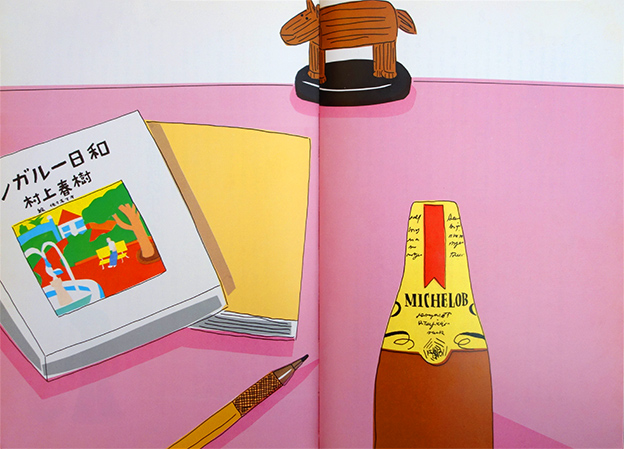
Even some of Murakami’s fiction has remained more or less off-limits to global readers. I discovered this when I came across a collection of his I’d never even heard of while book-shopping in Seoul. Realizing that of course more Murakami material would find its way into Korean, a grammatically similar language to Japanese, than English, I set about checking every bookstore in the city I knew for other unknown volumes. One book of short stories, titled in Korean 밤의 원숭이 (Spider Monkey of the Night), particularly delighted me with its strange and extremely brief tales, each accompanied by charming illustrations.

But where did these stories, with their titles like “Hotel Lobby Oysters,” “Julio Iglesias,” and “Takayama Noriko and My Libido,” come from? They came, as Neojaponisme’s post on them explains, from the world of advertising, and specifically from a company called “Onward,” which marketed the American Ivy League fashion label J. Press in Japan:
In the late 1970s and early 1980s, Onward spent massive sums on advertising J. Press in the print media. The classic ad format, often seen on the back cover of lifestyle magazine Popeye, showed a Japanese or American man telling a colorful story about their favorite trad clothing item. In 1985, as Japanese pop culture went in more avant-garde directions, Onward came up with a new idea — asking up-and-coming novelist Murakami Haruki to write a very short story inside each month’s advertisement for magazines Popeye, Box, and Men’s Club.
“So once a month from April 1985 to February 1987, Murakami wrote a ‘short short’ (短い短編), which was set on its own page with an illustration by famed artist Anzai Mizumaru at the top and a small J. Press logo in the lower left corner.” During that time, out came Murakami’s hit novel Norwegian Wood, which rocketed him to a level of fame that effectively put him in exile from his homeland. But the advertorial short-short form still appealed to him, and in 1993 he got famous penmaker Parker to sponsor 24 new ones.
To give you a flavor of all this, below is one of the English-language translations floating around of “Hotel Lobby Oysters,” Murakami’s first J. Press story. (You can also read “Miss Noriko Takayama and My Libido,” another J. Press story here):
At the time I was sitting on the hotel lobby sofa and vaguely thinking about oysters. Not lemon soufflé, not pencil sharpeners – oysters. I don’t know why. I just suddenly realized that I was thinking about oysters.
The oysters I was thinking about on the hotel lobby sofa were different from oysters thought about anywhere else. They were shaped differently, they smelled differently, and their color was different, too. They weren’t oysters harvested in some cove. They were pure oysters harvested in a hotel lobby.
After thinking about oysters for a while, I went to the sink to wash my face, then retied my tie and returned to the sofa. When I got back, the oysters had already disappeared from inside my head. Again, I don’t know why. Maybe it was because I washed my faced or because I retied my tie. Or maybe the hotel oyster season is extremely short.
When the girl came 17 minutes after our appointed time, I told her about the hotel lobby oysters. The image was so distinct I felt like I had to tell someone about them.
“You want to eat oysters?” she asked.
“No, these oysters, they were purely oysters as a concept, unrelated to my appetite,” I explained. “The oysters came into being as the very essence of oys—“
“But you do want to eat some, right?” she said.
When she mentioned it and I settled down to think about it, I certainly had developed an incredible desire to eat oysters. We went to the hotel restaurant and ate 25 oysters while drinking wine. Sometimes I think my appetite originates from a really strange place.
And, for Parker, Murakami wrote, “Spider Monkey of the Night”:
I was sitting at my desk at 2:00 in the morning and writing. I pushed my window open and a spider monkey came in.
“Oh, hey, who are you?” I asked.
“Oh, hey, who are you,” the spider monkey said.
“Don’t copy me,” I said.
“Don’t copy me,” the monkey said.
“Don’t copy me,” I copied him.
“Don’t copy me,” he copied me in italics.
Man, this is really annoying, I thought. If I get caught up with this copycat-crazed night monkey, who knows when this will end. I’ll just have to trip him up somewhere. I had a job that I had to finish by morning, and I couldn’t very well keep doing this all night.
“Heppoku rakurashi manga totemuya, kurini kamasu tokimi wakoru, pacopaco,” I said quickly.
“Heppoku rakurashi manga totemuya, kurini kamasu tokimi wakoru, pacopaco,” the spider monkey said.
Since I had said something completely random, I couldn’t actually tell if the monkey had copied me correctly or not. Well, that was pointless.
“Leave me alone,” I said.
“Leave me alone,” the monkey said.
“You got it wrong, I didn’t say it in italics that time.”
“You got it wrong, I didn’t say it in ītalics that time.”
“I didn’t put a macron over the i.”
“I didn’t put a macron over the eye.”
I sighed. No matter what I said, the spider monkey wouldn’t understand. I decided to not say anything and just keep doing my work. Still, when I pressed a key on my word processor, the monkey silently pressed the copy key. Click. Still, when I pressed a key on my word processor, the monkey silently pressed the copy key. Click. Leave me alone. Leave me alone.
via Neojaponisme
Related Content:
Read 3 Stories from Haruki Murakami’s Short Story Collection Published in Japan Last Year
Read 6 Stories By Haruki Murakami Free Online
Haruki Murakami Lists the Three Essential Qualities For All Serious Novelists (And Runners)
Haruki Murakami’s Passion for Jazz: Discover the Novelist’s Jazz Playlist, Jazz Essay & Jazz Bar
Colin Marshall writes on cities, language, Asia, and men’s style. He’s at work on a book about Los Angeles, A Los Angeles Primer, and the video series The City in Cinema. Follow him on Twitter at @colinmarshall or on Facebook.
Read More...Interactive Music Video Lets You Explore the Apartments on the Cover of Led Zeppelin’s Physical Graffiti
Dig that heavy metal / Underneath your hood / Baby I can work all night / Believe I got the perfect tools / Talkin’ bout love
Last February, Led Zeppelin released a deluxe, re-mastered version of their sprawling 1975 double album Physical Graffiti, a record perhaps best known for the epic, orchestral grandeur of the 8 1/2 minute “Kashmir” (not to be outdone by the 11-minute “In My Time of Dying”). In an album full of stylistic departures and solid returns to form, one track, “Trampled Under Foot,” manages to be both, driven by down-and-dirty blues and uptown 70s funk, courtesy of John Paul Jones’ Stevie Wonder-inspired organ groove. With lyrics Robert Plant himself described as “raunchy,” the song—one of Plant’s favorites—may be the band’s most 70s-sounding. That’s not to say it’s dated, only that it most perfectly captures the sound of the American street represented on the album cover, a shot of two adjacent tenements on New York City’s St. Mark’s Place.

Now, listeners can enter those buildings and tool around the apartments, courtesy of the interactive video at the top of the post (view it in a larger format here), which features a previously unreleased rough mix of the track called “Brandy & Coke.” Conceived and directed by Hal Kirkland, the video pulls together some of my favorite things—the period design and styling of That ‘70s Show, the most inventive tricks of the music video age, a la Tom Petty or Peter Gabriel, and of course, Zep—with the added 21st century technology of online interactivity. Click the arrow keys while the video plays and you’re transported from one vivid tableaux to another, some representing funky apartment scenes, others something else entirely. The video also integrates footage from Zeppelin’s performance of the song at Earl’s Court in ’75.
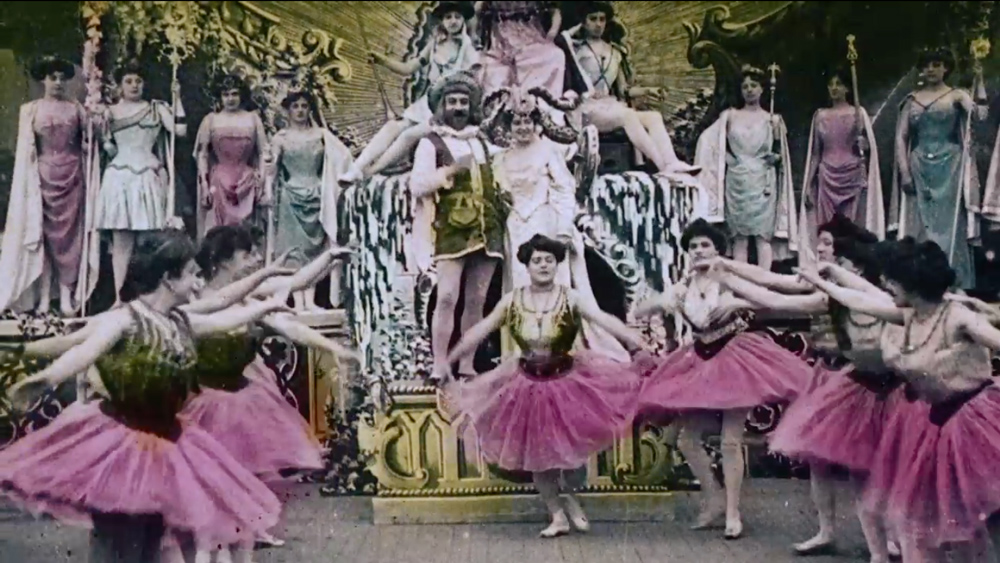
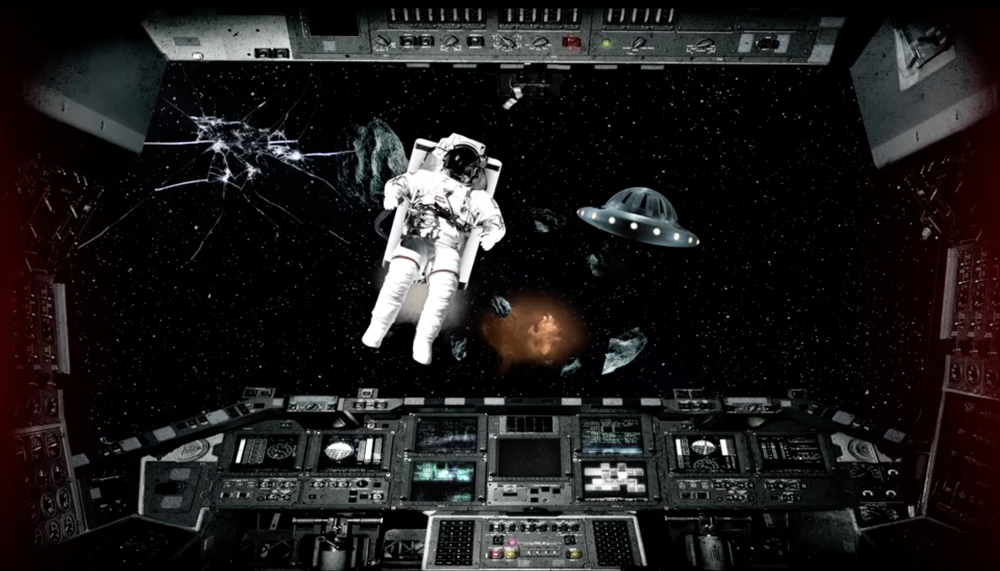
Clever references abound, like the nod to godfather of fantasy cinema Georges Méliès (above) and an allusion to the classic MTV moon landing intro (below). Overall, it’s an astonishing visual feast that hearkens back to the very best in music video technology, a seemingly lost art that Kirkland and company may singlehandedly resurrect. See Kirkland’s site for more of his internet age music video creations, including “Sour—Hibi No Neiro,” shot entirely on webcams.
Related Content:
Led Zeppelin Plays One of Its Earliest Concerts (Danish TV, 1969)
Hear Led Zeppelin’s Mind-Blowing First Recorded Concert Ever (1968)
Jimmy Page Describes the Creation of Led Zeppelin’s “Whole Lotta Love”
Josh Jones is a writer and musician based in Durham, NC. Follow him at @jdmagness
Read More...Watch Björk’s 6 Favorite TED Talks, From the Mushroom Death Suit to the Virtual Choir

Image by Zach Klein
Singer-songwriter Björk, currently enjoying a career retrospective at the Museum of Modern Art, celebrated TED’s billionth video view with a playlist of six treasured TED Talks. What do her choices say about her?
In this talk, artist Jae Rhim Lee models her Mushroom Death Suit, a kicky little snuggy designed to decompose and remediate toxins from corpses before they leech back into the soil or sky. Despite Björk’s fondness for outré fashion, I’m pretty sure this choice goes beyond the merely sartorial.
For more information, or to get in line for a mushroom suit of your own, see the Infinity Burial Project.
Continuing with the mushroom / fashion theme, Björk next turns to designer Suzanne Lee, who demonstrates how she grows sustainable textiles from kombucha mushrooms. The resulting material may variously resemble paper or flexible vegetable leather. It is extremely receptive to natural dyes, but not water repellent, so bring a non-kombucha-based change of clothes in case you get caught in the rain.
For more information on Lee’s homegrown, super green fabric, visit BioCouture.
Björk’s clearly got a soft spot for things that grow: mushrooms, mushroom-based fabric, and now…building materials? Professor of Experimental Architecture Rachel Armstrong’s plan for self-regenerating buildings involves protocols, or “little fatty bags” that behave like living things despite an absence of DNA. I’m still not sure how it works, but as long as the little fatty bags are not added to my own ever-growing edifice, I’m down.
For more information on what Dr. Armstrong refers to as bottom up construction (including a scheme to keep Venice from sinking) see Black Sky Thinking.
Björk’s next choice takes a turn for the serious… with games. Game Designer Brenda Romero began exploring the heavy duty emotional possibilities of the medium when her 9‑year-old daughter returned from school with a less than nuanced understanding of the Middle Passage. The success of that experiment inspired her to create games that spur players to engage on a deeper level with thorny historical subjects. (The Trail of Tears required 50,000 individual reddish-brown pieces).
Learn more about Romero’s analog games at The Mechanic is the Message.
Remember those 50,000 individual pieces? As photographer Aaron Huey documented life on Pine Ridge Reservation, he was humbled by hearing himself referred to as “wasichu,” a Lakota word that can be translated as “non-Indian.” Huey decided not to shy away from its more pointed translation: “the one who takes the best meat for himself.” His TED Talk is an impassioned history lesson that begins in 1824 with the creation of the Bureau of Indian Affairs and ends in an activist challenge.
Proof that Björk is not entirely about the quirk.
See Huey’s photos from the National Geographic cover story, “In the Spirit of Crazy Horse.”
Björk opts to close things on a musical note with excerpts from composer Eric Whitacre’s “Lux Aurumque” and “Sleep” performed by a crowdsourced virtual choir. Its members—they swell to 1999 for “Sleep”—record their parts alone at home, then upload them to be mixed into something sonically and spiritually greater than the sum of its parts.
Listen to “Sleep” in its entirety here.
Related Content:
Hear the Album Björk Recorded as an 11-Year-Old: Features Cover Art Provided By Her Mom (1977)
Björk and Sir David Attenborough Team Up in a New Documentary About Music and Technology
Ayun Halliday is an author, illustrator, and Chief Primatologist of the East Village Inky zine. Follow her @AyunHalliday
Read More...F. Scott Fitzgerald Has a Strange Dinner with James Joyce & Draws a Cute Sketch of It (1928)
The characters in many of F. Scott Fitzgerald’s stories—rakish, drunken undergraduates and overeducated gadabouts—so resemble their creator that it’s tempting to read into all of his work some autobiographical intent. One episode in the writer’s life that didn’t make it into his fiction, Fitzgerald’s meeting with James Joyce in Paris, nevertheless makes a fascinating anecdote all its own, and seems so perfectly in character that it could have inspired an amusing short story for The Saturday Evening Post.
According to Sylvia Beach, doyenne of the expat American literary scene in Paris, founder of Shakespeare and Company Books, and publisher of Ulysses, Fitzgerald “worshipped James Joyce, but was afraid to approach him.” In her memoir, Shakespeare and Company, Beach relates how in 1928 she and her friend, lover, and fellow bookseller Adrienne Monnier, “cooked a nice dinner and invited the Joyces, the Fitzgeralds, and André Chamson and his wife Lucie.”
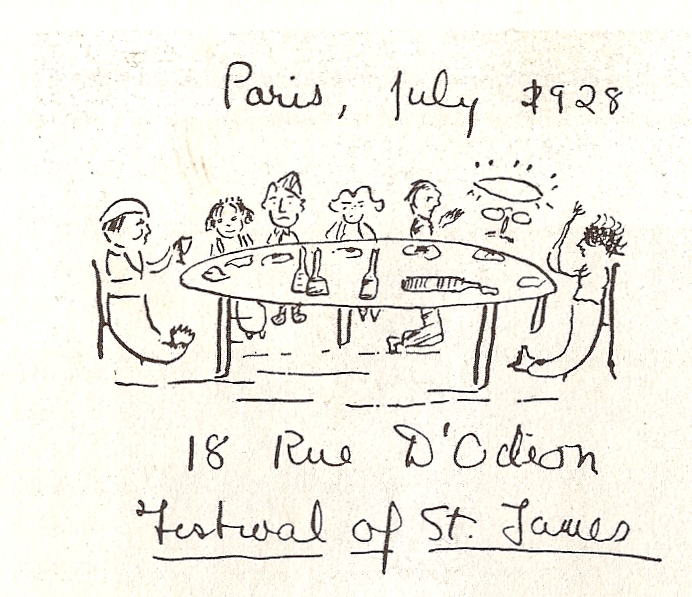
Scott drew a picture in my copy of The Great Gatsby of the guests—with Joyce seated at the table wearing a halo, Scott kneeling beside him, and Adrienne and myself, at the head and foot, depicted as mermaids (or sirens).
You can see Fitzgerald’s quirky little sketch above. Beach’s telling, it seems, omits many of the colorful details of the meeting. According to Herbert Gorman, another guest at the dinner and Joyce’s first biographer, Fitzgerald—so overawed by the Irish author that he referred to the evening as the “Festival of St. James”—“sank down on one knee before Joyce”—as in his drawing—“kissed his hand, and declared: ‘How does it feel to be a great genius, Sir? I am so excited at seeing you, Sir, that I could weep.’”
Most likely very drunk on champagne, Fitzgerald’s antics apparently quite alarmed Joyce. In her literary history, Noel Riley Fitch tells us that the American “offered to show his esteem for the Irish writer… by jumping out of the window. An amazed Joyce is supposed to have prohibited the display and exclaimed, ‘That young man must be mad—I’m afraid he’ll do himself some injury.’” The bizarre incident did not prevent Fitzgerald from obtaining Joyce’s autograph in his copy of Ulysses. Nor did it prevent him, on a later occasion, from threatening to jump from his apartment balcony onto the street, “drunk and depressed by his failing marriage.” This time, he was stopped by French novelist André Chamson, with whom he had struck up a friendship at the Joyce dinner.
Beach’s memoir contains many other charming, and somewhat dismaying, stories about the Fitzgeralds, most involving profligate spending and drinking of champagne. We may not have the pleasure of hearing these tales from the Gatsby author himself—save through his essays, letters, and many fictionalizations of his life. But the genial Beach, who outlived Joyce, Fitzgerald, Hemingway, and most every other author of the “Lost Generation,” appeared in several filmed interviews, in French and English, and told stories of 1920s Paris. In one such interview, above, hear her describe the founding of Shakespeare and Company, that Parisian literary hub without which some of the greatest literature of the 20th century may never have reached the reading public.
via Austin Kleon
Related Content:
F. Scott Fitzgerald in Drag (1916)
Ernest Hemingway to F. Scott Fitzgerald: “Kiss My Ass”
Beginnings Profiles Shakespeare and Company’s Sylvia Beach Whitman
Josh Jones is a writer and musician based in Durham, NC. Follow him at @jdmagness
Read More...Brian May Shows You How to Play Licks & Solos from 18 Queen Songs, and Reveals the Joy of the Guitar Riff
In the world of rock guitar, gear is king. And technique, one might say, is queen. Both rule, but the equipment can receive an unfair share of royal treatment. There is good reason for this. Electrified instruments playing electric music require heaps of wires, circuits, specialized effects, and amplifiers to make the sounds we’ve come to associate with hard rock and heavy metal. But those sounds didn’t come about by accident. They were designed at particular times by particular guitarists and engineers—serious gearheads. Perhaps the most obsessive of them all is Brian May, whose flashy but tasteful playing with Queen set the bar for pyrotechnics artists and fellow gearheads like Eddie Van Halen. Maybe it’s his work as an astrophysicist (no, really!) that inspired his scientific approach to making music. Wherever it comes from, no one plays, and sounds, quite like Brian May.
In the video above from 1984, May gives lessons on how to play his famous licks and solos from eighteen Queen songs. But first, he gets into the technical specs of his amplifiers, effects, and his guitar, “Red Special,” an instrument of his own design and build that functioned like no other at the time. Even today, no guitar but a Brian May signature guitar—now mass-produced—sounds like a Brian May guitar. At one point, May says, “I’ve had this guitar for 20 years, and it’s pretty much the only thing I can play to get the right sound.” He still feels the same way, as you can see in his much more recent “Rig Rundown,” that periodic delight of guitar geeks everywhere in which famous guitarists showcase the gear that gets them “the right sound.”
May’s full immersion in the technical details of electric guitars and amplifiers is rivaled only by his complex and intricate guitar lines. If you can keep up with him in the instructional video at the top, you might just learn a thing or two about the so-called “lick.” Just above, however, May helps guide us through an exploration of a much more direct and primitive means of expression—the riff. The BBC special also features such masters of this repetitive, rhythmic motif as Joan Jett, Wayne Kramer, Nile Rodgers, Tony Iommi, and Dave Davies, as well as—in archival footage—riff pioneers Chuck Berry and Link Wray, each of them demonstrating the earworms they’re known for. Brian May’s riffs—in “Bohemian Rhapsody” for example—may be more classical than most, but they’re no less memorable. And after watching his extended lesson, you now know exactly how he built them, piece by piece.
Related Content:
Brian May’s Homemade Guitar, Made From Old Tables, Bike and Motorcycle Parts & More
Guitarist Brian May Explains the Making of Queen’s Classic Song, ‘Bohemian Rhapsody’
Queen Documentary Pays Tribute to the Rock Band That Conquered the World
Josh Jones is a writer and musician based in Durham, NC. Follow him at @jdmagness
Read More...T.S. Eliot, Edith Wharton & Gertrude Stein Tell F. Scott Fitzgerald That Gatsby is Great, While Critics Called It a Dud (1925)
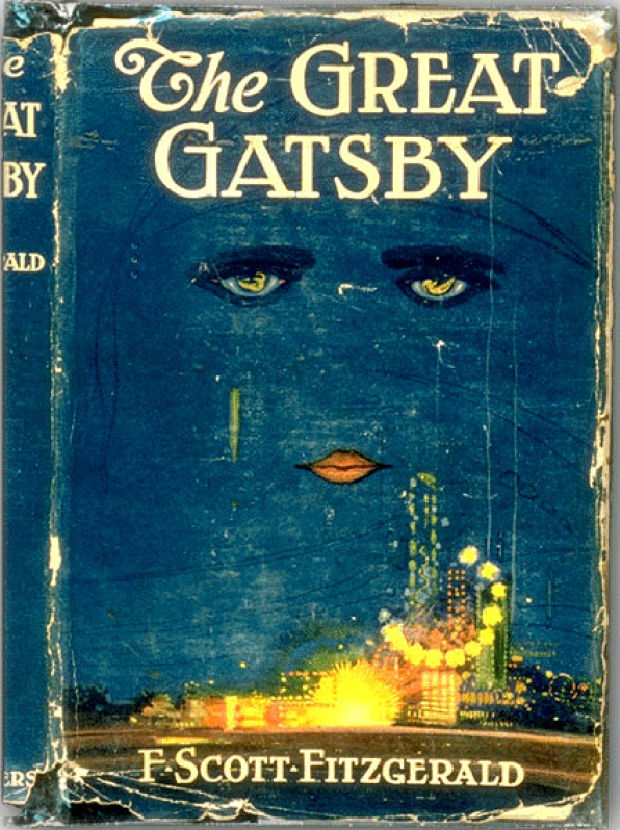
This month marks the 90th anniversary of the publication of F. Scott Fitzgerald’s masterpiece, The Great Gatsby. Perhaps no other book so embodies the ideal of the Great American Novel as Gatsby — and yet, when it first came out 90 years ago, it was regarded as a flop. As a headline writer for the New York World put it, “F. SCOTT FITZGERALD’S LATEST A DUD.”
Fitzgerald had a lot riding on Gatsby. He and his wife Zelda were living beyond their means, and he was desperately hoping the book would bring financial security as well as critical respect. On April 10, 1925 he wrote a letter to his editor, Maxwell Perkins:
Dear Max
The book comes out today and I am overcome with fears and forebodings. Supposing women didn’t like the book because it has no important woman in it, and critics didn’t like it because it dealt with the rich and and contained no peasants borrowed out of Tess in it and set to work in Idaho? Suppose it didn’t even wipe out my debt to you — why it’ll have to sell 20,000 copies even to do that!
The author’s fears and forebodings were more or less realized. The first print run of 20,870 copies sold slowly. A second run of 3,000 was ordered a few months later, but many of those copies were still gathering dust on the warehouse shelves when Fitzgerald died in 1940. And while a few critics recognized Gatsby’s brilliance, many missed it. H.L. Mencken, for example, praised Fitzgerald’s maturing craftsmanship as a prose stylist but savaged the story itself, calling it “no more than a glorified anecdote.”
It must have cheered the author up, then, to receive letters of praise from several of the most influential writers of his time. Fitzgerald had sent inscribed copies of the book to Edith Wharton, Gertrude Stein and T.S. Eliot — all of whom responded. Of the three, Wharton was the most tepid in her praise, with echoes of Mencken running through her comments:
Dear Mr. Fitzgerald,
I have been wandering for the last weeks and found your novel — with it’s friendly dedication — awaiting me here on my arrival, a few days ago.
I am touched at your sending me a copy, for I feel that to your generation, which has taken such a flying leap into the future, I must represent the literary equivalent of tufted furniture and gas chandeliers. So you will understand that it is in the spirit of sincere deprecation that I shall venture, in a few days, to offer you in return the last product of my manufactory.
Meanwhile, let me say at once how much I like Gatsby, or rather His Book, & how great a leap I think you have taken this time — in advance upon your previous work. My present quarrel with you is only this: that to make Gatsby really Great, you ought to have given us his early career (not from the cradle — but from his visit to the yacht, if not before) instead of a short résumé of it. That would have situated him, and made his final tragedy a tragedy instead of a “fate divers” for the morning papers.
But you’ll tell me that’s the old way, and consequently not your way…
Wharton made it clear she thought of Gatsby as a literary advance only in respect to Fitzgerald’s own earlier work. Gertrude Stein allowed only that the new book was “different and older”:
My dear Fitzgerald:
Here we are and have read your book and it is a good book. I like the melody of your dedication and it shows that you have a background of beauty and tenderness and that is a comfort. The next good thing is that you write naturally in sentences and that too is a comfort. You write naturally in sentences and one can read all of them and that among other things is a comfort. You are creating the contemporary world much as Thackeray did his in Pendennis and Vanity Fair and this isn’t a bad compliment. You make a modern world and a modern orgy strangely enough it was never done until you did it in This Side of Paradise. My belief in This Side of Paradise was alright. This is as good a book and different and older and that is what one does, one does not get better but different and older and that is always a pleasure. Best of luck to you always, and thanks so much for the very genuine pleasure you have given me.
The strongest and least equivocal praise came from Eliot:
Dear Mr. Scott Fitzgerald,
The Great Gatsby with your charming and overpowering inscription arrived the very morning I was leaving in some haste for a sea voyage advised by my doctor. I therefore left it behind and only read it on my return a few days ago. I have, however, now read it three times. I am not in the least influenced by your remark about myself when I say that it has interested and excited me more than any new novel I have seen, either English or American, for a number of years.
When I have more time I should like to write to you more fully and tell you exactly why it seems to me such a remarkable book. In fact it seems to me to be the first step that American fiction has taken since Henry James.
Fitzgerald was especially pleased with that last line. “I can’t express just how good your letter made me feel,” he wrote back to Eliot “– it was easily the nicest thing that’s happened to me in connection with Gatsby.”
Related Content:
Sylvia Plath Annotates Her Copy of The Great Gatsby
Haruki Murakami Translates The Great Gatsby, the Novel That Influenced Him Most
83 Years of Great Gatsby Book Cover Designs: A Photo Gallery
Download 55 Free Online Literature Courses: From Dante and Milton to Kerouac and Tolkien
Read More...The Mad Men Reading List: 25 Revealing Books Read by the Characters on the Show
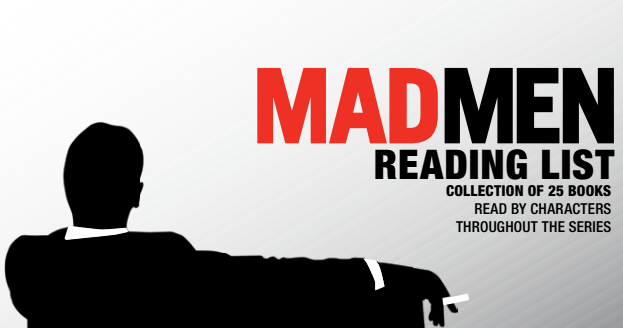
Image courtesy of The New York Public Library.
The good people over at the New York Public Library compiled a list of books read by the characters of Mad Men, which just started the last half of its seventh and final season. Over the course of the series, the show’s characters drank several swimming pools worth of cocktails, engaged in a host of ill-advised illicit affairs and, on occasion, dreamed up a brilliant advertising campaign or two. As it turns out, they also read quite a bit.
All the books seem to say something about the inner life of each character. The show’s enigmatic main character, Don Draper, favored works like Dante’s Inferno and William Faulkner’s The Sound and the Fury – books that point towards Draper’s series-long downward spiral. The whiny, insecure Pete Campbell read Thomas Pynchon’s paranoid classic The Crying of Lot 49. And Bert Cooper, the aristocratic bow-tie sporting patriarch of Sterling Cooper is apparently an Ayn Rand fan; he’s seen reading Atlas Shrugged early in the series. You can see the full reading list below or here in a beautiful PDF designed by the NYPL.
A number of the texts listed below also appear in our Free eBooks and Free AudioBooks collections.
DON DRAPER’S PICKS:
- EXODUS by Leon Uris (Episode 106 “Babylon”)
- THE BEST OF EVERYTHING by Rona Jaffe
- MEDITATIONS IN AN EMERGENCY by Frank O’Hara
- THE SOUND AND THE FURY by William Faulkner
- THE CHRYSANTHEMUM AND THE SWORD by Ruth Benedict
- THE SPY WHO CAME IN FROM THE COLD by John Le Carre
- THE FIXER by Bernard Malamud
- ODDS AGAINST by Dick Francis
- THE INFERNO by Dante Alighieri
- THE LAST PICTURE SHOW by Larry McMurtry
- PORTNOY’S COMPLAINT by Philip Roth
ROGER STERLING’S PICK:
- CONFESSIONS OF AN ADVERTISING MAN by David Ogilvy
JOAN HARRIS’S PICK:
- LADY CHATTERLEY’S LOVER by D. H. Lawrence
PETE CAMPBELL’S PICKS:
- THE CRYING OF LOT 49 by Thomas Pynchon
- GOODNIGHT MOON by Margaret Wise Brown
BETTY DRAPER’S PICKS:
- BABYLON REVISITED AND OTHER STORIES by F. Scott Fitzgerald
- THE GROUP by Mary McCarthy
LANE PRYCE’S PICK:
- THE ADVENTURES OF TOM SAWYER by Mark Twain
HENRY FRANCIS’S PICK:
- THE ADVENTURES OF HUCKLEBERRY FINN by Mark Twain
BERT COOPER’S PICK:
- ATLAS SHRUGGED by Ayn Rand
SALLY DRAPER’S PICKS:
- THE HISTORY OF THE DECLINE AND FALL OF THE ROMAN EMPIRE by Edward Gibbon
- TWENTY ONE BALLOONS by William Pene Du Bois
- NANCY DREW: THE CLUE OF THE BLACK KEYS by Carolyn Keene
- THE BLACK CAULDRON by Lloyd Alexander
- ROSEMARY’S BABY by Ira Levin
via The New York Public Library
Related Content:
Neil deGrasse Tyson Lists 8 (Free) Books Every Intelligent Person Should Read
Ernest Hemingway’s List for a Young Writer
Carl Sagan’s Undergrad Reading List: 40 Essential Texts for a Well-Rounded Thinker
David Foster Wallace’s 1994 Syllabus: How to Teach Serious Literature with Lightweight Books
Jonathan Crow is a Los Angeles-based writer and filmmaker whose work has appeared in Yahoo!, The Hollywood Reporter, and other publications. You can follow him at @jonccrow. And check out his blog Veeptopus, featuring lots of pictures of badgers and even more pictures of vice presidents with octopuses on their heads. The Veeptopus store is here.
Read More...What It’s Like to Be Color Blind and See Art in Color for the First Time
We all know that saying about walking in another’s shoes, but what about seeing through another’s eyeballs? I’m not talking about perspective. I’m talking about color. As in I see it, and my husband doesn’t. At least not the way I do.
His coping mechanism is to challenge me whenever I refer to something as “blue.” To him, it’s grey, or brown, or some other non-blue shade. He wants me to see it that way too. To admit that I am wrong. For my part, I feel it’s important that the person to whom I’m married acknowledge that there’s no way my favorite bowl can be the color of cement, no matter what his cone cell receptors are telling him.
Perhaps he’d have better luck asking patient strangers to describe color to him, as blind-from-birth film critic Tommy Edison does below. Hmm. Color may be more subjective than my husband’s and my spectral stand-offs would suggest.
According to EnChroma, the company that designed and sells the color-correcting lenses the onscreen guinea pigs are seen wearing in the video up top, an estimated 300 million people suffer from some form of color blindness. Their glasses offer some of those three million a chance at seeing red in the literal sense. The video participants are, not surprisingly, blown away by their first encounter with a Crayola-colored world.
Having refreshed myself on the structures of the eye, I took the color blindness test on EnChroma’s website. I tested normal, having identified the hidden (or in my case not-so-hidden) numbers in a variety of virtual mosaics.
My color blind friend, Bob, agreed to take it too, provided I muzzle myself from offering the sort of commentary to which husbands are subjected. (Whaddaya mean you can’t see it!? It’s bright fuchsia!!!) He pulled a pretty heavy duty protan deficiency, otherwise known as red-green color blindness.
According to the manufacturer, EnChroma glasses are unlikely to color his world. The best he could hope for is a slight improvement after weeks of wearing.
Bummer, except that he lives in Chicago, where the Museum of Contemporary Art offers EnChroma Cx loaners at the reception desk. Like many such institutions, the MCA is actively seeking ways to improve accessibility. (The museum’s color blind director of communications recommends having a look at Martin Creed’s Work No. 1351, a colorful lattice in the cafe. See right below.)

Perhaps Bob will get a peek at something he hasn’t seen before. Like red. Others will experience a revelation. Meanwhile, an insufferable non-colorblind individual such as myself might get an effect akin to an Instagram filter. My colors will pop.
“Unfair,” say Bob and my husband. I have to agree. Should the Museum of Contemporary Art offer color-leeching glasses, I will wear them, even if the frames are really ugly. Until then, the video below provides some sense of what those of us who see the full range of color aren’t missing.
Related Content:
Jorge Luis Borges, After Going Blind, Draws a Self-Portrait
Helen Keller Speaks About Her Greatest Regret — Never Mastering Speech
Ayun Halliday is an author, illustrator, and Chief Primatologist of the East Village Inky zine. Follow her @AyunHalliday
Read More...Download the Major Works of Jane Austen as Free eBooks & Audio Books

Why does Jane Austen feel so much like our contemporary? Is it the way she has been appropriated by popular culture, turned into a vampish, modern consumer icon in adaptations like From Prada to Nada, Clueless, and Bridget Jones’ Diary? Do these candy-colored updates of Austen truly represent the spirit of the late 18th/early 19th century novelist’s world? Or do we gravitate toward Austen because of nostalgia for a simpler, almost pre-industrial time, when—as in the rather reactionary world of Downton Abbey—the comings and goings in a single household constituted an entire human society?
Why not both? As the writers and artists in the video above from the Morgan Library assert, Austen, like Shakespeare, is a writer for every age. “The Divine Jane” as the title dubs her, had an insight into human behavior that transcends the particulars of her historical moment. But of course, the context of Austen’s fiction—a time of great English country houses and an emerging class-consciousness based on rapidly changing social arrangements—is no mere backdrop. Like Shakespeare, we need to understand Austen on her own terms as much as we enjoy her wit transposed into our own.
The Morgan Library’s “A Woman’s Wit” exhibit, moved online since its debut in the physical space in 2009, offers an excellent collection of resources for scholars and lay readers to discover Austen’s world through her correspondence and manuscripts. You’ll also find there drawings by Austen and her contemporaries and commentary from a number of twentieth century writers inspired by her work. Much of the Austen-mania of the past several years treats the novelist as a more-or-less postmodern ironist—“hotter,” wrote Martin Amis in 1996, “than Quentin Tarantino.” That she has become such fodder for films, both good and frankly terrible, can obscure her obsession with language, one represented by her novels, of course, as well as by her letters—so lively and immediate so as to have inspired a “Perfect Love Letter” competition among Austen enthusiasts.
As for the novels, well, there really is no substitute. Dressing Austen up in Prada and Gucci and recasting her bumbling suitors and impish heroines as mall-savvy teenage Americans has—one hopes—been done enough. Let not Austen’s appeal to our age eclipse the rich, fine-grained observations she made of hers. Whether you’re new to Austen or a lifelong reader, her work is always available, as she intended it to be experienced, on the page—or, er… the screen… thanks to internet publishing and organizations like Project Gutenberg and Librivox. At the links below, you can find all of Austen’s major works in various eBook and audio formats.
So by all means, enjoy the modern classic Clueless, that hilarious rendition of Austen’s Emma. And by all means, read Emma, and Pride and Prejudice, and Mansfield Park, and… well, you get the idea….
- Lady Susan (1794)
- eBooks: iPad/iPhone — Kindle Format + Other Formats
- Audio Book: Free iTunes — Free MP3 — Free Zip File
- Northanger Abbey (1798)
- eBook: iPad/iPhone – Kindle + Other Formats
- Audio Book: Free iTunes — Free MP3
- Sense and Sensibility (1811)
- eBook: iPad/iPhone – Kindle + Other Formats
- Audio Book: Free iTunes — Free MP3 Stream — Free MP3 Zip File
- Pride and Prejudice (1813)
- eBook: iPad/iPhone – Kindle + Other Formats
- Audio Book: Free iTunes — Free MP3
- Mansfield Park (1814)
- eBook: iPad/iPhone – Kindle + Other Formats
- Audio Book: — Free iTunes — Free MP3 Stream
- Emma (1816)
- eBook: iPad/iPhone – Kindle + Other Formats
- Audio Book: Free iTunes — Free MP3
- Persuasion (1817)
- eBook: iPad/iPhone – Kindle + Other Formats
- Audio Book: Free iTunes — Free MP3
- The Letters of Jane Austen
- eBook: Kindle + other formats
Related Content:
1,000 Free Audio Books: Download Great Books for FreeJane Austen Used Pins to Edit Her Abandoned Manuscript, The Watsons
800 Free eBooks for iPad, Kindle & Other DevicesJosh Jones is a writer and musician based in Washington, DC. Follow him at @jdmagness
Read More...Support Us
We're hoping to rely on loyal readers, rather than erratic ads. Please click the Donate button and support Open Culture. You can use Paypal, Venmo, Patreon, even Crypto! We thank you!

About Us

Open Culture scours the web for the best educational media. We find the free courses and audio books you need, the language lessons & educational videos you want, and plenty of enlightenment in between.
Advertise With Us

FREE UPDATES!
GET OUR DAILY EMAIL
Get the best cultural and educational resources on the web curated for you in a daily email. We never spam. Unsubscribe at any time.
FOLLOW ON SOCIAL MEDIA

Open Culture editor Dan Colman scours the web for the best educational media. He finds the free courses and audio books you need, the language lessons & movies you want, and plenty of enlightenment in between.
Advertise With Us


